
Judge, 1916-04-29 · page 15 of 28
Judge — April 29, 1916 — page 15: what you’re looking at
What you’re looking at
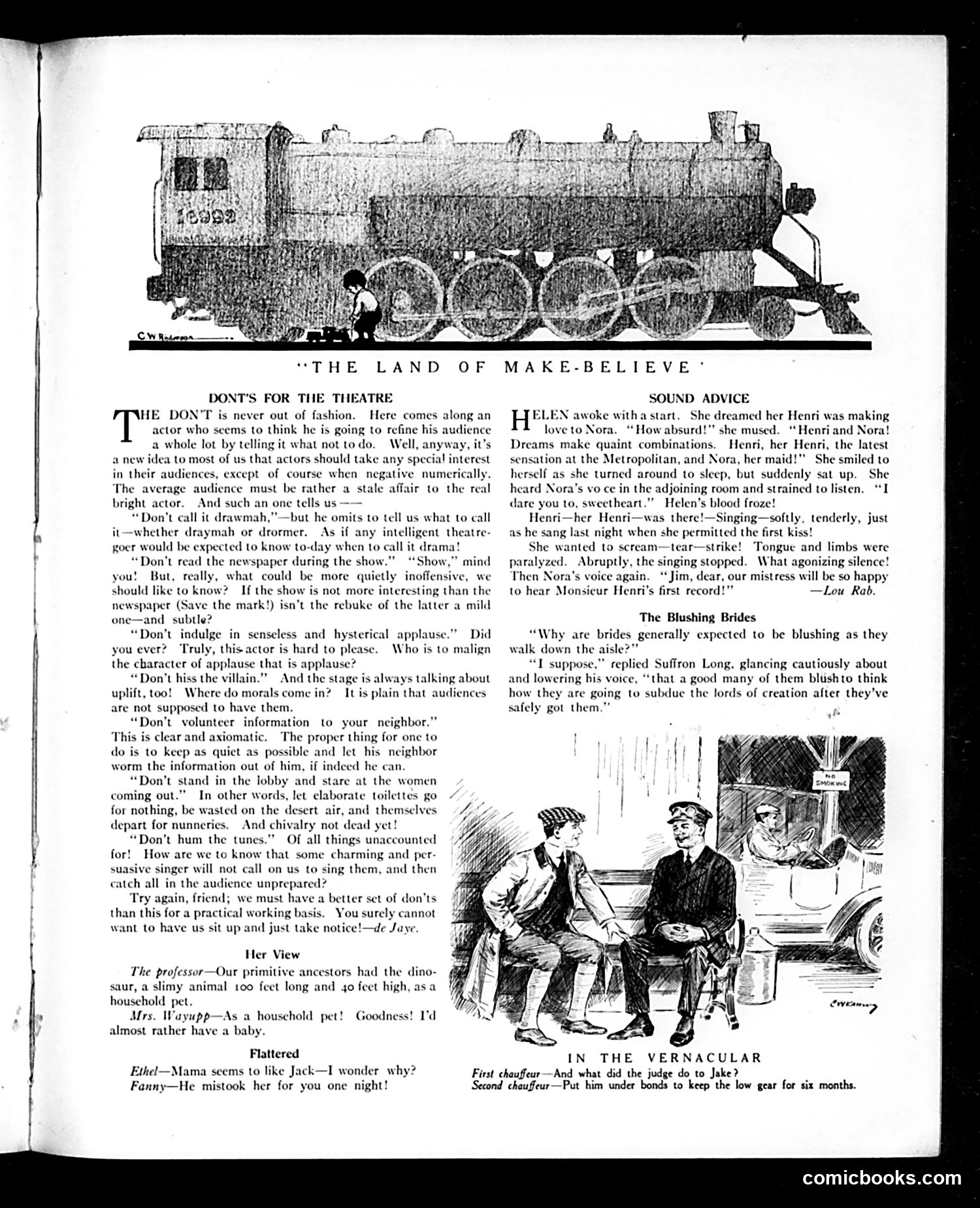
This is a theatrical satire page mocking an unnamed actor who presumes to lecture audiences on proper theater etiquette. The satire ridicules his pompous "don'ts": don't call it "drawmah," don't read newspapers, don't applaud hysterically, don't hiss villains, don't talk to neighbors, don't stare at women leaving. The humor lies in showing these rules as absurdly impractical and insulting to audiences. The writer mocks the actor's moral posturing—suggesting that if his show isn't more interesting than the newspaper, the real problem is his performance, not audience behavior. The satirist defends audience agency and enjoyment against theatrical pretension. Additional brief humor pieces include jokes about ancestors keeping dinosaurs as pets, a girlfriend mistaken for her mother, and blushing brides strategizing marital control—all typical period comedy fare.
📄 Transcribed text from this page (OCR, searchable)
Machine-transcribed from the original scan — historical spelling and the odd misread are preserved.
i FOR THE THEATRE HE DON'T is never out of fashion. Here comes along an T actor who seems to think he is going to refine his audience a whole lot by telling it what not todo. Well, anyway, it’s a new idea to most of us that actors should take any special interest in their audiences, except of course when negative numerically. The average audience must be rather a stale affair to the real bright actor. And such an one tells us —— “Don’t call it drawmah,”—but he omits to tell us what to call it—whether draymah or drormer. As if any intelligent theatre- goer would be expected to know to-day when to call it drama! “Don't read the newspaper during the show.” “Show,” mind you! But, really, what could be more quietly inoffensive, we should like to know? If the show is not more interesting than the newspaper (Save the mark!) isn’t the rebuke of the latter a mild one—and subtle? “Don’t indulge in senseless and hysterical applause.” Did you ever? Truly, this actor is hard to please. Who is to malign the character of applause that is applause? “Don’t hiss the villain.” And the stage is always talking about uplift, too! Where do morals come in? It is plain that audiences are not supposed to have them. “Don't volunteer information to your neighbor.” This is clear and axiomatic. The proper thing for one to do is to keep as quiet as possible and let his neighbor worm the information out of him, if indeed he can. “Don’t stand in the lobby and stare at the women coming out.” In other words, let elaborate toilettes go for nothing, be wasted on the desert air, and themselves depart for nunneries. And chivalry not dead yet! “Don’t hum the tun Of all things unaccounted for! How are we to know that some charming and per- suasive singer will not call on us to sing them, and then catch all in the audience unprepared? Try again, friend; we must have a better set of don'ts than this for a practical working basis. You surely cannot want to have us sit up and just take notice!—de Jaye. Her View The professor—Our primitive ancestors had the dino- saur, a slimy animal 100 fect long and 4o feet high, as a household pet. Mrs. Wayupp—As a household pet! Goodness! I'd almost rather have a baby. Flattered Ethel—Mama seems to like Jack—I wonder why? Fanny—He mistook her for you one night! “THE LAND OF MAKE-BELIEVE‘ SOUND ADVICE H SLEN awoke witha start. She dreamed her Henri was making love to Nora. “How absurd!" she mused. “Henri and Nora! Dreams make quaint combinations. Henri, her Henri, the latest sensation at the Metropolitan, and Nora, her maid!" She smiled to herself as she turned around to sleep, but suddenly sat up. She heard Nora’s vo ce in the adjoining room and strained to listen. “I dare you to, sweetheart.” Helen's blood froze! Henri—her Henri—was there!—Singing—softly, tenderly, just as he sang last night when she permitted the first kiss! he wanted to scream—tear—strike! Tongue and limbs were -d. Abruptly, the singing stopped. What agonizing silence! voice again. “Jim, dear, our mistress will be so happy to hear Monsieur Henri’s first record!” —Lou Rab. The Blushing Brides “Why are brides generally expected to be blushing as they walk down the “I suppose,” replied Suffron Long. glancing cautiously about and lowering his voice, “that a good many of them blushto think how they are going to subdue the lords of creation after they’ve safely got them.” IN THE VERNACULAR First chauffeur—And what did the judge do to Jake? Second chauffeur—Put him under bonds to keep the low gear for six months. comicbooks.com