
Judge, 1916-04-29 · page 24 of 28
Judge — April 29, 1916 — page 24: what you’re looking at
What you’re looking at
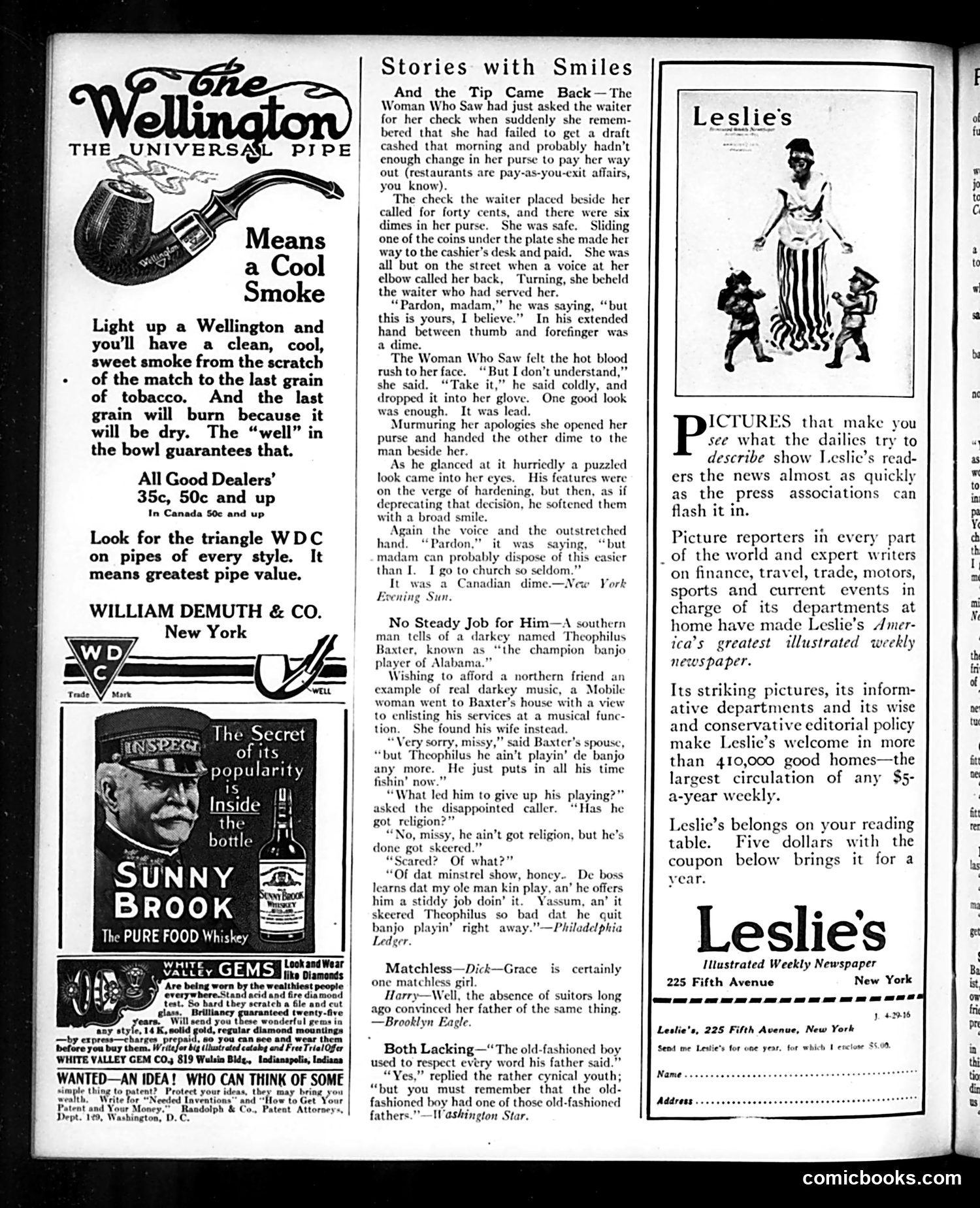
This page is primarily **advertising and light humor** rather than political satire. The main content includes: **Advertisements:** Wellington pipes, Sunny Brook whiskey, and White Valley gems dominate the layout. **"Stories with Smiles" section:** Three brief humorous anecdotes: 1. A woman embarrassed when a waiter returns a dime she undertipped with—a Canadian dime, implying it's worthless American currency. 2. A minstrel show joke: A Southern Black man named Theophilus Baxter quits his banjo playing after learning a minstrel show wants to hire him, fearing he'll be exploited. 3. Two short quips about romance and generational differences. **Leslie's Weekly advertisement:** Promotes their illustrated newspaper as superior for news delivery. The humor reflects early 20th-century attitudes, including casual racial stereotypes in dialect humor and period anxieties about currency. The page targets advertisers' interests rather than delivering political commentary.
📄 Transcribed text from this page (OCR, searchable)
Machine-transcribed from the original scan — historical spelling and the odd misread are preserved.
Light up a Wellington and you'll have a clean, cool, sweet smoke from the scratch of the match to the last grain of tobacco. And the last grain will burn because it will be dry. The “well” in the bowl guarantees that. All Good Dealers’ 35c, 50c and up In Canada S0c and up Look for the triangle WDC on pipes of every style. It means greatest pipe value. WILLIAM DEMUTH & CO. New York is Secret its P popularity ar ingiden| ia “the [sl ww bottle UN “Aa. Sever Baoat BROOK = The PURE FOOD Whiskey ==? IY Are being worn by the wealthiest people acid and fire diamoad eratch a file and cut teed twenty-five derful gems in sizer buy = nyt WHITE VALLEY GEM CO, 819 Welsia Bide, Undianapolie, lndiana WANTED—AN IDEA! WHO CAN THINK OF SOME simple thie Protect your Wi Inventions Stories with Smiles And the Tip Came Back—The Woman Who Saw had just asked the waiter for her check when suddenly she remem- bered that she had failed to get a draft cashed that morning and probably hadn’t enough change in her purse to pay her way out (restaurants are pay-as-you-exit affairs, you know). The check the waiter placed beside her called for forty cents, and there were six dimes in her purse. She was safe. Sliding one of the coins under the plate she made her way to the cashier’s desk and paid. She was all but on the street when a voice at her elbow called her back, Turning, she beheld the waiter who had served her. “Pardon, madam,” he was saying, “but this is yours, I believe.” In his extended hand between thumb and forefinger was a dime. The Woman Who Saw felt the hot blood rush to her face. “But I don’t understand,” she said. “Take it,” he said coldly, and dropped it into her glove. One good look was enough. It was leac Murmuring her apologies she opened her purse and handed the other dime to the man beside her. As he glanced at it hurriedly a puzzled look came into her eyes. His features were on the ge of hardening, but then, as if deprecating that decision, he softened them with a broad smile. Again the voice and the outstretched hand. “Pardon,” it was saying, “but madam can probably dispose of this easier than I. I go to church so seldom.” It was a Canadian dime.—New York Evening Sun. No Steady Job for Him—A southern man tells of a darkey named Theophilus Baxter, known as “the champion banjo er of Alabama.” Wishing to afford a northern friend an example of real darkey music, a Mobile woman went to Baxter’s house with a view to enlisting his serv a musical func- tion: i “Very sorry, missy,” “but Theophilus he ain’t playin’ de banjo any more. He just puts in all his time fishin’ now.” “What led him to give up his playing?” asked the disappointed caller. “Has “he got ligion? “No, missy, he ain’t got religion, but he’s done got skeered.”” Scared? Of what?” “Of dat minstrel show, " learns dat my ole man an’ he offe him a stiddy job doin’ it. Yassum, an’ skeered Theophilus so bad dat he quit banjo playin’ right away.”—Philadel phia Ledger. Matchless—Dick—Grace is certainly one matchless girl. Harry—Well, the absence of suitors long ago convinced her father of the same thing. —Brooklyn Eagle. Both Lacking—‘ The old-fashioned boy used to respect every word his father said.” “Yes,” replied the rather cynical youth; “but you must remember that the old- fashioned boy had one of those old-fashioned fathers.” —Iashington Star. ICTURES that make you see what the dailies try to describe show Leslic’s read- ers the news almost as quickly as the press associations can flash it in. Picture reporters in every part _ of the world and expert writers on finance, travel, trade, motors, sports and current events in charge of its departments at home have made Leslie’s dA mer- ica’s greatest illustrated weekly newspaper. Its striking pictures, its inform- ative departments and its wise and conservative editorial policy make Leslie’s welcome in more than 410,000 good homes—the largest circulation of any $5- a-year weekly. Leslie’s belongs on your reading table. Five dollars with the coupon below brings it for a year. Leslie's Illustrated Weekly Newspaper 225 Fifth Avenue New York A A A A = J. 42916 225 Fifth Avenue, New York Sept me Leslie's for one year. for which I enclose $5.04. comicbooks.com