
A complete issue · 28 pages · 1916
Judge — March 18, 1916
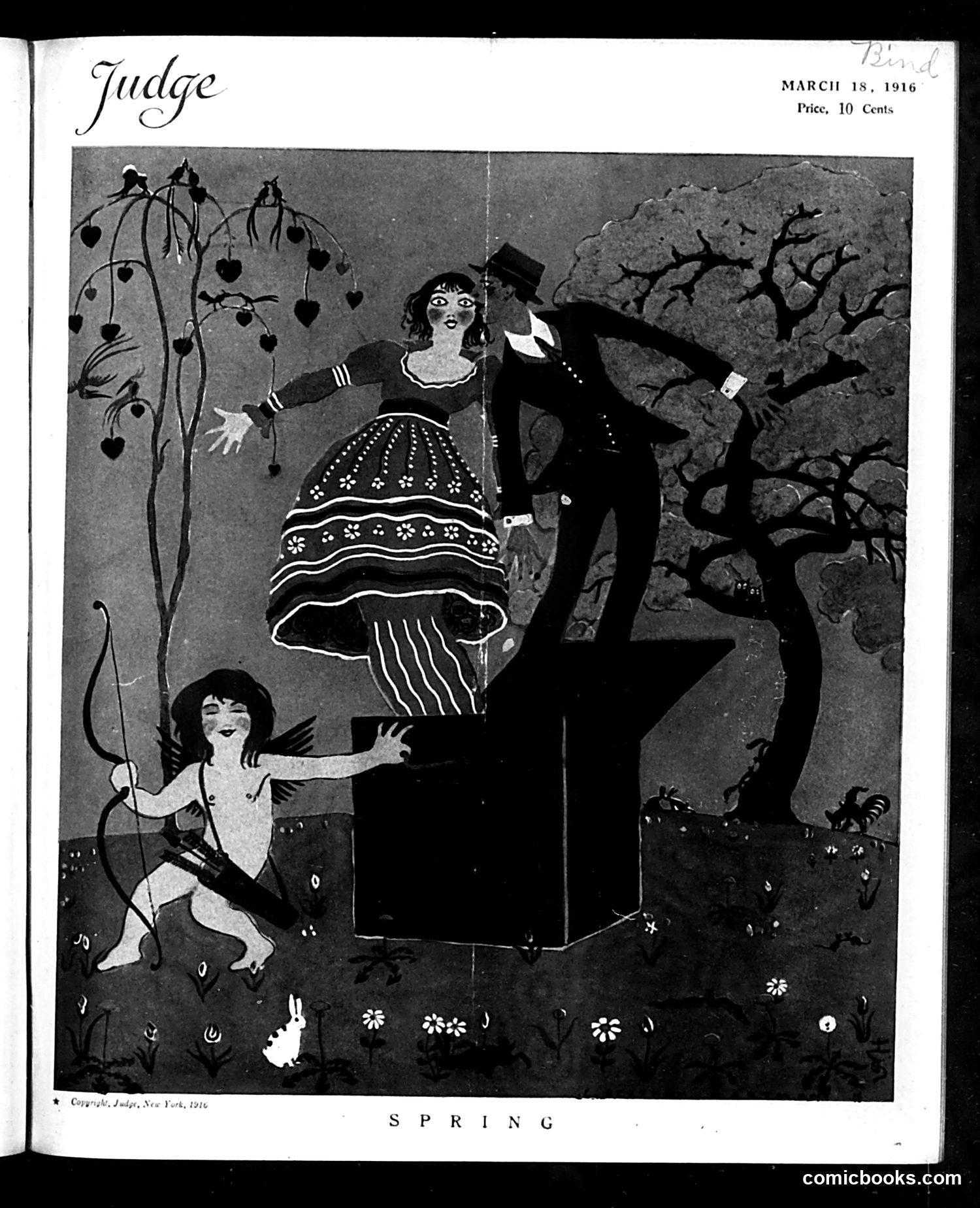
This satirical illustration depicts Spring as a magician or conjurer emerging from a box, presenting an elegantly dressed woman to a formally attired gentleman. The imagery plays on Spring's traditional association with romance, renewal, and courtship. The visual joke likely satirizes how Spring's arrival conventionally inspires romantic pursuits and social engagements among the upper classes. The "magician" presentation suggests Spring manufactures romantic opportunities—transforming the season into a theatrical performance where couples pair off. The cherub figure at lower left, the flowering plants, hanging hearts, and pastoral landscape all reinforce Spring's traditional role as cupid's season. The formal dress and stylized 1916 Art Deco aesthetic reflect the magazine's sophisticated, urbane audience and their social rituals around springtime courtship.
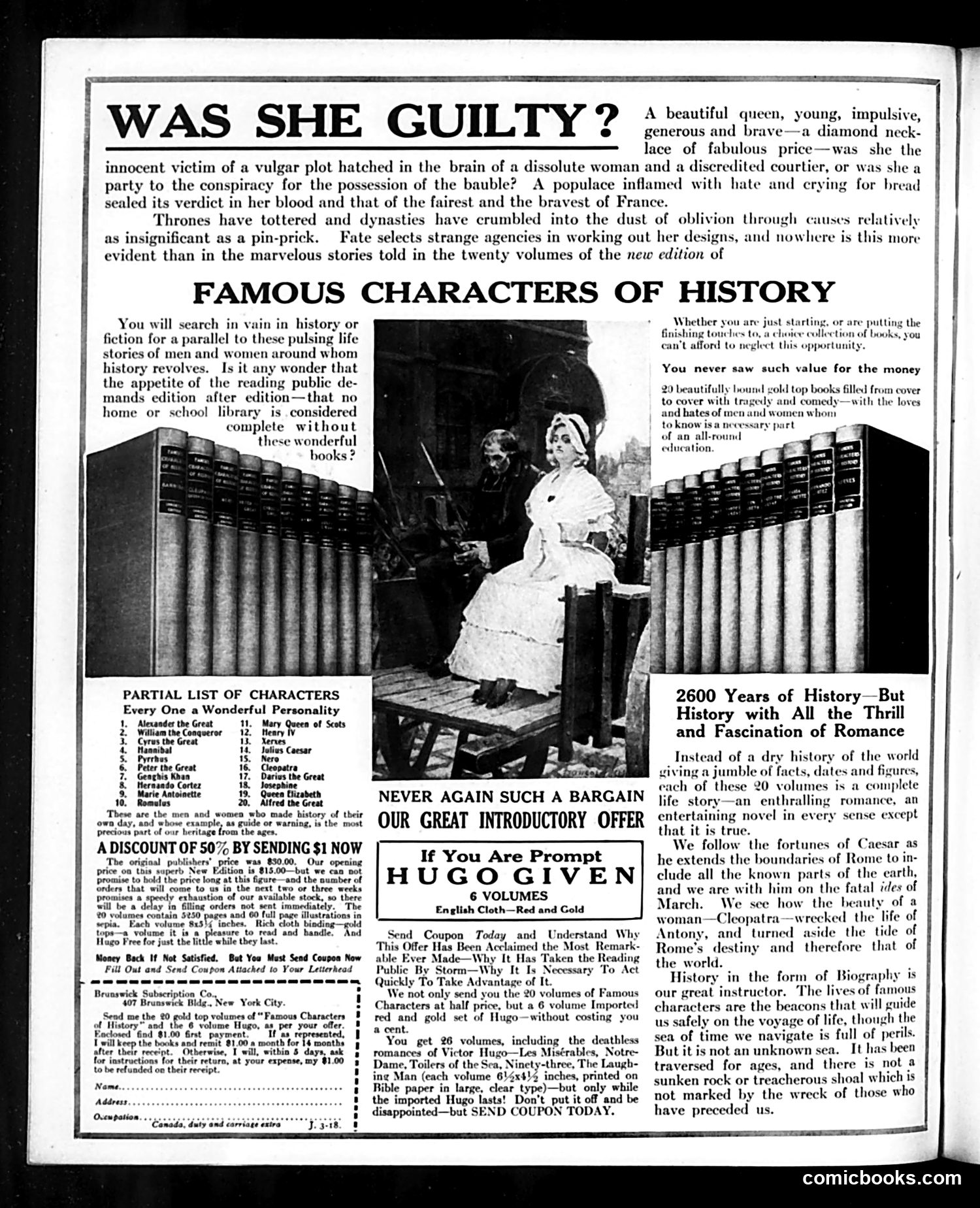
This page is primarily a commercial advertisement for "Famous Characters of History," a 20-volume book set published by Hugo. The central image shows a woman in period costume seated among bookshelves, appearing to represent a historical character. The "Was She Guilty?" headline refers to an unidentified historical or fictional female figure—possibly Marie Antoinette or similar controversial royal woman—used as sensational marketing copy. The advertisement emphasizes the books cover dramatic historical narratives with "thrill and fascination of romance" rather than dry facts. The "Partial List of Characters" includes figures like Alexander the Great and Queen Elizabeth. This is commercial publishing promotion, not political satire. Judge magazine, while satirical by nature, devoted considerable space to paid advertisements like this one.
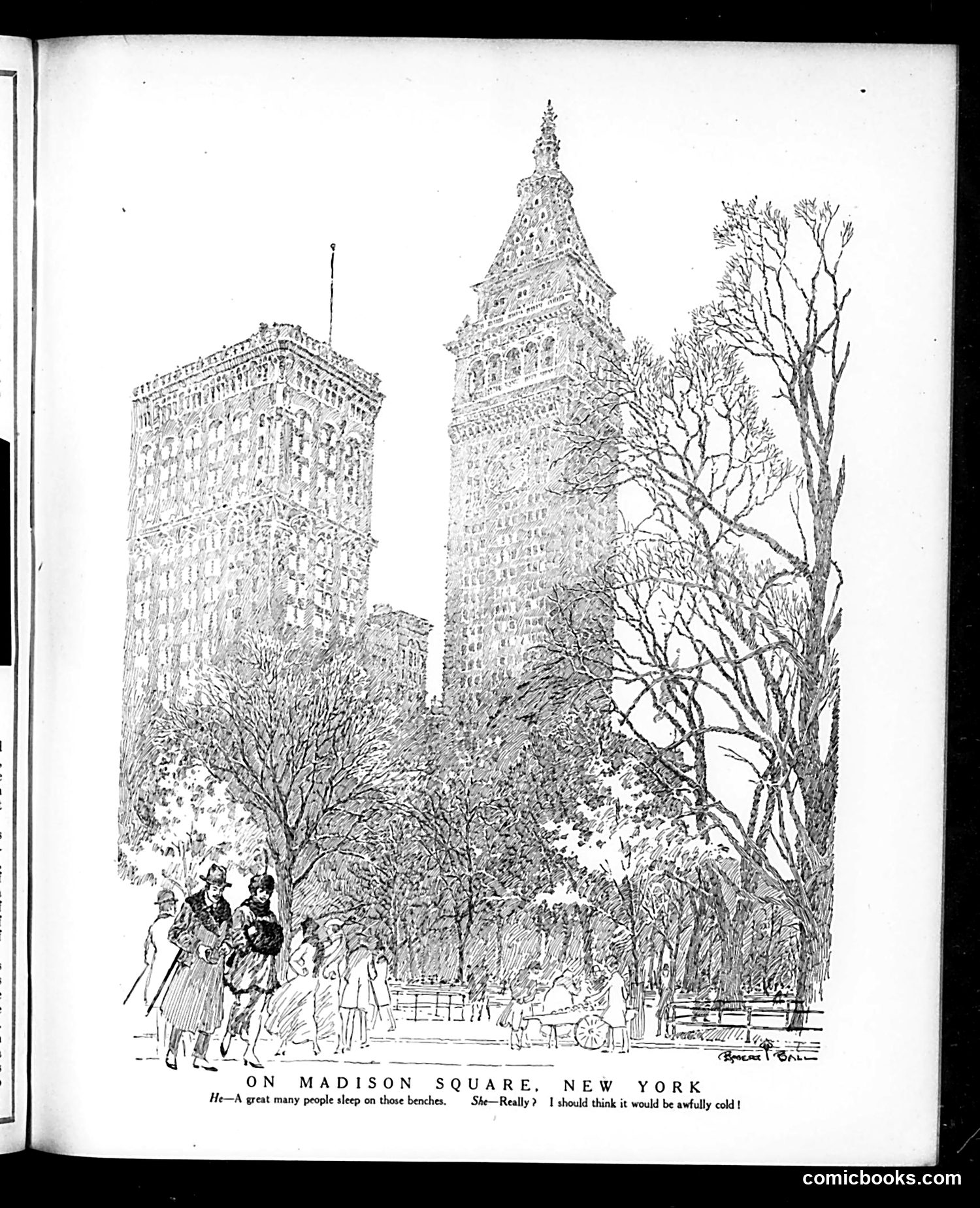
This is a straightforward social commentary sketch rather than political satire. The cartoon depicts Madison Square Park in New York City, showing well-dressed pedestrians strolling among bare trees and prominent buildings (including what appears to be the Flatiron Building). The dialogue between two figures—"He: A great many people sleep on those benches. She: Really? I should think it would be awfully cold!"—satirizes upper-class obliviousness to homelessness and poverty. The woman's naive shock suggests she's unaware that poor people use park benches as sleeping quarters, even in cold weather. The joke critiques the disconnect between wealthy New Yorkers and the harsh realities faced by the city's destitute populations living rough on city streets.
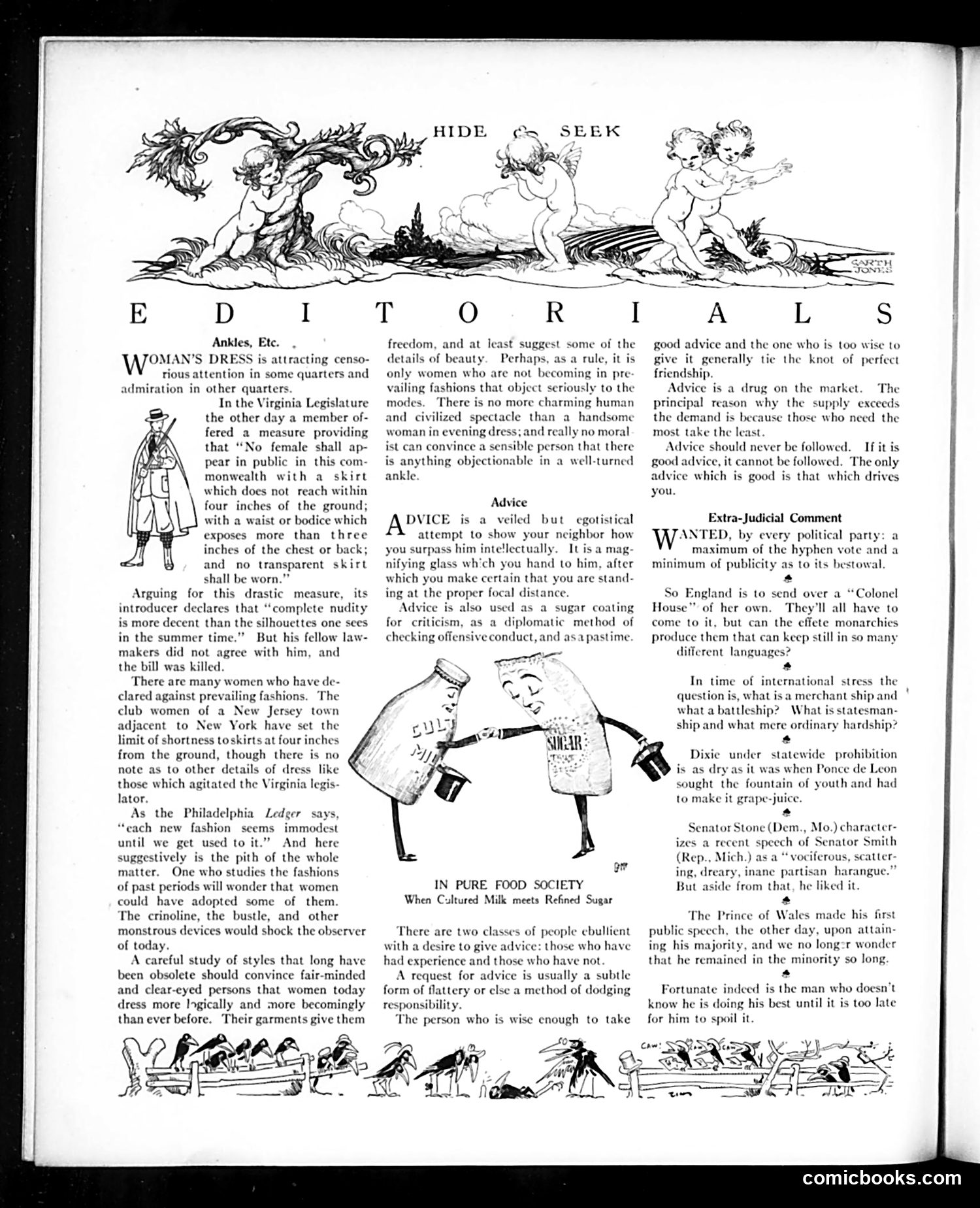
This Judge magazine page satirizes fashion and social advice through multiple pieces: **Main Section - "Woman's Dress" Controversy:** The text mocks a Virginia legislator's proposal restricting women's hemlines and skirt transparency. The satire argues that while some object to immodest fashion, this draconian measure is excessive. The illustrator depicts a woman in a long skirt, contrasting with contemporary flapper styles. **"Advice" Section:** A cartoon shows two milk bottles—representing "Cultured Milk" and "Refined Sugar"—in confrontation, captioned "In Pure Food Society." This satirizes food industry standards and purity debates of the era. **Right Column - Political Commentary:** References Senator Smith (Rep., Mich.) and mentions England sending a "Colonel House," likely alluding to World War I diplomatic efforts and political tensions. The page blends fashion criticism, food regulation satire, and international politics—typical Judge content targeting urban, educated readers.
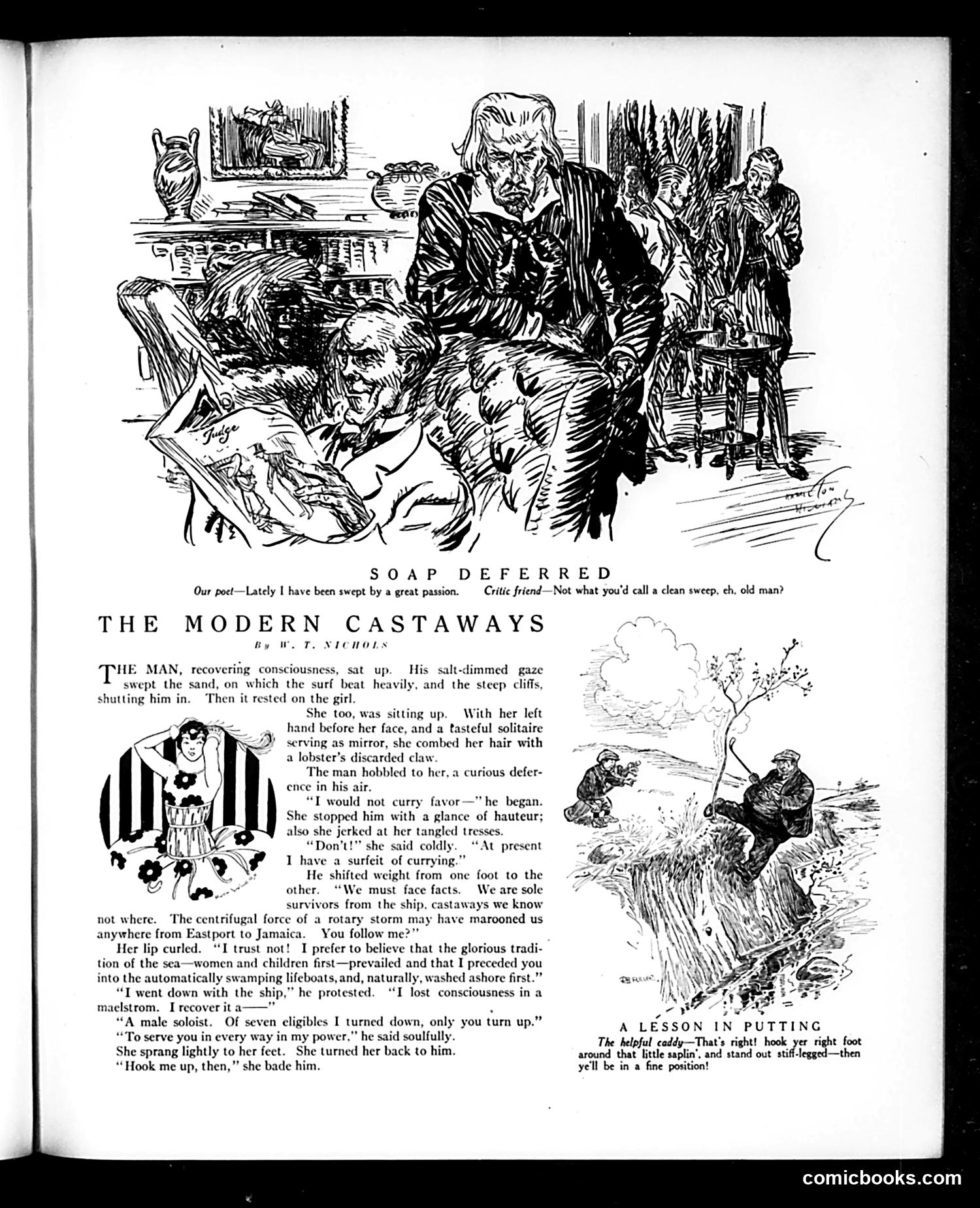
This page from *Judge* contains two separate items: **"Soap Deferred"** (top cartoon): A sketch depicting what appears to be a social gathering where a shabby man requests soap from a well-dressed woman. The dialogue suggests the man hasn't bathed in some time ("swept by a great passion"), and a critic friend observes it wasn't "a clean sweep." This is likely satirizing either poor hygiene among a particular social class or mocking someone's personal neglect—the humor relies on the obvious need for bathing. **"The Modern Castaways"** (bottom): A short story by H.T. Nichols about shipwreck survivors, unrelated to the cartoon above. **"A Lesson in Putting"** (right): A golf instruction illustration with humorous commentary on proper stance. The page mixes satirical humor with leisure-activity content typical of *Judge*'s audience.
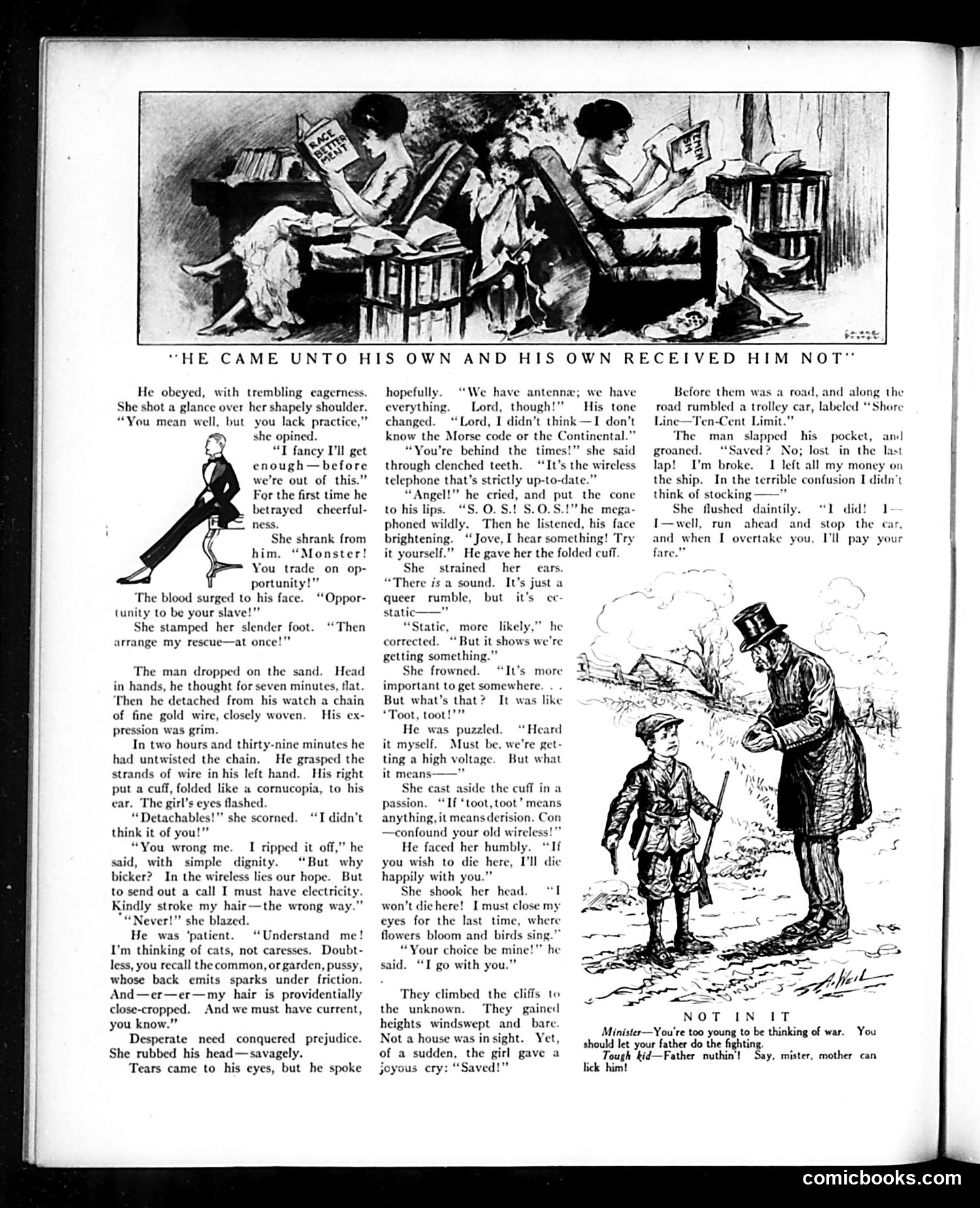
This page contains two distinct pieces of satirical content: **Upper Story**: A romantic adventure narrative mocking early wireless technology. A couple stranded on a beach attempts to signal for rescue using an improvised wireless apparatus. The satire targets the era's fascination with cutting-edge technology—the man fashions a transmitter from his watch chain and creates a "cuff" antenna, requiring the woman to stroke his hair to generate static electricity. The "toot toot" sounds suggest either the technology's unreliability or the absurdity of their expectations. The trolley car labeled "Shore Line—Ten-Cent Limit" appearing at the end undercuts the dramatic rescue narrative with mundane reality. **Lower Cartoon ("Not In It")**: A brief exchange between a minister and a "tough kid" about war. The child dismissively rejects the minister's suggestion that his father should handle fighting, boasting he could beat his father himself. This appears to satirize either youthful bravado or, possibly, commentary on class attitudes toward military service during an unstated conflict period. Both pieces employ humor through technological absurdity and deflated expectations.
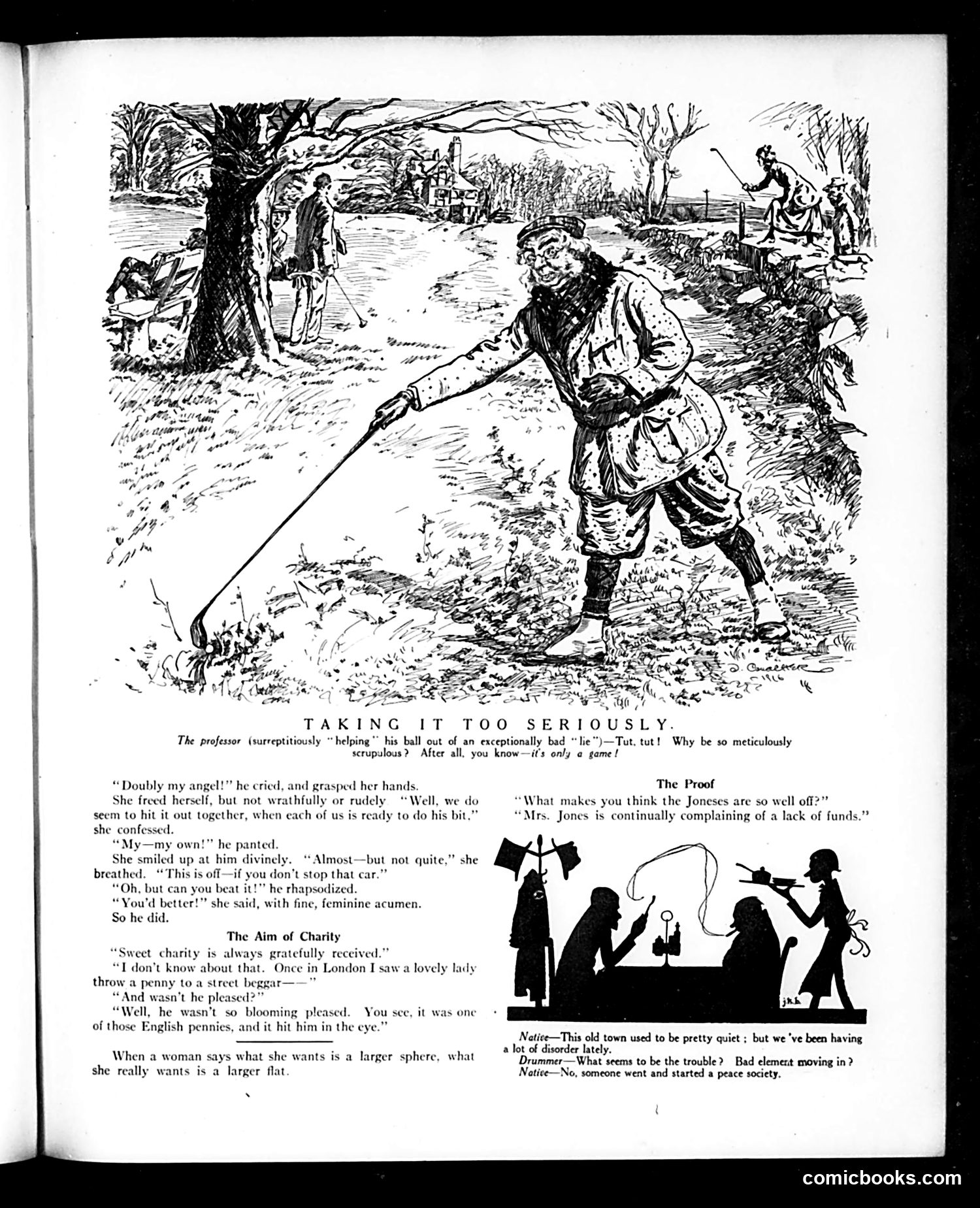
**Main Cartoon: "Taking It Too Seriously"** A golf professor cheats by moving his ball from a bad lie while lecturing another golfer about scrupulousness—the irony being his hypocrisy. The satire mocks those who rationalize unethical behavior ("it's only a game") while preaching morality to others. **Secondary Pieces:** Short humorous anecdotes satirizing early 20th-century social pretensions: - **"The Aim of Charity"**: A woman's penny charity backfires comically, suggesting charity-givers often don't truly care about recipients. - **"The Proof"**: Mocks the wealthy facade—the Joneses appear rich but constantly complain about money, suggesting performative status. - **Bottom item**: A town criticizes a "peace society" for causing disorder, absurdly blaming peace activism for social problems—likely satirizing progressive reformers as troublemakers. The page exemplifies Judge's recurring theme: deflating social hypocrisy and pretension among the middle and upper classes through ironic humor.
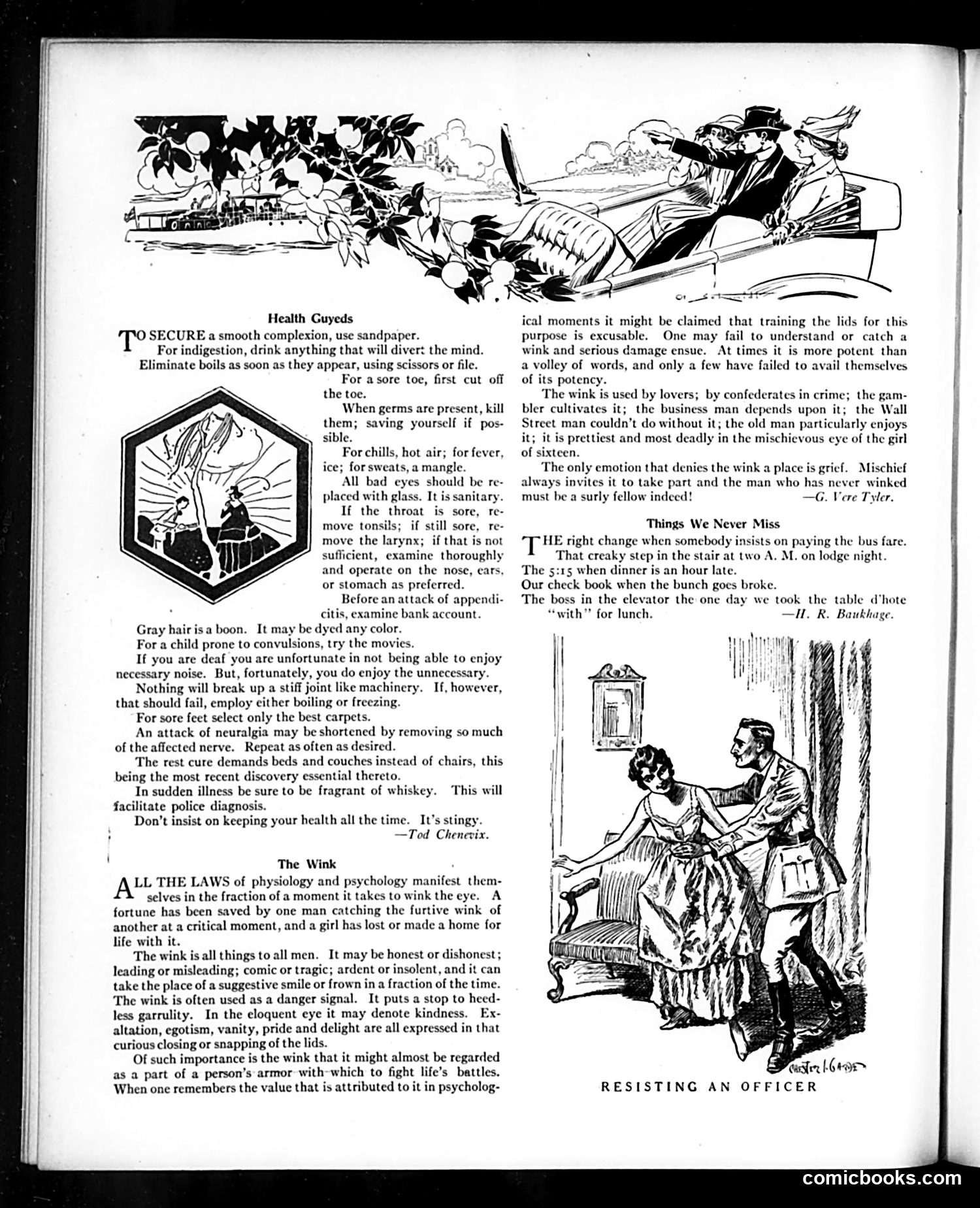
This page contains satirical humor pieces typical of early-20th-century Judge magazine. **"Health Guyeds"** mocks medical quackery and extreme surgical practices of the era through deliberately absurd advice: sandpaper for complexion, cutting off toes for soreness, removing body parts (tonsils, larynx, nerves) for minor ailments. The satire targets both overzealous doctors performing unnecessary surgeries and patients' gullibility during a period when medical science was advancing but still crude. **"The Wink"** is a lengthy essay treating the eye-wink as profoundly meaningful—used by lovers, criminals, gamblers, and businessmen. It humorously elevates this simple gesture to an essential life skill, suggesting society places bizarre importance on nonverbal communication. **"Things We Never Miss"** lists mundane annoyances (bus fare change, creaky stairs, checking accounts, encountering one's boss). The illustration titled **"Resisting an Officer"** depicts a man physically resisting a police officer, likely satirizing either police overreach or criminal behavior—context unclear without additional caption.
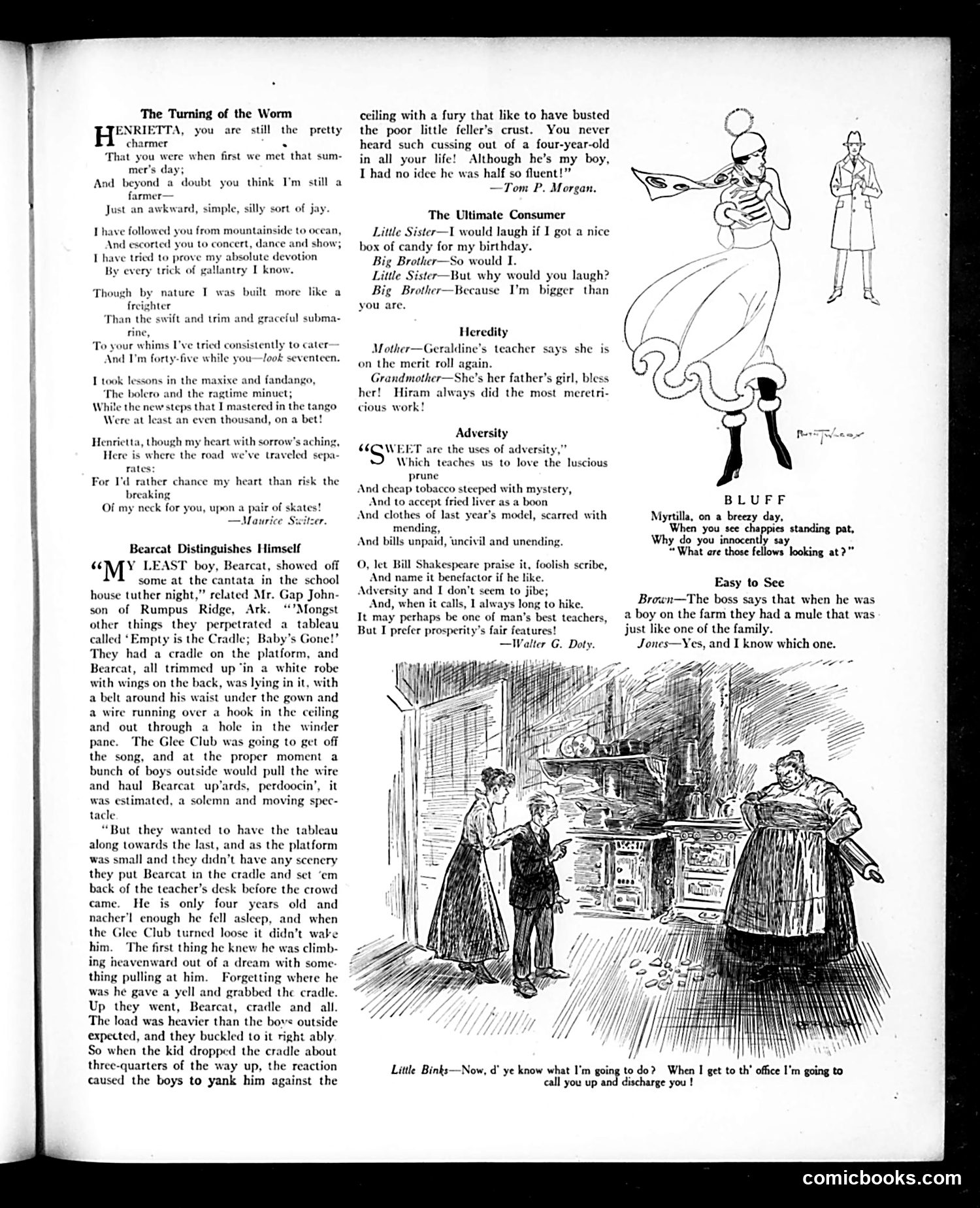
This page contains several humor pieces satirizing early 20th-century American social life: **"The Turning of the Worm"** portrays a romantic reversal: a devoted, aging suitor (who's learned fashionable dances like the maxixe and tango, taken fandango lessons) finally draws the line at ice skating—risking his neck for his eternally youthful paramour Henrietta. The satire mocks both aging men's desperation to keep up with modern trends and their ultimate limits. **"Bearcat Distinguishes Himself"** is a rural anecdote humor piece about a four-year-old accidentally hoisted during a school theatrical production, producing unexpectedly profane language—the joke being innocent childhood corrupted by accident. The smaller pieces ("The Ultimate Consumer," "Heredity," "Adversity") are brief comic dialogues exploiting obvious ironies: siblings' different reactions to candy, inherited traits, and philosophy versus practical preference. The illustration shows a domestic scene, likely accompanying one piece. Overall, the page reflects Judge's formula: social satire targeting middle-class pretensions and generational tensions.
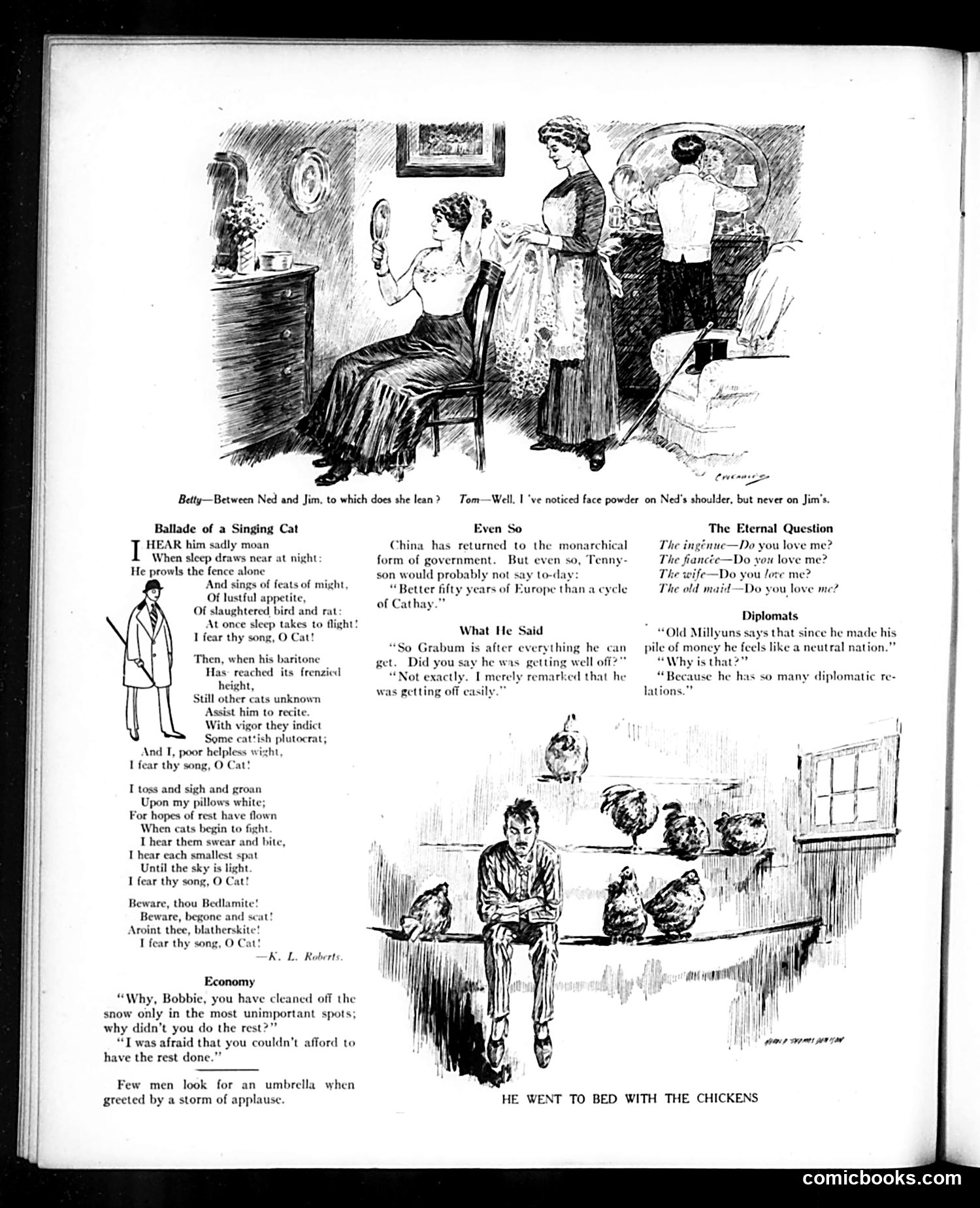
This page contains several satirical pieces typical of early 20th-century American humor: **Top cartoon**: A domestic scene where "Betty" is caught between two suitors ("Ned" and "Jim"). The joke's punchline—visible in the caption—uses makeup as evidence of infidelity: Tom notices powder on Ned's shoulder but never on Jim's, suggesting Betty's romantic preference. **"Ballad of a Singing Cat"**: A humorous poem mocking the nocturnal noise of fighting tomcats, presented as high dramatic verse. The repetitive complaint "I fear thy song, O Cat!" parodies serious poetry forms while addressing an everyday urban annoyance. **Remaining items**: Short quips satirizing contemporary topics—China's return to monarchy, economic hardship (a child only clears "important" snow spots to save parents money), and wealthy men's diplomatic pretensions (equating a rich man's many relationships to "diplomatic relations"). The page reflects turn-of-century urban middle-class concerns: romance, domestic animals, economic anxiety, and social status.
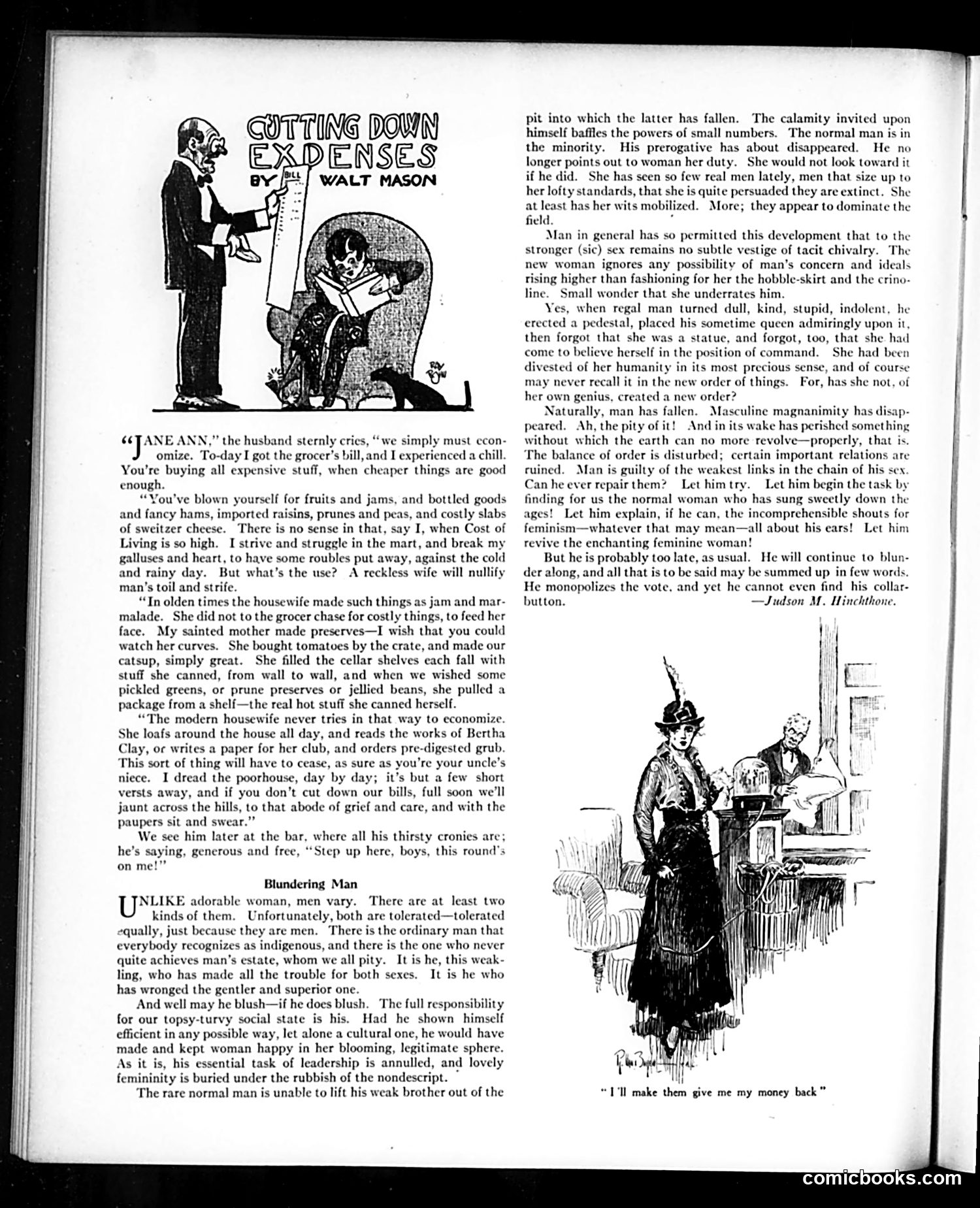
**"Cutting Down Expenses"** satirizes the hypocrisy of a miserly husband. He lectures his wife "Jane Ann" about wasteful spending on groceries and modern conveniences, invoking his mother's industrious homemaking (canning, preserving) as the ideal. The cartoon's punchline: he's later seen at a bar, buying drinks for friends, saying "Step up here, boys, this round's on me!" The satire targets men who demand their wives economize while squandering money themselves. **"Blundering Man"** is an essay-style commentary blaming weak, ineffectual men for social disorder. It argues that ordinary, incompetent men have failed their leadership role, allowing women to abandon their "legitimate sphere" and become independent. The author claims this "weak brother" has created chaos—women now ignore male guidance, concerning themselves only with fashion. The piece reflects early-20th-century anxieties about changing gender roles and the "New Woman." Both pieces reveal period tensions: economic strain, shifting domestic expectations, and male anxiety over women's independence.
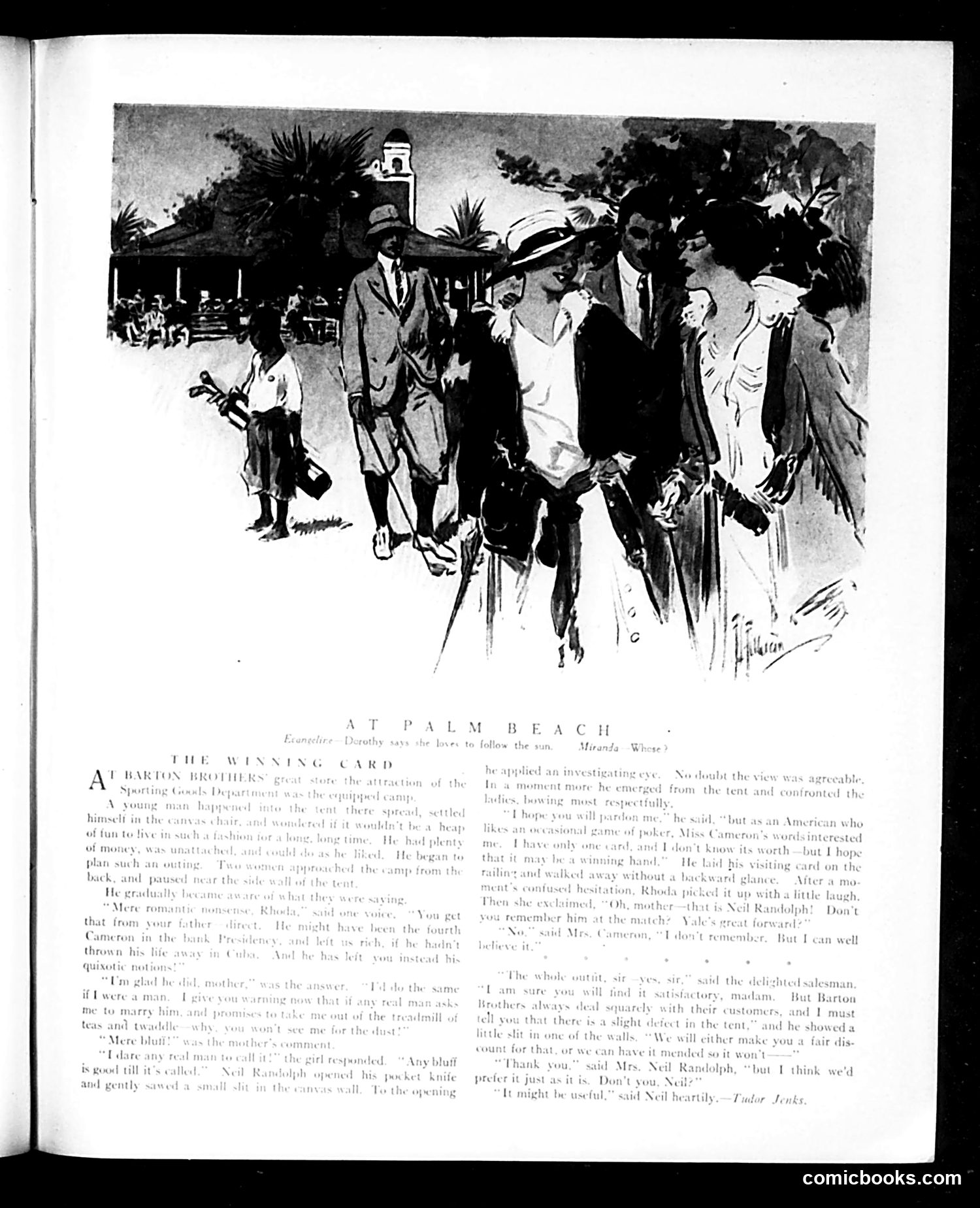
This satirical illustration depicts wealthy American tourists at a Palm Beach resort. The narrative describes a young man named Bart who arrives at camp and wins over the crowd through his charm and confidence. The main joke centers on romance and social status: Bart claims he "doesn't know a thing worth telling" about himself, yet this mysterious quality—combined with his apparent wealth and good looks—makes him attractive to the women present. The satire targets the superficiality of wealthy leisure society, where appearance and mystique matter more than substance or honest character. The reference to "an American who likes an occasional game of poker" suggests Bart's casual wealth and gambling habits are treated as marks of respectability among the affluent set, further mocking the values of early 20th-century high society.
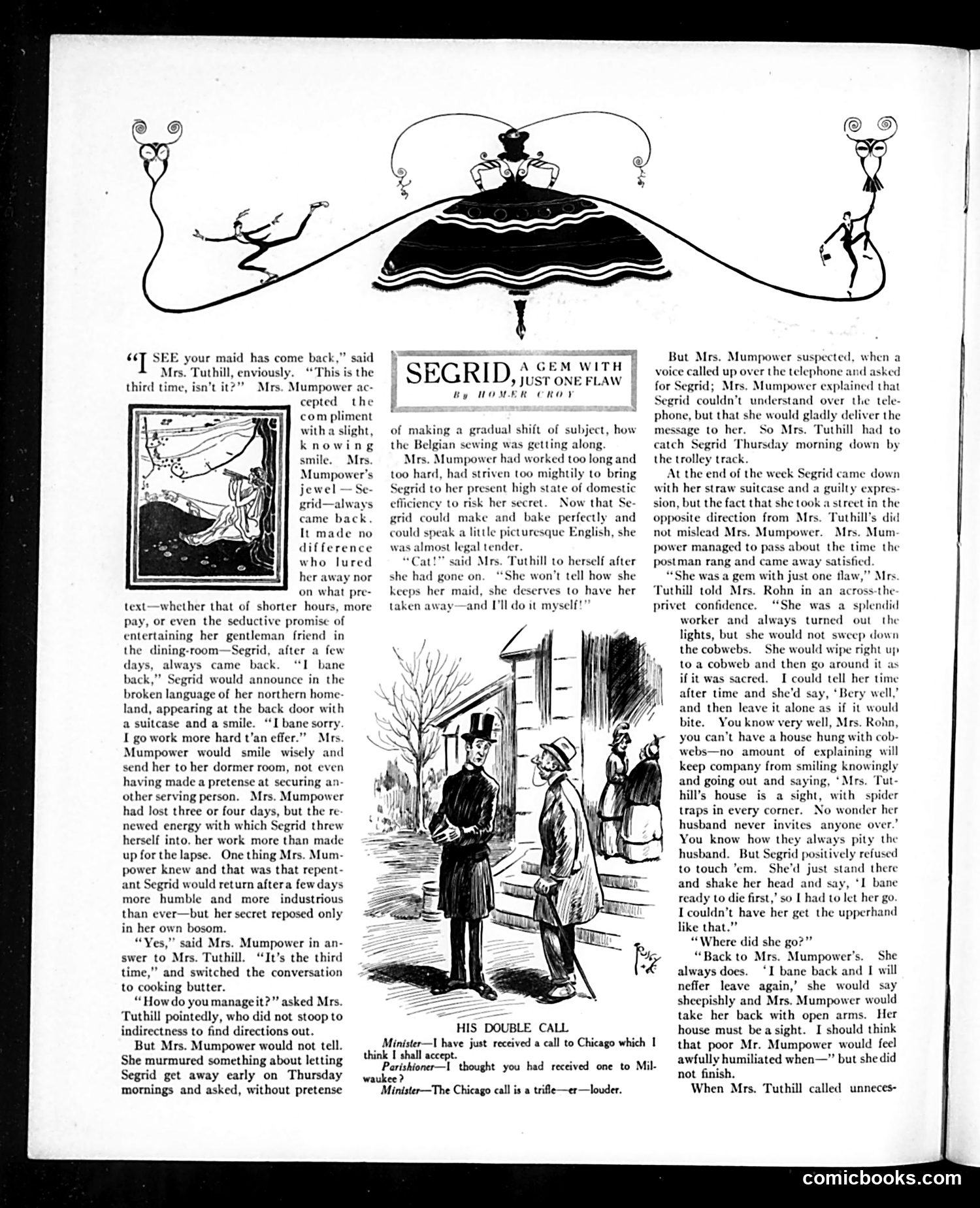
This is a humorous domestic story, not political satire. It concerns a servant named Segrid (apparently Scandinavian, from her broken English) who repeatedly quits her job with Mrs. Mumpower, then returns contrite and hardworking. Mrs. Tuthill, a rival society woman, becomes jealous of Mrs. Mumpower's ability to retain this excellent maid and attempts to steal her away via telephone. The satire targets early 20th-century domestic servant dynamics and female rivalry among employers. The joke is that Segrid's one flaw—refusing to clean cobwebs for superstitious reasons—ultimately makes her unsuitable despite her other talents. The story illustrates period attitudes toward immigrant servants and the competitive tension between wealthy housewives over household help.
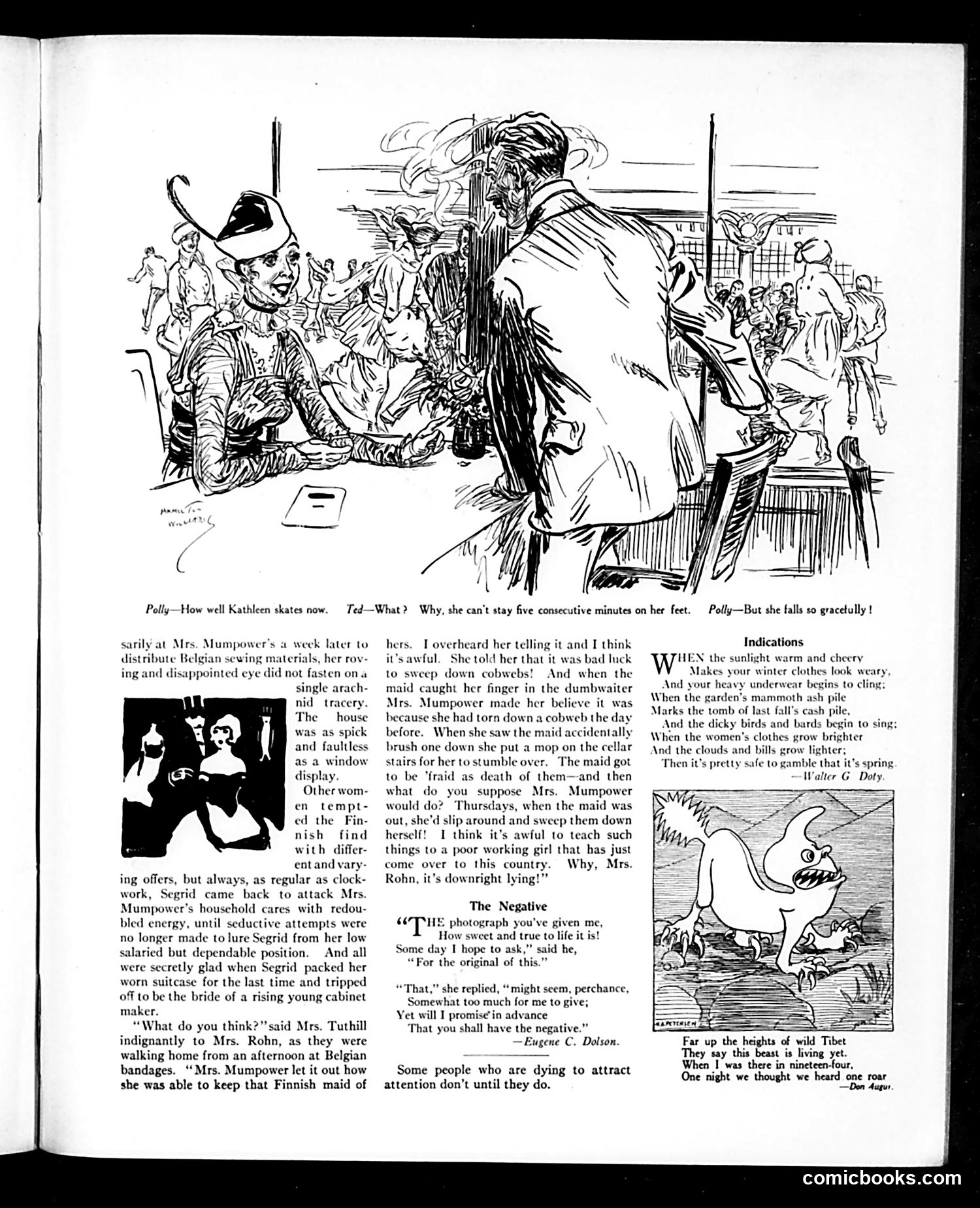
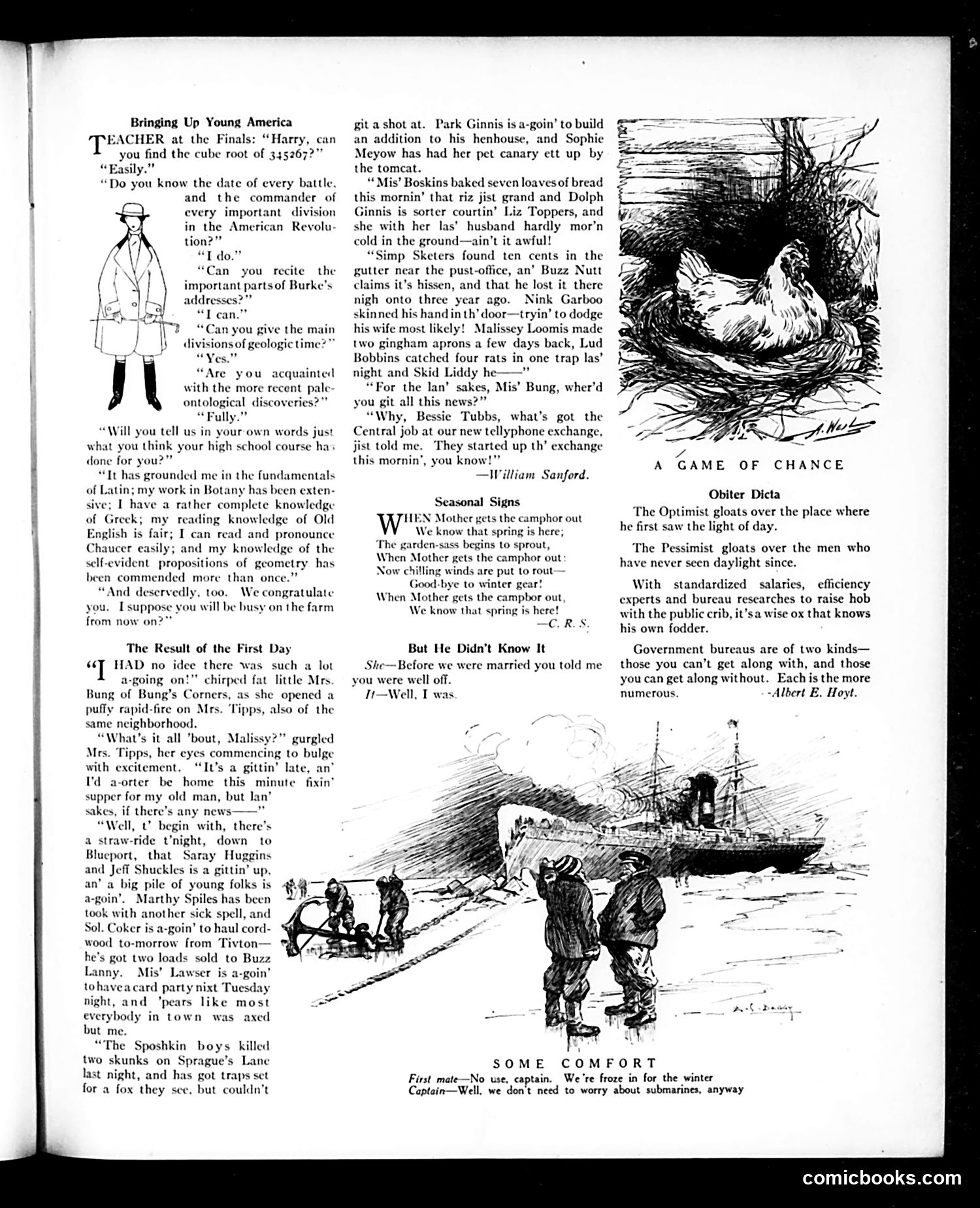
This page contains multiple unrelated satirical pieces typical of Judge's format. **Main cartoon (top):** Shows a social scene where a woman named Polly comments on another woman's skating. The accompanying story criticizes Mrs. Mumpower's treatment of her Finnish maid, Segrid. Mrs. Mumpower deliberately exploited superstition by lying to the maid about cobwebs being bad luck, then secretly creating cobweb "accidents" to keep her fearful and obedient. The satire targets wealthy employers who manipulate vulnerable immigrant workers through deception. **"The Negative":** A brief romantic poem about a photograph, playing on the double meaning of "negative" (photographic plate vs. refusal). **"Indications":** A humorous poem about spring's arrival, using absurd images (ash piles from last fall's expenses). **Beast illustration (right):** An unrelated comic drawing about a Tibetan creature. The page reflects Progressive-era concerns about labor exploitation and immigrant vulnerability in American households.
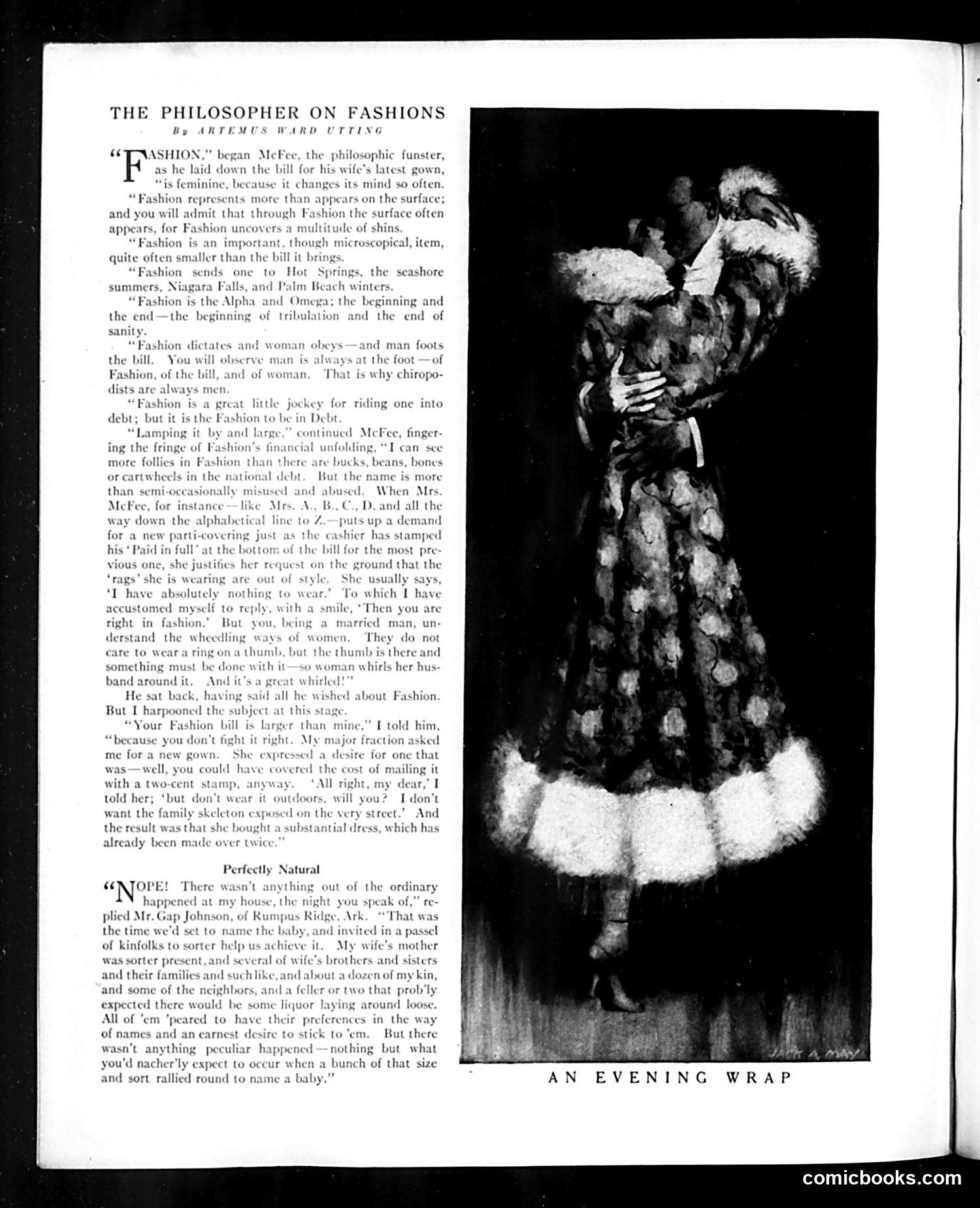
This satirical piece by Artemus Ward Utting mocks women's fashion obsession through a male character, McFee, philosophizing about Fashion's grip on household finances. The humor targets how women's clothing demands drive men into debt—McFee observes that Fashion "dictates and woman obeys—and man foots the bill." The satire catalogs fashion's illogical nature: it sends people to expensive destinations (Hot Springs, Palm Beach), represents "the beginning of tribulation and the end of sanity," and compels women to demand new garments constantly. McFee ridicules his wife and her social circle (Mrs. A, B, C, D, etc.) for claiming "I have absolutely nothing to wear" while demanding new party-covering garments. The accompanying "Evening Wrap" illustration shows an elaborately dressed woman, visually reinforcing the text's critique of excessive, impractical fashion expenditure. The tone is gentle mockery rather than harsh condemnation—characteristic of Judge magazine's social satire.
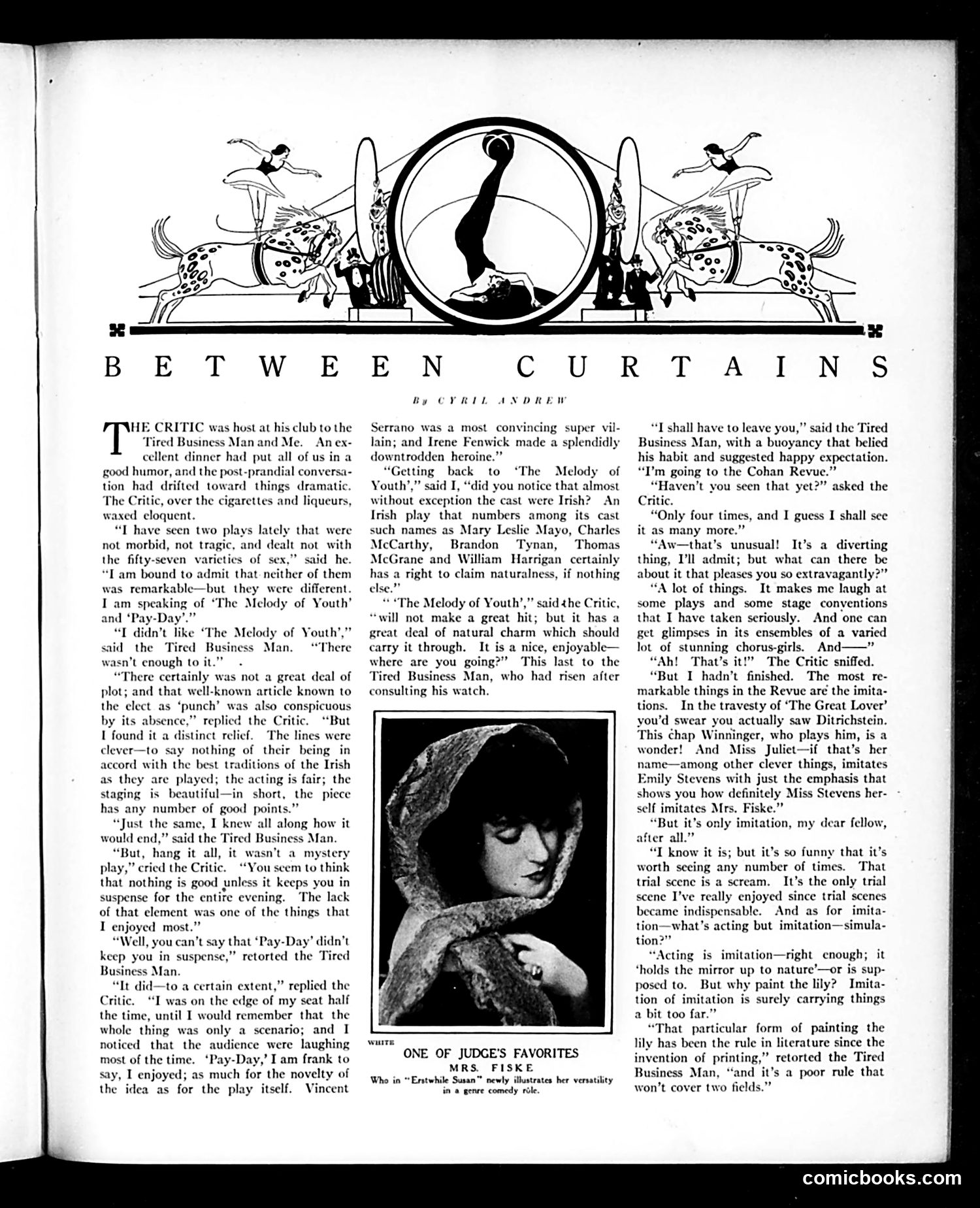
This page presents a dialogue between a theater critic and a "Tired Business Man" discussing recent Broadway plays. The satire targets middlebrow theater tastes and audience preferences. The critic praises *The Melody of Youth* for being non-sensational and well-acted (featuring Irish actors like Charles McCarthy and Brandon Tynan), while the Tired Business Man dismisses it as lacking suspense. He reveals he's attending *The Cohan Revue* for the fourth time, drawn to chorus girls and theatrical imitations rather than dramatic substance. The joke: the critic values artistic merit; the businessman values spectacle and comedy. A photograph of Mrs. Fiske, labeled a "Judge favorite," illustrates versatile dramatic acting—the implied contrast to revue-style entertainment. The satire mocks how popular audiences prioritize entertainment and physical beauty over serious theatrical art.
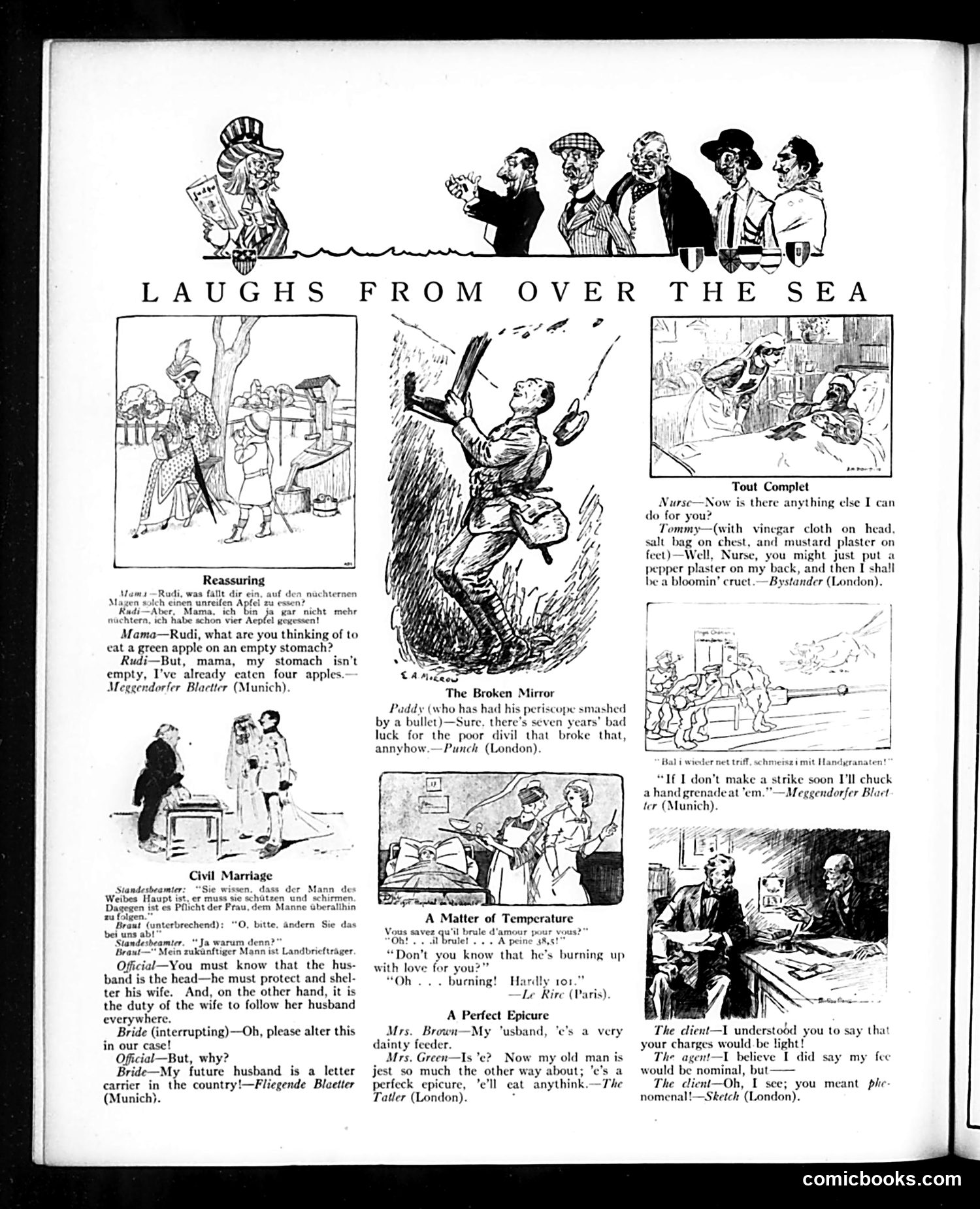
This page compiles humorous anecdotes translated from European satirical magazines (Munich, London, Paris), representing the early 20th-century practice of international joke-sharing among publications. The humor relies on simple domestic and wartime scenarios: **"Reassuring"** and **"Civil Marriage"** use innocent misunderstandings—a child's logic about eating apples on an empty stomach, and a bride's practical concern that her rural mail-carrier husband requires constant travel. **"The Broken Mirror"** references wartime (periscope damaged by bullets), playing on Irish superstition about seven years' bad luck. **"A Matter of Temperature"** uses a temperature pun: "burning with love" literally means having a fever of barely 101°F—mild affection. **"A Perfect Epicure"** contrasts finicky versus gluttonous eaters through working-class British women's dialogue. **"Tout Complet"** shows a sick child requesting increasingly absurd medicinal plasters, suggesting complete coverage. The page demonstrates early 20th-century transatlantic humor sharing and period attitudes toward class, marriage, and wartime experience.
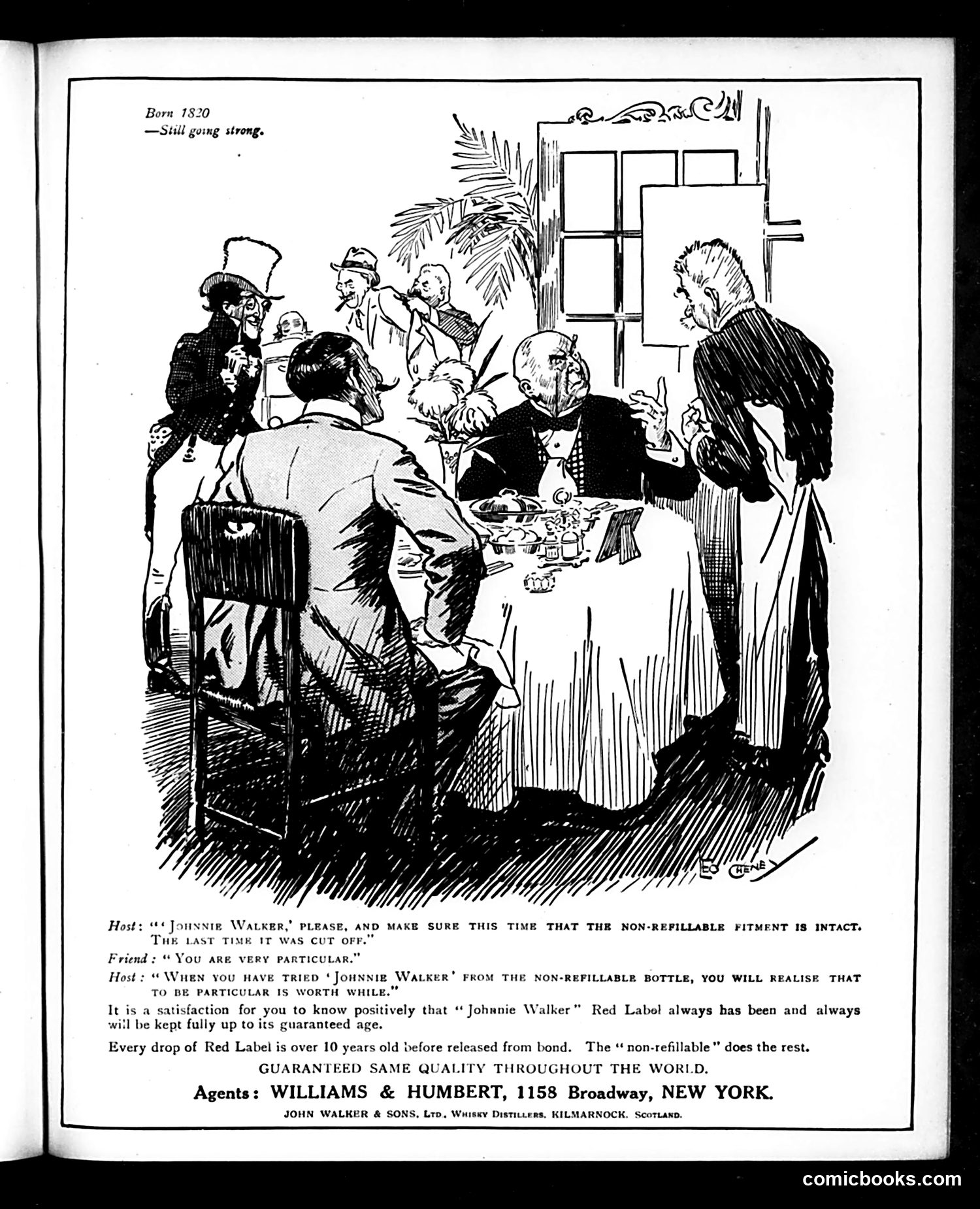
This is a **whisky advertisement**, not political satire. The cartoon depicts a dinner party where the host orders "Johnnie Walker" scotch whisky, emphasizing the "non-refillable fitment" (bottle cap) to prevent tampering or dilution. The joke plays on the host's insistence on bottle integrity: the friend finds him "particular," but the host explains that once you've experienced authentic Johnnie Walker Red Label—aged over 10 years—you'll understand why the sealed, non-refillable bottle matters. It guarantees quality hasn't been compromised. The "Born 1820—Still going strong" header refers to Johnnie Walker's founding date, positioning the brand as an enduring, trustworthy product. This is essentially a quality-assurance pitch disguised as social comedy, aimed at affluent diners concerned about receiving genuine, undiluted spirits.
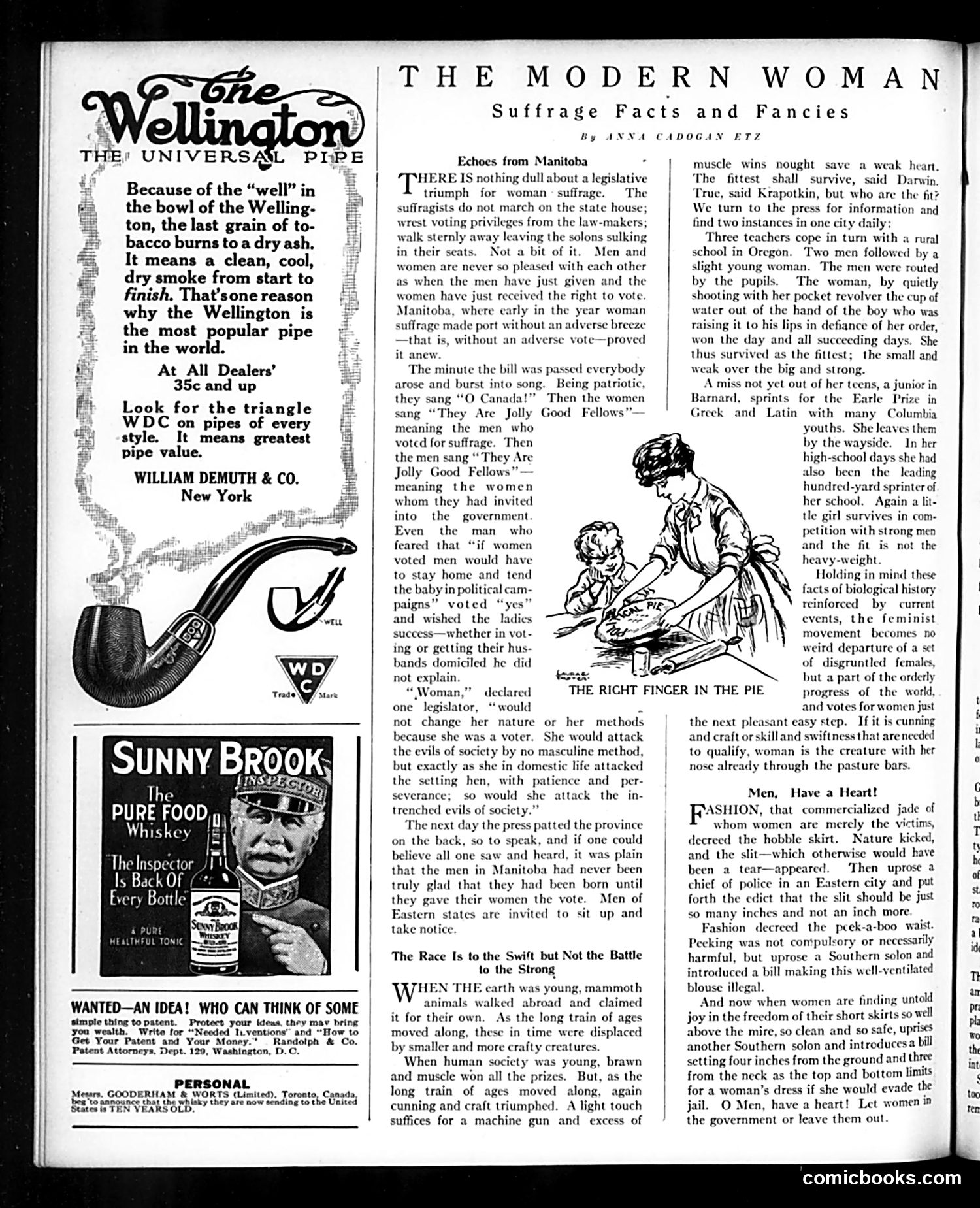
This article celebrates women's suffrage victory in Manitoba with satirical humor about gender dynamics. The piece describes how after legislators granted women voting rights, both sexes sang patriotic songs praising each other—a comedic portrayal of sudden mutual admiration replacing prior conflict. The author then argues that women succeed through "craft" rather than brute strength, using examples: a rural schoolteacher wins classroom control via a revolver shot (not physical dominance), and evolution favors cunning over muscle. The satire suggests women's political power derives from intelligence and tactical skill, not masculine aggression. A small illustration captioned "THE RIGHT FINGER IN THE PIE" depicts a woman guiding a child, reinforcing the theme of female influence through subtle direction rather than force. The page reflects early-20th-century feminist arguments: that women's different methods—patience, cleverness, precision—made them equally or more effective than men's traditional approaches, thus justifying their political enfranchisement.
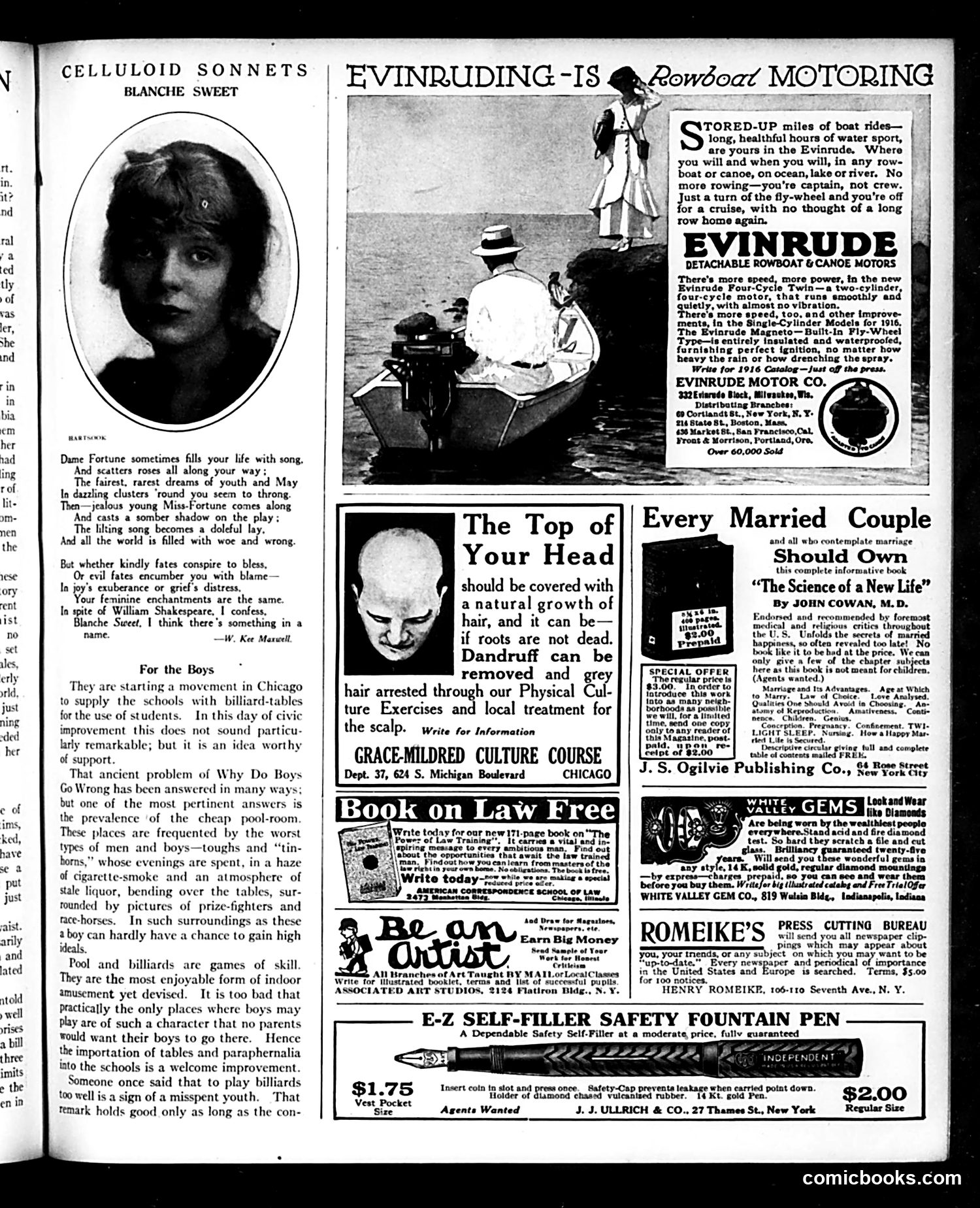
This page from *Judge* contains primarily **advertising and light literary content** rather than political satire. The main feature is a poem titled "Celluloid Sonnets" about **Blanche Sweet**, a silent film actress of the era. The poem uses romantic language about fortune and fate—typical sentimental verse of the period. The page is dominated by **product advertisements** including: - **Evinrude boat motors** (detachable rowboat engines) - **Grace-Mildred Culture Course** (hair/scalp treatments) - **"The Science of a New Life"** (marriage/sexual education book) - **White Gems** (diamonds marketed to wealthy consumers) - Various self-improvement and business opportunity ads The "Why Do Boys Go Wrong" section briefly addresses **youth delinquency**, attributing it to cheap pool halls frequented by "toughs"—a common early-20th-century social concern about working-class male recreation. This reflects a typical *Judge* page: celebrity gossip, consumer products, and conservative social commentary targeting middle-class readers.
This page is primarily **advertising and reader content** rather than political satire. The main elements are: **"College Wits" Section**: A collection of brief humor pieces from various college publications (Yale Record, Jester, Tiger, etc.), featuring romantic and academic jokes typical of early 20th-century collegiate humor—failed courtships, misunderstandings about women's intelligence, and military/trench references suggesting WWI-era context. **Advertisements**: Job training opportunities, correspondence schools for cartooning, and other period business pitches promising financial success. **Leslie's Motor Department**: The prominent right-hand column advertises a free booklet of automotive troubleshooting advice by Harold W. Slauson, targeting early motorists concerned about mechanical problems during trips. The page reflects **1910s-1920s popular culture**: college humor conventions, emerging automobile ownership concerns, and various self-improvement/job training schemes. There is no discernible political cartoon or sustained satirical argument—it's a typical mixed-content magazine page blending editorial jokes with commercial promotion.
This is a short story about a young newspaper reporter's initiation prank at the *Borogovia Herald*. When Wesley Barrett returns from covering a snowy wedding with wet shoes, veteran staff members Browning and Editor Hawkes trick him into repeatedly stamping his feet, ostensibly to remove snow—but actually as a signal to the Palace Café owner below. The "angel unaware" is Max Bergesheimer, the café's owner and bartender, who arrives bearing large trays of food and drinks. The prank's elaborate setup and the editor's initial silence suggest this is a traditional office hazing ritual meant to celebrate the newcomer. The satire targets newspaper office culture: the cramped, lowly quarters (above a café, beside a laundry and undertaker), the practical jokes on newcomers, and the camaraderie built through such rituals. The page also includes period advertisements for Cook's champagne and Cascade whisky.
This page from *Judge* magazine (a major American satirical publication) contains primarily **short humorous stories and advertisements** rather than political cartoons. The main content includes: 1. **"The Fable of the Ostrich"** — A satirical fable mocking willful ignorance and denial of danger. The ostrich rationalizes away threats through self-deception (claiming safety because he doesn't know who his enemy is, refusing preparation). The moral critiques those who ignore obvious problems. 2. **"A Bit Late"** — A British working-class comedy about mill workers who blacklead their windows instead of using blinds, then can't tell what time it is, causing them to oversleep. 3. **"Wise Constituent"** — A joke about a congressman receiving endless requests for garden seeds (specifically peas), satirizing either constituent demands or agricultural obsession. The page also features **Wilson whiskey advertising** emphasizing moderation as healthful, and a James Montgomery Flagg painting advertisement for *Judge* magazine itself. The humor relies on wordplay, irony, and social observation rather than explicit political commentary.
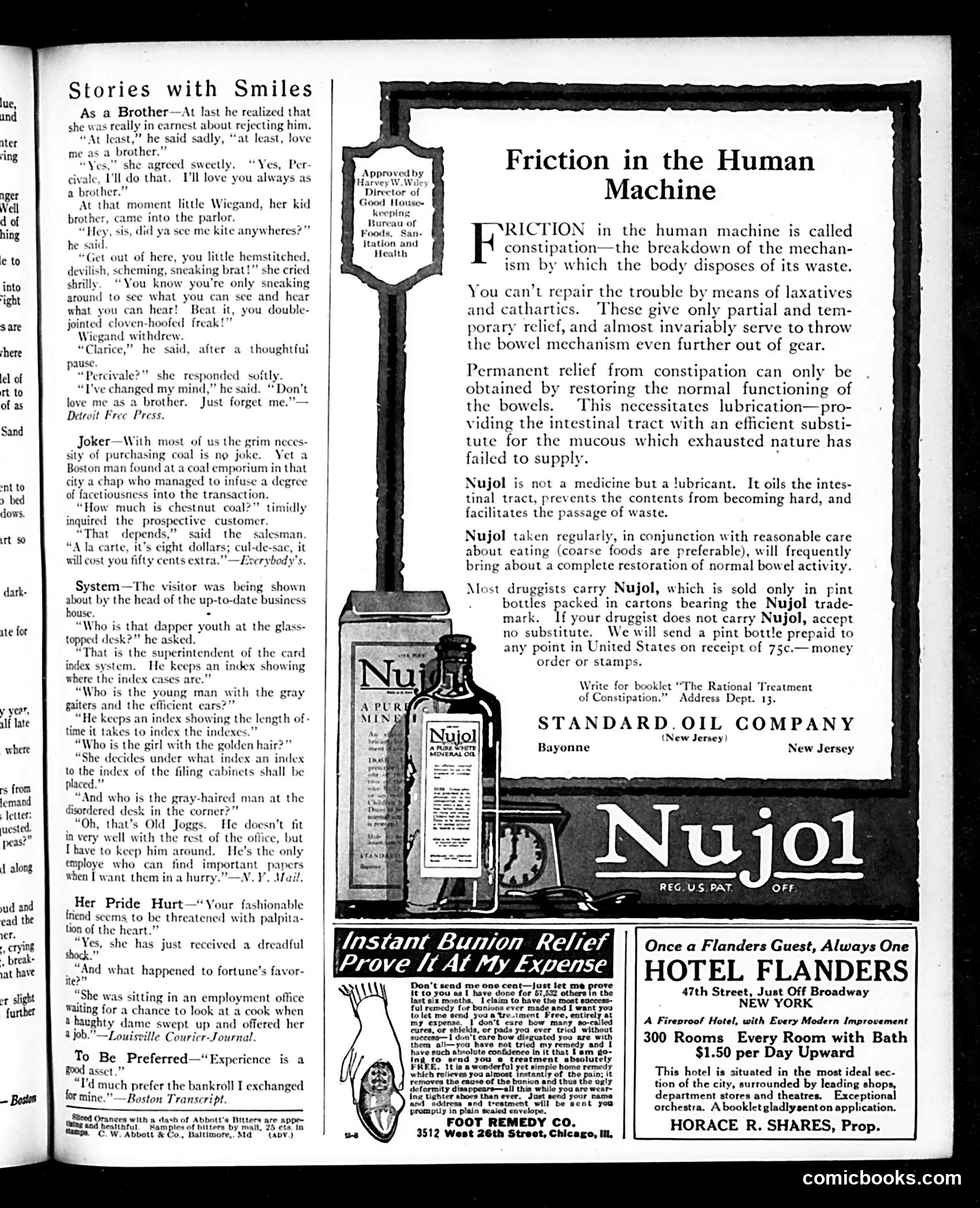
This page contains primarily **advertising and light humor** rather than political satire. The left column features "Stories with Smiles"—three brief comedic anecdotes: one about a rejected suitor told to love a woman "as a brother" (she then treats him with sibling hostility), a joke about coal pricing with pretentious terminology, and a satire on modern office bureaucracy where employees spend all their time maintaining filing systems rather than working. The right side is dominated by a **Nujol advertisement**—a medicinal laxative product. The ad uses pseudo-medical language about "friction in the human machine" and "constipation" to market the lubricant as a solution to digestive problems. This represents typical early 20th-century patent medicine advertising that blended dubious science with euphemistic language. The page also includes smaller ads for **Hotel Flanders** (New York) and a **foot remedy** (Bunion Relief). There is **no clear political cartoon** visible. The content reflects general early-1900s American consumer culture and mild humor about modern office life.
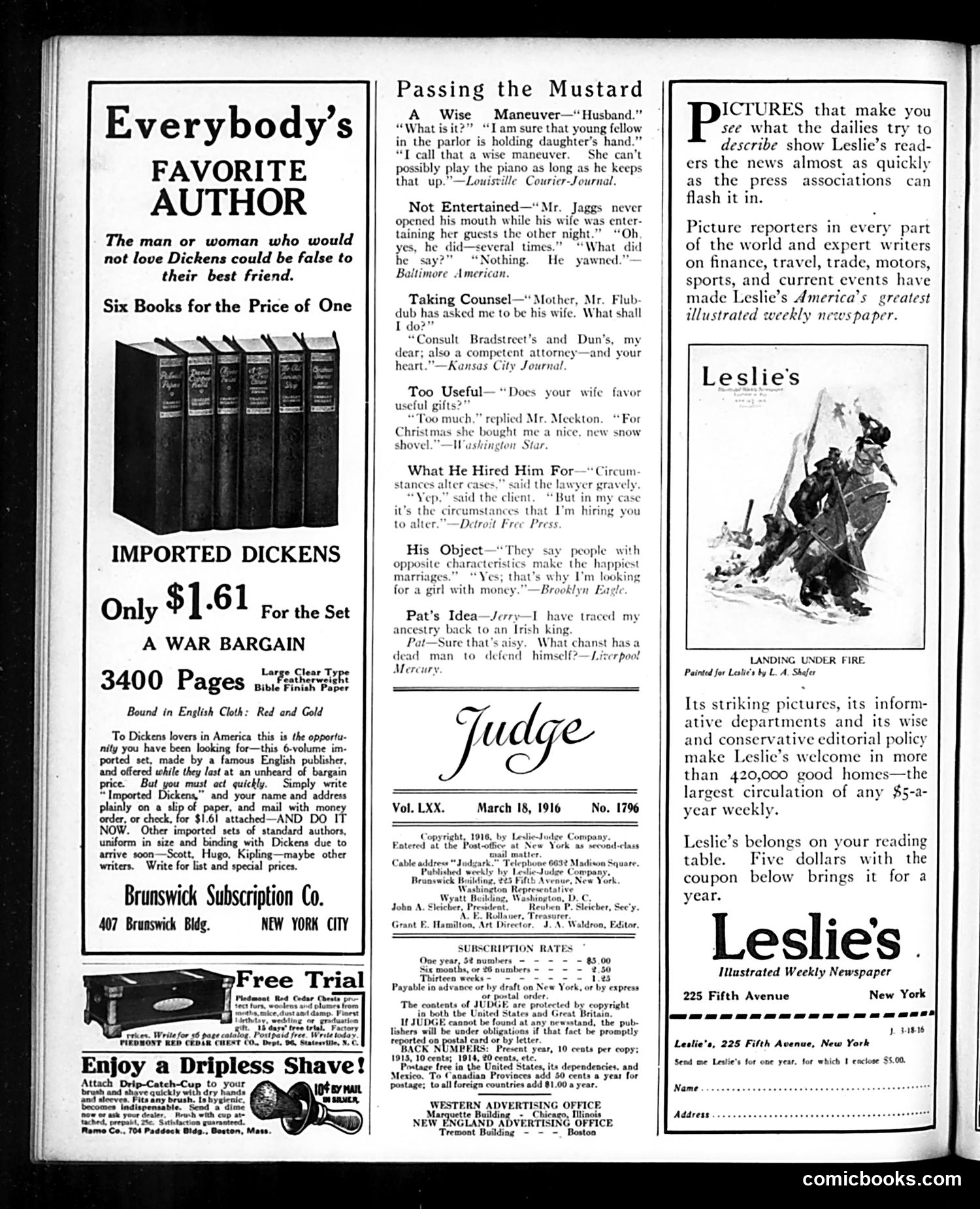
This page features six brief, topical jokes characteristic of Judge's satirical commentary on domestic life and social customs, circa 1916: **Key Jokes:** - "Passing the Mustard": A husband approves of his daughter's suitor because the boy's presence prevents her from practicing piano—satirizing noise complaints and parental ambivalence about courtship. - "Not Entertained": Mockery of a man who yawns throughout his wife's dinner party rather than feigning interest. - "Taking Counsel": A woman asking her mother whom to marry is advised to consult credit agencies (Bradstreet's, Dun's) alongside her heart—satirizing mercenary marriage calculations. - "Too Useful": A wife's gift of a snow shovel is deemed impractically utilitarian rather than romantic. - "What He Hired Him For": Legal satire about altering circumstances (implying corruption). - "Pat's Idea": Irish immigrant humor about lineage. The satire targets middle-class courtship rituals, marriages of convenience, and household dynamics rather than political figures.
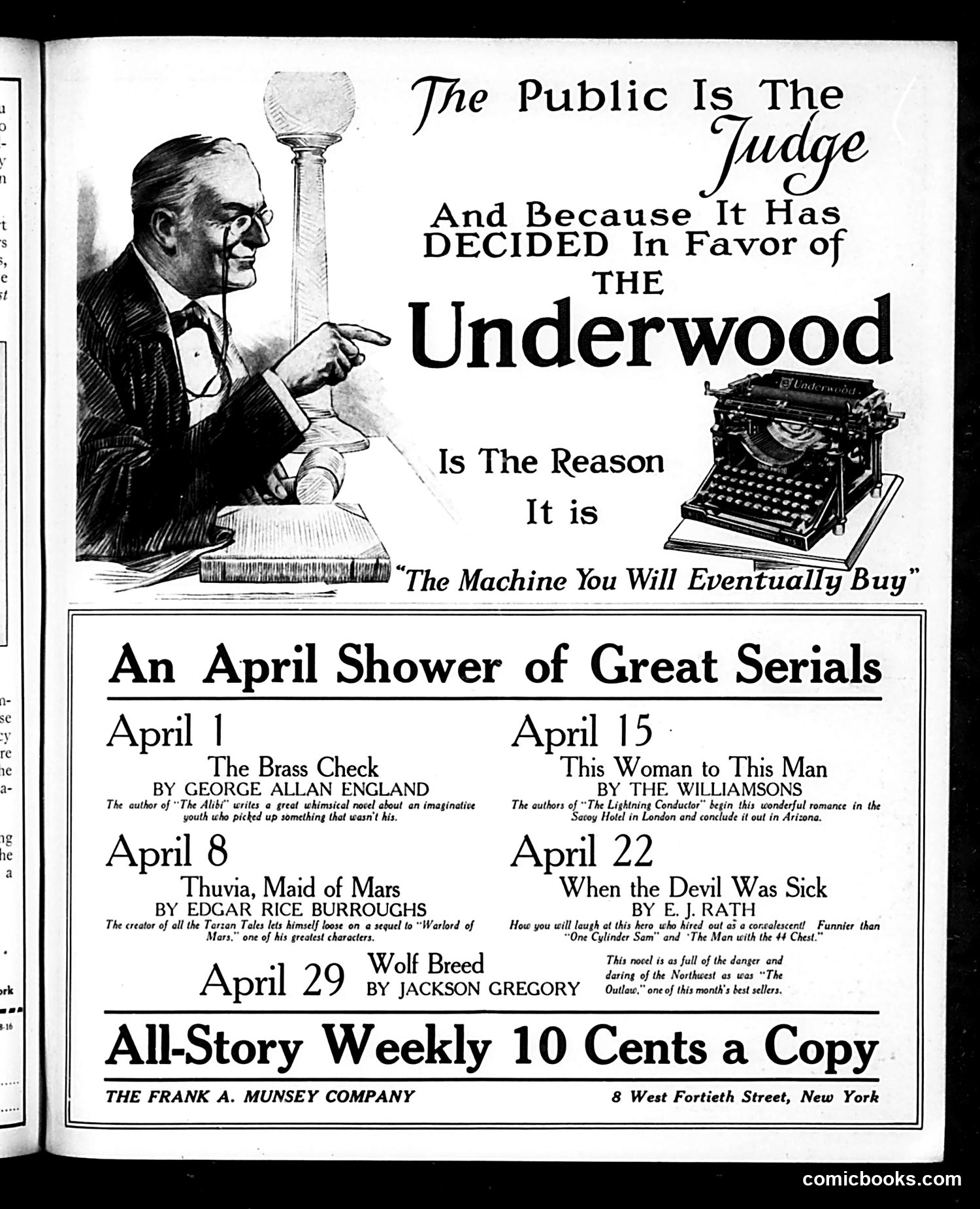
This page is primarily **advertising content** for All-Story Weekly magazine, not political satire. The top section features an Underwood typewriter advertisement that uses the satirical framing Judge is known for: a well-dressed man holds a wine glass and examines the typewriter, with text claiming "The Public Is The Judge" and that the public has "DECIDED in Favor of the Underwood"—a playful rhetorical device suggesting consumer approval validates the product's superiority. The bulk of the page advertises five serialized stories for April publication, including works by Edgar Rice Burroughs (Mars sequel), George Allan England, and Jackson Gregory. These appear to be adventure and romance tales typical of pulp fiction from this era. The satire is light—using Judge's authority as arbiter of public taste to endorse a commercial product through mock-serious judgment.
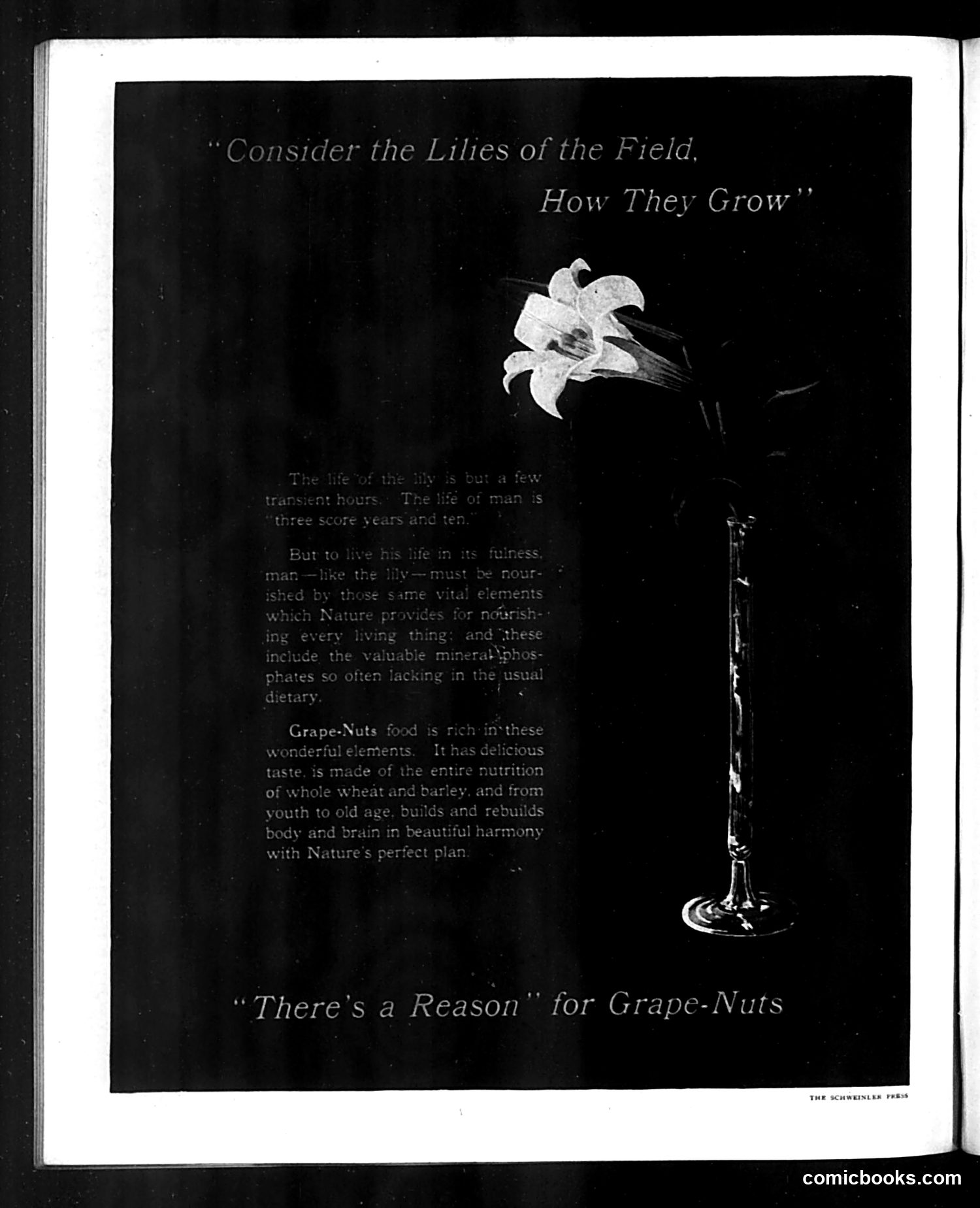
This is **not a political cartoon**, but rather a **product advertisement** for Grape-Nuts cereal disguised as inspirational content. The page uses a biblical reference ("Consider the Lilies of the Field") as a poetic framework to sell breakfast cereal. The text draws a parallel between lilies growing naturally and humans needing proper nutrition to develop "in beautiful harmony with Nature's perfect plan." The imagery shows a lily flower and a glass of what appears to be Grape-Nuts with milk. The advertisement argues that Grape-Nuts contains essential minerals and nutrients (particularly phosphates) that build "body and brain" from youth to old age, positioning the product as a natural, wholesome choice aligned with nature itself. This is early advertising rhetoric blending spiritual/philosophical language with nutritional claims.