
Judge, 1916-03-18 · page 17 of 28
Judge — March 18, 1916 — page 17: what you’re looking at
What you’re looking at
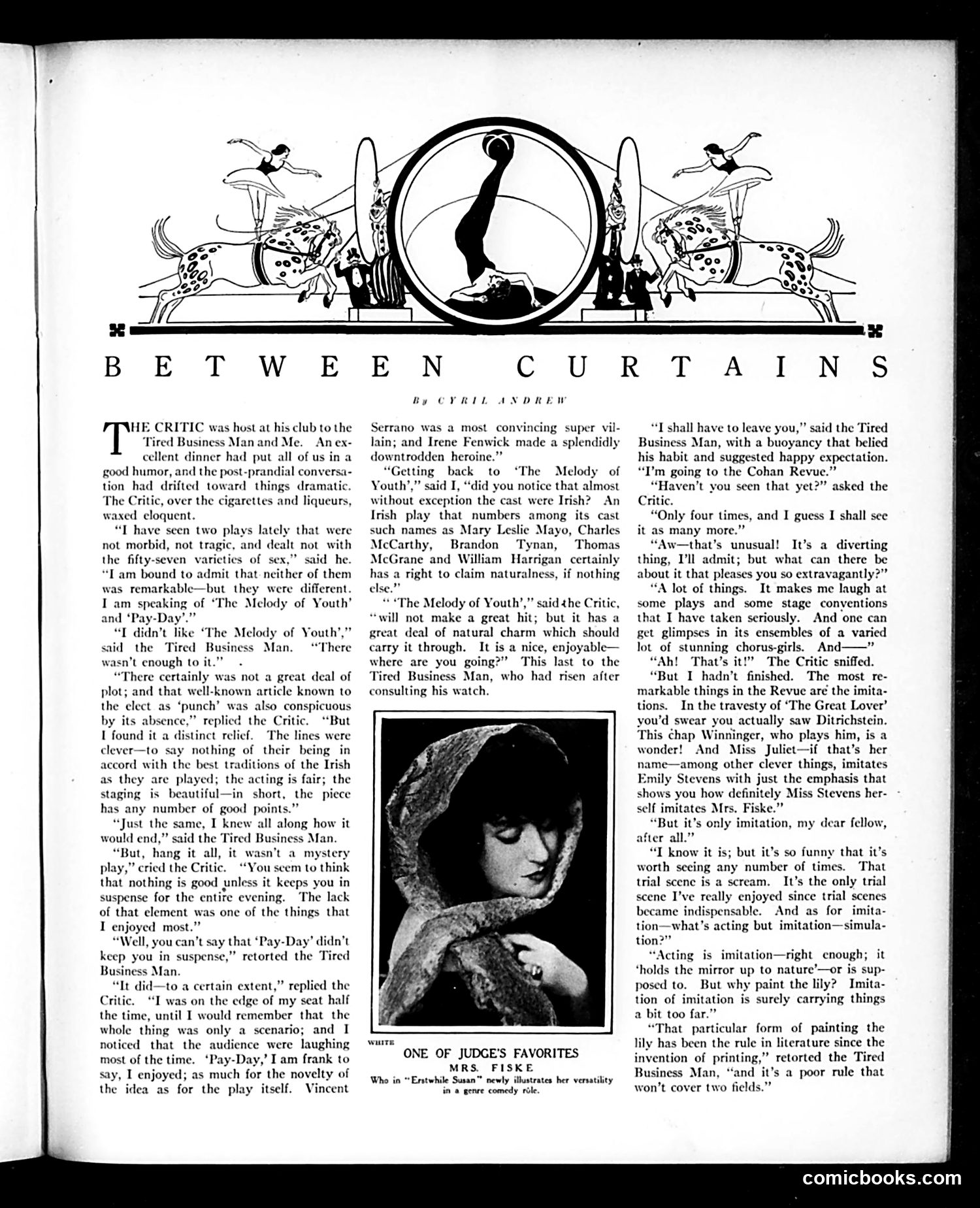
This page presents a dialogue between a theater critic and a "Tired Business Man" discussing recent Broadway plays. The satire targets middlebrow theater tastes and audience preferences. The critic praises *The Melody of Youth* for being non-sensational and well-acted (featuring Irish actors like Charles McCarthy and Brandon Tynan), while the Tired Business Man dismisses it as lacking suspense. He reveals he's attending *The Cohan Revue* for the fourth time, drawn to chorus girls and theatrical imitations rather than dramatic substance. The joke: the critic values artistic merit; the businessman values spectacle and comedy. A photograph of Mrs. Fiske, labeled a "Judge favorite," illustrates versatile dramatic acting—the implied contrast to revue-style entertainment. The satire mocks how popular audiences prioritize entertainment and physical beauty over serious theatrical art.
📄 Transcribed text from this page (OCR, searchable)
Machine-transcribed from the original scan — historical spelling and the odd misread are preserved.
B E T W E HE CRITIC was host at his club to the T Tired Business Manand Me. Anex- cellent dinner put all of us ina good humor, and the post-prandial conversa- tion had drifted toward things dramatic. The Critic, over the cigarettes and liqueurs, waxed eloquent. “I have seen two plays lately that were not morbid, not tragic, and dealt not with the fifty-seven varicties of sex,” said he. “Iam bound to admit that neither of them was remarkable—but they were different. I am speaking of ‘The Melody of Youth’ and ‘Pay “I didn’t said the Tired wasn’t enough to it.”” “There certainly was not a great deal of plot; and that well-known article known to the elect as ‘punch’ was also conspicuous by its absence,” replied the Critic. “But I found it a distinct relief. The lines were clever—to say nothing of their being in accord with the best traditions of the Irish as they are played; the acting is fair; the staging is beautiful short, the piece has any number of good points.” “Just the same, I knew all along how it would end,” said the Tired Business Man. “But, hang it all, it wasn’t a mystery play,” cried the Critic. ‘‘You seem to think that nothing is good unless it keeps you in suspense for the entire evening. The lack of that element was one of the things that I enjoyed mos' “Well, you can’t say that ‘Pay-Day’ didn’t keep you in suspense,” retorted the Tired Business Man. “It did—to a certain extent,” replied the Critic. “I was on the edge of my seat half the time, until I would remember that the whole thing was only a scenario; and I noticed that the audience were laughing most of the time. ‘Pay-Day,’ I am frank to say, I enjoyed; as much for the novelty of the idea as for the play itself. Vincent Business Man, “There E N By CYRIL ANDREW Serrano was a most convincing super vil- lain; and Irene Fenwick made a splendidly downtrodden heroine.” “Getting back to ‘The Melody of Youth’,” said I, “did you notice that almost without exception the cast were Irish? An Irish play that numbers among its cast such names as Mary Leslie Mayo, Charles McCarthy, Brandon Tynan, Thomas McGrane and William Harrigan certainly has a right to claim naturalness, if nothing ‘The Melody of Youth’,” said the Critic, “will not make a great hit; but it has a great deal of natural charm which should carry it through. It is a nice, enjoyable— where are you going?” This last to the Tired Business Man, who had risen after consulting his watch. wurre ONE OF JUDGE'S FAVORITES MRS. FISKE Who in “Erstwhile Susan” newly illustrates her versatility in a genre comedy rile. C U RTA “I shall have to leave you,” said the Tired Business Man, with a buoyancy that belied his habit and suggested happy expectation. “I’m going to the Cohan Revue.” “Haven't you seen that yet?” asked the Critic. “Only four times, and I guess I shall see it as many more.” w—that’s unusual! It’s a diverting thing, Dll admit; but what can there be about it that pleases you so extravagantly?” “A lot of things. It makes me laugh at some plays and some stage conventions that I have taken seriously. And one can get glimpses in its ensembles of a varied lot of stunning chorus-girls. And——” “Ah! That’s The Critic sniffed. “But I hadn't finished. The most re- markable things in the Revue are the imita- tions. In the travesty of ‘The Great Lover’ you’d swear you actually saw Ditrichstein. This chap Winninger, who plays him, is a wonder! And Miss Julict—if that’s her name—among other clever things, imitates Emily Stevens with just the emphasis that shows you how definitely Miss Stevens her- self imitates Mrs. Fiske.” “But it’s only imitation, my dear fellow, after all.” “TI know it is; but it’s so funny that it’s worth seeing any number of times. That trial scene is a scream. It’s the only trial scene I’ve really enjoyed since trial scenes became indispensable. And as for imita- tion—what’s acting but imitation—simula- tion? Acting is imitation—right enough; it ‘holds the mirror up to nature’—or is sup- posed to. But why paint the lily? Imita- tion of imitation is surely carrying things a bit too far.” “That particular form of painting the lily has been the rule in literature since the invention of printing,” retorted the Tired iness Man, “and it’s a poor rule that won't cover two fields. comicbooks.com