
Judge, 1916-03-18 · page 12 of 28
Judge — March 18, 1916 — page 12: what you’re looking at
What you’re looking at
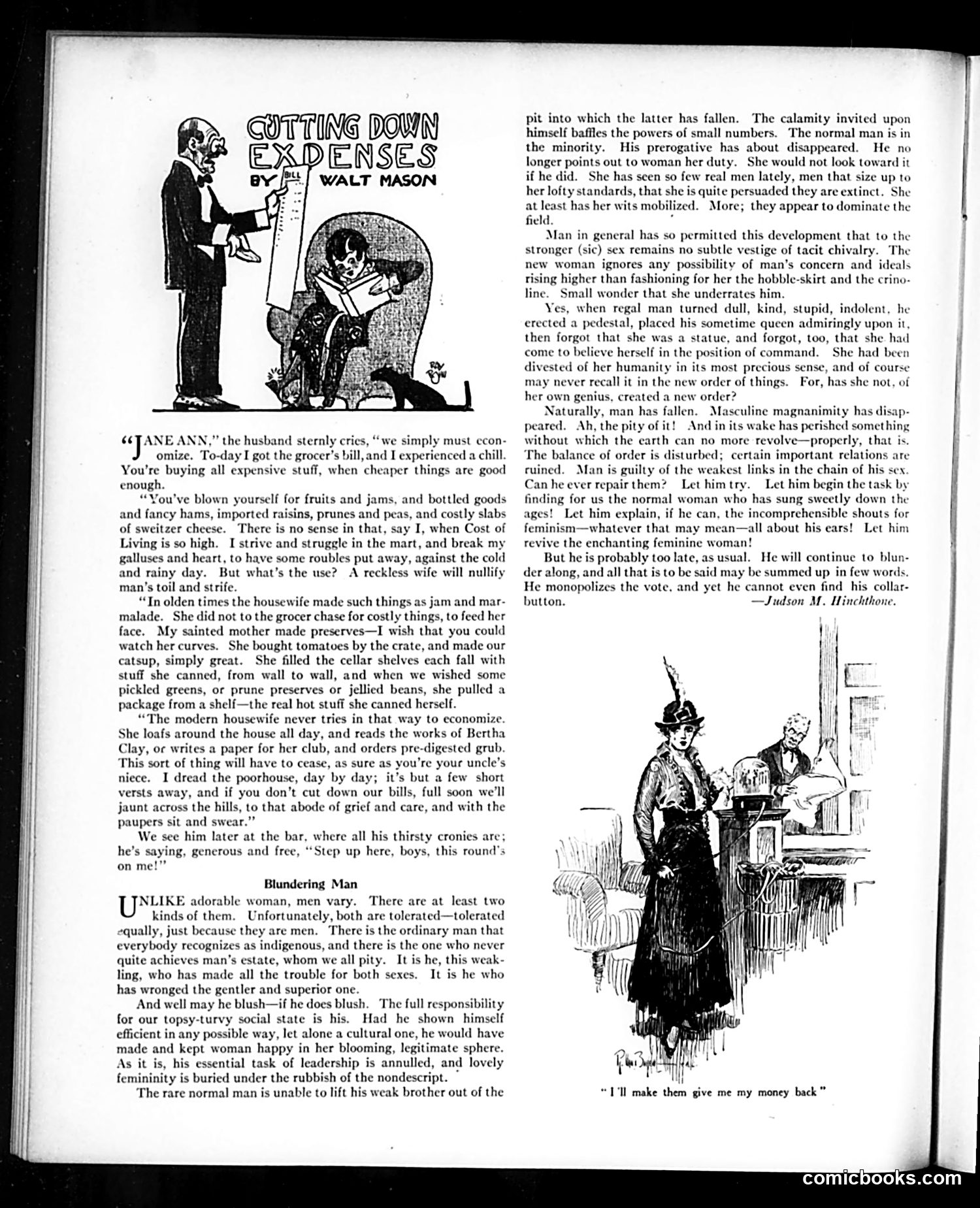
**"Cutting Down Expenses"** satirizes the hypocrisy of a miserly husband. He lectures his wife "Jane Ann" about wasteful spending on groceries and modern conveniences, invoking his mother's industrious homemaking (canning, preserving) as the ideal. The cartoon's punchline: he's later seen at a bar, buying drinks for friends, saying "Step up here, boys, this round's on me!" The satire targets men who demand their wives economize while squandering money themselves. **"Blundering Man"** is an essay-style commentary blaming weak, ineffectual men for social disorder. It argues that ordinary, incompetent men have failed their leadership role, allowing women to abandon their "legitimate sphere" and become independent. The author claims this "weak brother" has created chaos—women now ignore male guidance, concerning themselves only with fashion. The piece reflects early-20th-century anxieties about changing gender roles and the "New Woman." Both pieces reveal period tensions: economic strain, shifting domestic expectations, and male anxiety over women's independence.
📄 Transcribed text from this page (OCR, searchable)
Machine-transcribed from the original scan — historical spelling and the odd misread are preserved.
ANE ANN,” the husband sternly cries, “we simply must econ- omize. To-day I got the grocer’s bill, and I experienced a chill. You're buying all expensive stuff, when cheaper things are good enough. “You've blown yourself for fruits and jams, and fancy hams, imported ins, prunes and peas, and costly slabs no sense in that, say I, when Cost of and struggle in the mart, and break my some roubles put away, against the cold ss wife will nullify nd bottled goods and rainy day. But w' man’s toil and strife. “In olden times the housewife made such things as jam and mar- malade. She did not to the grocer chase for costly things, to feed her face. My sainted mother made preserves—I wish that you could watch her curves. She bought tomatoes by the crate, and made our catsup, simply great. She filled the cellar shelves each fall with stuff she canned, from wall to wall, and when we wished some pickled greens, or prune preserves or jellied beans, she pulled a package from a shelf—the real hot stuff she canned herself. The modern housewife never tries in that way to economize. She loafs around the house all day, and reads the works of Bertha Clay, or writes a paper for her club, and orders pre-digested grub. This sort of thing will have to cease, as sure as you're your uncle’s niece. I dread the poorhouse, day by day; it’s but a few short versts away, and if you don’t cut down our bills, full soon we'll jaunt across the hills, to that abode of grief and care, and with the paupers sit and swear.” We see him later at the bar, where all his thirsty cronies are; he’s saying, generous and free, “Step up here, boys, this round’s on me!” Blundering Man NLIKE adorable woman, men vary. There are at least two kinds of them. Unfortunately, both are tolerated—tolerated equally, just because they are men. There is the ordinary man that everybody recognizes as indigenous, and there is the one who never quite achieves man’s estate, whom we all pity. It is he, this weak- ling, who made all the trouble for both s It is he who has wronged the gentler and superior one. And well may he blush—if he does blush. The full responsibility for our topsy-turvy social state is his. Had he shown himself efficient in any possible way, let alone a cultural one, he would have made and kept woman happy in her blooming, legitimate sphere. As it is, his essential task of leadership is annulled, and lovely femininity is buried under the rubbish of the nondescript. The rare normal man is unable to lift his weak brother out of the pit into which the latter has fallen. The calamity invited upon himself baffles the powers of small numbers. The normal man is in the minority. His prerogative has about disappeared. He no longer points out to woman her duty. She would not look toward it if he did. She has seen so few real men lately, men that size up to her lofty standards, that she is quite persuaded they are extinct. She at least has her wits mobilized. More; they appear to dominate the field. ‘ Man in general has so permitted this development that to the stronger (sic) sex remains no subtle vestige of tacit chivalry. The new woman ignores any possibility of man’s concern and ideals rising higher than fashioning for her the hobble-skirt and the crino- line. Small wonder that she underrates him. ves, when regal man turned dull, kind, stupid, indolent, he erected a pedestal, placed his sometime queen admiringly upon it, then forgot that she was a statue, and forgot, too, that she had come to believe herself in the position of command. She had been divested of her humanity in its most precious sense, and of course may never recall it in the new order of things. For, has she not, of her own genius, created a new order? Naturally, man has fallen. Masculine magnanimity has d peared. Ah, the pity of it! And in its wake has perished something without which the earth can no more revolve—properly, that is. The balance of order is disturbed; certain important relations are ruined. Man is guilty of the weakest links in the chain of his sex. nheeverrepairthem? Let himtry. Let him begin the task by ng for us the normal woman who has sung sweetly down the ages! Let him explain, if he can, the incomprehensible shouts for feminism—whatever that may mean—all about his ears! Let him the enchanting feminine woman! But he is probably too late, usual. He will continue to blun- der along, and all that is to be said may be summed up in few words. He monopolizes the vote, and yet he cannot even find his collar- button. —Judson M. Hinchthone. tt “T'll make them give me my money back” comicbooks.com