
A complete issue · 28 pages · 1916
Judge — March 4, 1916
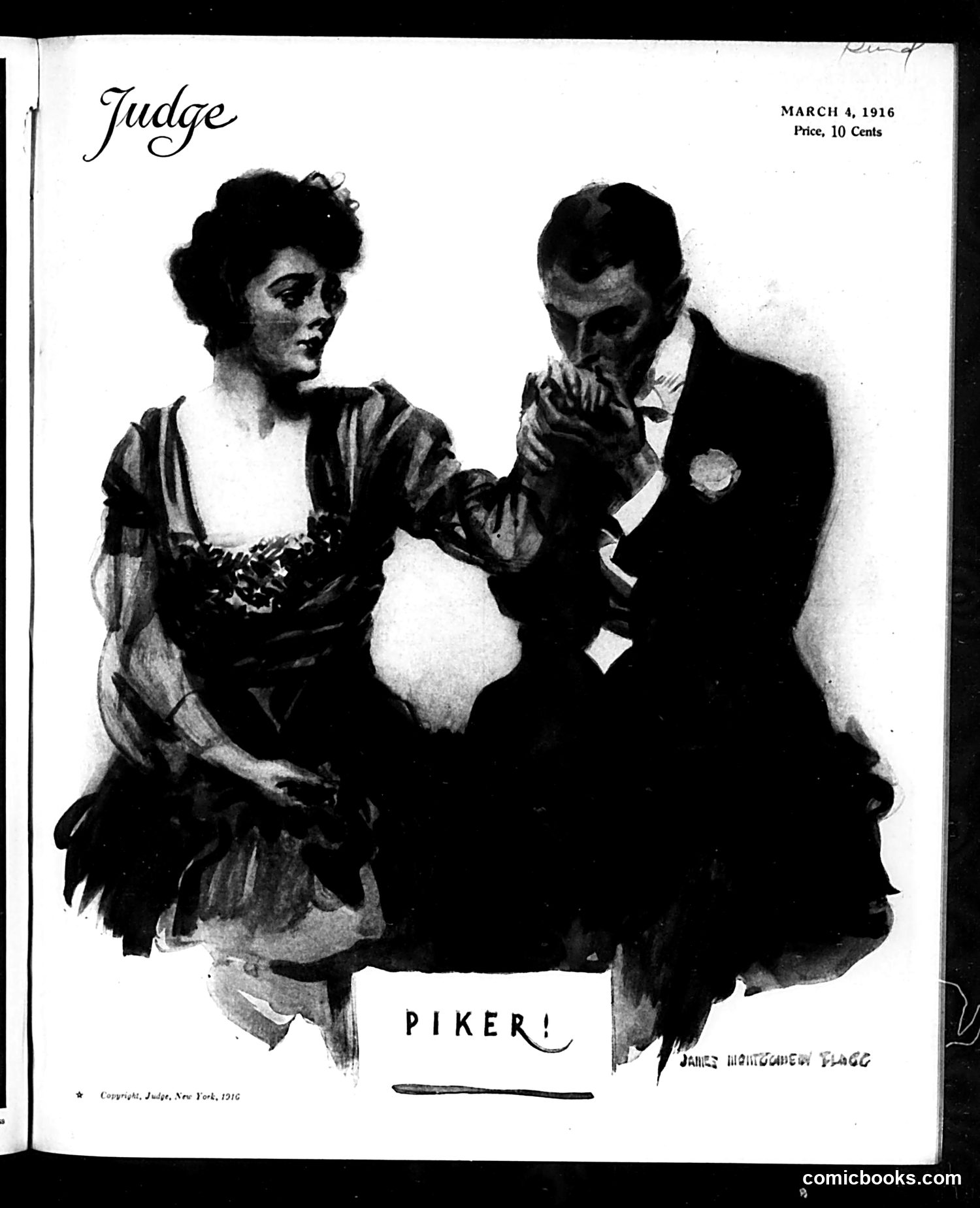
This cartoon depicts a well-dressed man in formal attire examining a woman's pregnant belly, labeled "PIKER!" beneath them. The title suggests mockery or contempt. The satire likely comments on **birth rates or family size** during this period. "Piker" was slang for someone who acted cheaply or insufficiently. The cartoon appears to ridicule either: 1. A man fathering only one child (considered inadequate by early-20th-century standards emphasizing large families), or 2. Social anxieties about declining birth rates among the middle/upper classes The woman's elegant dress and the man's formal presentation suggest this targets educated, affluent Americans. The specific historical context—whether tied to immigration debates, eugenics concerns, or women's changing roles—remains unclear from the image alone.
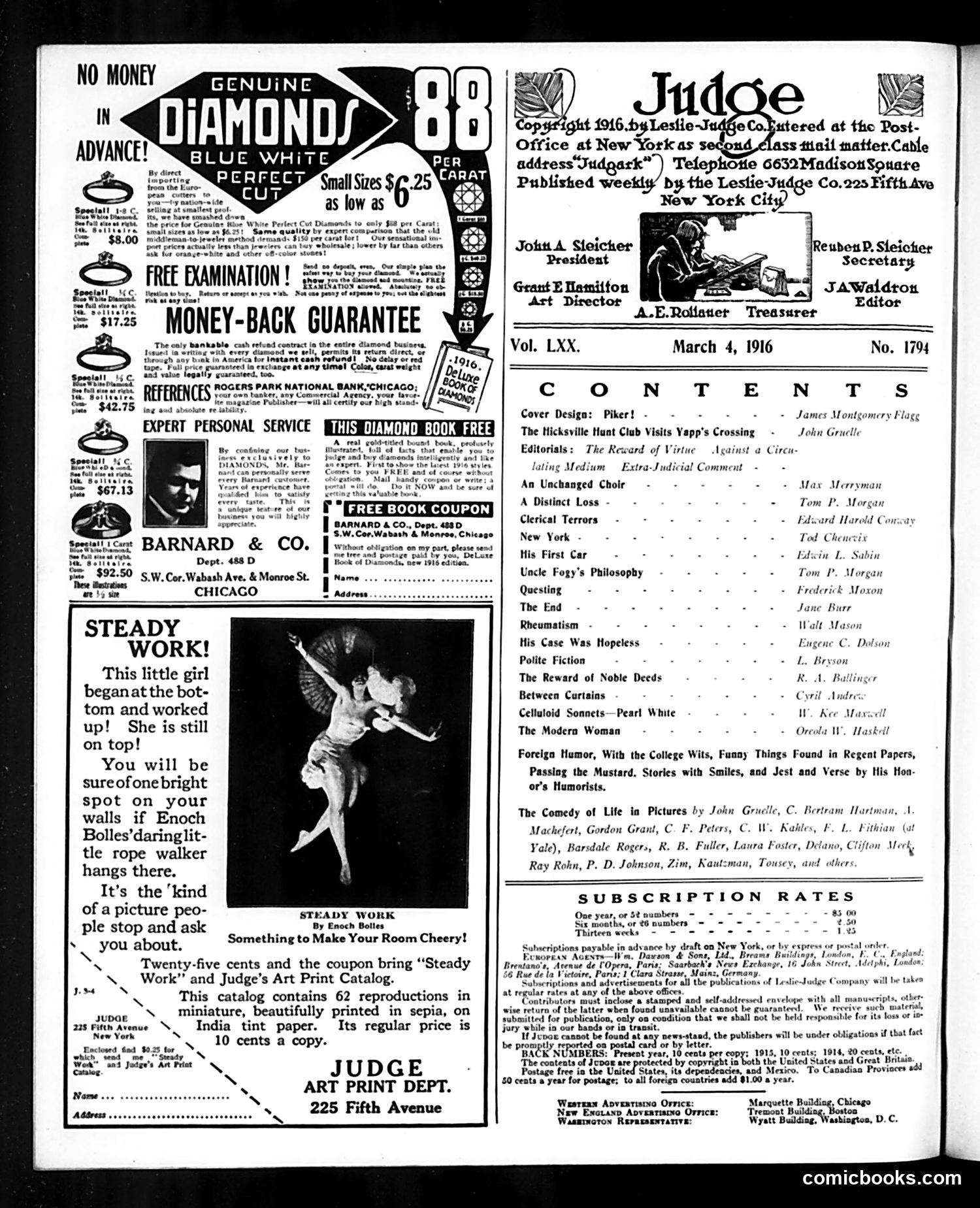
This page is primarily **advertising and editorial content** rather than political cartoons. The dominant feature is a diamond jewelry advertisement from Barnard & Co., emphasizing quality and affordability. The only substantial illustration is titled "**Steady Work**" by Enoch Bolles, depicting a young acrobat or performer. The accompanying text uses this image as a motivational metaphor about persistence and success—comparing the performer's dedication to building one's reputation. The page includes the magazine's table of contents, listing articles on various social topics (rheumatics, clerical matters, modern women). This appears to be a standard issue mixing light humor with lifestyle commentary typical of Judge magazine's early 20th-century format.
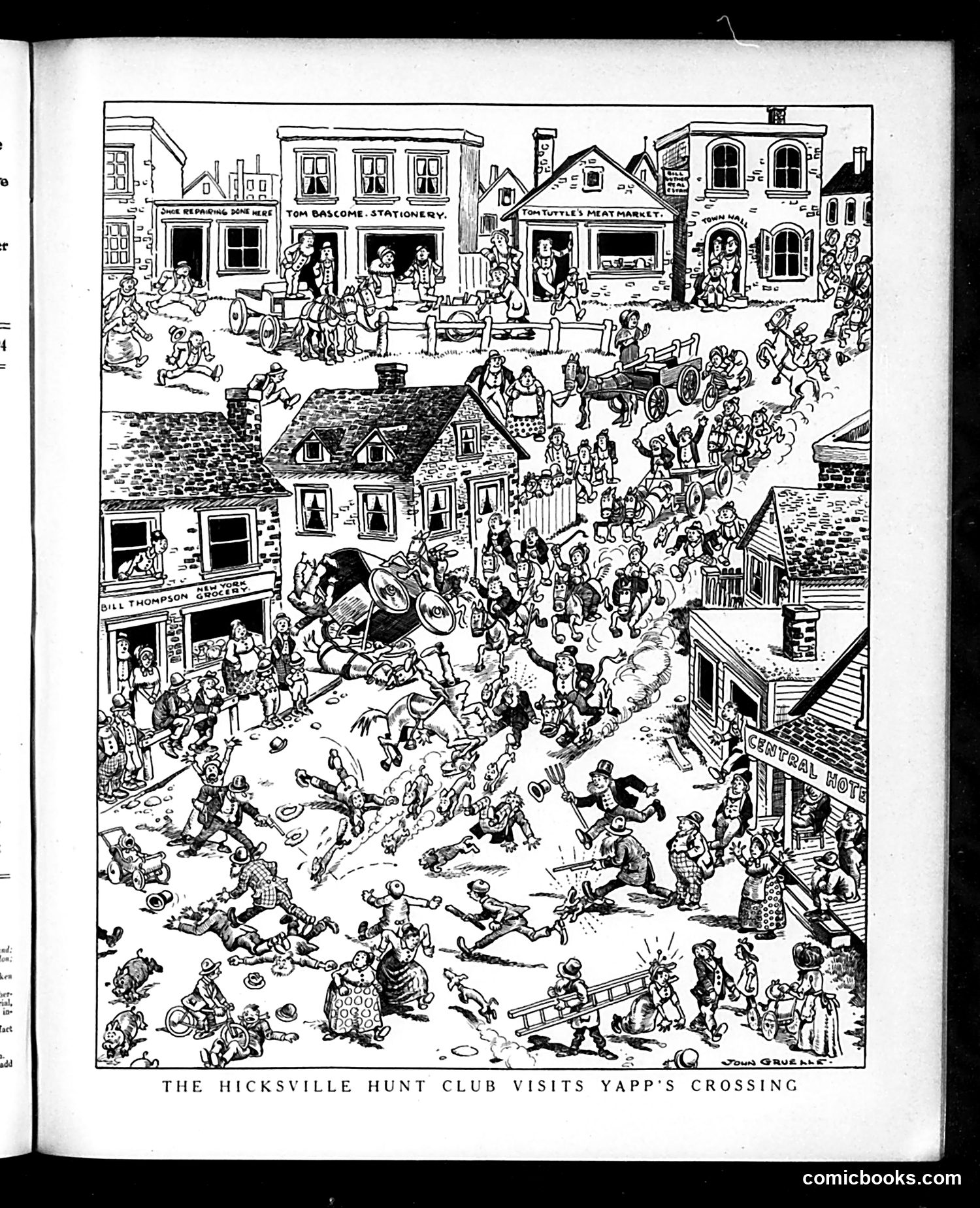
This cartoon satirizes the clash between rural rusticity and upper-class pretension. The title references "Hicksville" (a generic term for an unsophisticated country town) and "Yapp's Crossing," a country crossroads settlement. The chaos depicted—with figures tumbling from carriages, horses overturned, and general pandemonium in the town square—mocks wealthy hunt club members attempting country pursuits they're ill-suited for. The detailed storefronts (Bill Thompson Grocery, Tom Bascome Stationery, Tom Tuttle's Meat Market) ground this in small-town Americana. The satire targets the urban elite's bumbling attempts at country recreation and the disruption their incompetence causes to ordinary village life. It's a commentary on class pretension and the gap between wealthy dilettantes and authentic rural folk.
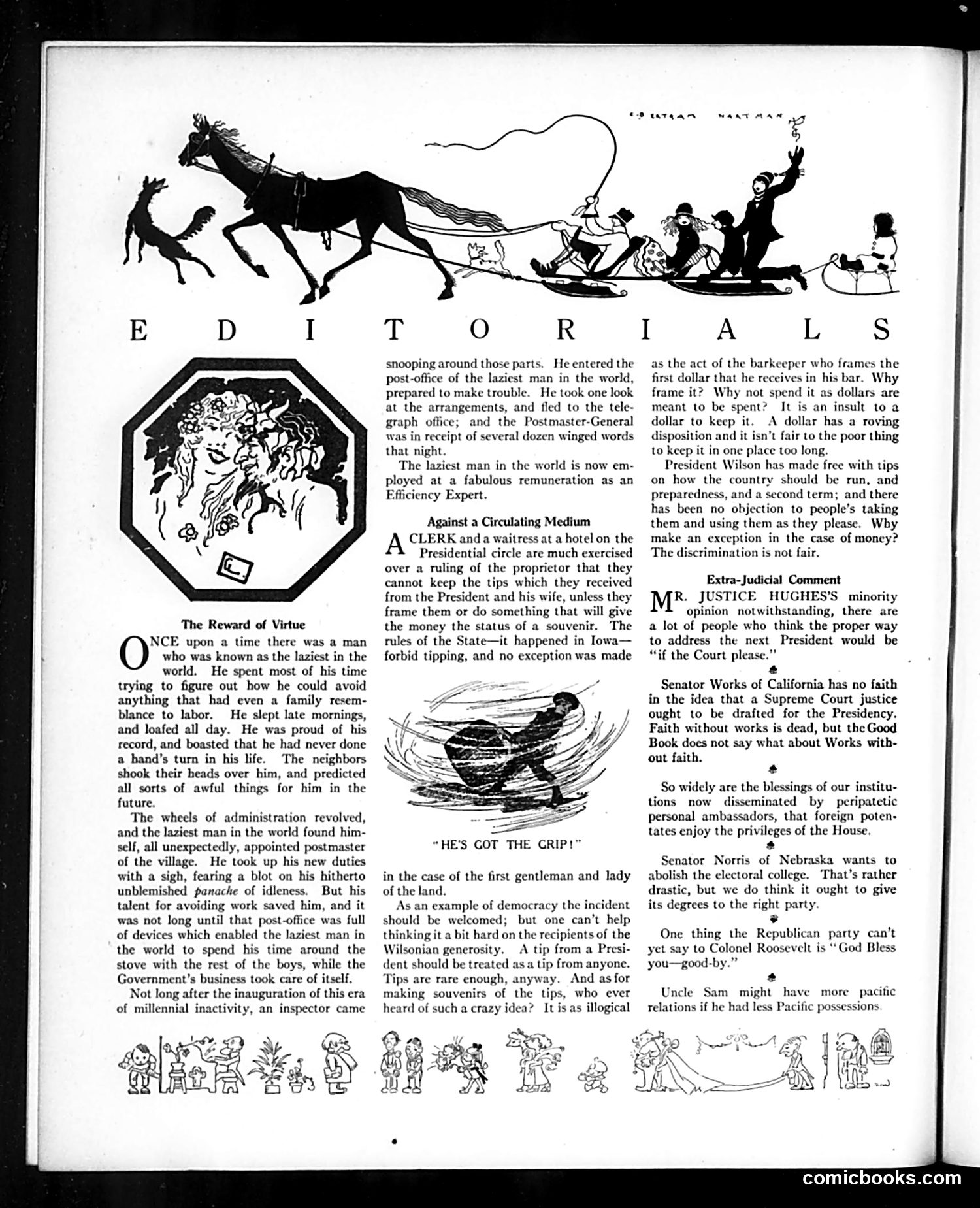
This page contains political commentary and satirical illustrations. **Top cartoon** ("Editorials"): A whimsical scene shows a dog pulling a sled with various figures, depicting chaos or mismanagement, likely criticizing government administration. **"The Reward of Virtue"**: A fable about an honest man appointed postmaster whose virtue goes unrewarded—satirizing how politics, not merit, determines government appointments. **"Against a Circulating Medium"**: Mocks a hotel dispute over tipping protocol with the President, critiquing rules about treating presidential tips as souvenirs rather than currency—satirizing bureaucratic absurdity. **"Extra-Judicial Comment"**: Brief political commentary on Supreme Court appointments and Senator Works's views on faith versus works, plus references to Senator Norris opposing the electoral college. The page exemplifies Judge's satirical approach to early 20th-century American politics and social customs.
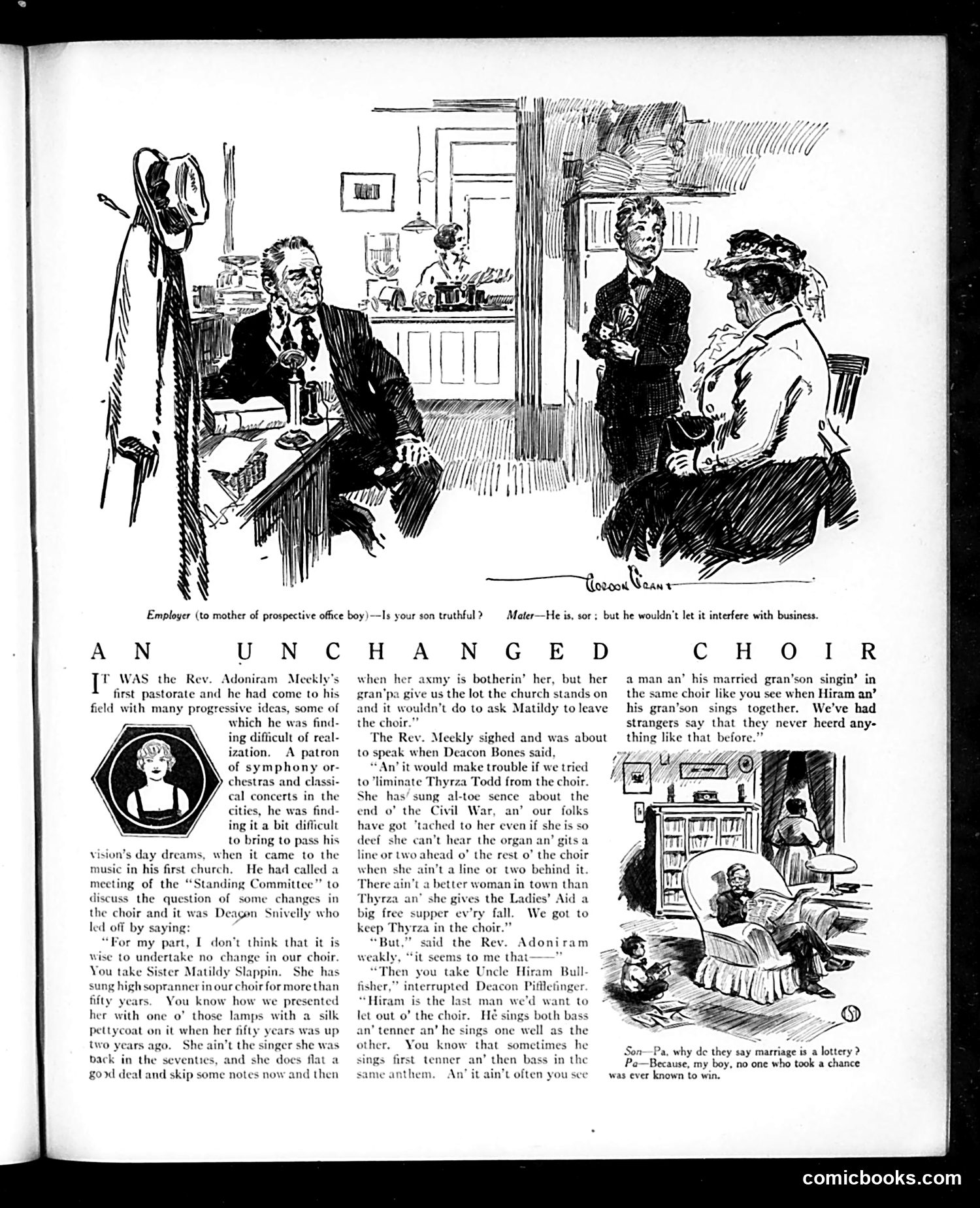
This satirical story illustrates early 20th-century church governance conflicts. Rev. Adoniram Meekly proposes reforming his church choir, which includes Thyza Todd, a long-standing singer described as difficult. The "Standing Committee" debates whether to remove her. The satire targets institutional resistance to change. Despite Thyza's admitted poor singing and difficult temperament, the committee refuses to eliminate her—citing her decades of service and the disruption removal would cause. Deacon Piffleinger argues keeping problematic members is preferable to conflict. The cartoon mocks how organizations prioritize avoiding confrontation over actual improvement, even when change would be beneficial. It's a timeless commentary on institutional inertia and the costs of appeasing difficult longtime members to maintain peace.
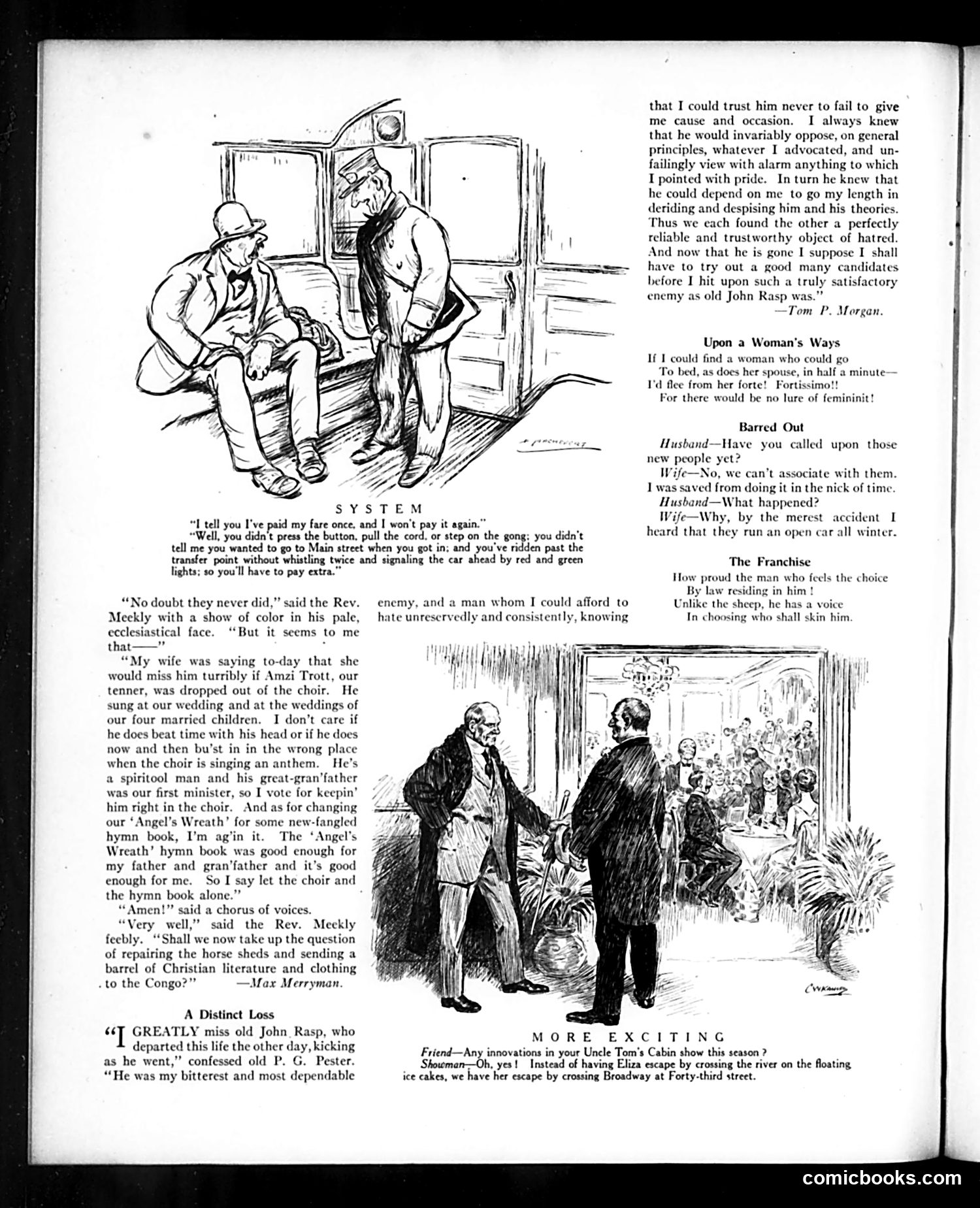
This page contains several satirical pieces reflecting early 20th-century American concerns: **"System"** (top cartoon): Mocks overly complicated streetcar payment procedures. A conductor demands a passenger pay again despite having paid once, citing arcane rules about buttons, cords, and signaling systems—satirizing bureaucratic absurdity and inefficient public transportation. **"A Distinct Loss"**: A man laments his deceased enemy John Rasp, whom he "could afford to hate unreservedly." The joke is that having a reliable, predictable antagonist provided life structure; finding a replacement will be difficult. This satirizes how people can become dependent on their conflicts. **Minor pieces** ("Upon a Woman's Ways," "Barred Out," "The Franchise"): Brief gags about gender stereotypes, social climbing, and voting rights. **"More Exciting"** (bottom): A vaudeville showman updates "Uncle Tom's Cabin" by replacing Eliza's escape across ice floes with crossing Broadway at 43rd Street—satirizing how producers sensationalize classics with contemporary urban references for jaded audiences. The overall tone is genteel satirical humor targeting social pretension and institutional inefficiency.
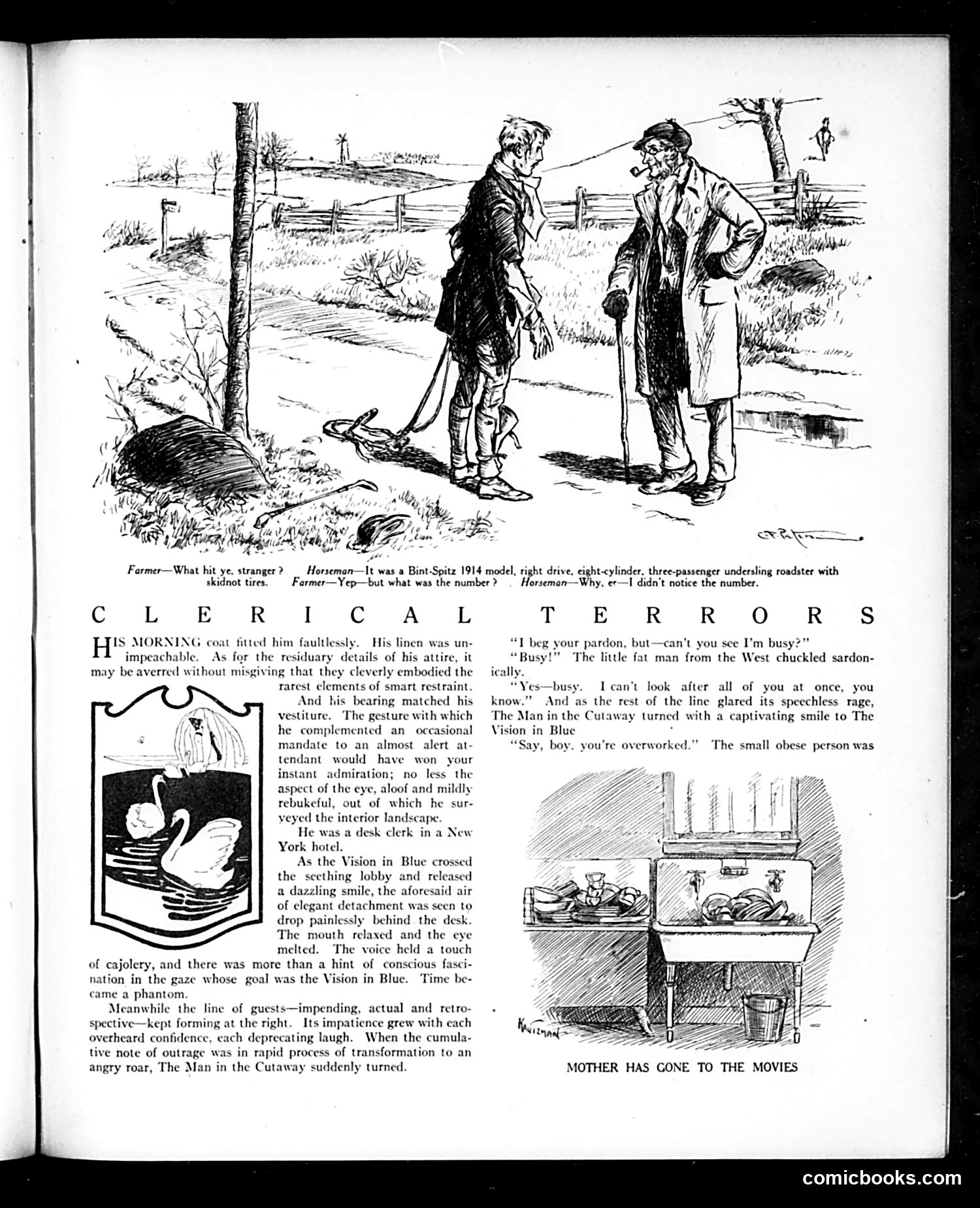
This page satirizes hotel desk clerk incompetence through two separate stories. **Top cartoon**: A farmer confronts a horseman about being hit by a car. The horseman describes the vehicle in exhaustive mechanical detail (1914 Bint-Spitz, specifications) but admits he didn't notice the license plate number—the one detail actually useful for identifying the car. The joke mocks people who focus on irrelevant minutiae while missing essential information. **"Clerical Terrors"**: A well-dressed desk clerk at a New York hotel abandons his duties when an attractive woman ("Vision in Blue") enters the lobby. He becomes so entranced that he ignores the growing line of frustrated guests, who increasingly rage at his inattention. The satire critiques hotel staff prioritizing romantic distraction over professional responsibility, leaving customers waiting. The bottom illustration, "Mother Has Gone to the Movies," appears unrelated—a domestic scene, likely referencing cinema's growing cultural impact.
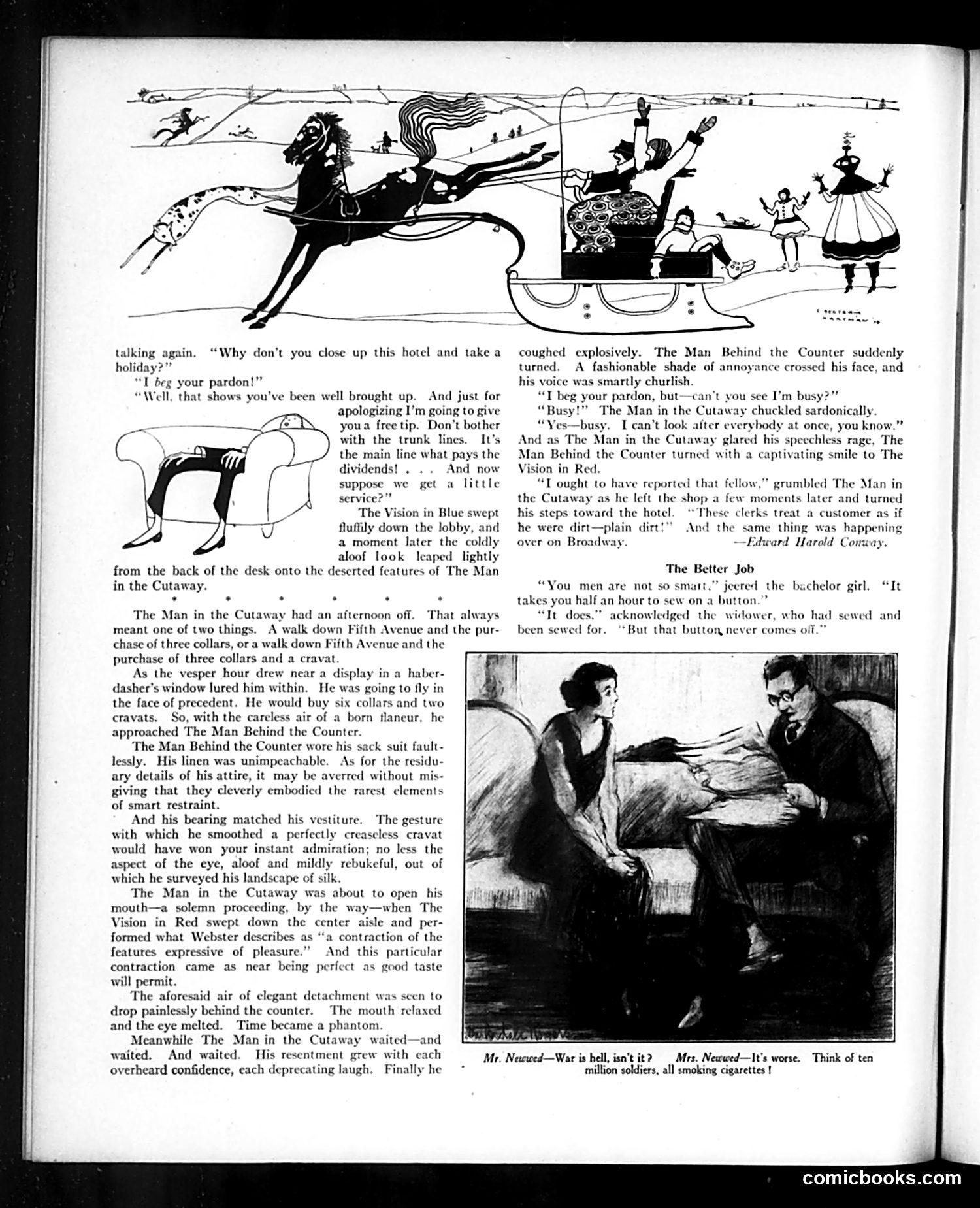
This page contains two satirical stories about social interaction and customer service in early 20th-century America. **"The Man in the Cutaway"** mocks class pretension and retail discourtesy. A well-dressed gentleman ("The Man in the Cutaway") enters a haberdashery intending to purchase collars and cravats. The counter clerk, despite his impeccable appearance and refined manner, ignores this customer to fawn over an attractive woman ("The Vision in Red"). The satire skewers both the snobbish clerk's class affectations and his shallow priorities—despite his "smart restraint" and polished appearance, he abandons service for a pretty face, humiliating the paying customer. **"The Better Job"** is a brief gender-comedy contrast: a bachelor girl boasts that men can't sew buttons properly. A widower counters that while his sewing may take longer, buttons sewn by him never fall off—implying superior workmanship and reliability over flashy incompetence. Both pieces reflect period anxieties about urbanization, service standards, and changing gender roles in early 20th-century America.
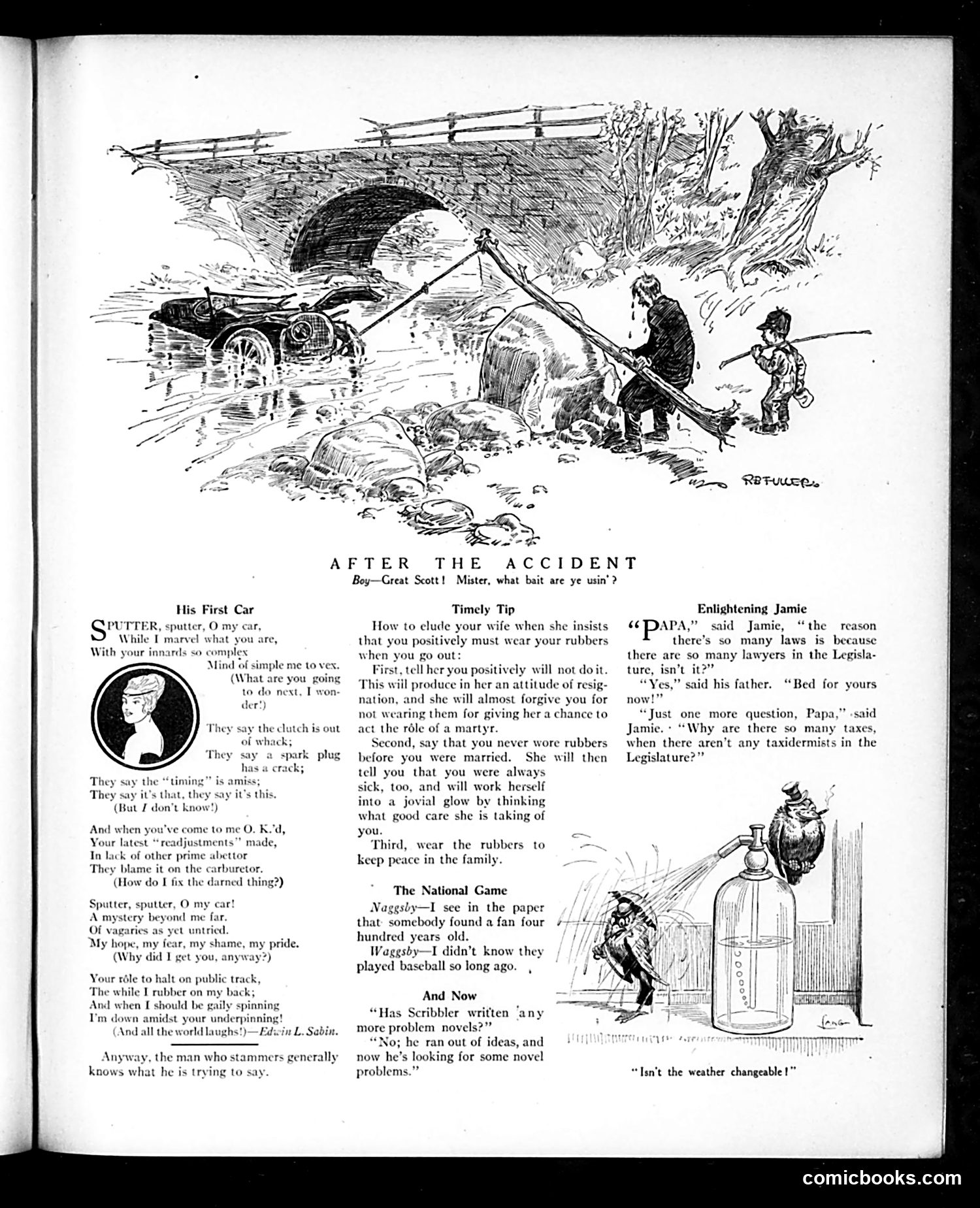
This is a humor page from *Judge* magazine featuring several unrelated satirical pieces about early 20th-century life: **"After the Accident"** (top): A cartoon showing a car accident by a bridge. The boy asks what "bait" the man is using—a joke about fishing, implying the man is now "hooked" or trapped by car ownership troubles. **"His First Car"** (left): A poem mocking the complexity and unreliability of early automobiles. The speaker is baffled by mechanical problems (clutch, carburetor) and frustrated by constant breakdowns—reflecting widespread anxiety about new car technology. **"Timely Tip"** (center): Satirizes marital dynamics by offering cynical advice on avoiding wearing rubbers (rain gear) despite a wife's insistence. The joke is that men use psychological manipulation rather than obedience. **Other pieces** include jokes about baseball history, a novelist running out of ideas, and a child's naive question about why legislators aren't taxidermists (pun on "taxes"). The satire targets early automotive frustration, gender relations, and general absurdities of the era.
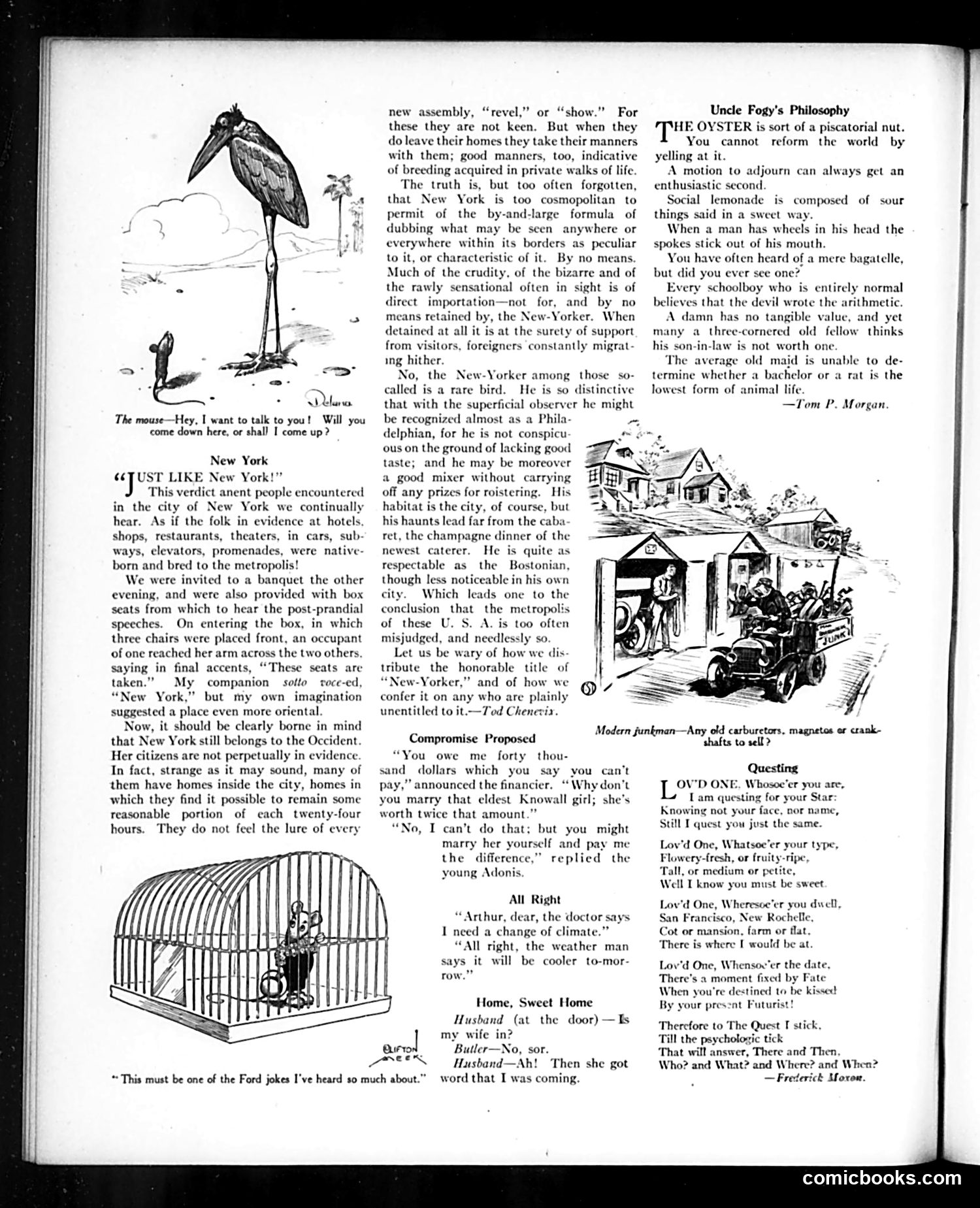
This page contains several satirical pieces lampooning New York society and manners. The main article criticizes visitors and transplants who adopt an exaggerated, rude "New York" persona—claiming rudeness as authenticity. The author argues that *true* New Yorkers are actually well-mannered and understated, unlike the loud, crude visitors constantly parading through hotels, theaters, and restaurants. The satire targets the pretentiousness of people adopting an affected metropolitan swagger. The cartoons provide supporting humor: a mouse confronting a stork (unclear reference), and a birdcage labeled as "one of the Ford jokes" (likely referencing Henry Ford's famous satirical quips). The short comedic pieces—"Compromise Proposed," "All Right," and "Home, Sweet Home"—are standard joke-column fare about marriage, money, and domestic life. "Uncle Fogy's Philosophy" offers brief, cynical observations about human nature. Overall, the page defends New York's *actual* character against stereotypes while mocking both pretentious newcomers and the crude behaviors mistakenly associated with city living.
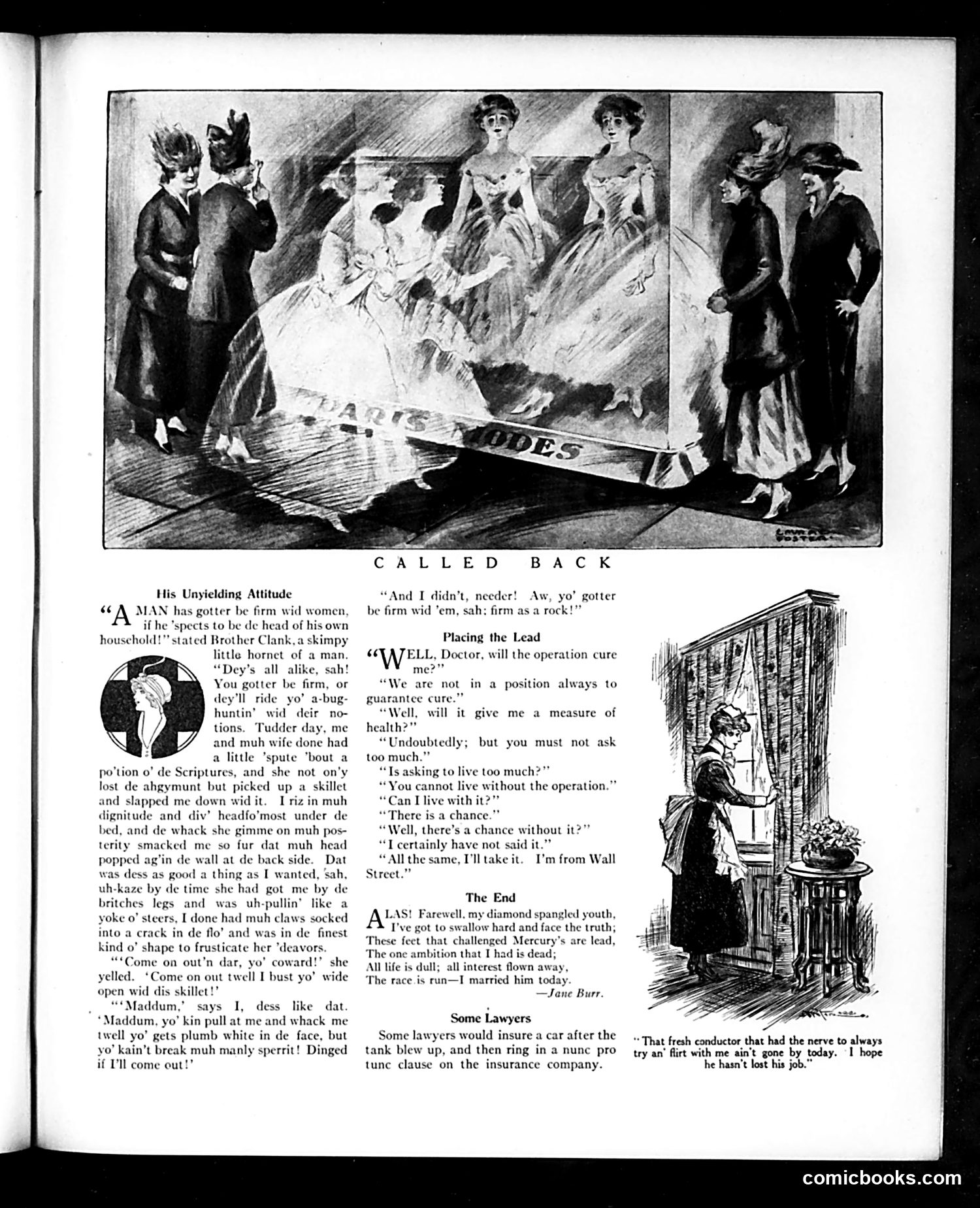
This Judge magazine page contains three separate satirical pieces mocking different aspects of early 20th-century American society: 1. **"Called Back"** (top illustration): A domestic comedy about male authority. Brother Clank boasts about maintaining firmness with his wife, but his actual story reveals he hid under the bed after she hit him with a skillet during a biblical argument—yet he frames this cowardly retreat as principled resistance. The satire targets men who claim domestic dominance while actually being physically dominated by their wives. 2. **"Placing the Lead"** (middle dialogue): Mocks a doctor-patient exchange where a wealthy Wall Street patient, unconcerned with health outcomes, agrees to surgery simply because there's "a chance" it might work—reflecting satirical criticism of both medical uncertainty and wealthy patients' cavalier attitudes toward serious procedures. 3. **"Some Lawyers"** (bottom): A brief jab at unethical legal practices, suggesting lawyers would manipulate insurance claims through technical maneuvers (*nunc pro tunc* clauses) even in fraudulent circumstances. The humor relies on exaggerating character types and exposing hypocrisy in gender relations, medicine, and law.
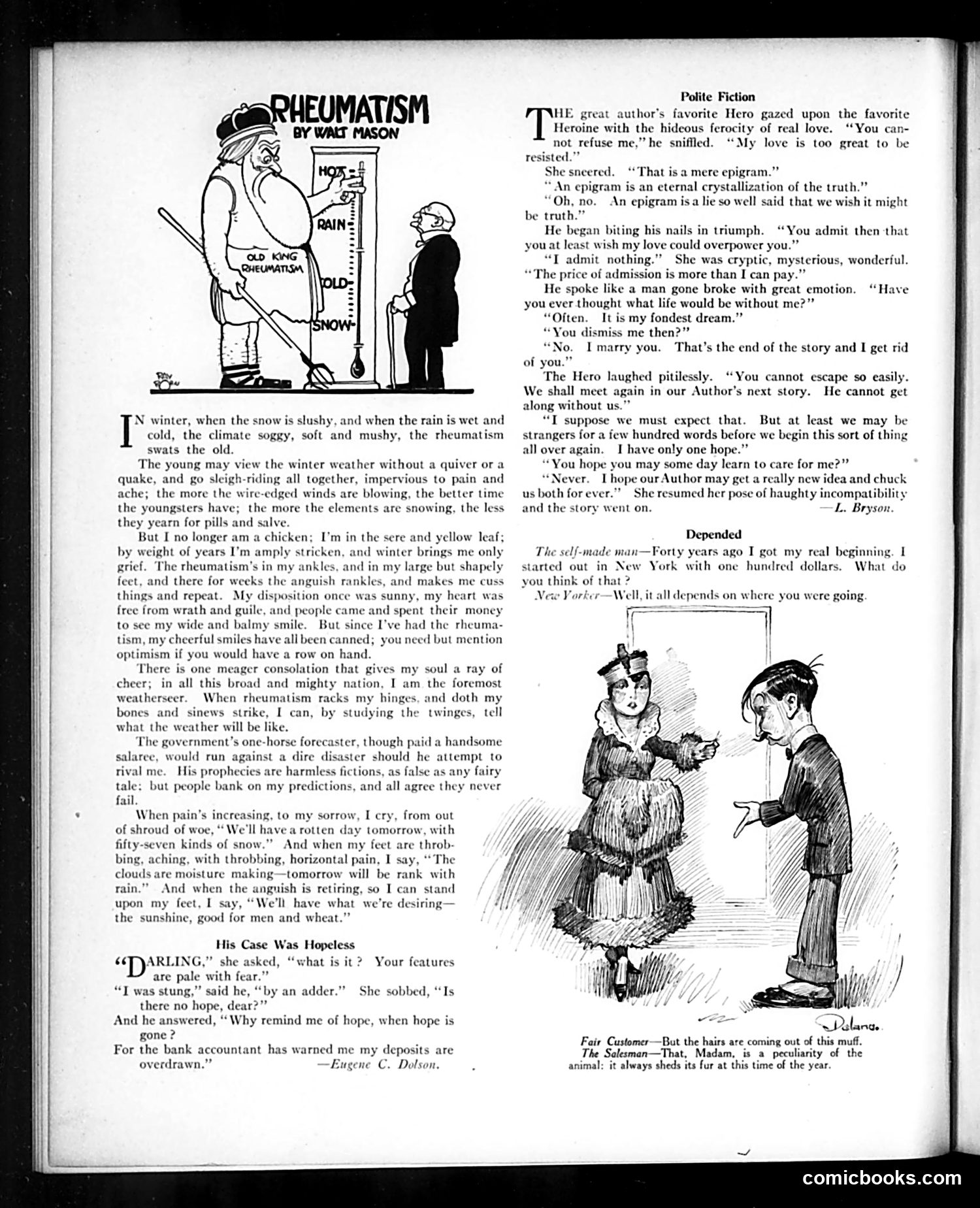
**"Rheumatism"** (left cartoon): An elderly man with exaggerated features represents a rheumatism sufferer who claims to be a better weather forecaster than the government's official meteorologist. The joke satirizes both aging (losing vigor, becoming unable to enjoy winter activities young people enjoy) and the unreliability of early 20th-century weather prediction. The "Old King Rheumatism" personification treats the ailment as a ruler. The humor lies in the ironic premise that chronic joint pain somehow grants supernatural predictive powers—a jab at both the elderly's tendency to attribute significance to their aches and the government weather service's actual poor accuracy. **"Polite Fiction"** (right): A satirical dialogue between a romantic Hero and Heroine mocking Victorian melodramatic literature. The hero's declarations of overwhelming love are met with the heroine's clever, evasive witticisms. The satire targets overwrought romantic fiction tropes—excessive emotion, purple prose, and stock character responses—by having characters constantly undermine sincerity with clever deflections. Their cynical banter and her ultimate agreement to marry him "to get rid of you" suggests the artificiality of romantic narratives itself.
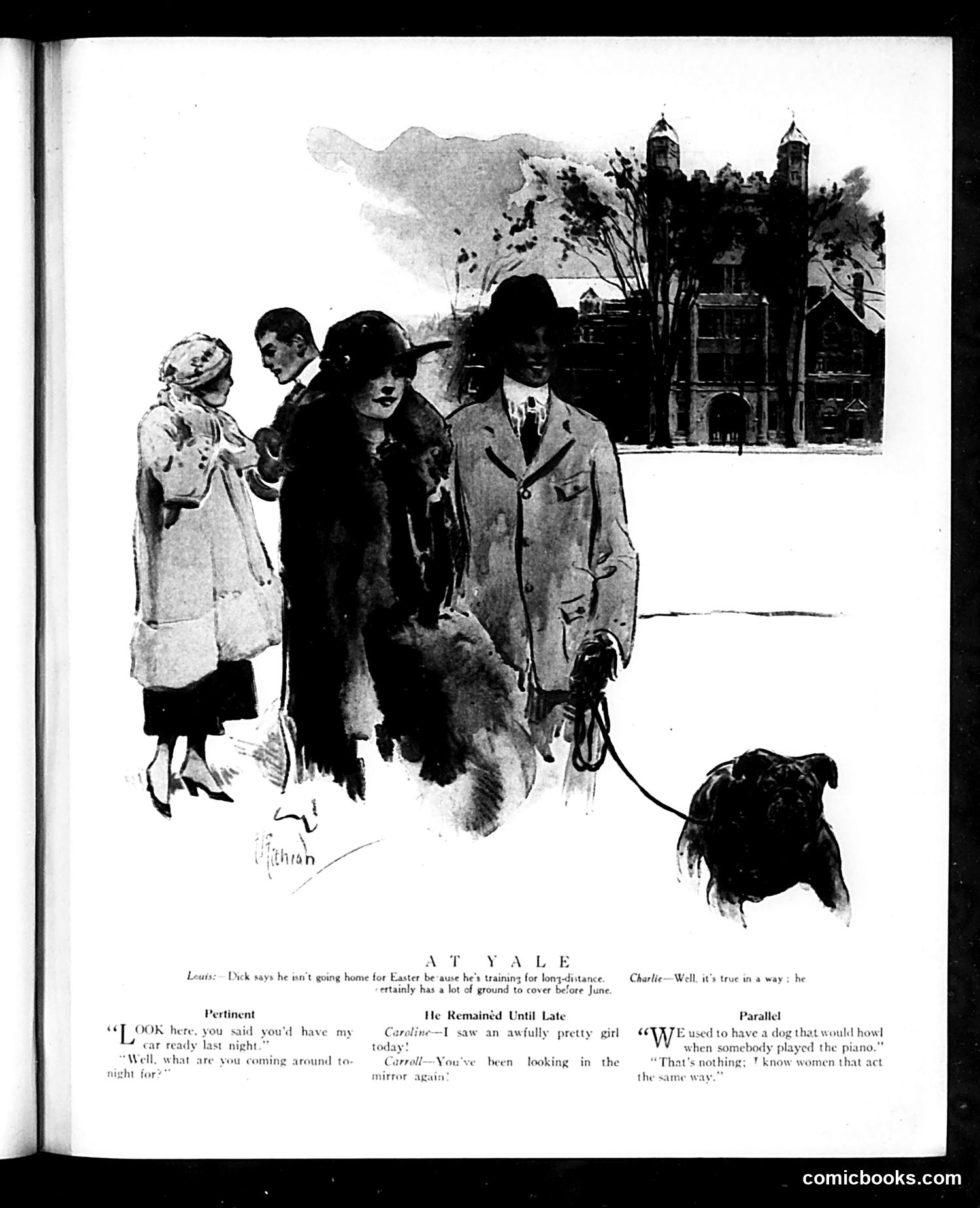
This page contains three brief comic vignettes set at Yale University, satirizing student life and romantic entanglements. **"At Yale" (top):** A student claims he's training for long-distance running and won't go home for Easter, when he actually has "a lot of ground to cover before June"—a euphemism suggesting he's pursuing romantic interests and needs time to manage multiple relationships. **"Pertinent":** A garage attendant's customer demands his car, revealing the attendant hasn't finished it. The joke hinges on the double meaning of "coming around"—both visiting the garage and courting. **"He Remained Until Late" and "Parallel":** Both mock men who linger after dates or social calls, with the final quip comparing such behavior to a dog howling at a piano—suggesting men's romantic persistence is animalistic and unrefined. The satire targets young male students' clumsy romantic pursuits and their tendency to make excuses for their time management, common themes in early 20th-century college humor.
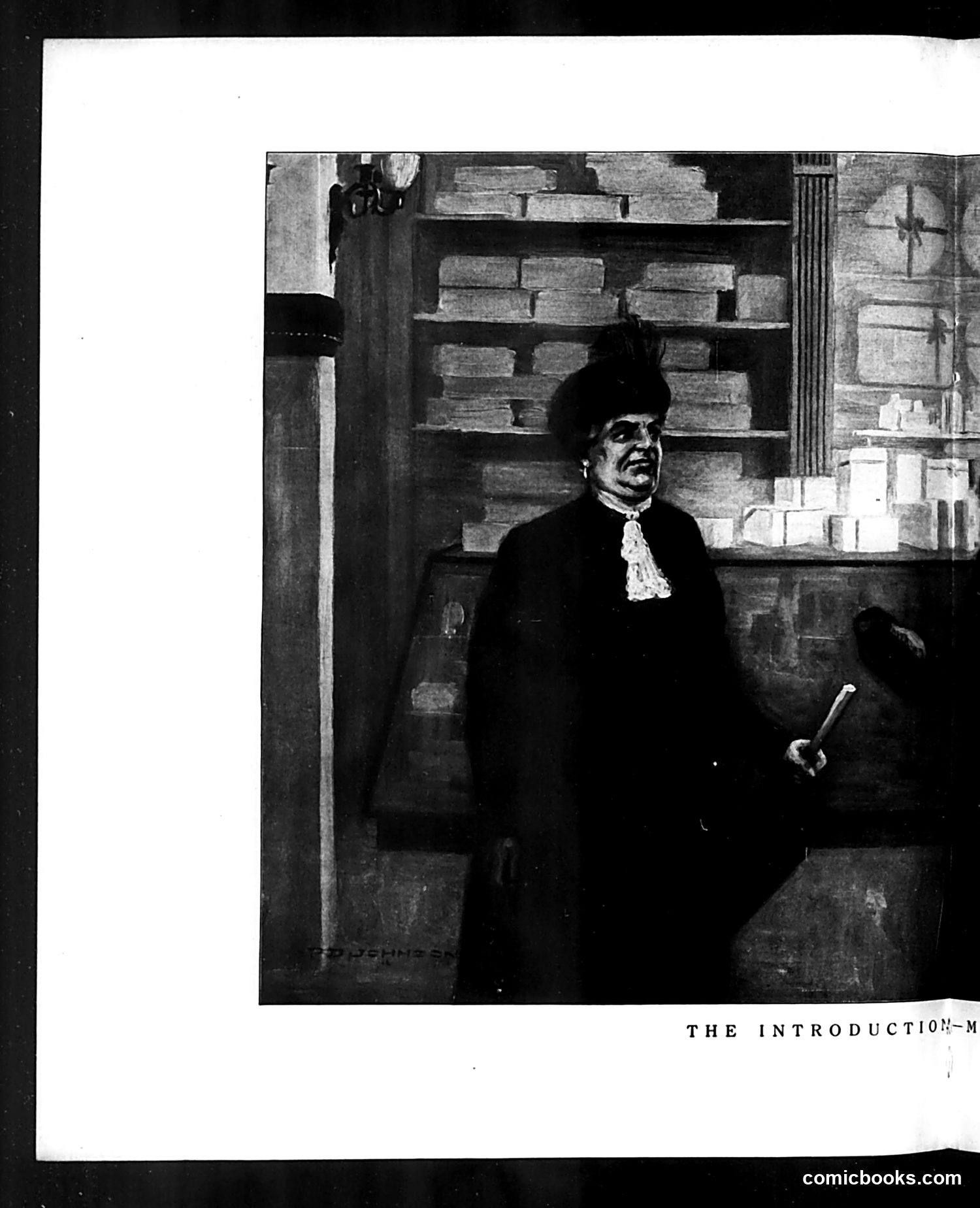
This appears to be a title page or section header from *Judge* magazine, labeled "THE INTRODUCTION-M" (text cut off). The image shows a single figure in dark formal attire with a white collar detail, positioned in what appears to be an interior setting with shelves of boxes or documents visible behind him. Without the complete OCR text and full context of the article, I cannot reliably identify who this figure represents or what specific political or social satire is intended. The formal dress and institutional setting suggest this may be introducing a notable public figure or bureaucrat, but identifying the specific person or satirical point would require more complete accompanying text or historical documentation.
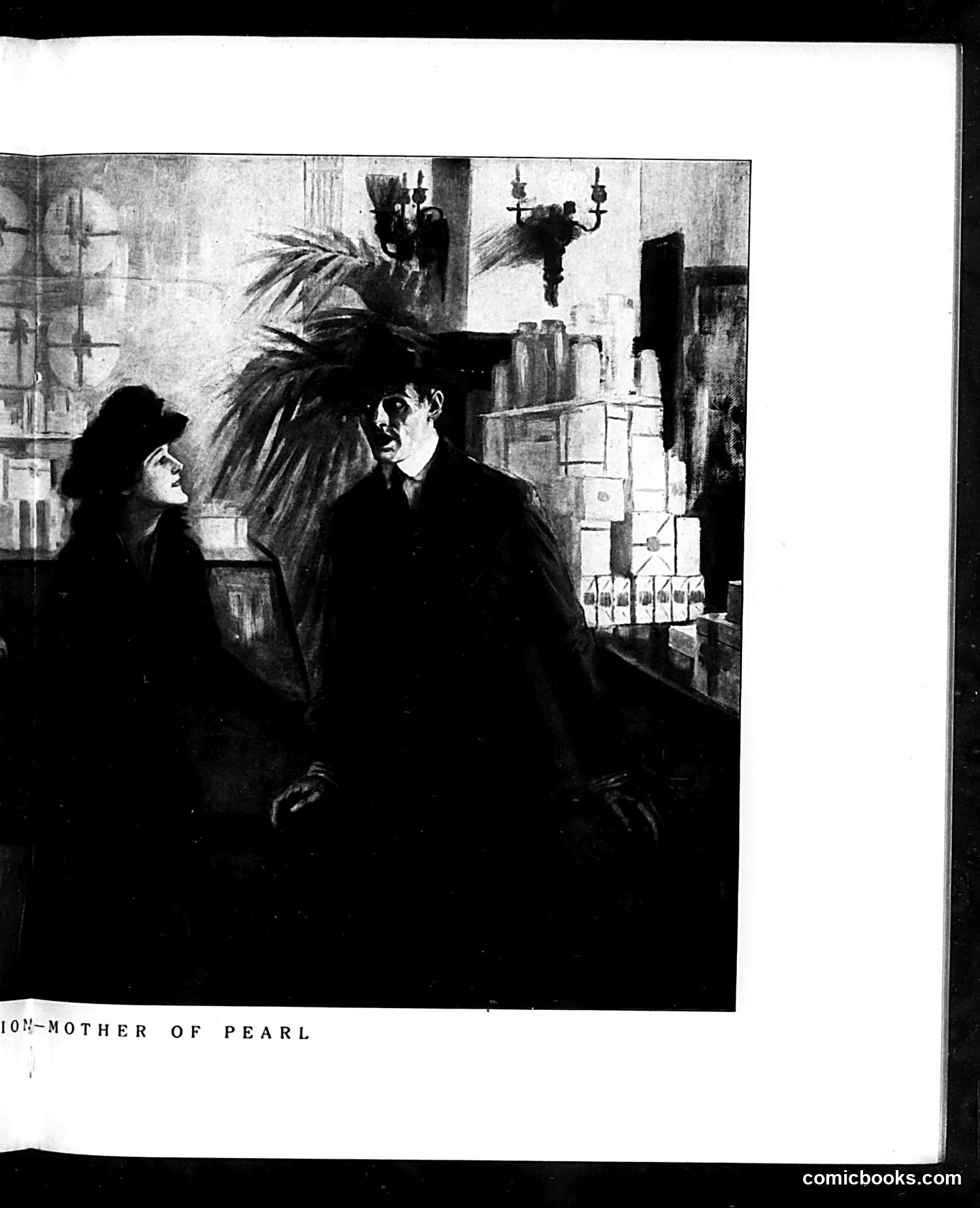
This appears to be a page from *Judge* magazine featuring a scene titled "ION-MOTHER OF PEARL." The black-and-white illustration shows two figures in dark coats in what appears to be an elegant interior with a potted plant, candelabra, and framed items on the wall. The title suggests wordplay—likely a pun on "ion" (a charged particle) combined with "mother of pearl" (a decorative material). Without additional context or visible OCR text explaining the cartoon, the specific political or social satire remains unclear. The scene itself depicts what might be a social interaction or confrontation, but the exact subject of the satire cannot be confidently determined from the image alone. More complete OCR text or surrounding page content would clarify the intended joke or criticism.
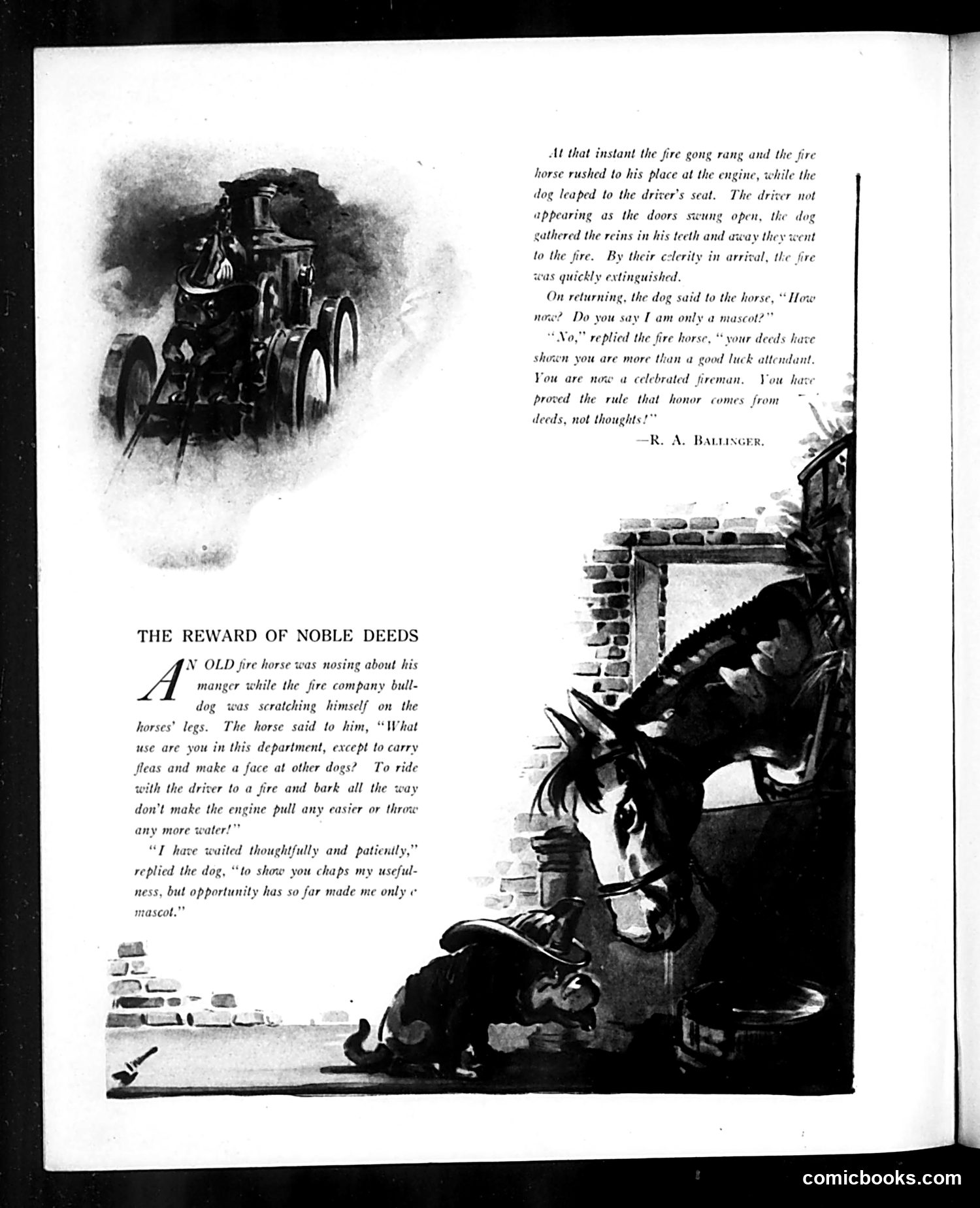
This is a fable-style story (by R.A. Ballinger) about a fire company's bulldog proving his worth. A fire horse dismisses the dog as merely a mascot—useful only for carrying fleas and making faces. The dog, patient and humble, awaits his chance. When a fire alarm sounds, the dog takes the driver's seat (the driver mysteriously absent), grabs the reins in his teeth, and helps extinguish the fire through swift arrival. Upon return, the horse admits the dog is now "a celebrated fireman," having proven "honor comes from deeds, not thoughts." The moral is straightforward Victorian-era sentiment: character and worth are demonstrated through action and duty, not mere appearance or status. The anthropomorphic animals deliver a lesson about humble service and redemption—themes common to Judge magazine's genteel humor and moral instruction.
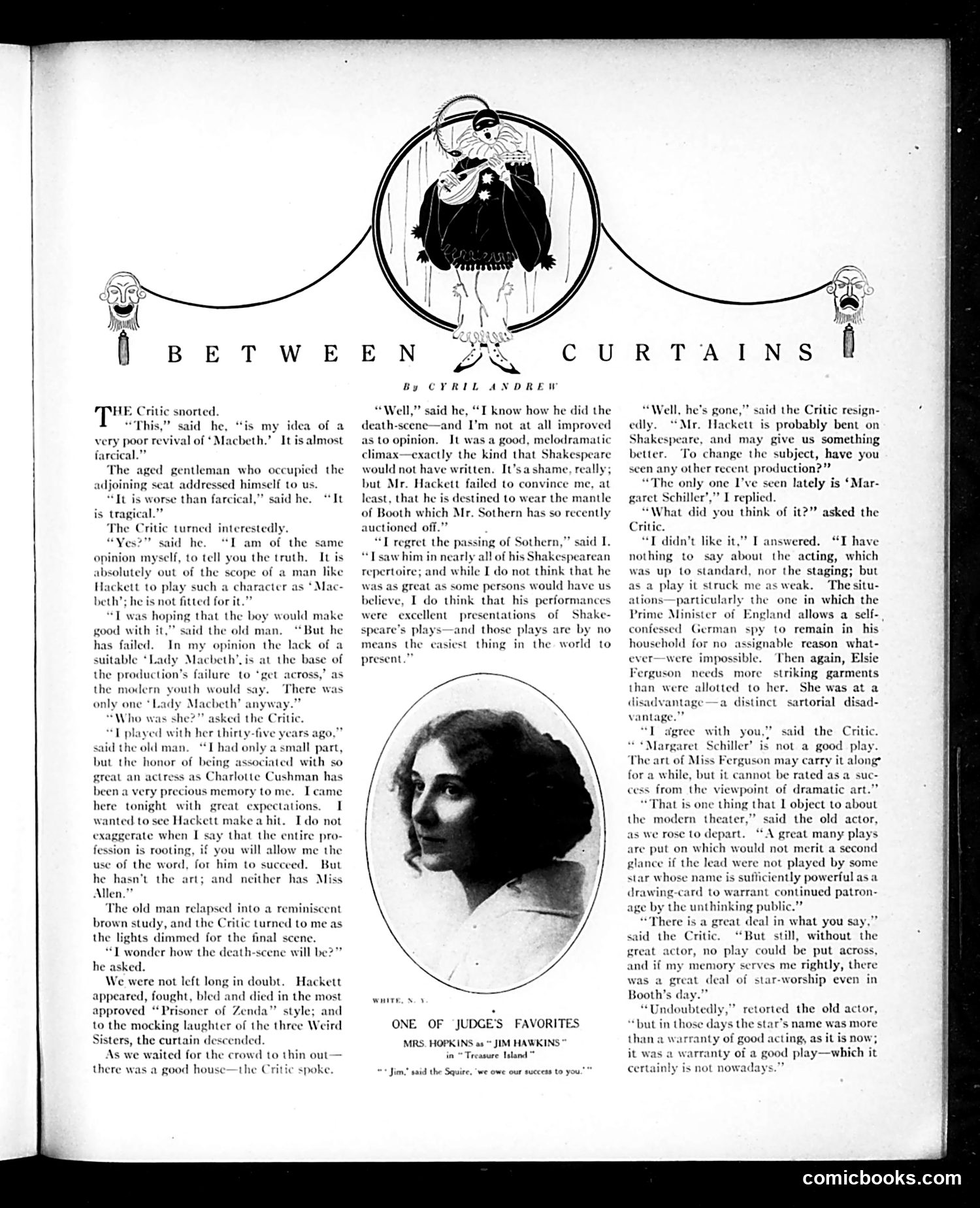
This page presents a theatrical dialogue by Cyril Andrew, framed as a debate between a theater Critic and an elderly gentleman at a performance of *Macbeth* starring James Hackett. **The Point:** The satire contrasts modern commercial theater with theatrical "golden age" standards. The old man nostalgically recalls performing alongside Charlotte Cushman (a celebrated 19th-century actress), implying contemporary actors like Hackett lack genuine artistry. The Critic agrees—Hackett's death scene is melodramatic spectacle rather than Shakespearean authenticity. A secondary review criticizes a play called "Margaret Schiller" for its implausible plot (a German spy in a Prime Minister's household) while acknowledging the actress Elsie Ferguson's talent cannot salvage weak material. **The Satire's Target:** Judge critiques both modern theater's commercial mediocrity and audiences' acceptance of star power over substance—a recurring concern in early 20th-century American theater criticism. The accompanying portrait identifies "One of Judge's Favorites": Mrs. Hopkins as Jim Hawkins in *Treasure Island*.
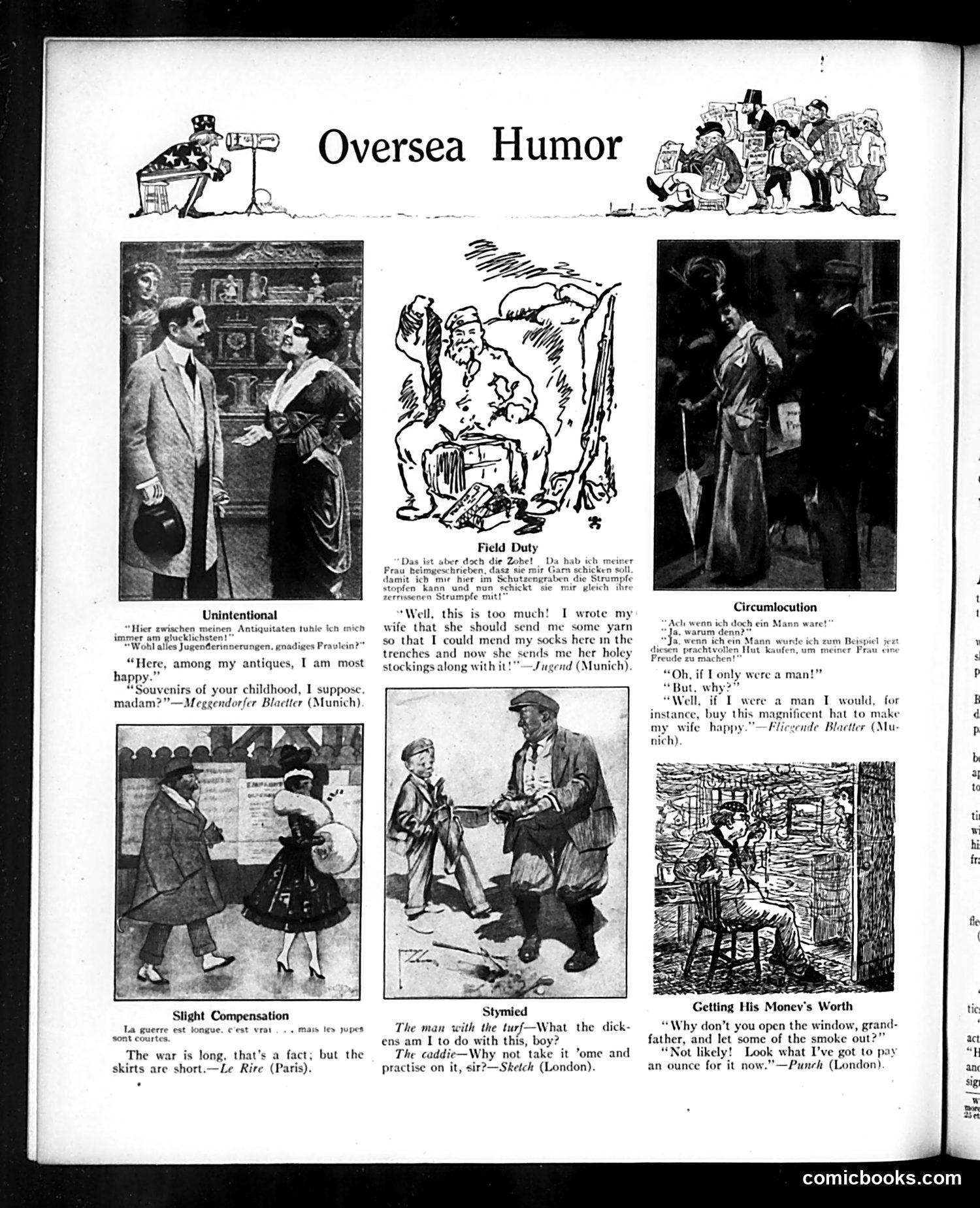
This page collects humorous cartoons from European publications during World War I, mocking wartime absurdities and domestic tensions. **Key pieces:** - **"Field Duty"**: A soldier complains his wife sent him her holey stockings instead of yarn for darning socks in the trenches—absurd domestic miscommunication amid combat. - **"Slight Compensation"**: Dark joke that while the war drags on, women's skirts have become shorter—a gallows humor observation about fashion trends during wartime. - **"Unintentional"**: A man among antiques says they remind him of his childhood—ambiguous but likely mocking nostalgia or aging. - **"Getting His Money's Worth"**: An elderly man refuses to open a window, not wanting to waste expensive tobacco smoke—miserly wartime penny-pinching. The cartoons reflect *Punch*, *Jugend*, and other international magazines using humor to process war's dislocations and its effects on civilian life, gender roles, and economic hardship.
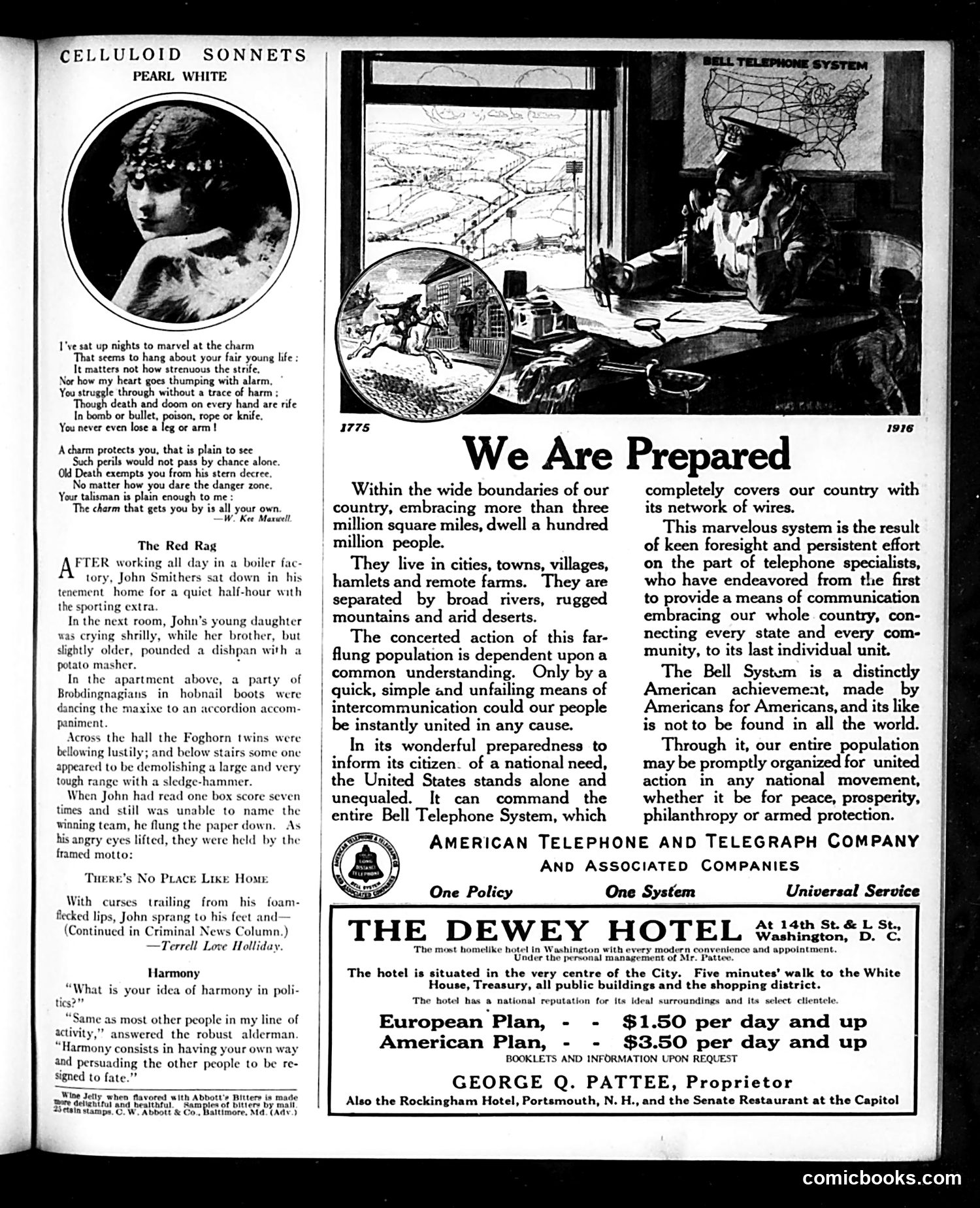
This page mixes entertainment content with serious patriotic messaging. The top features "Celluloid Sonnets"—light verses about Pearl White, a famous silent film serial star known for performing dangerous stunts. The poem cheekily praises her miraculous ability to survive impossible perils (bombs, bullets, poison, ropes, knives) without injury—a joke about her film character's implausible invulnerability. The bulk of the page is an AT&T advertisement titled "We Are Prepared," which frames the Bell Telephone System as essential national infrastructure for rapid communication during emergencies. The timing suggests this reflects pre-WWI "preparedness" concerns—the idea that America needed unified communication systems for potential military mobilization. The framing conflates commercial utility with patriotic duty: the phone network becomes a tool for organizing the nation "whether it be for peace, prosperity, philanthropy or armed protection." The page also contains humorous short pieces ("The Red Rag," "Harmony") dealing with working-class domestic life.
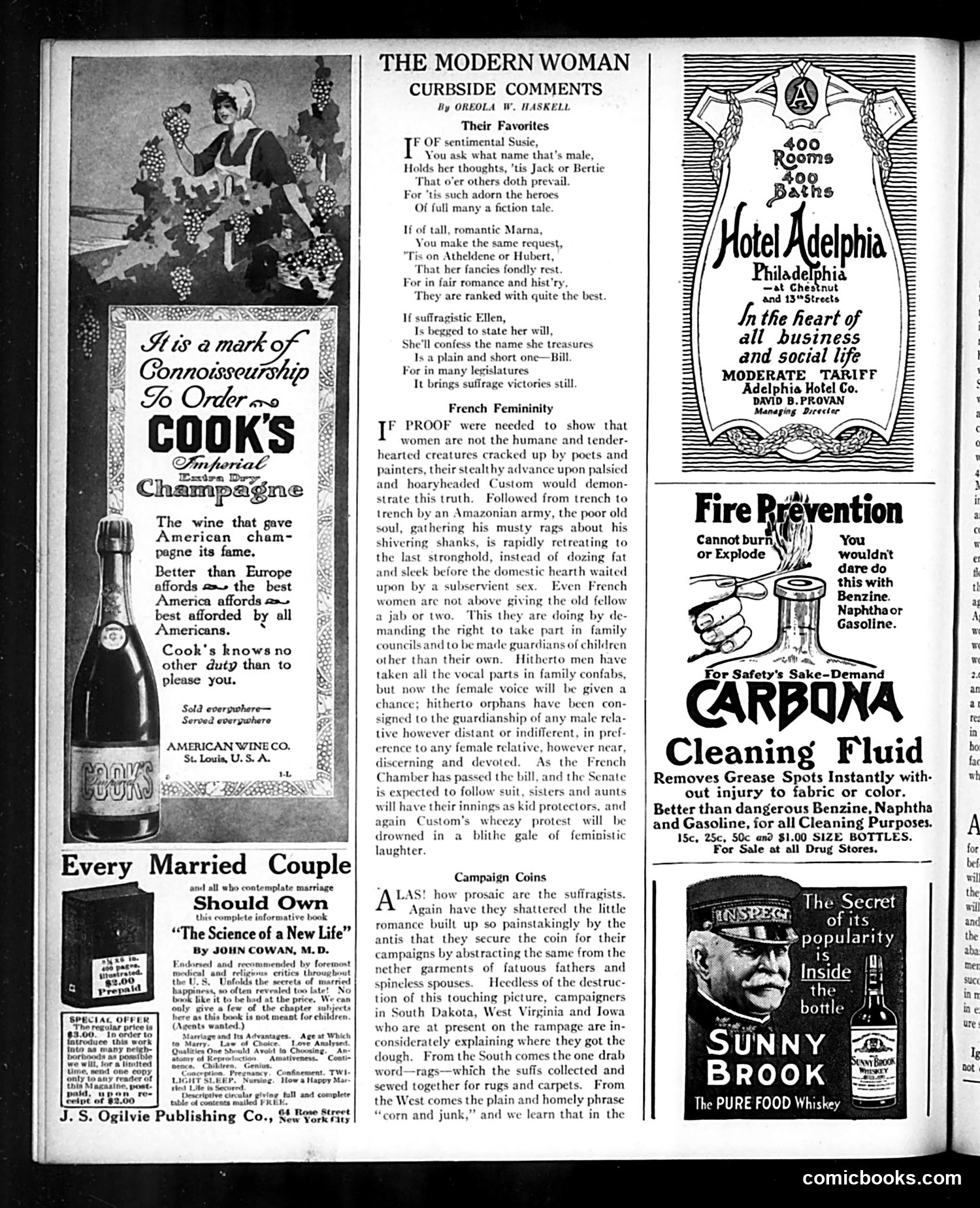
This page is primarily **advertising and editorial content** rather than political cartoons. The main editorial piece, "The Modern Woman: Curbside Comments" by Oreola W. Haskell, discusses three topics: 1. **"Their Favorites"** – A light poem about women's romantic preferences for male names like Jack, Bertie, Atheldene, and Hubert from fiction. 2. **"French Femininity"** – Satirizes women's rights advocates, mocking French women's demands for guardianship rights and participation in family councils. The author dismisses feminists' arguments while personifying "Custom" as an elderly man being chased away by an "Amazonian army" of women. 3. **"Campaign Coins"** – Ridicules suffragists' fundraising methods, sarcastically contrasting the "romance" of anti-suffragists' claims that women extract money from male relatives with the mundane reality: campaigns are funded through legitimate means like "corn and junk" donations. The page also contains advertisements for Cook's champagne, marriage advice books, a Philadelphia hotel, Carbona cleaning fluid, and Sunny Brook whiskey. The tone is dismissive toward women's suffrage and equality movements.
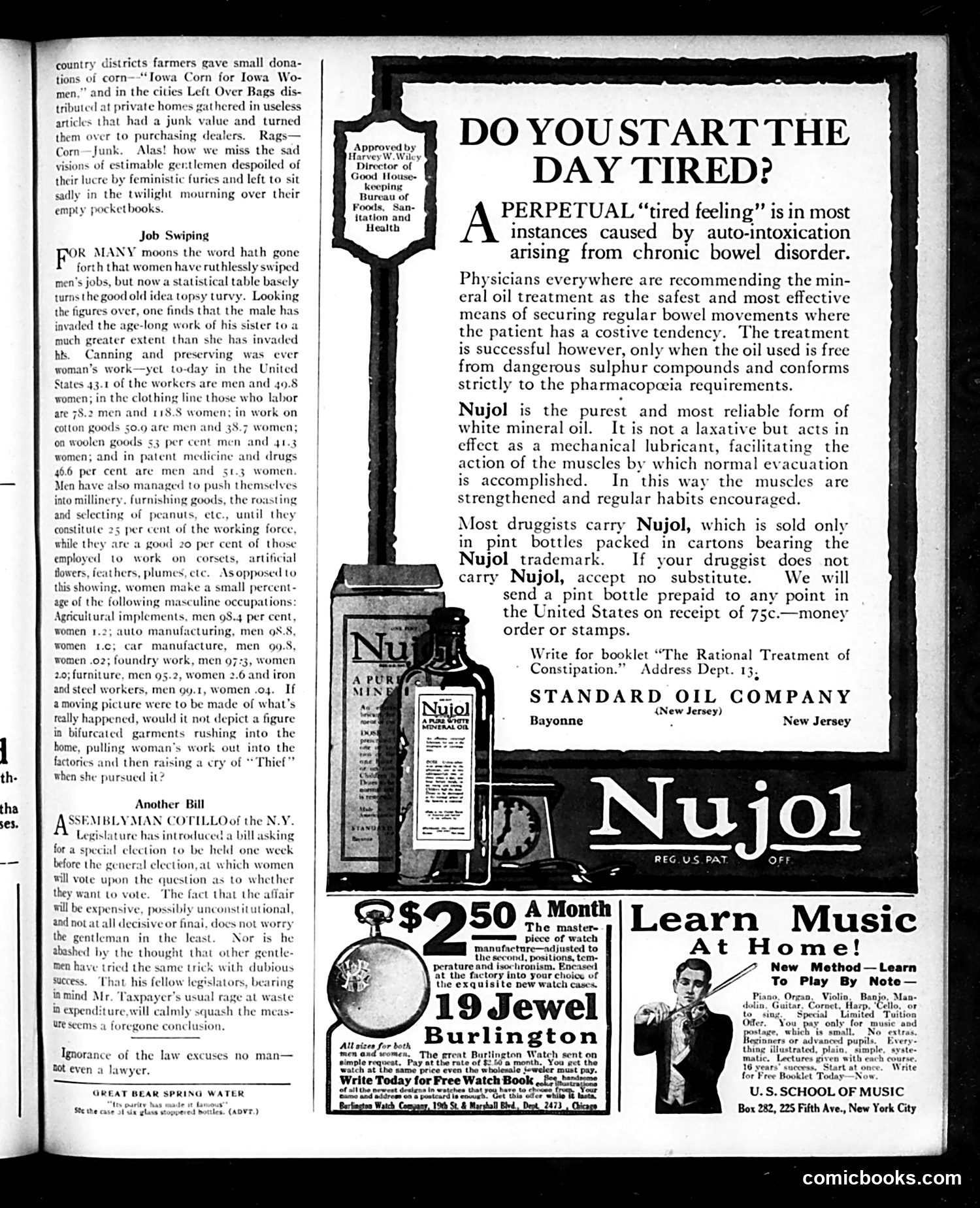
This page is primarily advertising for Nujol mineral oil, with supporting editorial content about gender and labor. The main satire criticizes feminist activists who, the text claims, "despoiled" men of their money through charitable fundraising ("feministic furies"). The article "Job Swiping" sarcastically undermines the era's common complaint that women were "stealing" men's jobs by presenting statistics showing men had actually invaded traditionally female occupations (canning, clothing manufacture, millinery) far more extensively than vice versa. The Nujol advertisement exploits era-typical anxieties about "auto-intoxication" from constipation causing perpetual fatigue. It's endorsed by Harvey W. Wiley, a real FDA official, lending false credibility to dubious health claims typical of patent medicine advertising. The page also includes unrelated advertisements for a Burlington watch and music lessons—standard magazine filler content.
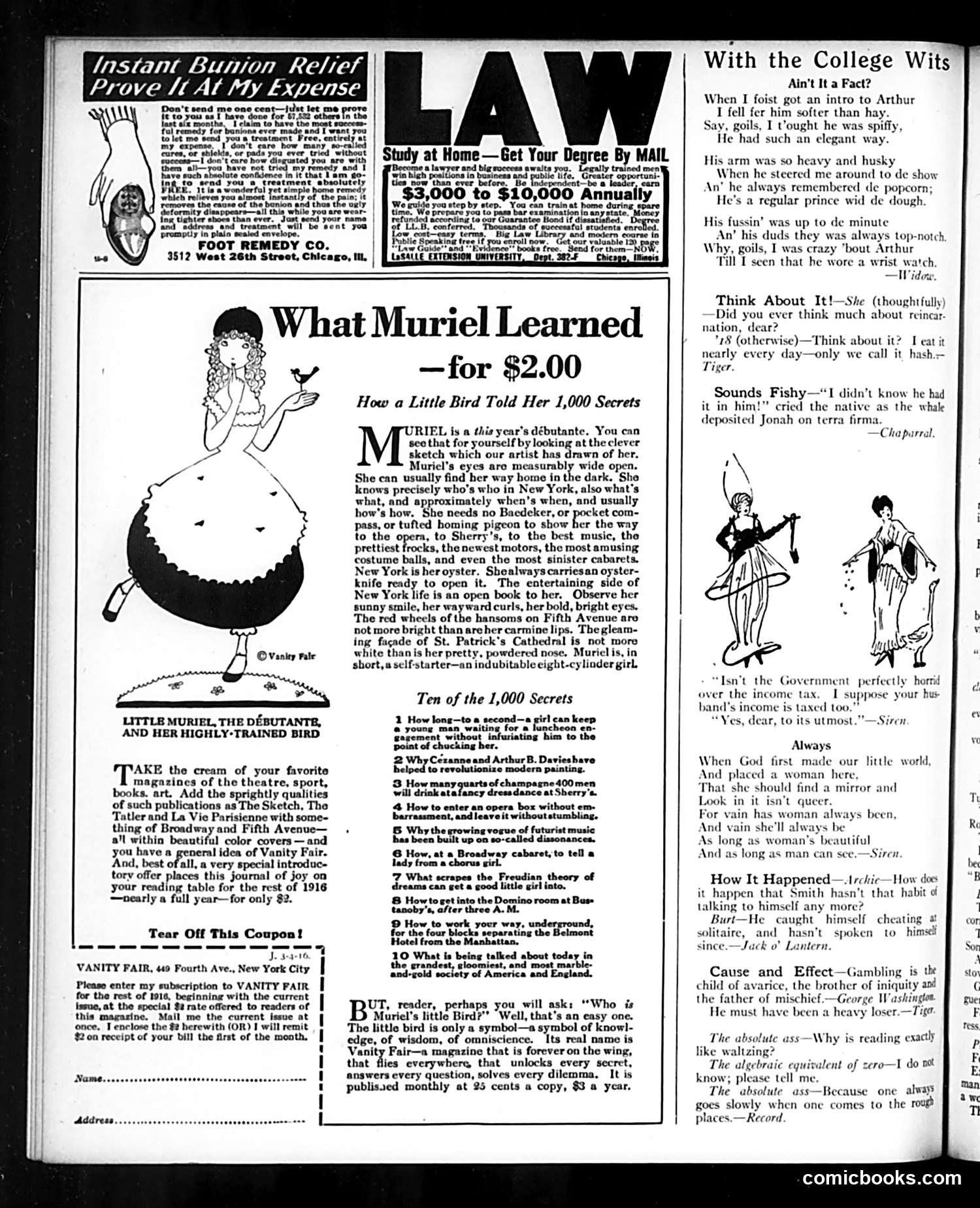
This page combines advertisements with satirical content about high society. The main feature, "What Muriel Learned—for $2.00," mocks a wealthy debutante named Muriel through a humorous conceit: she's portrayed as having learned 1,000 secrets about New York society from a "little bird" (a euphemism for gossip or observation). The satire targets upper-class pretension. Muriel is described in exaggerated, superficial terms—her beauty compared to architectural landmarks, her knowledge of opera and exclusive venues like Sherry's restaurant. The "1,000 secrets" listed parody socialite concerns: which artists are fashionable, how many men will attend costume balls, how to enter opera boxes "without embarrassment." The overall joke suggests that a debutante's education consists entirely of navigating wealthy Manhattan social rituals and gossip—a shallow, performative world obsessed with appearances and exclusivity. The accompanying illustration emphasizes her stylish but vacant demeanor.
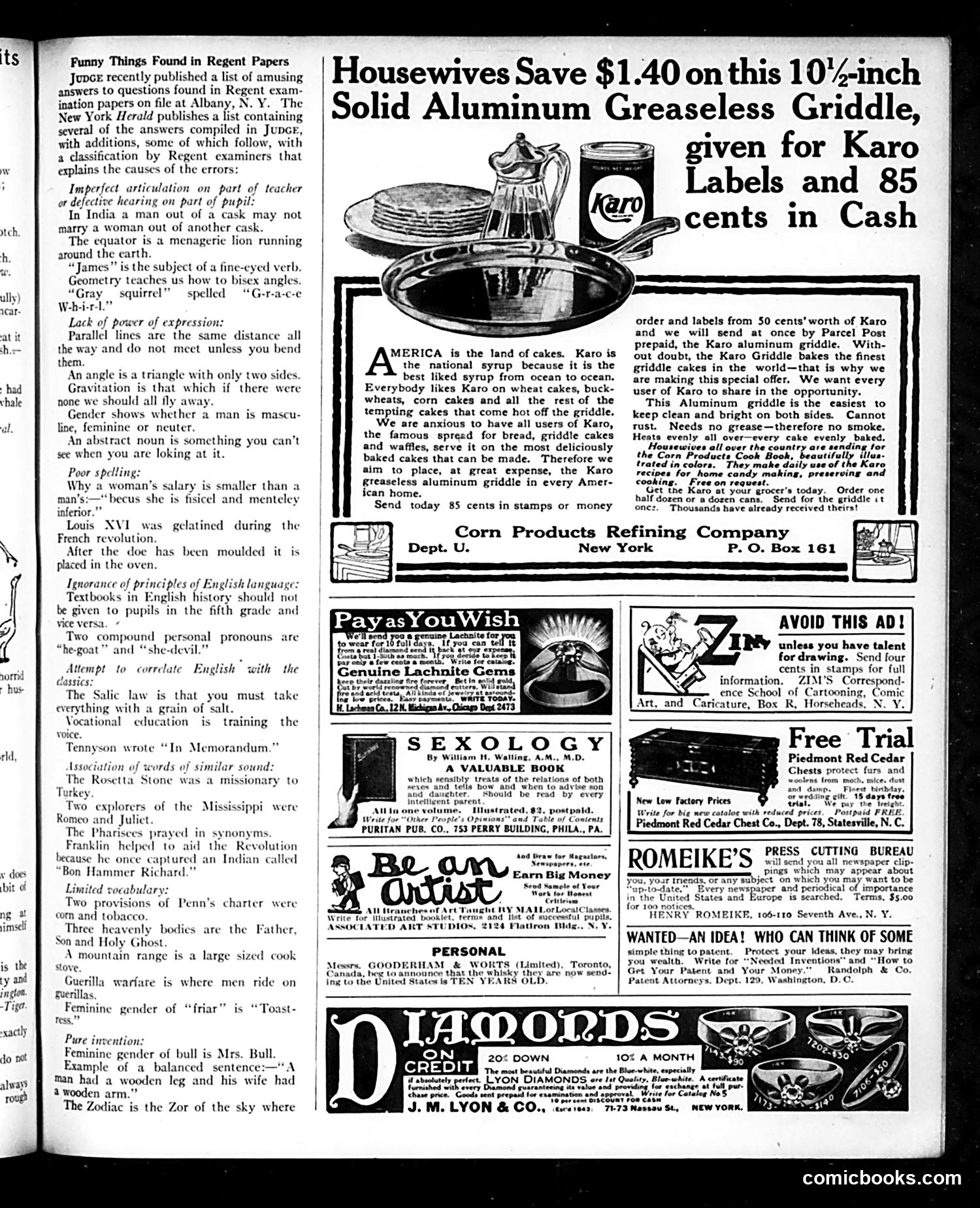
This page is primarily **advertising content** rather than political satire or editorial cartoons. The dominant feature is a full-page advertisement for Karo syrup's "greaseless aluminum griddle" promotion (top half). The left column contains educational humor titled "Funny Things Found in Regent Papers"—amusing student exam answers collected from New York state education tests. These aren't political cartoons but rather examples of student errors classified by examiners: mishearings ("bisex angles" for "bisect"), spelling mistakes, and malapropisms ("Memorandum" for "In Memoriam"). The humor is gentle, poking fun at education's quirks rather than any political agenda. The page includes additional advertisements below: Lachnite Gems, Sexology book, Zim (art instruction), Romeike's Press Cutting Bureau, and others. **This is a typical Judge magazine page mixing light educational humor with commercial advertising**—not political satire or social commentary requiring historical context beyond understanding early 20th-century consumer products and school systems.
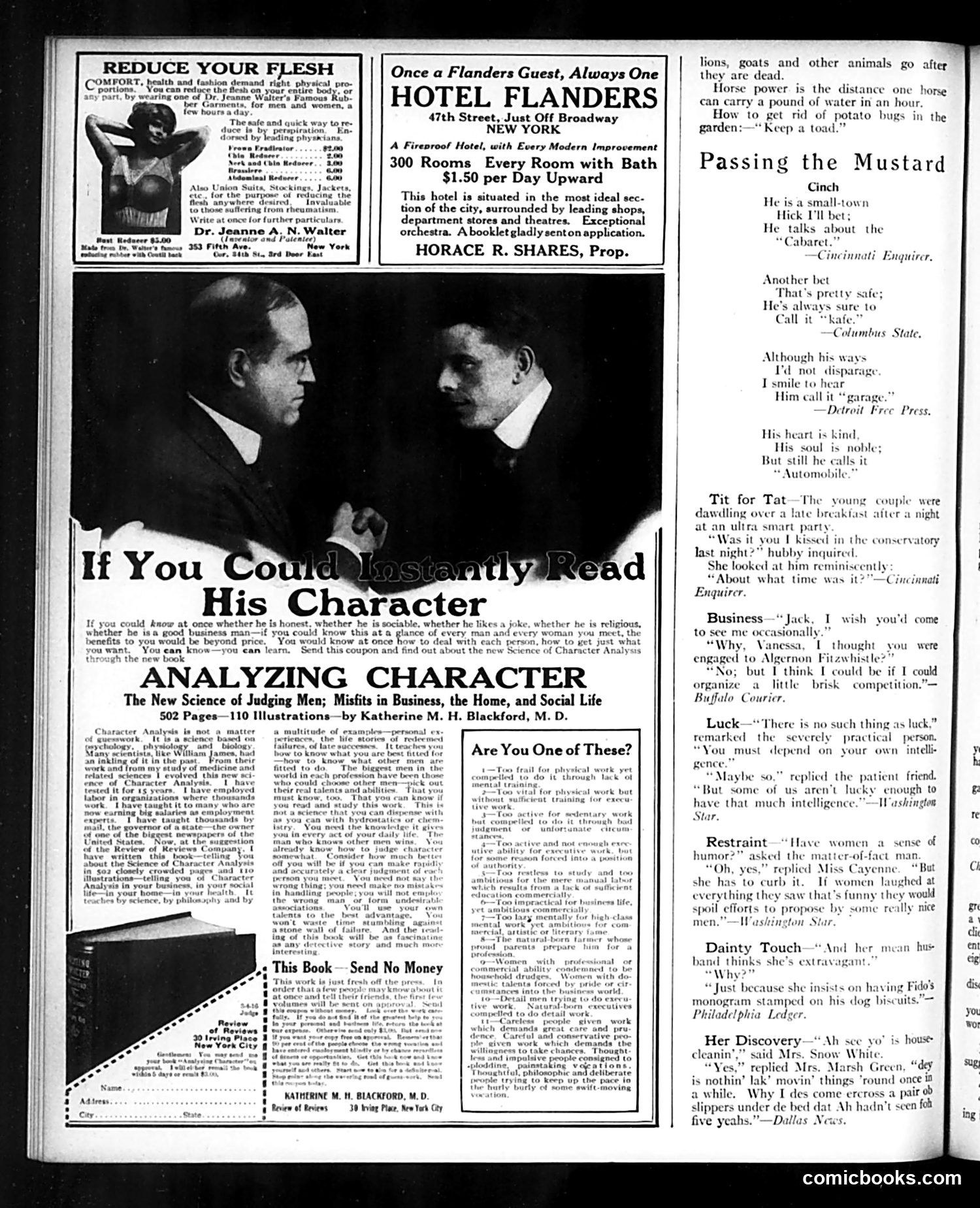
This page is primarily **advertising and humor filler** rather than political satire. The main content includes: **Advertisements:** A weight-loss pitch for "Dr. Jeanne A.N. Walter" and the Hotel Flanders (a real NYC hotel), typical of early 20th-century magazine ads. **"Analyzing Character"** - A book advertisement promoting pseudoscientific "character analysis," a popular but now-debunked practice of judging personality from facial features and behavior. **Humor section "Passing the Mustard":** Short jokes poking gentle fun at small-town speech patterns and social pretensions—a rural person calling things by fancy names like "cabaret," "garage," and "automobile" rather than plain language. This reflects urban magazine readers' condescension toward rural Americans. **Additional jokes** cover romance, business, and domestic situations with light, conventional humor. The overall tone is lighthearted social commentary rather than sharp satire—reflecting Judge's shift toward gentler, more commercial content by this era. The pseudoscience promotion now reads as quaint and misguided.
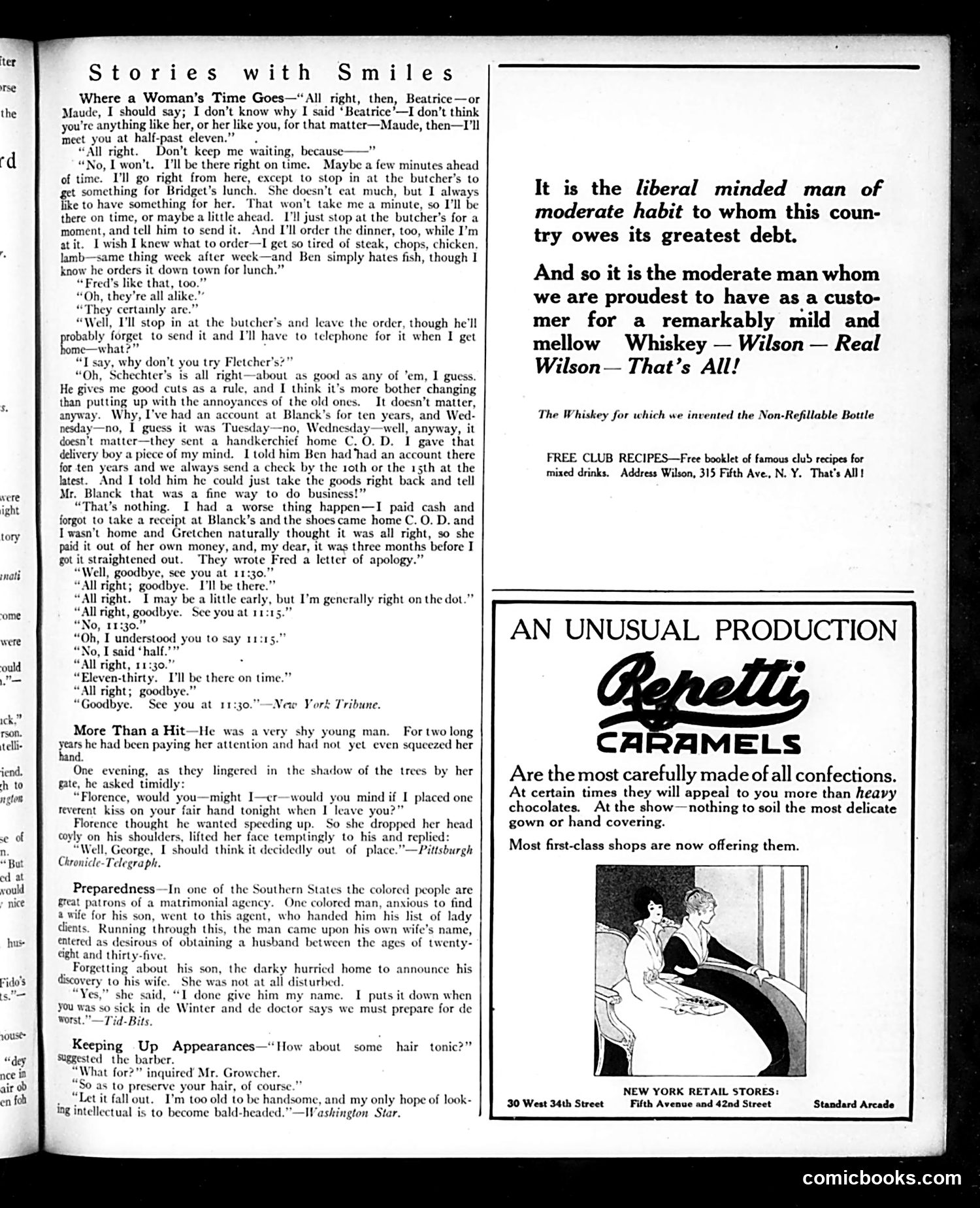
This page contains three brief humorous stories satirizing everyday American life: **"Where a Woman's Time Goes"** mocks the gap between women's stated intentions and reality. A woman promises to meet a friend at 11:30 but lists endless errands (butcher, dinner planning, past shopping mishaps) that will delay her. The satire targets how middle-class housewives, despite claiming punctuality, become caught in domestic responsibilities and indecision—ironically, both women can't even agree on their meeting time. **"More Than a Hit"** plays on miscommunication between shy suitors and modern women. A timid man asks permission for a hand kiss; the woman interprets this as excessive hesitation and boldly offers her face instead—subverting his cautious courtship. **"Preparedness"** jokes about a Black man discovering his own wife listed at a matrimonial agency seeking a husband. The humor derives from ironic situational comedy. The advertisements (Wilson whiskey, Repetti caramels) occupy the page's right side. The content reflects early 20th-century American middle-class domestic concerns and gender dynamics.
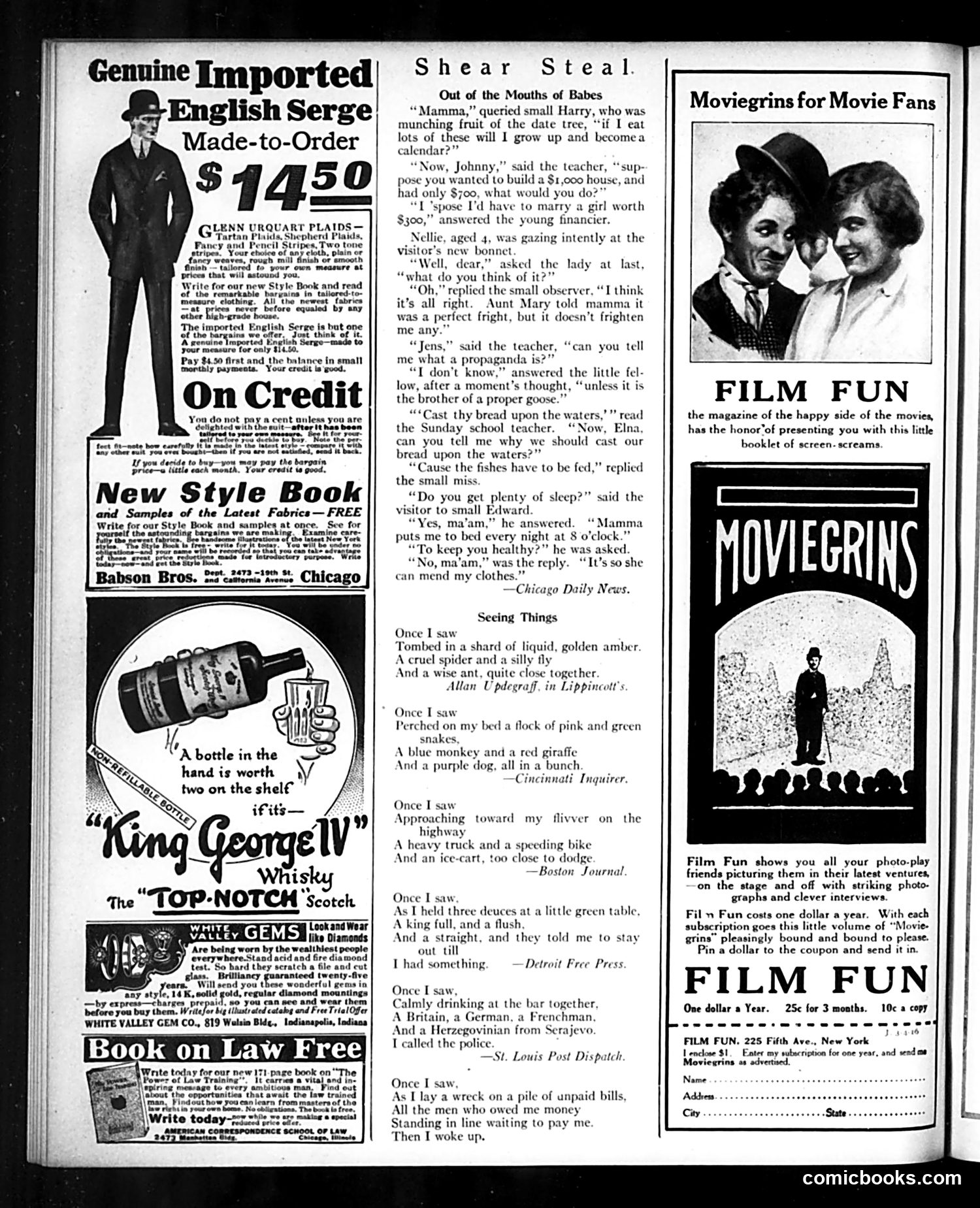
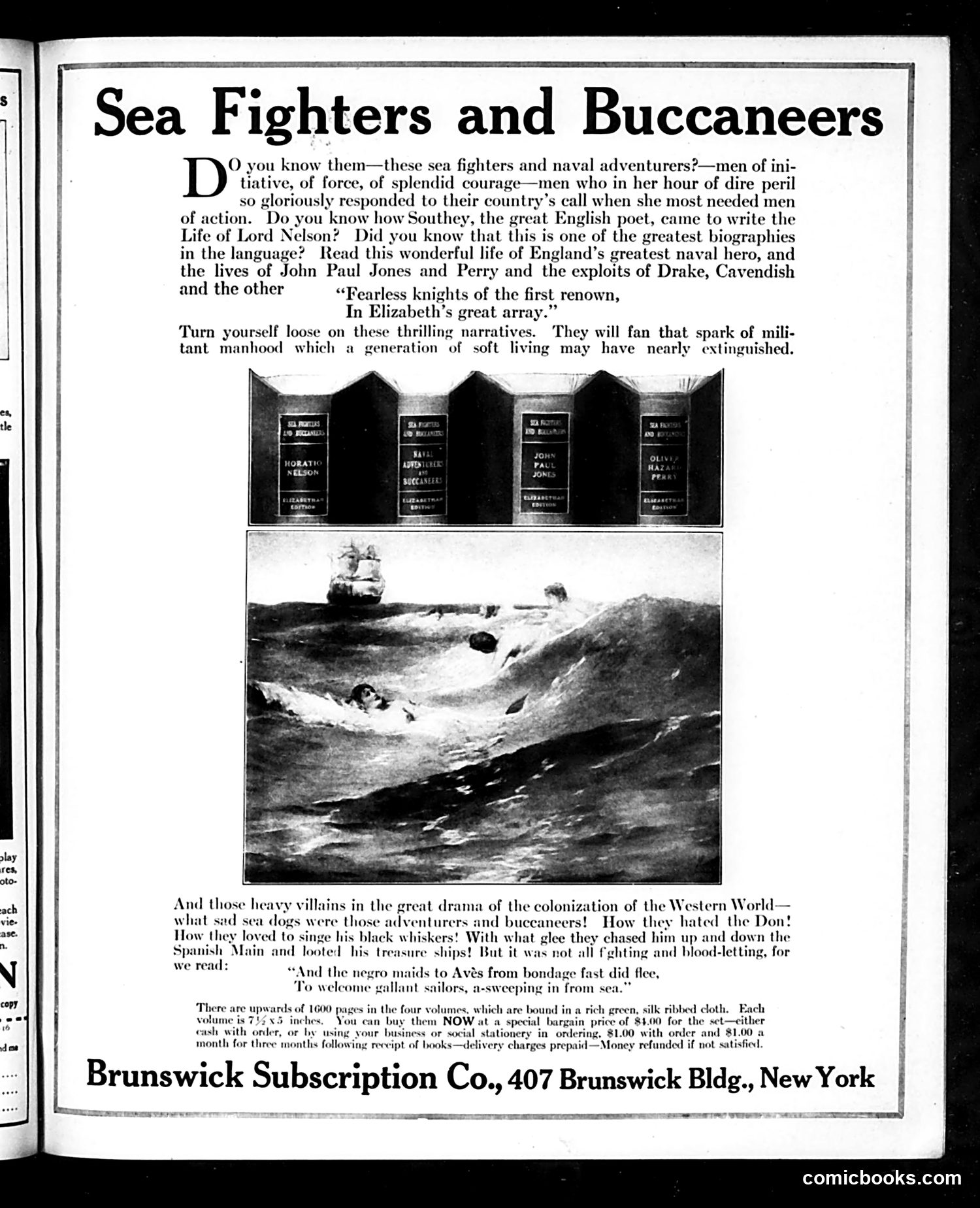
This is a **book advertisement**, not a political cartoon. It promotes a four-volume subscription series about naval history and adventure, published by Brunswick Subscription Co. The ad appeals to early 20th-century American masculinity by celebrating historical sea warriors—Lord Nelson, John Paul Jones, Drake, and Cavendish—as models of courage and patriotism. It invokes anxiety about declining manhood ("a generation of soft living may have nearly extinguished" militant spirit), a common concern during this period. The content romanticizes both legitimate naval heroes and **buccaneers** (pirates/privateers), mixing them as equally admirable. The final quoted lines reference enslaved people being "rescued" by sailors—reflecting the era's problematic colonial perspective on adventure narratives. The advertisement uses patriotic and martial language to sell books as character-building material for men, typical of early-century marketing that linked reading with masculine virtue. Pricing information and subscription terms are included at the bottom.
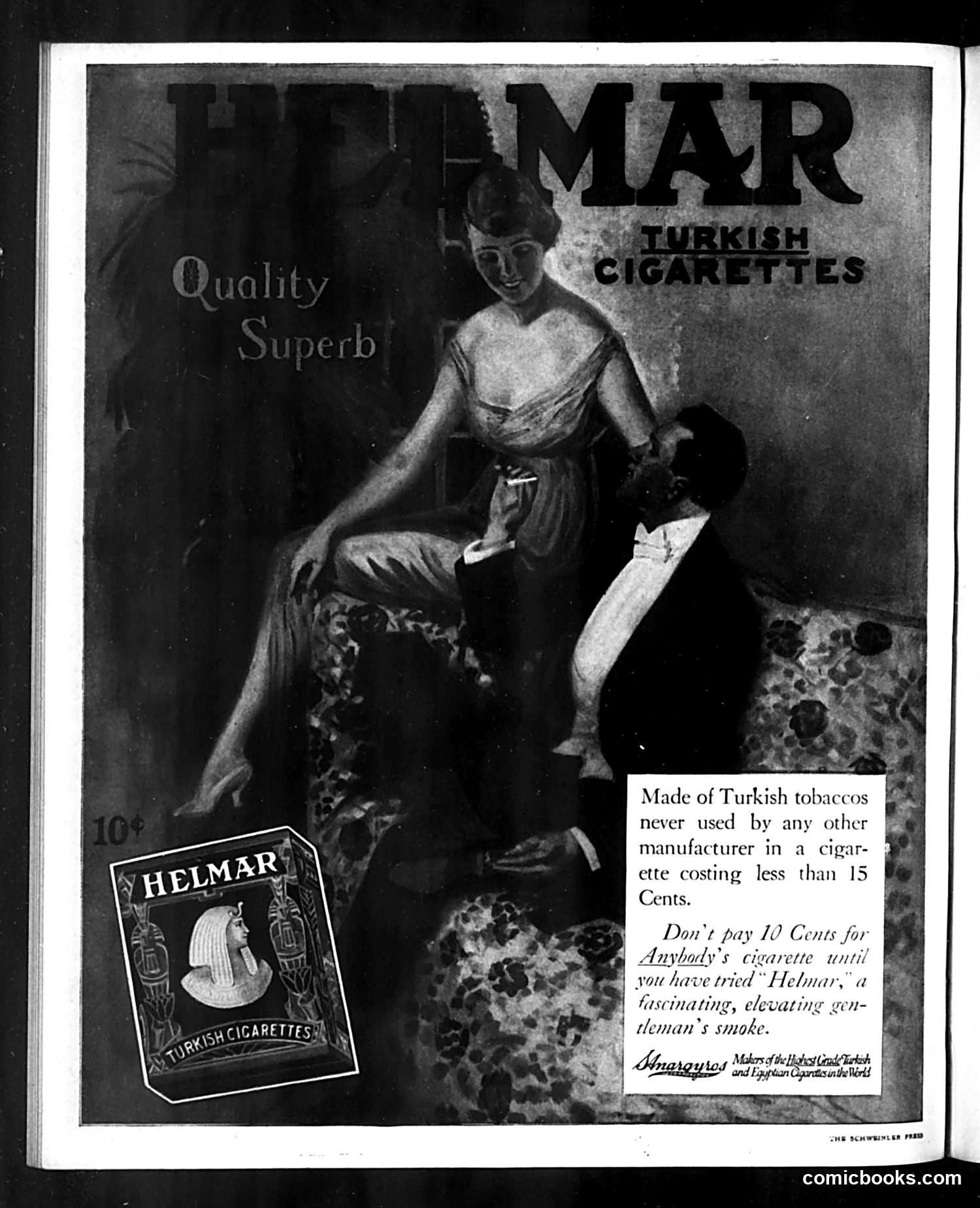
This is primarily a **cigarette advertisement** for Helmar Turkish Cigarettes, not a political cartoon. The page features: - A woman in elegant dress offering cigarettes to a seated man in formal attire - Marketing claims emphasizing quality ("Quality Superb") and exclusivity of Turkish tobacco - Price positioning: arguing consumers shouldn't pay 10 cents for competitors' cigarettes when Helmar offers superior quality at 15 cents - Aspirational messaging ("elevating gentleman's smoke") targeting middle-to-upper-class male consumers The imagery uses early 20th-century conventions of feminine allure and sophistication to market cigarettes as a refined luxury product. There is no apparent satire or political commentary—this is straightforward period advertising that today would be considered unethical tobacco promotion.