
Judge, 1916-03-04 · page 10 of 28
Judge — March 4, 1916 — page 10: what you’re looking at
What you’re looking at
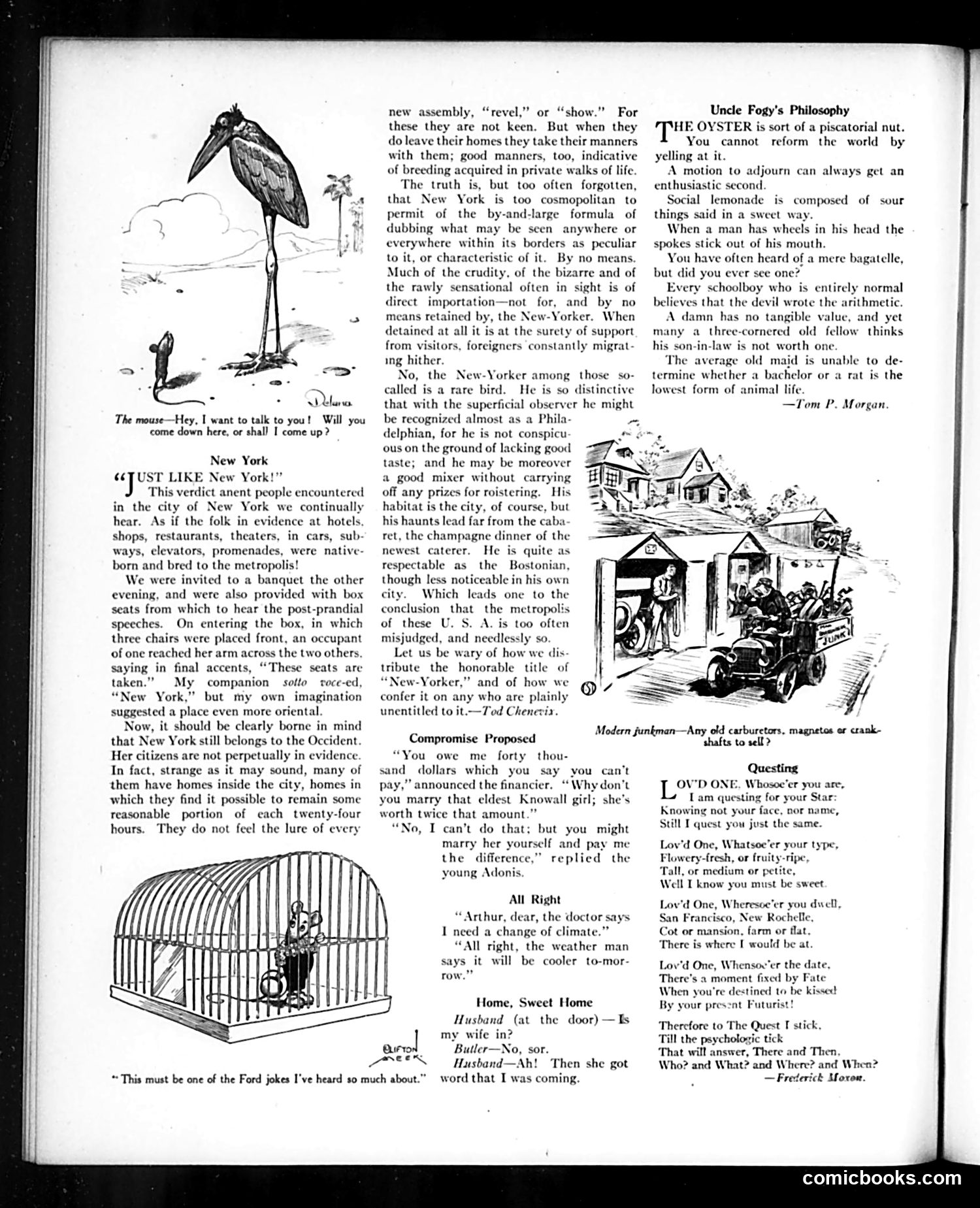
This page contains several satirical pieces lampooning New York society and manners. The main article criticizes visitors and transplants who adopt an exaggerated, rude "New York" persona—claiming rudeness as authenticity. The author argues that *true* New Yorkers are actually well-mannered and understated, unlike the loud, crude visitors constantly parading through hotels, theaters, and restaurants. The satire targets the pretentiousness of people adopting an affected metropolitan swagger. The cartoons provide supporting humor: a mouse confronting a stork (unclear reference), and a birdcage labeled as "one of the Ford jokes" (likely referencing Henry Ford's famous satirical quips). The short comedic pieces—"Compromise Proposed," "All Right," and "Home, Sweet Home"—are standard joke-column fare about marriage, money, and domestic life. "Uncle Fogy's Philosophy" offers brief, cynical observations about human nature. Overall, the page defends New York's *actual* character against stereotypes while mocking both pretentious newcomers and the crude behaviors mistakenly associated with city living.
📄 Transcribed text from this page (OCR, searchable)
Machine-transcribed from the original scan — historical spelling and the odd misread are preserved.
> The mouse—Hey, I want to talk to you! Will you come down here, or shall I come up? New York A be T LIKE New York!” verdict anent people encountered in the y of New York we continually hear. As if the folk in evidence at hotels. shops, restaurants, theaters, in cars, sub- ways, clevators, promenades, were native: born and bred to the metropolis! We were invited to a banquet the other evening, and were also provided with box seats from which to hear the post-prandial speeches. On entering the box, in which three chairs were placed front, an occupant of one reached her arm across the two others. saying in final accents, “These seats are taken.” My companion sotto voce-ed, “New York,” but my own imagination suggested a place even more oriental. Now, it should be clearly borne in mind that New York still belongs to the Occident. Her citizens are not perpetually in evidence. In fact, strange as it may sound, many of them have homes inside the city, homes in which they find it possible to remain some reasonable portion of each twenty-four hours. They do not feel the lure of every “This must be one of the Ford jokes I've heard so much about.” new assembly, “revel,” or “show.” For these they are not keen. But when they do leave their homes the their manners with them; good manners, too, indicative of breeding acquired in private walks of life. The truth but too often forgotten, that New York is too cosmopolitan to permit of the by-and-large formula of dubbing what may be seen anywhere or everywhere within its borders as peculiar to it, or characteristic of it. By no means. Much of the crudity, of the bizarre and of the rawly sensational often in sight is of direct importation—not for, and by no ns retained by, the New-Yorker. When detained at all it the surety of support from visitors, foreigners ‘constantly migrat- ing hither. No, the New-Yorker among those called is a rare bird. He is so distinctive that with the superficial observer he might be recognized almost as a Phila- delphian, for he is not conspicu ous on the ground of lacking good taste; and he may be moreover a good mixer without carrying off any prizes for roistering. His habitat is the city, of course, but his haunts lead far from the caba ret, the champagne dinner of the newest caterer. He is quite as respectable as the Bostonian, though less noticeable in his own city. Which leads one to the conclusion that the metropolis of these U. S. A. is too often misjudged, and needlessly so Let us be wary of how we dis tribute the honorable title of “New-Yorker,”” and of how we confer it on any who are plainly unentitled to it.—Tod Chenevix. so- Compromise Proposed “You owe me forty thou- sand dollars which you say you can't pay,” announced the financier. “Why don’t you marry that eldest Knowall girl; she’s worth twice that amount.” “No, I can’t do that; but you might marry her yourself and pay me the difference,” replied the young Adonis All Right rthur, dear, the doctor says ed a change of climate.” Il right, the weather man says it will be cooler to-mor- row.”” Home, Sweet Home Husband (at the door)—Is my wife in? Butler—No, sor. Husband—Ah! Then she got word that I was coming. enol atin Uncle Fogy's Philosophy HE OYSTER is sort of a piscatorial nut. You cannot reform the world by yelling a A motion to adjourn can always get an enthusiastic second Social lemonade is composed of sour things said in a sweet wa, When a man has wheels in his head the spokes stick out of his mouth. You have often heard of a mere bagatelle, but did you ever see one? ivery schoolboy who is entirely normal that the devil wrote the arithmetic. A damn has no tangible value, and yet many a three-cornered old fellow thinks hi -in-law is not worth one rage old maid is unable to de- termine whether a bachelor or a rat is the lowest form of animal lif —Tom P. Morgan Modern junkman—Aay old carburetors, magneton or crake ts to sell > Questing Lo ONE, Whosoe’er you are, Lam questing for your Star Knowing not your face, nor name, Still I quest you just the same. Lov'd One, Whatsoe’er your type, Flowery-fresh, or fruity-ripe, Tall, or medium or pe Well T know you must be sweet Lov'd One, Wheresoe’er you dwell, San Francisco, New Rochelle, Cot or mansion, farm or flat, There is where [ would be at. Lov'd One, Whensov’er the date, There's a moment fixed by When you're de By your preszat Futurist! Therefore to The Quest I stick, Till the psychologic tick That will answer, There and Then, Who? and What? and Where? and When? — Frederick Moxon. comicbooks.com