
Judge, 1916-03-04 · page 12 of 28
Judge — March 4, 1916 — page 12: what you’re looking at
What you’re looking at
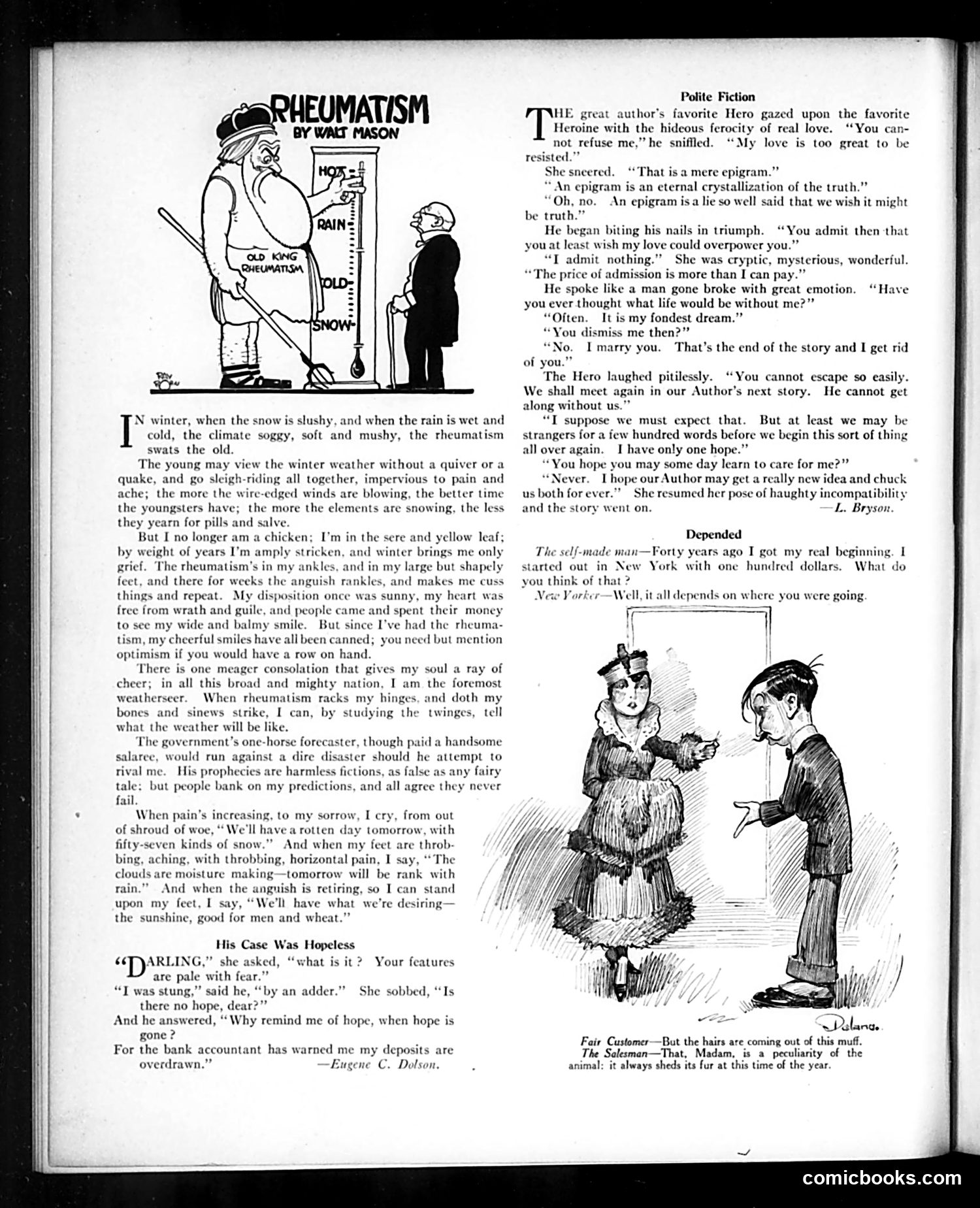
**"Rheumatism"** (left cartoon): An elderly man with exaggerated features represents a rheumatism sufferer who claims to be a better weather forecaster than the government's official meteorologist. The joke satirizes both aging (losing vigor, becoming unable to enjoy winter activities young people enjoy) and the unreliability of early 20th-century weather prediction. The "Old King Rheumatism" personification treats the ailment as a ruler. The humor lies in the ironic premise that chronic joint pain somehow grants supernatural predictive powers—a jab at both the elderly's tendency to attribute significance to their aches and the government weather service's actual poor accuracy. **"Polite Fiction"** (right): A satirical dialogue between a romantic Hero and Heroine mocking Victorian melodramatic literature. The hero's declarations of overwhelming love are met with the heroine's clever, evasive witticisms. The satire targets overwrought romantic fiction tropes—excessive emotion, purple prose, and stock character responses—by having characters constantly undermine sincerity with clever deflections. Their cynical banter and her ultimate agreement to marry him "to get rid of you" suggests the artificiality of romantic narratives itself.
📄 Transcribed text from this page (OCR, searchable)
Machine-transcribed from the original scan — historical spelling and the odd misread are preserved.
N winter, when the snow is slushy, and when the rain is wet and cold, the climate soggy, soft and mushy, the rheumatism swats the old. The young may view the winter weather without a quiver or a quake, and go sleigh-riding all together, impervious to pain and ache; the more the wire-edged winds are blowing, the better time the youngsters have; the more the elements are snowing, the less they yearn for pills and salve. But I no longer am a chicken; I’m in the sere and yellow lea! by weight of years I’m amply stricken, and winter brings me on grief. The rheumatism’s in my ankles, and in my large but shapely feet, and there for weeks the anguish rankles, and makes me cuss things and repeat. My disposition once was sunny, my heart was free from wrath and guile, and people came and spent their money to see my wide and balmy smile. But since I’ve had the rheuma- tism, my cheerful smiles have all been canned; you need but mention optimism if you would have a row on hand. There is one meager consolation that gives my soul a ray of cheer; in all this broad and mighty nation, I am the foremost weatherseer. When rheumatism racks my hinges, and doth m bones and sinews strike, I can, by studying the twinges, tell what the weather will be like. The government’s one-horse forecaster, though paid a handsome salaree, would run against a dire disaster should he attempt to rival me. His prophecies are harmless fictions, as false as any fairy tale: but people bank on my predictions, and all agree they never fail. When pain’s increasing, to my sorrow, I cry, from out of shroud of woe, “ We'll have a rotten day tomorrow, with fifty-seven kinds of snow.” And when my feet are throb- bing, aching, with throbbing, horizontal pain, I say, “The clouds are moisture making—tomorrow will be rank with rain.” And when the anguish is retiring, so I can stand upon my feet, I say, “We'll have what we're desiring— the sunshine, good for men and wheat.” His Case Was Hopeless 6éT)ARLING,” she ed, “what is it ? are pale with i “T was stung,” said he, “by an adder.” there no hope, dear?” And he answered, “Why remind me of hope, when hope is gone For the bank accountant has warned me my deposits are overdrawn.” Eug C. Dolson. Your features She sobbed, “Is Polite Fiction HE great author’s favorite Hero gazed upon the favorite Heroine with the hideous ferocity of real love. “You can- not refuse me,” he sniffled. ‘My love is too great to be resisted.” She sneered. “That is a mere epigram.”” “An epigram is an eternal crystallization of the truth.” “Oh, no. An epigram isa lie so well said that we wish it might be truth. He began biting his nails in triumph. “You admit then that you at least wish my love could overpower you.” “I admit nothing.” She was cryptic, mysterious, wonderful. “The price of admission is more than I can pay. He spoke like a man gone broke with great emotion. you ever thought what life would be without me?” “Often. It is my fondest dream.” “You dismiss me then?” ‘No. I marry you. That’s the end of the story and I get rid of you The Hero laughed pitilessly. We shall meet again in our Author’s next story. along without u: “T suppose we must expect that. strangers for a few hundred words before we begin this all over again. I have only one hope.” You hope you may some day learn to care for me?” I hope our Author may get a really new idea and chuck She resumed her pose of haughty incompatibility L. Bryson. “Have “You cannot escape so easily. He cannot get But at least we may be sort of thing Never. us both for ever.” and the story went on. Depended ears ago I got my real beginning. 1 What do The self-made man—Forty started out in New York with one hundred dollars. you think of that ? Vew Yorker —Well, it all depends on where you were going | Fair Customer—But the hairs are coming out of this muff. The Salesman—That, Madam, is a peculiarity of the animal: it always sheds its fur at this time of the year. comicbooks.com