
Judge, 1916-03-04 · page 5 of 28
Judge — March 4, 1916 — page 5: what you’re looking at
What you’re looking at
This satirical story illustrates early 20th-century church governance conflicts. Rev. Adoniram Meekly proposes reforming his church choir, which includes Thyza Todd, a long-standing singer described as difficult. The "Standing Committee" debates whether to remove her. The satire targets institutional resistance to change. Despite Thyza's admitted poor singing and difficult temperament, the committee refuses to eliminate her—citing her decades of service and the disruption removal would cause. Deacon Piffleinger argues keeping problematic members is preferable to conflict. The cartoon mocks how organizations prioritize avoiding confrontation over actual improvement, even when change would be beneficial. It's a timeless commentary on institutional inertia and the costs of appeasing difficult longtime members to maintain peace.
📄 Transcribed text from this page (OCR, searchable)
Machine-transcribed from the original scan — historical spelling and the odd misread are preserved.
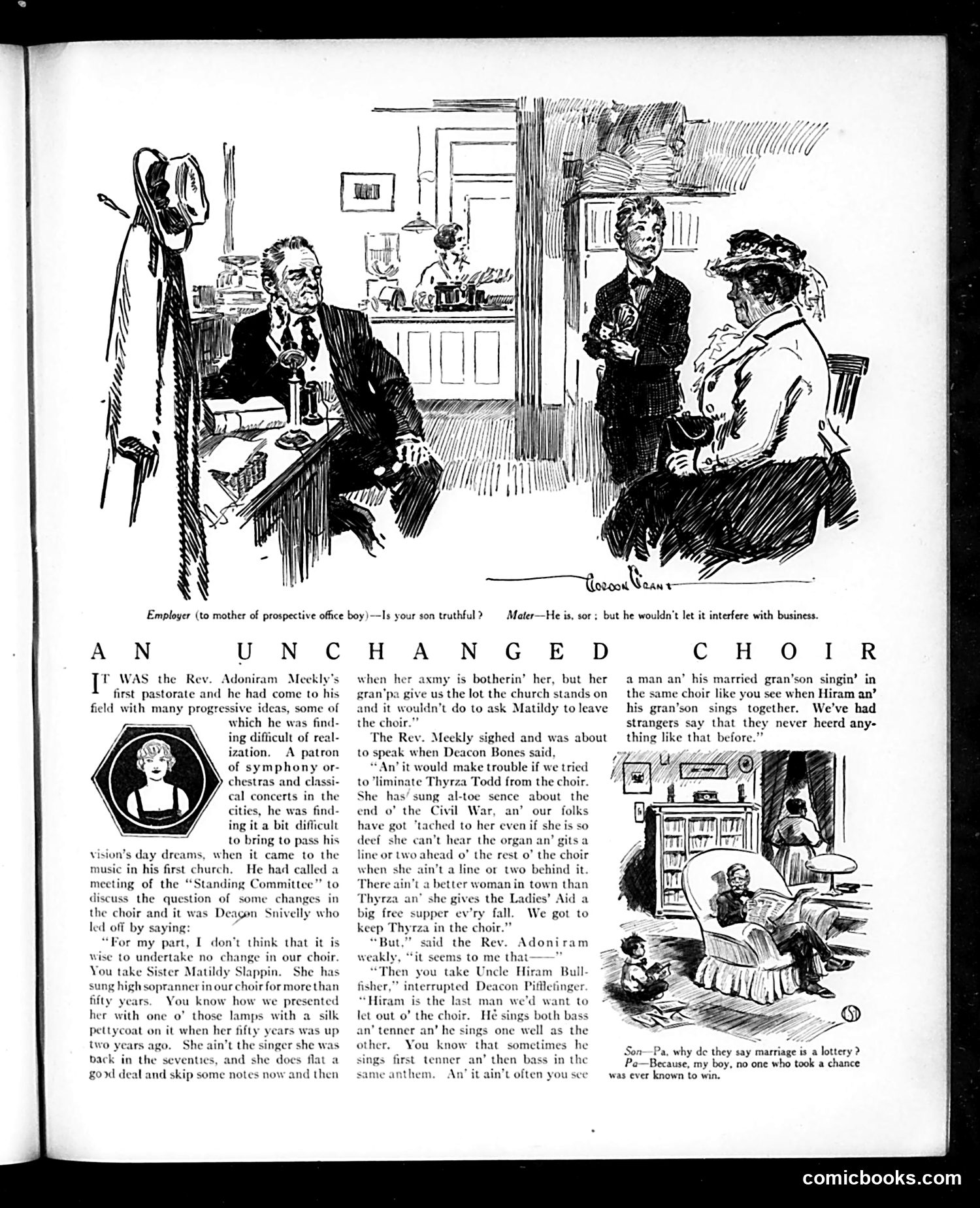
Employer (to mother of prospective office boy)--Is your son truthful ? A N UN C U WAS the Rev. Adoniram Meekly’s first pastorate and he had come to his field with many progre which he was find- ing difficult of real- ization. A patron of symphony or- chestras and classi cal concerts in the cities, he was find- ing it a bit difficult to bring to pass his vision’s day dreams, when it came to the music in his first church. He had called a meeting of the “Standing Committce”’ to discuss the question of some changes in the choir and it was Deagen Snivelly who led off by saying: ‘ “For my part, [ don’t think that it is wise to undertake no change in our choir. You take Sister Matildy Slappin. She has sung high sopranner in our choir for more than fif ars. You know how we presented her with one o’ those lamps with a. silk pettycoat on it when her fifty years was up two years ago. She ain’t the singer she was back in the seventies, and she does flat a good deal and skip some notes now and then YI, Mi ‘. ZZ ——be2000 an Mater—He is, sor; bi H A N G E D when her axmy is botherin’ her, but her gran’pa give us the lot the church stands on and it wouldn’t do to ask Matildy to leave the choir.” The Rev. Meekly sighed and w to speak when Deacon Bones said, “ An’ it would make trouble if we tried to ‘liminate Thyrza Todd from the choir. She has’ sung al-toe sence about the end o’ the Civil War, an’ our folks have got ‘tached to her even if she is so deef she can’t hear the organ an’ gits a line or two ahead o° the rest 0 the choir when she ain’t a line or two behind it. There ain’t a better woman in town than Thyrza an’ she gives the Ladies’ Aid a free supper ev’ry fall. We got to keep Thyrza in the choir “But,” said the Rev. Adoniram weakly, “it seems to me that— “Then you take Uncle Hiram Bull- fisher,” interrupted Deacon Pitfletinger. “Hiram is the last man we'd want to let out o’ the choir. Heé sings both bass an’ tenner an’ he sings one well as the other, You know that sometimes he sings first tenner an’ then bass in the An’ it ain’t often you sce about same anthem, ut he wouldn't let it interfere with business. C H O I aman an’ his married gran’son singin’ the same choir like you see when Hiram an’ his gran’son sings together. We’ve had strangers say that they never heerd any- thing like that befor Son—Pa, why de they say marriage is a lottery ? Po—Because, my boy, no one who took a chance was ever known to win, comicbooks.com