
Judge, 1916-03-04 · page 17 of 28
Judge — March 4, 1916 — page 17: what you’re looking at
What you’re looking at
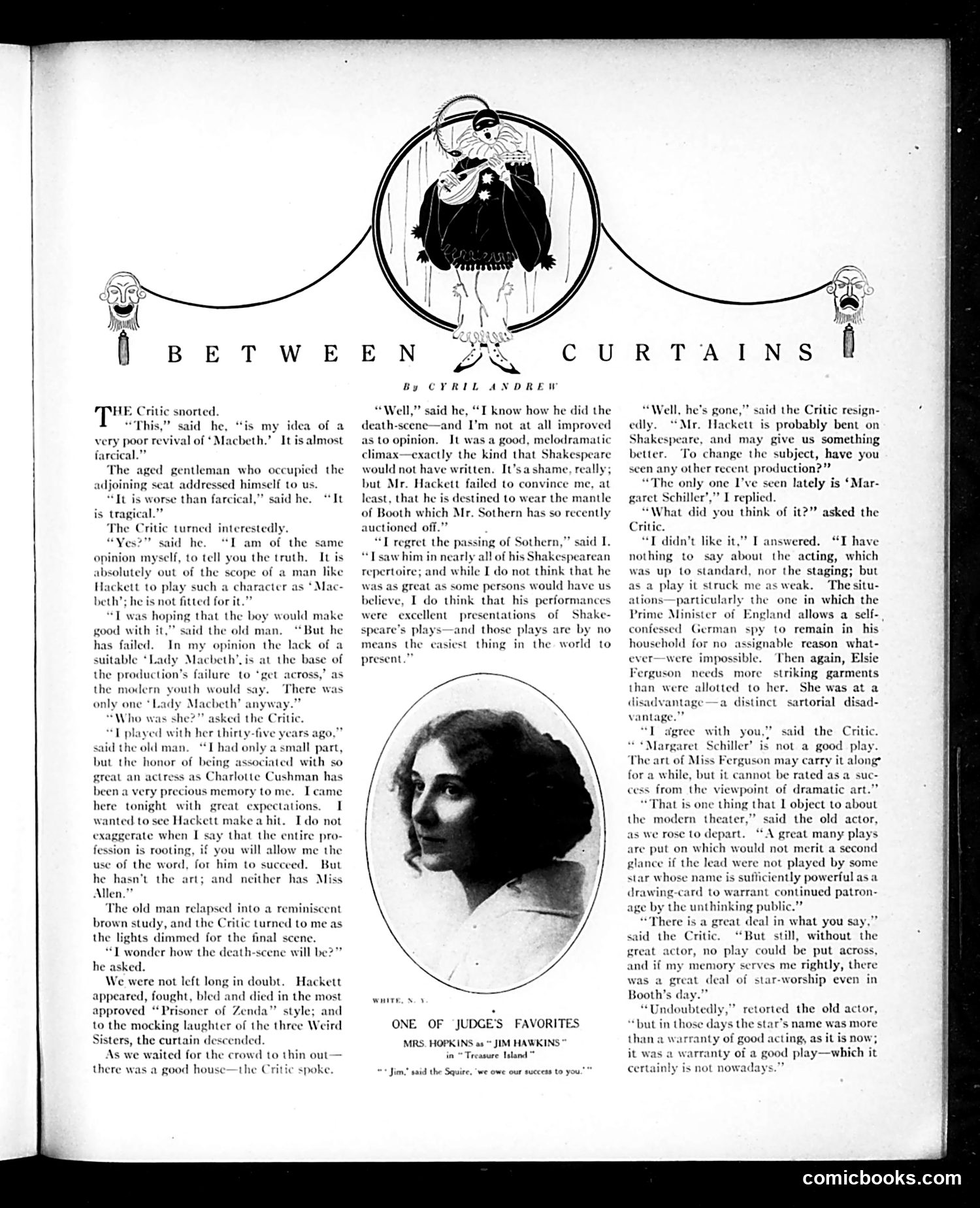
This page presents a theatrical dialogue by Cyril Andrew, framed as a debate between a theater Critic and an elderly gentleman at a performance of *Macbeth* starring James Hackett. **The Point:** The satire contrasts modern commercial theater with theatrical "golden age" standards. The old man nostalgically recalls performing alongside Charlotte Cushman (a celebrated 19th-century actress), implying contemporary actors like Hackett lack genuine artistry. The Critic agrees—Hackett's death scene is melodramatic spectacle rather than Shakespearean authenticity. A secondary review criticizes a play called "Margaret Schiller" for its implausible plot (a German spy in a Prime Minister's household) while acknowledging the actress Elsie Ferguson's talent cannot salvage weak material. **The Satire's Target:** Judge critiques both modern theater's commercial mediocrity and audiences' acceptance of star power over substance—a recurring concern in early 20th-century American theater criticism. The accompanying portrait identifies "One of Judge's Favorites": Mrs. Hopkins as Jim Hawkins in *Treasure Island*.
📄 Transcribed text from this page (OCR, searchable)
Machine-transcribed from the original scan — historical spelling and the odd misread are preserved.
BET WE HE Critic snorted. “This,” said he, “is my idea of a very poor revival of ‘Macbeth.” It is almost farcical.” aged gentleman who occupied the udjoining seat addressed himself to us. “It is worse than farcical,” said he. “It is tragical.”” The Critic turned interestedly. “Yes?” said he. “I am of the same opinion myself, to tell you the truth. It is absolutely out of the scope of a man like Hackett to play such a character as ‘Mac- beth’; he is not fitted for it.” “Twas hoping that the boy would make good with it,” said the old man, “But he has failed. In my opinion the lack of a suitable ‘Lady Macbeth’.is at the base of the production’s failure to ‘get across,’ as the modern youth would say, There was only one ‘Lady Macbeth’ anyway.” “Who was she?” asked the Critic. “L played with her thirty-five years ag said the old man. “Thad only a small part, but the honor of being great an actress as Charlotte Cushman has been a very precious memory to me. Icame here tonight with great expectations. I wanted to see Hackett make a hit. Ido not exaggerate when I say that the entire pro- fession is rooting, if you will allow me the use of the word, for him to succeed. But he hasn't the art; and neither has Miss Allen.” The old man relapsed into a reminiscent brown study, and the Critic turned to me as the lights dimmed for the final scene. “1 wonder how the death-scene will be?” he asked. We were not left long in doubt. Hackett appeared, fought, bled and died in the most approved “Prisoner of Zenda” style; and to the mocking laughter of the three Weird s, the curtain descended. As we waited for the crowd to thin out— there was a good house—the Critic spoke. sociated with so EN 7 By CYRIL ANDREW “Well,” said he, “I know how he did the death-scene—and I’m not at all improve: as to opinion. It was a good, melodramatic climax—exactly the kind that Shakespeare would not have written. It’sashame, really; but Mr. Hackett failed to convince me, at least, that he is destined to wear the mantle of Booth which Mr. Sothern so recently auctioned off.”” “T regret the passing of Sothern,” said I. “T saw him in nearly all of his Shakespearean repertoire; and while I do not think that he Was as great as some persons would have us I do think that his performances presentations of Shake- and those plays are by no thing in the world to believe, were excellent speare’s plays means the easiest present.” waite, Sy ONE OF JUDGE'S FAVORITES MRS. HOPKINS as = JIM HAWKINS in Treasure Island * + Jim. said the Squire, ‘we owe our success to you." " CURTAINS “Well, he’s gone,” said the Critic resign- edly. “Mr. Hackett is probably bent on Shakespeare, and may give us something better. To change the subject, have you seen any other recent production?” “The only one I’ve seen lately is ‘Mar- garet Schiller’,” I replied. “What did you think of it?” asked the Critic. “1 didn’t like it,” I answered. “TI have nothing to about the acting, which was up to standard, nor the staging; but as a play it struck me as weak. The situ- particularly the one in which the Prime Minister of England allows a self- confessed German spy to remain in his houschold for no assignable reason what- ever—were impossible. Then again, Elsie Ferguson more striking garments than were allotted to her. She was at a disadvantage —a distinct sartorial disad- ations: needs vantage “TL agree with you,” said the Critic. “ ‘Margaret Schiller’ is not a good play. The art of Miss Ferguson may carry it along? for a while, but it cannot be rated as a suc- cess from the viewpoint of dramatic art.” “That is one thing that 1 object to about the modern theater,” said the old actor, as we rose to depart. “A great many plays are put on which would not merit a second glance if the lead were not played by some star whose name is sufficiently powerful as a drawing-card to warrant continued patron- by the unthinking public.” There is a great deal in what you say,” said the Critic. “But still, without the great actor, no play could be put across, and if my memory serves me rightly, there was a great deal of star-worship even in Booth’s day.” “Undoubtedly,” retorted the old actor, “but in those days the star’s name was more than a warranty of good acting, as it is now; it was a warranty of a good play—which it y is not nowadays.” certain comicbooks.com