
A complete issue · 28 pages · 1916
Judge — February 12, 1916
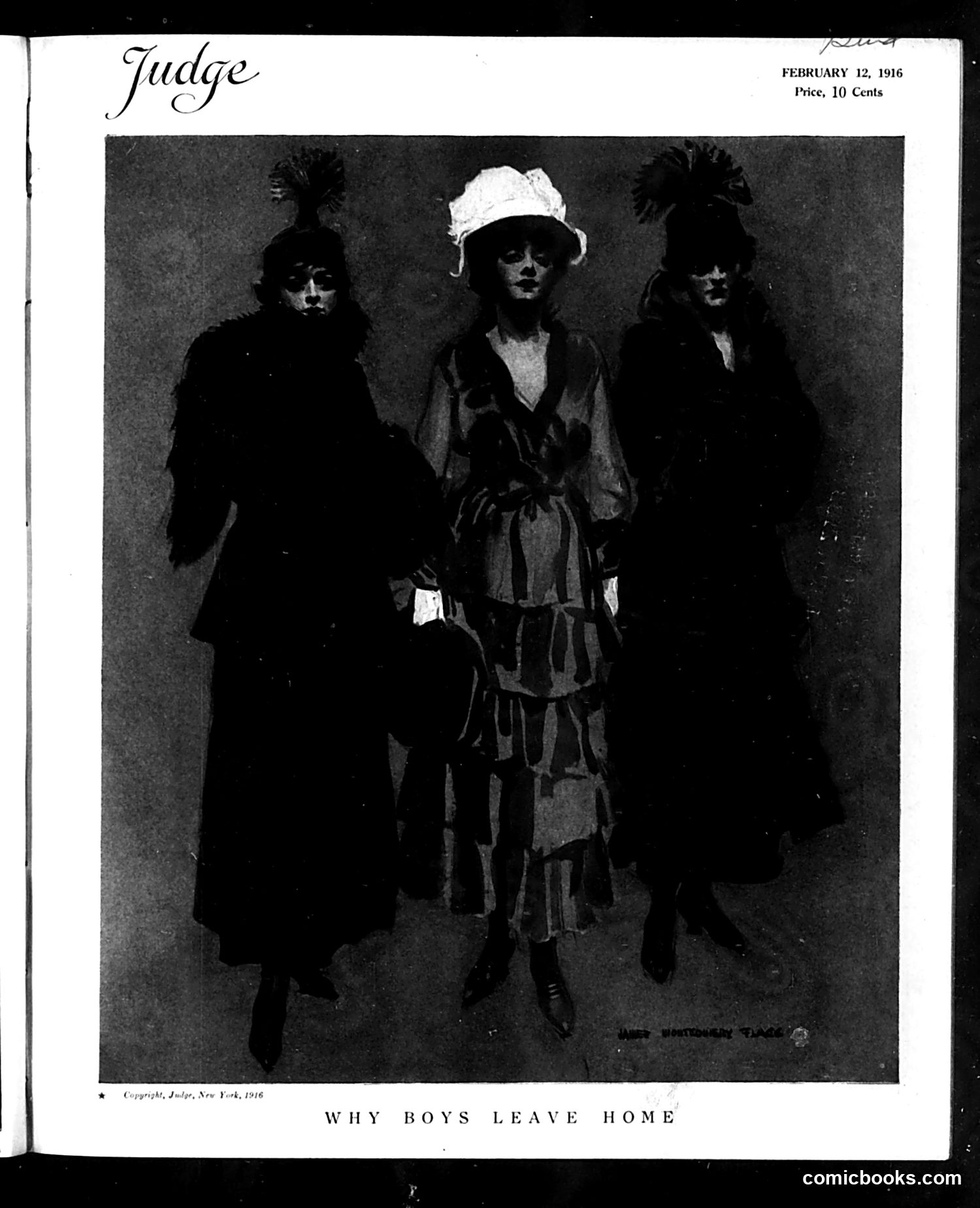
This 1916 Judge magazine cartoon satirizes the attraction of women to young men. The image shows three fashionably dressed women in period clothing—the center figure notably wearing a distinctive white hat and striped dress, flanked by two women in dark coats and feathered hats. The caption "Why Boys Leave Home" is a humorous commentary on heterosexual attraction and courtship. The joke suggests that young men abandon their family homes to pursue romantic interests, implicitly blaming attractive women for this departure. The women's fashionable attire emphasizes their appeal as the "reason" boys leave. This reflects early 20th-century social commentary on youth, romance, and changing domestic patterns, presented through lighthearted satirical humor typical of Judge magazine's content.
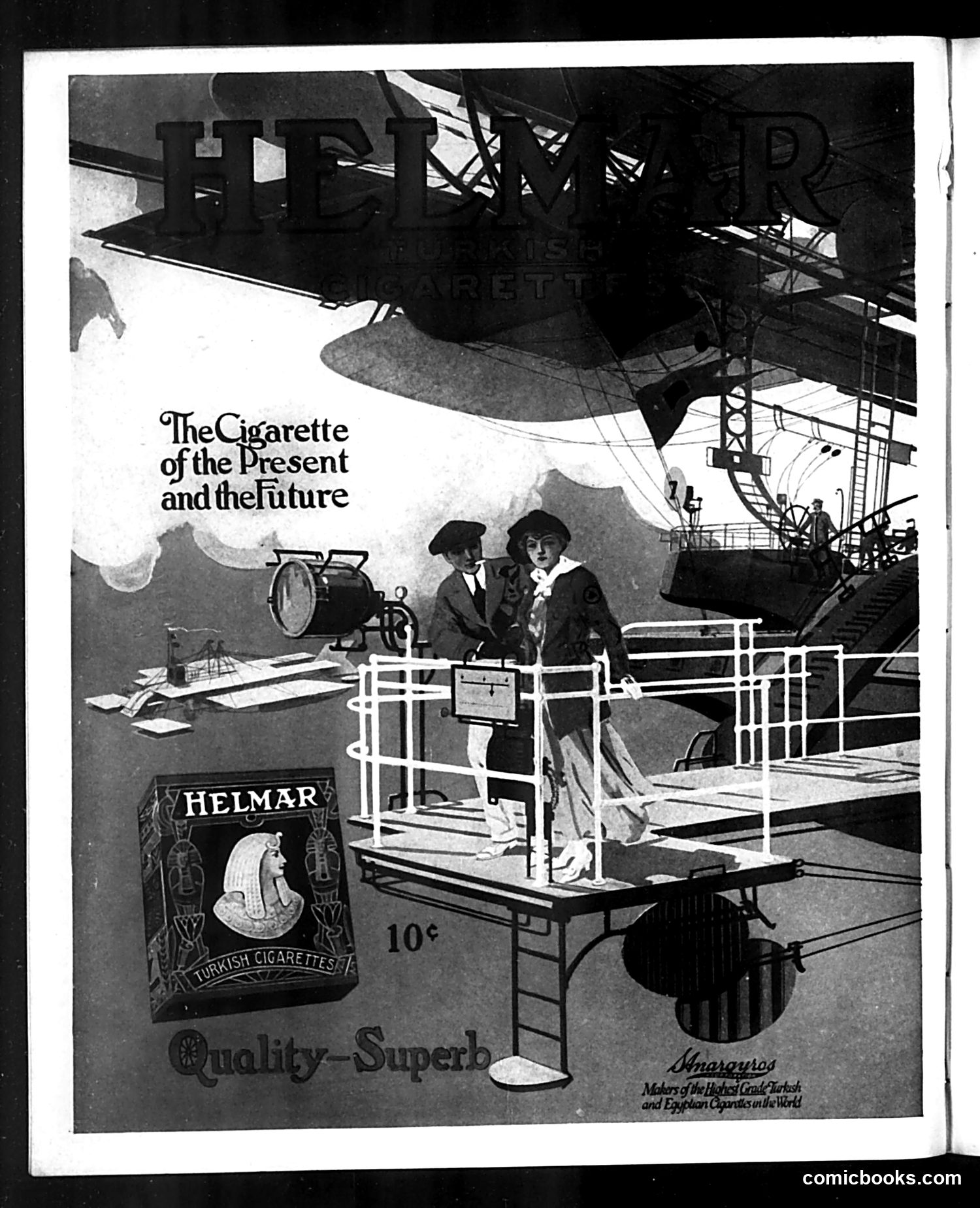
This is primarily a **cigarette advertisement** for Helmar brand Turkish cigarettes (priced at 10¢), not political satire. The ad's headline—"The Cigarette of the Present and the Future"—promotes the product as modern and forward-thinking. The image depicts two well-dressed men aboard what appears to be an airship or zeppelin, with industrial machinery visible. This futuristic setting was meant to suggest progress and sophistication. The tagline "Quality-Superb" emphasizes product superiority. The detailed technical background suggests the advertiser was appealing to readers interested in modern technology and innovation—positioning cigarette smoking as part of an aspirational, technologically advanced lifestyle. This reflects early 20th-century marketing strategies linking consumer products to ideas of progress.
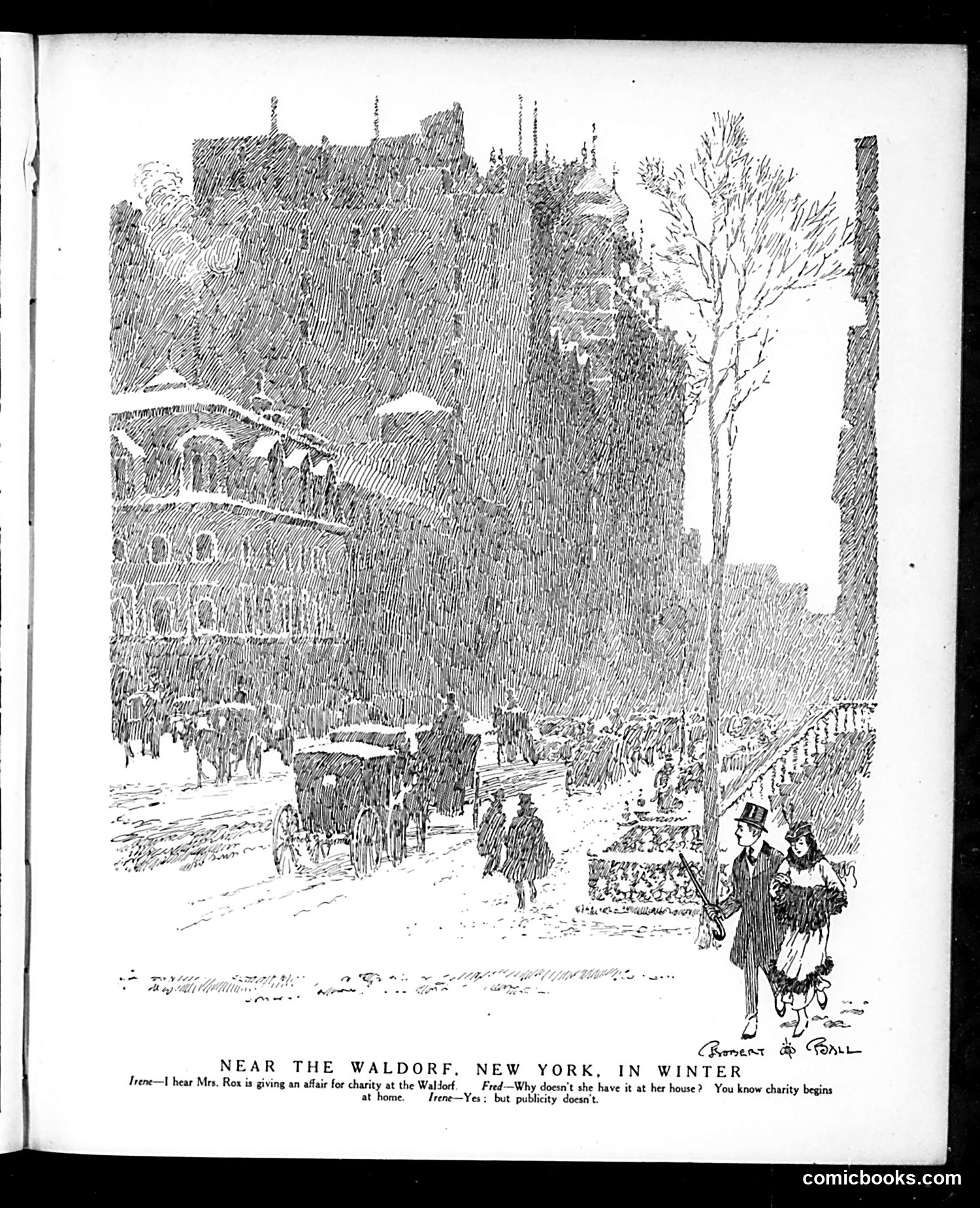
This is a Robert Cobell sketch titled "Near the Waldorf, New York, in Winter." The cartoon depicts a wealthy woman (likely Mrs. Rox, referenced in the dialogue) conducting a winter charity event near the exclusive Waldorf Hotel. The scene shows crowds of poor citizens gathered in snowy conditions. The satire targets hypocrisy in charitable giving: Irene notes Mrs. Rox is "giving an affair for charity at the Waldorf," while Fred cynically observes she won't do charity at her own home, concluding "You know charity begins at home." The joke mocks the performative nature of public philanthropy—wealthy donors prefer visible, prestigious venues where their generosity earns social recognition, rather than genuine private charity. The contrast between the ostentatious setting and actual charitable need underscores the critique of self-serving benevolence.
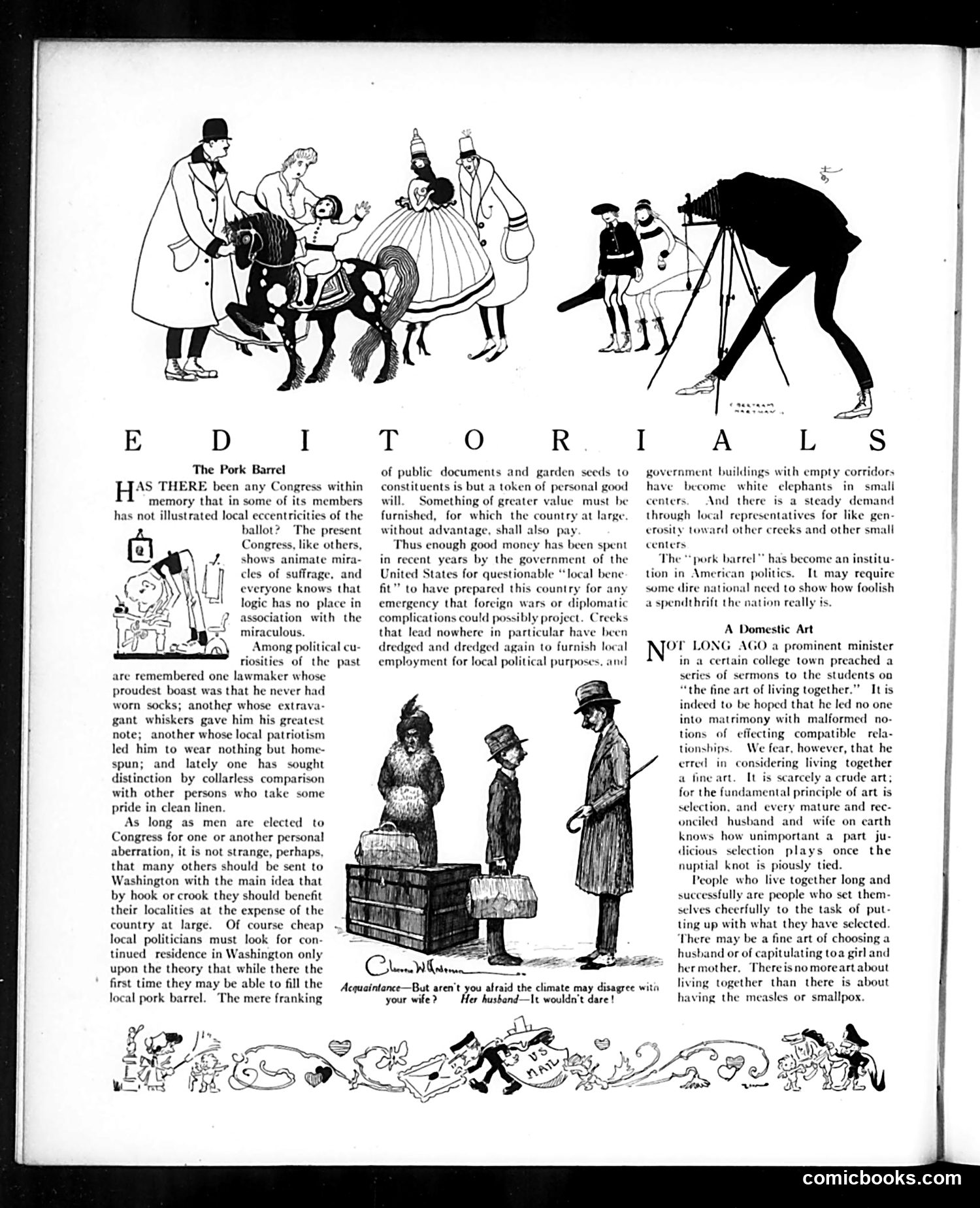
This page satirizes Congress members' hypocrisy regarding "local pork barrel" spending. The top illustration shows politicians photographing themselves with constituents—mocking performative patriotism for political gain. The central cartoon depicts two figures debating climate concerns. One warns about climate affecting his wife; the other dismissively replies "It wouldn't dare!"—satirizing politicians' unwillingness to take environmental issues seriously. The article criticizes Congress for: 1. Seeking credit for "local benefits" while avoiding responsibility for wasteful spending 2. Using public works projects for political advantage rather than genuine need 3. Hypocrisy: demanding fiscal responsibility while securing personal district funding The "Domestic Art" section comments on marriage selection as social/artistic choice, comparing it to political patronage. Overall, the page attacks congressional self-serving behavior and empty rhetoric.
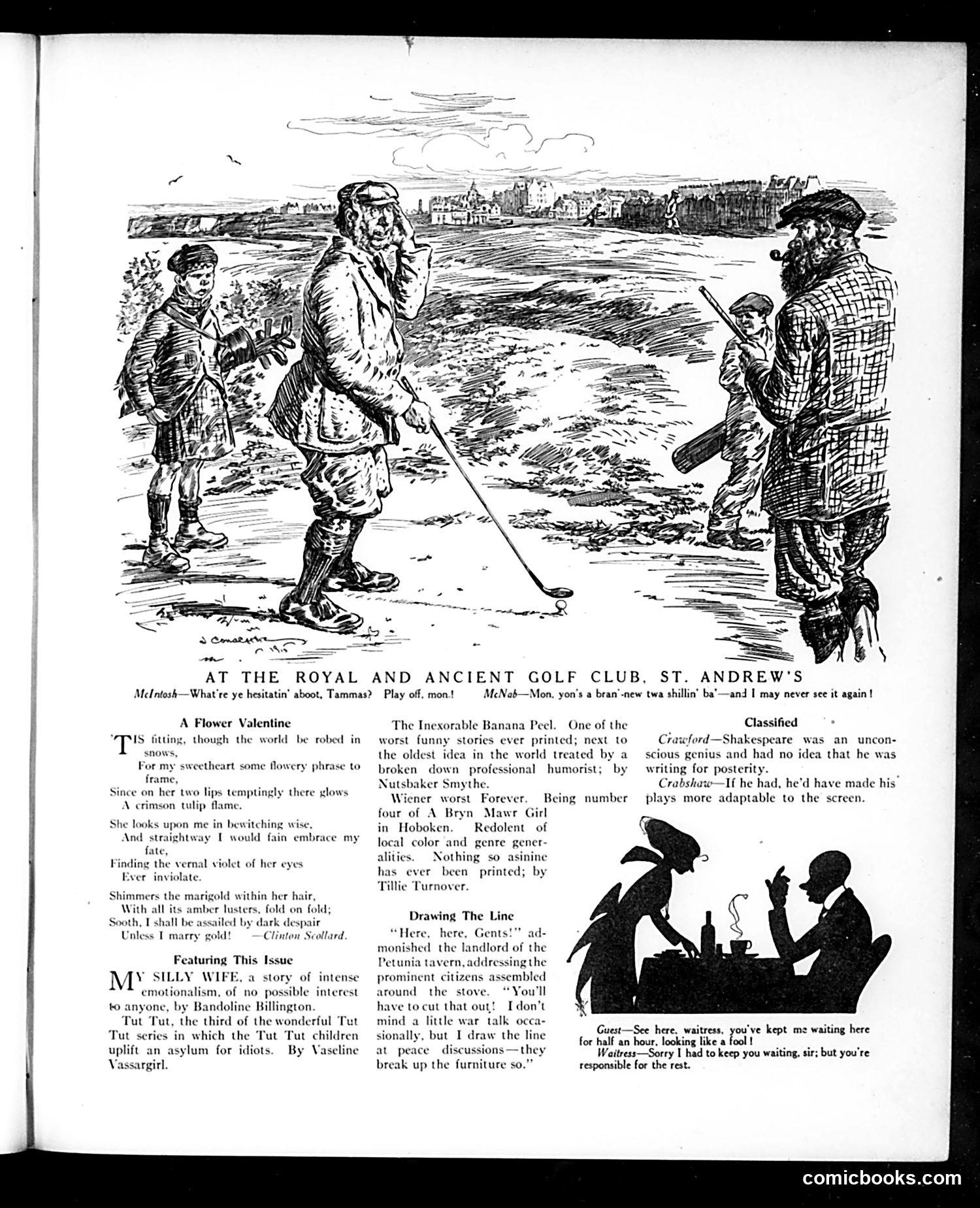
The top cartoon depicts golfers at St. Andrew's golf club in Scotland. The caption includes Scottish dialect ("What'e ye hoistain' aboot, Tammas?") and jokes about golf etiquette—one golfer appears to have hit unusually far and is asking another to "Play off, mon!" The humor derives from Scottish regional speech and the absurdity of golf's formal rules being applied to an extraordinarily long shot. Below are literary commentary pieces critiquing famous authors (Shakespeare, Crashaw) and book reviews. The bottom cartoon shows a restaurant scene where a waiter apologizes for a long wait, blaming it on the guest's own tardiness—a joke about service industry hospitality excuses. This page mixes sports satire with literary criticism and social humor typical of Judge magazine's general-interest content.
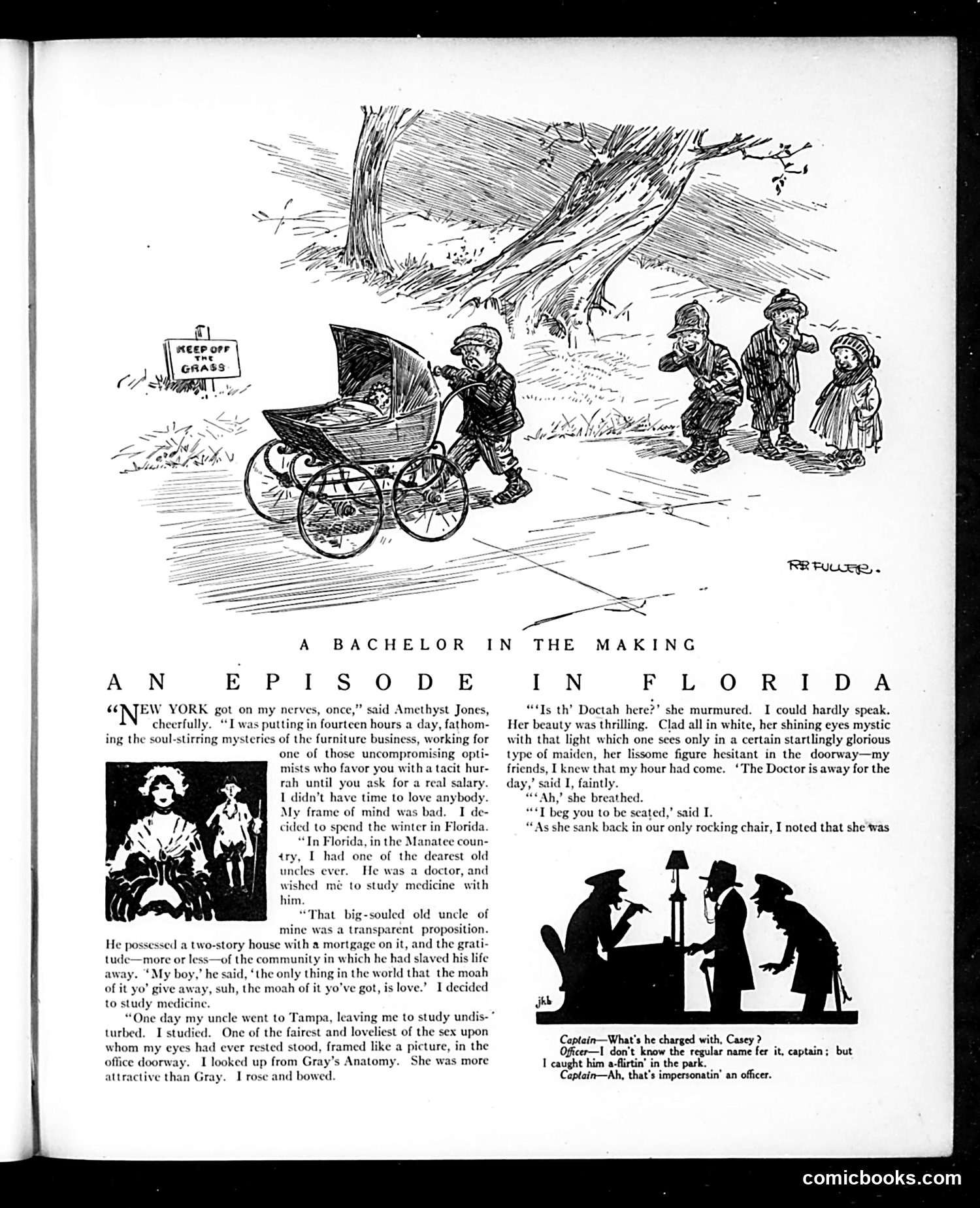
This page contains two separate pieces from Judge magazine: **Main Story:** "A Bachelor in the Making: An Episode in Florida" is a serialized romantic comedy. The narrator, Amethyst Jones, flees New York's grinding work life for Florida to study medicine with his uncle. When a beautiful young woman arrives seeking the doctor, he's instantly smitten. The humor derives from his melodramatic infatuation and the satirical portrait of his uncle—a supposedly noble country doctor who actually owns property with a mortgage and subtly manipulates the narrator into studying medicine. The narrative pokes fun at romantic idealization and small-town social dynamics. **Cartoon:** The bottom silhouette gag satirizes police enforcement of public morality. An officer arrests someone for "flirtin' in the park," and the captain dismisses it as "impersonatin' an officer"—suggesting that only officers should be flirting, or that the arrest itself is absurdly overreaching. It's social satire on Victorian-era restrictions on public behavior and overzealous law enforcement.
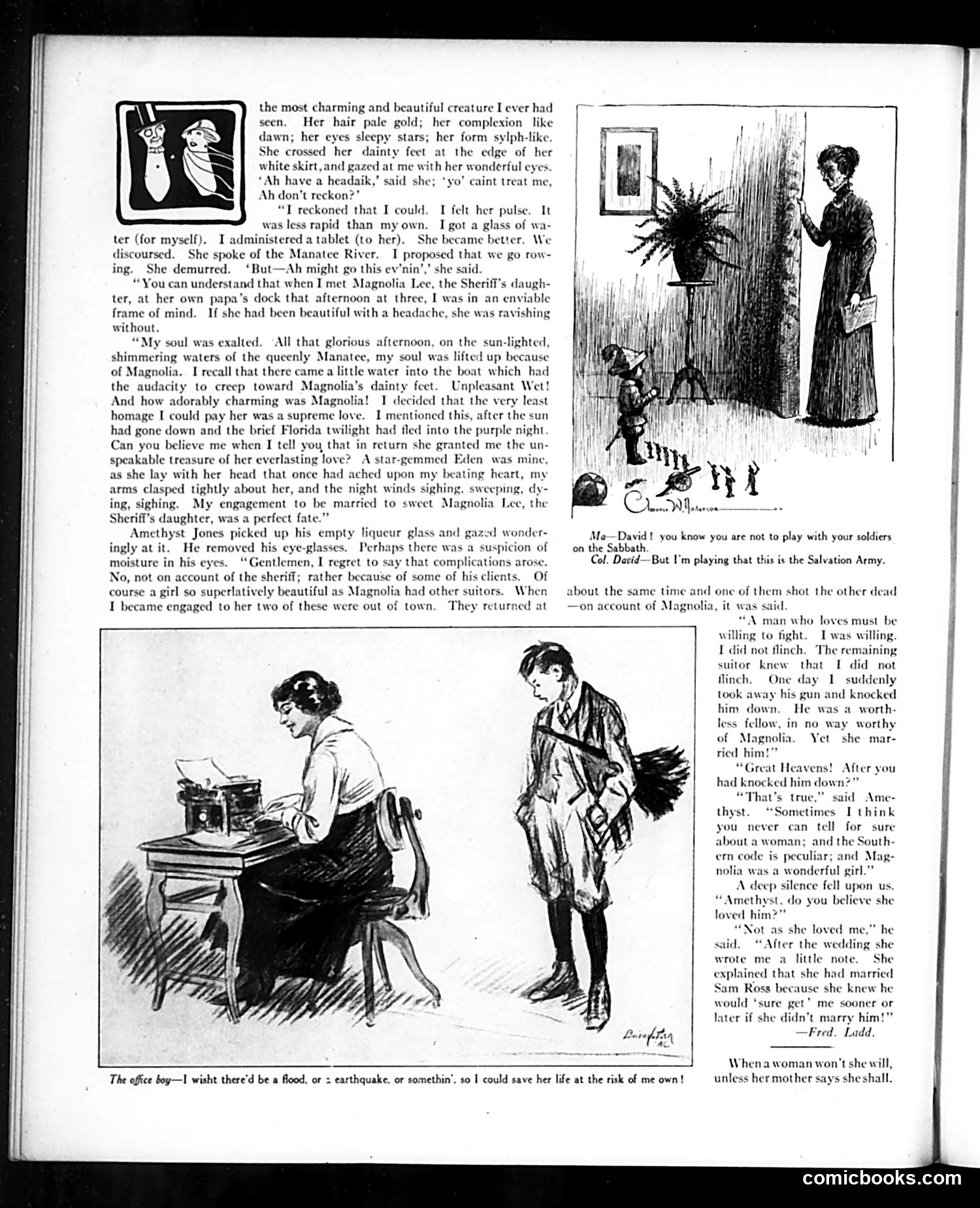
This page contains a romantic narrative with social commentary typical of early 20th-century Judge humor. **Main Story**: A man (Amethyst Jones) recounts his doomed courtship of Magnolia Lee, a Southern belle. He believed she loved him, but she married a rival suitor (Sam Ross) instead—allegedly to protect Jones from being killed by Sam in a duel. The joke is the absurd logic: the woman chose the man who would "sooner or later" kill her suitor, framing this as an act of love. **Social Satire**: The story mocks Southern romantic codes and male pride. The narrator's emotional self-indulgence contrasts with the woman's pragmatic ruthlessness. The ending moral—"When a woman won't she will, unless her mother says she shall"—suggests women's autonomy despite appearing passive. **Small Cartoon**: A child playing soldiers calls it "the Salvation Army," satirizing how children reframe military play as charity work. The overall tone suggests skepticism toward romantic sentimentality and Southern courtship conventions.
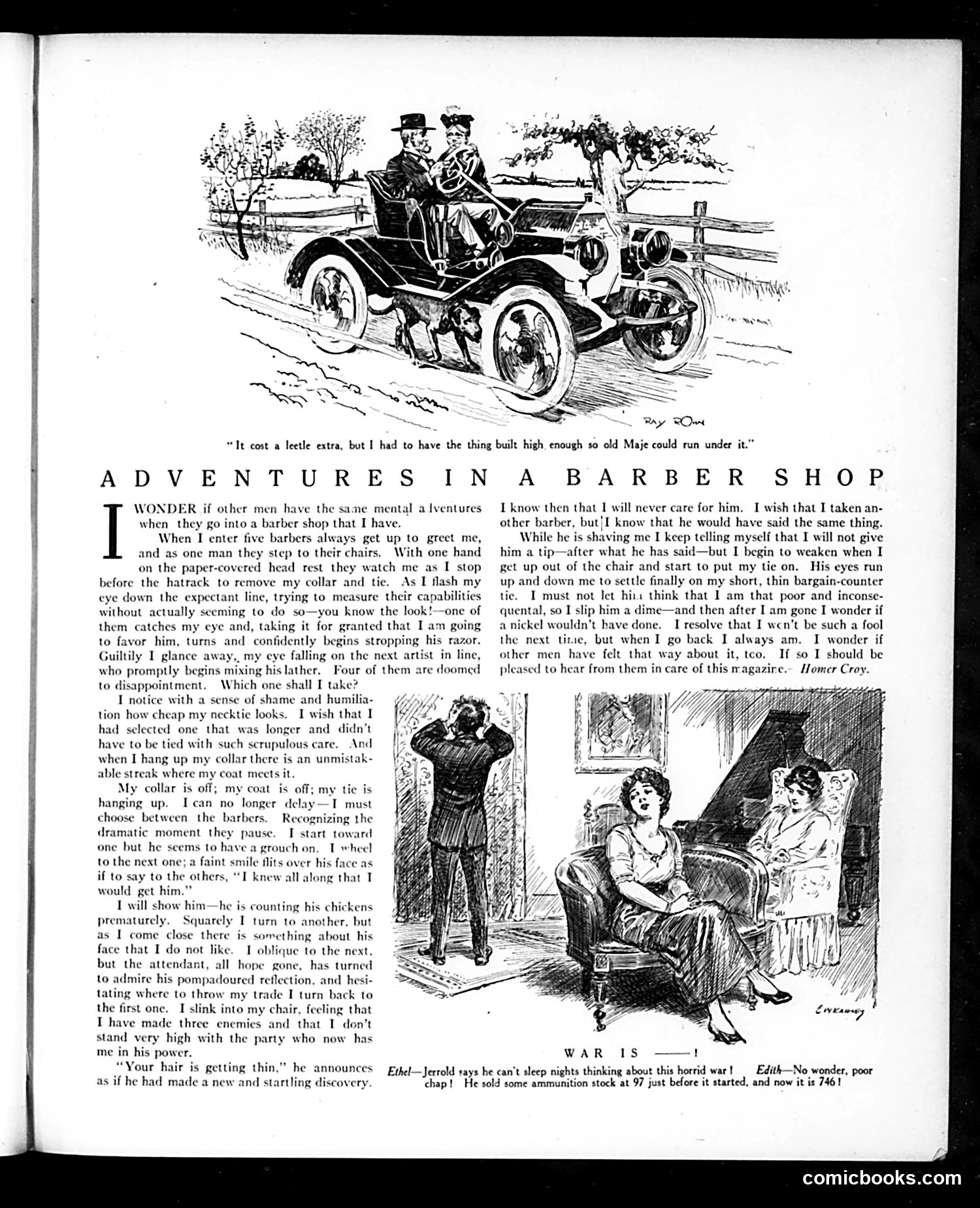
This page contains a humorous essay by Homer Croy about the social anxieties of choosing a barber, paired with two satirical cartoons. **Main Essay**: The narrator describes the awkward psychology of barber selection—how five barbers compete for his attention, and he must choose while feeling self-conscious about his cheap necktie and thin hair. He agonizes over tip-giving and whether the barber he rejects will hold a grudge. The humor lies in depicting universal male vanity and social anxiety as absurdly dramatic. **Top Cartoon**: Shows a couple in an early automobile built with an exaggerated chassis height. The caption jokes that it was built high enough "so old Maje could run under it"—likely referring to a horse or donkey, suggesting this new automobile technology is comically oversized. **Bottom Cartoon ("War Is—")**: A brief satirical exchange about World War I profiteering. One character mentions a man losing sleep over "this horrid war," but the punchline reveals he's actually upset because he sold ammunition stock at 97 before the war started—and it's now worth 746. This mocks war profiteers disguising financial self-interest as patriotic concern.
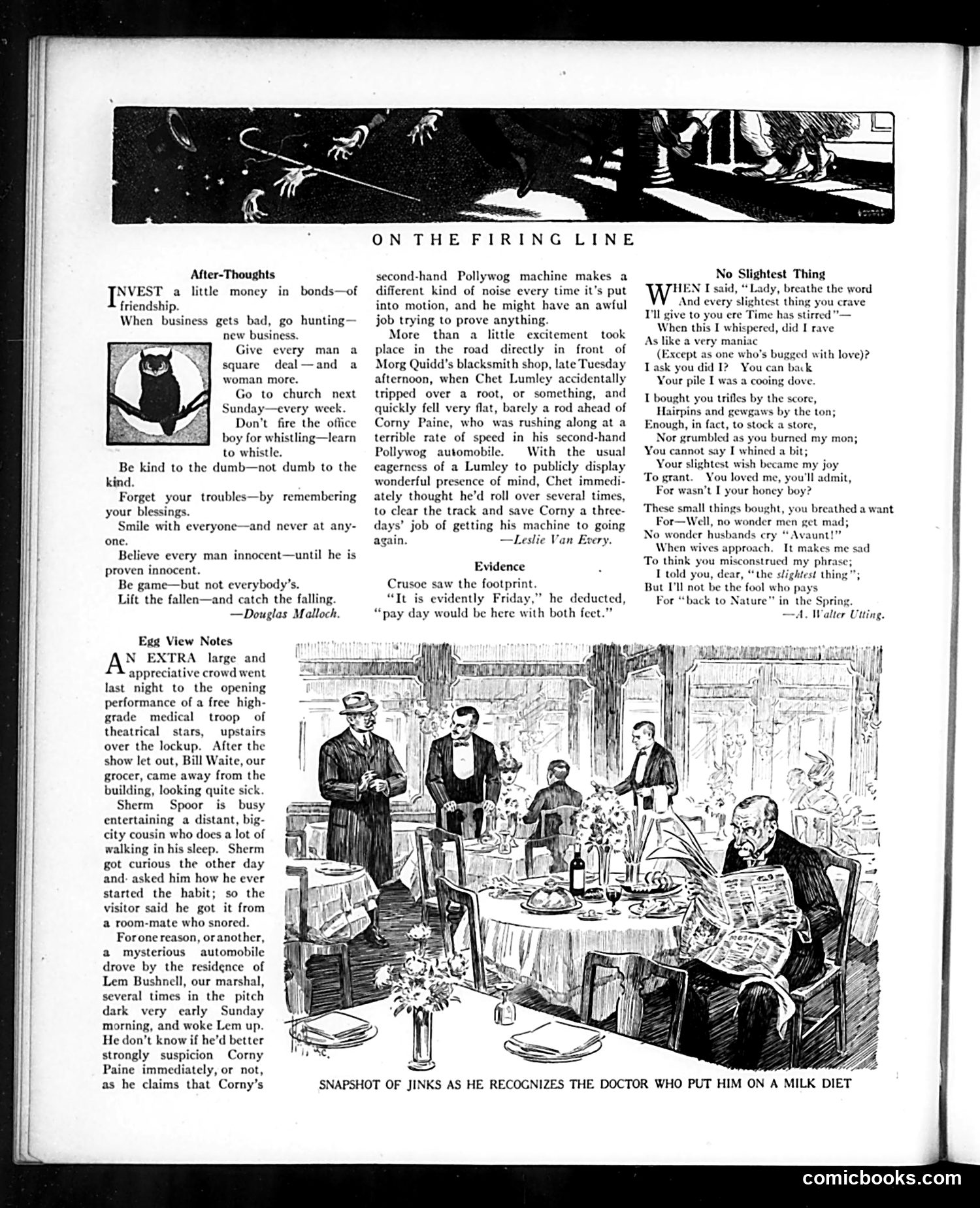
This page from *Judge* magazine contains three distinct pieces of light social humor: **"After-Thoughts"** presents homespun wisdom attributed to Douglas Malloch—pithy aphorisms about business ethics, kindness, and fair dealing ("Give every man a square deal—and a woman more"). These reflect early 20th-century moral philosophy. **"Egg View Notes"** is small-town gossip humor about rural characters and their mishaps: a mysterious automobile repeatedly driving past the marshal's house at night (possibly a prank), and a near-accident involving Corny Paine's unreliable "Pollywog" automobile. The comedy relies on local color and mechanical unreliability as a running joke. **The main cartoon** depicts a domestic dinner scene where a man recognizes a doctor among the guests—presumably the physician who prescribed a restrictive milk diet. The caption plays on social embarrassment and the awkwardness of encountering medical professionals socially. **"Evidence"** is a short joke about Robinson Crusoe deducing a footprint belongs to a visitor because "pay day would be here with both feet"—a dated pun on payday arrival. The content reflects pre-1920s American small-town life and genteel humor conventions.
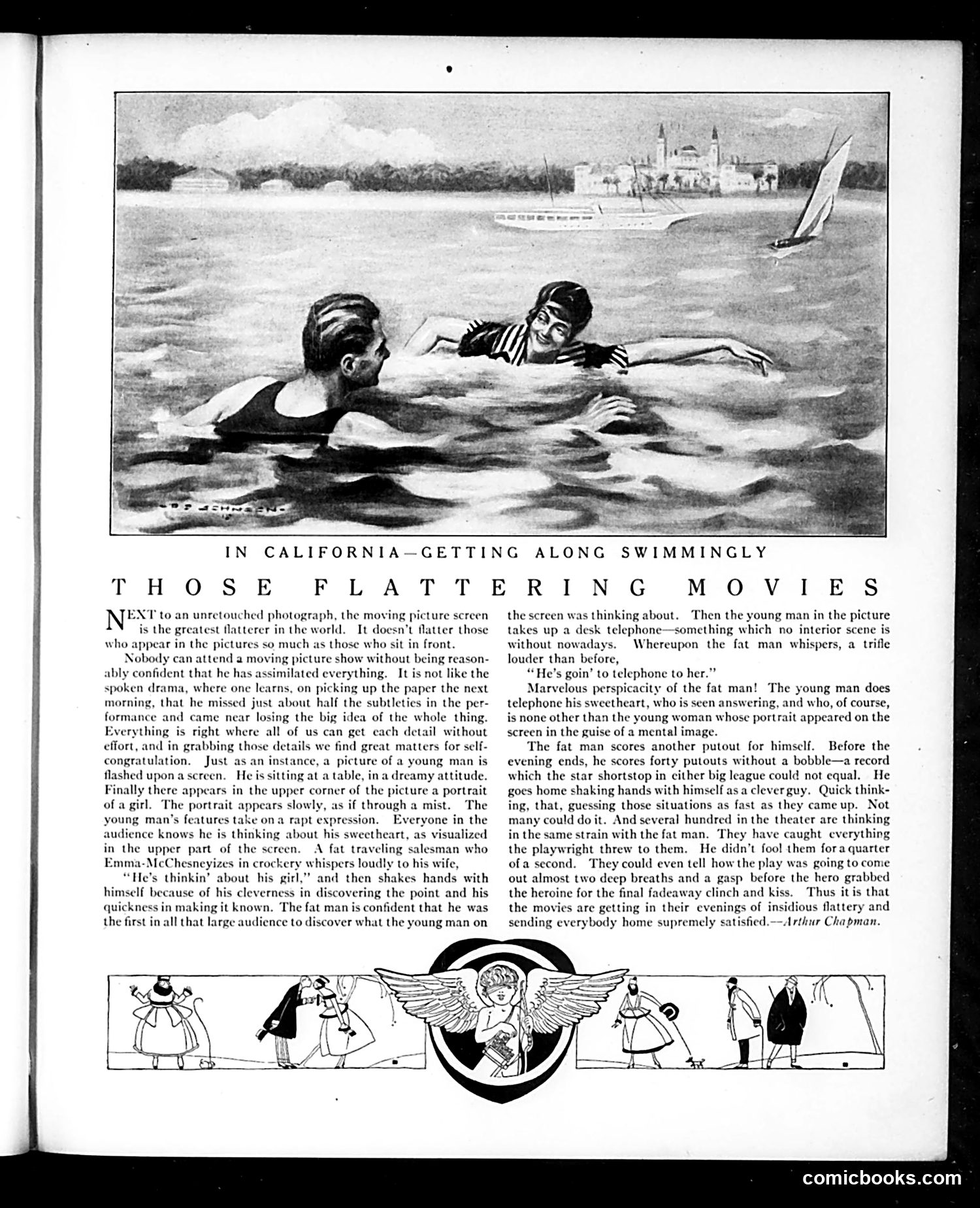
This satirical article mocks moviegoers' inflated sense of cleverness. The piece argues that silent films, unlike theater, make audiences feel intellectually superior because everything is visually spelled out—no subtlety to miss. The example centers on a "fat traveling salesman" who smugly congratulates himself for "discovering" obvious plot points: recognizing that a man is thinking of his sweetheart when her portrait appears on screen, predicting he'll telephone her. He scores "forty putouts" by evening's end, feeling brilliant. Chapman's satire targets the false confidence movies inspire in ordinary viewers. Unlike theater's spoken subtleties that require effort to parse, cinema's explicit visual storytelling allows anyone to follow along and mistake basic comprehension for genuine insight. The piece suggests movies flatter audiences by making them feel perceptive when they're simply following obvious narrative cues—a phenomenon Chapman finds both amusing and somewhat troubling about cinema's popularity.
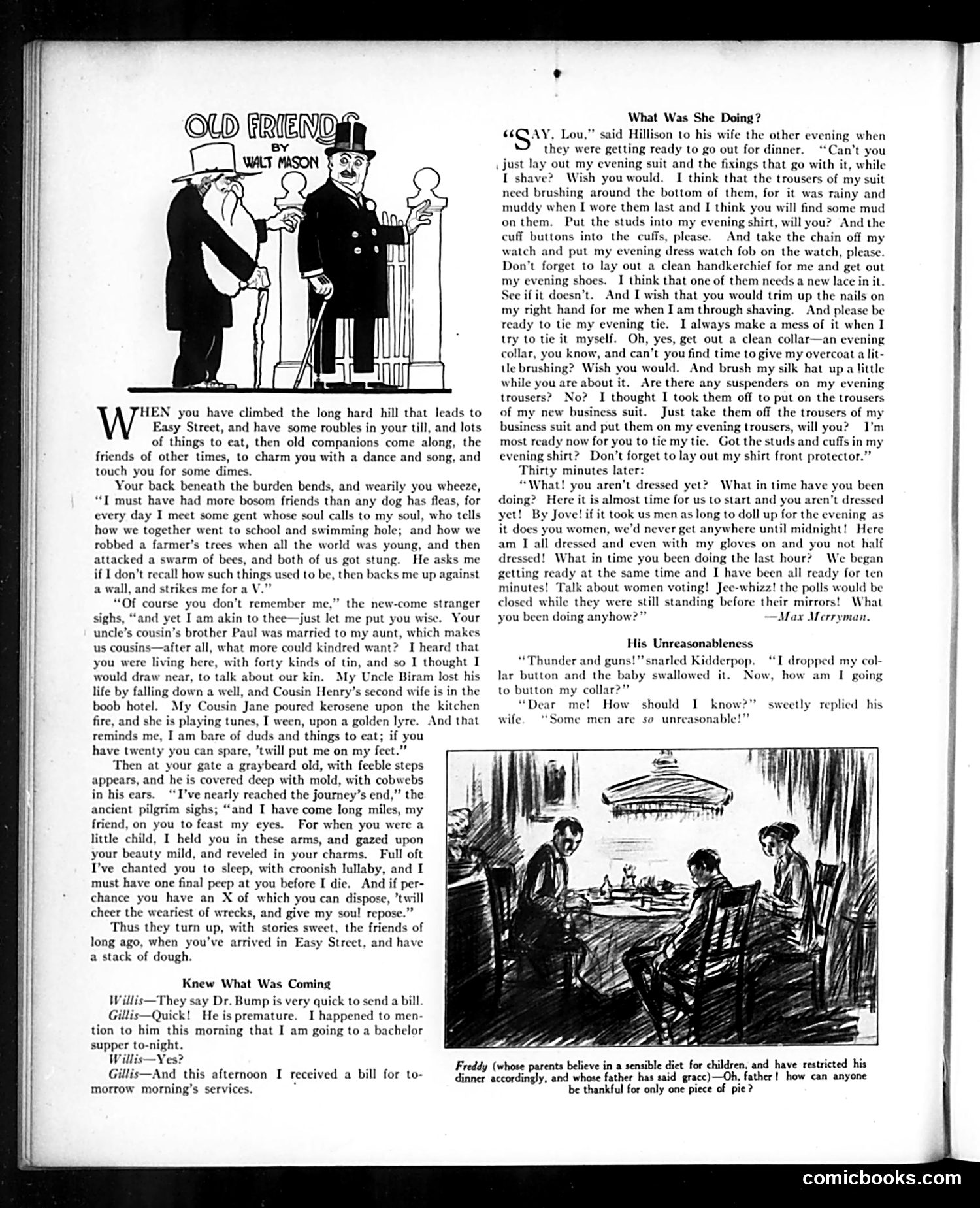
**"Old Friend"** satirizes social parasitism among the poor. The cartoon depicts men who exploit loose social connections—claiming distant kinship or childhood friendship—to extract money from someone who has achieved modest success ("Easy Street"). The repeated requests for loans ("strikes me for a V") from supposed relatives and old schoolmates illustrate how financial success attracts opportunistic hangers-on. **"What Was She Doing?"** mocks the double standard in domestic labor. A husband barks an endless list of demands—pressing clothes, arranging accessories, trimming nails—before going out. When his wife isn't ready at the appointed time, he complains bitterly about women's inefficiency and fitness to vote. The satire exposes his obliviousness: his wife spent the time preparing *his* appearance while he merely dressed himself. The piece critiques both male entitlement and the anti-suffrage argument that women lack efficiency.
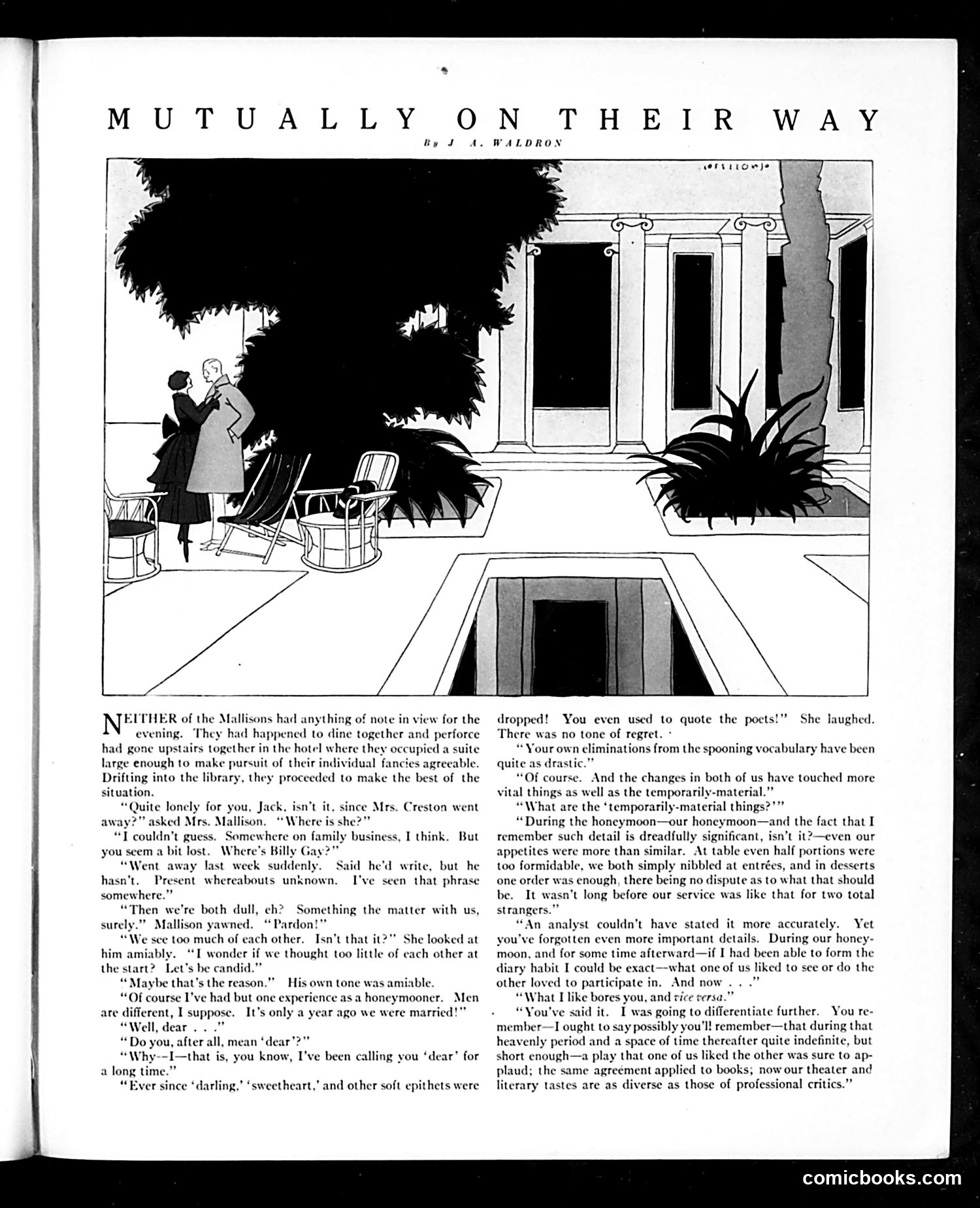
This story illustrates the disillusionment of married life through dialogue between Mr. and Mrs. Mallison, who are staying in a hotel. The narrative traces how their relationship has deteriorated since their honeymoon. The satire targets the erosion of romantic connection in marriage: the couple once used affectionate terms like "darling" and "sweetheart" but now call each other merely "dear"; they shared identical tastes and appetites during their honeymoon but now have completely divergent interests in theater, literature, and dining; and activities one partner enjoyed once held mutual appeal but now bore the other. The illustration shows them in a modernist hotel setting—appearing somewhat distant despite occupying the same space. The piece satirizes how marriages transform from passionate unions into arrangements between "total strangers" sharing a life, using the couple's own clinical self-analysis as the humor. It's a commentary on the mundane reality that often follows romantic beginnings.
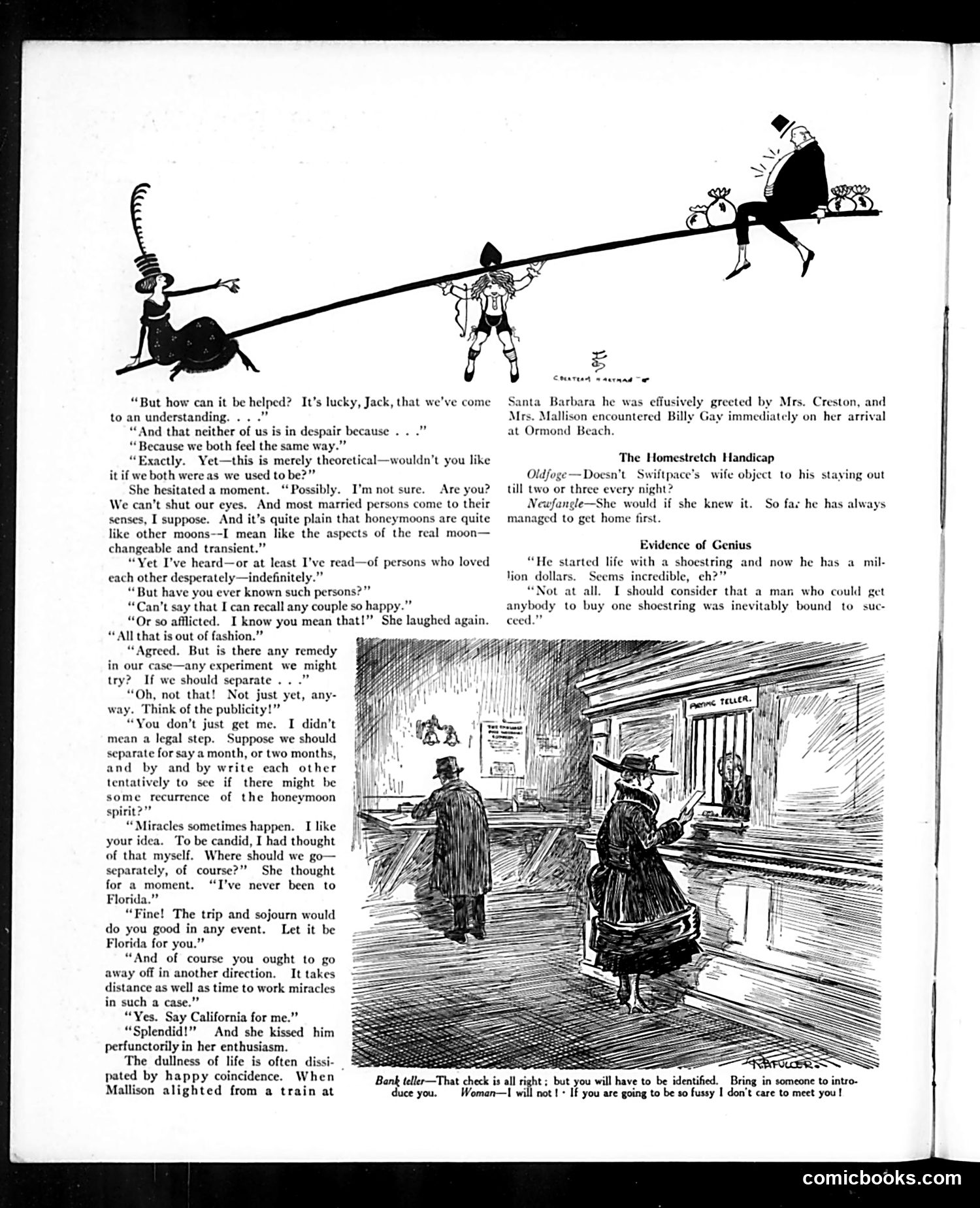
This page contains multiple satirical pieces typical of early 20th-century Judge magazine: **Main Story ("The Homestretch Handicap"):** A married couple, feeling their marriage has grown dull, proposes a trial separation—he to California, she to Florida—hoping absence and distance will rekindle their romance. The satire mocks the era's relationship advice and the couple's naive belief that geographical separation might restore passion. The title suggests their marriage is in its final stretch, worn out like a horse at the end of a race. **Supporting Jokes:** Brief vignettes satirize common social situations: a wife unaware her husband stays out late; a man who made his fortune from humble beginnings; and a woman at a bank unwilling to provide identification, frustrated by bureaucratic requirements. The cartoons use simple line drawings typical of Judge's style. The overall tone satirizes middle-class American marriage and social conventions of the era, suggesting marital dissatisfaction was commonplace and remedies often ineffective or absurd.
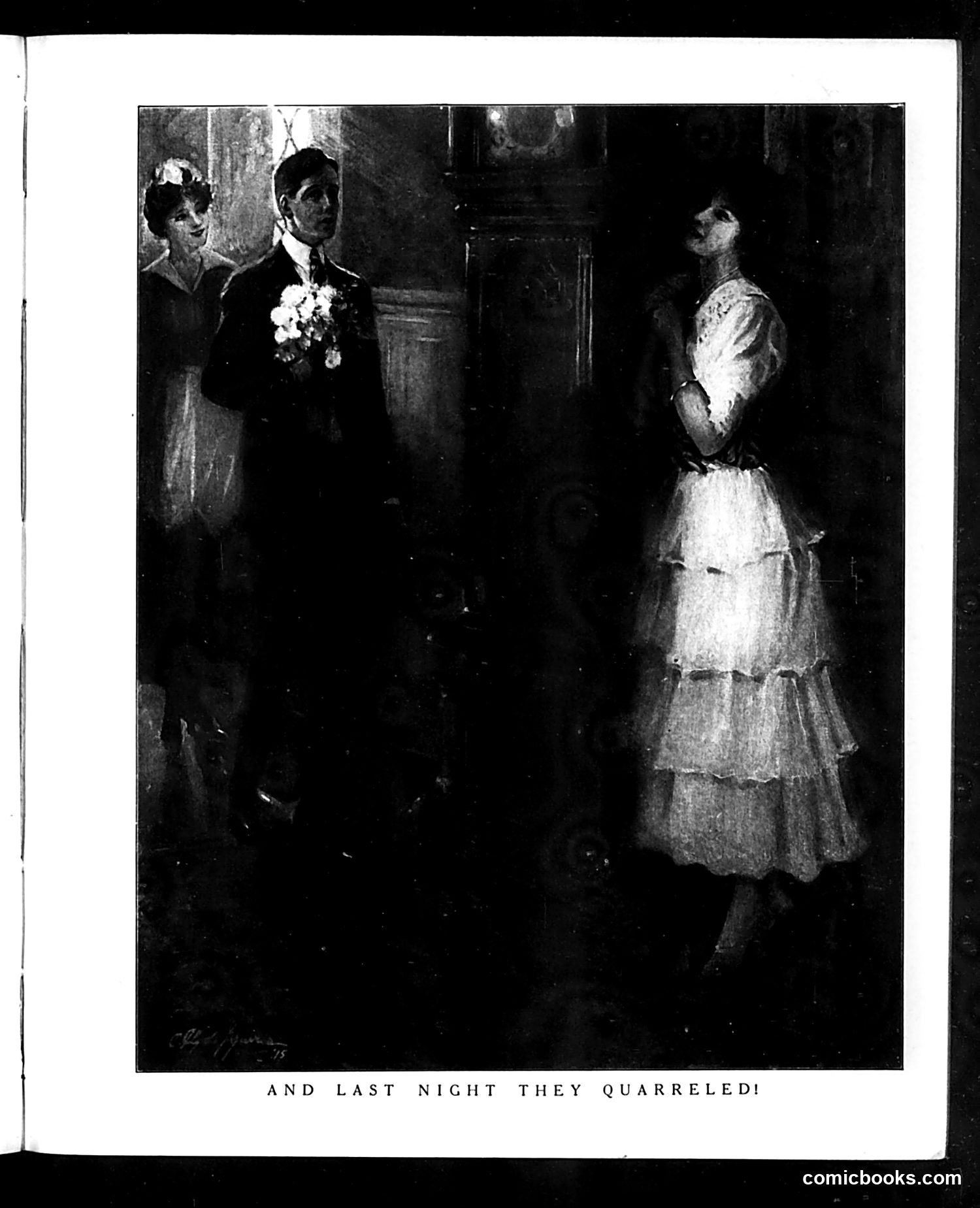
This appears to be an illustration from *Judge* magazine depicting a dramatic domestic scene. The caption "AND LAST NIGHT THEY QUARRELED!" suggests commentary on marital conflict. The image shows three figures in what appears to be an interior setting: a man in formal attire holding flowers (likely reconciling), a woman in an elegant dress, and another figure in the background. The theatrical staging and dramatic lighting emphasize the tension. Without additional context or visible identifying details, the specific satirical target remains unclear—this could be referencing a contemporary scandal, political figure's personal life, or simply commenting generally on the absurdities of romantic relationships and domestic disputes. The tone suggests social satire typical of *Judge*'s approach to criticism through illustration.
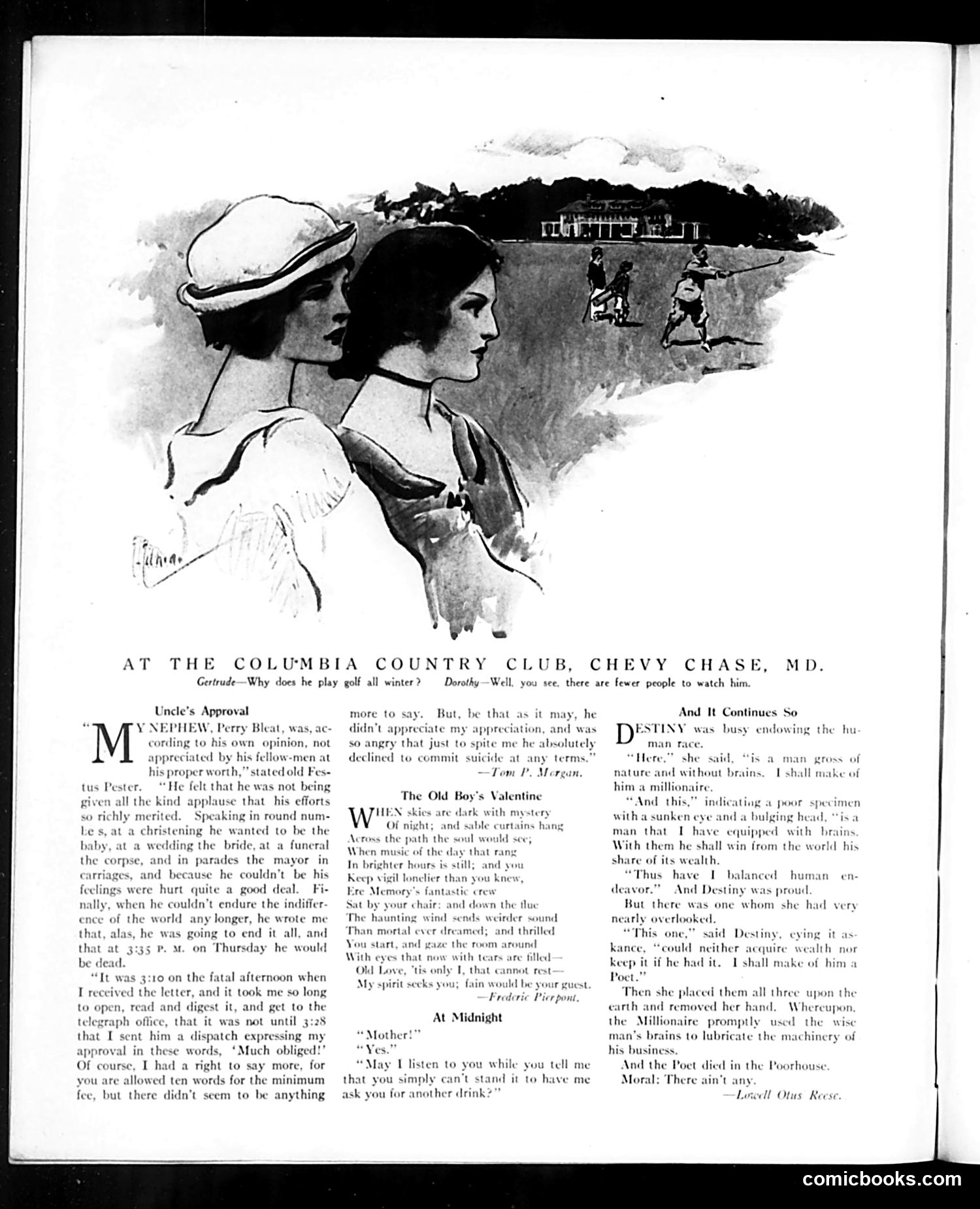
This page contains three separate satirical stories, typical of Judge's humor: 1. **"Uncle's Approval"**: A dark comedy about a nephew seeking his uncle's approval. The nephew announces his suicide plan via letter, but the uncle's delayed congratulatory telegram arrives too late—the nephew, annoyed at the tardiness, spitefully refuses to kill himself out of spite. 2. **"At the Columbia Country Club"**: A brief comic exchange where a woman (Gertrude) asks why a man (implied to be named Chevy Chase, MD) plays golf all winter. The punchline: fewer people watch him, suggesting he's a poor golfer. 3. **"And It Continues So"**: An allegorical story where Destiny distributes human traits. She gives one man nature and brains to accumulate wealth, another brains to become a wise businessman—who exploits the first man's intelligence. A third receives only poetic talent and dies in poverty. The moral: "There ain't any" (fairness/justice). The cartoons satirize materialism, social pretension, and the futility of human ambition in early 20th-century America.
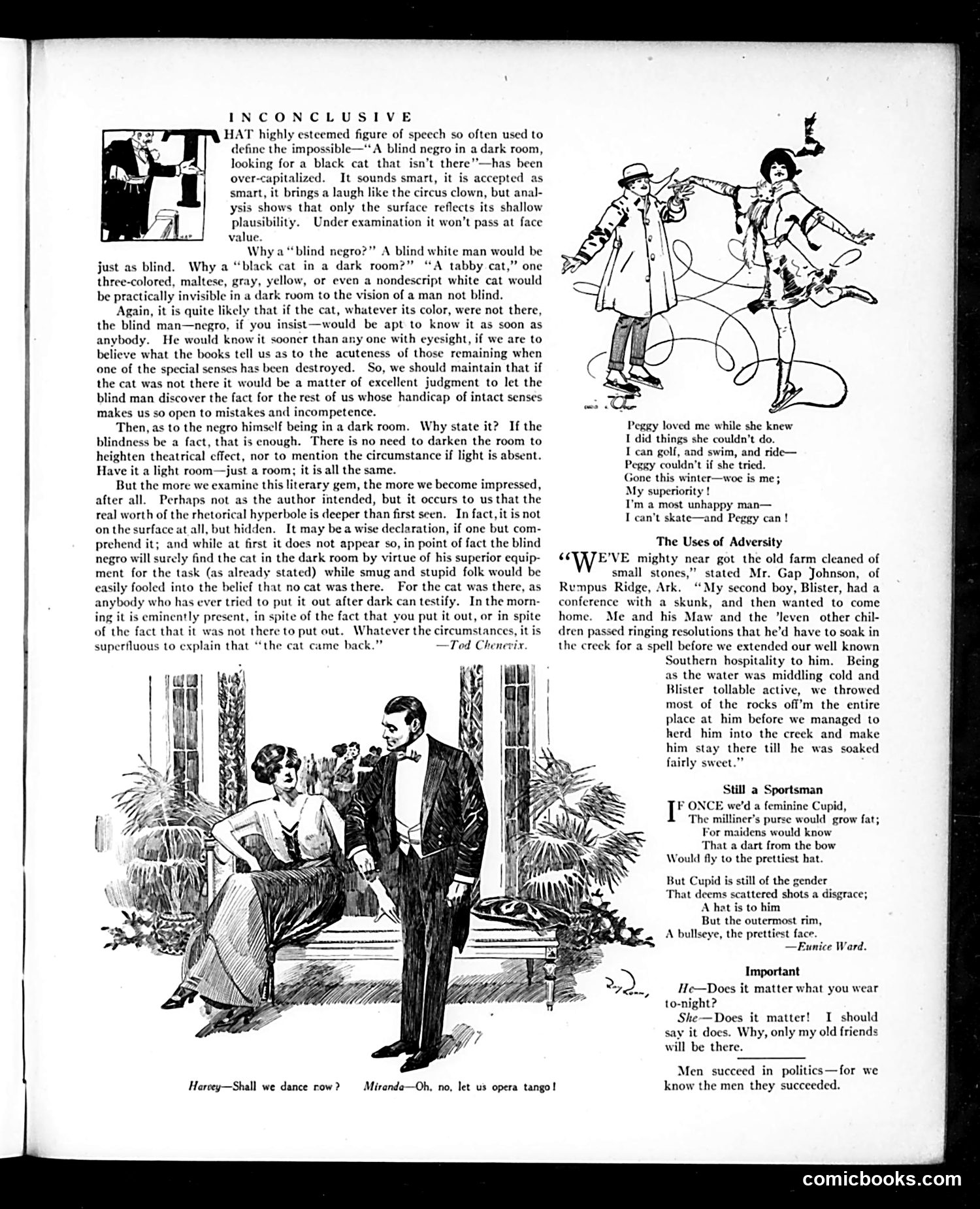
This page from *Judge* magazine contains satirical commentary and humorous pieces: **"Inconclusive"** (main article): A lengthy critique dissecting the famous phrase "a blind Negro in a dark room, looking for a black cat that isn't there"—used to describe the impossible. The author argues the saying is logically flawed: a blind person would actually *find* the cat by superior remaining senses; the racial and color specifics are unnecessary; and the phrase's rhetorical power relies on hidden assumptions rather than actual sense. **Cartoon caption**: "Shall we dance row?" / "Oh, no, let us opera tango!"—a pun on the words "row" and "tango." **Other pieces** include light verse about romantic disappointment when a girlfriend gains independence, rural humor about a skunk encounter, and poetry about Cupid targeting faces rather than hats. These are typical magazine filler—social commentary and wordplay rather than political satire. The page reflects early-20th-century magazine humor: clever wordplay, domestic scenarios, and surprisingly progressive social critique alongside casual racial language.
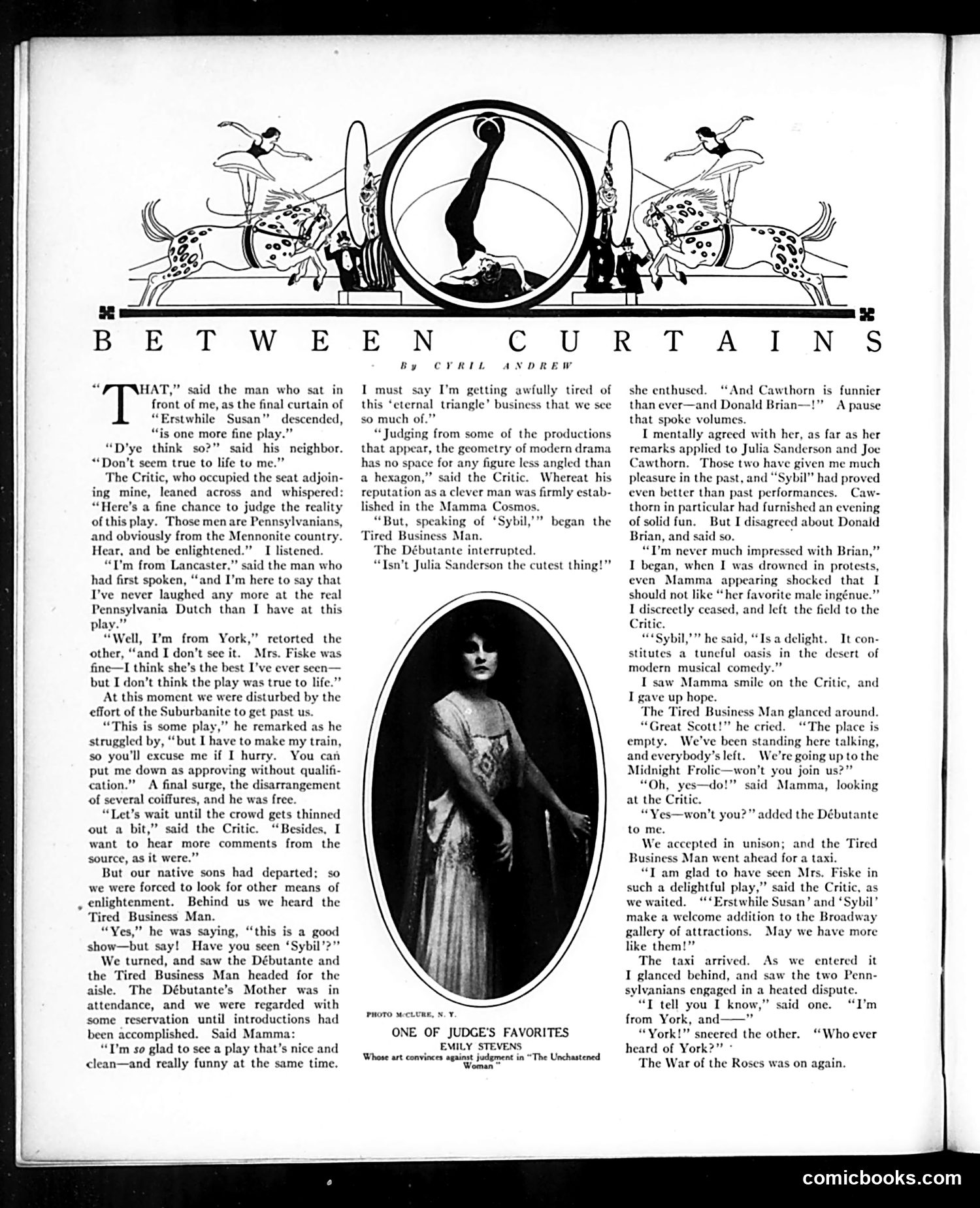
This is a theater-goer's commentary on different audience types and their responses to Broadway productions. The narrative presents several character archetypes judging a play (likely "Erstwhile Susan"): - **Pennsylvanians** dispute whether the play authentically represents their regional experience - **The Critic** offers intellectualized observations (witty comment about "hexagon" geometry of modern drama's eternal triangle plots) - **The Suburbanite** approves casually while rushing to catch his train - **The Tired Business Man** and **Débutante** focus on star performers (Julia Sanderson, Joe Cawthorn, Donald Brian) - **Mamma** values cleanliness and humor The satire targets how different social classes and personality types consume theater—from earnest authenticity-seekers to distracted commuters to those interested primarily in celebrity performers rather than dramatic substance. The Critic emerges as most discerning, while others reveal superficial engagement with theater.
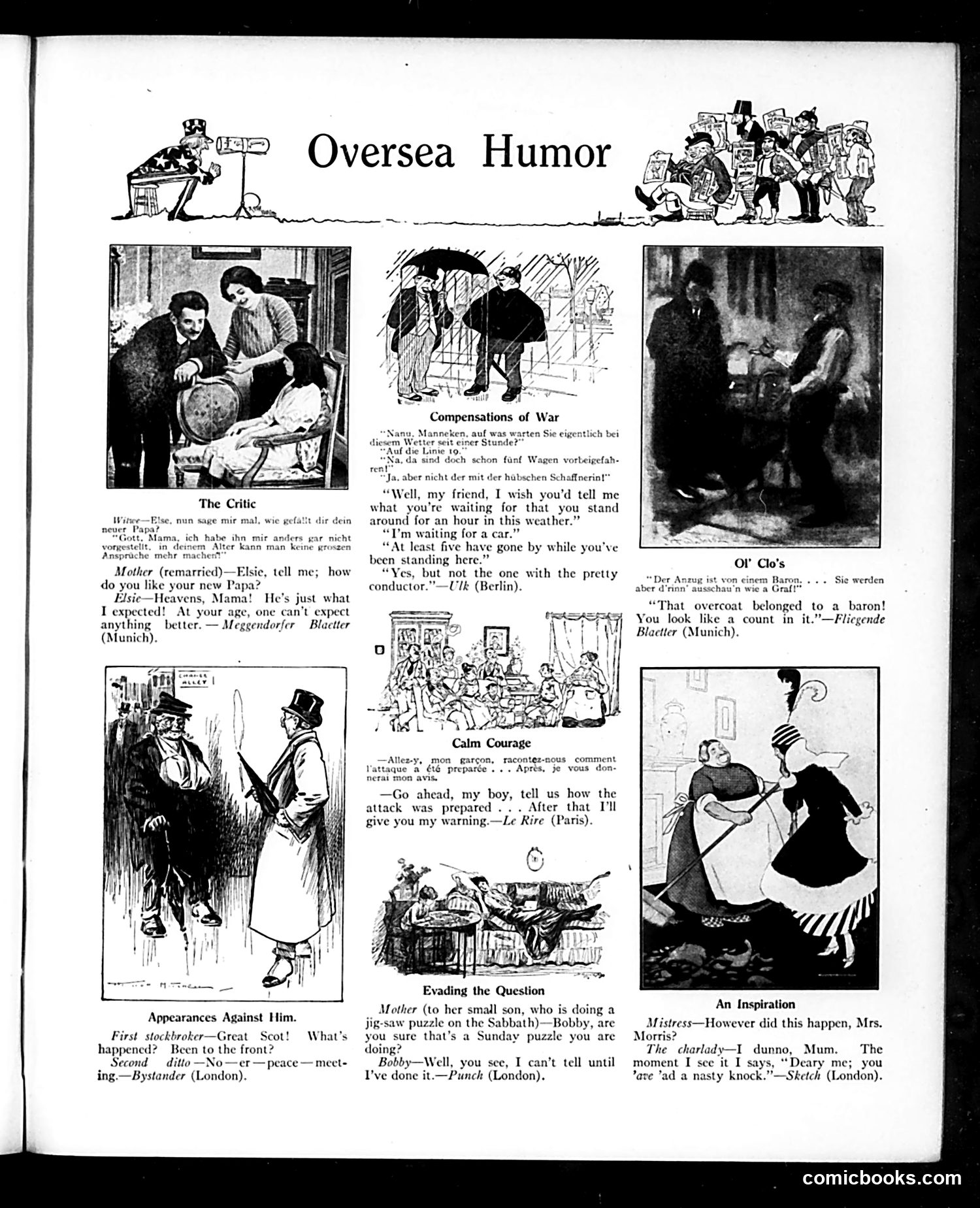
This page collects humorous anecdotes from European publications, translated for American readers. The content reflects WWI-era concerns: **"Compensations of War"** depicts a woman waiting for a streetcar with a handsome conductor—wartime romantic distraction amid civilian inconvenience. **"Calm Courage"** shows a mother reassuring her anxious son about an impending attack, emphasizing stoic composure during wartime. **"Appearances Against Him"** jokes that a stockbroker avoided the front by attending a peace meeting instead—satirizing those perceived as evading military service through pacifism. **"Evading the Question"** presents a child unable to identify puzzle pieces until completion—a metaphor for uncertainty during wartime. **"Ol' Clo's"** and **"An Inspiration"** offer working-class humor about shabby clothing and domestic accidents. The recurring theme across these international excerpts is maintaining composure, finding humor, and navigating daily life during wartime disruption—appealing to Judge's American audience experiencing similar anxieties.
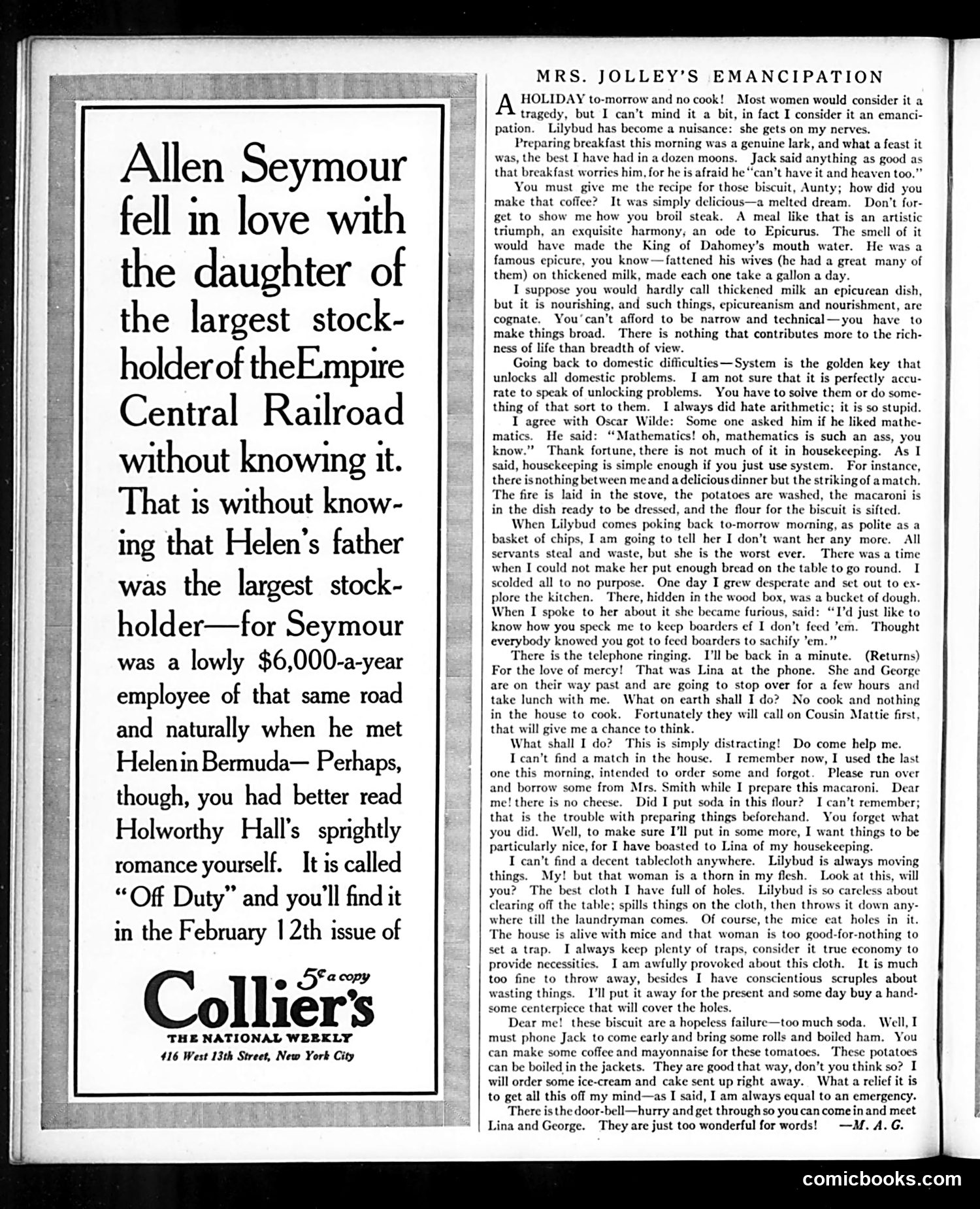
This page contains two distinct pieces: **Left side:** An advertisement for *Collier's* magazine promoting a romance story titled "Off Duty" by Holworthy Hall. The ad uses a satirical premise: Allen Seymour unknowingly fell in love with Helen, daughter of the Empire Central Railroad's largest stockholder, while he himself was only a $6,000-a-year employee. The humor lies in this class-based romantic irony—a common theme in early 20th-century fiction. **Right side:** A humorous domestic essay titled "Mrs. Jolley's Emancipation," celebrating a day without her cook. The narrator discovers she enjoys cooking herself and criticizes her lazy servant, Lilybud, who hoards food and refuses to feed boarders adequately. The satire mocks both incompetent household help and the narrator's cheerful naïveté about managing a household alone. The broader social commentary: servants' unreliability and the class tensions between employers and domestic workers in this era.
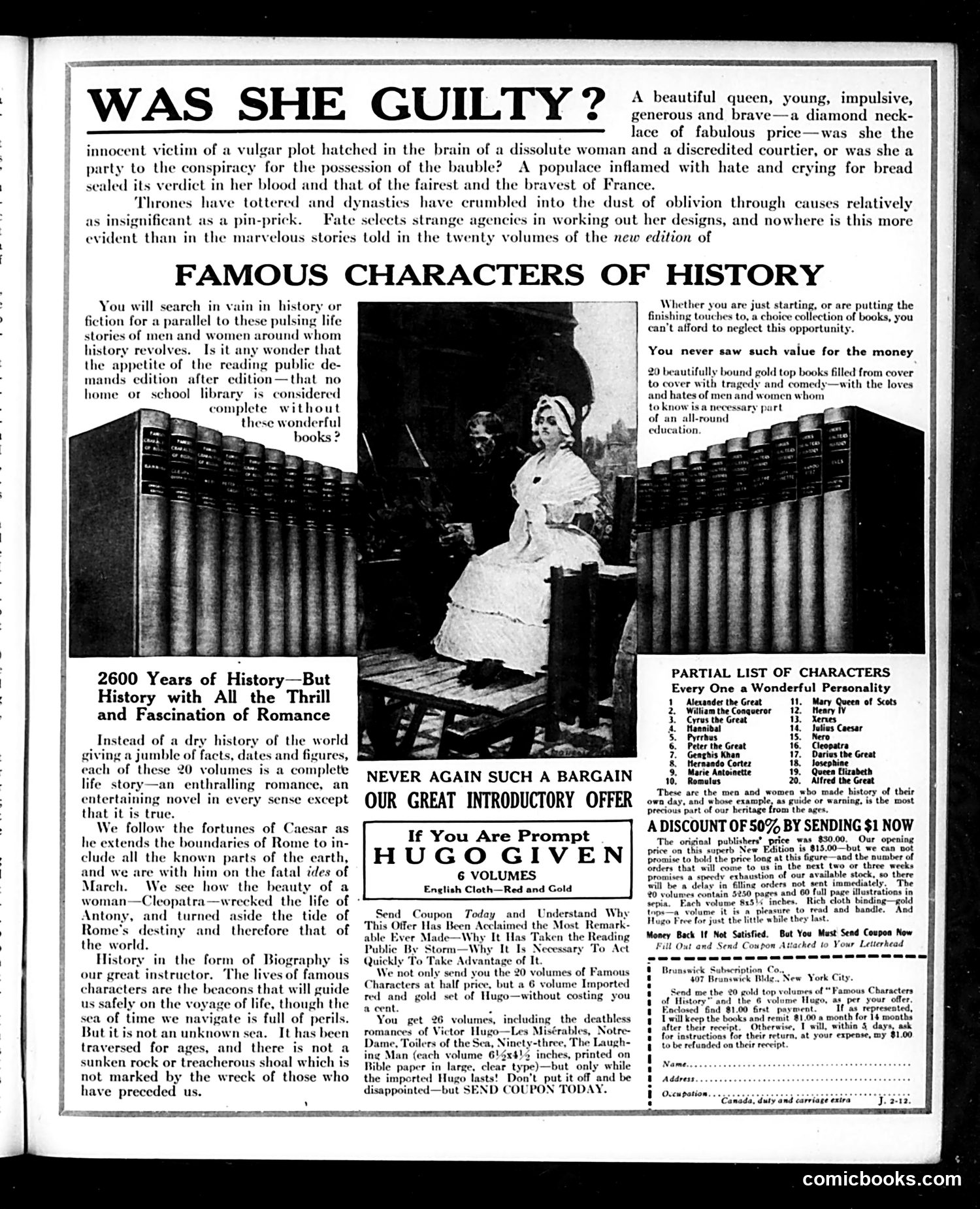
This page primarily advertises a book series called "Famous Characters of History" rather than presenting a political cartoon. The headline "Was She Guilty?" likely references **Marie Antoinette and the Diamond Necklace Affair**—a famous 18th-century French scandal where the queen was accused of involvement in a plot to steal a valuable necklace, though she was innocent. The affair damaged her reputation and contributed to anti-monarchy sentiment. The advertisement uses this historical drama as a hook, arguing that biography is more compelling than dry history. It promotes a 20-volume set (with a discounted 6-volume Hugo collection offer) featuring famous historical figures—Caesar, Cleopatra, Napoleon, Nero, and others. The pitch emphasizes that these "life stories" provide moral lessons and guidance unavailable elsewhere, making them essential for any respectable home or school library. This is primarily a commercial advertisement, not satire.
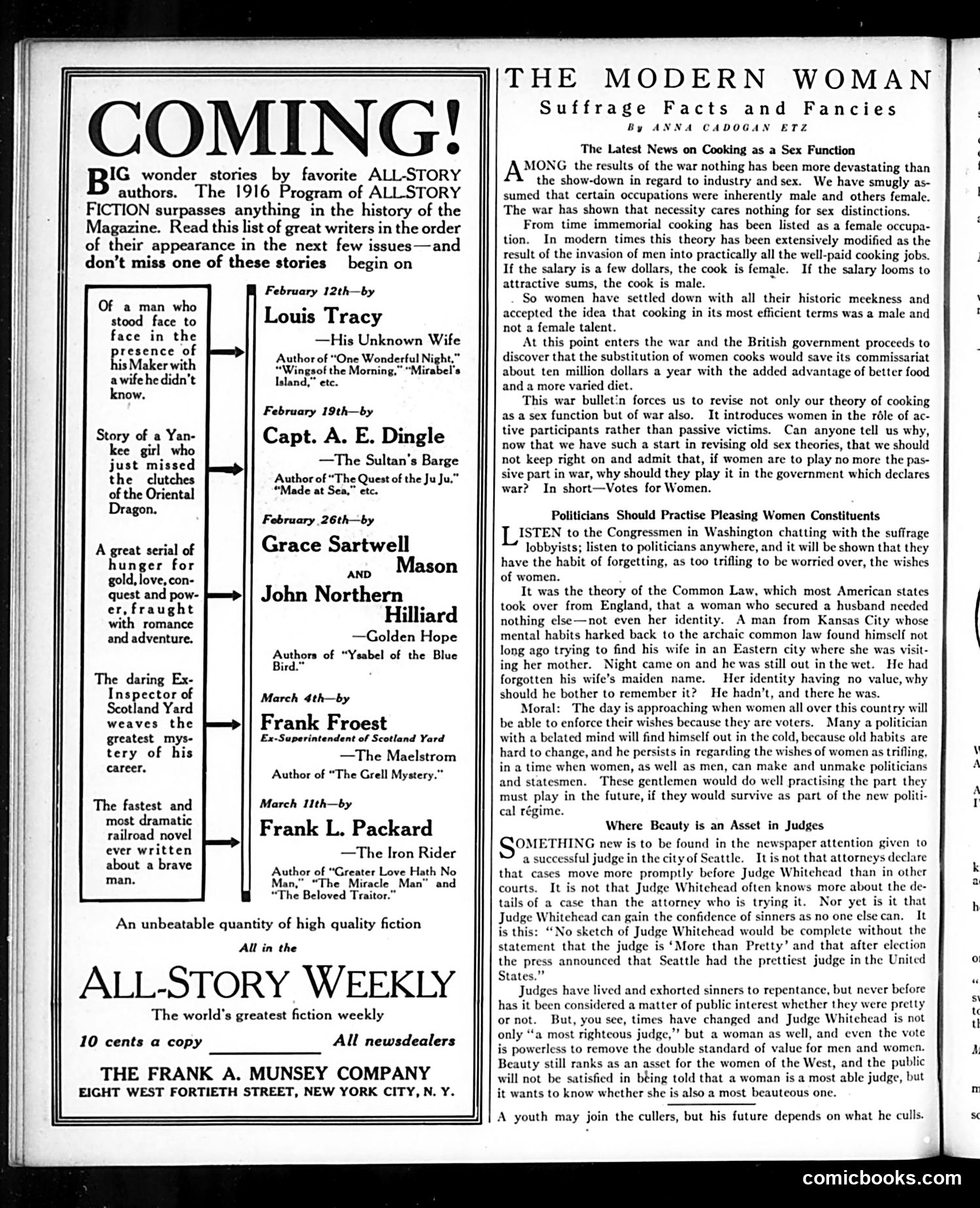
This page from Judge (circa 1916) is primarily advertising for *All-Story Weekly* magazine on the left side, showcasing serialized fiction by popular authors like Louis Tracy and Frank L. Packard. The right side contains an opinion column titled "The Modern Woman: Suffrage Facts and Fancies" by Anna Cadogan Etz. The satirical point targets **gender inequality and women's suffrage**. The author uses ironic logic: if WWI demonstrated women could competently perform "male" jobs like professional cooking (saving the British military millions), why should women remain passive in voting and governance? She notes that politicians casually dismiss women's concerns while relying on their votes—yet deny them formal political power. The column mocks how women's abilities are selectively acknowledged (for wartime labor) while their political voice remains suppressed. It's advocacy satire: using absurdist reasoning to expose the hypocrisy of denying women suffrage when war had already proven their capability and value.
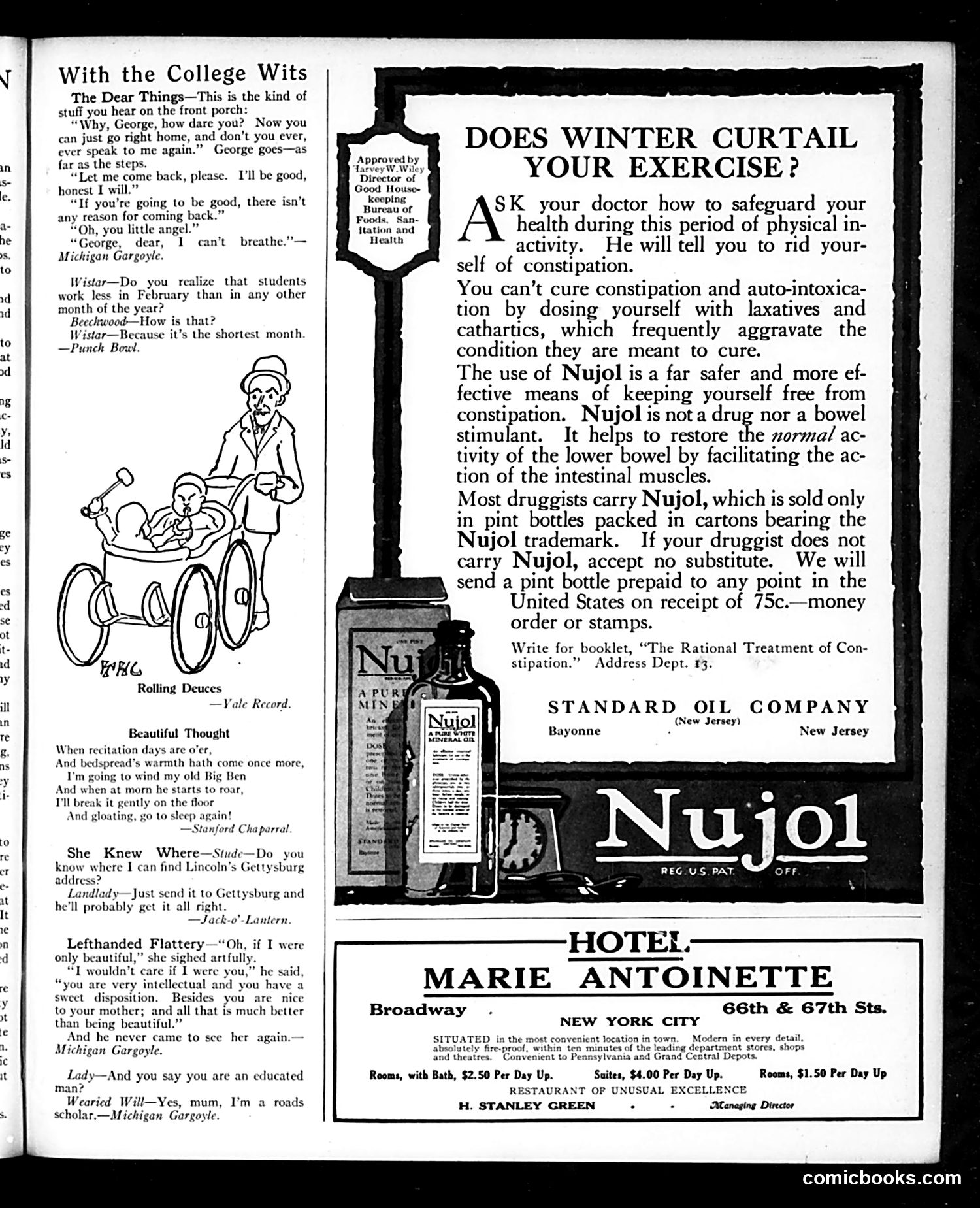
This page contains college humor and advertisements typical of early 20th-century *Judge* magazine. **"With the College Wits"** presents brief, mild romantic/social comedies from college publications. "The Dear Things" satirizes overwrought breakup dialogue ("How dare you!"). "Winstar" jokes about February being the shortest month. The cartoons show idealized courtship scenarios and a humorous illustration of rolling deuces (dice). **The main advertisement** promotes Nujol, a mineral oil laxative, emphasizing it's safer than harsh cathartics—addressing winter's supposed constipation problem with pseudo-medical authority. The doctor's endorsement and mail-order option were standard marketing tactics of the era. **Remaining college jokes** mock student naiveté (confusing Lincoln's address with Gettysburg's location) and awkward romantic flattery. The **Hotel Marie Antoinette advertisement** offers budget Manhattan lodging. The satire here is gentle—college humor mocking dating rituals and student silliness rather than sharp political commentary. Modern readers should note the casual medical marketing and the assumption that constipation was a serious seasonal concern worth prominent advertising.
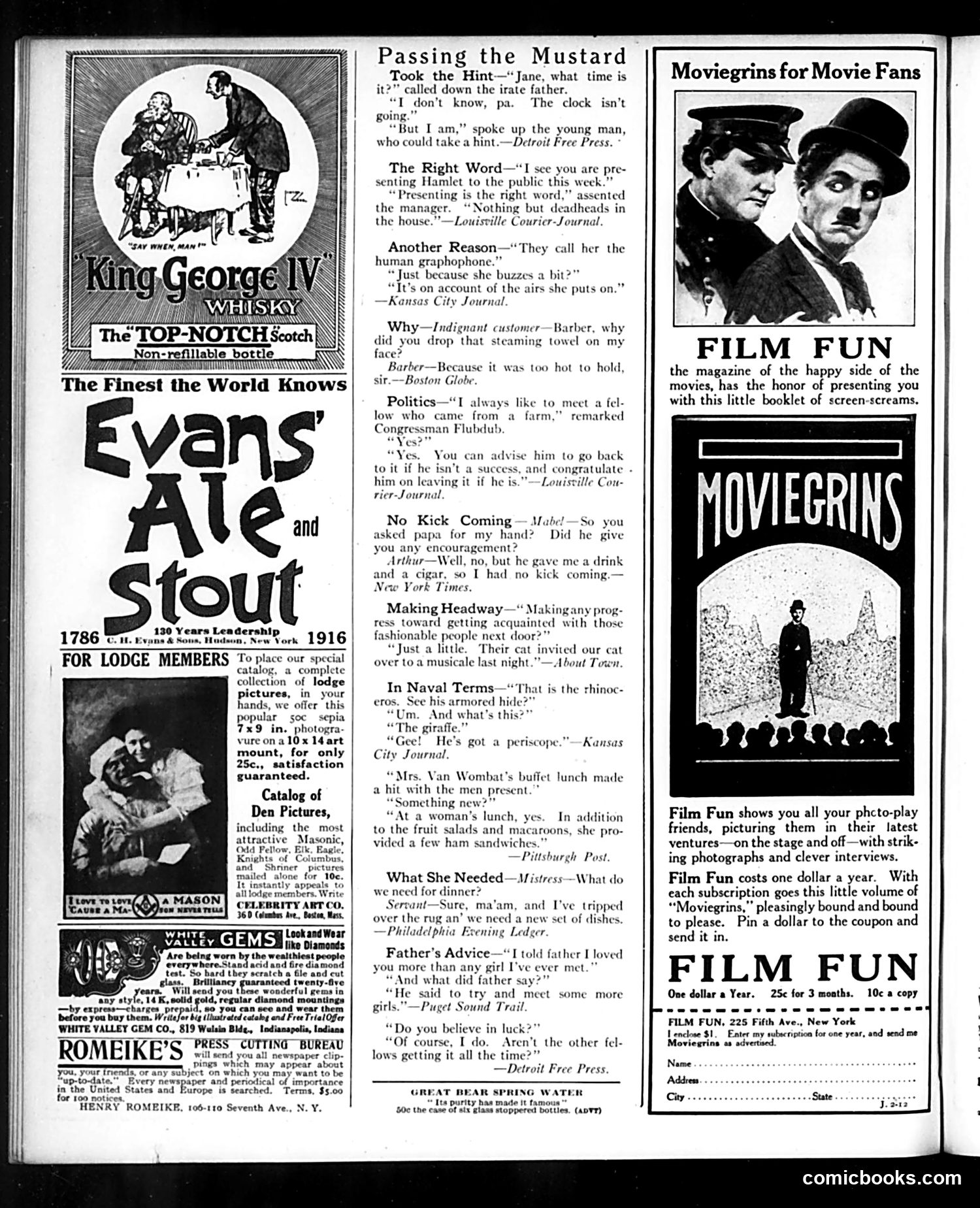
This page is primarily **advertising and humor columns**, not political cartoons. The top-left features ads for **King George IV Whisky** and **Evans Ale & Stout** (British beverages), alongside lodge member catalogs and costume jewelry. The right side advertises **Film Fun magazine** and **Moviegrins**. The center column contains numerous **brief humorous anecdotes** sourced from contemporary newspapers. These joke about domestic life, romantic mishaps, and social situations—typical early-20th-century humor. Examples include a father's comment about a broken clock, a theater manager admitting his audience consists of freeloaders, and a young man's romantic misadventures. The humor reflects **period attitudes**: casual condescension toward servants, assumptions about gender roles, and light mockery of social climbing. The "Politics" joke satirizes congressional rhetoric about farm life. **Context for modern readers**: This represents how magazines mixed advertising with syndicated humor before radio and television became dominant entertainment media.
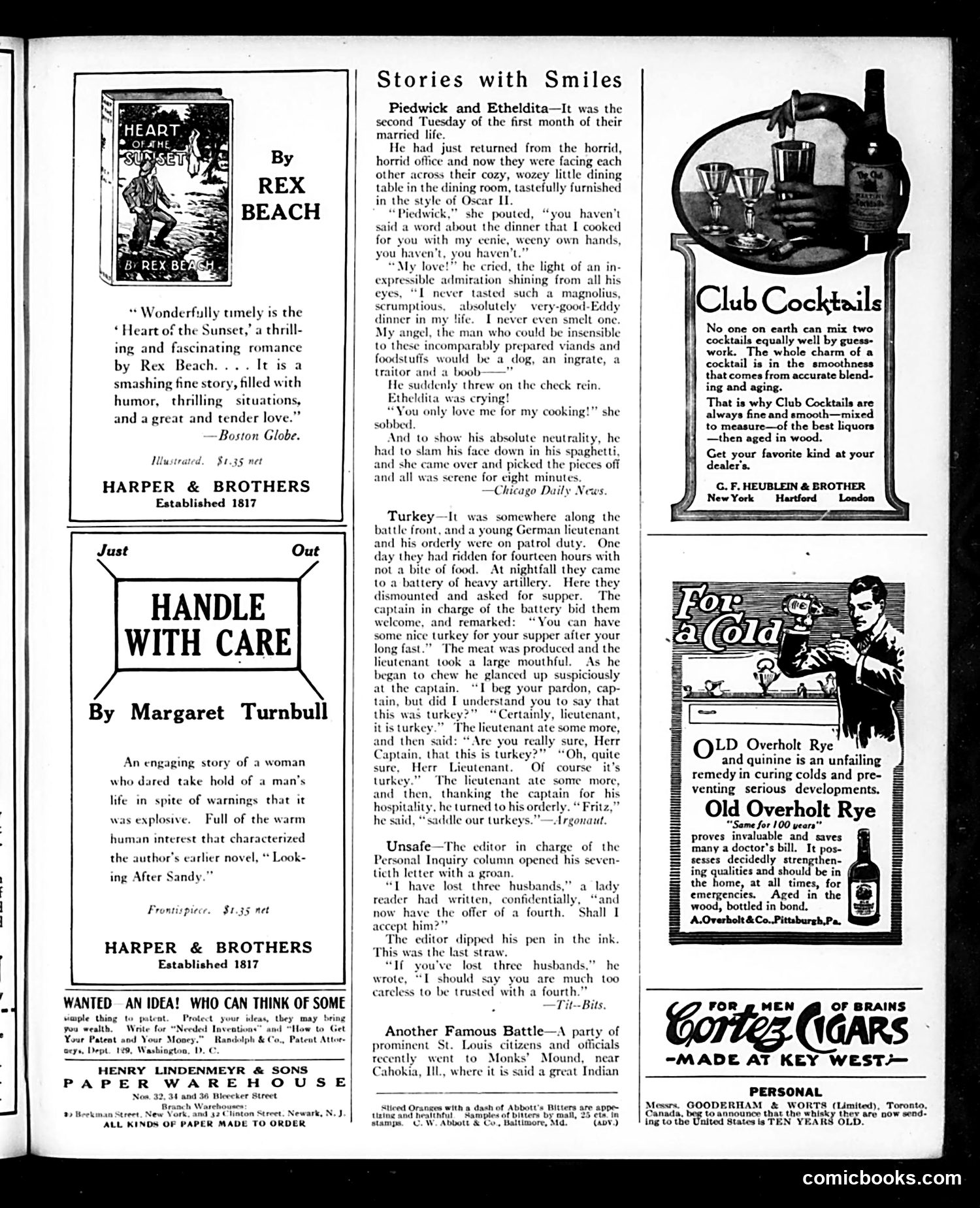
This page contains three humorous short stories typical of Judge's satirical humor: **"Piedwick and Etheldita"** mocks newlywed sentimentality and marital discord. A husband, returning from work, praises his wife's cooking with exaggerated flattery ("magnolius"), but when he accidentally reveals he actually dislikes it, he literally face-plants into spaghetti to save face. The joke targets both honeymoon affectation and domestic tension masked by false politeness. **"Turkey"** satirizes military absurdity. A starving German officer suspects his meal isn't turkey but pretends to believe the captain anyway, repeatedly asking for confirmation while continuing to eat. The humor lies in the absurd politeness maintained despite obvious deception—a commentary on military hierarchy and wartime desperation. **"Handle with Care"** appears to be a book advertisement for Margaret Turnbull's novel about a woman managing a man's life despite warnings. The surrounding advertisements (Club Cocktails, Old Overholt Rye) suggest this is a magazine aimed at middle-class readers with disposable income.
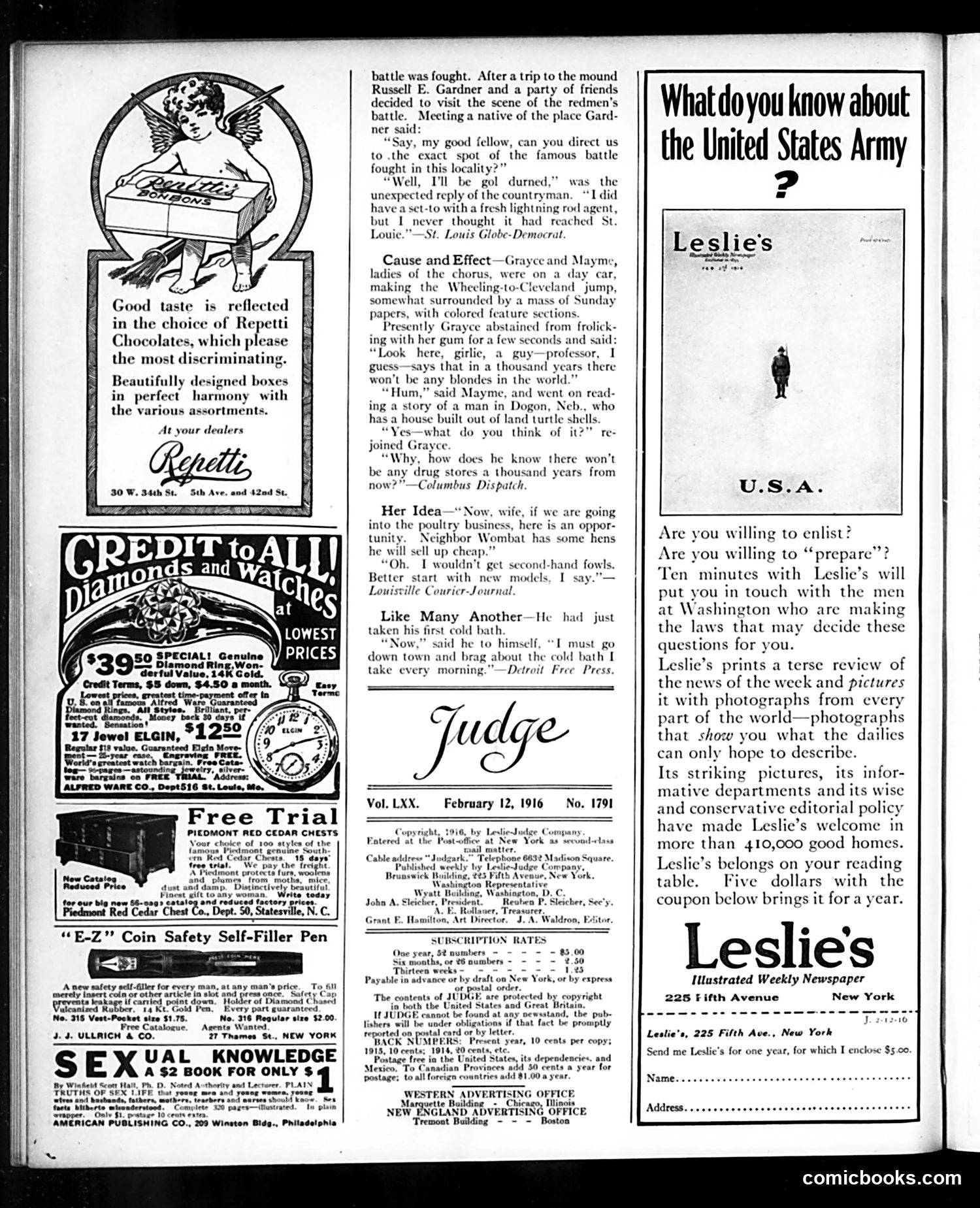
This page is primarily **advertisements and subscription information** for Judge magazine, with several short humorous anecdotes rather than political cartoons. The brief stories employ gentle satire on American social types: 1. **"Battle"** mocks rural ignorance—a countryman misinterprets a historical inquiry about Native American battles as a reference to his personal fight with a traveling salesman. 2. **"Cause and Effect"** jokes about blonde chorus girls' superficiality—one dismisses a professor's prediction that blondes won't exist in 1,000 years, worried instead about future drug stores. 3. **"Her Idea"** satirizes a wife's materialism—she refuses secondhand chickens for a poultry business, demanding new models. 4. **"Like Many Another"** ridicules male vanity—a man takes his first cold bath and immediately plans to boast about his discipline. These reflect typical *Judge* humor: lightweight social commentary targeting working-class pretension, gender stereotypes, and human folly rather than serious political critique. The magazine's 1916 date and U.S. Army recruitment ad suggest pre-WWI American concerns.
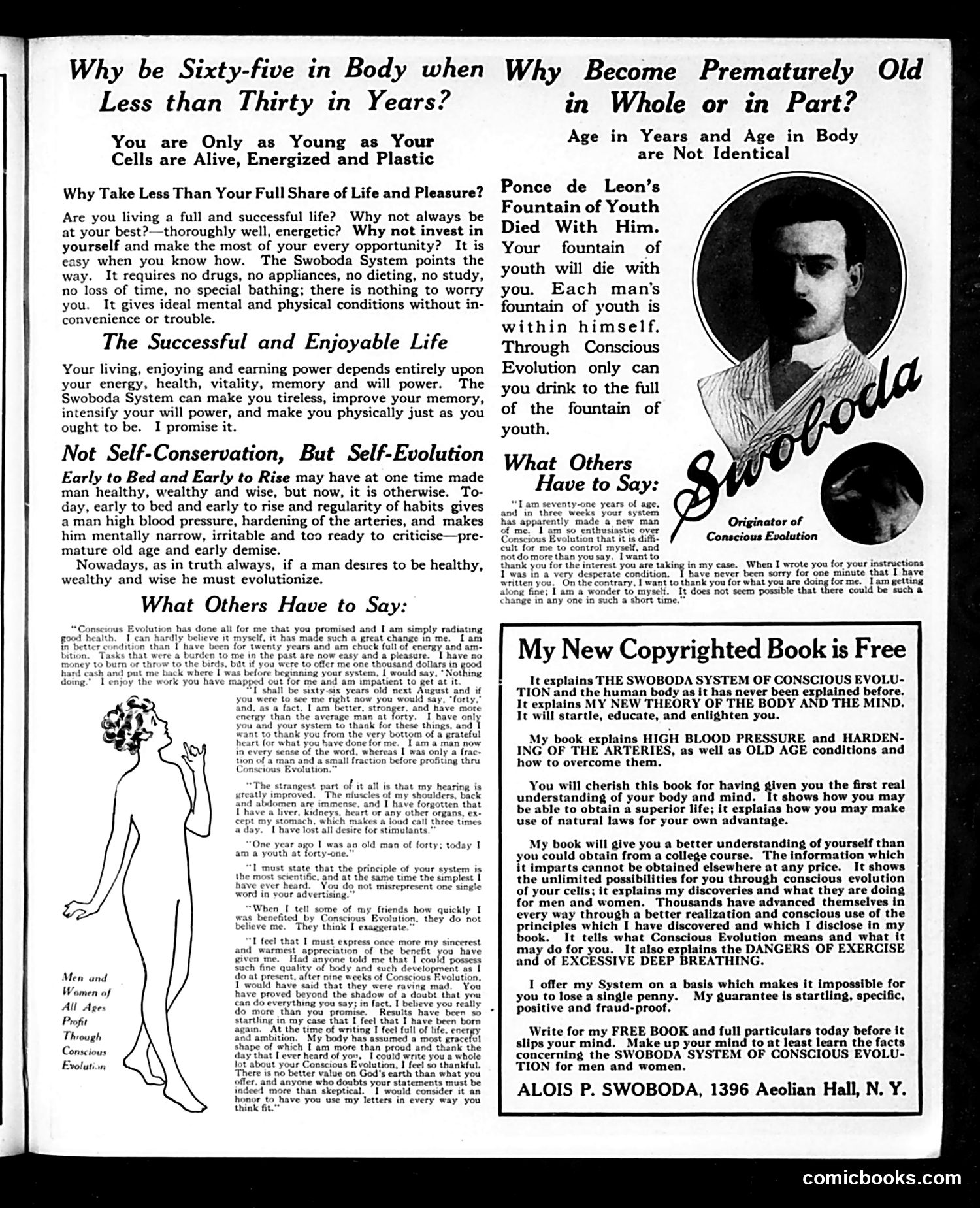
This page is primarily **advertising disguised as editorial content** for the "Swoboda System of Conscious Evolution"—a health/self-improvement scheme from the early 20th century. **What's being sold:** A pseudo-scientific system claiming to reverse aging and boost vitality without drugs, diet, or exercise. The promised result: appearing 30 when you're 65. **The satire/con:** The page exploits common anxieties about aging and vitality. Testimonials (likely fabricated) claim dramatic transformations in weeks. The language is deliberately vague—"conscious evolution" sounds scientific but means nothing specific. **Historical context:** This reflects the era's boom in quack remedies and wellness schemes. The reference to "Ponce de Leon's Fountain of Youth" invokes the legendary quest, implying the system offers what philosophers sought. **The nude figure** on the left appears decorative, emphasizing physical transformation promises. This is a period example of **fraudulent wellness marketing**—predecessor to modern supplement scams and dubious self-help programs.
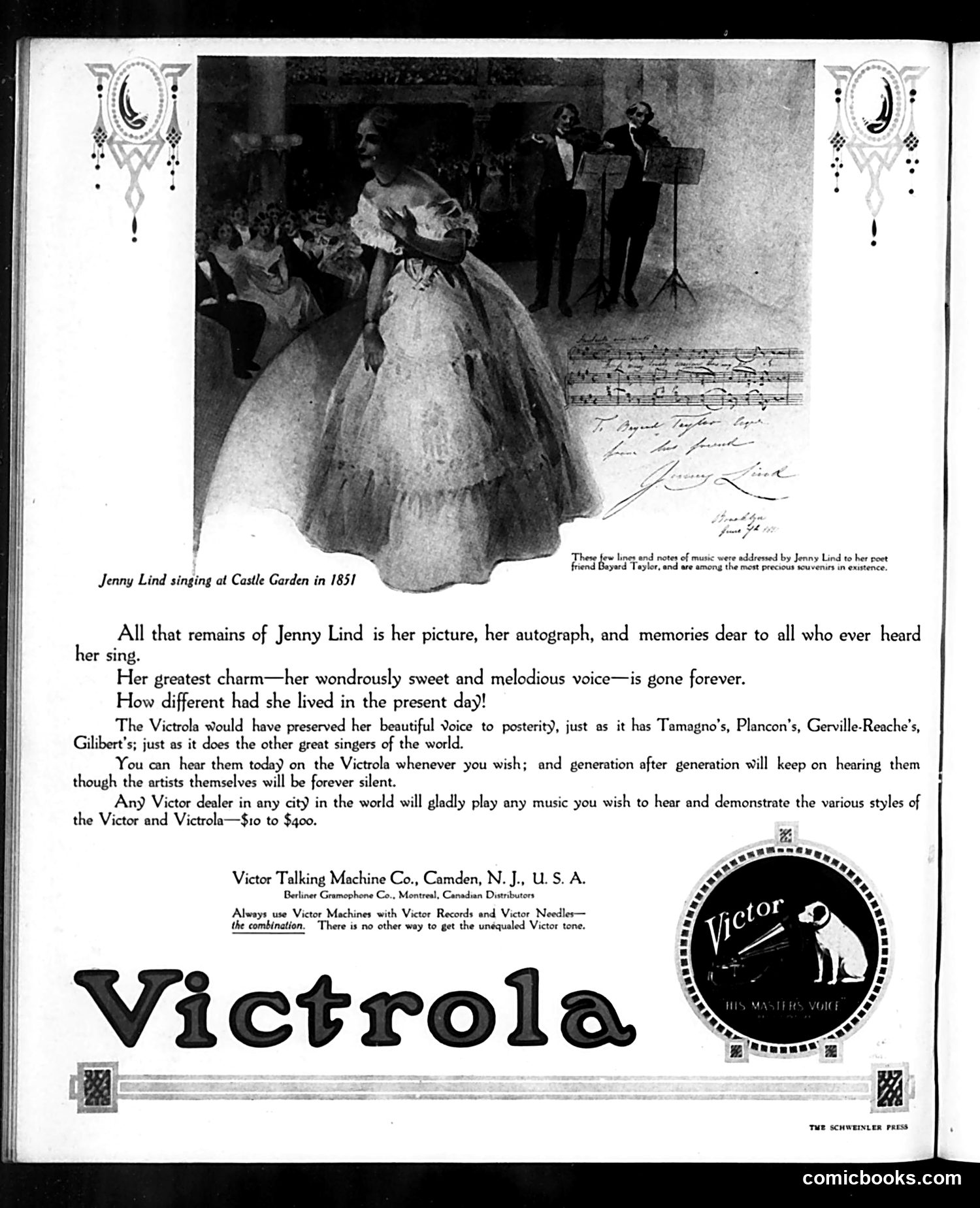
This is primarily a **Victrola phonograph advertisement**, not political satire. It uses Jenny Lind, the famous 19th-century Swedish opera singer, to promote recorded music technology. **The argument:** Lind's "wondrously sweet" voice is lost to history because she lived before recording technology. The ad contrasts her fate with contemporary singers (Tamagno, Plancon, Gerville-Reache, Gilibert) whose voices the Victrola preserves "to posterity." **The sales pitch:** Future generations can hear these artists indefinitely via Victrola recordings, even after "the artists themselves will be forever silent." This was genuinely novel—the phonograph made immortality of performance possible. The historical image of Lind singing at Castle Garden (1851) underscores what was lost before recording existed, making the technology's value seem obvious to Judge readers of this era. This reflects the early excitement around recorded sound's cultural preservation capabilities.