
Judge, 1916-02-12 · page 17 of 28
Judge — February 12, 1916 — page 17: what you’re looking at
What you’re looking at
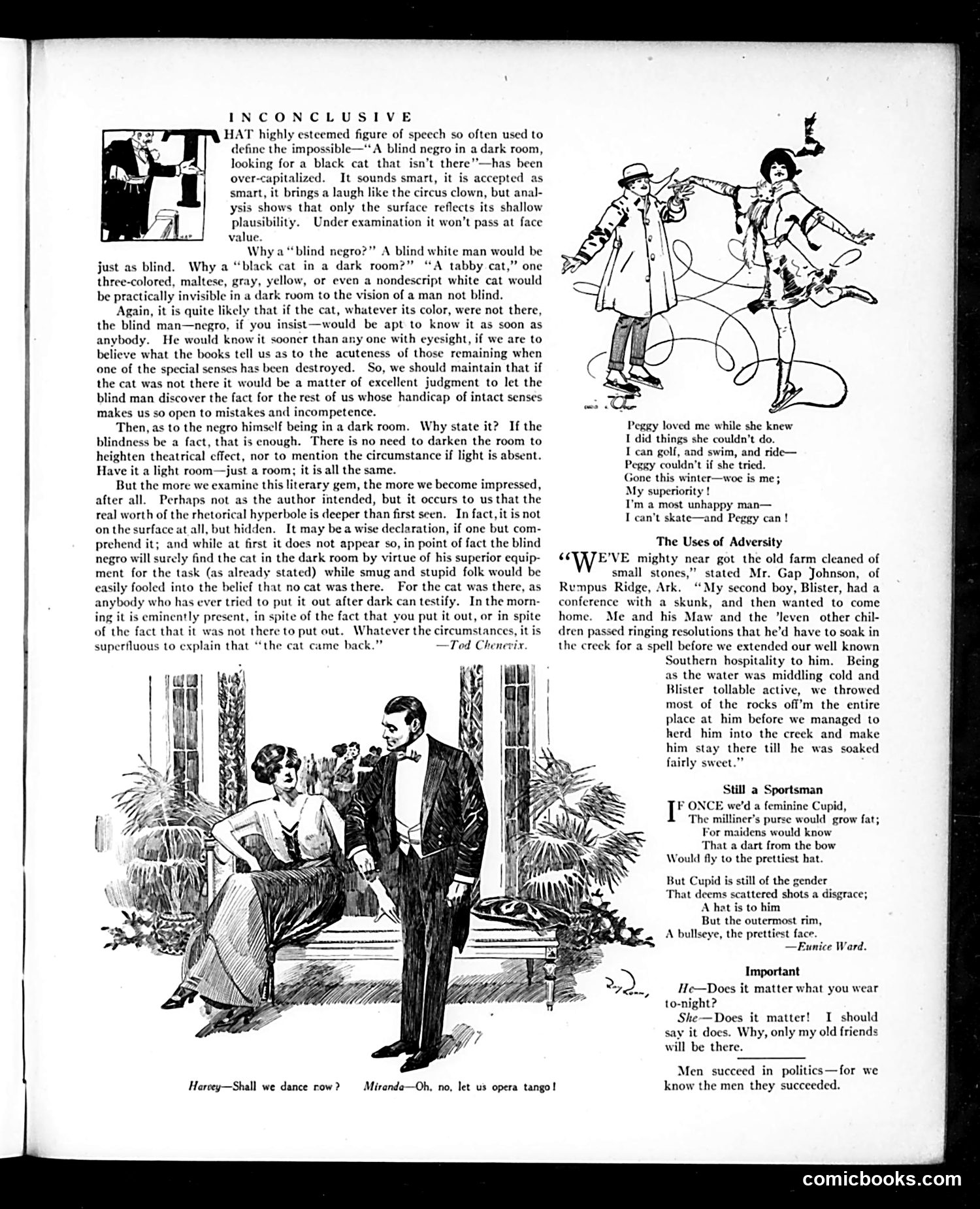
This page from *Judge* magazine contains satirical commentary and humorous pieces: **"Inconclusive"** (main article): A lengthy critique dissecting the famous phrase "a blind Negro in a dark room, looking for a black cat that isn't there"—used to describe the impossible. The author argues the saying is logically flawed: a blind person would actually *find* the cat by superior remaining senses; the racial and color specifics are unnecessary; and the phrase's rhetorical power relies on hidden assumptions rather than actual sense. **Cartoon caption**: "Shall we dance row?" / "Oh, no, let us opera tango!"—a pun on the words "row" and "tango." **Other pieces** include light verse about romantic disappointment when a girlfriend gains independence, rural humor about a skunk encounter, and poetry about Cupid targeting faces rather than hats. These are typical magazine filler—social commentary and wordplay rather than political satire. The page reflects early-20th-century magazine humor: clever wordplay, domestic scenarios, and surprisingly progressive social critique alongside casual racial language.
📄 Transcribed text from this page (OCR, searchable)
Machine-transcribed from the original scan — historical spelling and the odd misread are preserved.
INCONCLUSIVE HAT highly esteemed figure of speech so often used to define the impossible—‘tA blind negro in a dark room, looking for a black cat that isn’t there’—has been lized. It sounds smart, it is accepted as ings a laugh like the circus clown, but anal- that only the surface reflects its shallow Under examination it won’t pass at face “blind negro?” A blind white man would be just as blind. Why a “black cat in a dark room?” “A tabby cat,” one three-colored, maltese, gray, yellow, or even a nondescript white cat would be practically invisible in a dark room to the vision of a man not blind. Again, it is quite likely that if the cat, whatever its color, were not there, the blind man—negro, if you insist—would be apt to know it as soon as anybody. He would know it sooner than any one with eyesight, if we are to believe what the books tell us as to the acuteness of those remaining when one of the special senses has been destroyed. So, we should maintain that if the cat was not there it would be a matter of excellent judgment to let the blind man discover the fact for the rest of us whose handicap of intact senses makes us so open to mistakes and incompetence. Then, as to the negro himself being in a dark room. Why state it? If the blindness be a fact, that is enough. There is no need to darken the room to heighten theatrical effect, nor to mention the circumstance if light is absent. Have it a light room—just a room; it is all the same. But the more we examine this literary gem, the more we become impressed, after all. Perhaps not as the author intended, but it occurs to us that the real worth of the rhetorical hyperbole is deeper than first seen. In fact, it is not on the surface at all, but hidden. It may bea wise declaration, if one but com- prehend it; and while at first it does not appear so, in point of fact the blind negro will surely find the cat in the dark room by virtue of his superior equip- ment for the task (as already stated) while smug and stupid folk would be easily fooled into the belief that no cat was there. For the cat was there, as anybody who has ever tried to put it out after dark can testify. In the morn- ing it is eminently present, in spite of the fact that you put it out, or in spite of the fact that it was not there to put out. Whatever the circumstances, it i Harcey—Shall we dance row? — Miranda—Oh, no, let us opera tango! Peggy loved me while she knew I did things she couldn’t do. I can golf, and swim, and ride— Peggy couldn't if she tried. Gone this winter—woe is me; My superiority ! I'm a most unhappy man— I can’t skate—and Peggy can ! The Uses of Adversity COWEVE mighty near got the old farm cleaned of small stones,” stated Mr. Gap Johnson, of Rumpus Ridge, Ark. “My second boy, Blister, had a conference with a skunk, and then wanted to come home. Me and his Maw and the ‘leven other chil- sed ringing resolutions that he’d have to soak in k for a spell before we extended our well known Southern hospitality to him. Being as the water was middling cold and Blister tollable active, we throwed most of the rocks off’m the entire place at him before we managed to herd him into the creek and make him stay there till he was soaked fairly sweet.” The milliner’s purse would grow fat; For maidens would know That a dart from the bow Would fly to the prettiest hat. But Cupid is still of the gender That deems scattered shots a disgrace; A hat is to him But the outermost rim, A bullseye, the prettiest face. —Eunice Ward. Important He—Does it matter what you wear to-night? She—Does it matter! I should say it does. Why, only my old friends will be ther Men succeed in politics—for we know the men they succeeded. comicbooks.com