
Judge, 1916-02-12 · page 18 of 28
Judge — February 12, 1916 — page 18: what you’re looking at
What you’re looking at
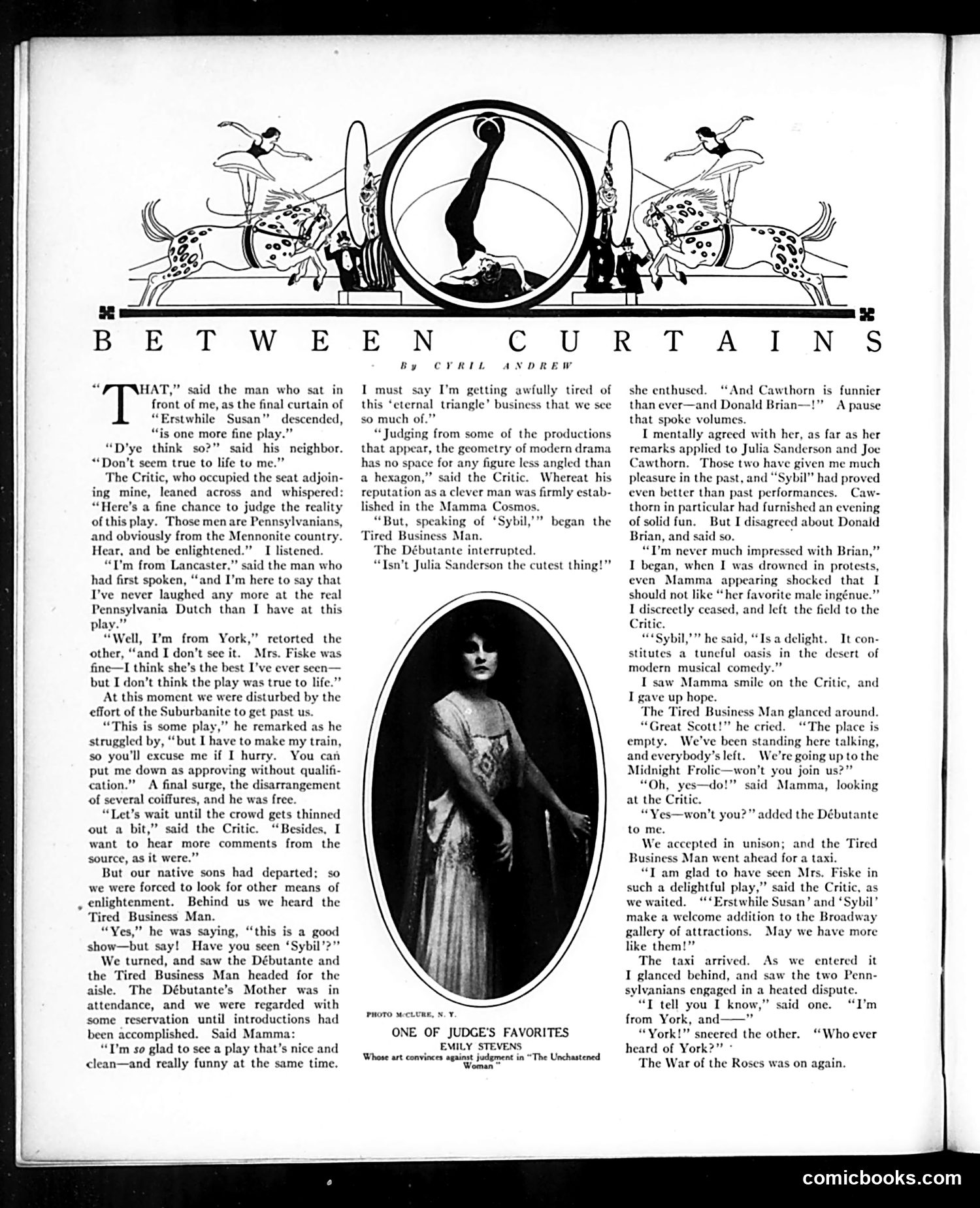
This is a theater-goer's commentary on different audience types and their responses to Broadway productions. The narrative presents several character archetypes judging a play (likely "Erstwhile Susan"): - **Pennsylvanians** dispute whether the play authentically represents their regional experience - **The Critic** offers intellectualized observations (witty comment about "hexagon" geometry of modern drama's eternal triangle plots) - **The Suburbanite** approves casually while rushing to catch his train - **The Tired Business Man** and **Débutante** focus on star performers (Julia Sanderson, Joe Cawthorn, Donald Brian) - **Mamma** values cleanliness and humor The satire targets how different social classes and personality types consume theater—from earnest authenticity-seekers to distracted commuters to those interested primarily in celebrity performers rather than dramatic substance. The Critic emerges as most discerning, while others reveal superficial engagement with theater.
📄 Transcribed text from this page (OCR, searchable)
Machine-transcribed from the original scan — historical spelling and the odd misread are preserved.
x B E T W E “fF | SHAT,” said the man who sat in front of me, as the final curtain of stwhile Susan" descended, one more fine play.” e think so?” said his neighbor. “Don’t seem true to life to me.” The Critic, who occupied the seat adjoin- ing mine, leaned across and whispered: “Here's a fine chance to judge the reality of this play. Those men are Pennsylvanians, and obviously from the Mennonite country. Hear, and be enlightened.” I listened. “T'm from Lancaster,” said the man who had first spoken, “‘and I’m here to say that I’ve never laughed any more at the real Pennsylvania Dutch than I have at this play.” “Well, I’m from York,” retorted the other, “and I don’t see it. Mrs. Fiske was fine—I think she’s the best I’ve ever seen— but I don’t think the play was true to life.”” At this moment we were disturbed by the effort of the Suburbanite to get past us. “This is some play,” he remarked as he struggled by, “but I have to make my train, so you'll excuse me if I hurry. You can put me down as approving without qualifi- cation.” A final surge, the disarrangement of several coiffures, and he was free. “Let’s wait until the crowd gets thinned out a bit,” said the Critic. “Besides, I want to hear more comments from the source, as it were.” But our native sons had departed: so we were forced to look for other means of , enlightenment. Behind us we heard the Tired Business Man. “Yes,” he was saying, “this is a good show—but say! Have you seen ‘Sybil’?” We turned, and saw the Débutante and the Tired Business Man headed for the aisle. The Débutante’s Mother was in attendance, and we were regarded with some reservation until introductions had been accomplished. Said Mamm “I'm so glad to see a play that’s nice and clean—and really funny at the same time. E N By CYRIL ANDREW I must say I’m getting awfully tired of this ‘eternal triangle’ business that we see so much of.”” “Judging from some of the productions that appear, the geometry of modern drama has no space for any figure less angled than a hexagon,” said the C Whereat his reputation as a clever man was firmly estab- lished in the Mamma Cosmos. “But, speaking of ‘Sybil,’ began the Tired Business Man. The Débutante interrupted. “Isn't Julia Sanderson the cutest thing!” PHOTO MeCLURE, N. ¥. ONE OF JUDGE'S FAVORITES EMILY STEVENS Whose art convinces against judgment in “The Unchastened C U R TA TI t “And Cawthorn is funnier A pause she enthused. than ever—and Donald Brian— that spoke volumes. I mentally agreed with her, as far as her remarks applied to Julia Sanderson and Joe Cawthorn. Those two have given me much pleasure in the past, and “Sybil” had proved even better than past performances. Caw- thorn in particular had furnished an evening of solid fun. But I disagreed about Donald Brian, and said so. : “I'm never much impressed with Brian,” I began, when I was drowned in protests, even Mamma appearing shocked that I should not like “her favorite male ingénue.” I discreetly ceased, and left the field to the Critic. “*Sybil,’”’ he said, “Is a delight. stitutes a tuneful oasis in the desert of modern musical comedy.” I saw Mamma smile on the Critic, and I gave up hope. The Tired Business Man glanced around. “Great Scott!” he cried. “The place is empty. We've been standing here talking, and everybody’s left. We're going up to the Midnight Frolic—won’t you join us?” “Oh, yes—do!” said Mamma, looking at the Critic. “Yes—won’t you?” added the Débutante to me. We accepted in unison; and the Tired Business Man went ahead for a taxi. “T am glad to have seen Mrs. Fiske in such a delightful play,” said the Critic, as we waited. “‘Erstwhile Susan’ and ‘Sybil’ make a welcome addition to the Broadway gallery of attractions. May we have more like them!” The t arrived. As we entered it I glanced behind, and saw the two Penn- sylvanians engaged in a heated dispute. “T tell you I know,” said one. “I’m from York, and——” “York!” sneered the other. heard of York?” * The War of the Roses was on again. It con- “Who ever comicbooks.com