
Judge, 1916-02-12 · page 13 of 28
Judge — February 12, 1916 — page 13: what you’re looking at
What you’re looking at
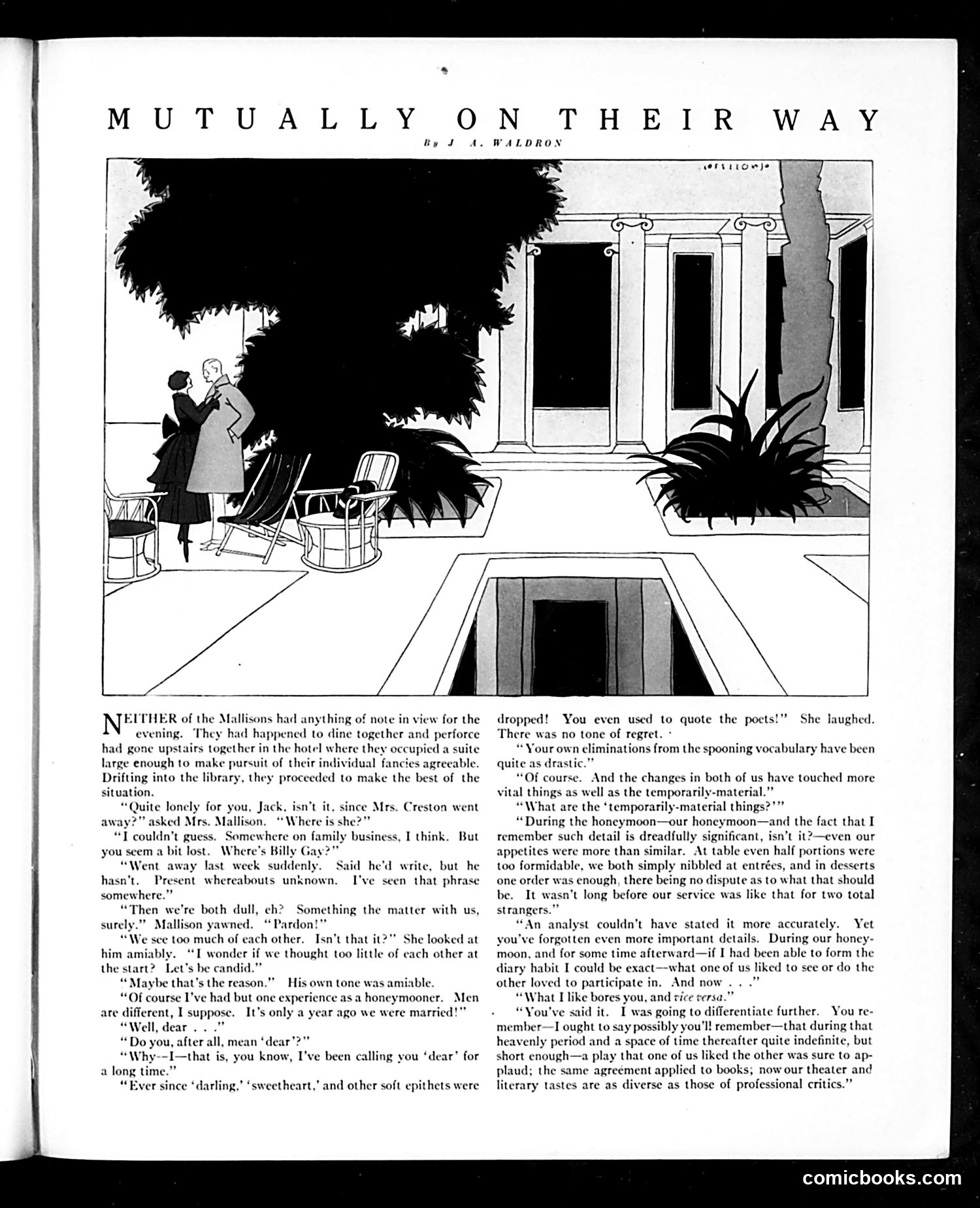
This story illustrates the disillusionment of married life through dialogue between Mr. and Mrs. Mallison, who are staying in a hotel. The narrative traces how their relationship has deteriorated since their honeymoon. The satire targets the erosion of romantic connection in marriage: the couple once used affectionate terms like "darling" and "sweetheart" but now call each other merely "dear"; they shared identical tastes and appetites during their honeymoon but now have completely divergent interests in theater, literature, and dining; and activities one partner enjoyed once held mutual appeal but now bore the other. The illustration shows them in a modernist hotel setting—appearing somewhat distant despite occupying the same space. The piece satirizes how marriages transform from passionate unions into arrangements between "total strangers" sharing a life, using the couple's own clinical self-analysis as the humor. It's a commentary on the mundane reality that often follows romantic beginnings.
📄 Transcribed text from this page (OCR, searchable)
Machine-transcribed from the original scan — historical spelling and the odd misread are preserved.
U TUALLY O By JAW N THEIR WAY WALDRON witiiow) THER of the Mallisons had anything of note in view for the ning. They had happened to dine together and perforce had gone upstairs together in the hotel where they occupied a suite large enough to make pursuit of their individual fancies agreeable. Drifting into the library, they proceeded to make the best of the situation. “Quite lonely for you, Jack, isn’t it, since Mrs. Creston went ay?” asked Mrs. Mallison. “ Where is she?” “T couldn't gue Somewhere on family business, I think. you seem a bit lost. Where’s Billy Gay? Went away last week suddenly. n't. Present whereabouts unknown. somewhere.” hen we're both dull, ch? Something the matter with us, y.”” Mallison yawned. “ Pardon!" ee too much of each other. Isn't that it? him amiably. “I wonder if we thought too little of the start? Let’s be candid.” “Maybe that’s the reason.”” His own tone was amiable. “Of course I’ve had but one experience as a honeymoone: are different, I suppose. It’s only a y Zo We Were marrit “Well, dear...’ “Do you, after all, mean ‘dear’?” “Wh: —that is, you know, I've been calling you ‘dear’ for a long time.” “Ever since ‘darling, But Said he'd write, but he I've seen that phrase * She looked at h other at Men sweetheart,’ and other soft epithets were dropped! You even used to quote the poet: She laughed. There was no tone of regret. * “Your own eliminations from the spooning vocabulary have been quit drastic.” “Of course. And the changes in both of vital things as well as the temporarily-materi “What are the ‘temporarily-material thing: “During the honeymoon—our honeymoon—and the fact that I remember such detail is dreadfully significant, isn’t it?—even our appetites were more than similar. At table even half portions were too formidable, we both simply nibbled at entrées, and in desserts one order was enough, there being no dispute as to what that should be. It wasn’t long before our service was like that for two total strangers. An analyst couldn't have stated it more accurately. Yet you've forgotten even more important details. During our honey- moon, and for some time afterward—if I had been able to form the diary habit I could be exact—what one of us liked to see or do the other loved to participate in. And now . . . “What I like bores you, and vice versa.” “You've said it. I was going to differentiate further. You re- member—I ought to possibly you'l! remember—that during that heavenly period and a space of time thereafter quite indefinite, but short enough—a play that one of us liked the other was sure to ap- plaud; the same agreement applied to books; now our theater and literary tastes are as diverse as those of professional critics.” s have touched more comicbooks.com