
A complete issue · 29 pages · 1915
Judge — December 25, 1915
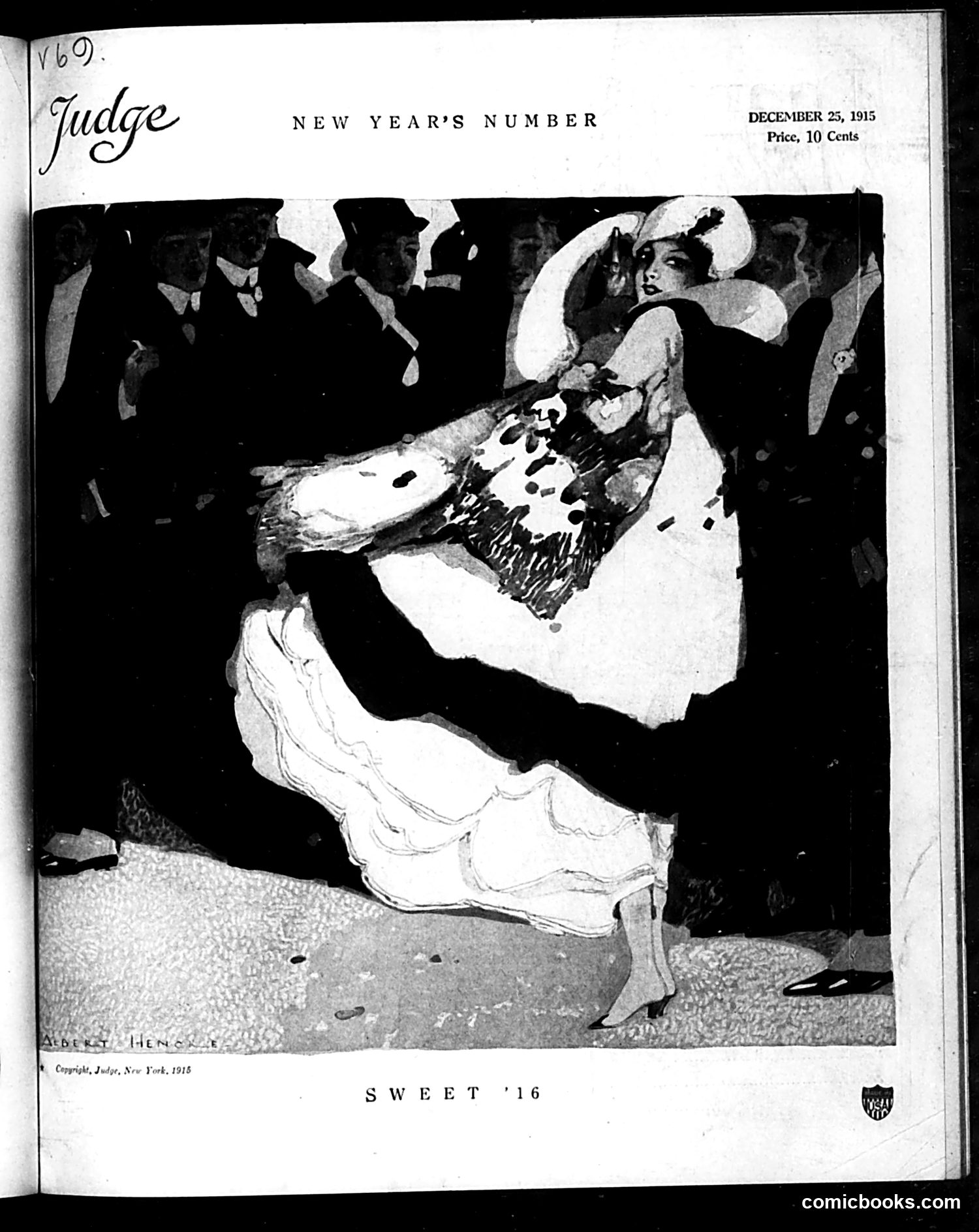
This is a New Year's issue cover illustration titled "Sweet '16," depicting a young woman in an elaborate white dress and large feathered hat, kicking her leg up playfully while surrounded by admiring men in formal attire. The satire plays on the phrase "Sweet 16" — referring to a girl's sixteenth birthday as an idealized, carefree age. The illustration mocks the frivolous, flirtatious behavior associated with upper-class young women of the era, showing her as the center of male attention and admiration. The work appears to be social satire about wealth, youth culture, and gender dynamics in early 20th-century America, presented with the magazine's typical mix of humor and gentle mockery of contemporary society.
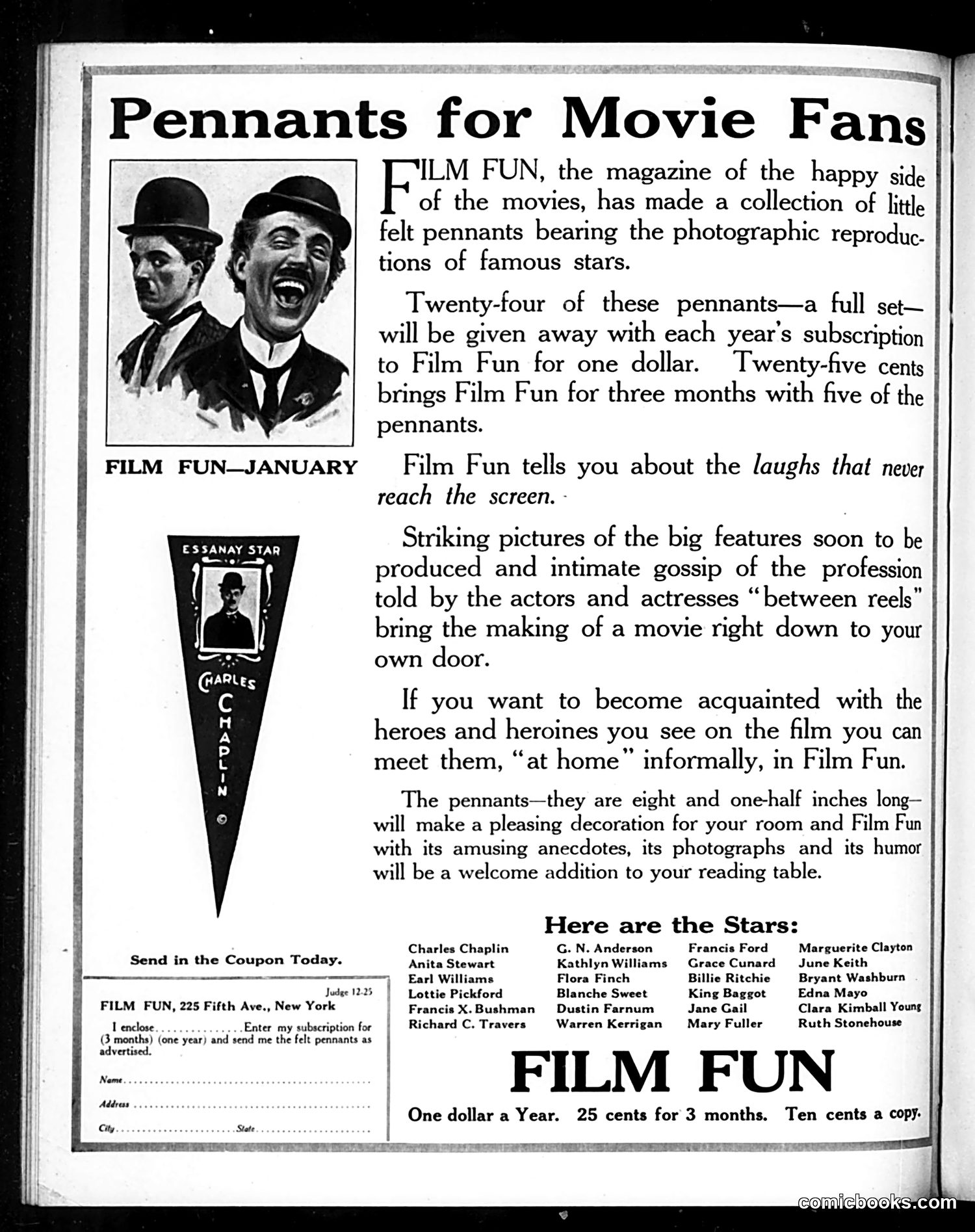
This page is primarily **advertising rather than satire or political commentary**. It promotes "Film Fun," a movie fan magazine offering collectible pennants featuring photographs of famous movie stars. The two illustrations shown are: 1. **Top left**: Two men in early 20th-century attire (bowler hats, formal wear)—likely **Charlie Chaplin** and another popular silent film comedian, representing the entertainment industry the magazine covers. 2. **Bottom left**: A pennant design labeled "Essanay Star" showing **Charles Chaplin**, demonstrating the product being sold. The ad emphasizes the pennants' appeal to movie fans: eight-and-a-half inches long, collectible decorations featuring 24 different stars. The pricing and subscription information indicates this was a modest, accessible product for general audiences interested in celebrity culture.
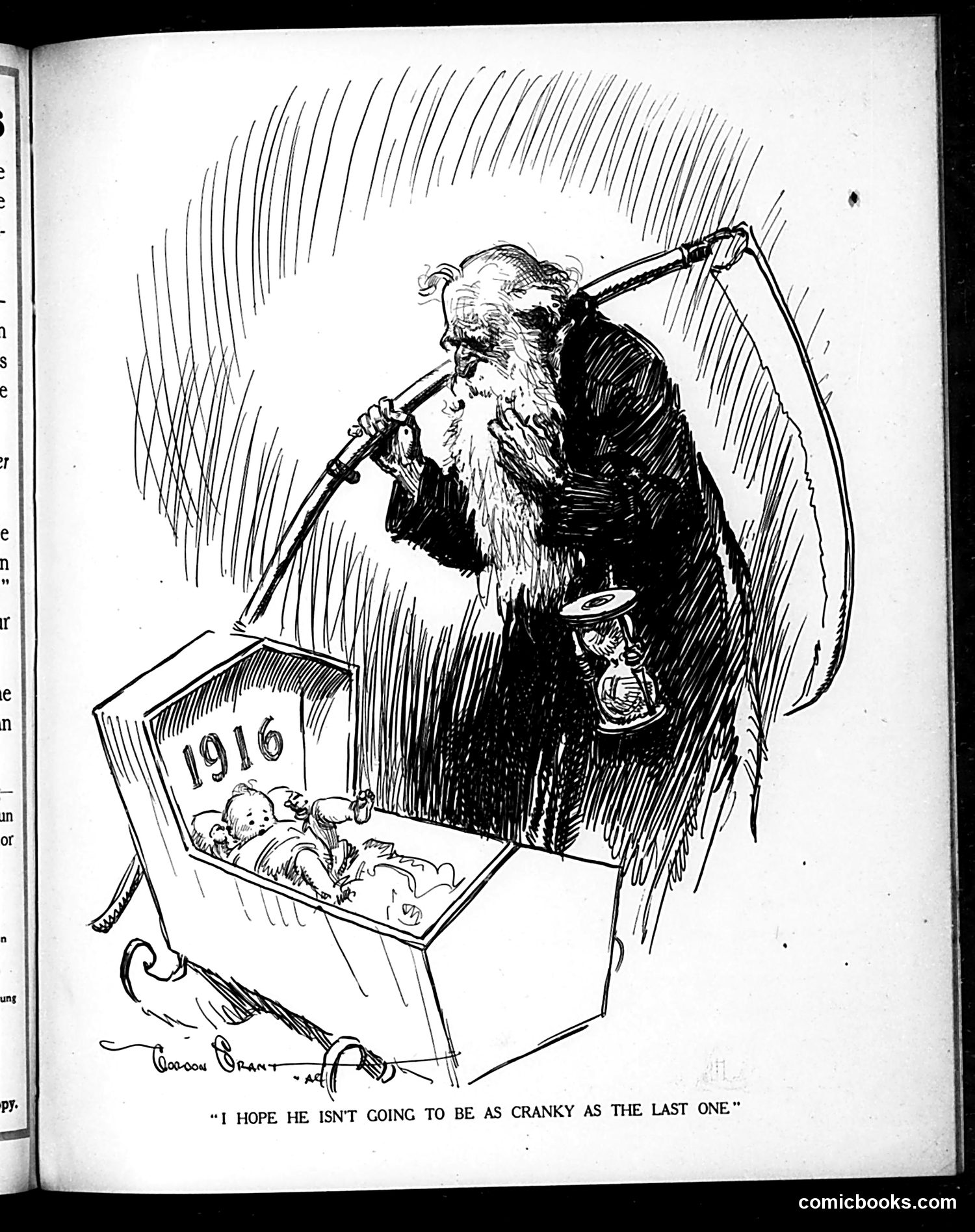
This 1916 cartoon depicts **Death** (the Grim Reaper) standing over a coffin marked "1916," containing an infant labeled with what appears to be a new leader or regime. The caption reads: "I HOPE HE ISN'T GOING TO BE AS CRANKY AS THE LAST ONE." The cartoon appears to reference political or military leadership transitions during World War I. The "cranky" predecessor likely refers to a previous leader's controversial policies. The coffin and death imagery suggest the speaker (possibly representing a nation or institution) expresses concern that a new administration will prove as difficult or contentious as its predecessor. The satirical tone mocks political continuity and warns of potential future complications.
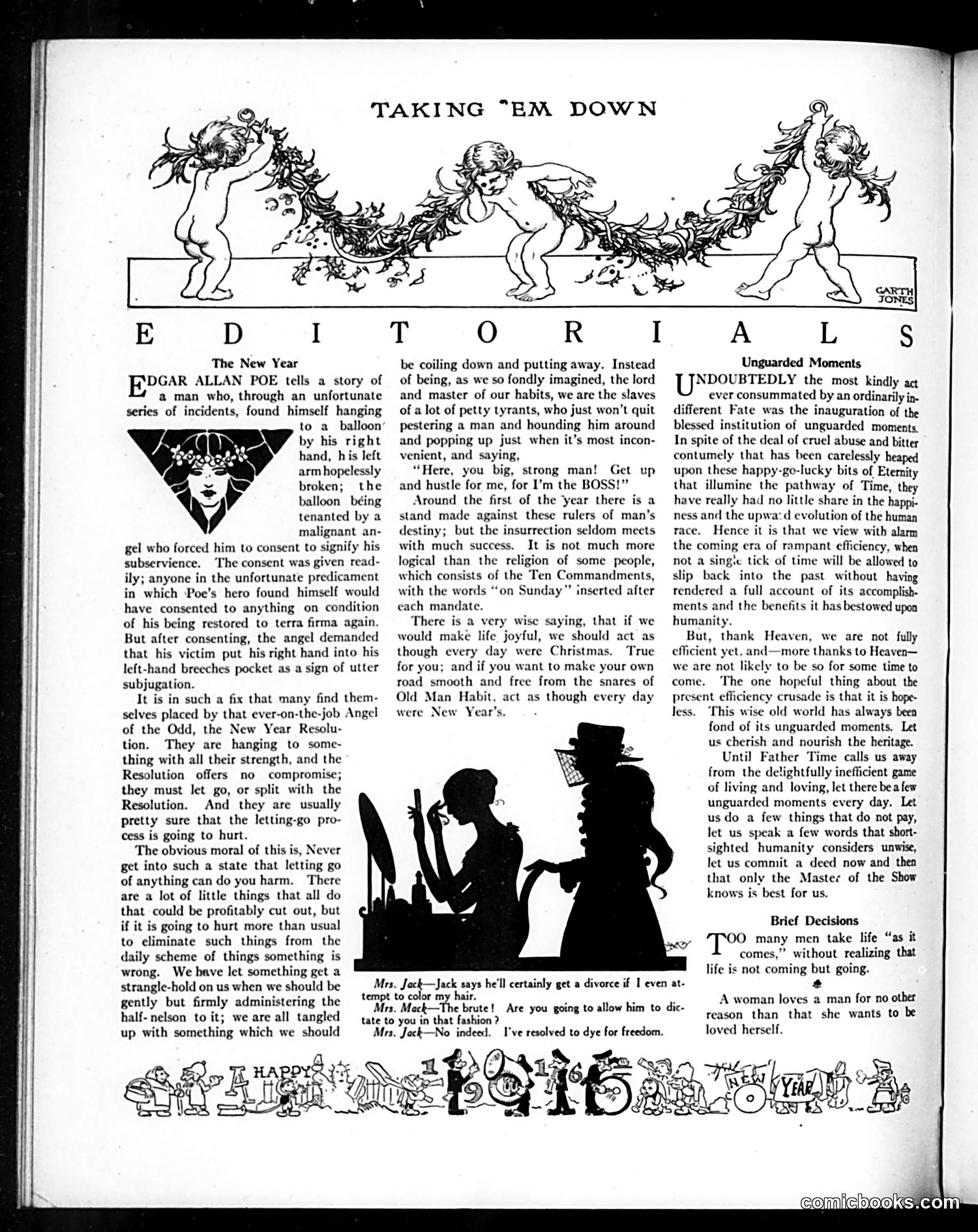
This page from *Judge* magazine uses satire to critique New Year's resolutions and personal reform. The header illustration shows cherubs struggling with a long chain of resolutions, suggesting the difficulty of maintaining them. The main editorial "The New Year" satirizes the paradox of New Year's reform: people make grand resolutions they rarely keep, comparing this to forced subjugation under tyrannical "Old Man Habit." The text argues that letting go of resolutions entirely might be better than the inevitable failure—a cynical commentary on human weakness and self-deception. The companion piece "Unguarded Moments" advocates cherishing life's small, unplanned joys rather than obsessing over efficiency and progress. The dialogue snippet at bottom appears to mock marital discord disguised as witty banter.
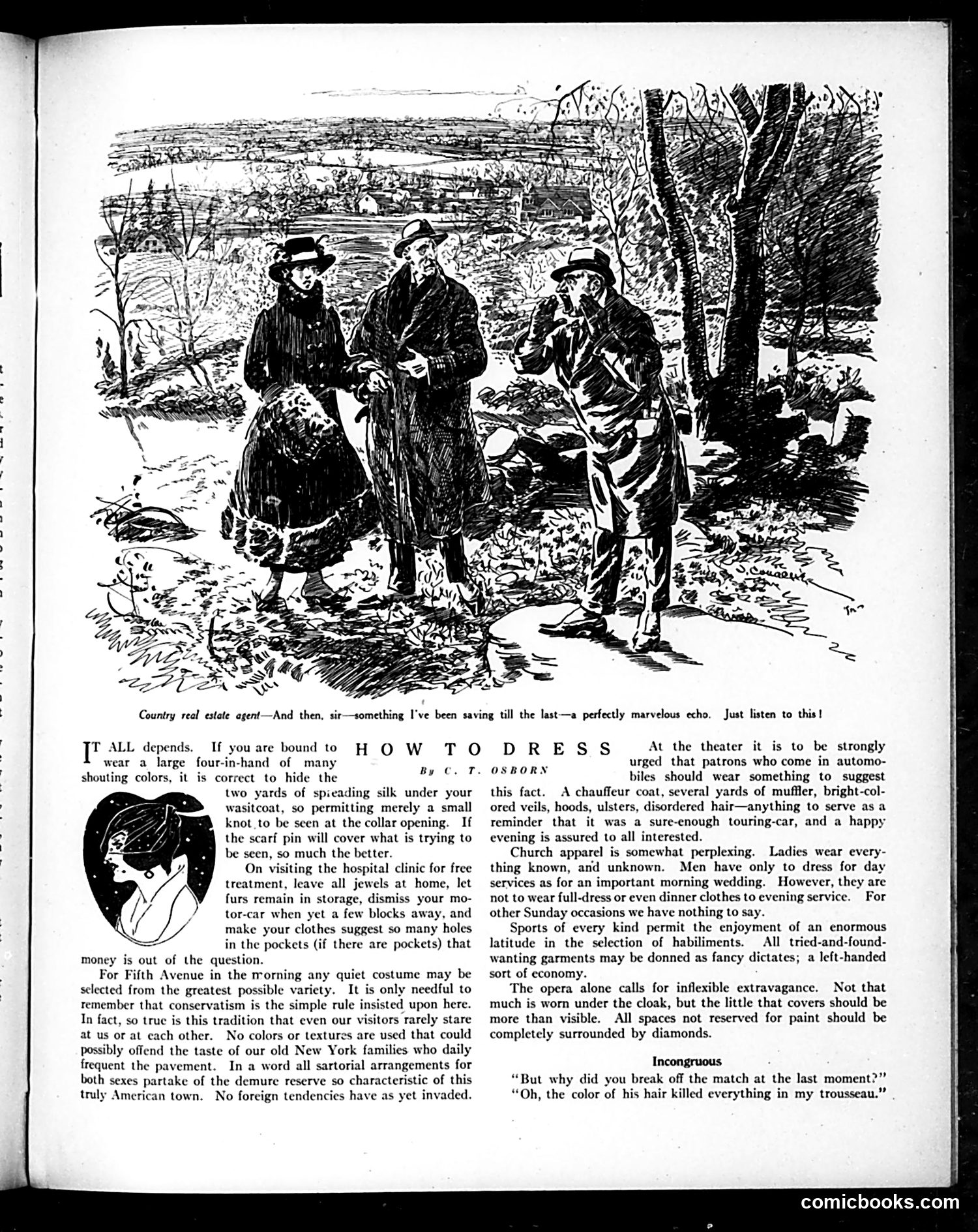
This page contains a fashion/etiquette article titled "How to Dress" by C.T. Osborn, rather than political satire. The main illustration shows four figures in conversation at a country estate, establishing the setting for dress code advice. The article satirizes social pretension by mocking overly formal dress expectations. It advises against excessive ornamentation (four-in-hand scarves, spreads of silk) and recommends conservative American taste over "foreign tendencies." The humor targets wealthy elites who obsess over clothing rules—suggesting that choosing appropriate dress for different venues (theater, church, sports) requires navigating confusing, often contradictory social conventions. The satirical approach criticizes class-conscious Americans who police appearance while claiming democratic values.
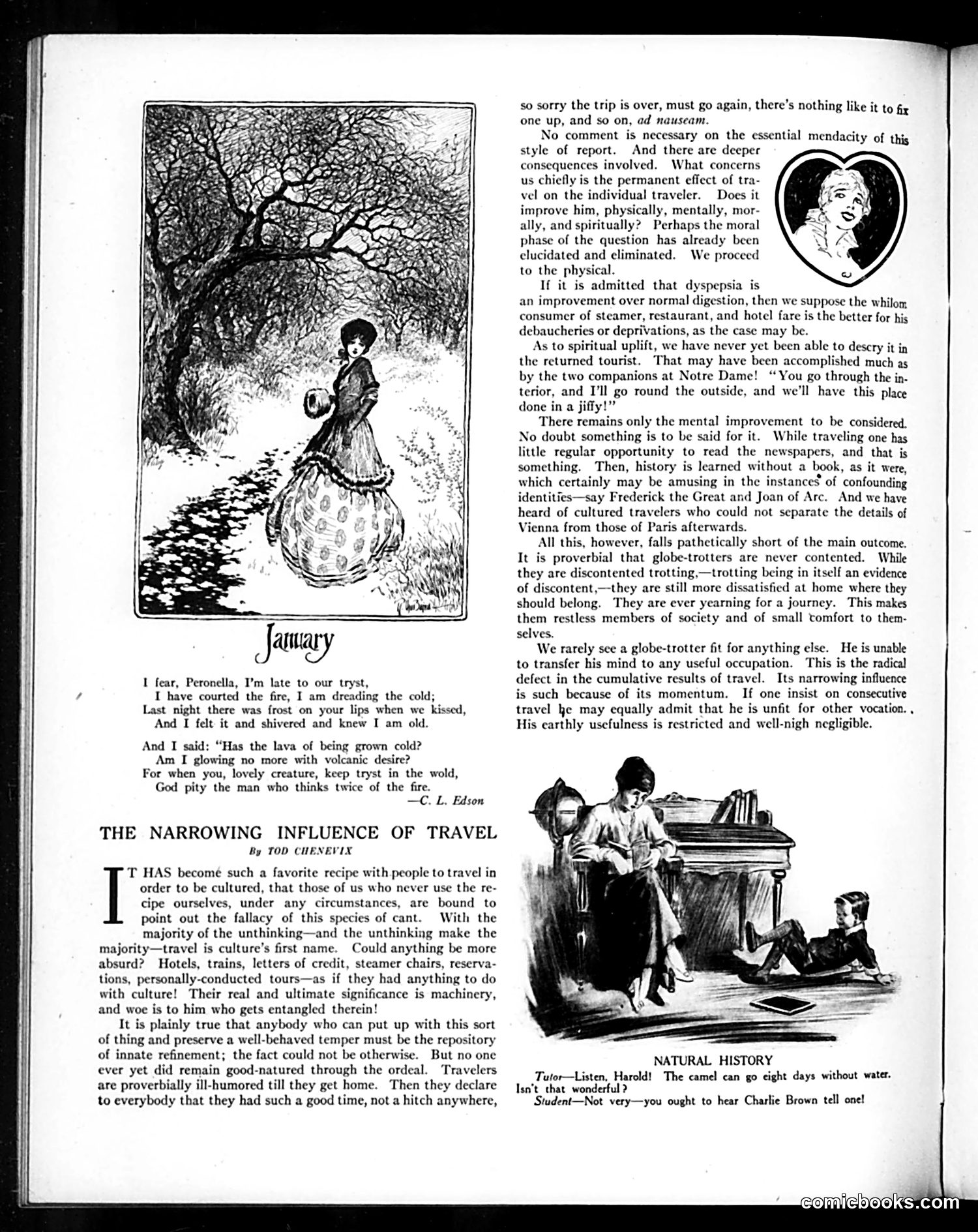
This page contains a romantic poem by C.L. Edson about aging and lost passion, followed by an essay titled "The Narrowing Influence of Travel" by Tod Chenevix. **The Main Satire:** Chenevix argues that travel—then fashionable among the wealthy as a marker of culture and refinement—actually *damages* people rather than improving them. He mocks the hypocrisy of travelers who claim enrichment while displaying physical ailments (dyspepsia from poor food), spiritual emptiness, and mental confusion (confusing Vienna and Paris). **The Central Joke:** Rather than becoming cultured, travelers become restless, ill-humored complainers who romanticize journeys while alienated at home. Chenevix sardonically suggests that merely enduring travel's mechanical discomforts (hotels, trains, reservations) proves one has "innate refinement"—obviously absurd logic he's exposing. The illustrations show a woman traveler and tourists, reinforcing the critique of fashionable but ultimately hollow "grand tour" culture among the upper classes.
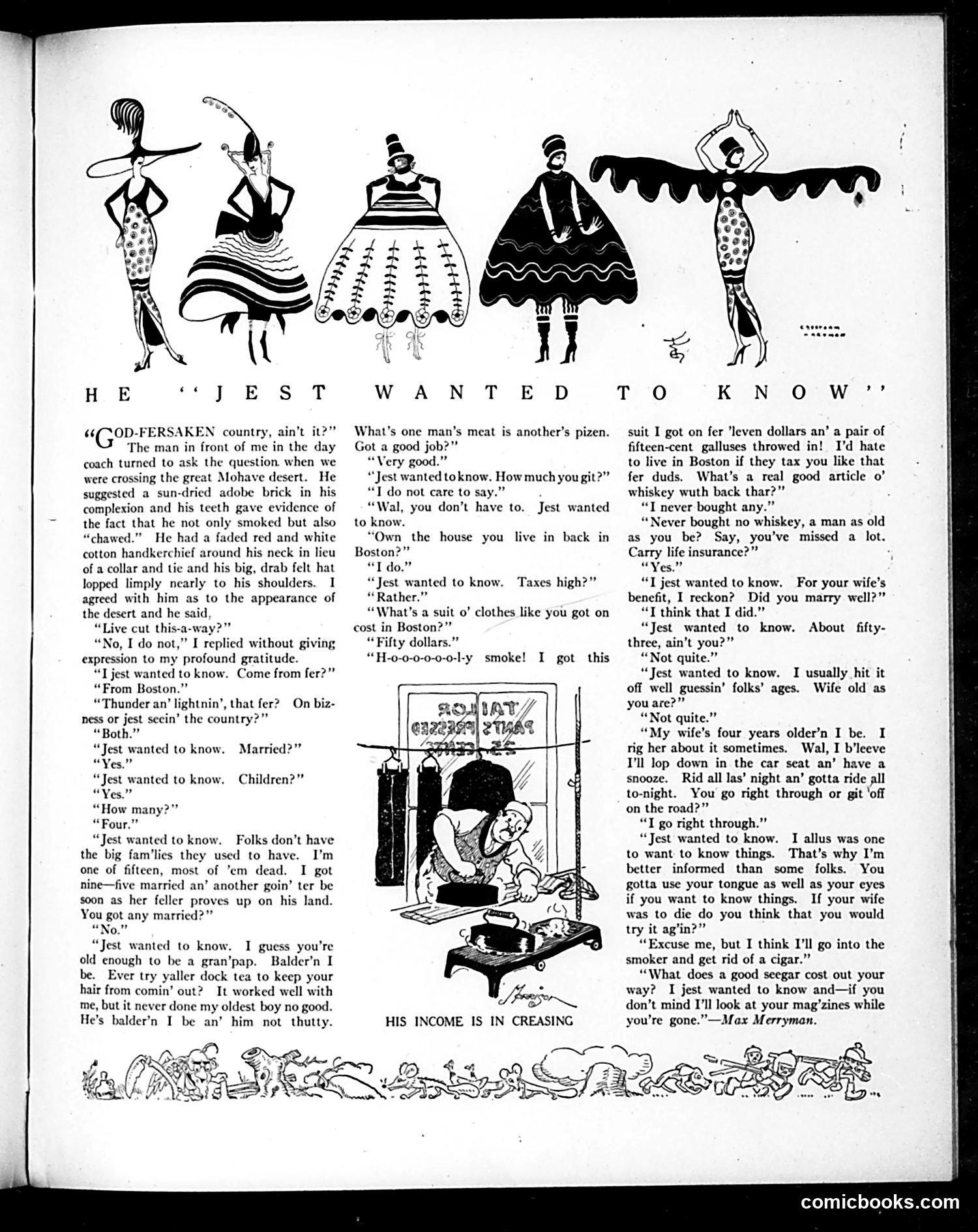
This page satirizes the stereotype of the garrulous, nosy American frontiersman. The title "He Jest Wanted to Know" frames a monologue where a rough, impoverished desert traveler interrogates a Boston businessman about his personal finances, family size, clothing costs, insurance, marriage, age, and even whether he'd remarry if widowed. The satire works on multiple levels: it mocks rural working-class Americans as intrusive and obsessively curious; it contrasts the traveler's crude appearance and limited means (eleven-dollar suit, homemade remedies) with his presumption to judge the educated Bostonian's life choices; and it illustrates how relentless questioning masquerades as friendly interest while actually being deeply invasive. The illustration shows the tired passenger escaping to the smoking car—the punchline being that even escape offers no relief, as the traveler follows to examine his magazines. The satire reflects early 20th-century urban condescension toward rural Americans.
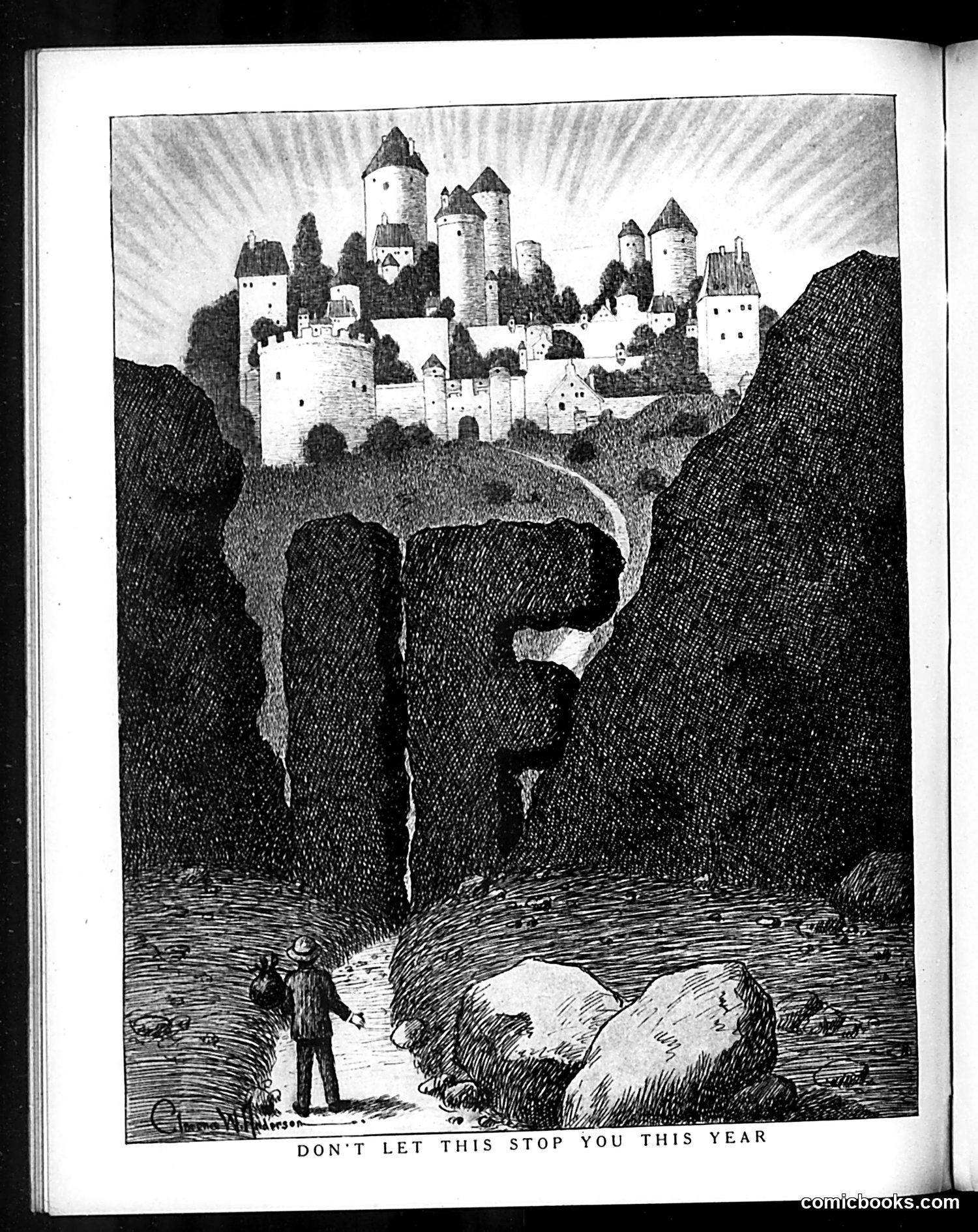
This is a political cartoon warning against complacency. The image shows a medieval castle perched on a hilltop, viewed from a deep ravine or chasm. A lone figure stands below, looking up at the distant fortification. The caption reads "DON'T LET THIS STOP YOU THIS YEAR." The cartoon appears to use the castle as a metaphor for an obstacle or barrier—likely representing some social, political, or economic challenge facing Americans. The vast gulf between the viewer and the castle suggests that the challenge feels insurmountable or distant. The message warns against allowing such obstacles to prevent action or progress "this year," urging persistence and determination despite apparent difficulties. Without the magazine's date or additional context, the specific issue referenced remains unclear.
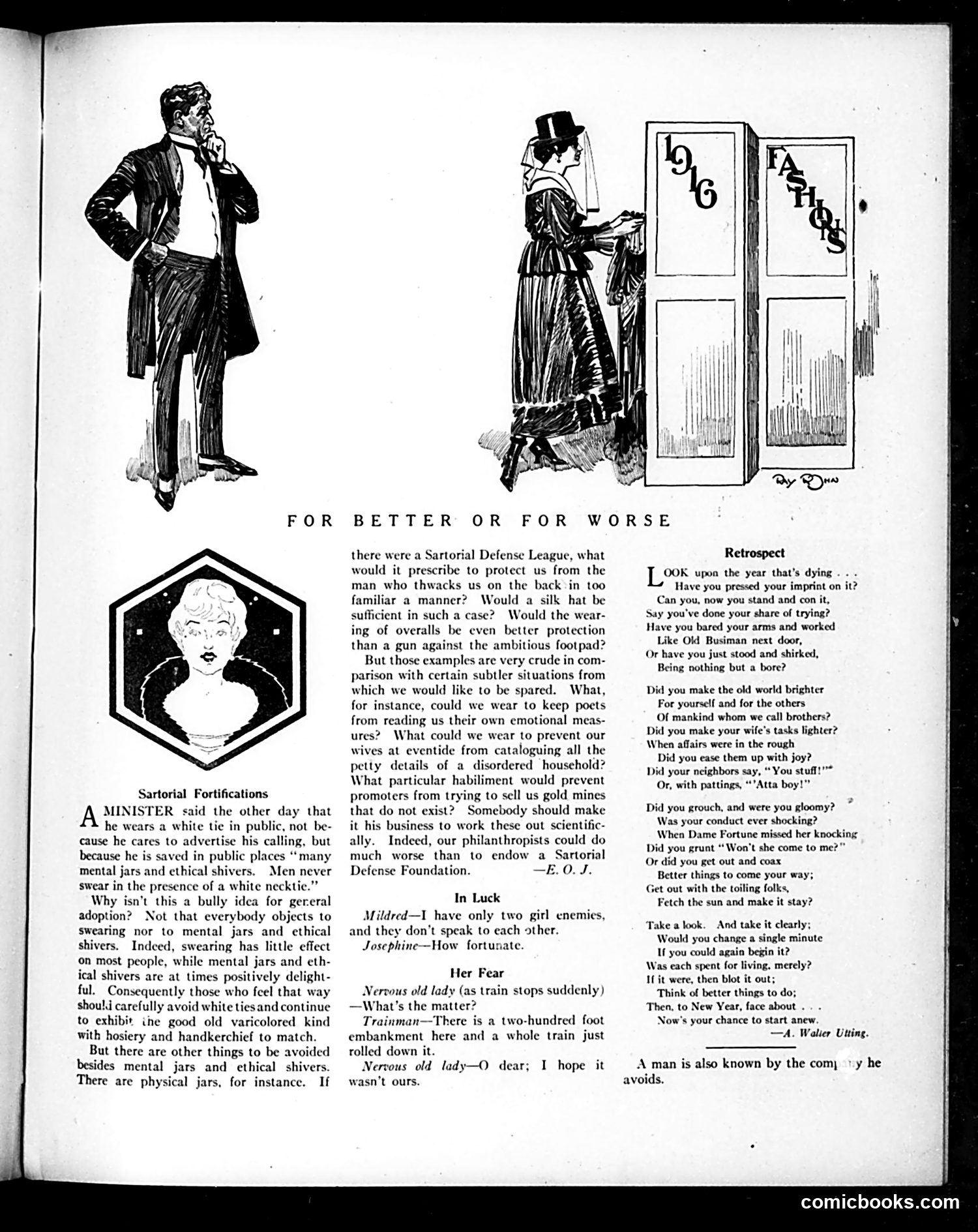
This page satirizes the idea that clothing can protect us from social discomforts. A minister claimed wearing a white tie prevents "mental jars" by discouraging swearing around him. The article humorously extends this logic: if neckwear deters rudeness, what clothing could protect us from *other* annoyances? The satire targets absurd social problems: a silk hat against back-slapping, overalls against muggers, and most pointedly—special garments to stop poets from reading their work aloud, wives from complaining about household disorder, and con artists from pitching fake gold mines. The joke mocks both the minister's naïve faith in social signaling and the notion that fashion solves fundamental human problems. It's gentle social commentary suggesting that etiquette and clothing cannot genuinely reform people's behavior—they merely create superficial courtesy. The cartoons at top illustrate the "better or worse" theme of marital situations and social encounters.
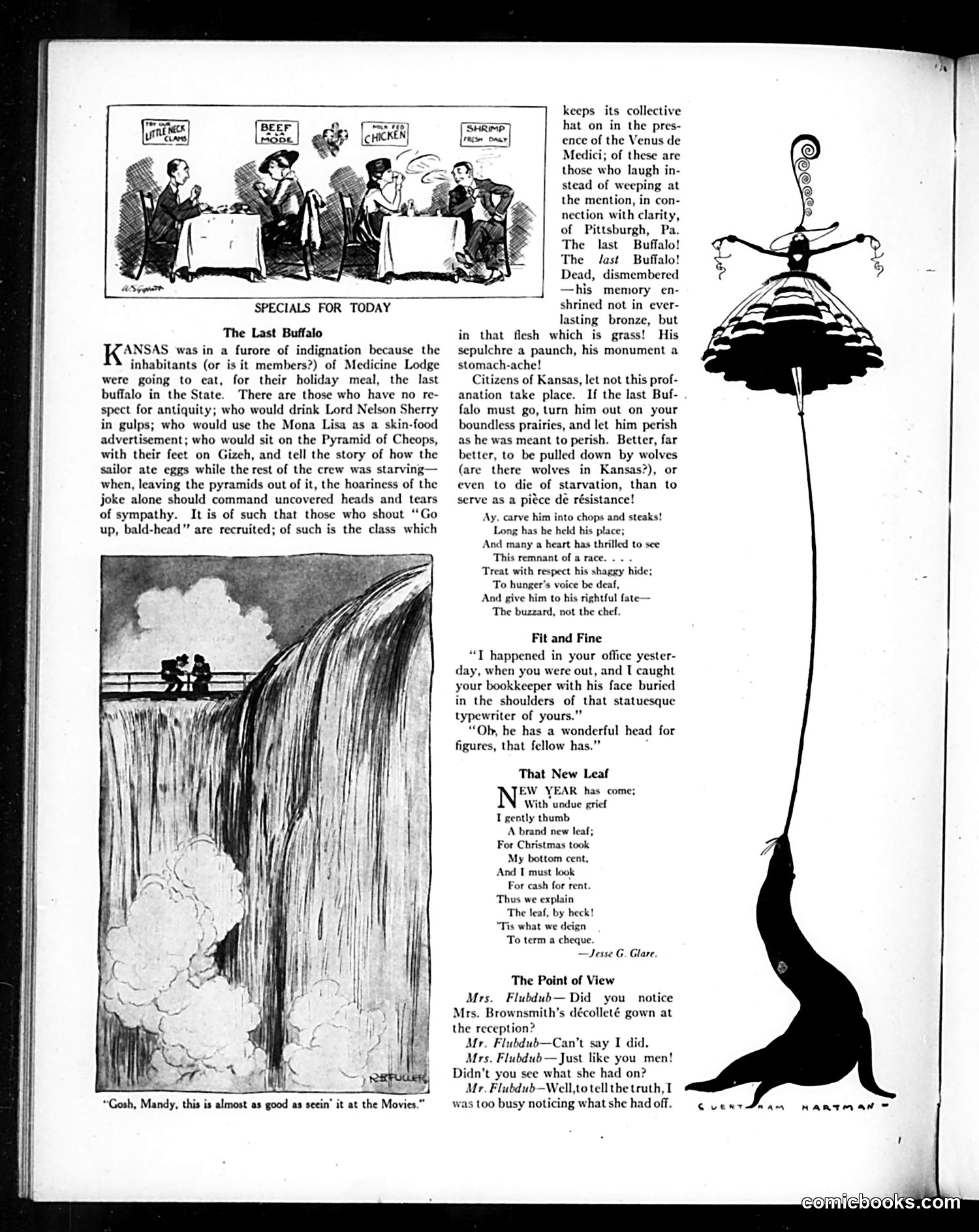
This page satirizes contemporary American attitudes toward nature and progress circa early 1900s. **"The Last Buffalo"** is the main piece—a mock-serious lament about Medicine Lodge, Kansas planning to slaughter the last state buffalo for their holiday meal. The satire targets philistinism: people who disrespect historical/cultural treasures (comparing such diners to those who'd drink Nelson Sherry in gulps or sit on the Pyramids). The text argues the buffalo deserves a "noble" death in the prairie, killed by wolves or starvation, rather than becoming a menu item—ironically treating a wild animal's death with more reverence than its actual preservation. The humor lies in this inverted logic. **"Fit and Fine"** jokes about a bookkeeper caught embracing a typewriter—the boss's pun about his "head for figures" plays on double meaning. **"That New Leaf"** puns on New Year resolutions: a poor man's "new leaf" is literally writing checks (cheques) instead of financial reform. **"The Point of View"** is a marital joke about a husband noticing what a woman *isn't* wearing rather than what she is.
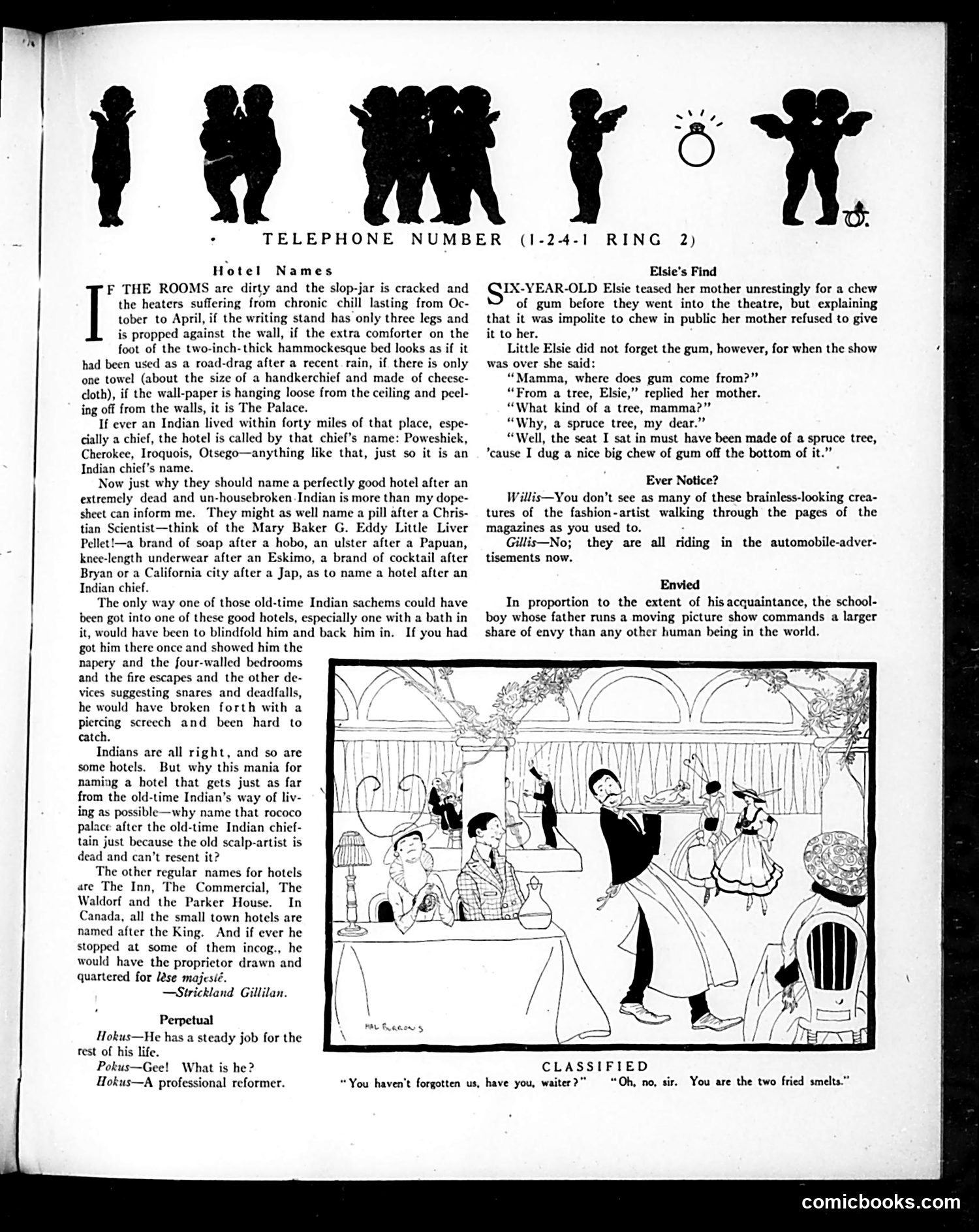
This page contains multiple short satirical pieces typical of early 20th-century Judge magazine humor. **"Hotel Names"** mocks the widespread practice of naming shabby American hotels after Native American chiefs. The author argues this is absurd—naming decrepit, uncomfortable establishments after indigenous peoples bears no logical connection to actual Native American life or values. The satire suggests hotels with names like "Cherokee" or "Poweshiek" are often run-down establishments, and the practice is disrespectful to deceased tribal leaders who "can't resent it." **Shorter humor pieces** include "Elsie's Find" (a child's joke about gum stuck under theater seats), "Ever Notice?" (commentary on magazine advertising trends), and "Perpetual" (wordplay about a professional reformer). The **cartoon** depicts a restaurant scene where waiters have forgotten customers, with the caption satirizing inattentive service. Overall, the page reflects early 1900s American attitudes toward Native Americans while poking fun at contemporary commercial and social customs.
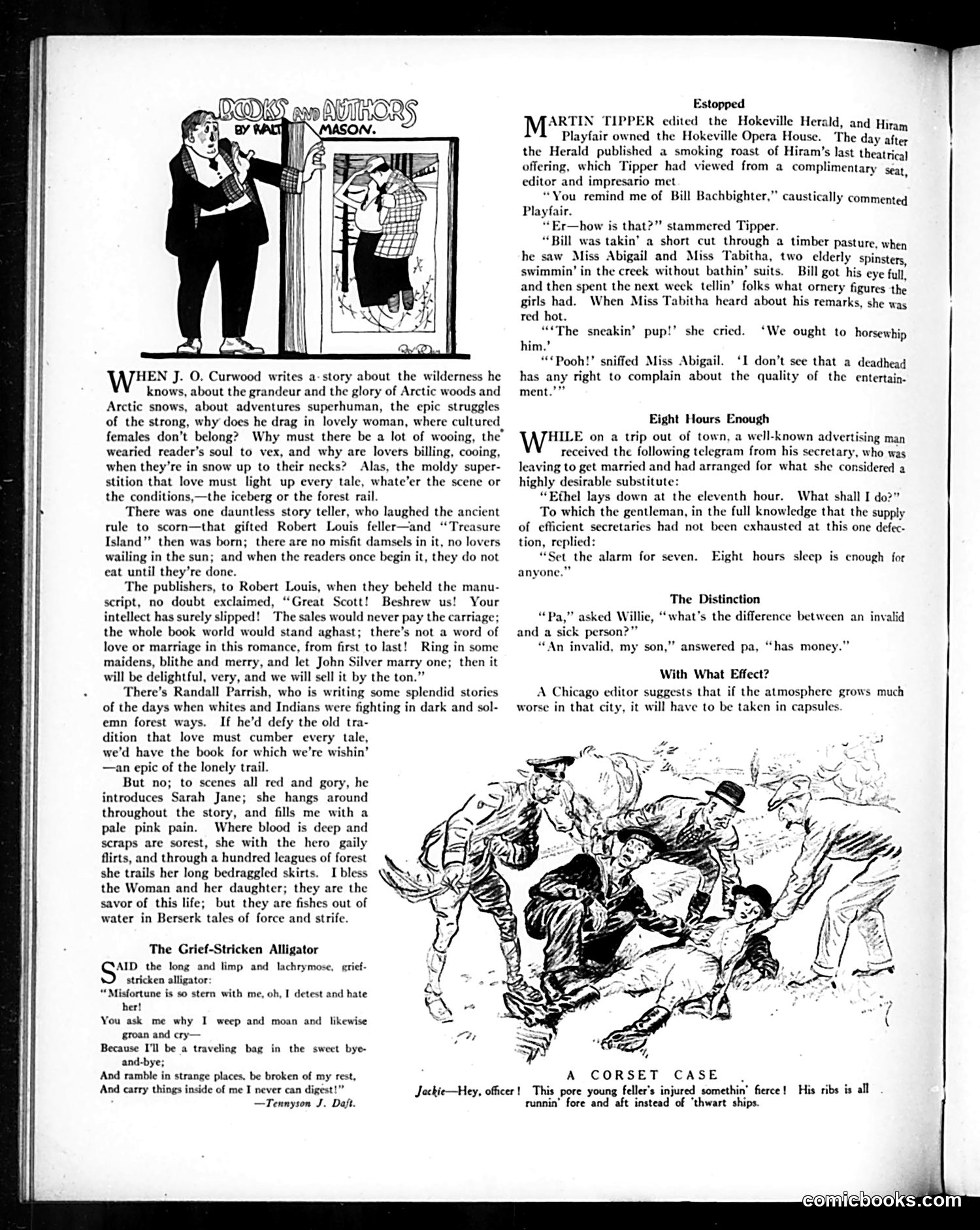
This page contains several satirical pieces. The main article critiques adventure novelists (J.O. Curwood, Robert Louis Stevenson, Randall Parrish) for inserting romantic subplots into wilderness stories where they don't belong. The author argues that adding love interests and female characters to tales of Arctic exploration or frontier combat weakens the narrative—praising *Treasure Island* as an exception with no romance. The sidebar jokes are brief social commentary: one mocks a theater critic (Tipper) by comparing him to a man who gossips about seeing women bathing; another features an alligator lamenting becoming a handbag; a final anecdote puns on "deadhead" (free theater ticket) versus legitimate complaints. The cartoons and humor reflect early 20th-century attitudes about gender roles, literature, and workplace dynamics—particularly skepticism about mixing "serious" masculine adventure with romantic sentiment.
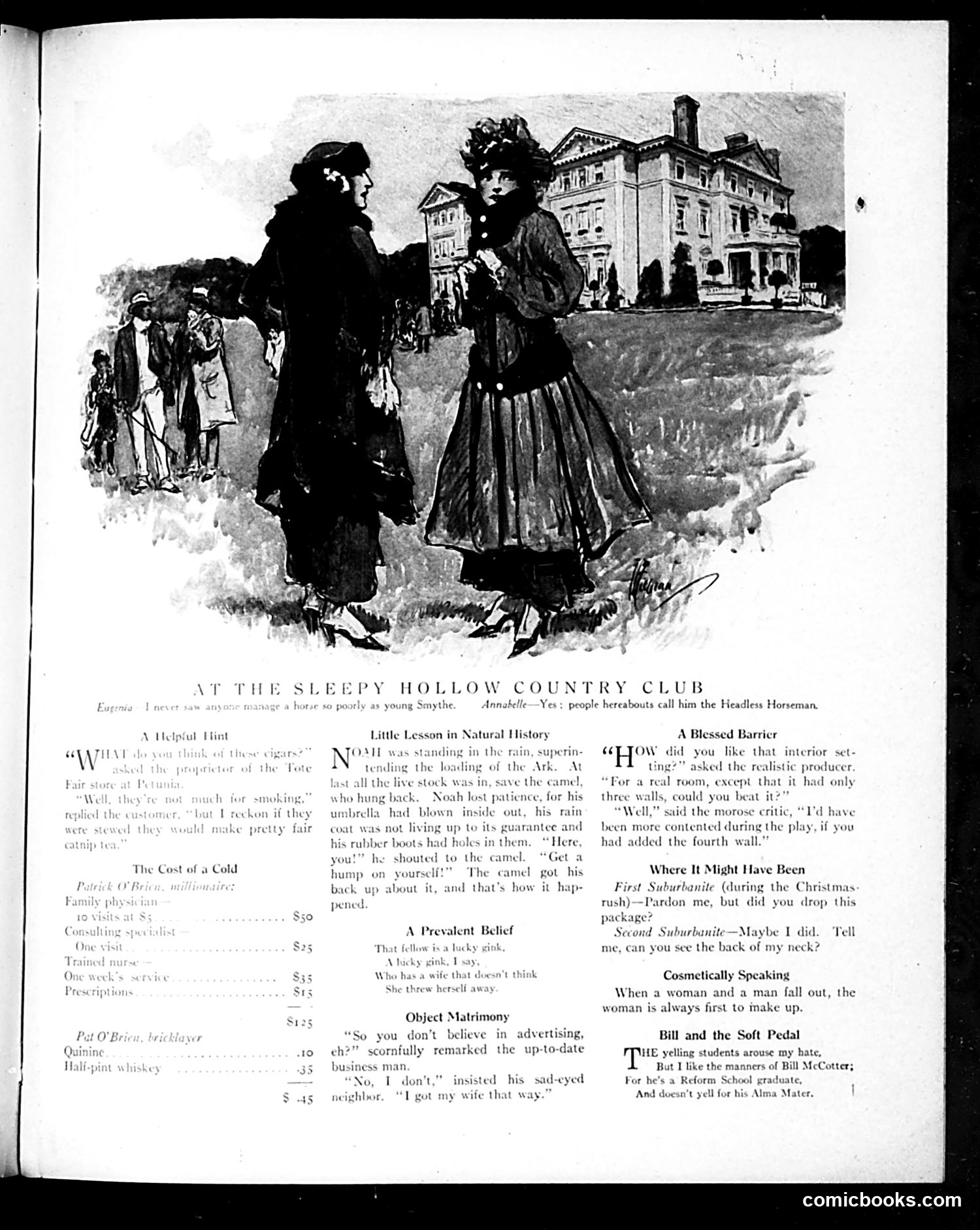
This page features a satirical illustration and multiple short humorous pieces typical of early 20th-century Judge magazine. The main cartoon depicts two fashionably dressed women at a country club, with one identifying a man as "the Headless Horseman" — likely a reference to Washington Irving's famous character, here used to mock an unremarkable club member. The text pieces are brief social satires on contemporary life: "The Cost of a Cold" mocks medical expenses; "Object Matrimony" jokes about advertising versus old-fashioned courtship; various quips target pretentious theater, competitive suburbanites, and gender relations ("woman is always first to make up"). "Bill and the Soft Pedal" appears to satirize a Reform School graduate who, unusually, doesn't brag loudly about his alma mater—a gentle jab at institutional pride and class distinctions. The humor targets upper-middle-class anxieties, social pretension, and gender dynamics of the period.
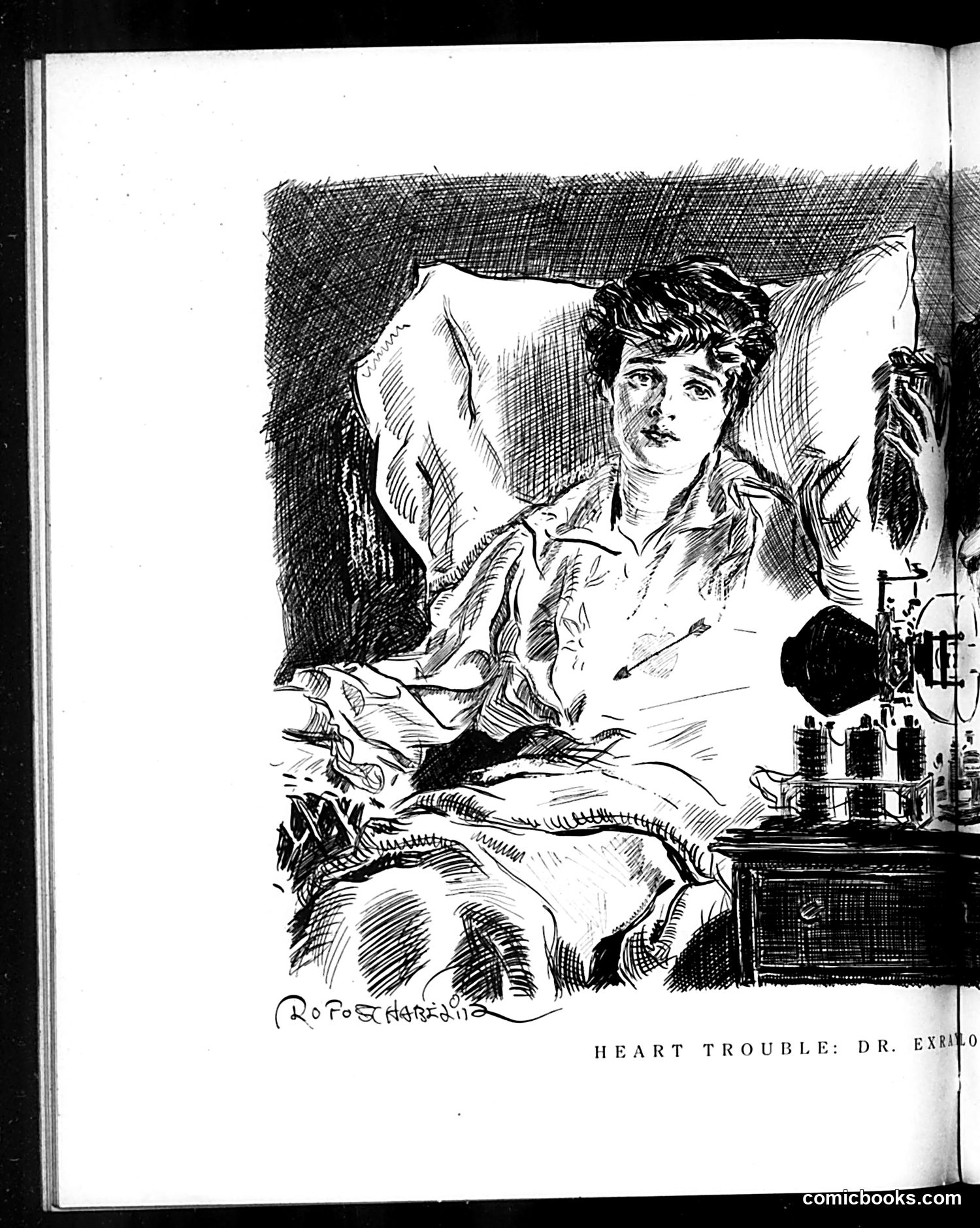
This appears to be a satirical illustration from *Judge* magazine showing a young woman reclining in bed, appearing ill or distressed. The caption reads "HEART TROUBLE: DR. EXRAEO" (the artist's signature appears to read "Ropostaraxia" or similar). The satire likely plays on the Victorian-era convention of "heart trouble" as a euphemism for romantic or emotional distress rather than actual cardiac illness. The presence of a doctor's visit and medical apparatus (visible on the nightstand) suggests the cartoon mocks either hypochondria or the tendency to medicalize what are actually emotional problems. Without clearer identification of "Dr. Exraeo," the specific satirical target remains unclear, though the general critique appears aimed at dramatic overstatement of romantic suffering or dubious medical practices.
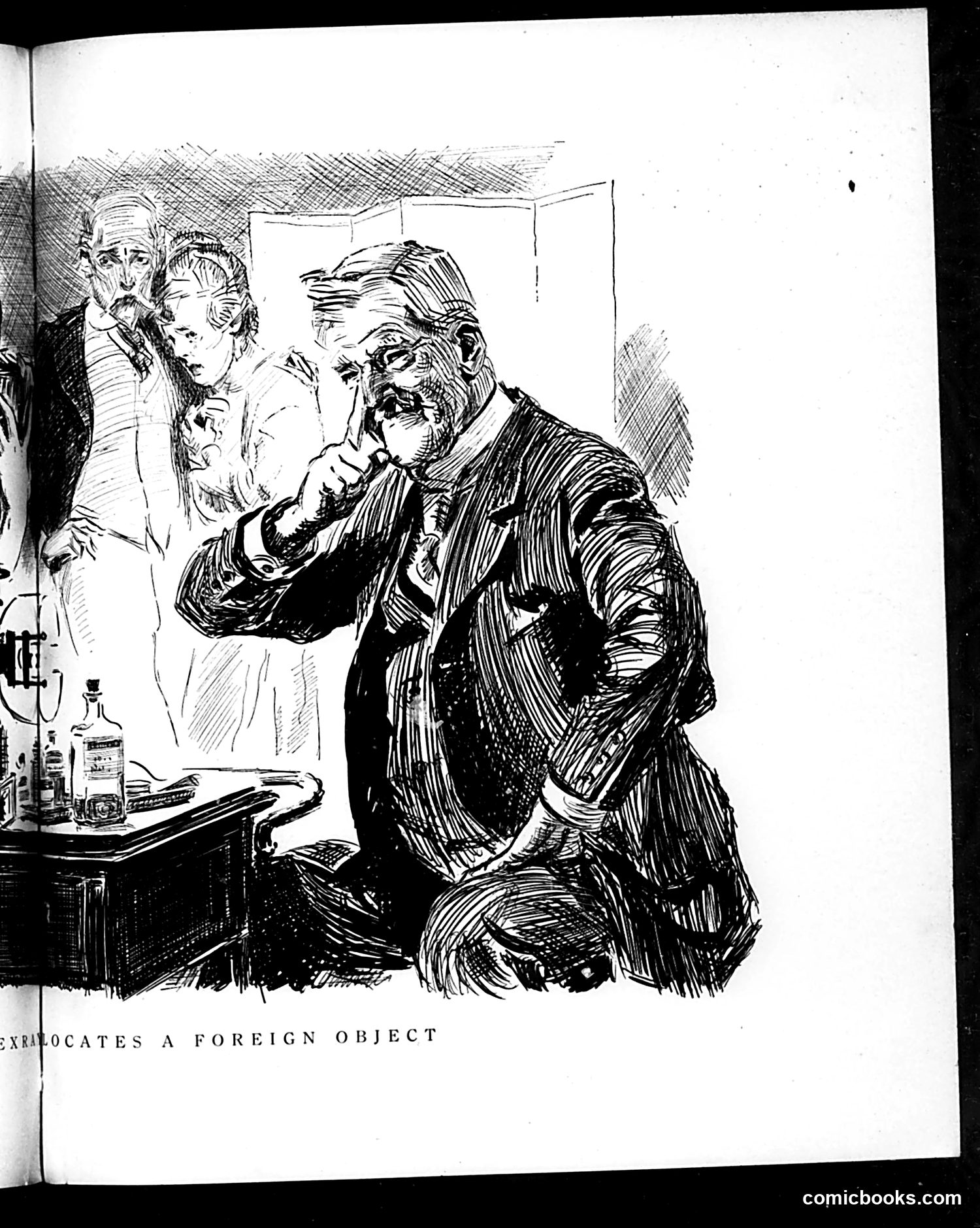
This political cartoon from *Judge* magazine depicts a medical scene where a doctor is extracting something from a patient's throat or mouth. The caption reads "EXRALOCATES A FOREIGN OBJECT" (likely "EXTRLOCATES" with OCR error). The satire appears to reference a contemporary political or social issue involving removal of a "foreign object"—possibly an immigrant, foreign influence, or unwanted foreign element—from American society. The medical framing suggests treating this removal as a necessary health/safety procedure. Without the publication date visible, I cannot identify the specific historical context, political figures involved, or which particular foreign policy debate this targets. The caricature style and dramatic rendering suggest commentary on nativist or isolationist sentiment, but the exact reference remains unclear.
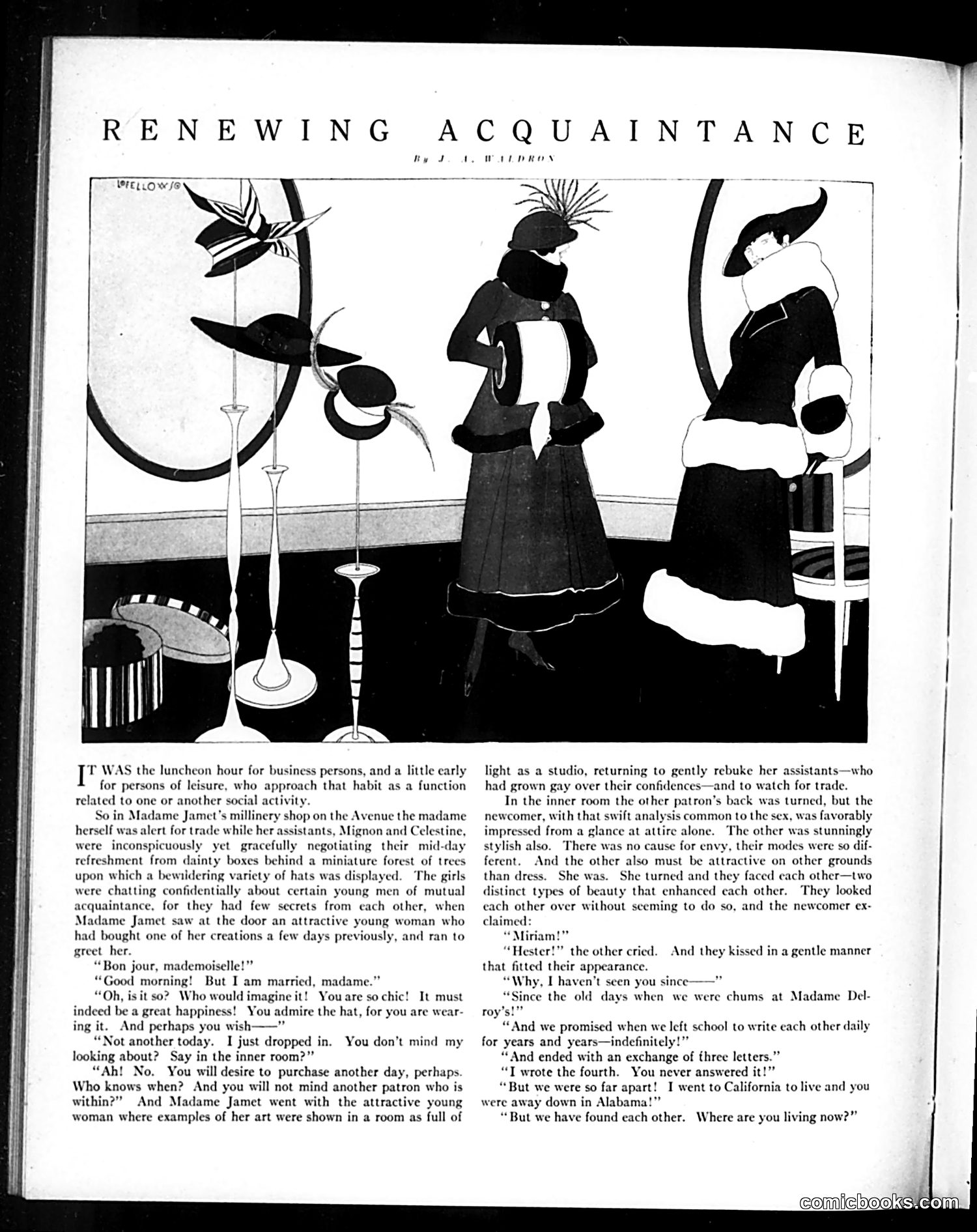
This is a narrative illustration (not political satire) from Judge magazine depicting a chance reunion between two women who were childhood schoolmates. The story unfolds in a Parisian millinery shop where a customer unexpectedly encounters an old friend while shopping for hats. The humor centers on social conventions of the era: the customer's arrival as a married woman surprises Madame Jamet, who compliments her stylishness and assumes she'll buy more hats. The two women—Miriam and Hester—recognize each other despite years of separation and broken correspondence (they exchanged only three letters despite promising daily contact). They had been separated by distance (California vs. Alabama). The satire is genteel rather than political, poking fun at women's fashion consciousness, the transience of childhood friendships, and the coincidences of urban life. The artwork shows typical 1910s-20s women's fashion and shop setting.
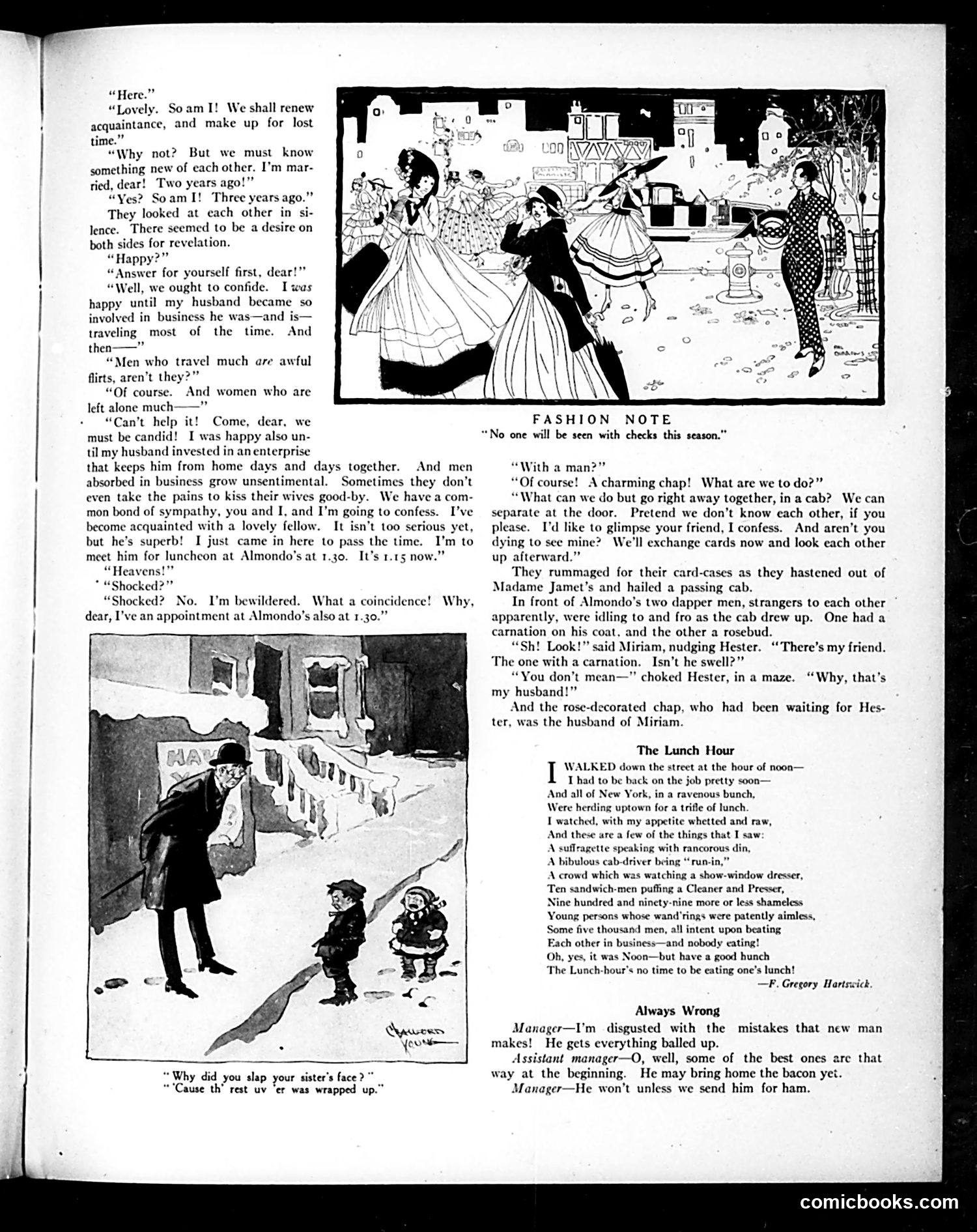
This page satirizes the hypocrisy and infidelity lurking beneath early 20th-century respectability. **Main Cartoon (top right):** Two married women meet by chance and confess to each other that their husbands neglect them due to business travel, pushing them toward affairs. They discover they're meeting *the same two men* at lunch at Almondo's restaurant—only to find those men are actually *each other's husbands*. The joke exposes how easily marriages deteriorate when spouses travel, and the absurd irony when infidelity circles back on itself. **Secondary cartoon (bottom left):** A crude joke about a child hitting his sister, with the punchline suggesting her entire body is "wrapped up"—likely a reference to tight corsetry, common women's fashion of the era. **"Fashion Note":** A brief satirical comment mocking whatever checked patterns were fashionable that season. **"The Lunch Hour" poem:** Social commentary on New York's chaotic noon hour—crowded streets, hustling workers, various types (suffragettes, cab drivers, the unemployed)—with the ironic observation that no one actually has time to eat lunch. The overall theme critiques modern urban life's pressures and moral compromises.
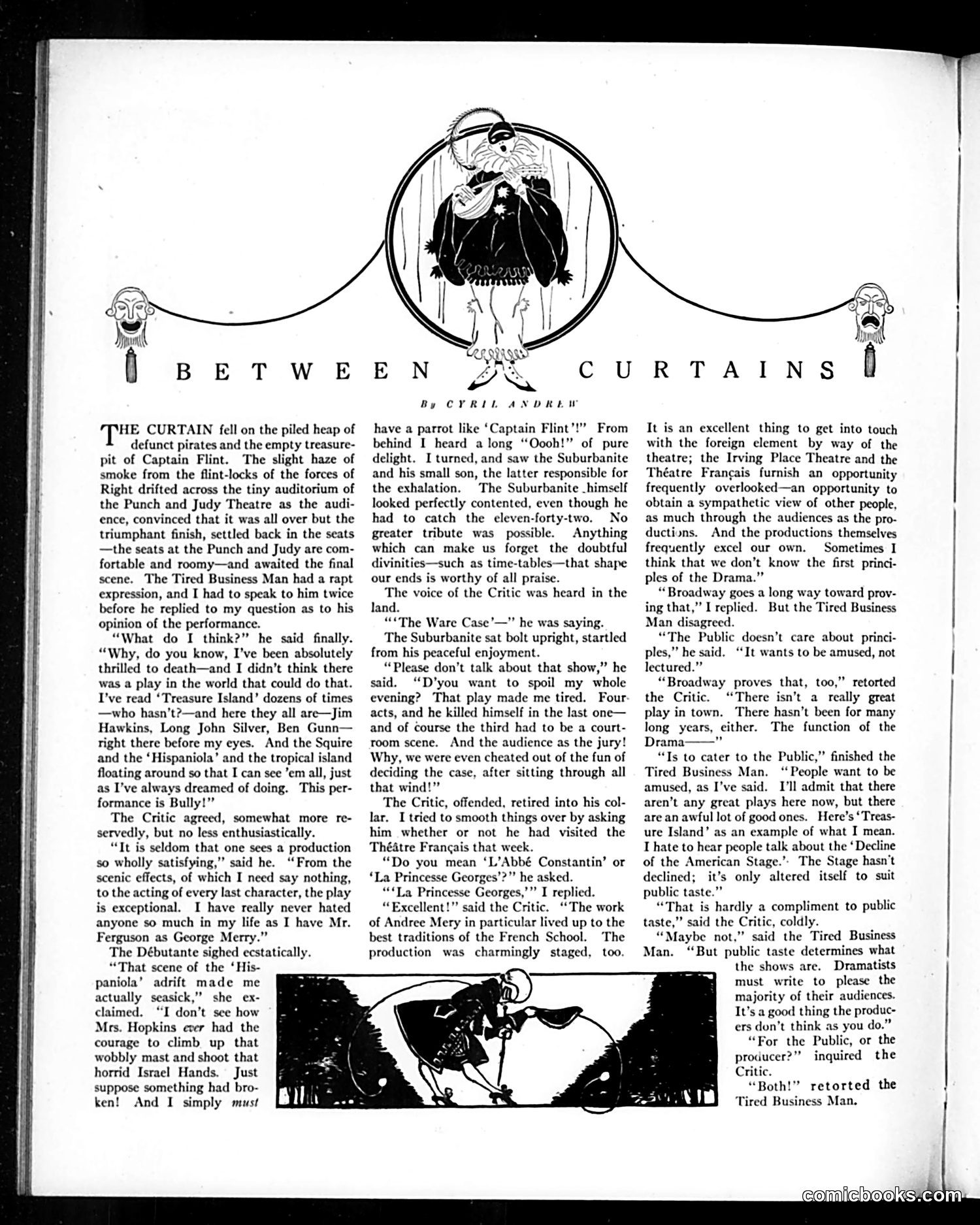
This piece satirizes different theatergoers' reactions to productions. The article contrasts three audience types attending a Punch and Judy Theatre production of "Treasure Island": - **The Tired Business Man**: Completely enchanted, lost in nostalgic escapism - **The Critic**: Intellectually appreciative but pedantic, prone to praising European productions over American ones - **The Suburbanite**: Practical and easily annoyed (upset by "The Ware Case" for its depressing courtroom drama) The satire mocks how theater critics valorize French productions while dismissing popular entertainment, and how exhausted businessmen seek simple escapism. The dialogue reveals class tensions—the Critic's pretension versus the working man's honest emotional response. The cartoon likely illustrates one of these character types, though the specific image details are unclear from this scan.
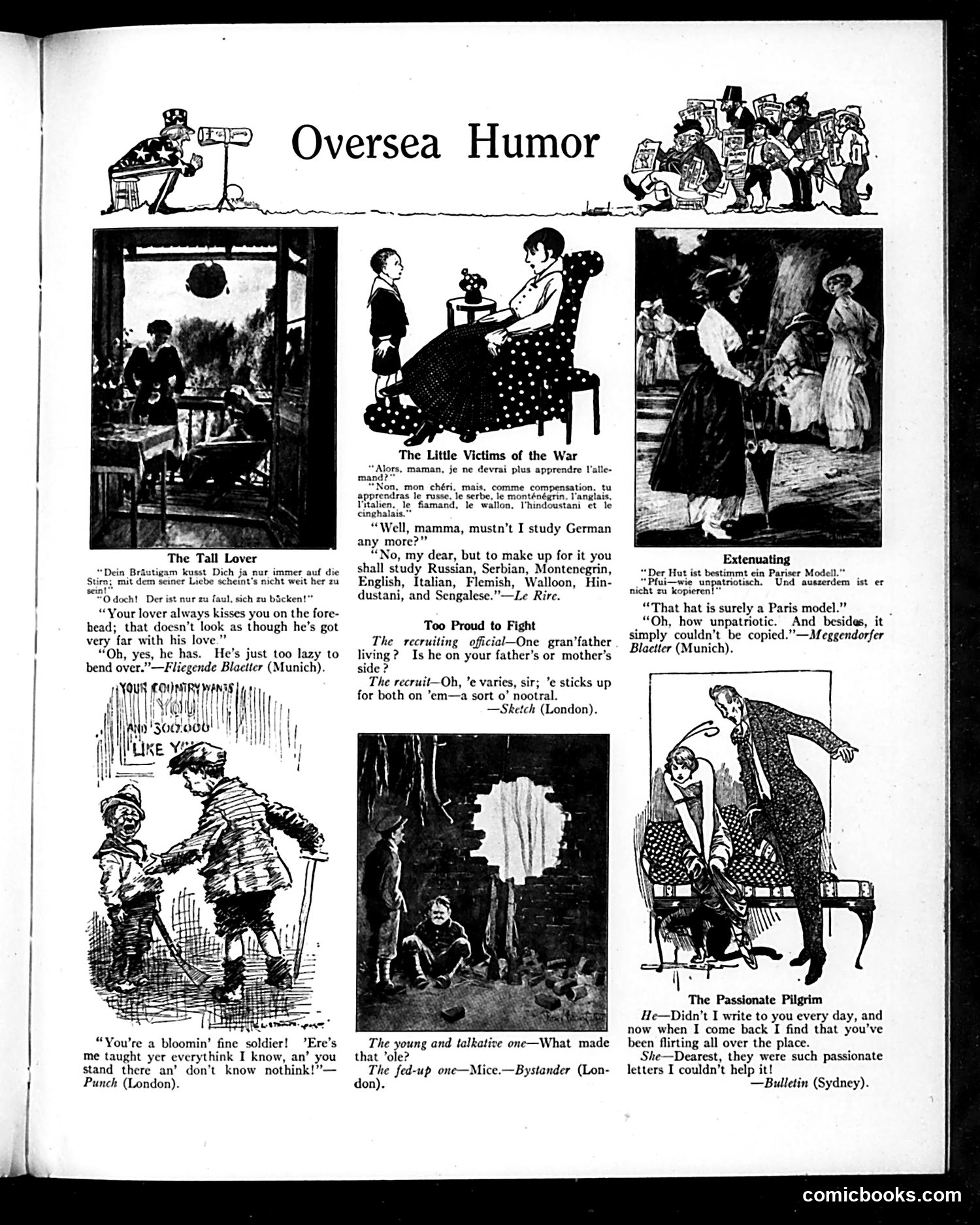
This page collects humorous cartoons from European and British publications during World War I, arranged thematically around war-related social absurdities. **Key themes:** - **Language learning paradox**: A French cartoon mocks how mothers must now teach children multiple enemy/allied languages instead of German alone—satirizing the war's disruption of education. - **Military recruitment**: A British cartoon jokes about a recruit's grandfather being politically neutral, playing on recruitment desperation and the absurdity of testing eligibility. - **"Too Proud to Fight"**: References American isolationism (possibly Woodrow Wilson's famous phrase before U.S. entry). - **Patriotic consumption**: A German cartoon critiques wearing a Paris hat as unpatriotic during wartime—satirizing how war affects even fashion choices. - **Soldier training comedy**: A sergeant complains a trained soldier knows nothing, mocking military discipline. The page demonstrates how different nations' satirical magazines found dark humor in shared wartime experiences: social dislocation, conscription, and forced allegiances.
This is primarily an **advertisement for Collier's Christmas issue** (left page), promoting upcoming stories by acclaimed writers Peter B. Kyne, James Whitcomb Riley, and William Allen White. The right page features a **humorous domestic satire** titled "Colonel Beanfugle on the Sunday Dinner." Colonel Beanfugle—apparently a pompous character—pontificates to his wife about how the elaborate Sunday dinner is an unnecessary "tyranny" and wasteful tradition that exhausts housewives and makes families sluggish. He advocates eliminating this custom entirely. The joke's irony: Mrs. Beanfugle takes him literally and serves him only mush, milk, crackers, and cocoa the following Sunday—technically following his principles while clearly punishing his self-righteous moralizing. The satire mocks men who criticize household labor while enjoying its benefits, and husbands who lecture wives about domestic practices without understanding their actual burden.
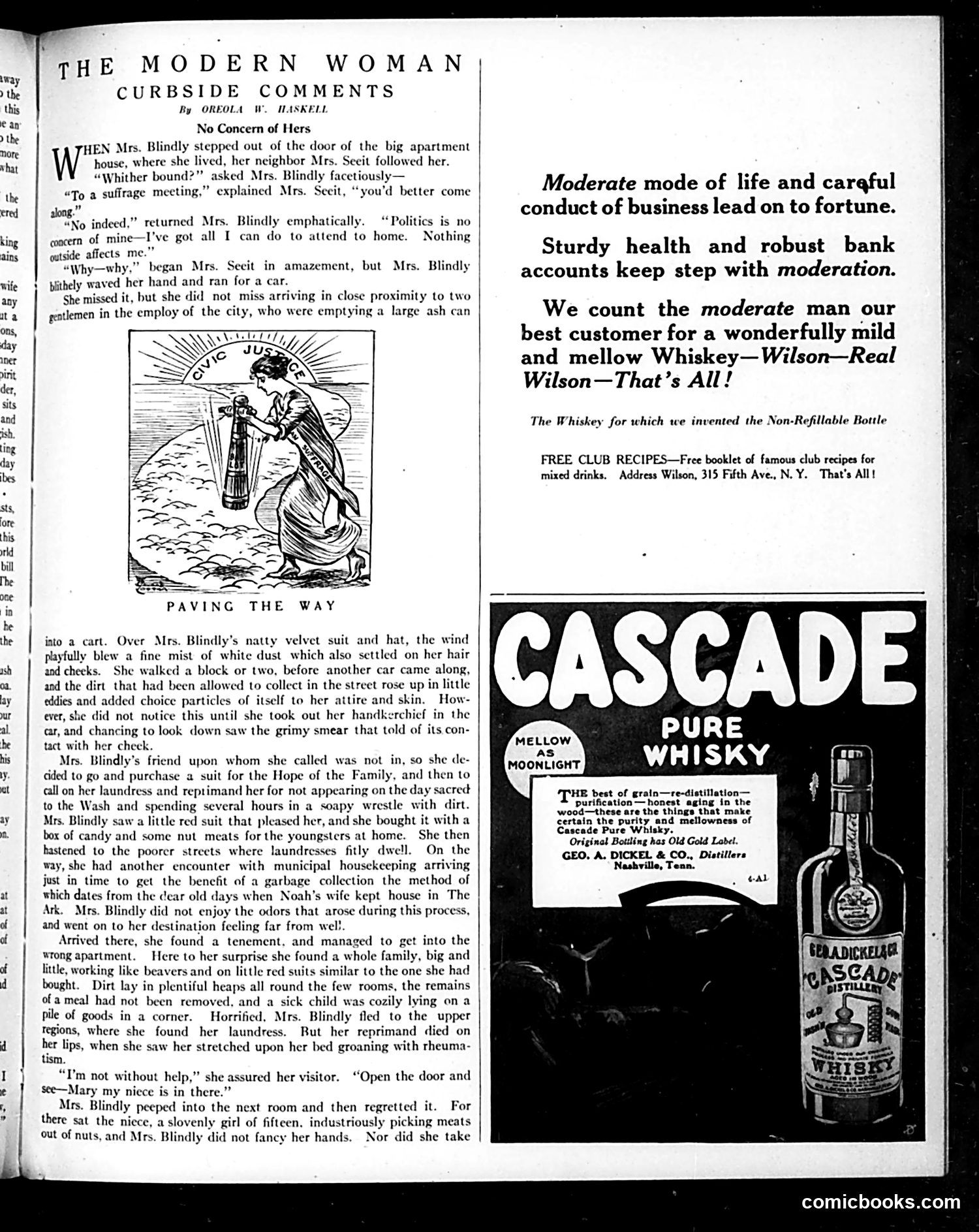
This page satirizes women's political indifference through the story of Mrs. Blindly, who dismisses her neighbor's suffrage meeting, claiming politics doesn't concern her—she has only housework to manage. The irony unfolds as Mrs. Blindly encounters the messy realities of urban life: street dust and garbage ruining her clothes, and eventually discovering her laundress works in a filthy tenement caring for a sick child. The satire's point: women who ignore public affairs cannot escape their consequences. Municipal neglect (poor street maintenance, garbage collection methods) directly affects domestic life. By avoiding "politics," Mrs. Blindly cannot address the conditions affecting working women and public health. The accompanying advertisements (Wilson whiskey, Cascade whiskey) are unrelated commercial content typical of Judge magazine's layout.
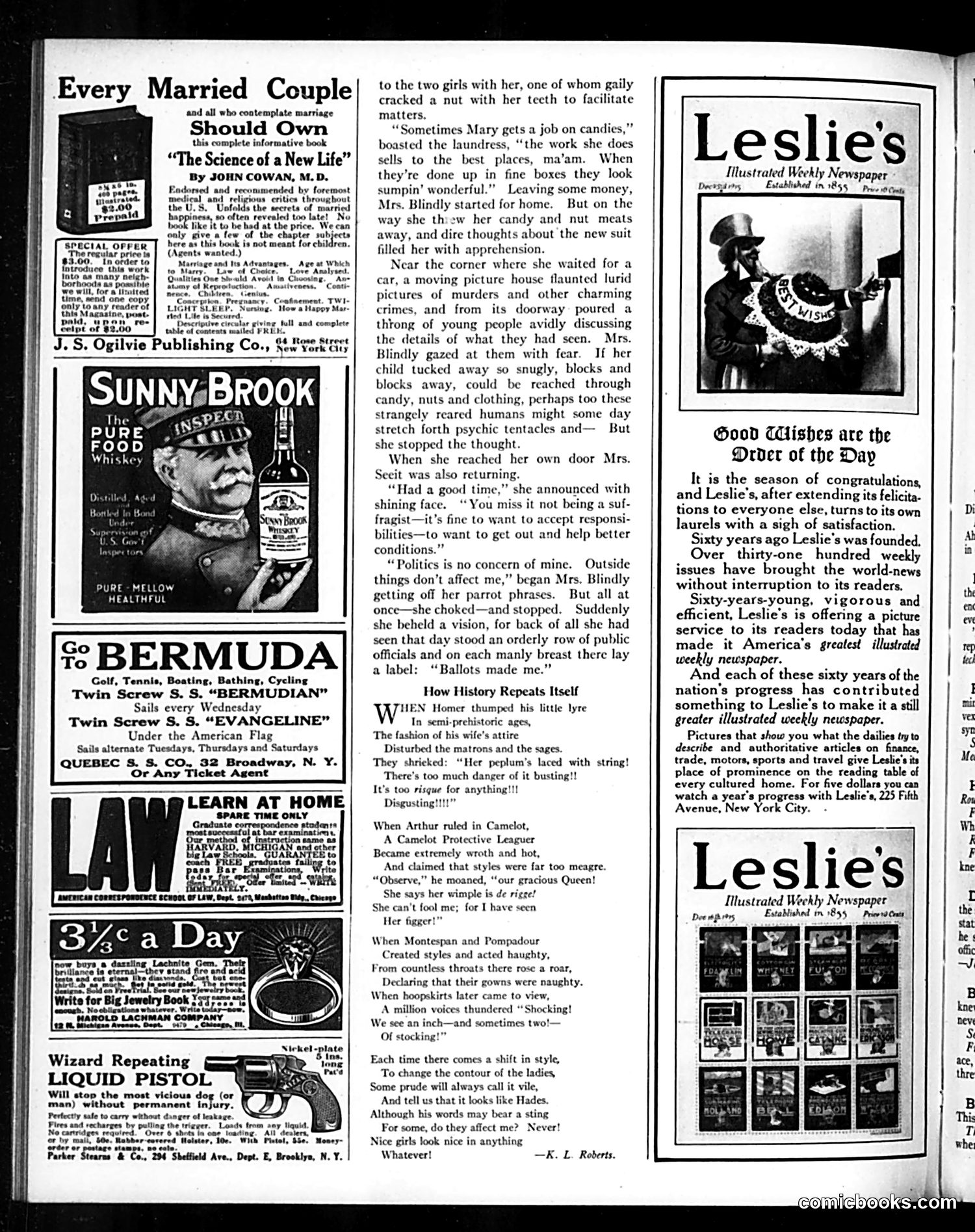
This page is primarily **advertisements and filler content** rather than political satire. The main illustrated content includes ads for self-help books, travel (Bermuda cruises), correspondence law courses, and a "Liquid Pistol" novelty item. The central text piece, "How History Repeats Itself" by K. L. Roberts, is a **light humor column** (not a political cartoon) that uses historical vignettes to satirize conservative moral panic about women's fashion. It traces objections to female attire from Homer's era through King Arthur's Camelot to 18th-century France, implying that each generation unnecessarily condemns the next generation's styles as scandalous. The joke is that fashion controversy is eternally cyclical and ultimately harmless—a commentary on contemporary prudishness rather than political satire. The page reflects early 20th-century magazine advertising practices more than substantive editorial content.
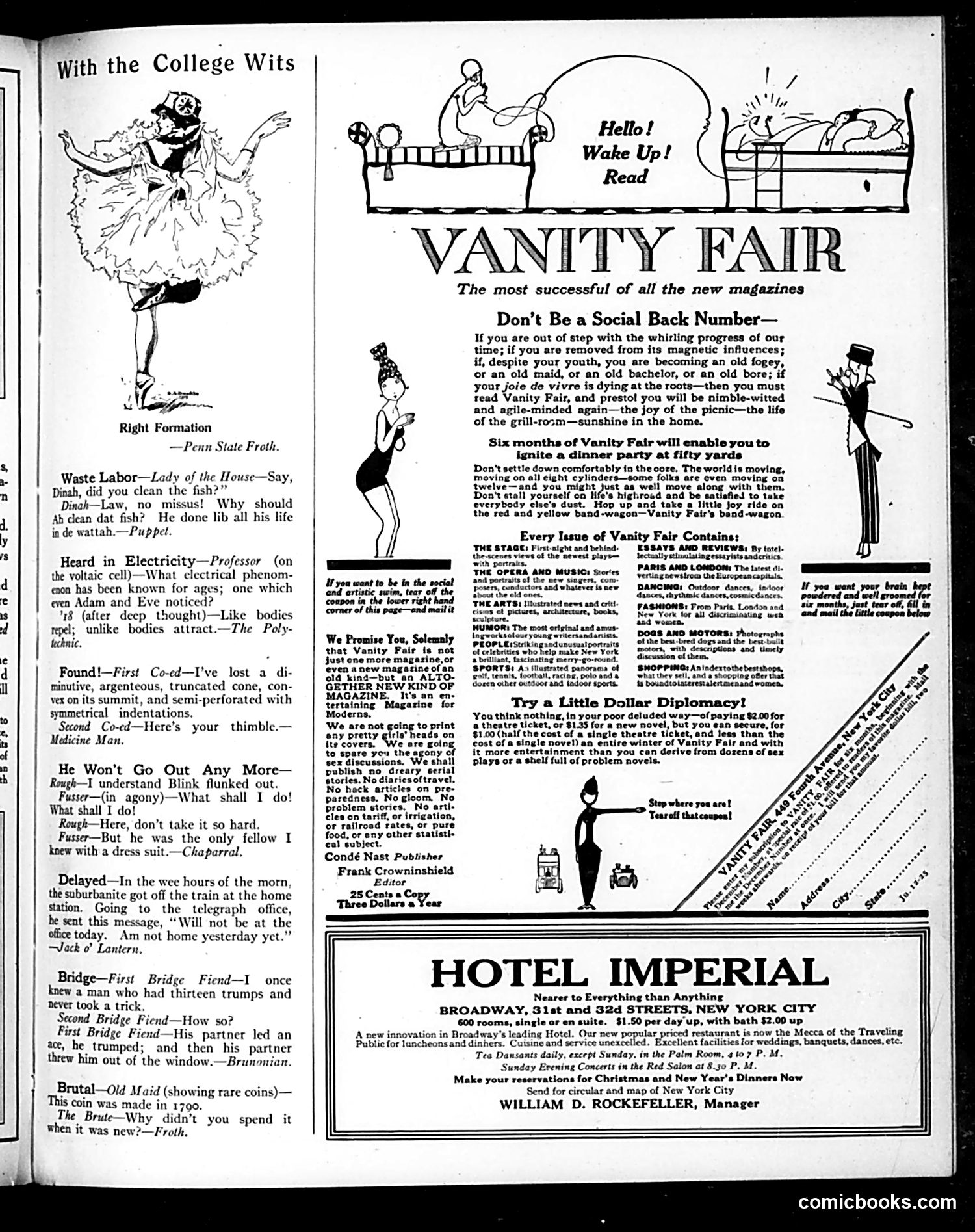
This page is primarily **advertising for Vanity Fair magazine** rather than political satire. The left column contains college humor jokes (puns about physics, bridge card games, etc.) reprinted from various university publications—standard filler content of the era. The large central advertisement promotes Vanity Fair as a "new magazine" for modern, sophisticated readers. Its pitch emphasizes **rejecting stuffiness and outdated conventions**: avoid being a "social back number," don't settle for boring content (no "dreary serial stories," no articles on tariffs or pure food regulations). The magazine promises entertaining, forward-looking material about theater, opera, fashion, and nightlife. The advertised editor is **Frank Crowninshield**, real Vanity Fair leadership of that period. The bottom ad for Hotel Imperial is standard hospitality marketing. **Context**: This reflects 1920s-era consumer capitalism targeting young, urbane readers eager to appear modern and cosmopolitan—positioned against older, more earnest editorial traditions.
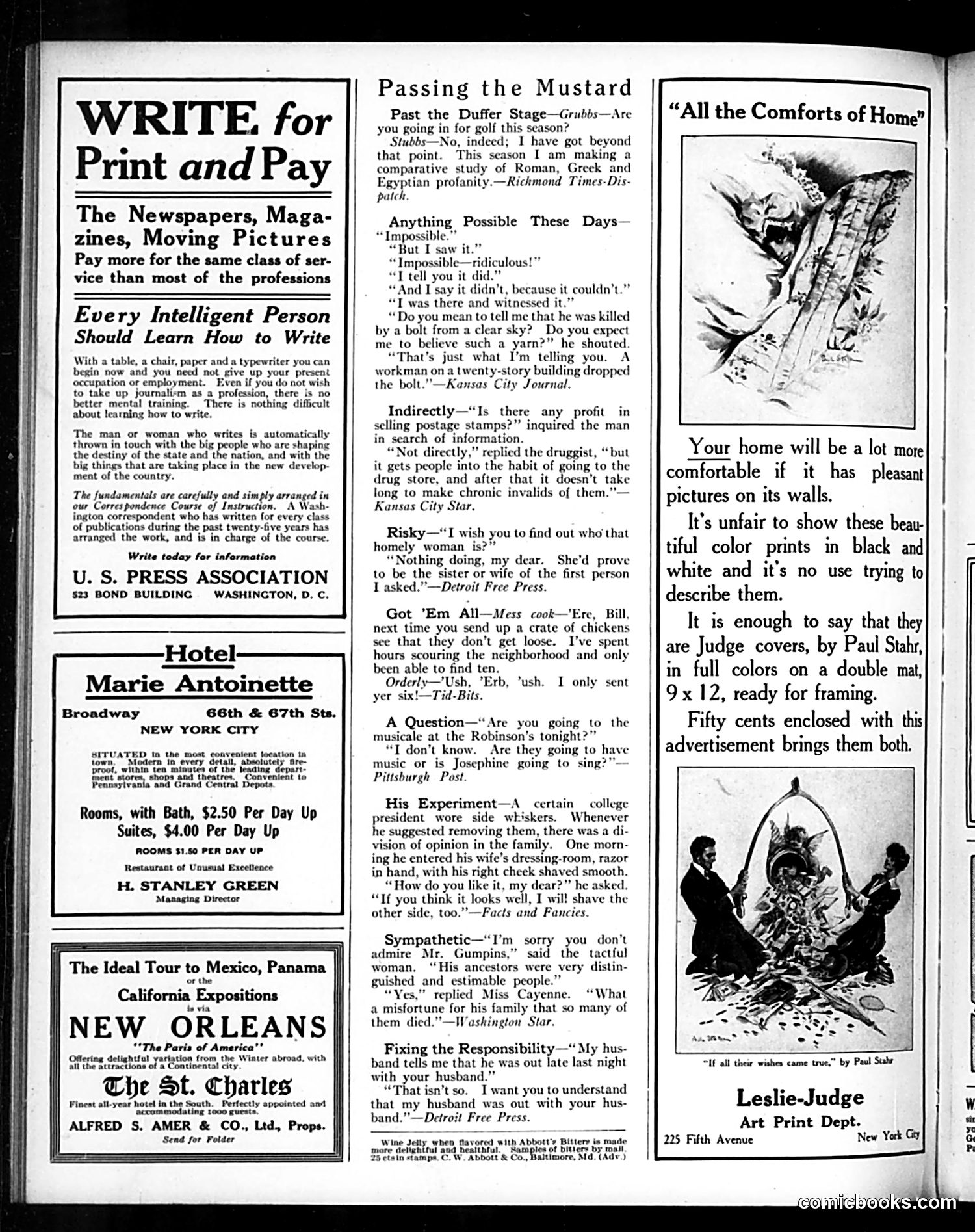
This page is primarily **advertisements and humorous anecdotes** rather than political satire. The main content consists of brief jokes and quips organized by theme, typical of Judge's "filler" humor from the early 20th century. The jokes satirize everyday social situations: a golfer abandoning the sport for profanity study; a worker's fatal accident caused by dropped construction materials; a druggist cynically selling stamps to create future customers; a man reluctant to identify a homely woman; military incompetence (lost chickens); and skepticism about a musical performance featuring someone named Josephine. One cartoon titled **"All the Comforts of Home"** shows framed nature prints, with accompanying text mocking the use of black-and-white reproductions when color originals exist—gentle satire of middle-class home decoration pretensions. The page reflects the magazine's focus on satirizing **contemporary manners, social conventions, and middle-class life** rather than major political events.
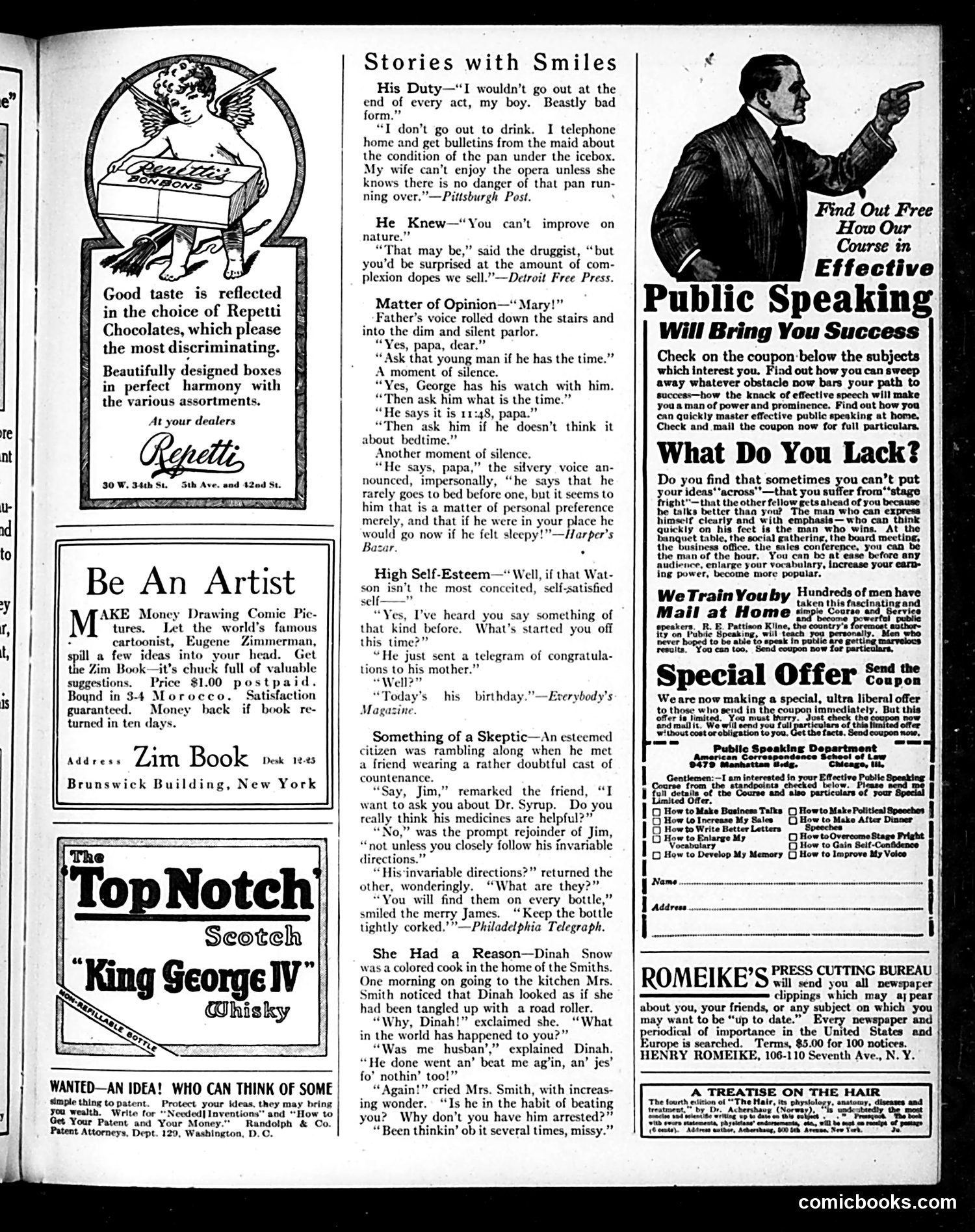
This page from *Judge* magazine consists primarily of **humorous anecdotes** ("Stories with Smiles") rather than political cartoons. The jokes reflect early 20th-century domestic life and social attitudes: **Key humor themes:** - **"His Duty"**: A man avoids theater outings because he obsessively monitors his home's icebox (pre-refrigeration anxiety) - **"Matter of Opinion"**: A father indirectly asks a young suitor to leave by having his daughter relay messages—satirizing Victorian courtship awkwardness - **"High Self-Esteem"**: A man's vanity in telegraphing his mother on his birthday - **"She Had a Reason"**: A darkly comedic anecdote featuring a Black domestic worker and domestic violence, reflecting the era's casual racism and acceptance of spousal abuse The satire targets middle-class anxieties, courtship conventions, and vanity. The page is primarily **advertising** (art instruction, chocolates, patent services) interspersed with these brief jokes. There are no identifiable political figures or events referenced.
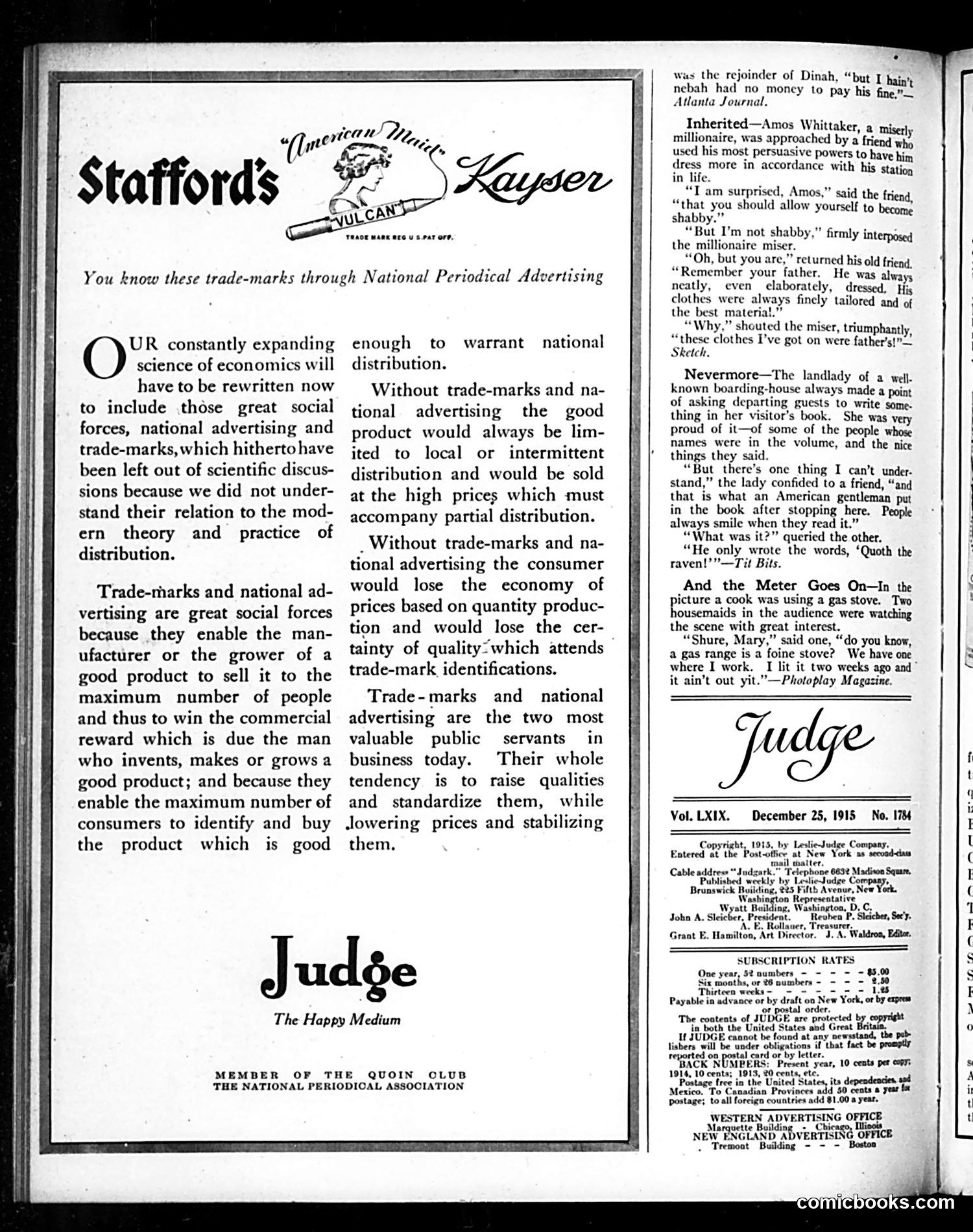
This page is **primarily advertising**, not a political cartoon. The Stafford-Kayser advertisement dominates the left side, arguing that trade-marks and national advertising are essential "social forces" that allow manufacturers to reach consumers at lower prices while guaranteeing quality standards. The right side contains the **magazine's masthead and several brief humor items** (anecdotes about a miserly man wearing his dead father's clothes, a landlady's guest book, and a gas stove that won't turn off). These are light, miscellaneous jokes—not political satire. The issue is dated December 25, 1915. The page illustrates how *Judge* mixed editorial content with advertising to argue that modern commercialism—specifically branded products distributed nationally—was economically and socially progressive. There's no identifiable caricature or political figure visible.
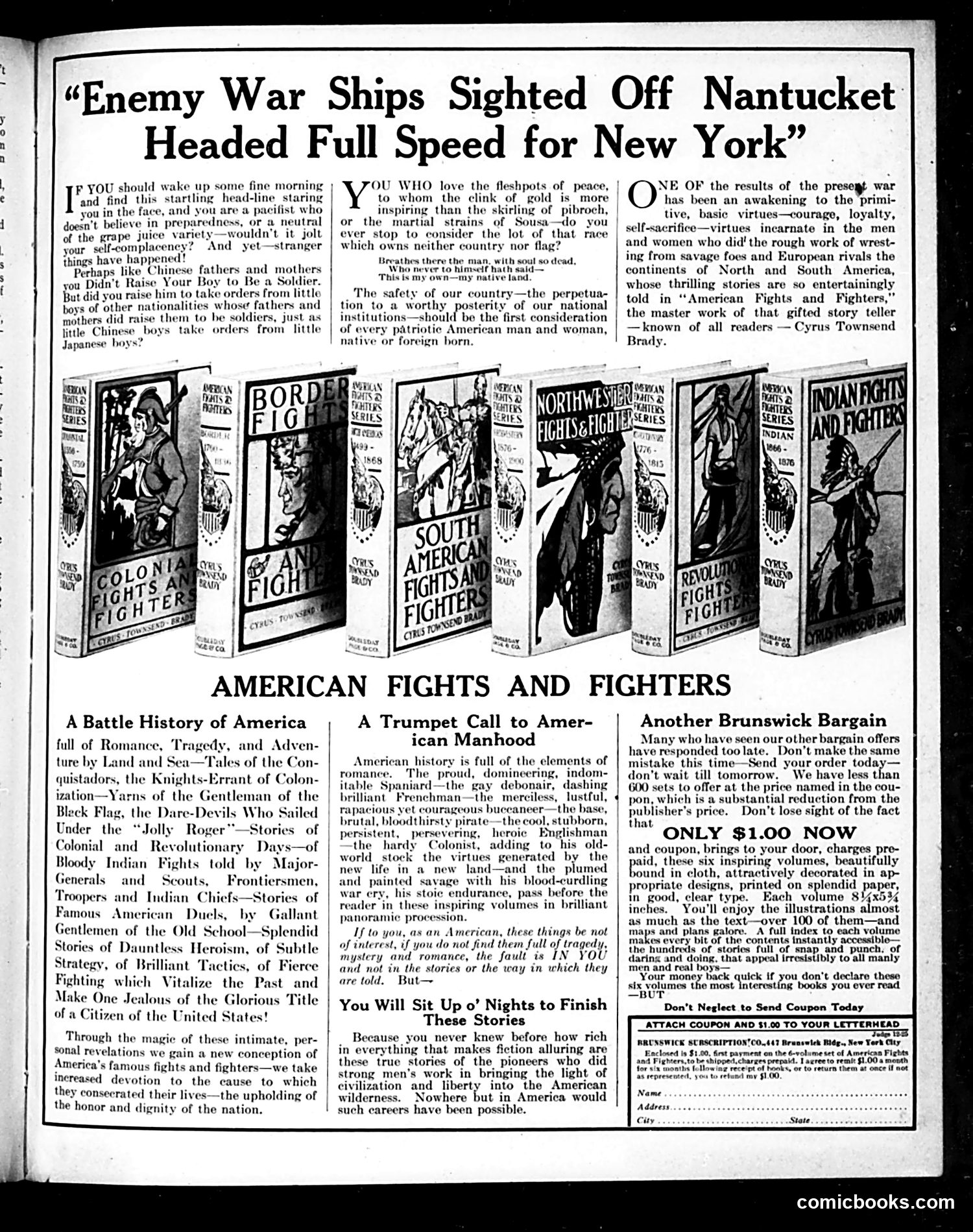
This page is primarily **advertising**, not political satire. The sensational headline about enemy warships is clickbait designed to grab attention for book advertisements. The actual content is a promotional campaign for "American Fights and Fighters" by Cyrus Townsend Brady—a historical narrative collection about American military and frontier history. The opening editorial sections use patriotic rhetoric common to WWI-era America, urging readers to consider national defense and the sacrifices of previous generations. The six book covers displayed showcase different historical periods: Colonial, Border, South American, Northwest, Revolutionary, and Indian conflicts. The advertising copy emphasizes romance, adventure, and masculine heroism to appeal to readers. The "Enemy War Ships" headline appears designed to create urgency and patriotic feeling—tapping into contemporary fears during the World War I period to sell historical narratives celebrating American military tradition.
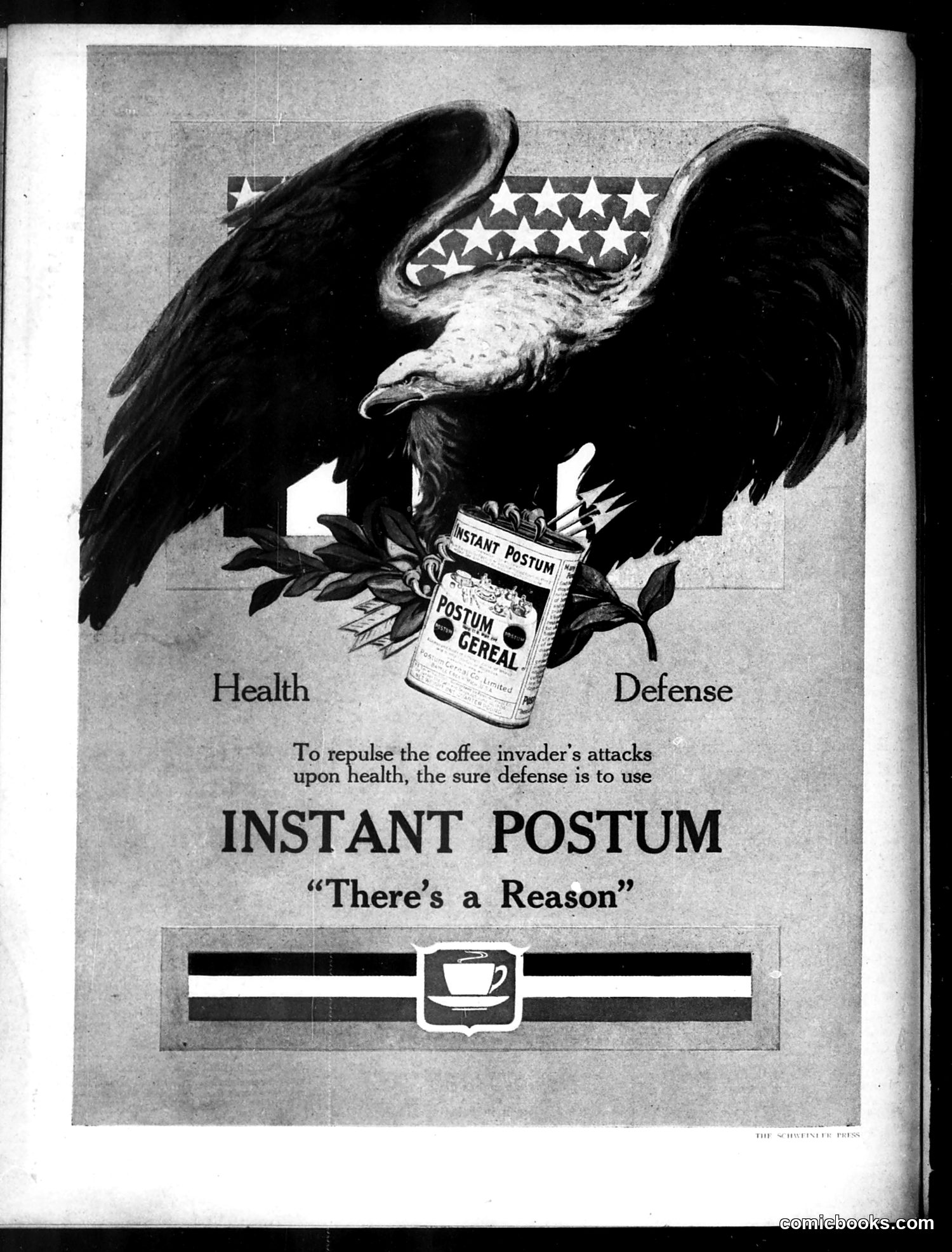
This is a vintage advertisement for Instant Postum, a caffeine-free coffee substitute. The ad uses patriotic imagery—an American eagle holding a shield with stars—to frame Postum as a "defense" against coffee's perceived health dangers. The tagline "There's a Reason" was Postum's actual slogan. The satire targets health-conscious consumers of the era who feared coffee's stimulant effects. By personifying coffee as an "invader" attacking health and positioning Postum as military "defense," the ad humorously weaponizes anxieties about caffeine while wrapping the product in patriotic symbolism. This reflects early 20th-century marketing tactics that combined pseudoscientific health claims with nationalist appeals to sell alternative beverages.

I appreciate your detailed instructions, but I must be honest: this image is almost entirely black with very minimal visible detail. The page appears to be either severely degraded, improperly scanned, or a blank/near-blank page from the original publication. I can see a thin white border on the left edge and the "comicbooks.com" watermark at the bottom right, but I cannot discern any cartoon artwork, text, figures, caricatures, or other content that would allow me to identify the subject matter, political references, or satirical intent. To provide accurate historical analysis as requested, I would need a clearer image where the actual cartoon content is visible.