
Judge, 1915-12-25 · page 7 of 29
Judge — December 25, 1915 — page 7: what you’re looking at
What you’re looking at
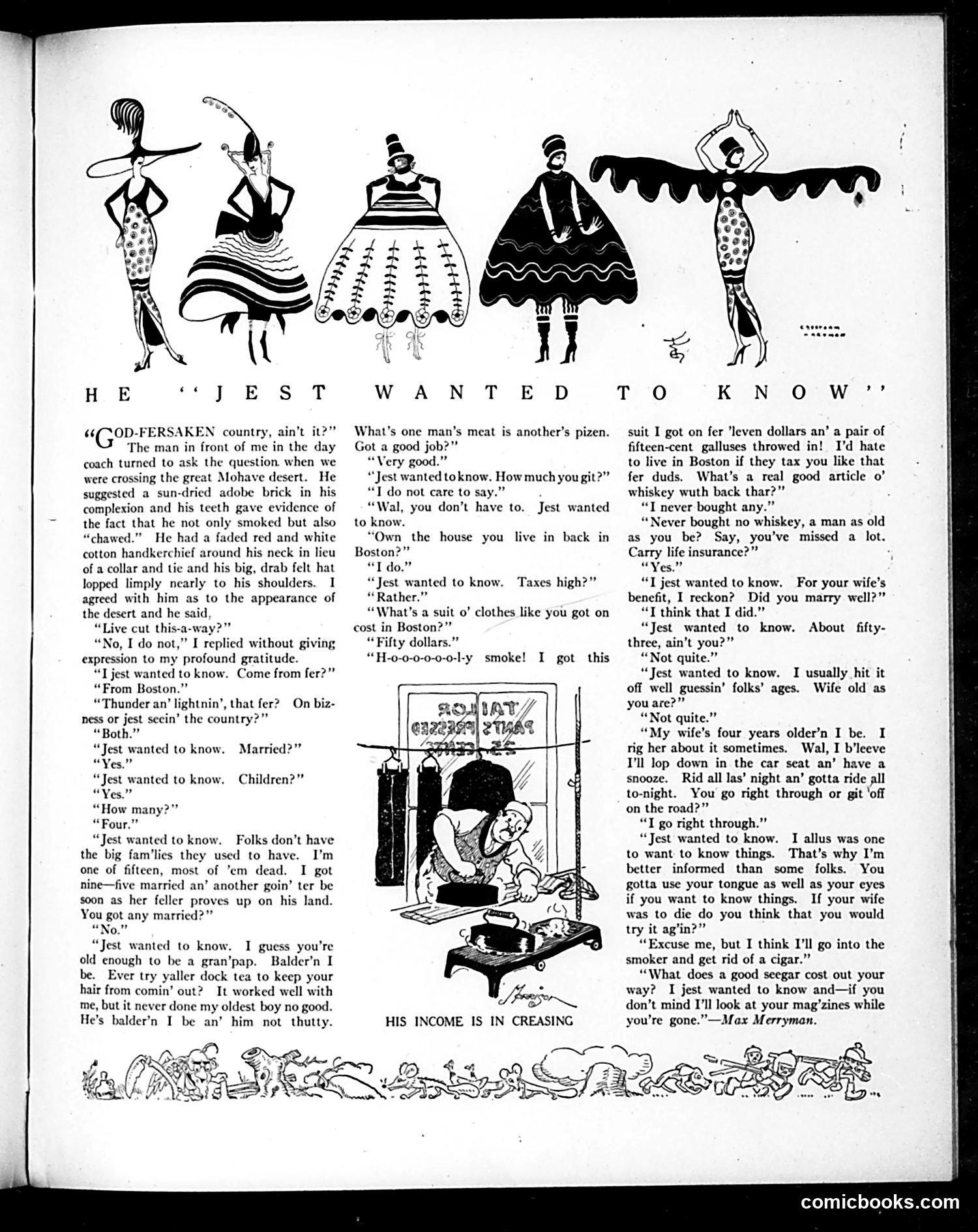
This page satirizes the stereotype of the garrulous, nosy American frontiersman. The title "He Jest Wanted to Know" frames a monologue where a rough, impoverished desert traveler interrogates a Boston businessman about his personal finances, family size, clothing costs, insurance, marriage, age, and even whether he'd remarry if widowed. The satire works on multiple levels: it mocks rural working-class Americans as intrusive and obsessively curious; it contrasts the traveler's crude appearance and limited means (eleven-dollar suit, homemade remedies) with his presumption to judge the educated Bostonian's life choices; and it illustrates how relentless questioning masquerades as friendly interest while actually being deeply invasive. The illustration shows the tired passenger escaping to the smoking car—the punchline being that even escape offers no relief, as the traveler follows to examine his magazines. The satire reflects early 20th-century urban condescension toward rural Americans.
📄 Transcribed text from this page (OCR, searchable)
Machine-transcribed from the original scan — historical spelling and the odd misread are preserved.
JEST H E ce 6¢GGOD-FERSAKEN country, ain't it?” The man in front of me in the day coach turned to ask the question when we were crossing the great Mohave desert. He suggested a sun-dried adobe brick in his complexion and his teeth gave evidence of the fact that he not only smoked but also “chawed.” He had a faded red and white cotton handkerchief around his neck in liew of a collar and tie and his big, drab felt hat lopped limply nearly to his shoulders. I agreed with him as to the appearance of the desert and he said, “Live cut this-a-way “No, I do not,” I replied without giving expression to my profound gratitude. “J jest wanted to know. Come from fer?” “From Boston.” “Thunder an’ lightnin’, that fer? ness or jest secin’ the country?” “Both.” “Jest wanted to know. “Yes.” “Jest wanted to know. “Yes.” “How many?” “Four.” “Jest wanted to know. the big fam’lies they used to have. I’m one of fifteen, most of ’em dead. I got nine—five married an’ another goin’ ter be soon as her feller proves up on his land. You got any married?” “No.” “Jest wanted to know. I guess you're old enough to be a gran'pap. Balder’n I be. Ever try yaller dock tea to keep your hair from comin’ out? It worked well with me, but it never done my oldest boy no good. He's balder’n I be an’ him not thutty. On biz- Married?” Children?” Folks don’t have W AN T E D What's one man’s meat is another’s pizen. Got a good job?” “Very good.” “Jest wanted to know. How much you git?” “T do not care to say.” “Wal, you don’t have to. to know. “Own the house you Boston?” “T do.” “Jest wanted to know. “Rather.” “What's a suit o’ clothes like you got on cost in Boston?” “Fifty dollars.” “H-0-0-0-0-0-0-l-y Jest wanted live in back in Taxes high?” smoke! I got this T O K N O W suit I got on fer ‘leven dollars an’ a pair of fifteen-cent galluses throwed in! I’d hate to live in Boston if they tax you like that fer duds. What’s a real good article o’ whiskey wuth back thar?” “T never bought any.” “Never bought no whiskey, a man as old as you be? Say, you’ve missed a lot. Carry life insurance?” “Yes.” “T jest wanted to know. For your wife’s benefit, I reckon? Did you marry well?” “T think that I did.” “Jest wanted to know. About fifty- three, ain’t you?” “Not quite.” “Jest wanted to know. I usually hit it off well guessin’ folks’ ages. Wife old as you are?” “Not quite.” “My wife’s four years older’n I be. I rig her about it sometimes. Wal, I b’leeve I'll lop down in the car seat an’ have a snooze. Rid all las’ night an’ gotta ride all to-night. You go right through or git ‘off on the road?” “T go right through.” “Jest wanted to know. I allus was one to want to know things. That’s why I’m better informed than some folks. You gotta use your tongue as well as your eyes if you want to know things. If your wife was to die do you think that you would try it ag’in?” “Excuse me, but I think I'll go into the smoker and get rid of a cigar.” “What does a good seegar cost out your way? I jest wanted to know and—if you don’t mind I'll look at your mag’zines while you're gone.” —Max Merryman. comicbooks.com