
Judge, 1915-12-25 · page 12 of 29
Judge — December 25, 1915 — page 12: what you’re looking at
What you’re looking at
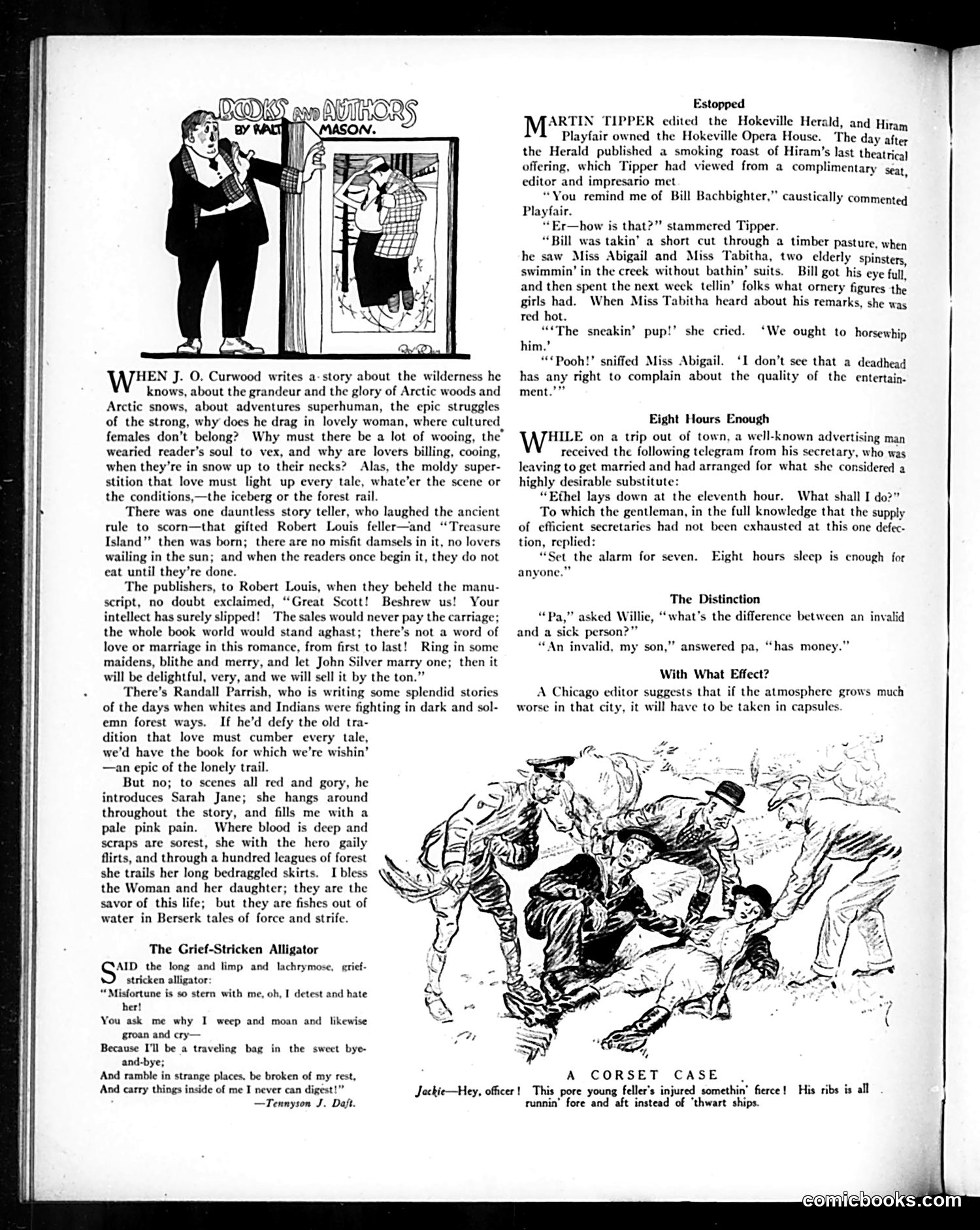
This page contains several satirical pieces. The main article critiques adventure novelists (J.O. Curwood, Robert Louis Stevenson, Randall Parrish) for inserting romantic subplots into wilderness stories where they don't belong. The author argues that adding love interests and female characters to tales of Arctic exploration or frontier combat weakens the narrative—praising *Treasure Island* as an exception with no romance. The sidebar jokes are brief social commentary: one mocks a theater critic (Tipper) by comparing him to a man who gossips about seeing women bathing; another features an alligator lamenting becoming a handbag; a final anecdote puns on "deadhead" (free theater ticket) versus legitimate complaints. The cartoons and humor reflect early 20th-century attitudes about gender roles, literature, and workplace dynamics—particularly skepticism about mixing "serious" masculine adventure with romantic sentiment.
📄 Transcribed text from this page (OCR, searchable)
Machine-transcribed from the original scan — historical spelling and the odd misread are preserved.
HEN J. O. Curwood writes a-story about the wilderness he knows, about the grandeur and the glory of Arctic woods and Arctic snows, about adventures superhuman, the epic struggles of the strong, why does he drag in lovely woman, where cultured females don’t belong? wearied reader’s soul to vex, and why are lovers billing, cooing, when they’re in snow up to their necks? Alas, the moldy super- stition that love must light up every tale, whate’er the scene or the conditions,—the iceberg or the forest rail. There was one dauntless story teller, who laughed the ancient tule to scorn—that gifted Robert Louis fellerp—and “Treasure Island” then was born; there are no misfit dam in it, no lovers wailing in the sun; and when the readers once begin it, they do not eat until they’re done. The publishers, to Robert Louis, when they beheld the manu- script, no doubt exclaimed, “Great Scott! Beshrew us! Your intellect has surely slipped! The sales would never pay the carriage; the whole book world would stand aghast; there’s not a word of love or marriage in this romance, from first to last! Ring in some maidens, blithe and merry, and let John Silver marry one; then it will be delightful, very, and we will sell it by the ton.” There’s Randall Parrish, who is writing some splendid stories of the days when whites and Indians were fighting in dark and sol- emn forest ways. If he’d defy the old tra- dition that love must cumber every tale, we'd have the book for which we're wishin’ —an epic of the lonely trail. But no; to scenes all red and gory, he introduces Sarah Jane; she hangs around throughout the story, and fills me with a pale pink pain. Where blood is deep and scraps are sorest, she with the hero gaily flirts, and through a hundred leagues of forest she trails her long bedraggled skirts. I bless the Woman and her daughter; they are the savor of this life; but they are fishes out of water in Berserk tales of force and strife. The Grief-Stricken Alligator AID the long and limp and lachrymose, grief- stricken alligator: “ Misfortune is so stern with me, oh, her! You ask me why I weep and moan and likewise groan and cry— Because I'll be a traveling bag in the sweet bye- and-bye; And ramble in strange places, be broken of my rest, And carry things inside of me I never can digest!” —Tennyson J. Daft. I detest and hate Why must there be a lot of wooing, the” Estopped ARTIN TIPPER edited the Hokeville Herald, and Hiram Playfair owned the Hokeville Opera House. The day after the Herald published a smoking roast of Hiram’s last theatrical offering, which Tipper had viewed from a complimentary seat editor and impresario met : “You remind me of Bill Bachbighter,” caustically commented Playfair. —how is that?” stammered Tipper. “Bill was takin’ a short cut through a timber pasture, when he sa iss Abigail and Miss Tabitha, two elderly spinsters, swimmi the creek without bathin’ suits. Bill got his eye full, and then spent the next week tellin’ folks what ornery figures the girls had. When Miss Tabitha heard about his remarks, she was red hot. “*The sneakin’ pup! she cried. ‘We ought to horsewhip him. “Pooh!” sniffed Miss Abigail. ‘I don’t see that a deadhead has any right to complain about the quality of the entertain. ment.’” Eight Hours Enough HILE on a trip out of town, a well-known advertising man received the following telegram from his secretary, who was leaving to get married and had arranged for what she considered a highly desirable substitute: “Ethel lays down at the eleventh hour. What shall I do?” To which the gentleman, in the full knowledge that the supply of efficient secretaries had not been exhausted at this one defec- tion, replied: the alarm for seven. Eight hours sleep is cnough for anyone.” The Distinction “Pa,” asked Willie, “what's the difference between an invalid and a sick person?” “An invalid, my son,” answered pa, “has money.” With What Effect? A Chicago editor suggests that if the atmosphere grows much worse in that city, it will have to be taken in capsules. A CORSET CASE , Jockie—Hey, officer! This pore young feller’s injured somethin’ fierce! His ribs is all runnin’ fore and aft instead of ‘thwart ships.