
Judge, 1915-12-25 · page 6 of 29
Judge — December 25, 1915 — page 6: what you’re looking at
What you’re looking at
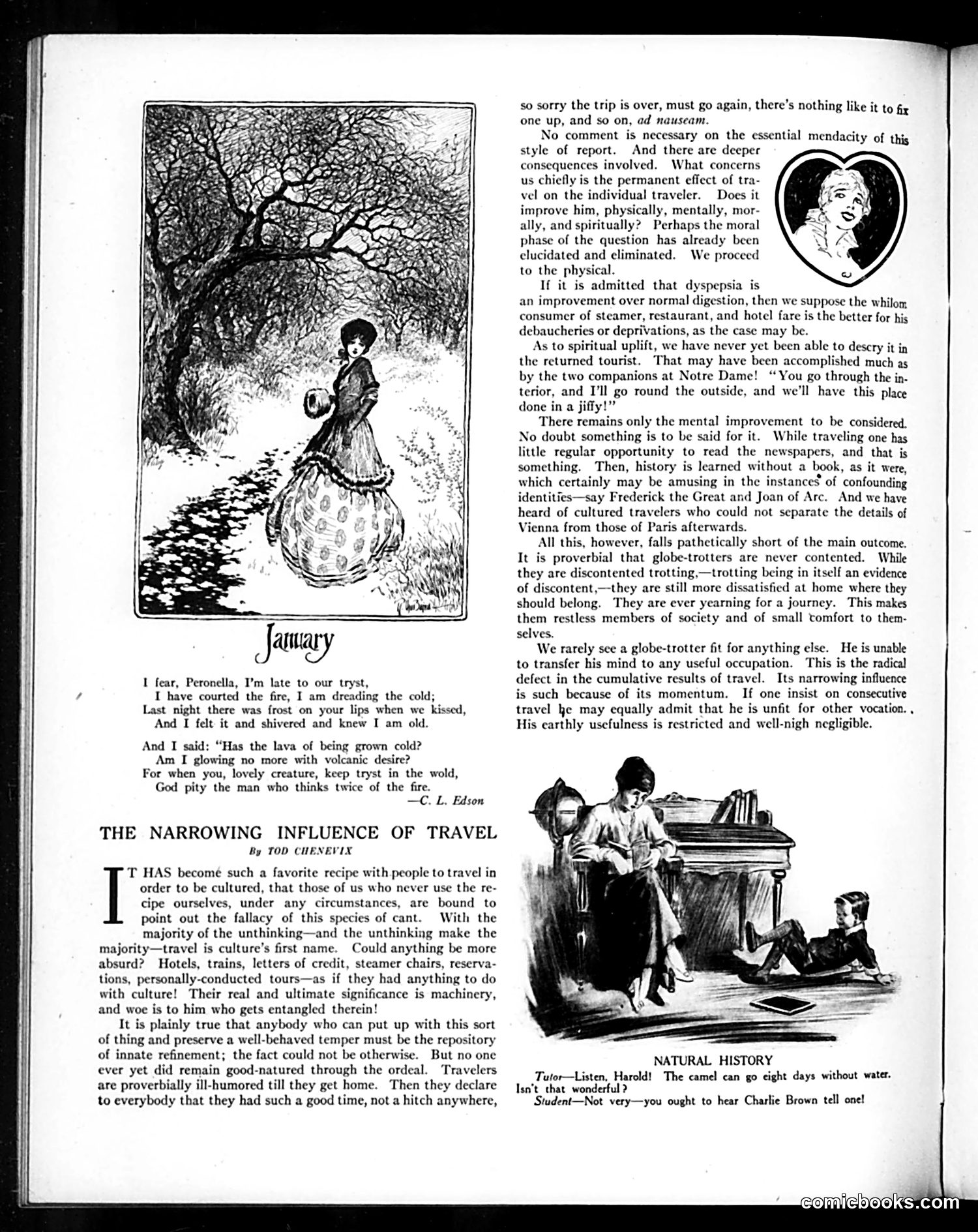
This page contains a romantic poem by C.L. Edson about aging and lost passion, followed by an essay titled "The Narrowing Influence of Travel" by Tod Chenevix. **The Main Satire:** Chenevix argues that travel—then fashionable among the wealthy as a marker of culture and refinement—actually *damages* people rather than improving them. He mocks the hypocrisy of travelers who claim enrichment while displaying physical ailments (dyspepsia from poor food), spiritual emptiness, and mental confusion (confusing Vienna and Paris). **The Central Joke:** Rather than becoming cultured, travelers become restless, ill-humored complainers who romanticize journeys while alienated at home. Chenevix sardonically suggests that merely enduring travel's mechanical discomforts (hotels, trains, reservations) proves one has "innate refinement"—obviously absurd logic he's exposing. The illustrations show a woman traveler and tourists, reinforcing the critique of fashionable but ultimately hollow "grand tour" culture among the upper classes.
📄 Transcribed text from this page (OCR, searchable)
Machine-transcribed from the original scan — historical spelling and the odd misread are preserved.
I fear, Peronella, I’m late to our tryst, I have courted the fire, I am dreading the cold; Last night there was frost on your lips when we kis: And I felt it and shivered and knew I am old. And I said: “Has the lava of being grown cold? Am I glowing no more with volcanic desire? For when you, lovely creature, keep tryst in the wold, God pity the man who thinks twice of the fire. —C. L. Edson THE NARROWING INFLUENCE OF TRAVEL By TOD CHENEVIX T HAS become such a favorite recipe with people to travel in order to be cultured, that those of us who never use the re- cipe ourselves, under any circumstances, are bound to point out the fallacy of this species of cant. With the majority of the unthinking—and the unthinking make the majority—travel is culture’s first name. Could anything be more absurd? Hotels, trains, letters of credit, steamer chairs, reserva- tions, personally-conducted tours—as if they had anything to do with culture! Their real and ultimate significance is machinery, and woe is to him who gets entangled therein! It is plainly true that anybody who can put up with this sort of thing and preserve a well-behaved temper must be the repository of innate refinement; the fact could not be otherwise. But no one ever yet did remain good-natured through the ordeal. Travelers are proverbially ill-humored till they get home. Then they declare to everybody that they had such a good time, not a hitch anywhere, so sorry the trip is over, must go again, there’s nothing like it to fix one up, and so on, ad nauseam. No comment is necessary on the essential mendacity of this style of report. And there are deeper consequences involved. What concerns us chiefly is the permanent effect of tra- vel on the individual traveler. Does it improve him, physically, mentally, mor- ally, and spiritually? Perhaps the moral phase of the question has already been elucidated and eliminated. We proceed to the physical. If it is admitted that dyspepsia is an improvement over normal digestion, then we suppose the whilom, consumer of steamer, restaurant, and hotel fare is the better for his debaucheries or deprivations, as the case may be. As to spiritual uplift, we have never yet been able to descry it in the returned tourist. That may have been accomplished much as by the two companions at Notre Dame! “You go through the in- terior, and I'll go round the outside, and we'll have this place done in a jiffy!” There remains only the mental improvement to be considered. No doubt something is to be said for it. While traveling one has little regular opportunity to read the newspapers, and that is something. Then, history is learned without a book, as it were, which certainly may be amusing in the instances of confounding identities—say Frederick the Great and Joan of Arc. And we have heard of cultured travelers who could not separate the details of Vienna from those of Paris afterwards. All this, however, falls pathetically short of the main outcome. It is proverbial that globe-trotters are never contented. While they are discontented trotting,—trotting being in itself an evidence of discontent,—they are still more dissatisfied at home where they should belong. They are ever yearning for a journey. This makes them restless members of society and of small tomfort to them- selves. We rarely sce a globe-trotter fit for anything else. He is unable to transfer his mind to any useful occupation. This is the radical defect in the cumulative results of travel. Its narrowing influence is such because of its momentum. If one insist on consecutive travel he may equally admit that he is unfit for other vocation. , His earthly usefulness is restricted and well-nigh negligible. NATURAL HISTORY Tutor—Listen, Harold! The camel can go eight days without water. Isn’t_ that wonderful ? Student—Not very—you ought to hear Charlie Brown tell one!