
Judge, 1915-12-25 · page 11 of 29
Judge — December 25, 1915 — page 11: what you’re looking at
What you’re looking at
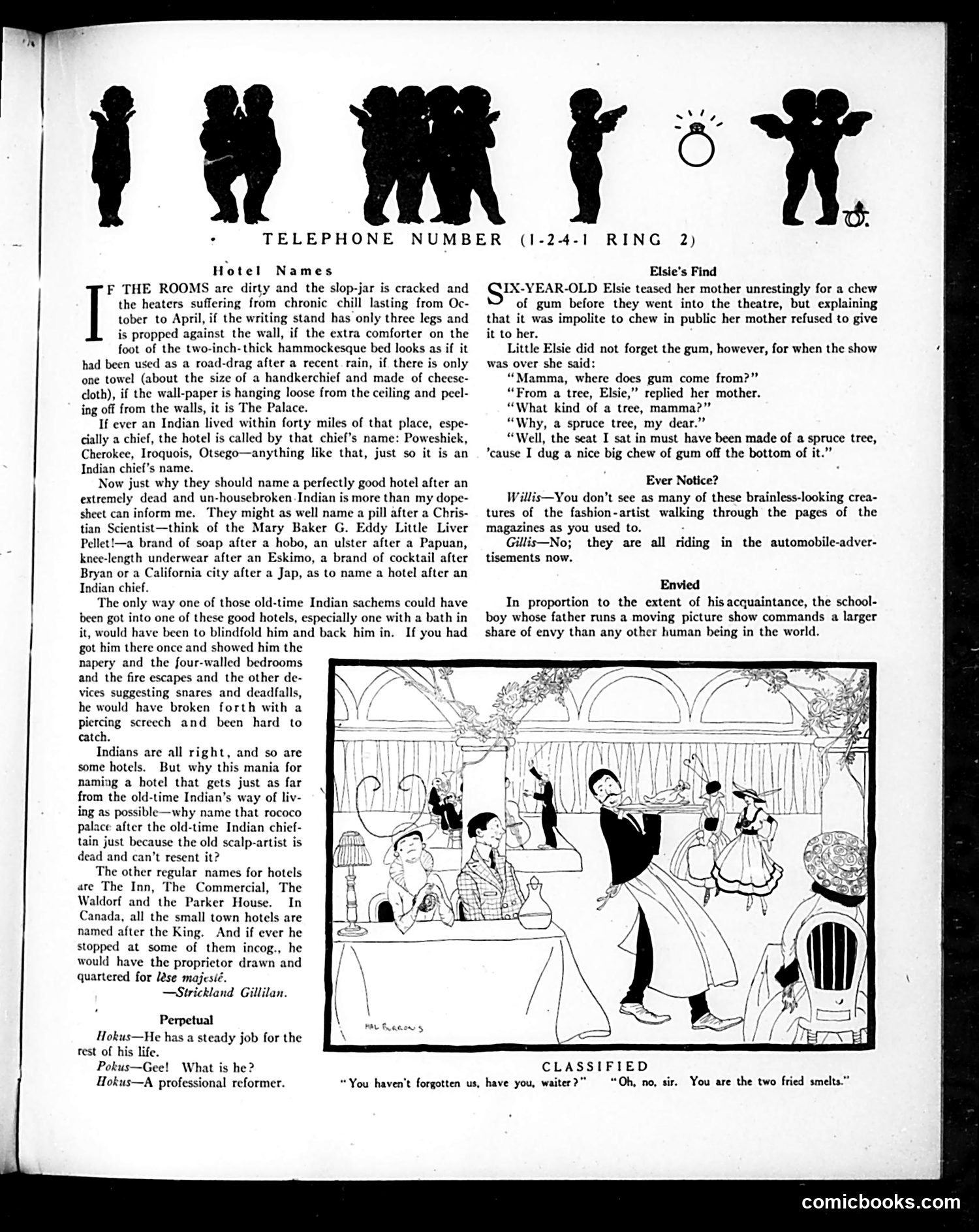
This page contains multiple short satirical pieces typical of early 20th-century Judge magazine humor. **"Hotel Names"** mocks the widespread practice of naming shabby American hotels after Native American chiefs. The author argues this is absurd—naming decrepit, uncomfortable establishments after indigenous peoples bears no logical connection to actual Native American life or values. The satire suggests hotels with names like "Cherokee" or "Poweshiek" are often run-down establishments, and the practice is disrespectful to deceased tribal leaders who "can't resent it." **Shorter humor pieces** include "Elsie's Find" (a child's joke about gum stuck under theater seats), "Ever Notice?" (commentary on magazine advertising trends), and "Perpetual" (wordplay about a professional reformer). The **cartoon** depicts a restaurant scene where waiters have forgotten customers, with the caption satirizing inattentive service. Overall, the page reflects early 1900s American attitudes toward Native Americans while poking fun at contemporary commercial and social customs.
📄 Transcribed text from this page (OCR, searchable)
Machine-transcribed from the original scan — historical spelling and the odd misread are preserved.
Hotel Names F THE ROOMS are dirty and the slop-jar is cracked and the heaters suffering from chronic chill lasting from Oc- tober to April, if the writing stand has only three legs and is propped against the wall, if the extra comforter on the foot of the two-inch-thick hammockesque bed looks as if it had been used as a road-drag after a recent rain, if there is only one towel (about the size of a handkerchief and made of cheese- doth), if the wall-paper is hanging loose from the ceiling and peel- ing off from the walls, it is The Palace. If ever an Indian lived within forty miles of that place, espe- cially a chief, the hotel is called by that chief’s name: Poweshiek, Cherokee, Iroquois, Otsego—anything like that, just so it is an Indian chief’s name. Now just why they should name a perfectly good hotel after an extremely dead and un-housebroken Indian is more than my dope- sheet can inform me. They might as well name a pill after a Chris- tian Scientist—think of the Mary Baker G. Eddy Little Liver Pellet!—a brand of soap after a hobo, an ulster after a Papuan, knee-length underwear after an Eskimo, a brand of cocktail after Bryan or a California city after a Jap, as to name a hotel after an Indian chief. The only way one of those old-time Indian sachems could have been got into one of these good hotels, especially one with a bath in it, would have been to blindfold him and back him in. If you had got him there once and showed him the napery and the four-walled bedrooms and the fire escapes and the other de- vices suggesting snares and deadfalls, he would have broken forth with a Piercing screech and been hard to catch. Indians are all right, and so are some hotels. But why this mania for naming a hotel that gets just as far from the old-time Indian’s way of liv- ing as possible—why name that rococo palace after the old-time Indian chief- tain just because the old scalp-artist is dead and can’t resent it? The other regular names for hotels are The Inn, The Commercial, The Waldorf and the Parker House. In Canada, all the small town hotels are named after the King. And if ever he stopped at some of them incog., he would have the proprictor drawn and quartered for lése majeséé. —Strickland Gillilan. Perpetual Hokus—He has a steady job for the rest of his life. Pokus—Gee! What is he? Hokus—A professional reformer. ML Reaens OMI G: : TELEPHONE NUMBER “You haven't forgotten us, have you, waiter?” (1-2-4-1 RING 2) Elsie’s Find IX-YEAR-OLD Elsie teased her mother unrestingly for a chew of gum before they went into the theatre, but explaining that it was impolite to chew in public her mother refused to give it to her. Little Elsie did not forget the gum, however, for when the show was over she said: “Mamma, where does gum come from?” “From a tree, Elsie,” replied her mother. “What kind of a tree, mamma?” “Why, a spruce tree, my dear.” “Well, the seat I sat in must have been made of a spruce tree, "cause I dug a nice big chew of gum off the bottom of it.”” Ever Notice? Willis—You don’t see as many of these brainless-looking crea- tures of the fashion-artist walking through the pages of the magazines as you used to. Gillis—No; they are all riding in the automobile-adver- tisements now. Envied In proportion to the extent of his acquaintance, the school- boy whose father runs a moving picture show commands a larger share of envy than any other human being in the world. CLASSIFIED “Oh, no, sir. You are the two fried smelts.” comicbooks.com