
Judge, 1915-12-25 · page 26 of 29
Judge — December 25, 1915 — page 26: what you’re looking at
What you’re looking at
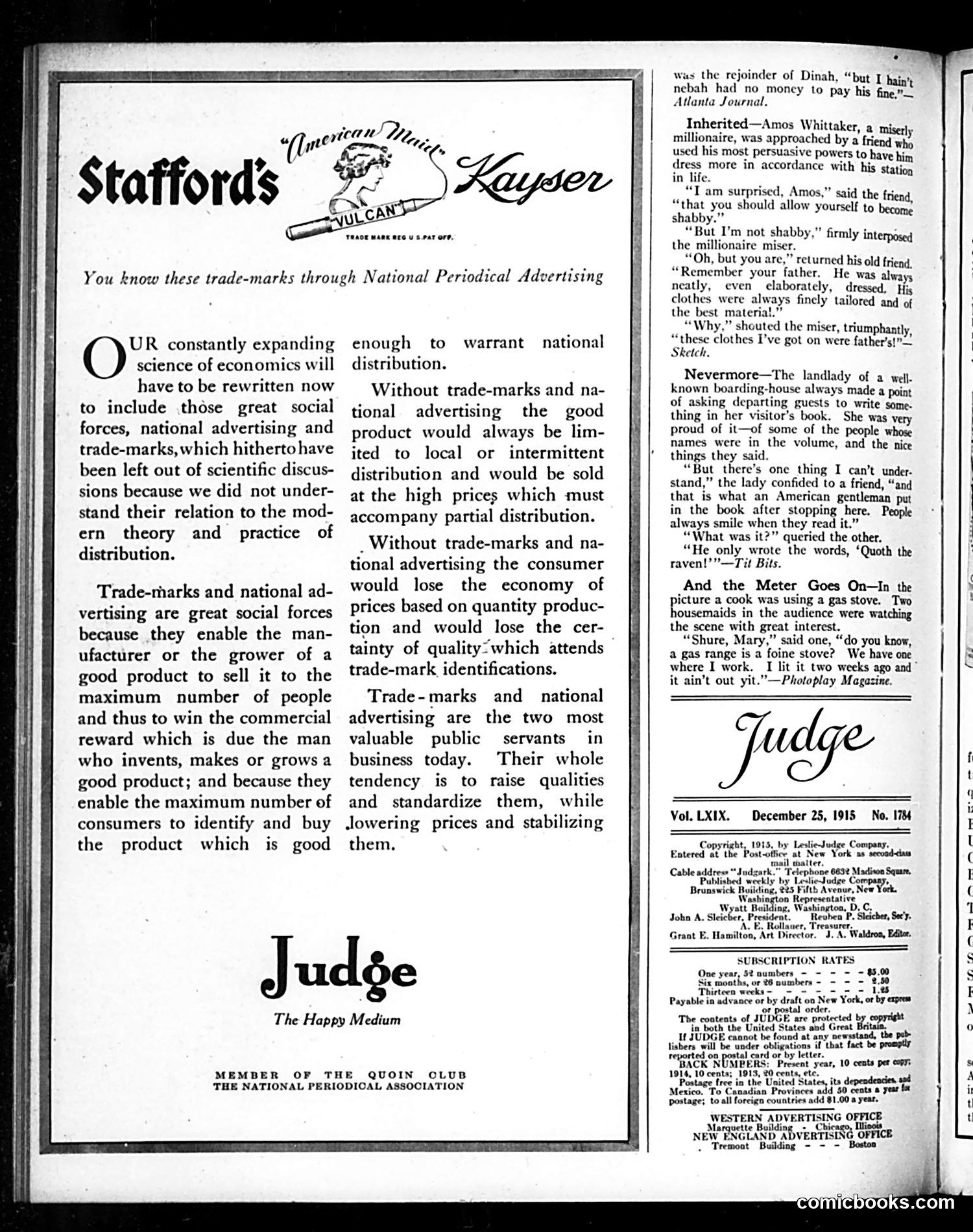
This page is **primarily advertising**, not a political cartoon. The Stafford-Kayser advertisement dominates the left side, arguing that trade-marks and national advertising are essential "social forces" that allow manufacturers to reach consumers at lower prices while guaranteeing quality standards. The right side contains the **magazine's masthead and several brief humor items** (anecdotes about a miserly man wearing his dead father's clothes, a landlady's guest book, and a gas stove that won't turn off). These are light, miscellaneous jokes—not political satire. The issue is dated December 25, 1915. The page illustrates how *Judge* mixed editorial content with advertising to argue that modern commercialism—specifically branded products distributed nationally—was economically and socially progressive. There's no identifiable caricature or political figure visible.
📄 Transcribed text from this page (OCR, searchable)
Machine-transcribed from the original scan — historical spelling and the odd misread are preserved.
(neem wp Staffords 2 Cte aS pi cas TRADE MARK AEG U 5.PAr OFF, You know these trade-marks through National Periodical Advertising UR constantly expanding science of economics will have to be rewritten now to include thdse great social forces, national advertising and trade-marks, which hitherto have been left out of scientific discus- sions because we did not under- stand their relation to the mod- ern theory and practice of distribution. Trade-marks and national ad- vertising are great social forces because they enable the man- ufacturer or the grower of a good product to sell it to the maximum number of people and thus to win the commercial reward which is due the man who invents, makes or grows a good product; and because they enable the maximum number of consumers to identify and buy the product which is good enough to warrant national distribution. Without trade-marks and na- tional advertising the good product would always be lim- ited to local or intermittent distribution and would be sold at the high prices which must accompany partial distribution. _ Without trade-marks and na- tional advertising the consumer would lose the economy of prices based on quantity produc- tion and would lose the cer- tainty of quality:which attends trade-mark identifications. Trade-marks and _ national advertising are the two most valuable public servants in business today. Their whole tendency is to raise qualities and standardize them, while dowering prices and stabilizing them. J udge The Happy Medium MEMBER OF THE QUOIN OLUB THE NATIONAL PERIODICAL ASSOCIATION was the rejoinder of Dinah, “but n't nebah had no moncy to pay his Thai Atlanta Journal. % t Inherited—Amos Whittaker, a miserly millionaire, was approached by a friend are uel his most persuasive powers to have him dress more in accordance with hi i in life. nei “I am surprised, Amos,” said the friend. “that you should allow yourself to become shabby.” 2 b? “But I’m not shabby,” firmly i Tposed the millionaire ? ee “Oh, but you are,” returned his old friend, “Remember your father. He was always neatly, even elaborately, dressed, His clothes were always fincly tailored and of the best material.” “Why,” shouted the miser, triumphantly, “these clothes I’ve got on were father’s!"— Sketch. Nevermore—The landlady of a well. known boarding-house always made a point of asking departing guests to write some- thing in her visitor’s book. She was very proud of it—of some of the people whose names were in the volume, and the nice things they said. “But there’s one thing I can’t under- stand,” the lady confided to a friend, “and that is what an American gentleman put in the book after stopping here. People always smile when they read it.” “What was it?” queried the other, “He only wrote the words, ‘Quoth the raven!’ —Tit Bits. And the Meter Goes On—In the paws a cook was using a gas stove. Two jousemaids in the audience were watching the scene with great interest. “Shure, Mary,” said one, “do you know, a gas range is a foine stove? We have one where I work. I lit it two weeks ago and” it ain’t out yit.”—Photoplay Magasine. Vol. LXIX. December 25, 1915 No. 1784 Copyright, 1915, by LeslieJudge Company, Entered at the Post-office at New York as secosd<ias halter Madiwon Square, ‘elephone 6632 Leslie-Judge w New Yet. Ww Joba A. Sleicber, President BR A. E. Rollauer, Treasurer, Grant E. Hamilton, Art Director. J. A. Waldroa, Editor. —————————————————————— SUBSCRIPTION RATES One year, 5? numbers - - Six moaths, or 26 numbers . Thirteen weeks ~ 1 Payable in advance or by draft on New York, or by ‘or postal order. The contents of JUDGE are protected by copyright i Jnited States and Great Britain, If JUDGE cannot be found at any lishers will be under obligations if rted on postal card or by letter. “ABACK NUMBERS: ‘Present year, 10 cents per corr: 1914, 10 cents; 1913, 20 cents, ete. Postage free in the United States, its dependencies, sad Mexico. To Canadian Provinces add 50 cents a yeat fat postage; to all foreign count Marquette Building ~ Chi NEW ENGLAND ADVERT . Tremont Building - -