
Judge, 1915-12-25 · page 20 of 29
Judge — December 25, 1915 — page 20: what you’re looking at
What you’re looking at
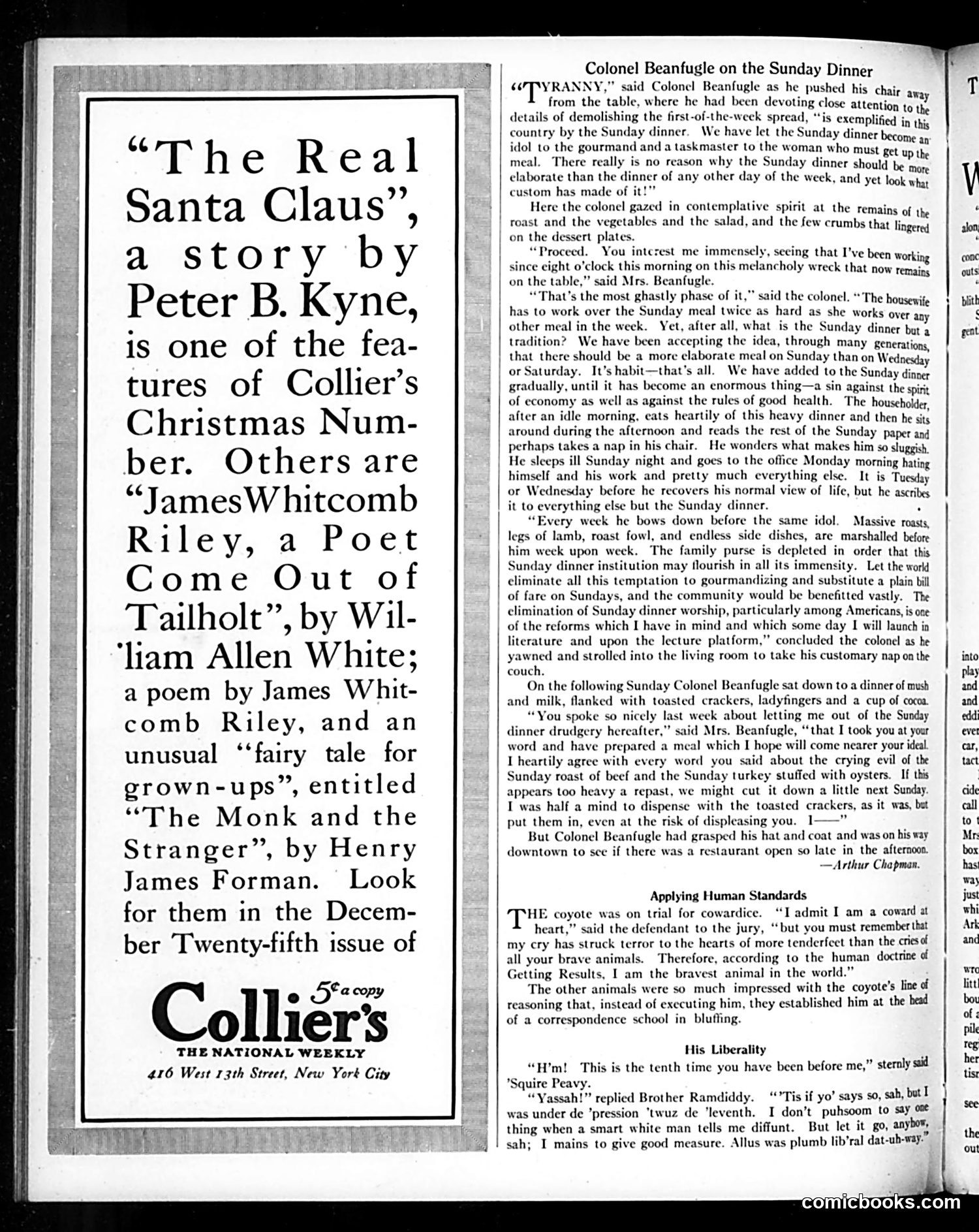
This is primarily an **advertisement for Collier's Christmas issue** (left page), promoting upcoming stories by acclaimed writers Peter B. Kyne, James Whitcomb Riley, and William Allen White. The right page features a **humorous domestic satire** titled "Colonel Beanfugle on the Sunday Dinner." Colonel Beanfugle—apparently a pompous character—pontificates to his wife about how the elaborate Sunday dinner is an unnecessary "tyranny" and wasteful tradition that exhausts housewives and makes families sluggish. He advocates eliminating this custom entirely. The joke's irony: Mrs. Beanfugle takes him literally and serves him only mush, milk, crackers, and cocoa the following Sunday—technically following his principles while clearly punishing his self-righteous moralizing. The satire mocks men who criticize household labor while enjoying its benefits, and husbands who lecture wives about domestic practices without understanding their actual burden.
📄 Transcribed text from this page (OCR, searchable)
Machine-transcribed from the original scan — historical spelling and the odd misread are preserved.
“The Real Santa Claus”, a story by Peter B. Kyne, is one of the fea- tures of Collier’s Christmas Num- ber. Others are “JamesWhitcomb Riley, a Poet Come Out of Tailholt”, by Wil- ‘liam Allen White; a poem by James Whit- comb Riley, and an unusual ‘‘fairy tale for grown-ups”, entitled “The Monk and the Stranger”, by Henry James Forman. Look for them in the Decem- ber Twenty-fifth issue of eo orery ollier's THE NATIONAL WEEKLY 416 West 13th Street, New York City Colonel Beanfugle on the Sunday Dinner 6OPYRANNY,” said Colonel Beanfugle as he pushed his chair ay from the table, where he had been devoting close attention tei details of demolishing the first-of-the-week spread, “is exemplified in th country by the Sunday dinner. We have let the Sunday dinner become : idol to the gourmand anda taskmaster to the woman who must get op ko meal. There really is no reason why the Sunday dinner should tees elaborate than the di of any other day of the week, and yet look wie custom has made of : Here the colonel gazed in contemplative spirit at the remains Of the | roast and the vegetables and the salad, and the few crumbs that lingered | on the dessert plates. “Proceed. You intezest_ me immensely, seeing that I’ve been workin since eight o'clock this morning on this melancholy wreck that now remait on the table,” said Mrs. Beanfugle. “That's the most ghastly phase of it,” said the colonel. “The housewife has to work over the Sunday meal twice as hard as she works over any other meal in the week. Yet, after all, what is the Sunday dinner bat a tradition? We have been accepting the idea, through many generations that there should be a more claborate meal on Sunday than on Wednesday or Saturday. It’s habit—that's all. We have added to the Sunday dinner gradually, until it has become an enormous thing—a sin against the spirit of economy as well as against the rules of good health. The houscholder, after an idle morning, eats heartily of this heavy dinner and then he sits around during the afternoon and reads the rest of the Sunday Paper and perhaps t nap in his chair. He wonders what makes him so sluggish, He sleeps ill Sunday night and goes to the office Monday morning hating himself and his work and pretty much everything else. It is Tuesday or Wednesday before he recovers his normal view of life, but he ascribes it to everything else but the Sunday dinner. i “Every week he bows down before the same idol. Massive roasts, legs of lamb, roast fowl, and endless side dishes, are marshalled before him week upon week. The family purse is depleted in order that this Sunday dinner institution may flourish in all its immensity. Let the world eliminate all this temptation to gourmandizing and substitute a plain bill of fare on Sundays, and the community would be benefitted vastly. The elimination of Sunday dinner worship, particularly among Americans, is one of the reforms which I have in mind and which some day I will launch in literature and upon the lecture platform,” concluded the colonel as he yawned and strolled into the living room to take his customary nap on the couch. On the following Sunday Colonel Beanfugle sat down to a dinner of mush and milk, flanked with toasted crackers, ladyfingers and a cup of cocoa. “You spoke so nicely week about letting me out of the Sunday dinner drudgery hereafter, id Mrs. Beanfugle, ‘that I took you at your word and have prepared a meal which I hope will come nearer your ideal I heartily agree with every word you said about the crying evil of the Sunday roast of beef and the Sunday turkey stuffed with oysters. If this appears too heavy a repast, we might cut it down a little next Sunday. I was half a mind to dispense with the toasted crackers, as it was, bet put them in, even at the risk of displeasing you. But Colonel Beanfugle had grasped his hat and coat and was on his way downtown to sce if there was a restaurant open so late in the afternoon, —Arthur Chapman. Applying Human Standards "THE coyote was on trial for cowardice. “I admit I am a coward at heart,” said the defendant to the jury, ‘but you must remember that my cry has struck terror to the hearts of more tenderfeet than the cries of all your brave animals. Therefo! ccording to the human doctrine of Getting Results, I am the bravest animal in the world.” The other animals were so much impressed with the coyote’s line of reasoning that, instead of executing him, they established him at the bead of a correspondence school in bluffing. His Liberality 4 “H’m! This is the tenth time you have been before me,” sternly said "Squire Peavy. “Yassah!” replied Brother Ramdiddy. ‘*’Tis if yo’ says 50, sab, but I was under de ‘pression ‘twuz de ‘leventh. I don’t puhsoom to say 0@ thing when a smart white man tells me diffunt. But let it go, anybor, sah; I mains to give good measure. Allus was plumb lib’ral dat-uh-way-