
A complete issue · 24 pages · 1915
Judge — May 15, 1915
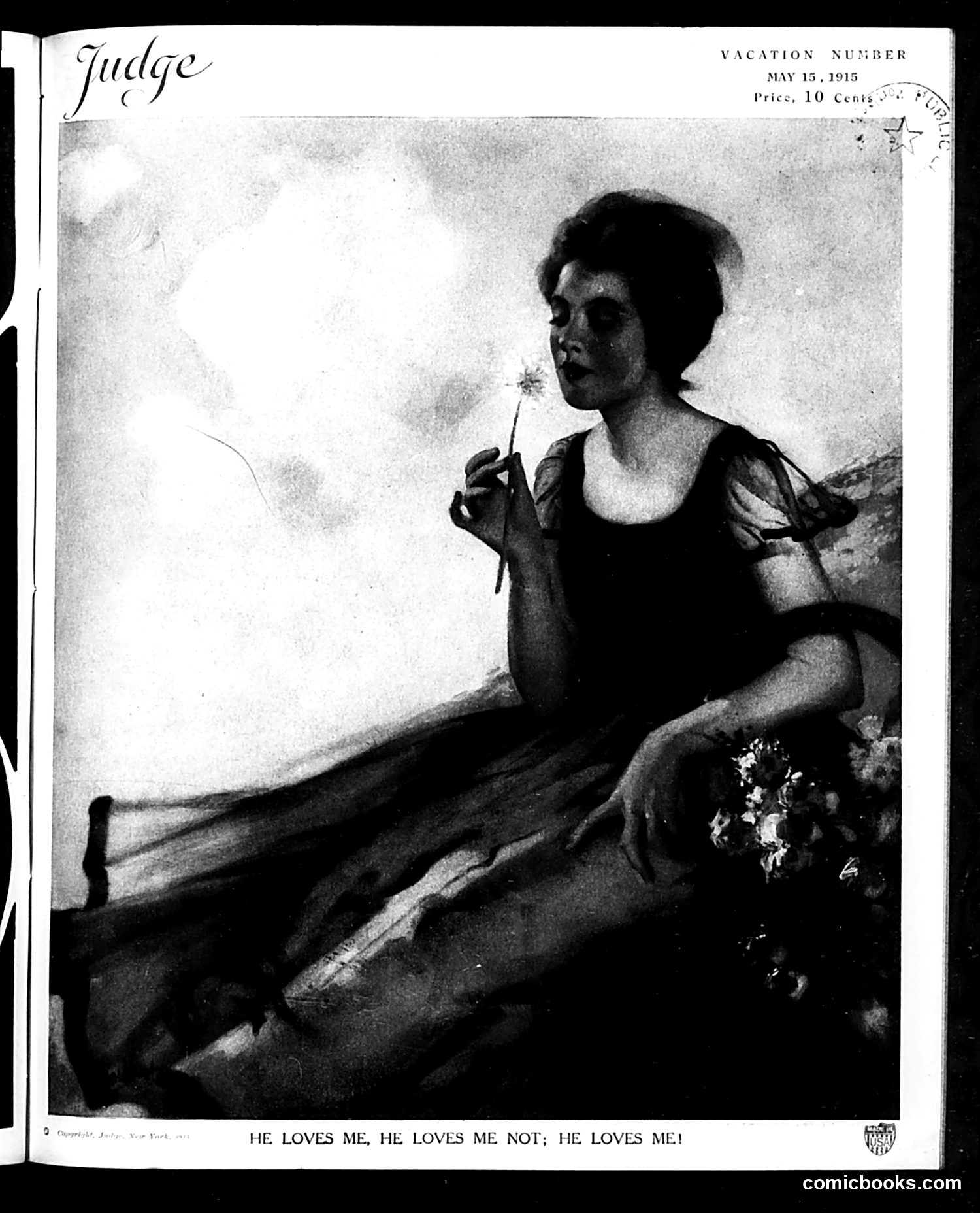
This is the cover of Judge's "Vacation Number" from May 15, 1915. The image shows a woman in a dark dress sitting indoors, holding a single flower stem and gazing pensively. The caption reads "HE LOVES ME, HE LOVES ME NOT; HE LOVES ME!" The illustration depicts a woman performing the classic parlor game of plucking flower petals while reciting the titular phrase to divine her romantic fortune. The exclamation mark at the end suggests uncertainty or yearning about her lover's affections. This appears to be a lighthearted seasonal cover playing on themes of romance and summer leisure—appropriate for a vacation issue. The melancholic pose and indoor setting suggest romantic longing rather than carefree vacation joy, offering gentle satire on courtship anxieties of the era.
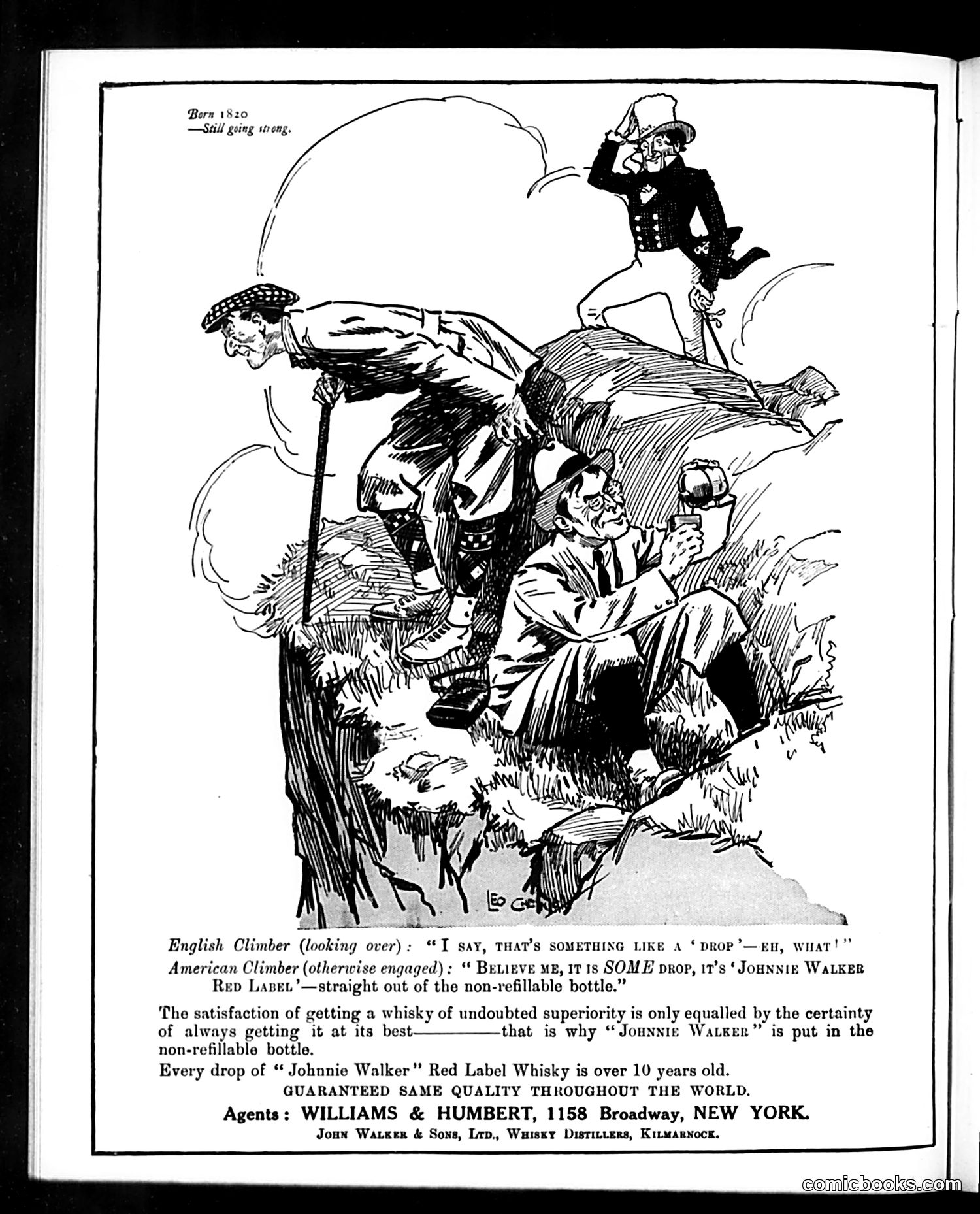
This page is primarily **advertising for Johnnie Walker Red Label whisky**, not political satire. The cartoon depicts two mountain climbers—labeled "English Climber" and "American Climber"—on a steep peak. The English climber claims his discovery is "something like a drop," while the American climber identifies it as Johnnie Walker Red Label whisky from a "non-refillable bottle." The ad's joke plays on national rivalry: the English climber mistakes premium whisky for a mere water droplet, while the American recognizes superior quality. The advertisement emphasizes the whisky's guaranteed age (over 10 years) and consistent quality worldwide. The Judge magazine framing suggests this satirical comparison appealed to American readers' competitive pride.
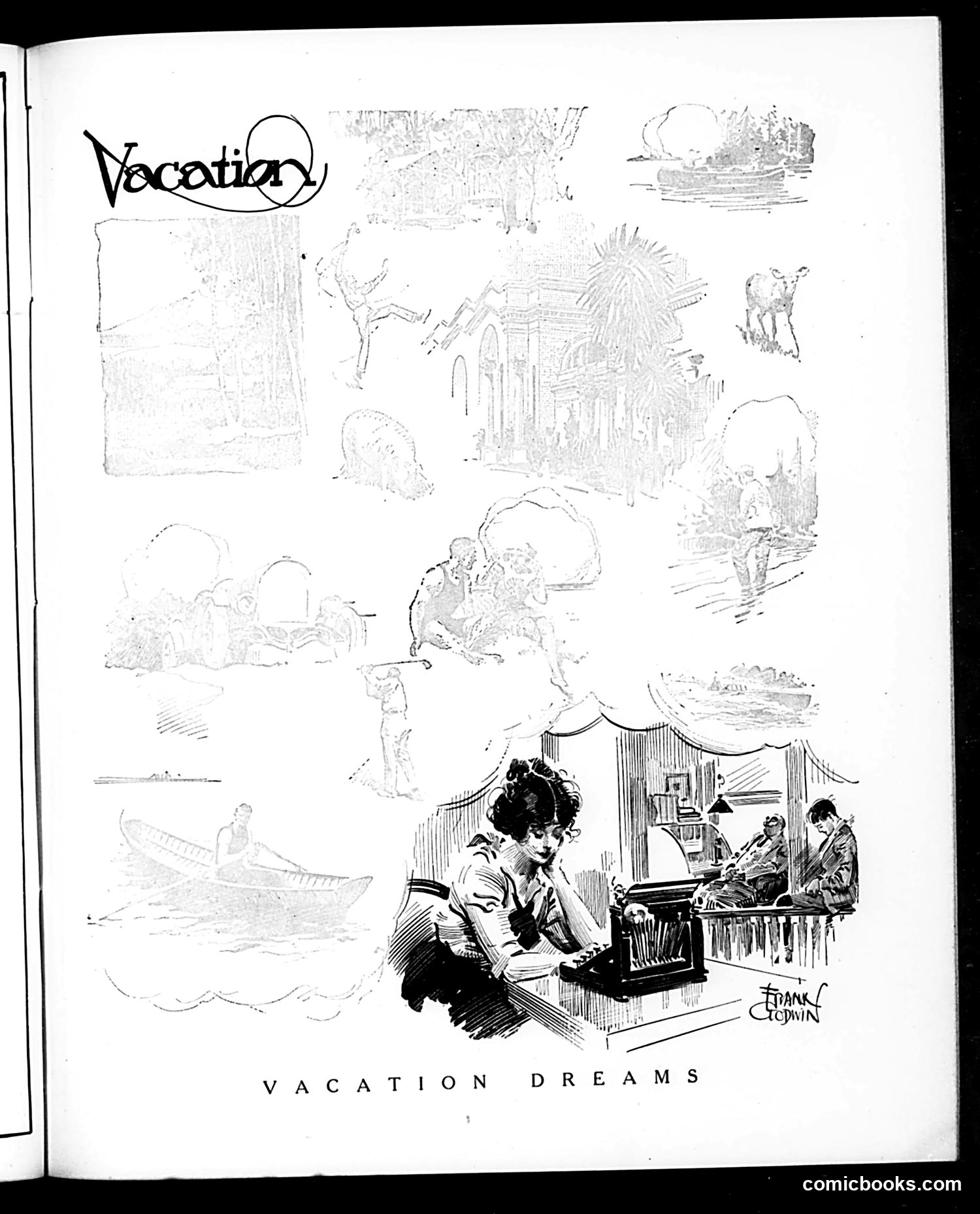
This satirical illustration depicts the contrast between vacation fantasies and reality. The page title "VACATION DREAMS" frames scattered sketches of idealized vacation scenarios—exotic locations, wildlife, boating, architectural landmarks, and leisurely activities. The main illustration, signed by Frank Edwin (a Judge cartoonist), shows a woman at a typewriter in what appears to be a modest tent or makeshift shelter, while others relax in comfortable surroundings behind her. The satire suggests that while others enjoy vacations, someone (likely a working woman or secretary) remains tethered to labor—unable to escape work even during vacation time. This reflects early 20th-century social commentary on work-life balance and gender roles in employment.
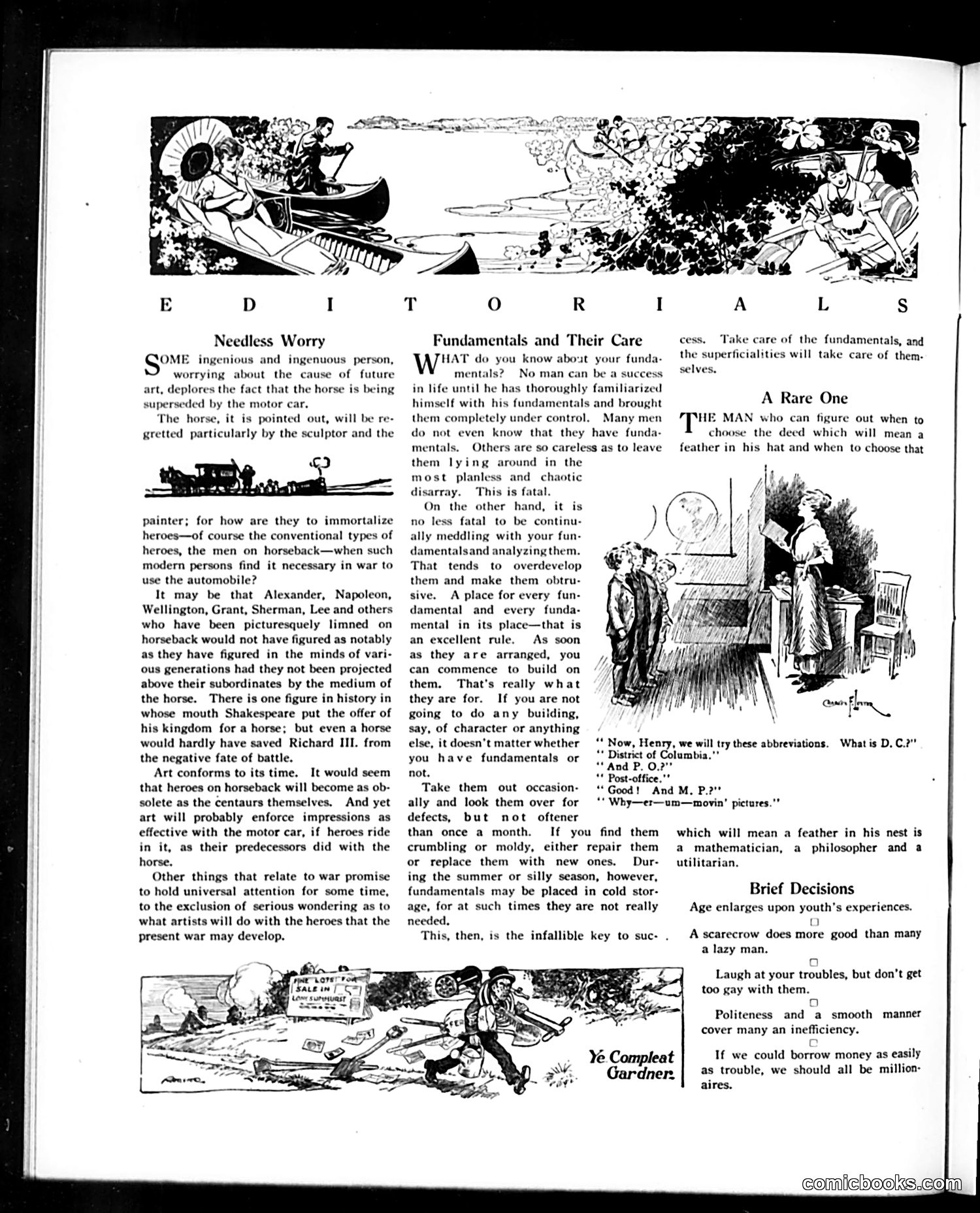
This page features three distinct sections: **"Needless Worry"** (left): A satirical essay critiquing concerns that horses will become obsolete in art due to the automobile's rise. The author argues that great military leaders (Alexander, Napoleon, Wellington) are remembered partly through equestrian imagery, so horses will remain artistically significant despite technological change. **"Fundamentals and Their Care"** (center): Practical advice on maintaining basic life skills and habits—presented as essential "fundamentals" that shouldn't be over-analyzed or neglected. **"A Rare One"** (right): A cartoon showing a man selecting a feather for his hat, with the caption suggesting that finding someone who can make practical decisions (choosing the right feather) is as rare as finding a mathematician or philosopher—satirizing indecisiveness in everyday matters. The page mixes commentary on modernization anxiety with practical humor about decision-making.
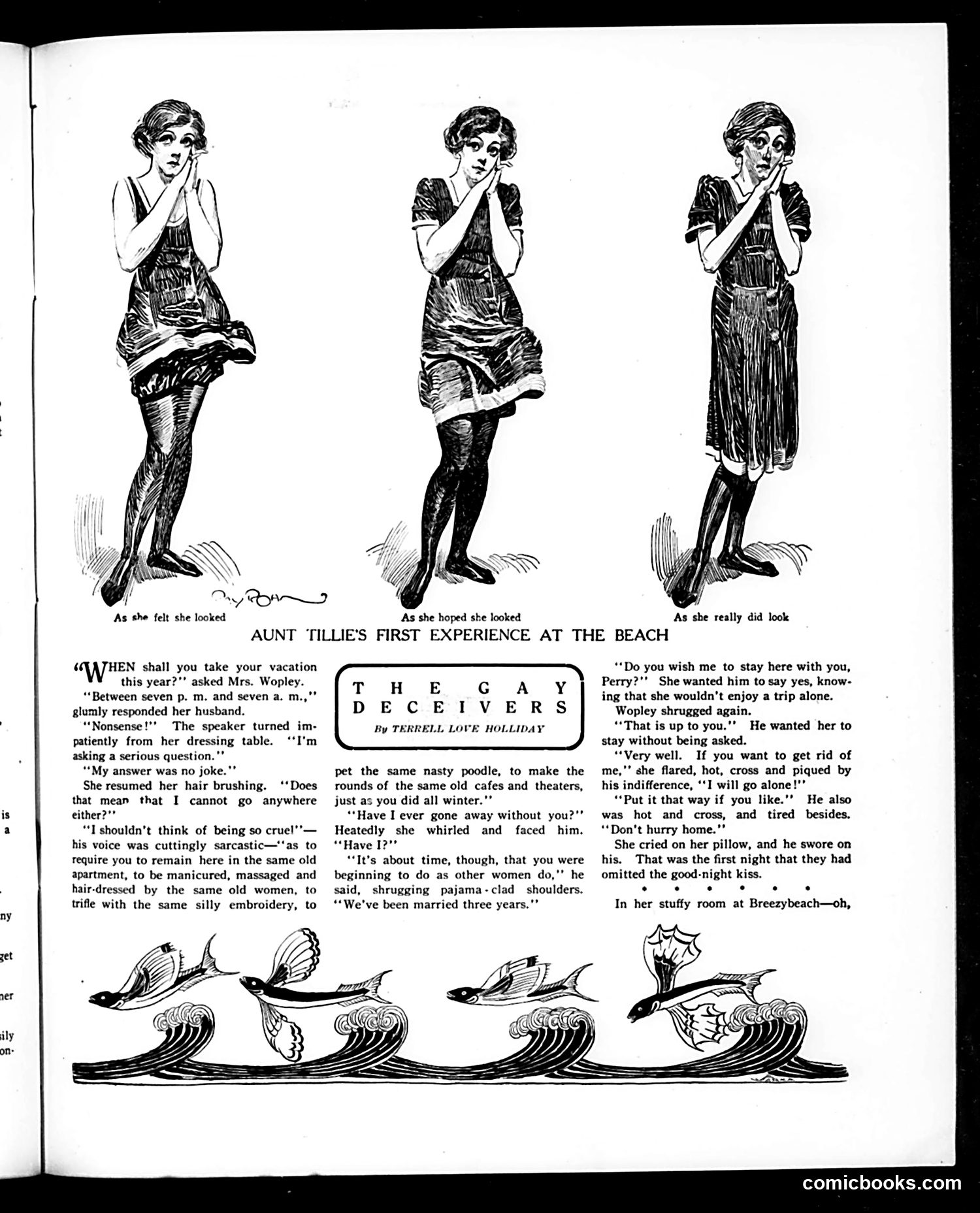
This page presents a short story titled "Aunt Tillie's First Experience at the Beach" by Terrell Love Holliday, satirizing marital dynamics and women's independence. The three illustrated panels at top show a woman's changing appearance and demeanor, captioned "As she felt she looked," "As she hoped she looked," and "As she really did look"—mocking the gap between self-perception and reality. The narrative centers on a husband's sarcastic resistance to his wife's vacation desires. He demands she remain in their apartment for manicuring and grooming, while he refuses to accompany her. The satire targets both his controlling behavior and her frustrated response—she ultimately threatens to leave alone if necessary, exposing the tension between marital obligation and personal autonomy during this era. The decorative wave border with fish suggests the beach setting.
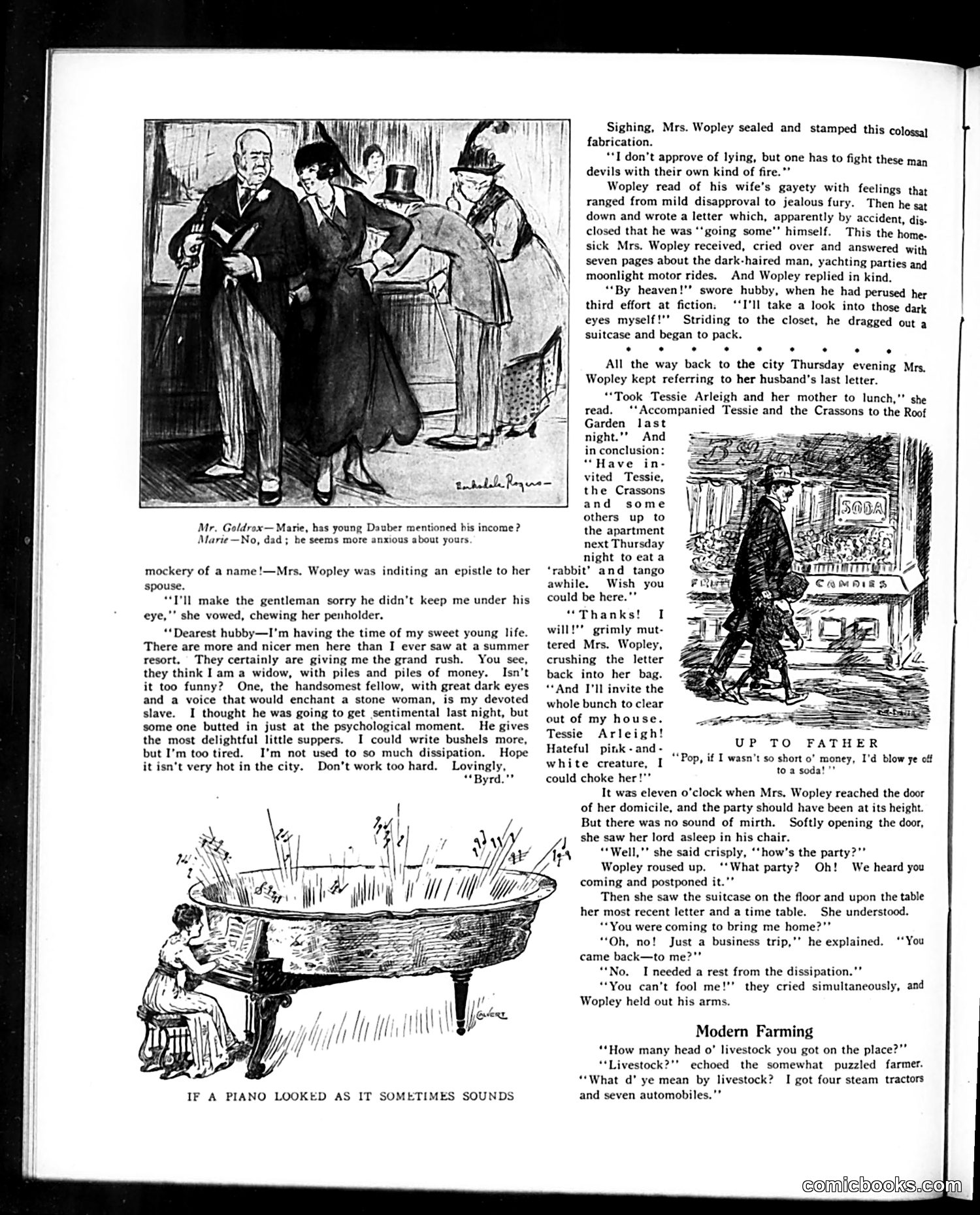
This story satirizes early 20th-century marital jealousy and deception. Mr. and Mrs. Wopley, separated for the summer, engage in a escalating war of lies—each fabricating tales of romantic attention to provoke the other's jealousy. Mrs. Wopley invents suitors and social engagements; her husband responds with invented female companions. The satire works on two levels: it mocks both the couple's transparent dishonesty (they immediately see through each other's fabrications) and the era's assumptions about marriage and gender—that a woman with "piles of money" would attract male attention, that jealousy proves devotion. The resolution is sentimental rather than satirical: both rush back to reconcile, neither fooled but both reassured of being wanted. The "Modern Farming" cartoon below offers unrelated agricultural humor about industrialization—a farmer conflating farm equipment with livestock.
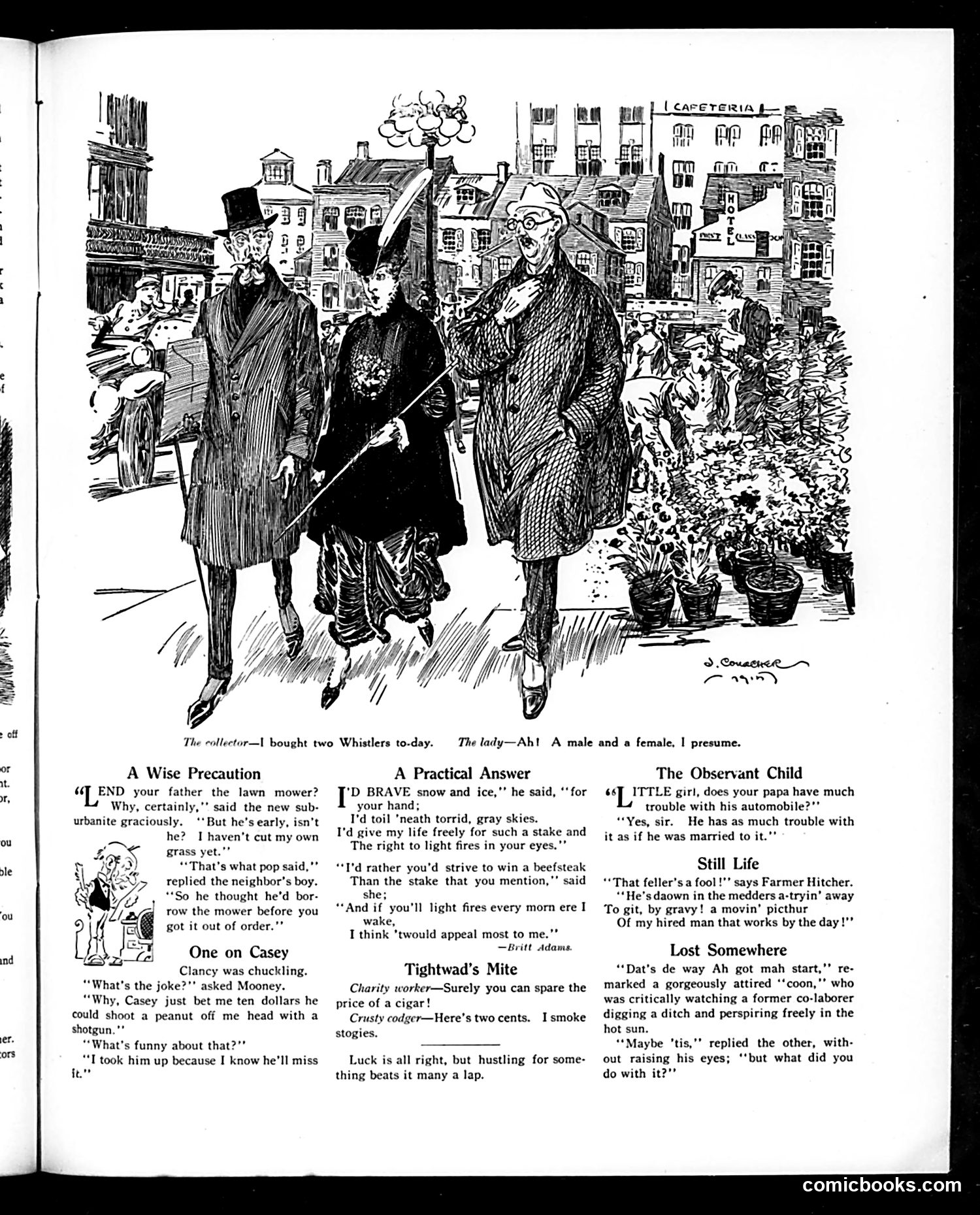
This page from Judge contains six separate humorous short pieces typical of early 20th-century American satire. **Key items:** The top cartoon depicts three well-dressed urbanites; the caption references "Whistlers" (likely James McNeill Whistler paintings), satirizing wealthy collectors' pretension. The jokes below mock suburban newcomers borrowing tools, working-class men like "Casey" and "Clancy," and romantic clichés. "One on Casey" jokes about a man betting he'll *miss* shooting a peanut off someone's head—the humor relies on audience assumptions about Irish-American working-class competence. "Still Life" mocks a farmer's hired laborer and early cinema ("movin' picture"). **"Lost Somewhere"** uses racist dialect and a caricatured Black figure ("coon"), presenting a stereotypical narrative of someone who "made it" while watching former peers still labor—reflecting deeply offensive period attitudes. The cartoons collectively satirize social aspirations, courtship, charity, and class dynamics through period-specific prejudices now recognized as bigoted.
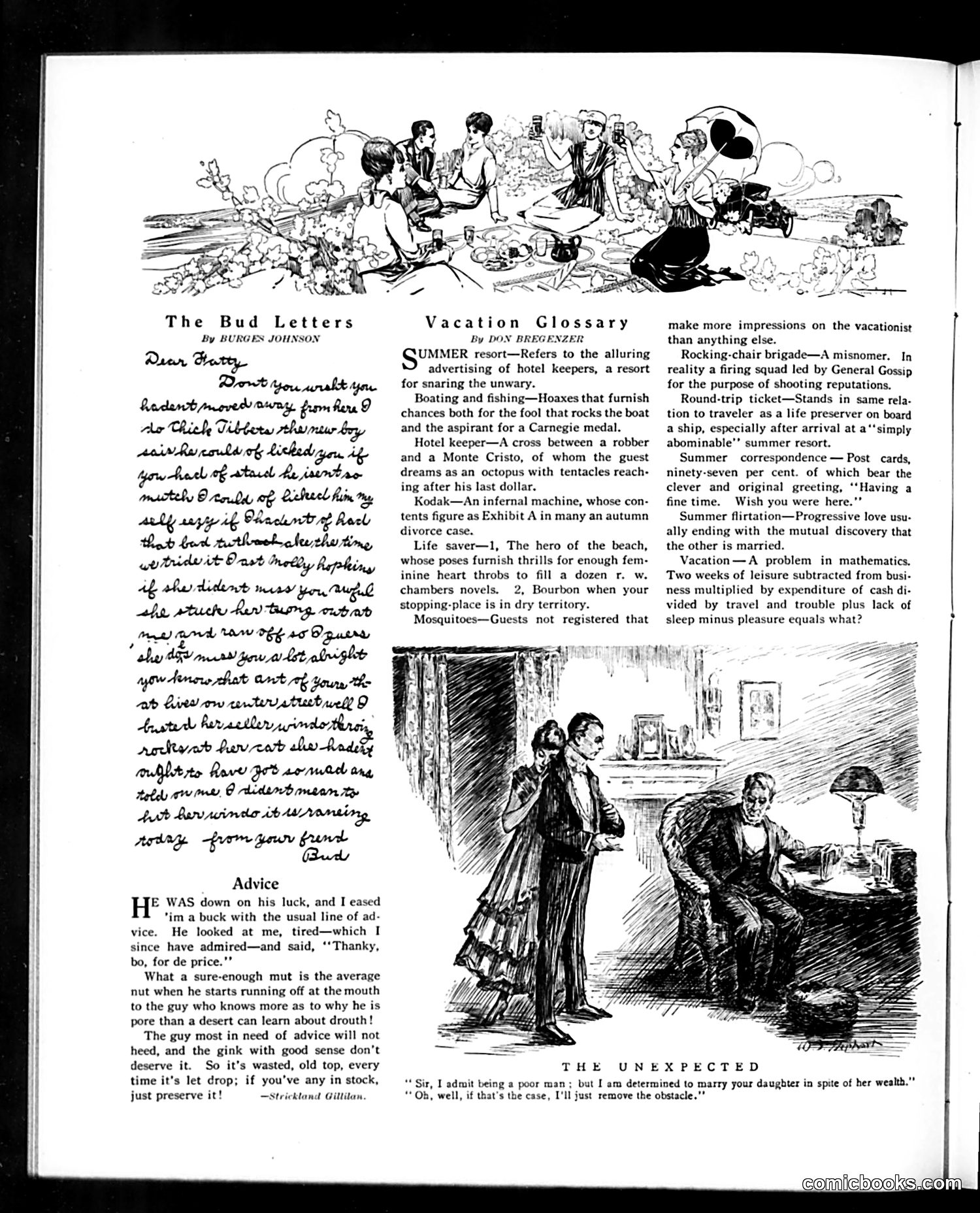
This page contains three distinct pieces from *Judge* magazine: **"The Bud Letters"** (top left) is a handwritten personal letter from Burges Johnson—difficult to fully decipher due to cursive handwriting, but appears to be casual correspondence about social observations. **"Vacation Glossary"** (top right) is satirical wordplay defining vacation-related terms mockingly. It ridicules resort advertising as deceptive, fishing as futile, hotel keepers as greedy ("cross between a robber and Monte Cristo"), and particularly mocks vacationers' shallow behavior—gossip ("rocking-chair brigade"), generic postcards, and temporary flirtations. The final definition jokes that vacation enjoyment mathematically equals zero. **"The Unexpected"** (bottom) is a single-panel cartoon showing a man proposing to a wealthy woman despite being poor, with her father's response: he'll "remove the obstacle"—implying he'll kill the suitor. The humor lies in the dark twist on what appears to be a romantic setup, and the father's casual acceptance of his daughter's determination. All three pieces reflect early-20th-century middle-class American social satire.
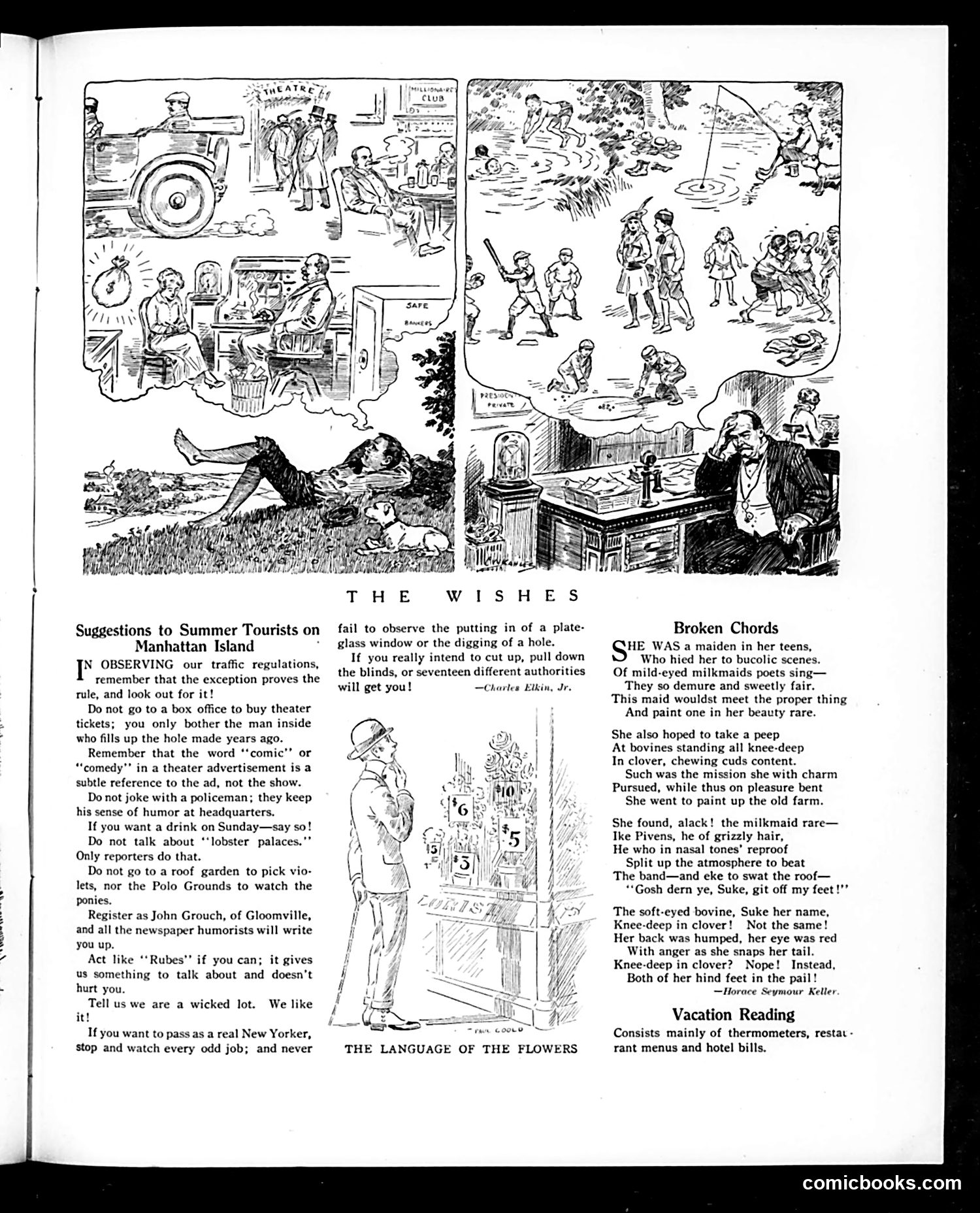
This page contains satirical advice for summer tourists visiting Manhattan, illustrated with humorous vignettes. The left column mocks naive visitors by offering tongue-in-cheek "tips" that expose New York City's actual rudeness and chaos—advising tourists to ignore traffic laws, expect indifferent service, avoid joking with hostile police, and watch construction work like locals do. The satire works by presenting bad behavior as sophisticated New York culture. "The Language of the Flowers" (right) is a mock-romantic poem about a young woman visiting a farm to paint idealized pastoral scenes. She encounters the opposite of her romantic expectations: an ill-tempered, crude farmer named Ike Pivens with a nasal voice, and an angry cow named Suke (not the gentle milkmaid she imagined). The humor lies in shattering sentimental rural fantasies with crude reality—the cow's hooves literally end up in a milk pail. Both pieces satirize romantic illusions versus gritty urban and rural actualities.
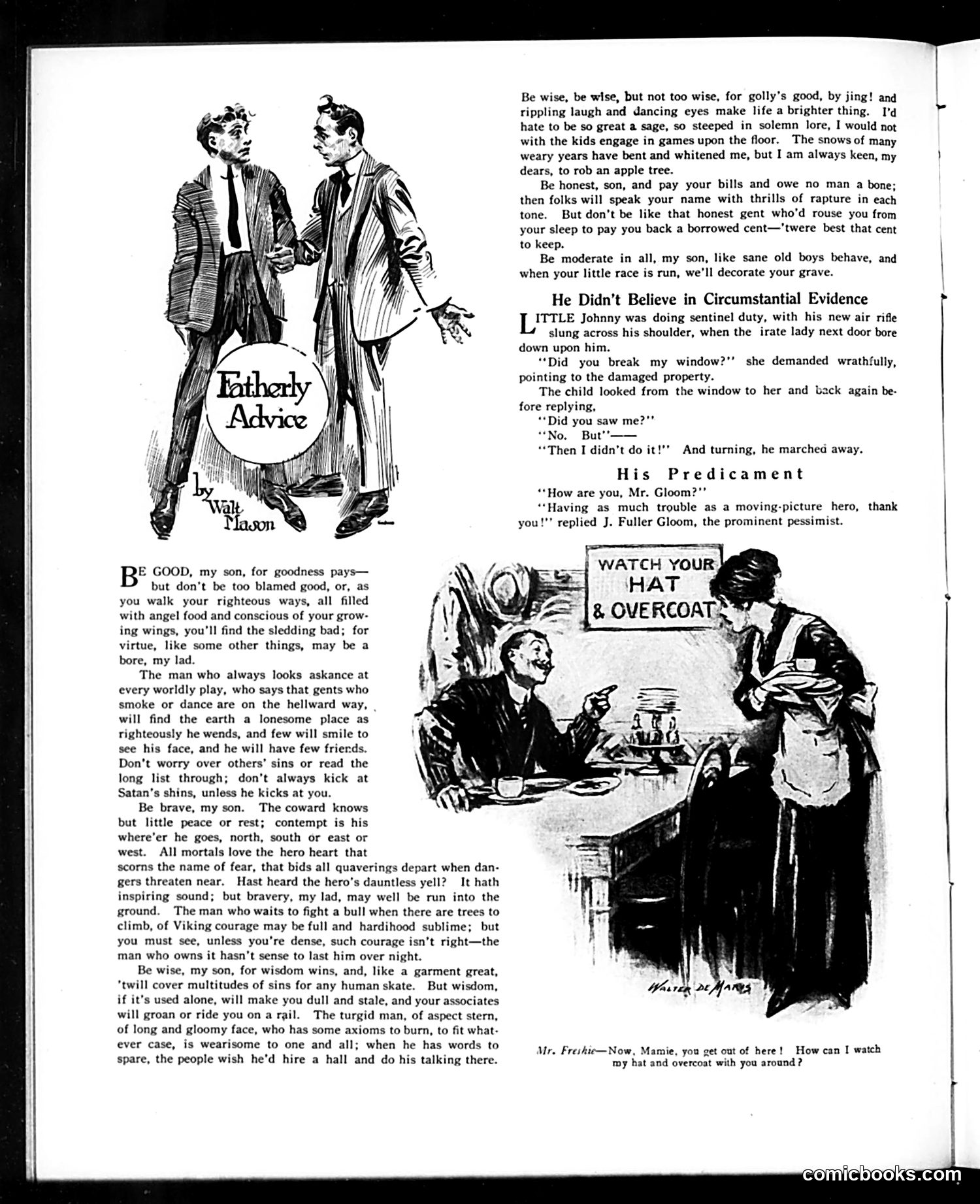
This Judge magazine page contains three distinct pieces: **"Fatherly Advice"** (left): A humorous essay-in-verse about parenting, warning against *excessive* virtue. The satire targets self-righteous moralists—men so obsessed with goodness, temperance, and rule-following that they become unbearably tedious bores whom nobody likes. The twist: moderation in virtue is better than rigid sanctimoniousness. This mocks the stern, joyless moralism of early 20th-century social reformers. **"He Didn't Believe in Circumstantial Evidence"** (top right): A brief comic anecdote where young Johnny, confronted about breaking a neighbor's window, denies it because she didn't actually *see* him do it—despite obvious circumstantial guilt. The joke satirizes literal-minded logic and a child's sophistry. **"His Predicament"** (bottom right): A one-panel gag about Mr. Gloom, a "prominent pessimist," complaining that his movie-star troubles rival those of cinema heroes. The humor lies in his self-absorbed, dramatic pessimism. All three mock human pretension and absurdity in everyday life.
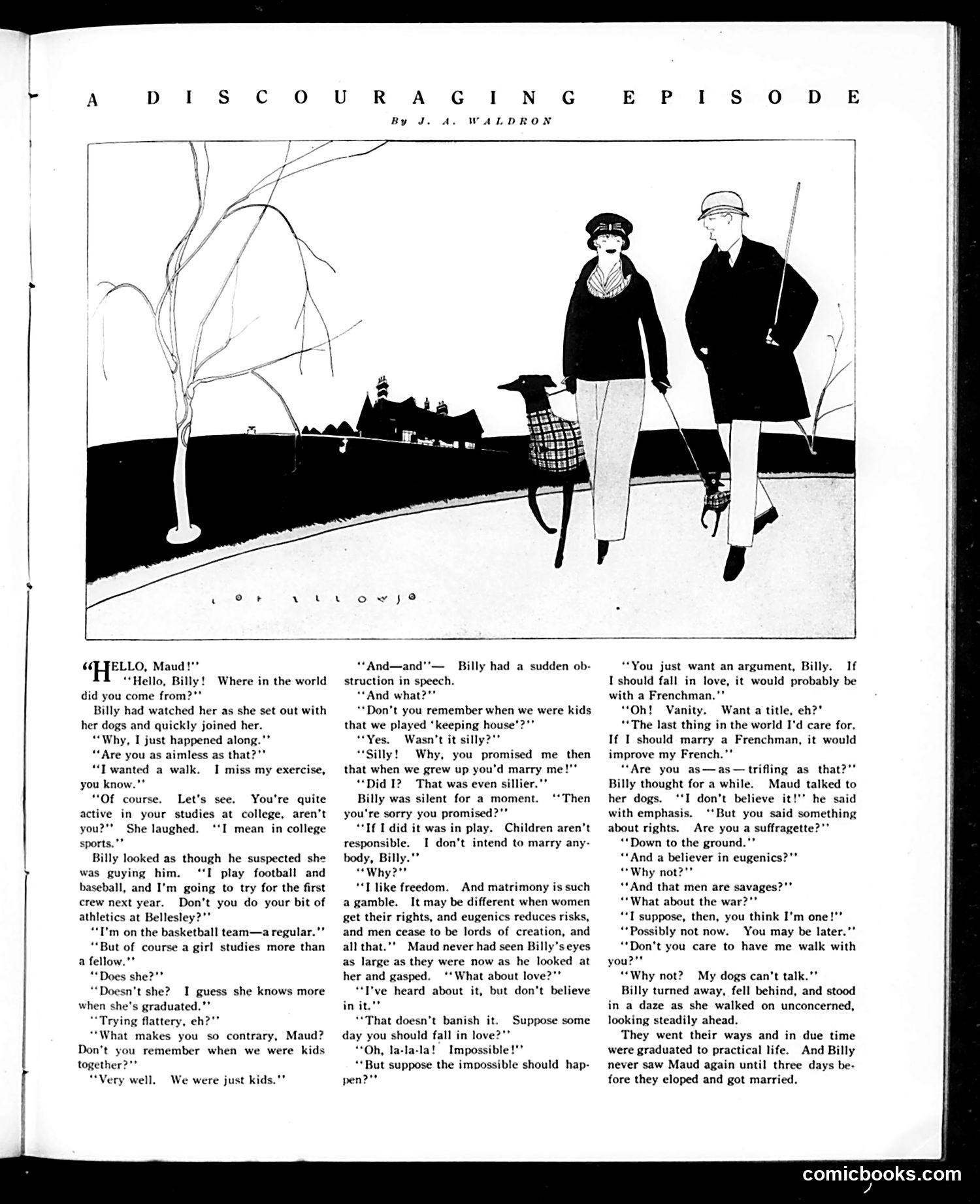
This comic story satirizes the "New Woman" of the 1910s-20s era—specifically, a college-educated woman named Maud who rejects traditional expectations. Billy, an old childhood friend, encounters her during a walk and attempts to rekindle romance. Maud articulates progressive positions: she values personal freedom over marriage, supports women's suffrage and eugenics, and dismisses romantic love as impractical. Billy finds her arguments frustrating and contradictory. The satire mocks both her ideological posturing and the social anxieties her independence provokes. The ending—that despite all her declarations against matrimony, Maud elopes with Billy anyway—suggests the cartoonist's skepticism about whether "modern" women truly reject traditional outcomes, or whether their progressive rhetoric masks inevitable conventional choices. This reflects common anti-feminist humor of the period that portrayed suffragettes and educated women as hypocritical or confused about their own desires.
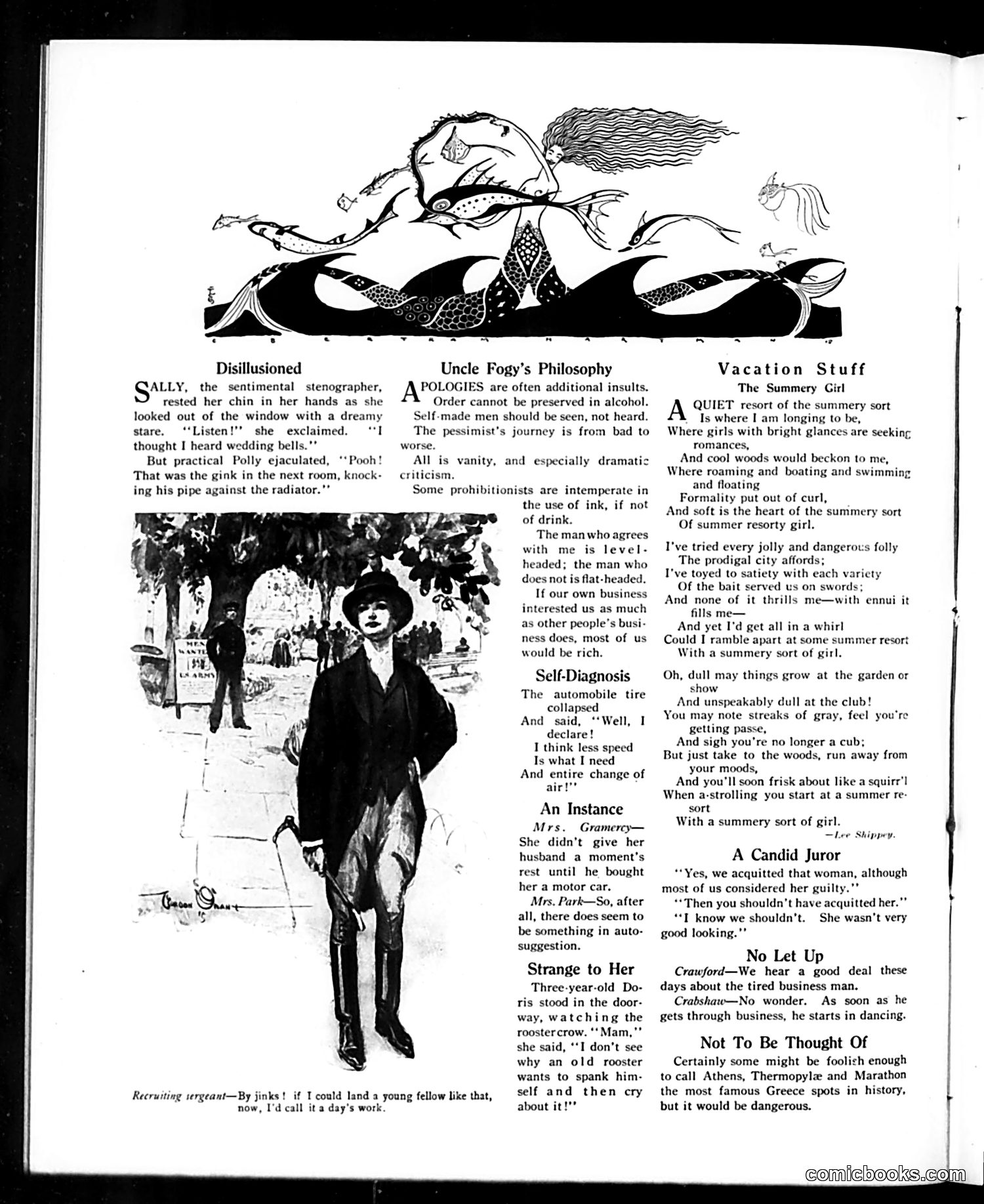
This page contains humorous short fiction and jokes typical of early 20th-century American satire magazines. **Main elements:** The illustrated story "Disilllusioned" depicts a stenographer mishearing pipe-knocking as wedding bells—satirizing romantic daydreaming versus practical reality. The recruiting sergeant's comment suggests young men were in demand (likely WWI-era context). **Other content includes:** - "Uncle Fogy's Philosophy": cynical one-liners about human nature (vanity, prohibition, self-made men) representing the voice of a cranky elder character - Short comic anecdotes mocking social pretensions and marital dynamics ("auto-suggestion," wives demanding motor cars) - A poem celebrating "summery" resort girls—flirtatious young women seeking romantic escapades - Jokes about juror bias (acquitting unattractive defendants), the "tired businessman," and tourist clichés about Greek historical sites The page primarily targets urban middle-class leisure culture, courtship rituals, and social hypocrisy rather than specific political figures.
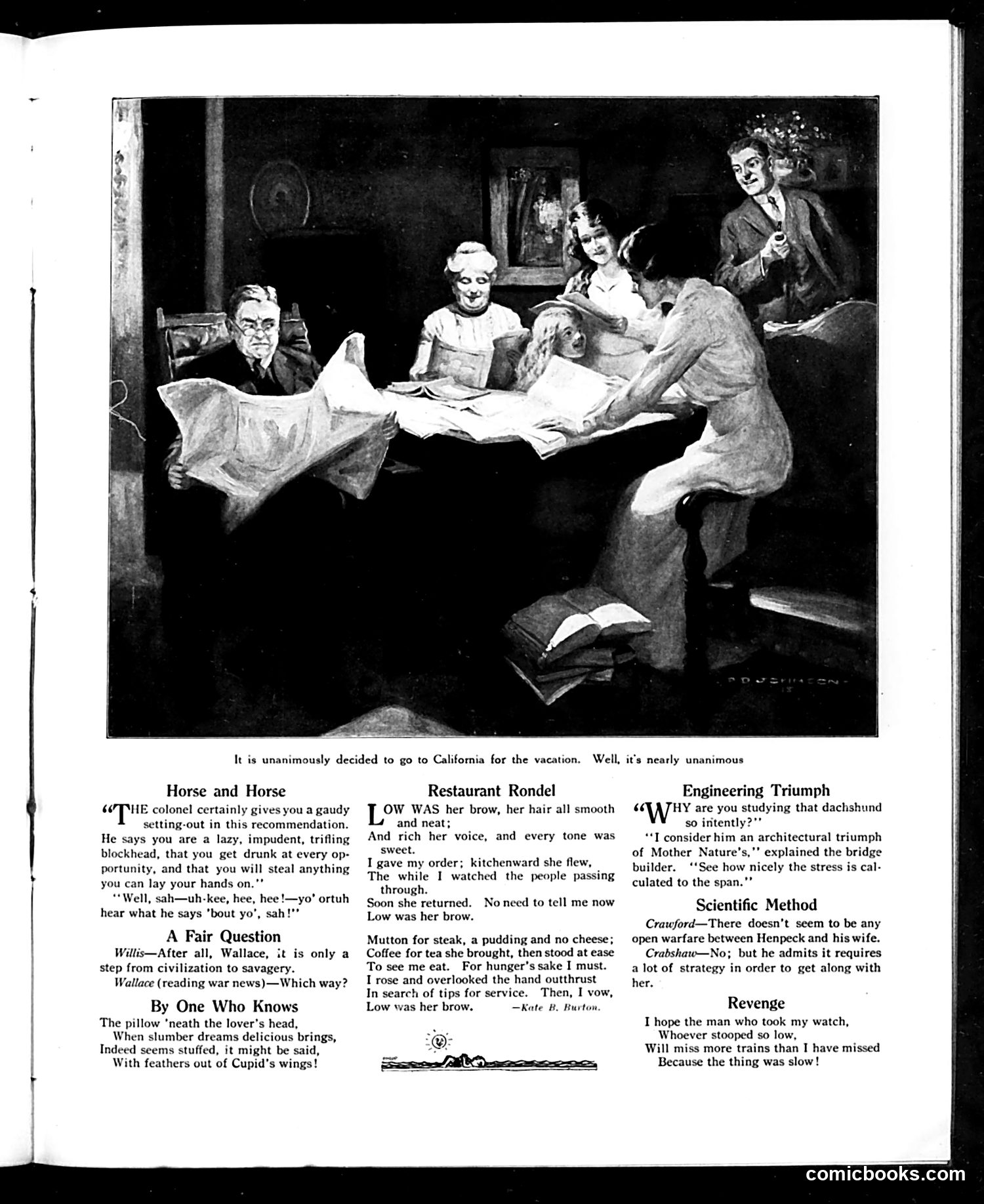
This page contains six brief satirical pieces typical of early 20th-century American humor magazines. The main cartoon depicts a group deciding to vacation in California. The accompanying anecdotes mock various social situations: a Black servant's misunderstanding of his employer's insults ("Horse and Horse"), marital discord disguised as civility ("Scientific Method"), and service-industry disappointments. A recurring theme is social pretense collapsing under scrutiny—the restaurant waitress presented as graceful becomes "low-browed" after delivering wrong orders; the dachshund becomes a engineering joke; the "unanimous" decision humorously masks ongoing argument. The humor relies on period stereotypes (racial caricature in "Horse and Horse"), class observations about servants and labor, and domestic friction presented as witty banter. The final "Revenge" poem offers mild working-class humor about a slow watch. Overall, the page represents Judge's formula: brief, cynical observations on manners, relationships, and social pretense, delivered through verse and anecdote rather than elaborate visual satire.
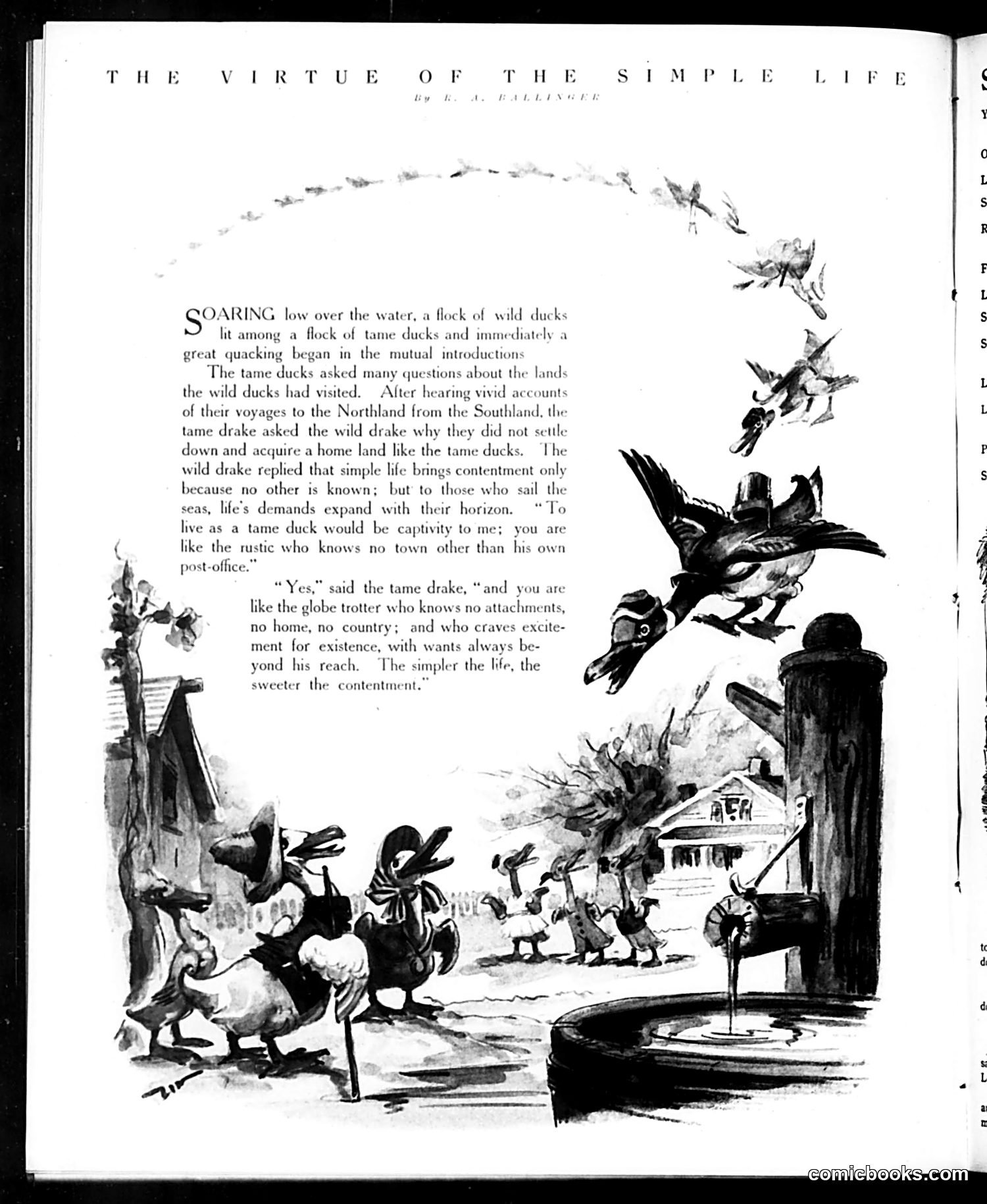
This fable contrasts two lifestyles through anthropomorphic ducks. Wild ducks represent adventurers and wanderers who seek excitement and constant new experiences across distant lands. Tame ducks embody settled domesticity and contentment with home, community, and stable attachments. The satire critiques both extremes: the wild drake mocks rural provincialism ("rustic who knows no town"), while the tame drake counters that restless globe-trotters lack genuine roots or satisfaction. The dialogue suggests early 20th-century American anxiety about competing values—the appeal of exploration and progress versus traditional stability and family life. The cartoon's moral appears deliberately ambiguous, allowing readers to choose which lifestyle deserves endorsement, reflecting contemporary debates about modernization, immigration, and American identity.
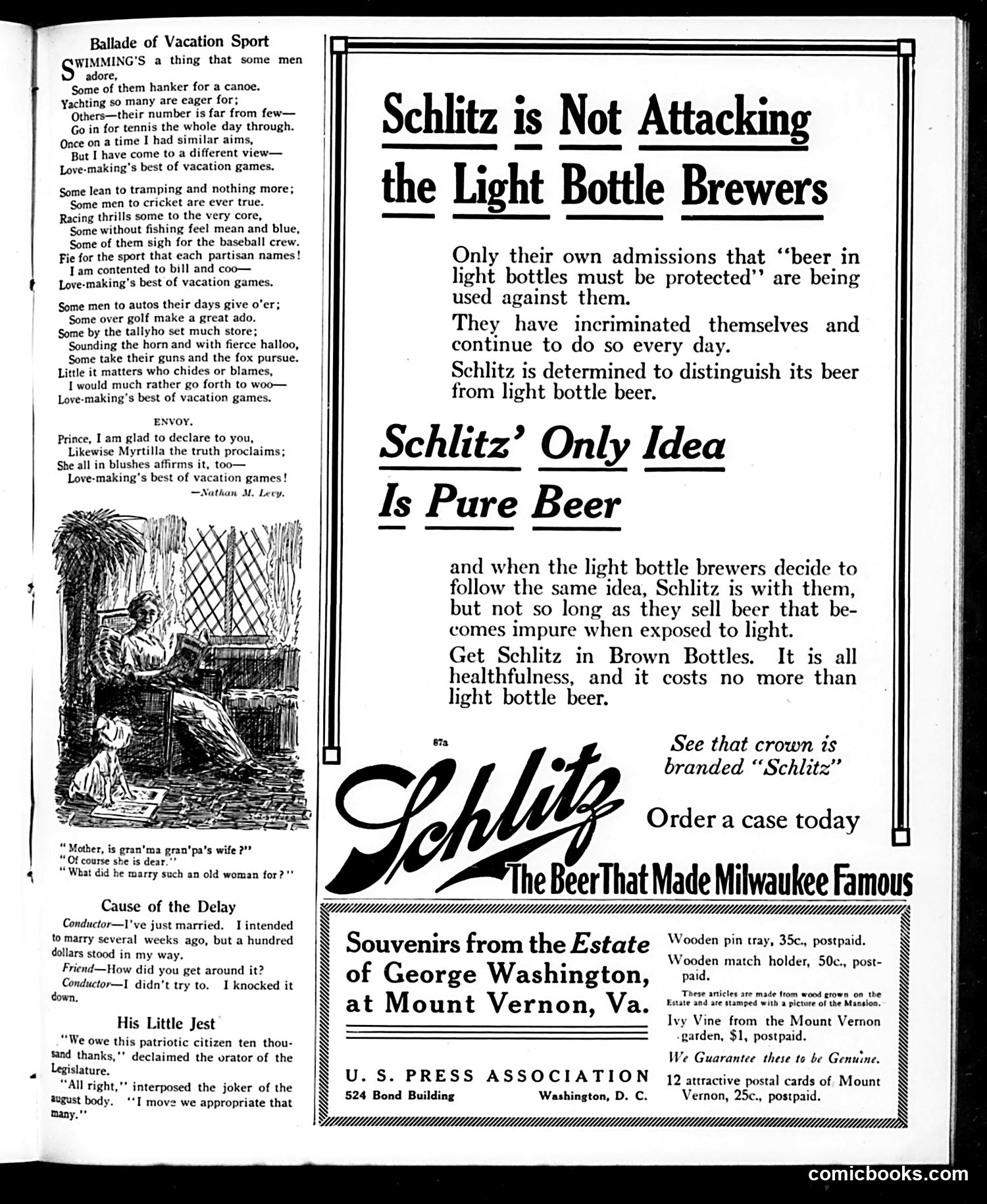
This page contains a **poetry section** (a formal "Ballade" by Nathan M. Levy celebrating romance as the best vacation activity) and **three brief humorous anecdotes**, alongside a substantial **Schlitz beer advertisement**. The advertisement defends Schlitz against competitors selling beer in light bottles. Schlitz argues that light bottle brewers have "incriminated themselves" by admitting their beer needs protection from light exposure—implying their product degrades when exposed. Schlitz claims its brown bottles preserve beer purity and quality at no higher cost. The ad positions Schlitz as superior because it requires no special packaging gimmick. The three jokes are period-typical: one about a conductor who married cheaply by knocking down his savings, one about a legislator who withholds funds, and one with unclear context (possibly a family joke). The page is primarily **commercial content**—the advertisement dominates the right side—with light entertainment filling space on the left.
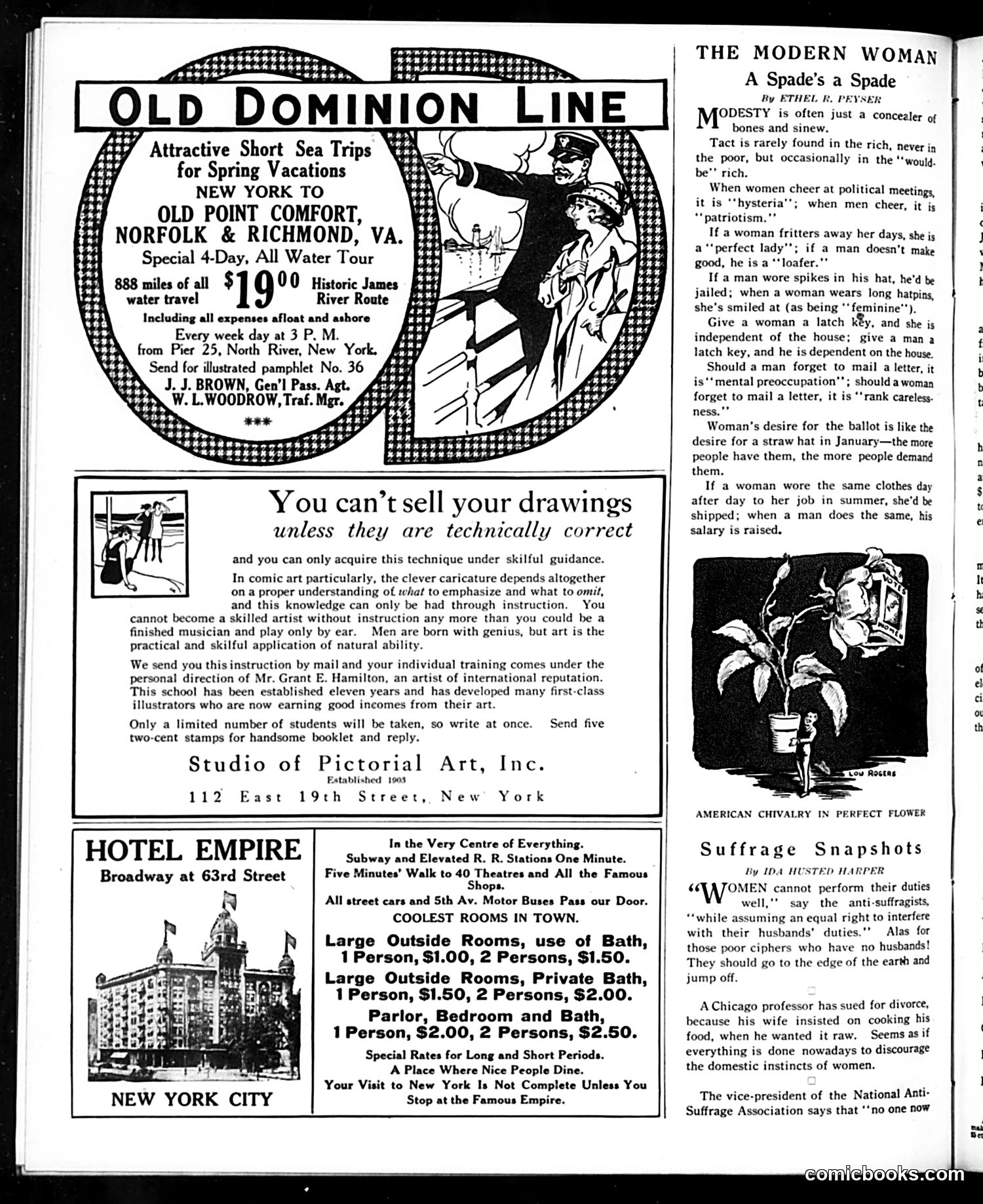
This page is primarily **advertisements and satirical essays**, not political cartoons. **"The Modern Woman: A Spade's a Spade"** by Ethel R. Peys is a sharp social satire exposing **gender double standards** in early 20th-century America. It catalogs hypocrisies: women cheering at meetings are called "hysterical" while men are "patriotic"; women in worn clothes lose jobs while men get raises; men forgetting letters show "mental preoccupation" while women show "carelessness." The piece ridicules these inconsistencies. **"Suffrage Snapshots"** by Ida Husted Harper mocks anti-suffrage arguments—particularly the claim that voting women would neglect domestic duties. Harper sarcastically notes that unmarried women, having no husbands to interfere with, should apparently "jump off" the earth, exposing the absurdity of such logic. Both essays advocate for **women's equality and voting rights**, presenting feminist critique through ironic humor. The page reflects Judge's engagement with contemporary suffrage debates (pre-1920 Amendment passage).
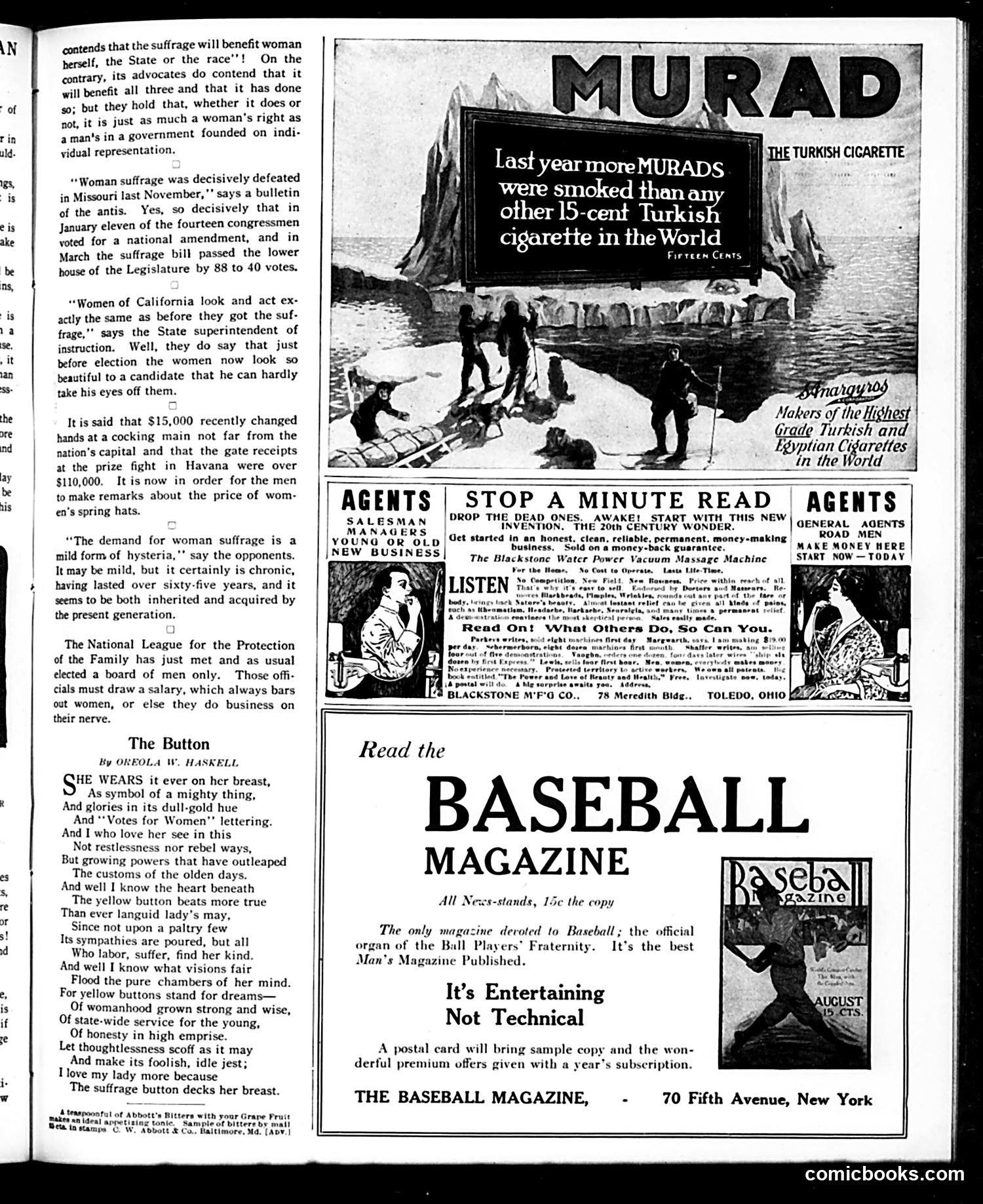
This page from *Judge* magazine contains editorial commentary on women's suffrage alongside advertisements and poetry. **The Suffrage Content**: The left column consists of anti-suffrage arguments being sarcastically refuted. Critics claimed suffrage wouldn't benefit women, that women in California remained unchanged after gaining it, or that the movement was "hysteria." The author systematically dismantles these claims, pointing out the hypocrisy of groups like the "National League for the Protection of the Family," which excludes women from its board while drawing salaries. **"The Button" Poem**: By Oreola W. Haskell, this celebrates the "Votes for Women" button worn by suffragists as a symbol of evolved womanhood and compassion—not rebellion. **The Advertisements**: The page is dominated by ads for cigarettes (Murad), baseball magazines, and various patent medicines and business opportunities—typical of the era. **Historical Context**: This represents early 20th-century pro-suffrage advocacy in a satirical magazine, using humor and poetry to argue for women's voting rights while simultaneously mocking their opponents' logic.
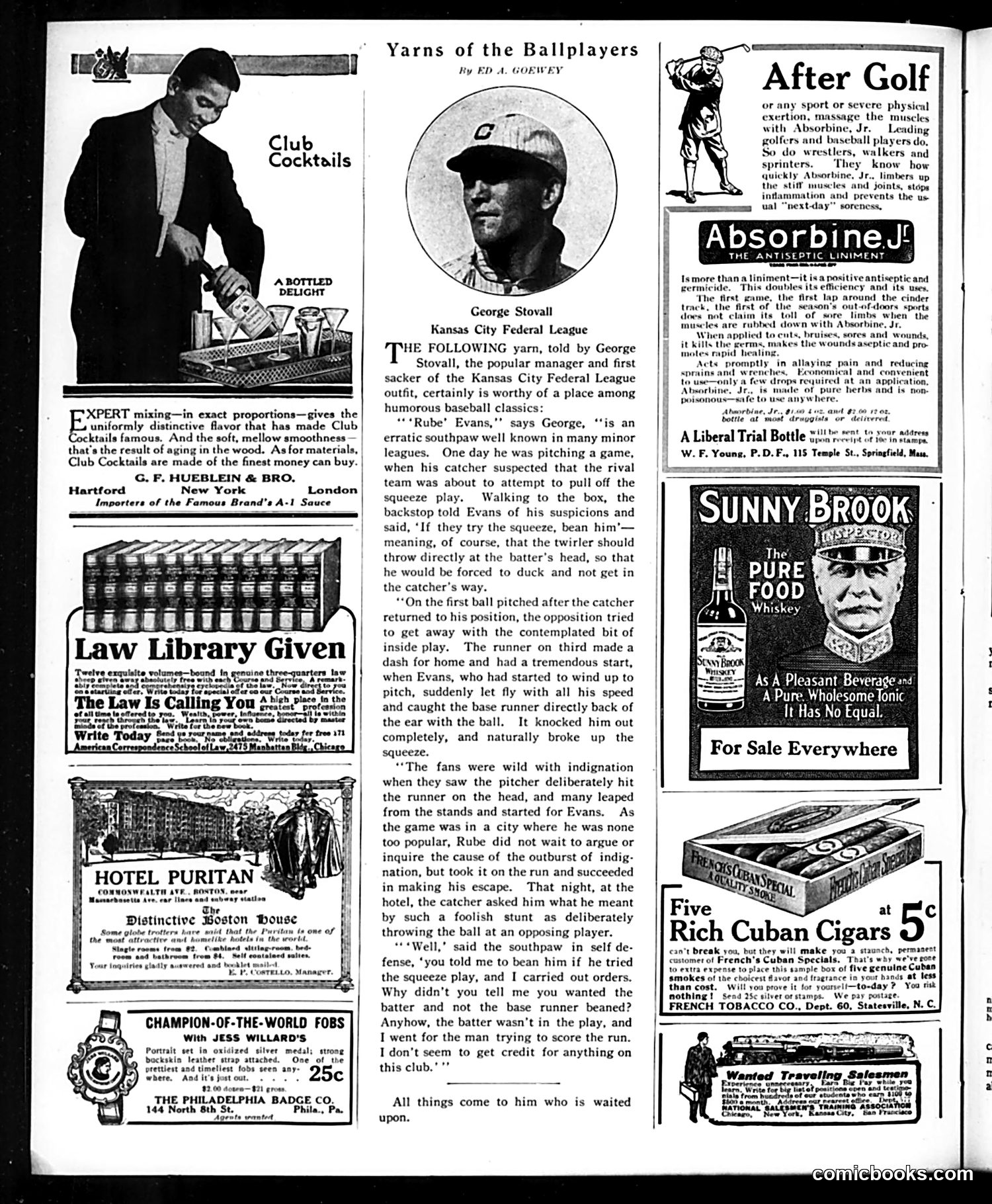
The central feature is a humorous baseball story told by George Stovall, manager of the Kansas City Federal League team. The yarn concerns pitcher "Rube" Evans, described as an erratic but talented southpaw. The joke: Evans's catcher instructs him to "bean" (hit) an opposing batter attempting a squeeze play. Evans literally obeys—but hits the base runner instead, knocking him out cold. When confronted that night, Evans protests he followed orders exactly: the catcher said to bean someone if they tried the squeeze, and he did. The humor lies in Evans's literalist defense: he got the right play stopped, just the wrong player. The story illustrates baseball slang and tactics of the era while poking fun at both misunderstandings and overzealous rule-following. The page is primarily advertising otherwise (golf liniment, whiskey, cigars, law school).
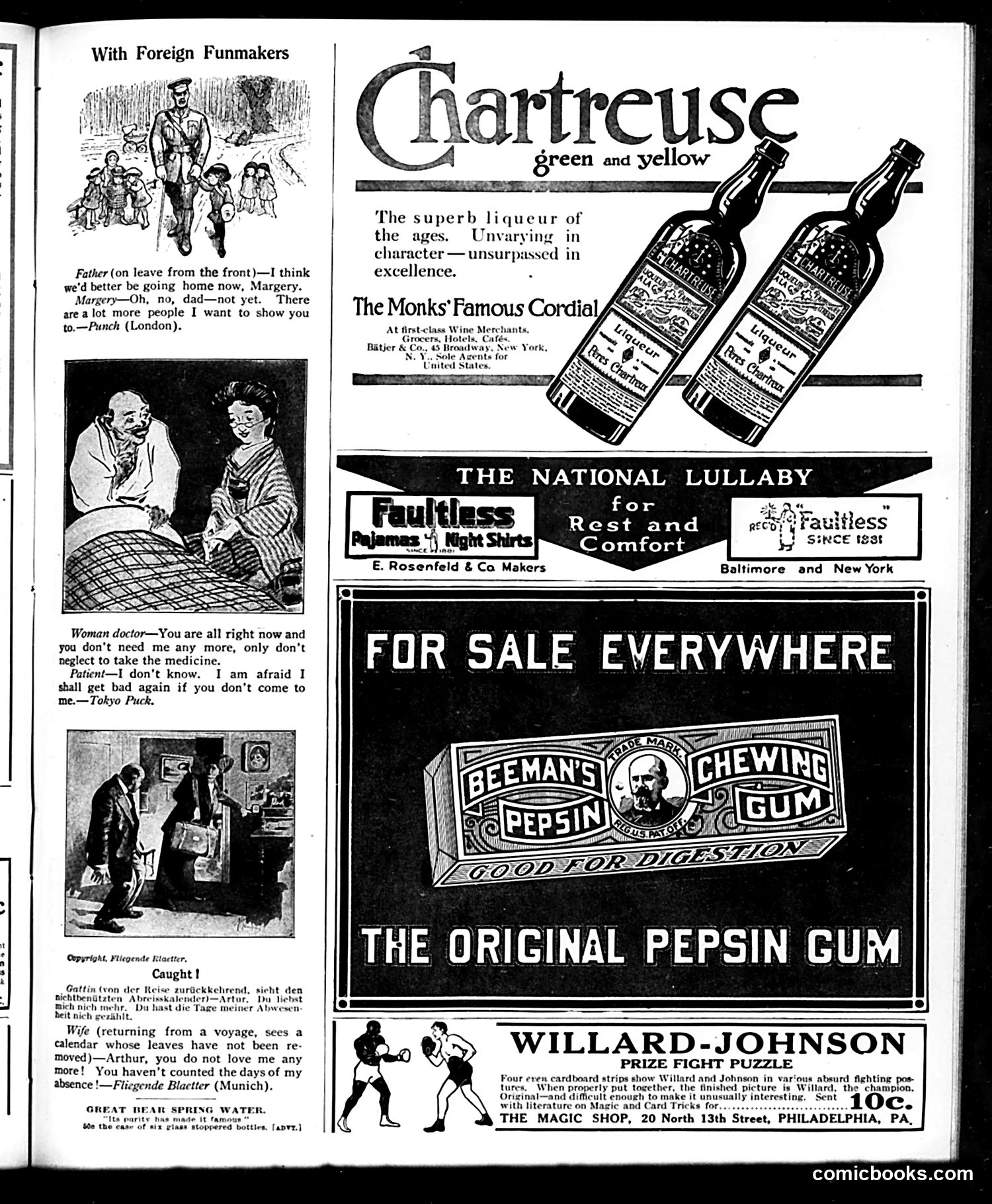
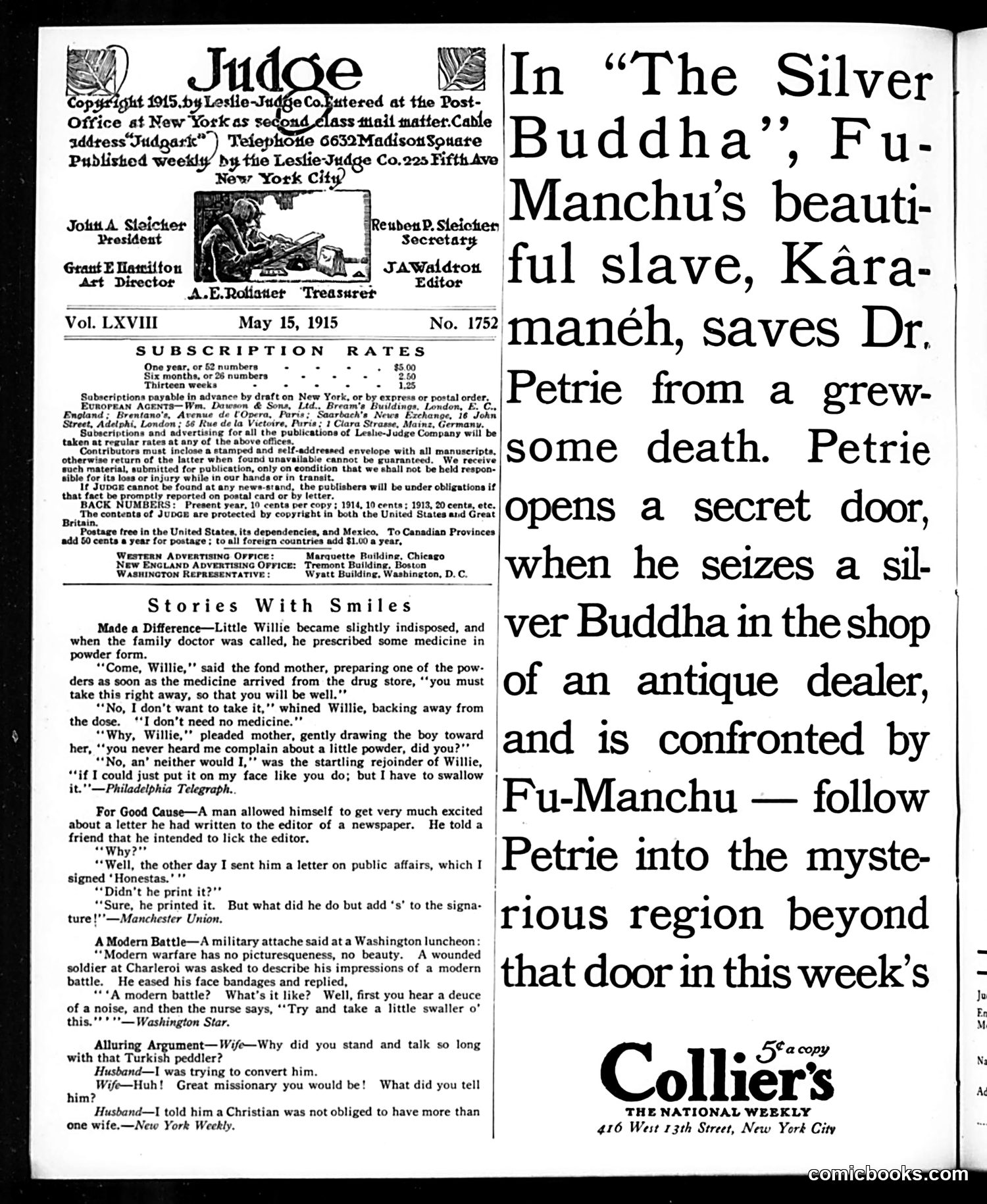
This is primarily a **magazine masthead and humor section**, not a political cartoon page. The left column contains three brief **humorous anecdotes** (common Judge content): - A child refusing medicine because his mother uses powder as makeup - A man angry his newspaper editor added an 's' to his pseudonym "Honestas" - A wounded soldier's dark joke about WWI ("Modern Battle") The right side is an **advertisement for serialized fiction**: a teaser for "The Silver Buddha," featuring the villain **Fu-Manchu** and his slave Karamaneh rescuing Dr. Petrie. This references the popular **Fu-Manchu pulp fiction series** circulating in 1915—sensationalist tales of an evil Chinese mastermind, reflecting period **Sinophobic attitudes** common in American popular culture. The humor pieces employ mild satire about domestic life and military experience, typical of Judge's lighter fare. No significant political commentary is evident on this particular page.
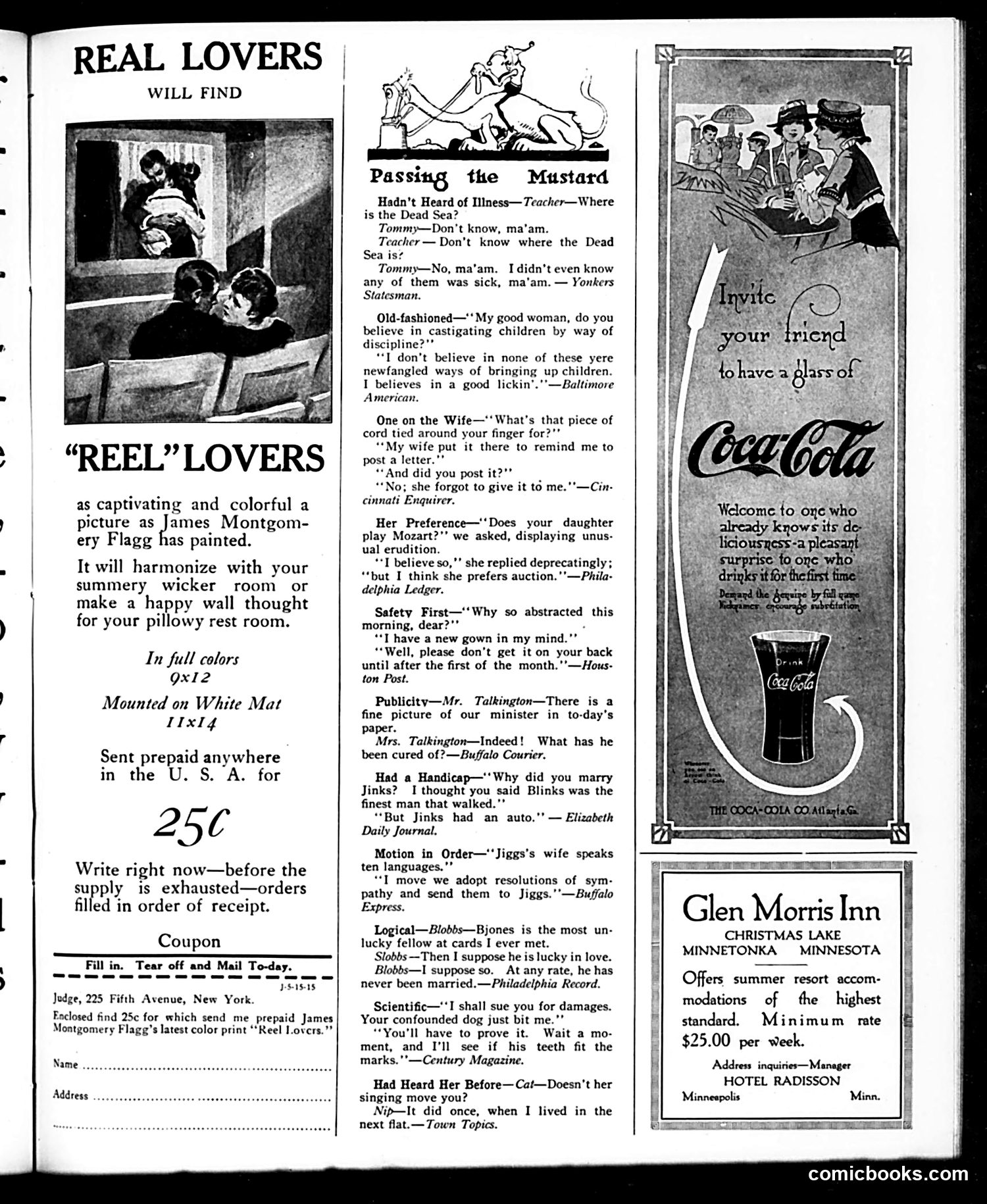
This page from the satirical magazine *Judge* mixes advertising with humor pieces typical of early 20th-century American magazines. The main content is a **James Montgomery Flagg print advertisement** promoting a romantic illustration titled "Reel Lovers" (a pun on "real"). The ad suggests it's suitable for decoration in summer rooms or bedrooms—appealing to sentimentality about romance and domestic spaces. The bulk of the page consists of **short joke columns** under "Passing the Mustard," featuring brief humorous anecdotes on everyday topics: children's ignorance (the "Dead Sea" joke), old-fashioned discipline, forgetfulness, musical preferences, and marital dynamics. These jokes reflect common domestic situations and class attitudes—note the "old-fashioned" preference for corporal punishment and the assumed desirability of owning an automobile. The humor is gentle, family-oriented satire typical of the era, poking fun at miscommunications, absent-mindedness, and social pretension rather than political targets. The page also includes resort advertising for the Glen Morris Inn in Minnesota, reflecting the magazine's mixed editorial-commercial format.
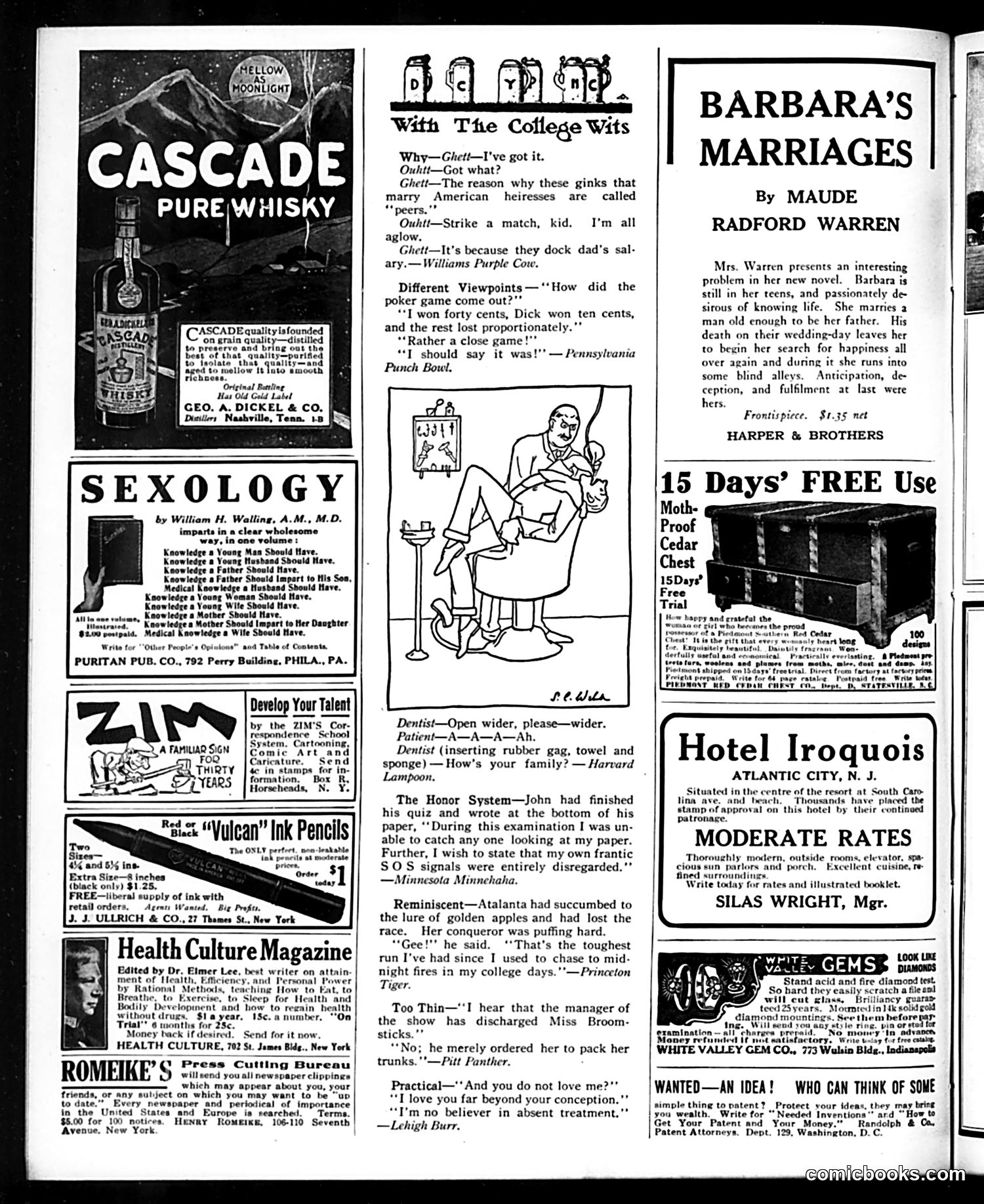
This is primarily an **advertising page** from Judge magazine, a major American satirical weekly. The content mixes modest humor pieces with commercial advertisements typical of the era. The small comic sections ("With The College Wits," "Different Viewpoints," etc.) are brief, punchy jokes about college life and social situations—standard filler content. They reference contemporary concerns like honor systems in schools and dating rituals. **Key advertisements include:** - **Cascade Whisky** (prominent upper left) - **Sexology book** (educational/medical text on marital relations) - **Hotel Iroquois** (Atlantic City resort) - Various trade schools, ink pencils, and clipping services The **Barbara's Marriages** novel excerpt announces a book about a young woman navigating marriage, widowhood, and romantic disappointment—reflecting period interest in women's independence and life experience. Overall, this reflects **1910s-20s consumer culture**: targeting educated, middle-class readers with educational books, luxury goods, and correspondence schools alongside light humor.
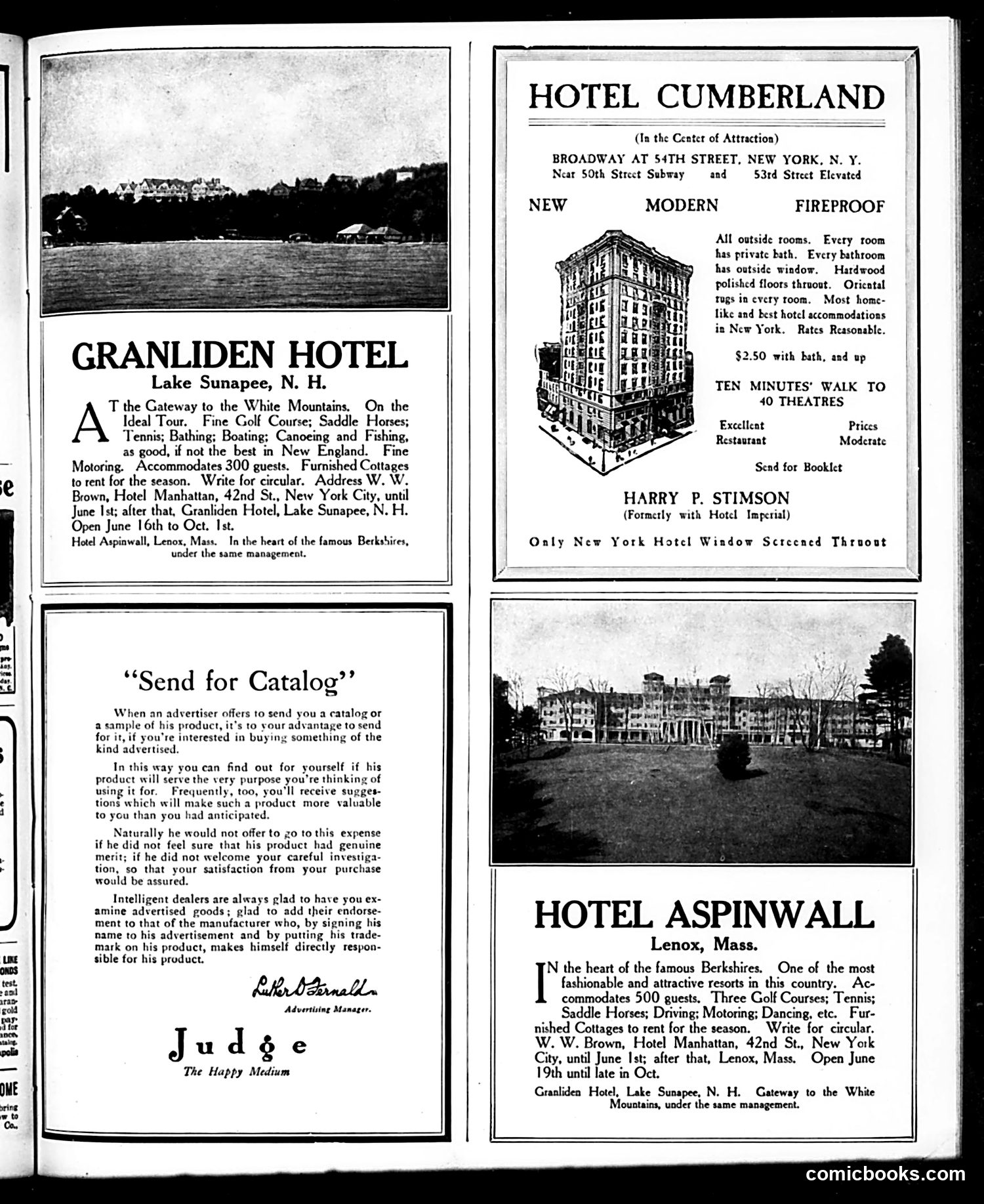
This page is **primarily advertisements**, not satire or editorial content. It features hotel promotions from the early 20th century. The ads showcase upscale resort destinations popular with wealthy travelers: the Granliden Hotel (Lake Sunapee, New Hampshire), Hotel Cumberland (Times Square, New York), and Hotel Aspinwall (Lenox, Massachusetts). They emphasize amenities like golf courses, tennis, horseback riding, and modern conveniences (private baths, screened windows, fireproof construction). The only non-advertising content is "Send for Catalog," an editorial piece by the Advertising Manager titled "Judge: The Happy Medium." This advocates sending for product catalogs as a smart consumer practice, legitimizing advertiser claims through direct investigation. **This reflects early advertising philosophy**: products should withstand customer scrutiny, and requesting catalogs demonstrated genuine manufacturer confidence.
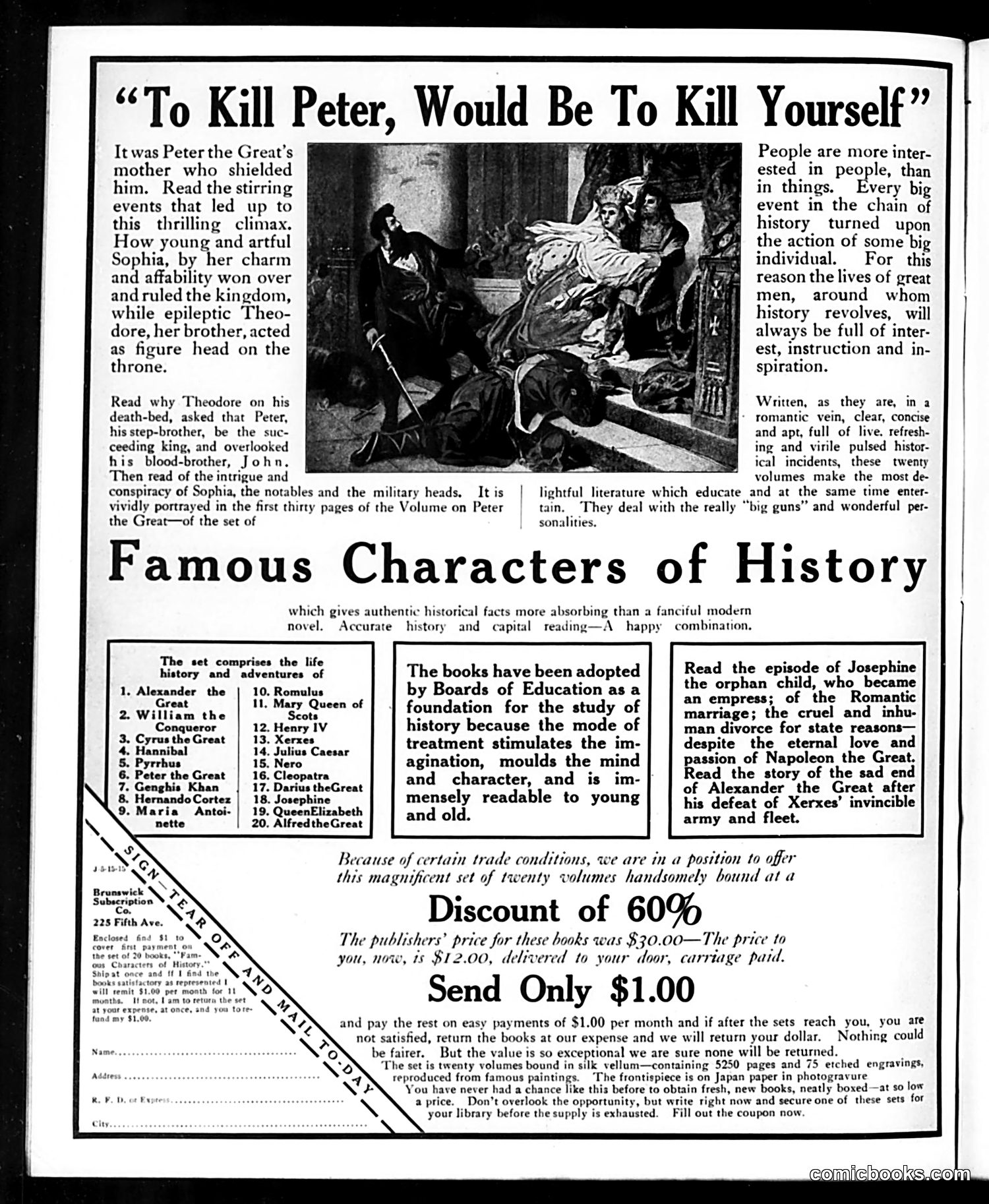
This is primarily **advertising, not satire**. The page promotes a 20-volume book series called "Famous Characters of History." The headline quote—"To Kill Peter, Would Be To Kill Yourself"—appears designed to create dramatic intrigue. It references the historical drama surrounding **Peter the Great** of Russia, specifically the power struggle with his sister **Sophia** (depicted in the central engraving). The text teases the narrative: Sophia ruled through her brother Theodore while scheming against Peter; Theodore's deathbed request favored Peter over his biological brother John. The advertisement emphasizes that these volumes combine "authentic historical facts" with romantic storytelling, targeting readers who find people and personalities more engaging than abstract history. It lists 20 historical figures (Alexander, Julius Caesar, Napoleon, etc.) and claims the books were "adopted by Boards of Education." The sales pitch offers a steep discount (60% off, from $30 to $12), requiring only $1 down with monthly payments—a common mail-order strategy of the era. There's no apparent satire here; it's straightforward period advertising in *Judge* magazine.