
A complete issue · 24 pages · 1915
Judge — May 8, 1915
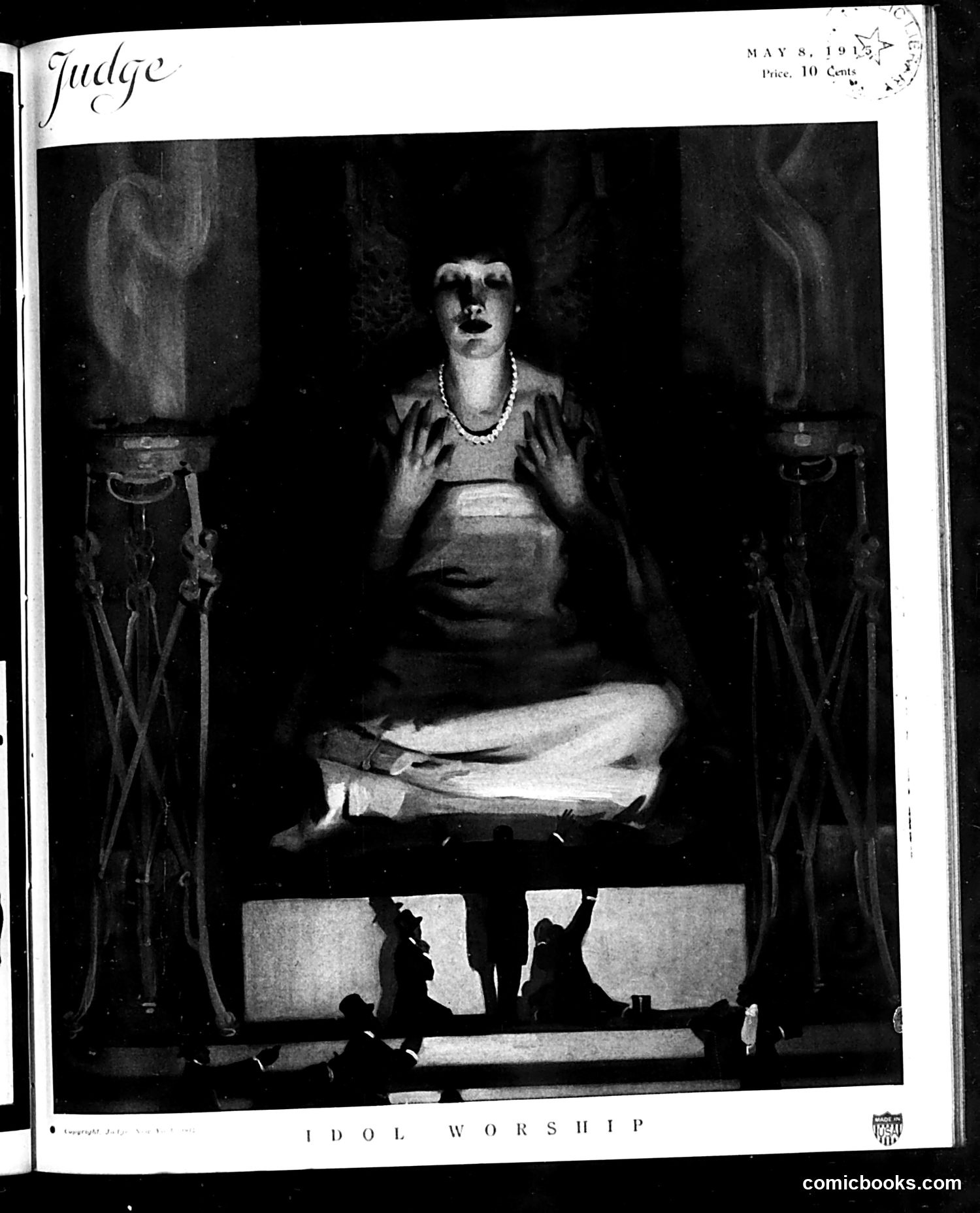
This early 20th-century satirical image critiques the public's obsessive veneration of celebrities or political figures. The composition shows a woman seated on a pedestal like a religious statue, flanked by torch-bearing figures in an architectural setting resembling a temple or shrine. The caption "IDOL WORSHIP" suggests the cartoon mocks how modern society treats certain individuals—possibly actresses, politicians, or socialites—with religious-like devotion. The theatrical staging and dramatic lighting emphasize the absurdity of elevating ordinary people to god-like status. The silhouetted audience members at the bottom suggest mass participation in this "worship," critiquing both the celebrity culture and the public's willing complicity in creating false idols during this era.
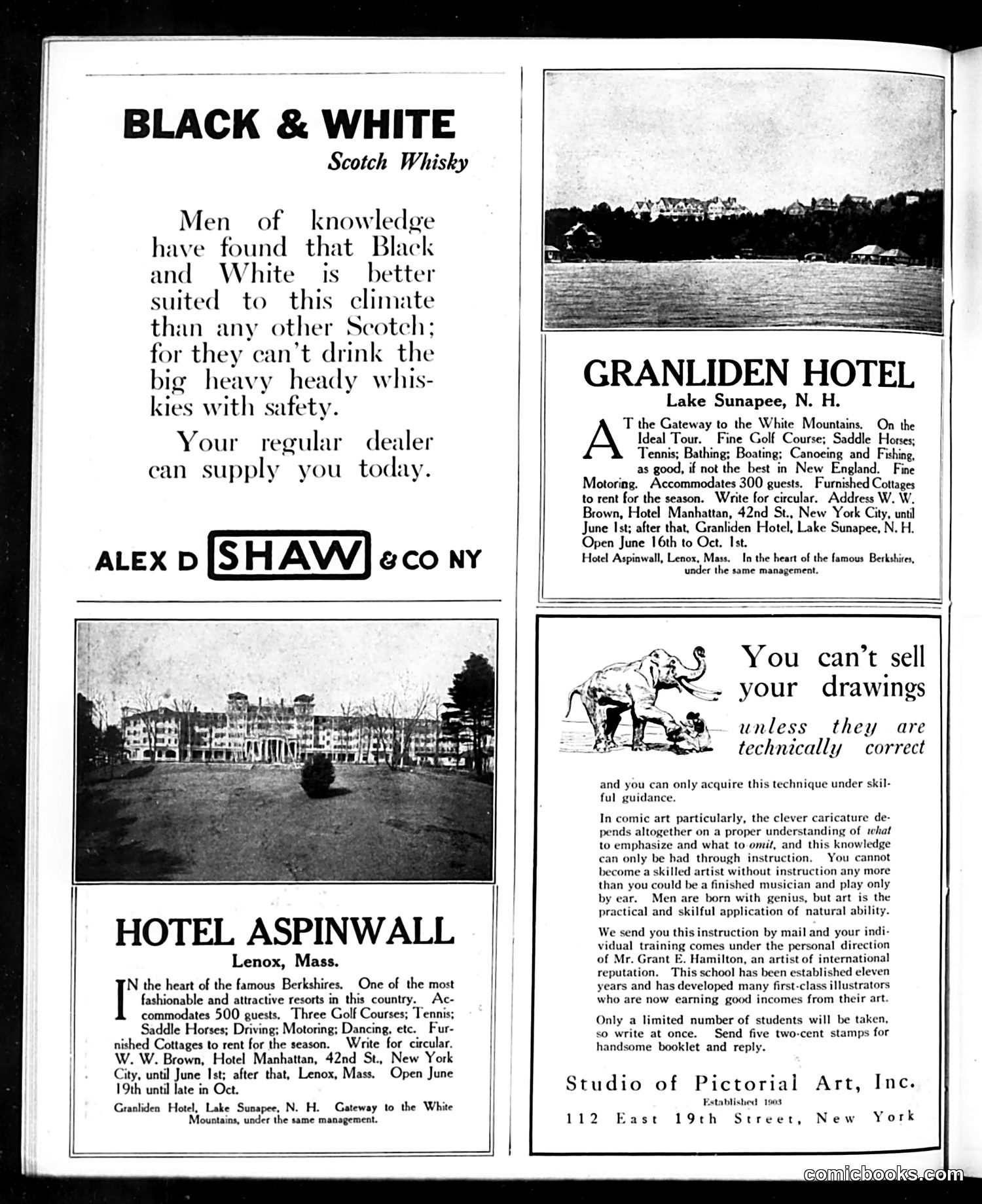
This page is primarily **advertising** rather than editorial content. It contains three hotel/resort advertisements (Black & White Scotch Whisky, Hotel Aspinwall in Lenox, Massachusetts, and Granliden Hotel in Lake Sunapee, New Hampshire) alongside an instructional ad for the Studio of Pictorial Art, Inc. The only cartoon element is a small illustration of an elephant with a person, used to advertise comic art instruction. The accompanying text argues that technical skill in cartooning—particularly in comic art and caricature—requires proper instruction; one cannot become a skilled artist through natural talent alone. The elephant likely serves as a simple example of the technical drawing required. No political satire or named figures appear on this page.
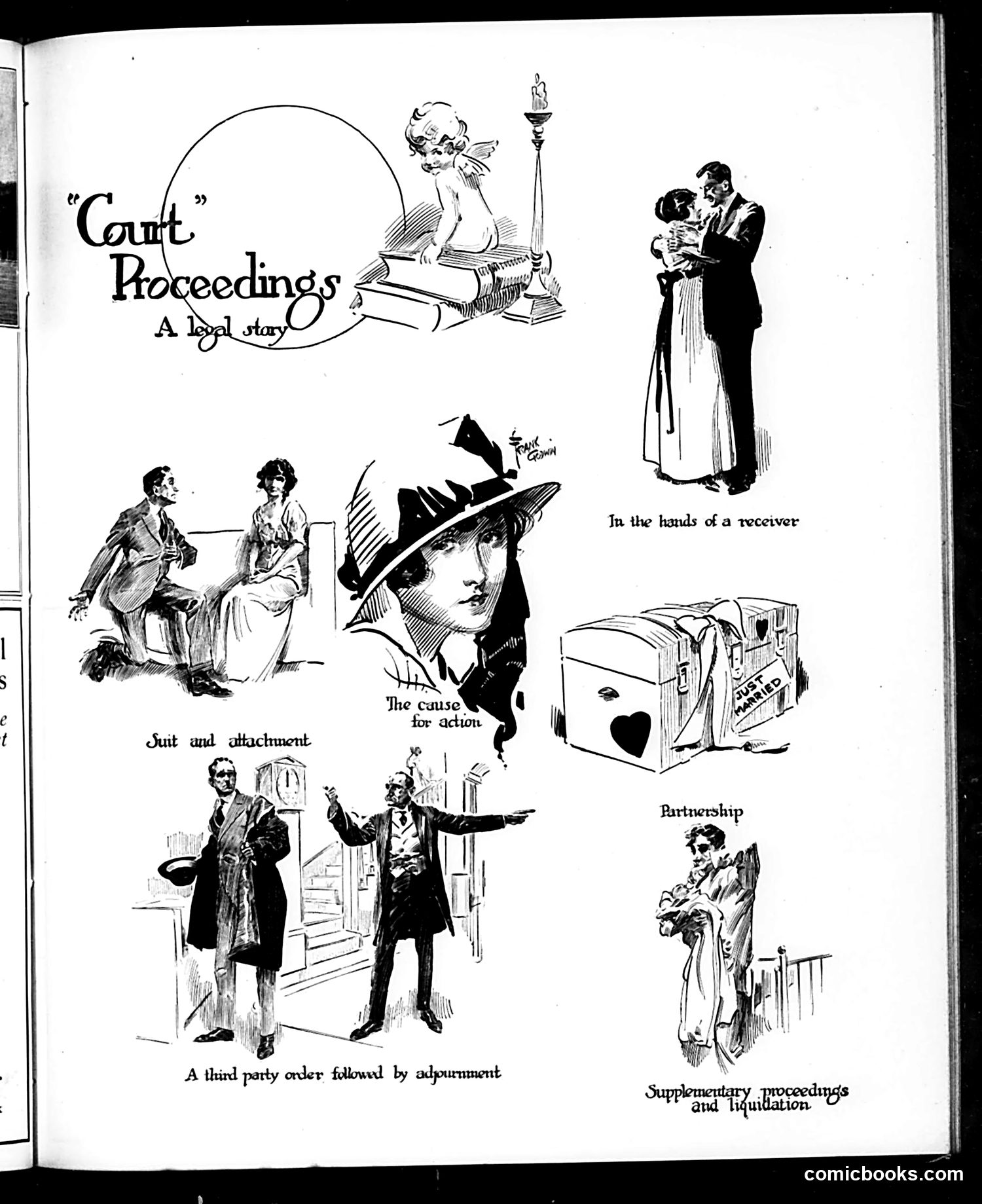
This educational illustration from *Judge* magazine explains legal processes through satirical vignettes. Each panel depicts a stage in civil litigation: **"Suit and attachment"**: A couple in dispute, presumably over property or contract. **"The cause for action"**: A fashionable woman (representing the lawsuit itself as a desirable but troublesome matter). **"In the hands of a receiver"**: A man holding an infant, symbolizing judicial custody of disputed assets. **"A third party order followed by adjournment"**: Two men (lawyers or judges) conducting court business. **"Partnership"** and **"Supplementary proceedings and liquidation"**: Additional legal stages. The cartoons mock the complexity and emotional toll of legal proceedings through anthropomorphization and domestic scenes, suggesting that lawsuits consume time, money, and emotional energy while judges and lawyers manage the process.
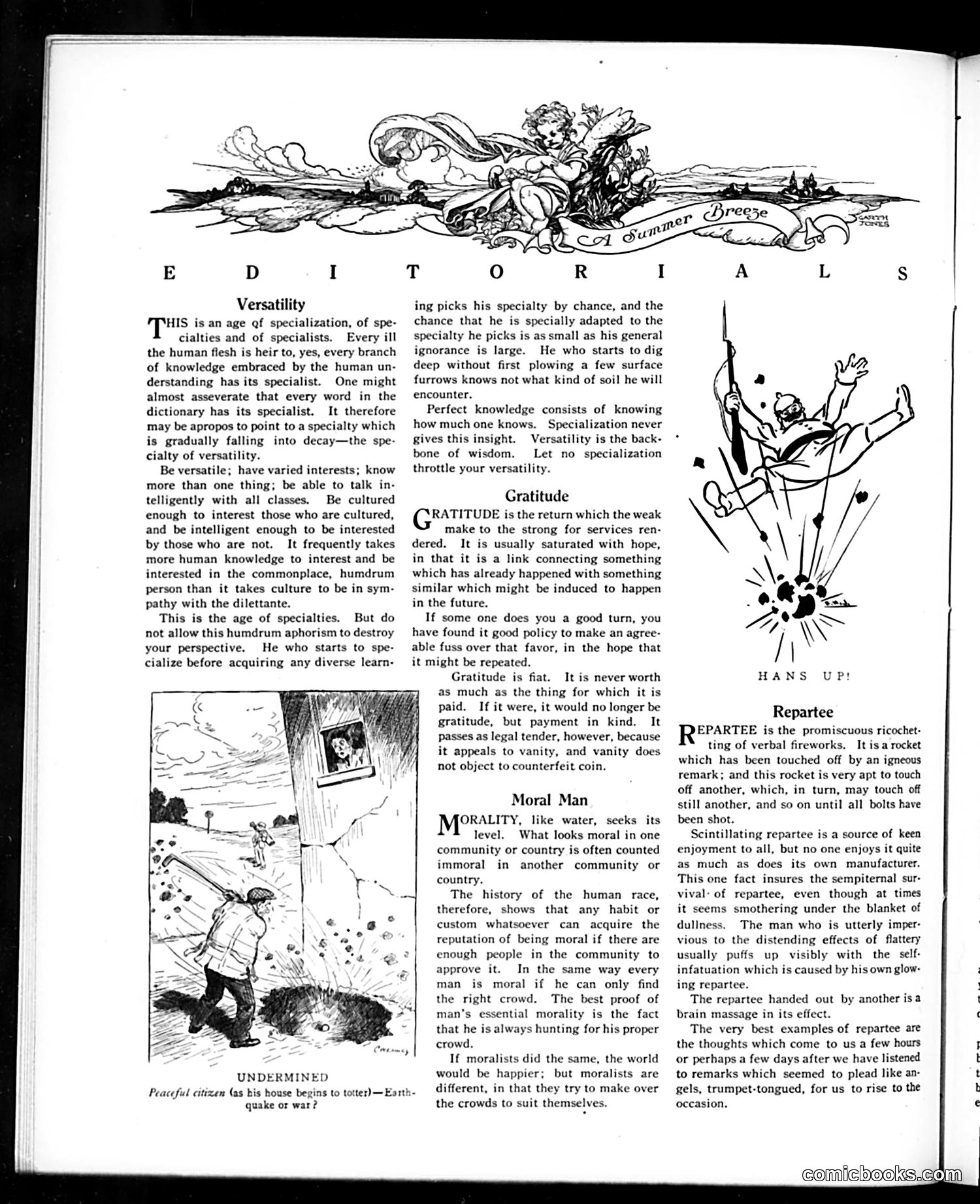
This page contains three distinct editorial pieces rather than political cartoons: **"Versatility"** and **"Gratitude"** are philosophical essays on character traits, arguing that specialists should maintain broad knowledge and that genuine gratitude shouldn't be transactional. **"Moral Man"** discusses how morality varies across communities and cultures, suggesting that moral behavior requires community support to flourish. The cartoon labeled **"UNDERMINED"** depicts a citizen whose house is literally collapsing from underground damage, captioned "Peaceful citizen (as his house begins to totter)—Earthquake or war?" This appears to be Cold War-era commentary questioning whether domestic instability stems from natural disaster or military/political conflict—likely referencing anxieties about war, subversion, or social upheaval threatening ordinary life. The illustration "HANS UP!" shows a dramatic explosion or impact effect, though its specific reference remains unclear without additional context.
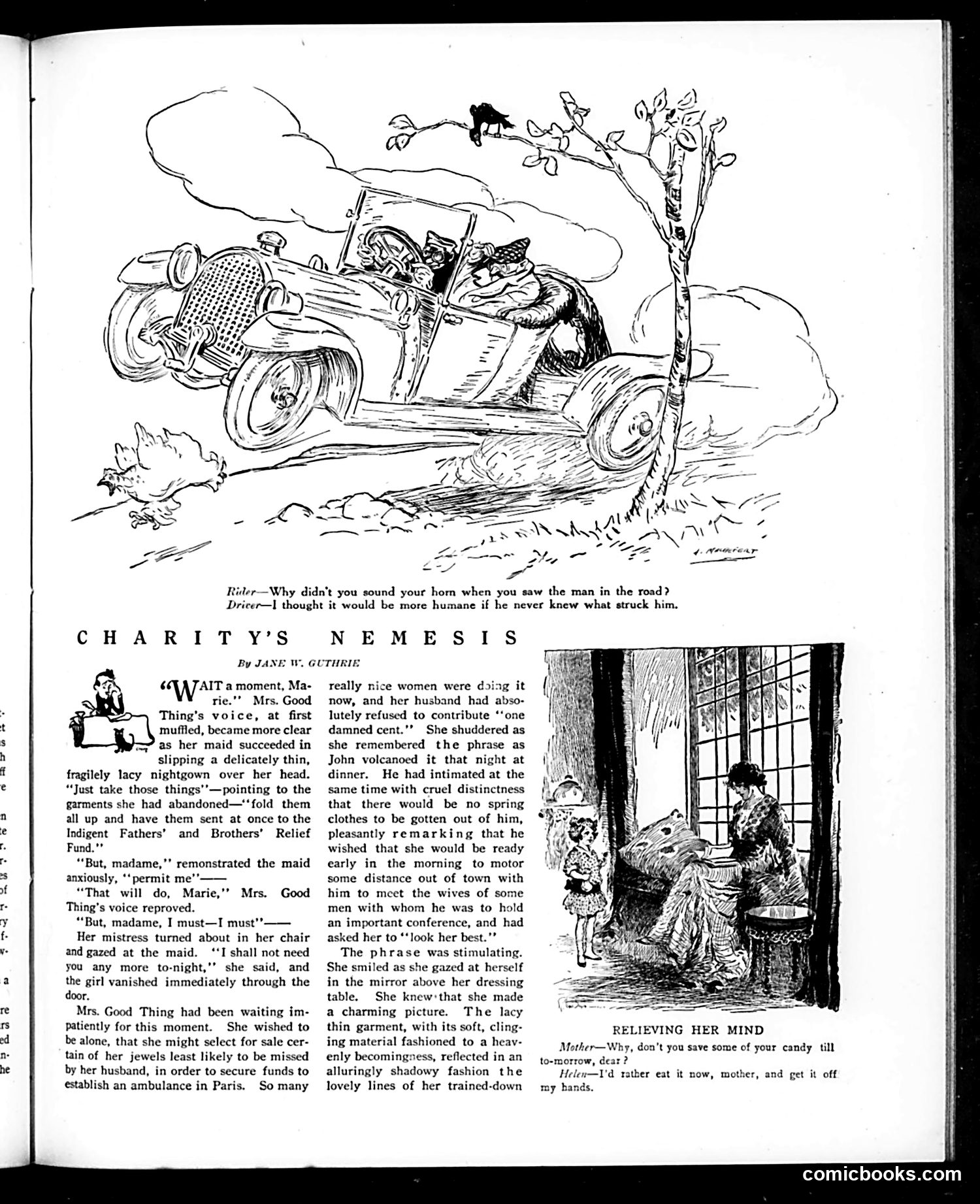
This page contains a short story by Jane W. Gutheir rather than political satire. The top cartoon illustrates a darkly humorous anecdote: a driver hits a man but doesn't sound the horn, claiming it would be "more humane" if the victim never knew what struck him. The joke relies on absurdist logic—rationalizing negligence as kindness. The story below depicts Mrs. Good Thing, a wealthy woman pressuring her maid to donate clothing to charity while simultaneously planning to donate her own jewels to an ambulance fund. The satire targets the self-righteousness of the wealthy who display charity while expecting servants to sacrifice more than they do themselves—critiquing performative philanthropy and class hypocrisy.
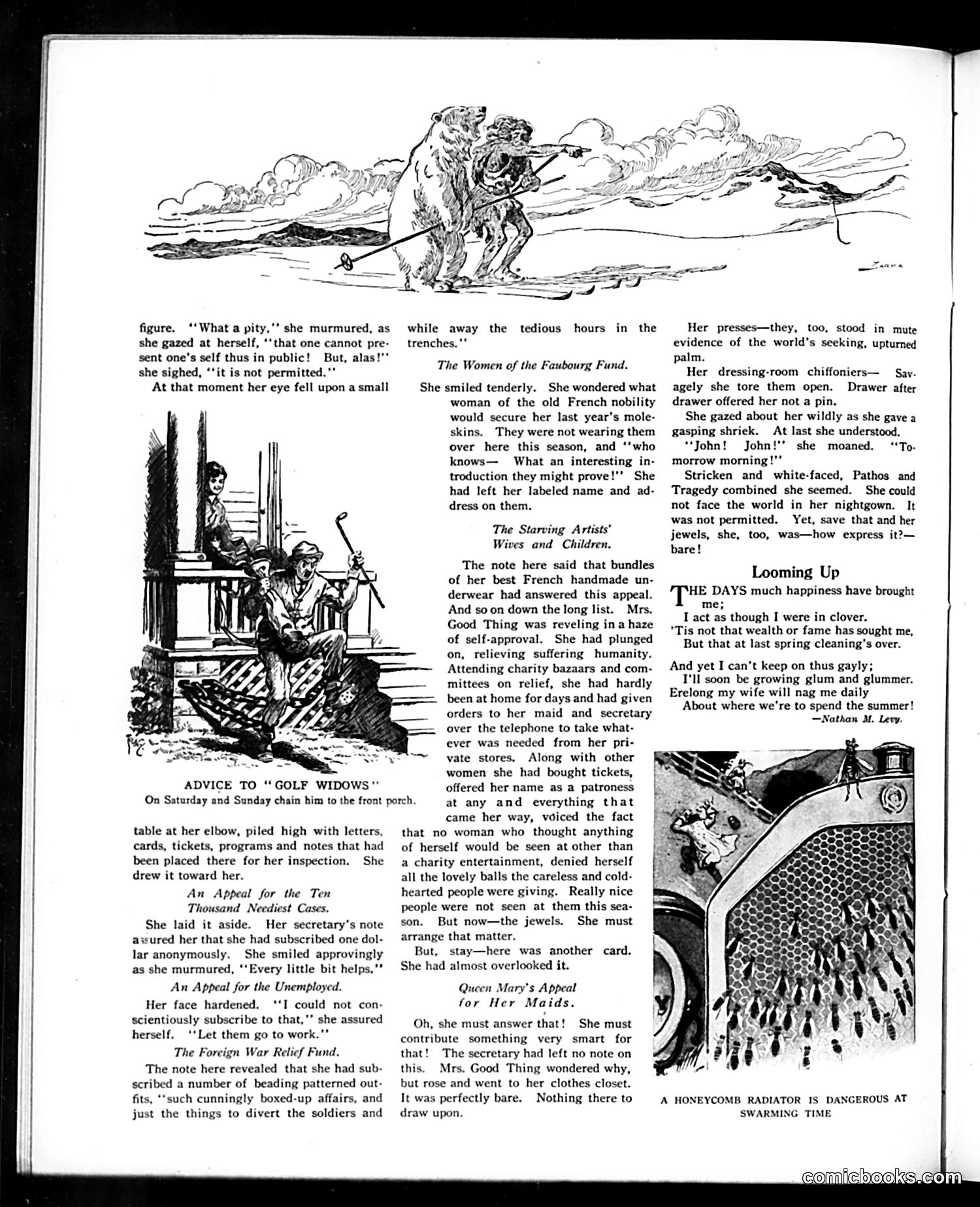
This Judge page satirizes wealthy women's shallow approach to wartime charity during WWI. The main cartoon (top) mocks "Golf Widows"—wives whose husbands abandon them for golf on weekends—with the sardonic advice to "chain him to the front porch." The longer narrative piece ridicules "Mrs. Good Thing," a society woman who performs conspicuous charitable giving while maintaining strict social pretense. She donates generously to *respectable* causes (French nobility, starving artists) while refusing the "Unemployed" appeal—she believes poor people should simply work. She brags publicly about charity work while attending no "lovely balls" (implying nice people only attend charity events, not social ones). The bitter punchline: when Queen Mary requests contributions for "Her Maids," Mrs. Good Thing frantically discovers she owns nothing but the jewels on her body—everything else has been donated. She cannot appear in public without clothes, yet charity has stripped her bare. The satire targets elite hypocrisy: performative wartime generosity masking class prejudice, and the vanity of women who donate castoffs while preening about their sacrifice.
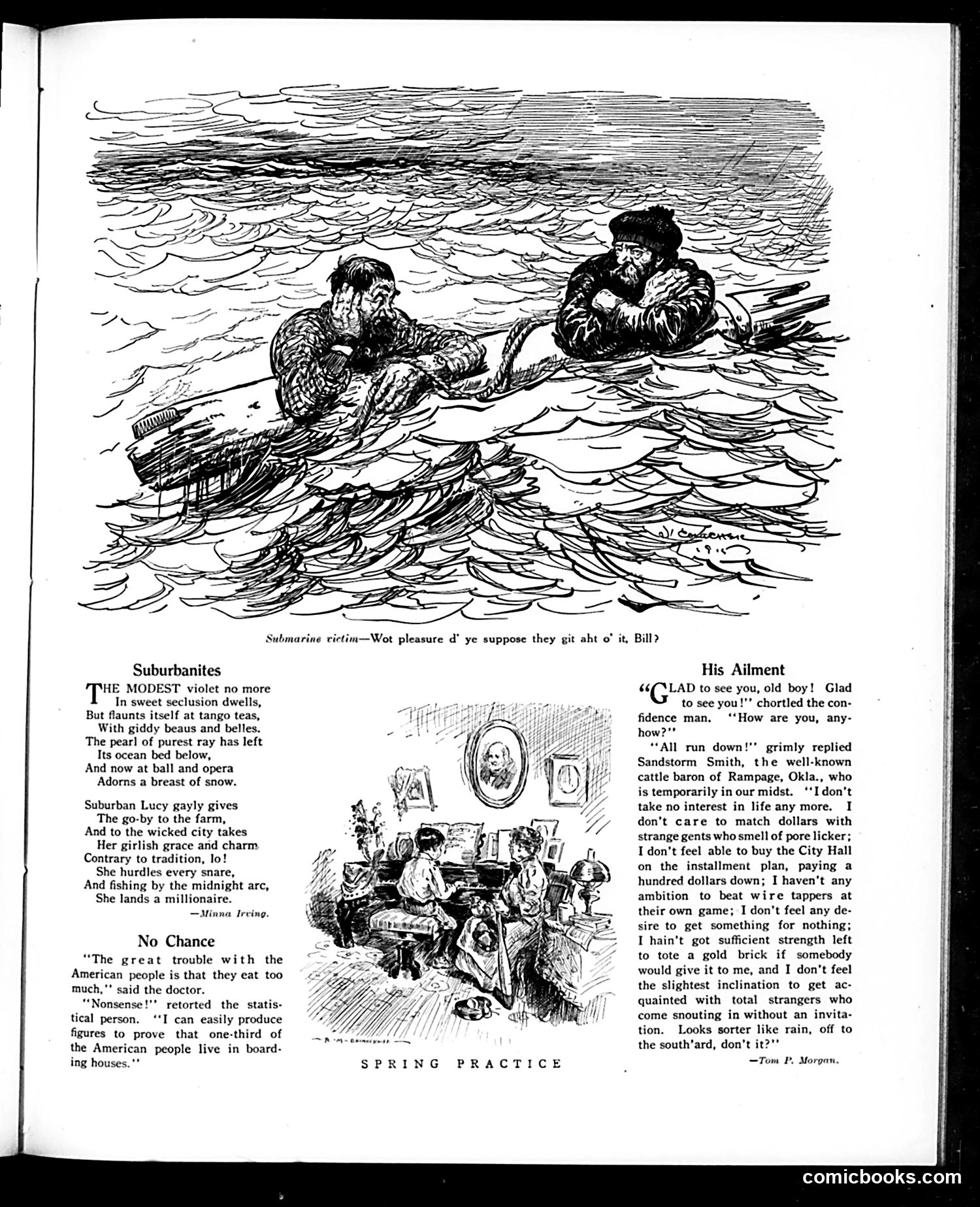
The top cartoon depicts a submarine attack (likely WWI-era), with two sailors observing drowning victims, asking what pleasure people get from such destruction—dark commentary on the brutality of modern warfare. Below are three separate pieces: **"Suburbanites"**: A poem mocking the hypocrisy of suburban women who abandon rural propriety for city life, attending parties and dances while somehow "landing a millionaire"—satirizing changing social norms and women's newfound urban independence. **"No Chance"**: A joke about American overconsumption. A doctor warns against overeating; a statistician "counters" that one-third of Americans live in boarding houses—implying they eat communal meals, thus disproving the problem. The humor relies on absurdist logic. **"His Ailment"**: A con-man recognizes Sandstorm Smith, a wealthy Oklahoma cattle baron, and greets him warmly. Smith complains of depression—he's lost interest in gambling, buying city property, swindling people, or accepting obvious scams. The satire mocks wealthy Western businessmen as naturally inclined toward fraud and vice.
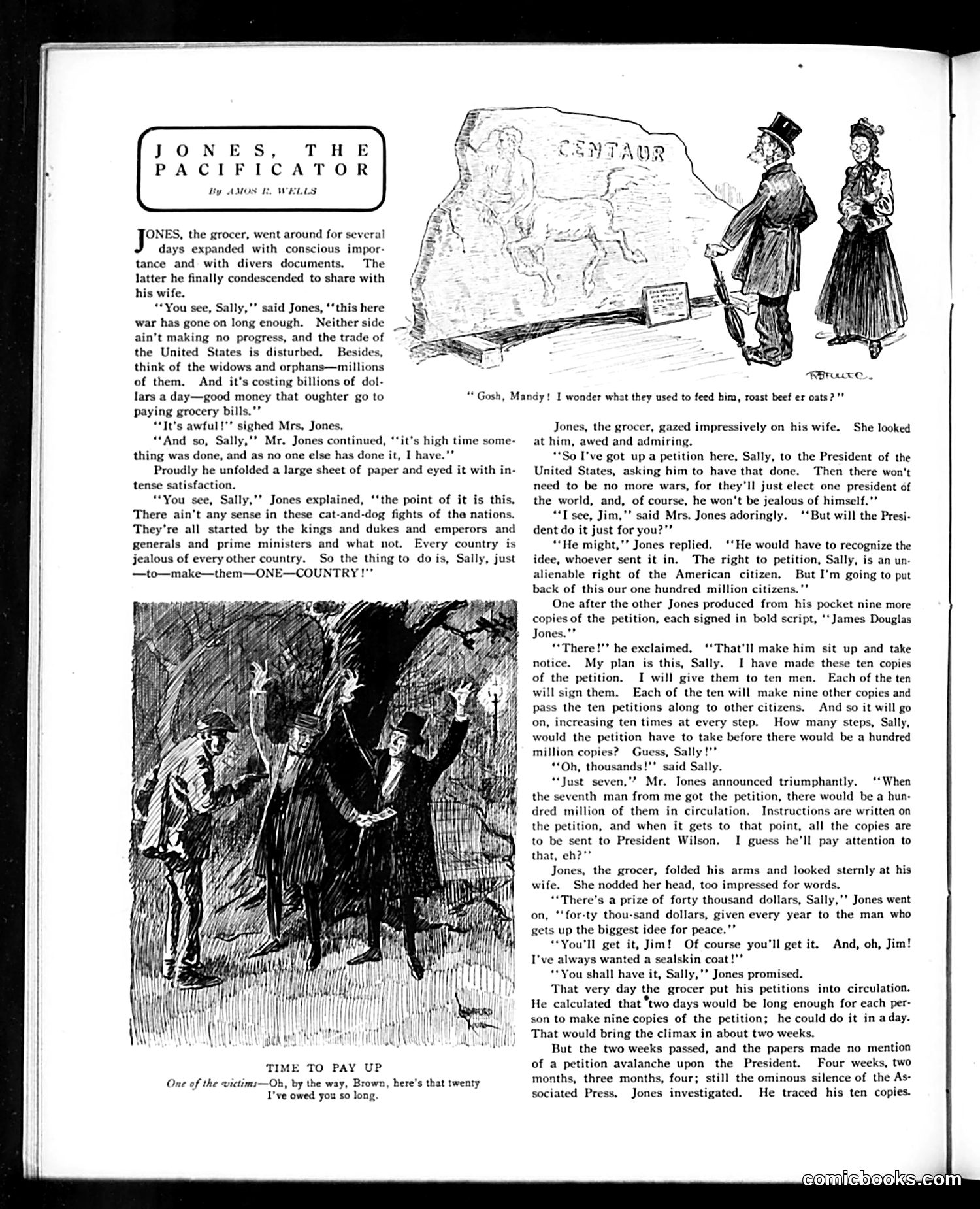
This story satirizes naive American pacifism and the fantasy of solving international conflict through simple schemes. Jones, an ordinary grocer, proposes ending all wars by petitioning President Wilson to create a single world government with one elected president—reasoning that one president couldn't be jealous of himself. The satire deepens through his exponential petition plan: ten copies become a hundred million through geometric multiplication over seven steps, which he'll send to Wilson as proof of public support. Jones imagines this will win him a $40,000 annual "peace prize." The humor targets both Jones's comical overconfidence and the broader American belief that idealistic solutions could resolve complex geopolitical rivalries. Published during WWI (when Wilson was president), it mocks the period's peace movement as well-intentioned but absurdly disconnected from political reality. His wife's admiration and his self-satisfied certainty underscore the satirical point: good intentions cannot substitute for understanding how nations actually function.
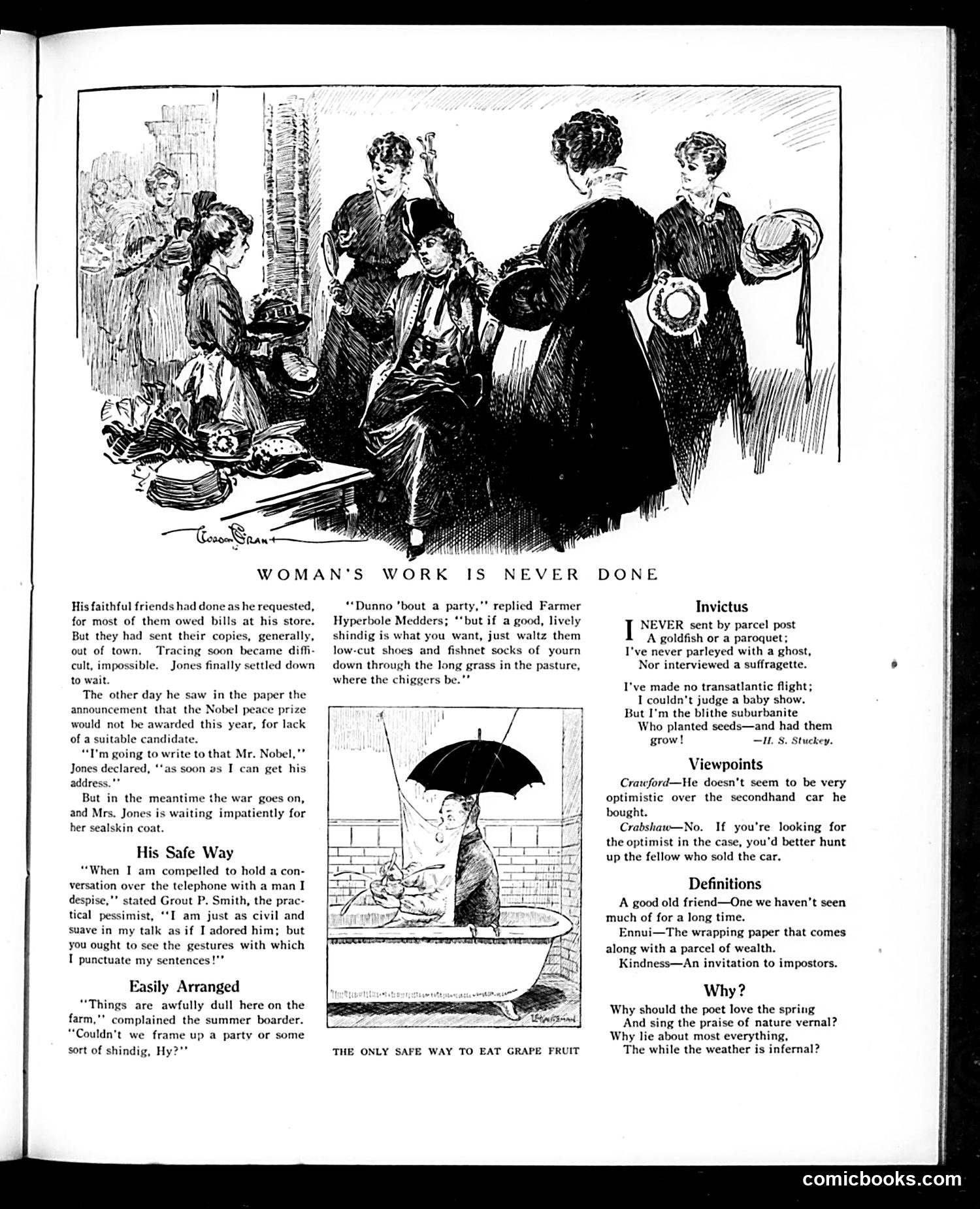
This page from the satirical magazine *Judge* contains several humorous short pieces mocking early 20th-century American life. The main cartoon "Woman's Work Is Never Done" depicts a group of women engaged in domestic labor—cleaning, mending, organizing—illustrating the relentless nature of housework. The accompanying story about Mr. Jones attempting to nominate himself for a Nobel Peace Prize (while his wife waits for a sealskin coat) satirizes male self-importance and obliviousness to family needs during wartime. Other sections include light social humor: a man's secret rude gestures during polite phone calls, a farmer's prank suggestion involving chiggers to entertain a bored boarder, and a poem celebrating suburban gardening success. The "Viewpoints" and "Definitions" sections offer gentle, witty observations on period concerns—skepticism about used cars, definitions of social concepts like "ennui" and "kindness." The overall tone mocks Victorian propriety, gender dynamics, and middle-class pretensions through everyday domestic scenarios.
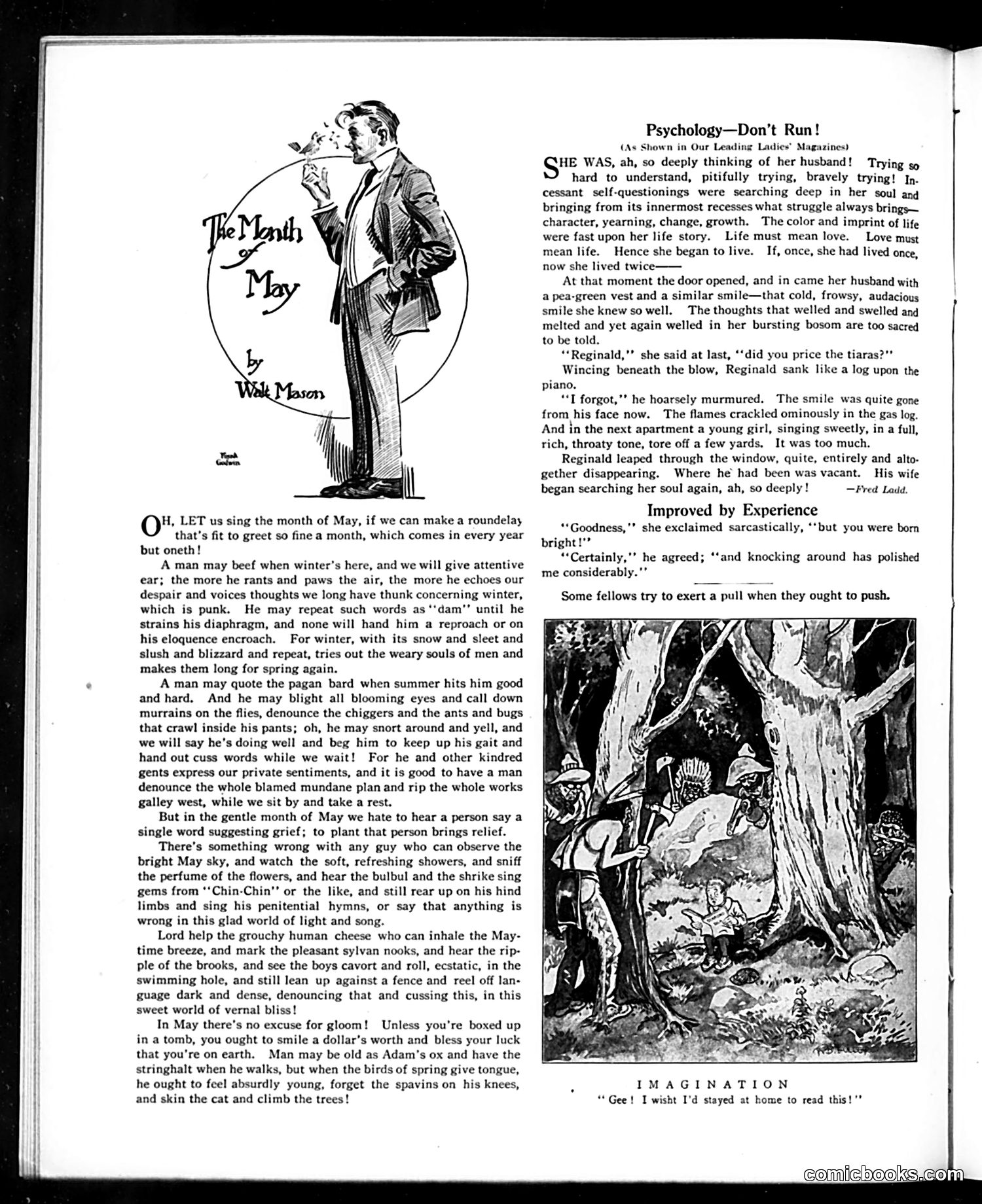
This page contains two distinct pieces of satire: **"The Month of May"** (left): A whimsical essay by Walt Mason celebrating May as the only month where complaining is socially unacceptable. The piece humorously argues that while men may legitimately grumble about winter's hardships or summer's discomforts, May's perfect weather makes griping inexcusable. It mocks anyone who remains gloomy despite May's beauty—flowers, singing birds, swimming holes—suggesting only the literally entombed have excuse for gloom. **"Psychology—Don't Run!"** (right): A satire of melodramatic literary fiction popular in women's magazines of the era. It mocks overwrought psychological introspection and emotional intensity in domestic scenarios. The wife's profound inner struggle about her husband dissolves into mundane reality when he arrives in an ugly vest and admits he forgot to price tiaras. The satire targets the gap between highbrow literary pretension and ordinary married life's banality. Both pieces mock excessive sentimentality and self-importance through exaggeration and deflation.
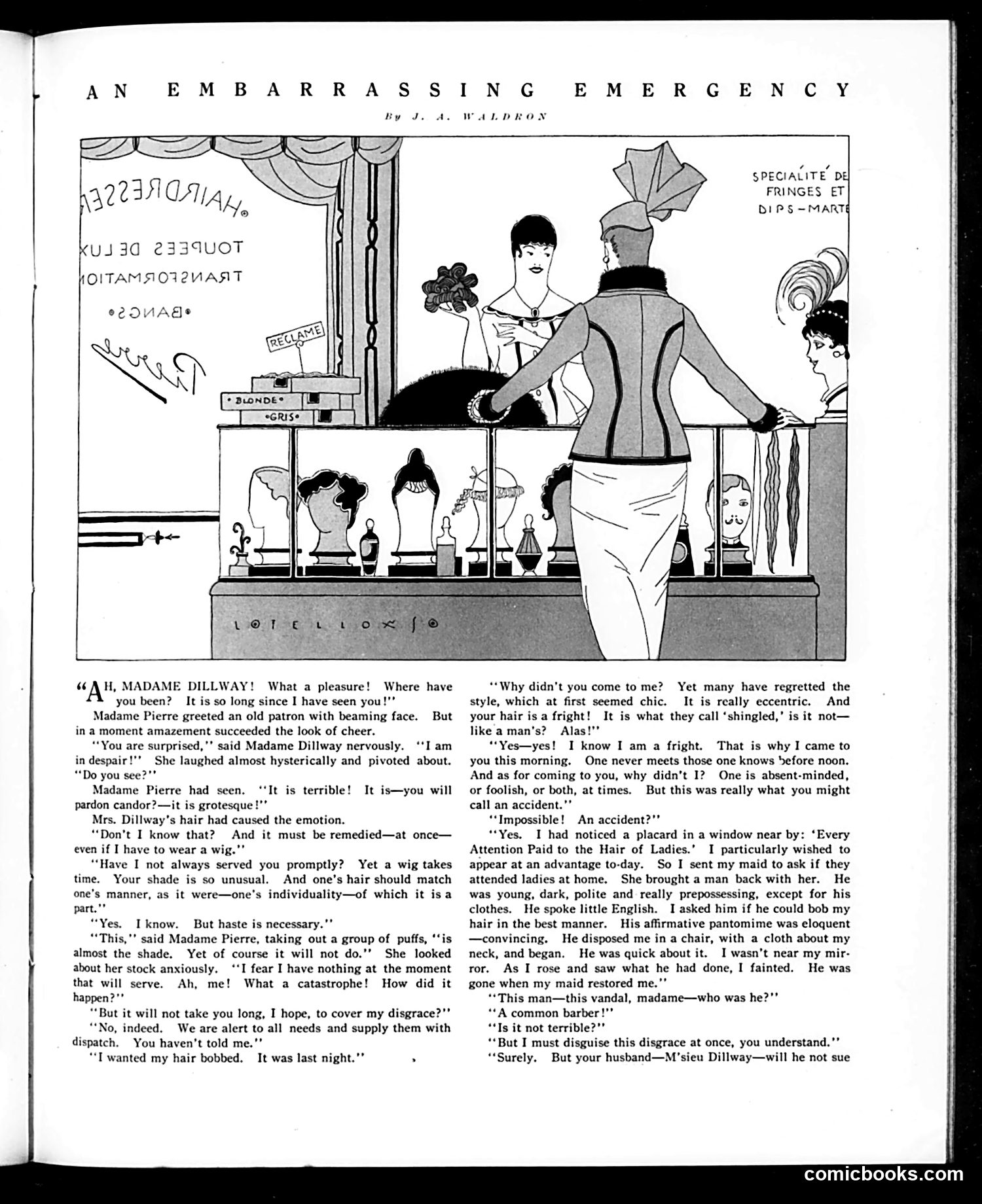
This satirical story illustrates early 20th-century anxieties about the fashionable "bob" hairstyle. Mrs. Dillway impulsively had her long hair bobbed by an unknown barber after seeing an advertisement, and now regrets the drastic change—calling it a "fright" and comparing herself to a man. The humor relies on period class and gender anxieties: a wealthy woman's mortification over an unfashionable (or too-fashionable) cut, her concern about being seen in public before visiting her regular beautician, and the scandal of hiring an unknown tradesman without proper vetting. The story's title suggests the "emergency" nature of hair mishaps for fashionable women of the era, when hairstyle was a crucial marker of respectability and social standing. The illustration depicts a beauty salon where such disasters could be remedied—if one had sufficient means and connections.
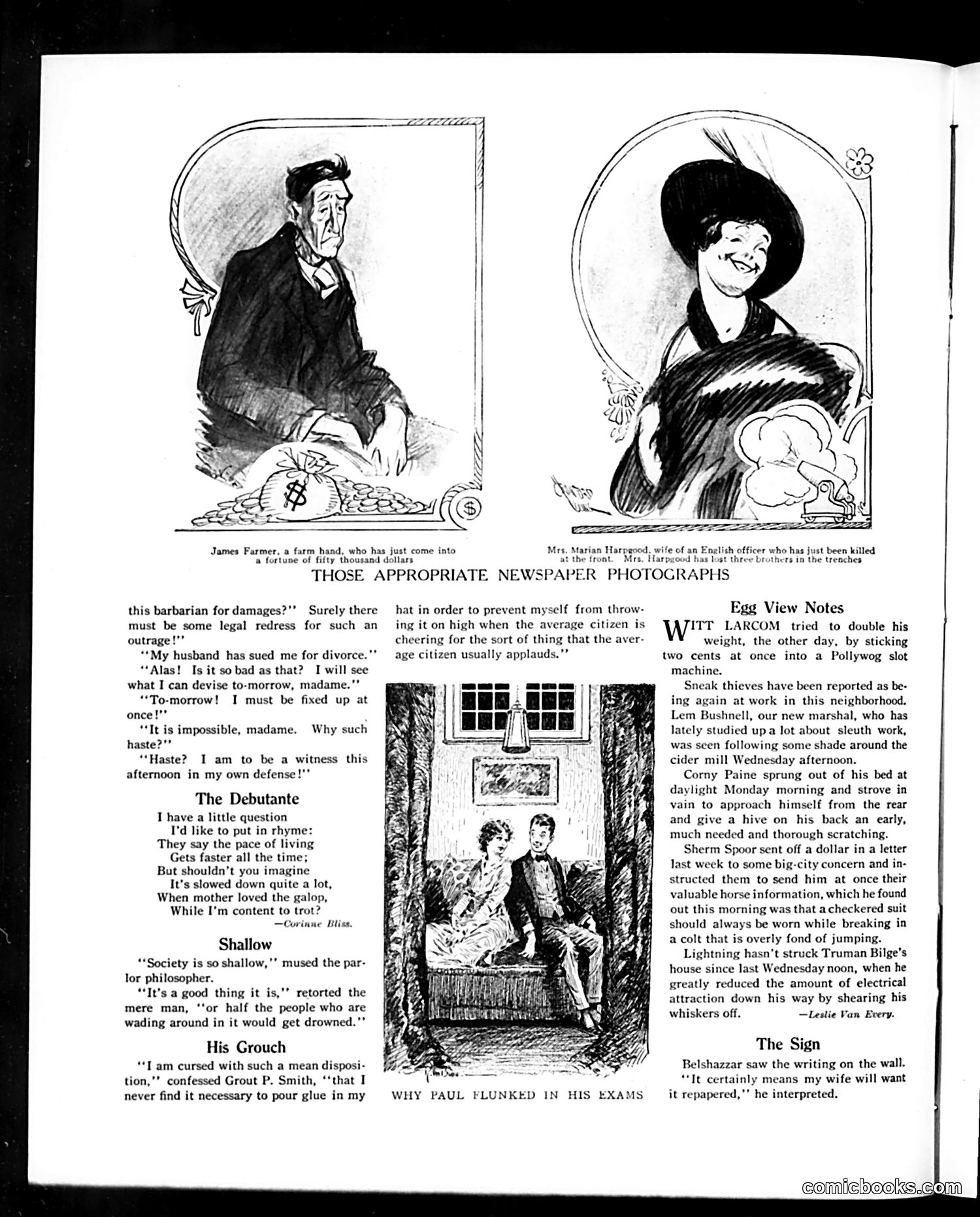
The top photographs show "appropriate newspaper photographs"—a satirical juxtaposition contrasting a grieving war widow (Mrs. Harewood, whose officer husband and three brothers died in WWI trenches) with a farm laborer (James Farmer) who inherited fifty thousand dollars. The satire critiques newspapers' sensationalism: they present these images as "appropriate," suggesting media treats human tragedy and sudden wealth as equally newsworthy spectacles rather than meaningful stories. The page's humor pieces mock social pretension and everyday absurdities. "The Debutante" questions modern life's supposed acceleration. "Shallow" jokes that society's superficiality prevents drowning in it. "His Grouch" offers dark humor about a perpetually miserable man. The "Egg View Notes" column contains rural gossip—theft, mishaps, and humorous misunderstandings (a man buying "horse information" thinking it's literal advice). The final item plays on the biblical Belshazzar's famous wall writing, reframing it as a mundane marital complaint about redecorating.
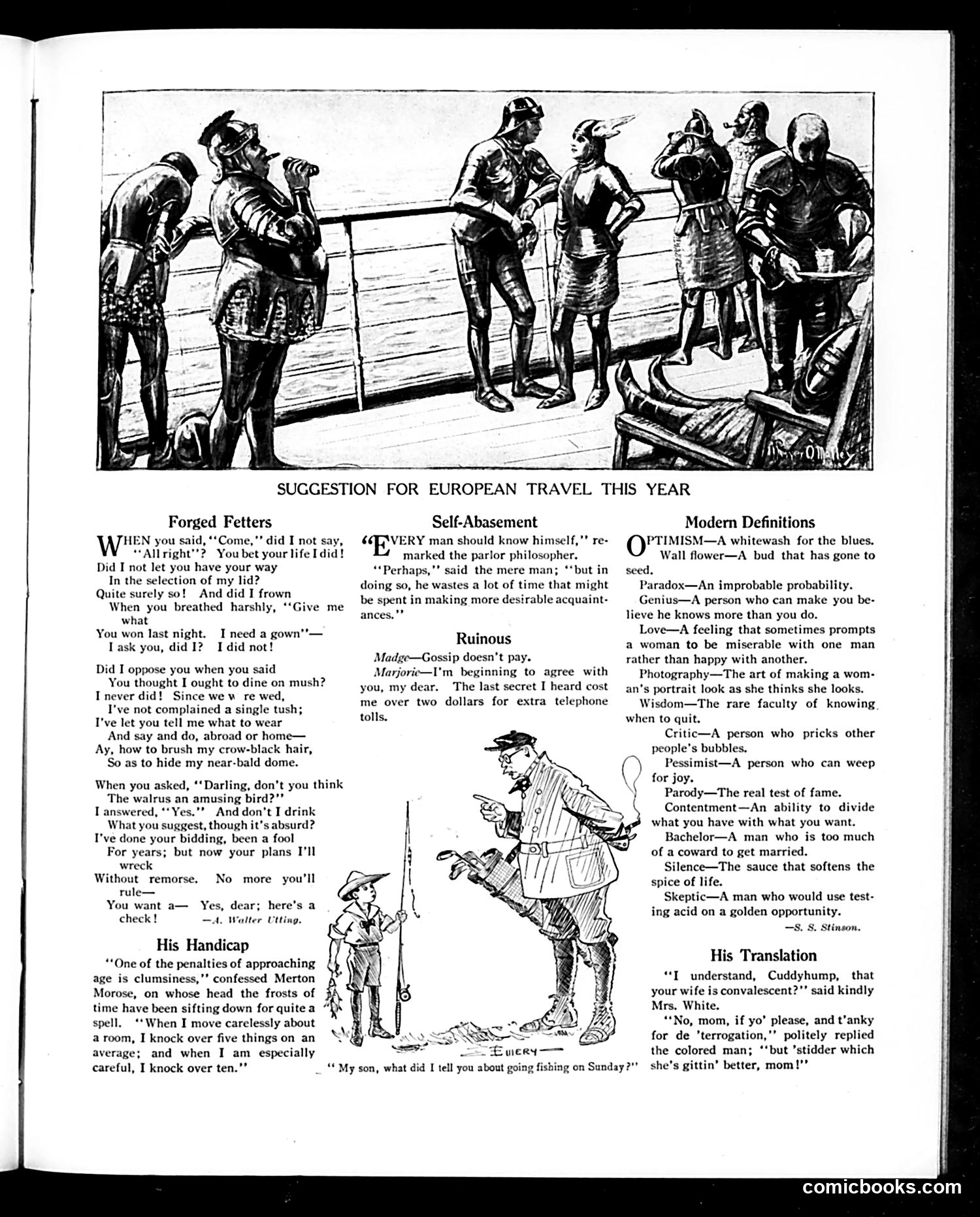
This page from *Judge* contains multiple short satirical pieces mocking early 20th-century social dynamics: **"Forged Fetters"** depicts a husband who has slavishly obeyed his wife's every whim—selecting her clothes, accepting her opinions, enduring her criticism—then abruptly rebels by refusing to comply further. The irony: he still gives her a check. The satire targets both nagging wives and hen-pecked husbands, suggesting male financial dependence undermines any real independence. **"His Handicap"** jokes that aging men become clumsy, breaking things constantly—a gentle commentary on aging's indignities. **"Self-Abasement"** mocks false modesty through a philosopher who claims self-knowledge wastes time better spent on social advancement. The **"Modern Definitions"** section offers cynical one-liners on love, photography, and marriage—typical period humor suggesting romantic love and domestic life are illusions. **"His Translation"** presents dialect humor featuring a Black servant's affected speech, reflecting the casual racism of early 20th-century American publications.
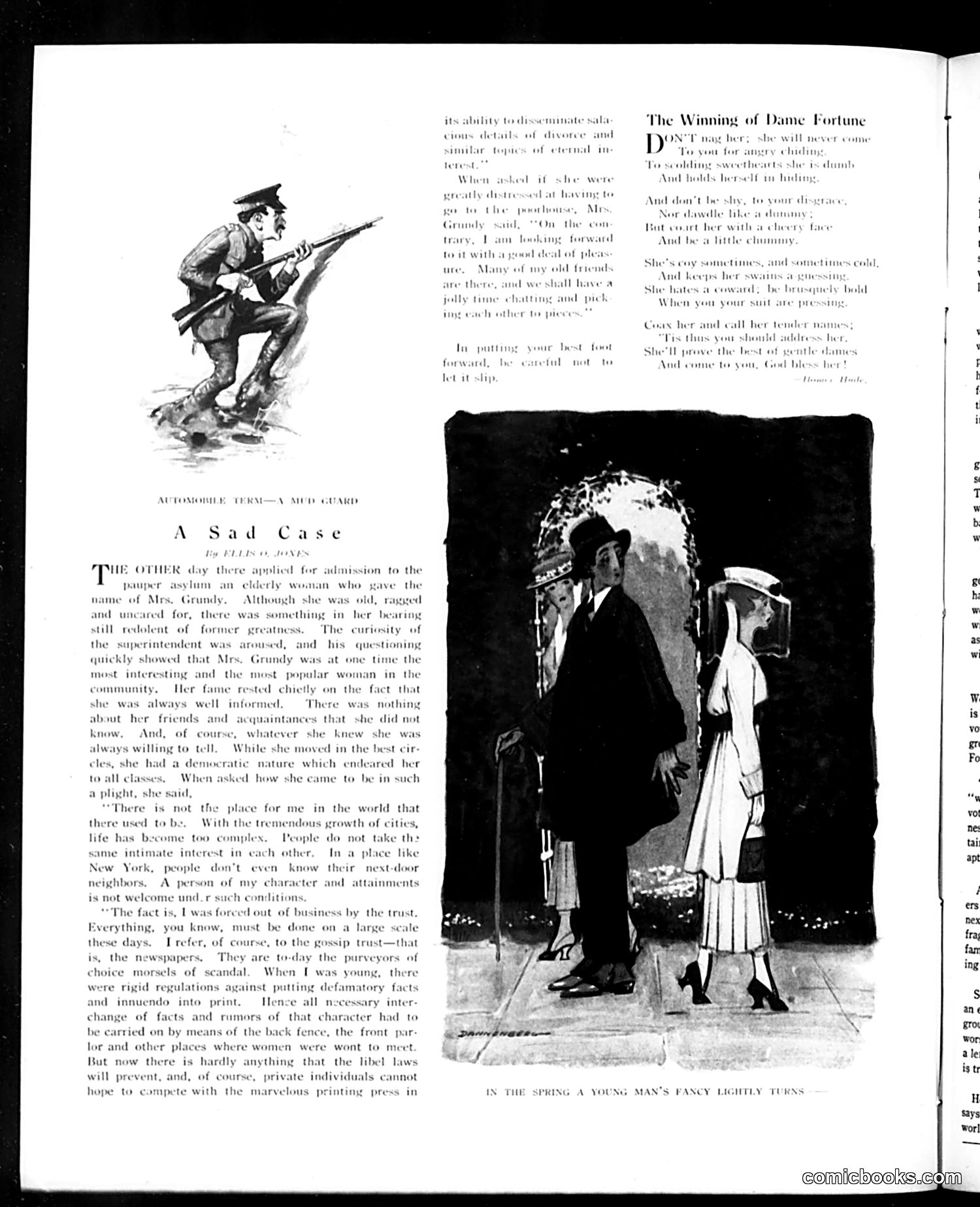
This satirical piece mocks the decline of **Mrs. Grundy**—a personification of societal gossip and moral gatekeeping—who has been rendered obsolete by modern times. **The Satire:** Mrs. Grundy, once the community's most influential gossip and arbiter of propriety, arrives at an almshouse, destitute. She explains her fall: cities have grown too large and impersonal for her trade. People no longer engage in intimate neighborhood gossip ("back fence" conversations). Instead, **newspapers and the printing press** have monopolized scandal-mongering and character assassination on an industrial scale—a "gossip trust," as she calls it. **The Point:** Judge is satirizing both the decline of traditional small-town moralism and the rise of sensationalist journalism. Mrs. Grundy's obsolescence reflects anxieties about urbanization destroying community bonds while corporate newspaper interests profit from tabloid scandals. The irony is cutting: the very figure who once policed morality is displaced by institutions doing the same thing more efficiently and ruthlessly. The cartoon critiques modern journalism's role in replacing grassroots social control with commercialized scandal-peddling.
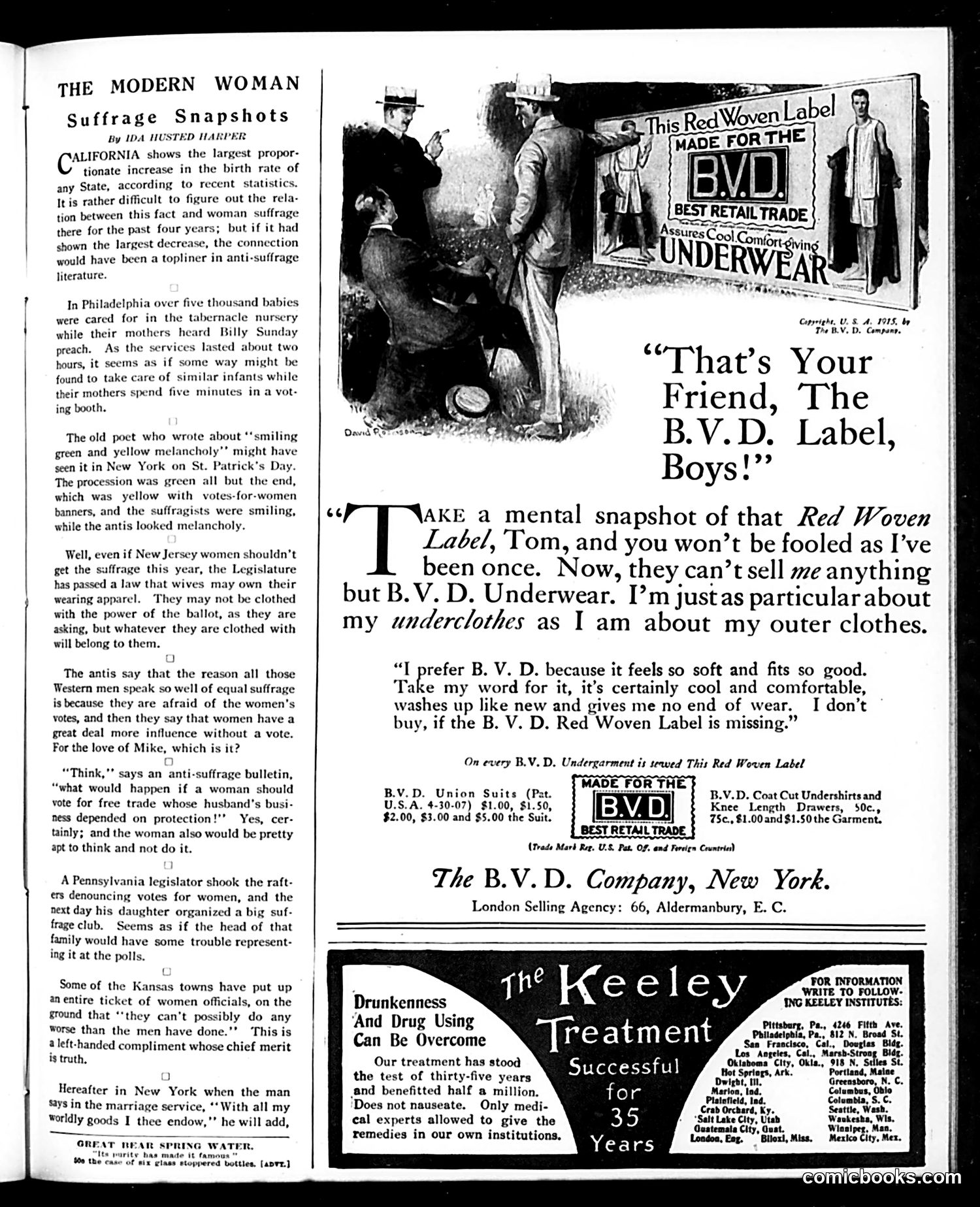
This page contains anti-suffrage satire disguised as supportive commentary. The left column, titled "Suffrage Snapshots by Ida Husted Harper," uses ironic logic and false equivalencies to mock women's voting rights. Key satirical arguments include: - Comparing voting to childcare inconvenience (the 5-minute voting booth analogy) - Mocking women's presumed self-interest (the free-trade/husband's business quip) - Suggesting women already wield sufficient "influence without a vote" - Presenting women's political organizing as absurd (the legislator's daughter forming a suffrage club) The overall strategy: present anti-suffrage points as though defending them, allowing readers to "laugh" at the arguments' weakness while the magazine subtly reinforces opposition to women's voting rights. The remainder comprises advertisements (B.V.D. underwear and Keeley drug treatment), unrelated to the suffrage commentary but typical of early-20th-century Judge layout.
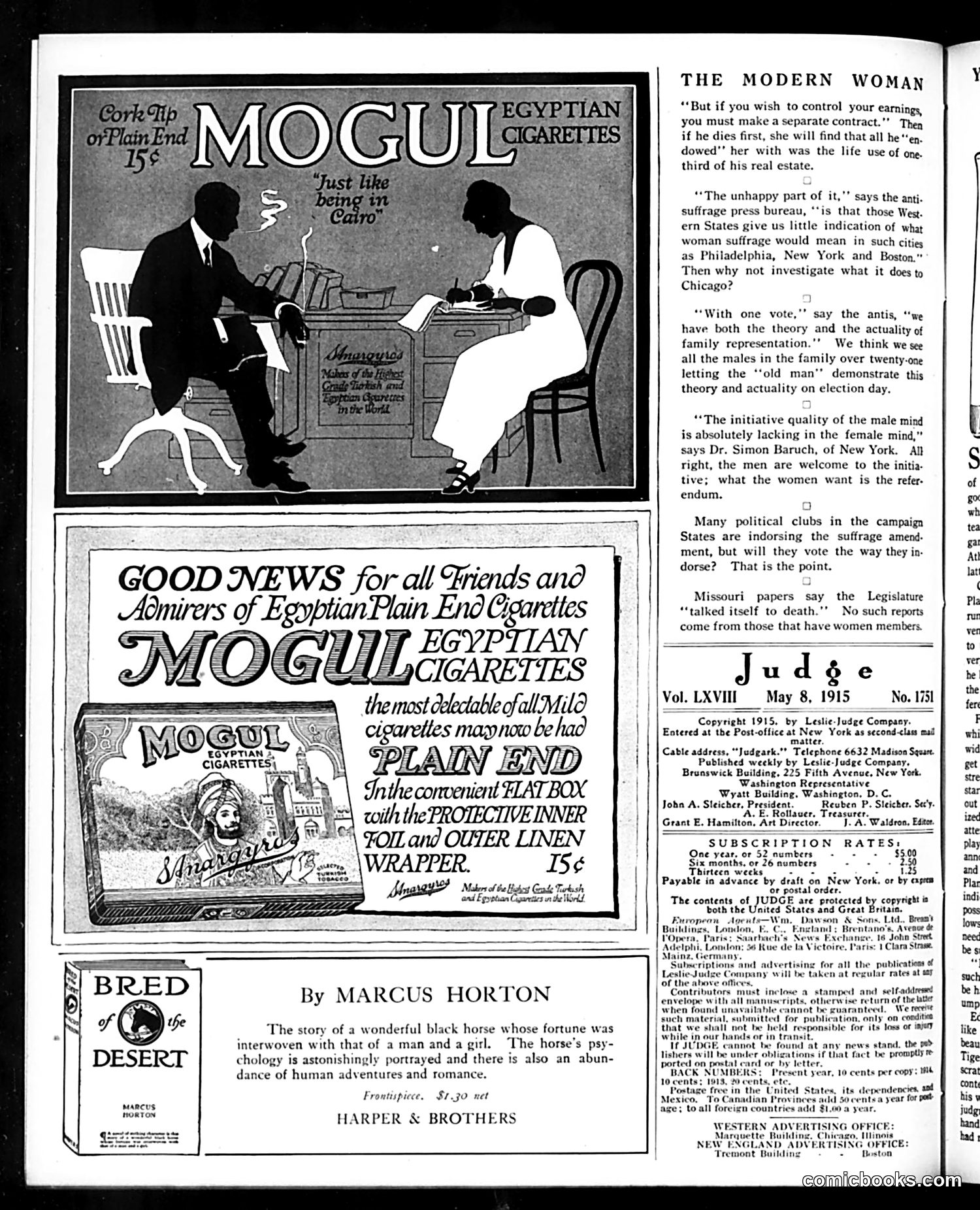
The top cartoon satirizes arguments against women's suffrage. It depicts two silhouetted figures—a man and woman—in an office setting, discussing a woman's financial independence through a "separate contract." The satire targets anti-suffrage claims that women don't need voting rights because they're protected by marriage laws. The accompanying text mocks anti-suffrage arguments: that Western suffrage wouldn't apply to Eastern cities, that one family vote suffices (implying the husband votes for everyone), and that women lack initiative. The piece uses these quotes from anti-suffrage advocates to expose their logical inconsistencies. For instance, it questions why only men should demonstrate voting rights "on election day," and notes that women want the referendum (direct democracy), not just initiative. The overall message: anti-suffrage rhetoric doesn't withstand scrutiny. This reflects the 1915 suffrage debate, before women gained federal voting rights in 1920.
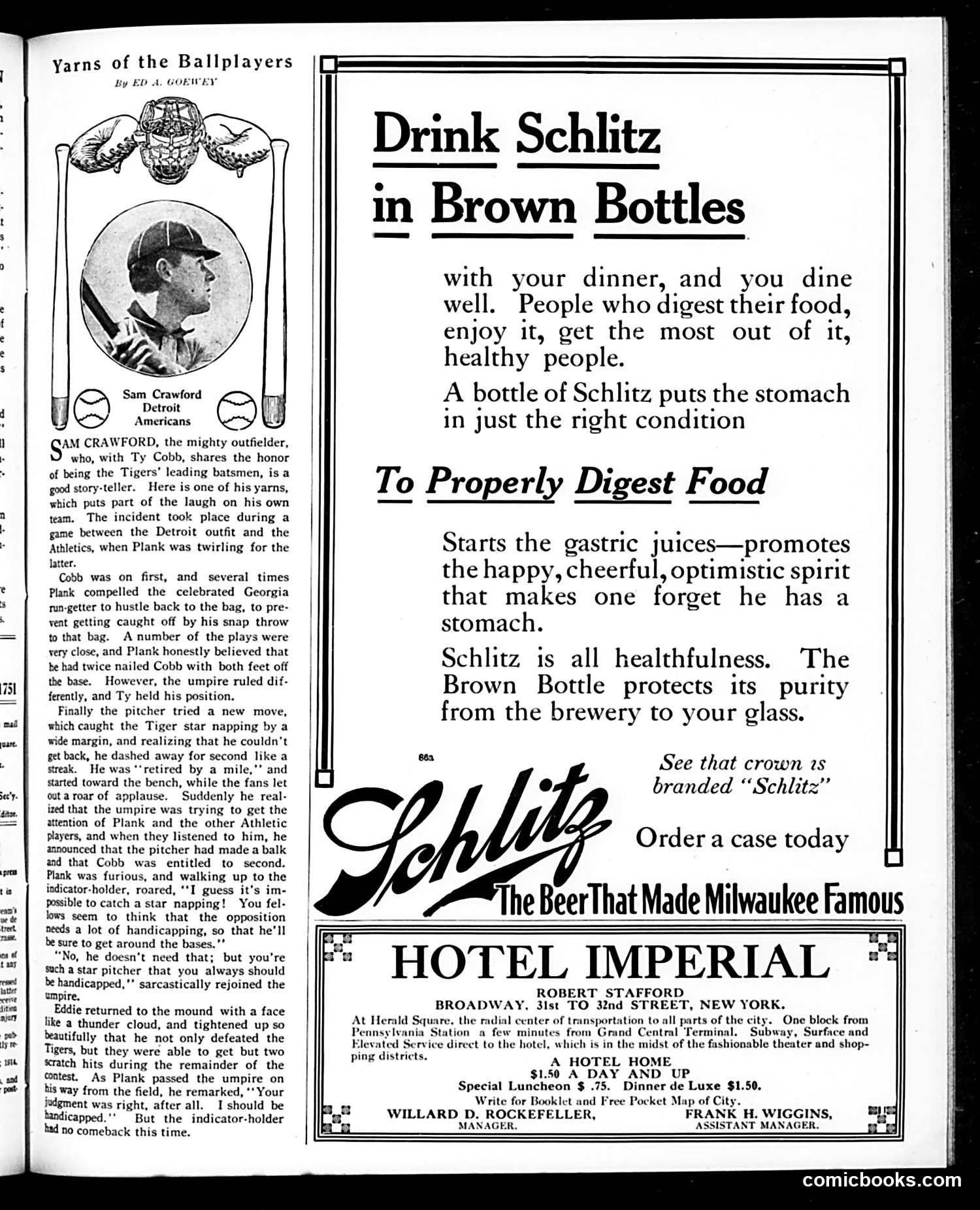
This page contains two distinct elements: a sports anecdote and advertising. **The Baseball Story** ("Yarns of the Ballplayers") features Sam Crawford of the Detroit Tigers recounting an incident against pitcher Eddie Plank of the Philadelphia Athletics. The joke turns on umpire bias: Plank repeatedly tries to catch Ty Cobb off base without success, then attempts a trick play that appears to work—until the umpire calls a balk, awarding Cobb second base anyway. Plank sarcastically complains the opposition receives unfair handicapping, and the umpire retorts that *Plank* is such a great pitcher he needs handicapping. The humor lies in the umpire's reversal and Plank's grudging acceptance. **The Advertisement** for Schlitz beer makes health claims now considered fraudulent: that beer aids digestion and promotes "gastric juices," claiming it's "all healthfulness." The brown bottle supposedly protects purity. Both elements reflect early 1900s sensibilities—celebrating athletic stars and making dubious medicinal claims for alcohol.
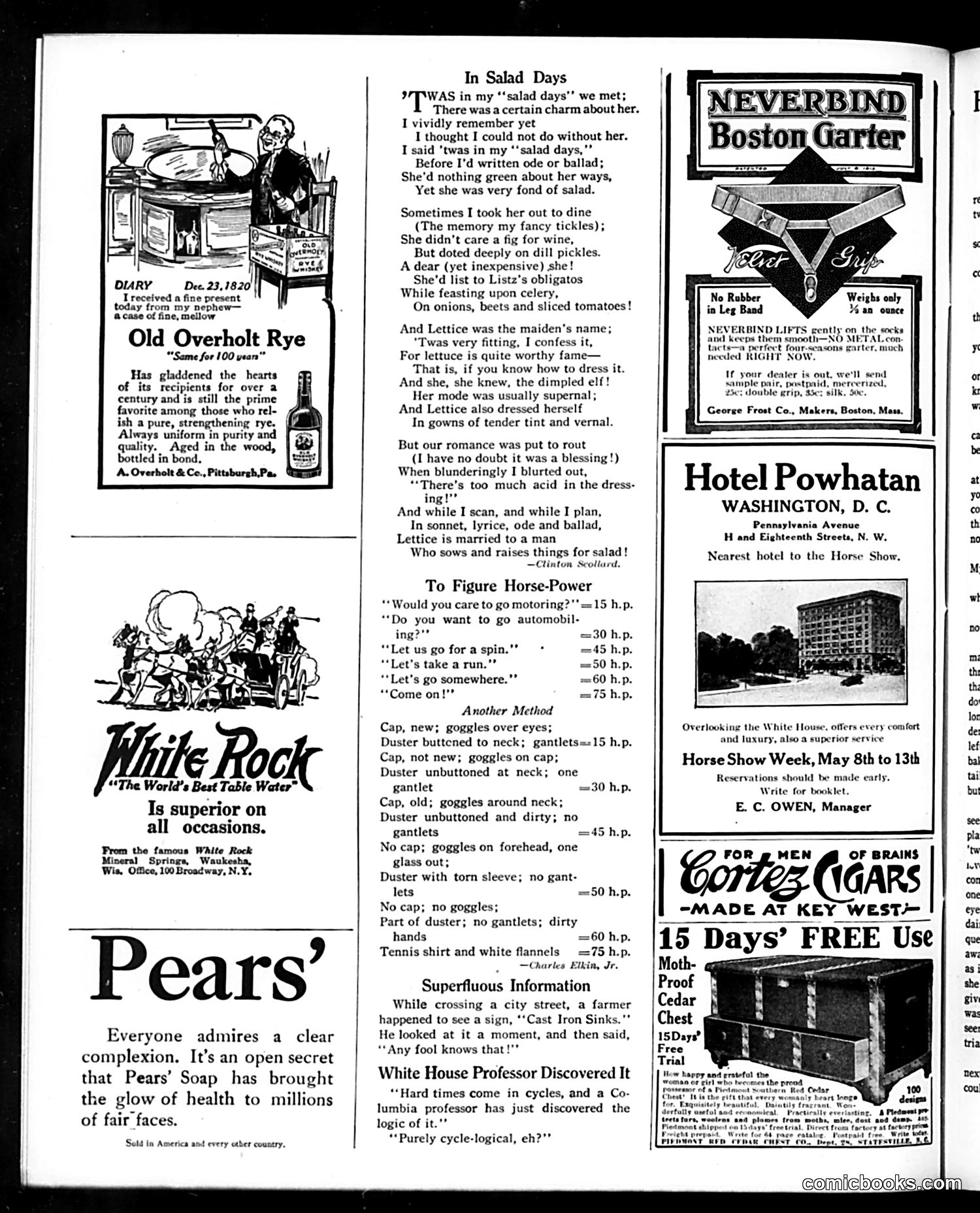
This page from Judge (circa 1920) is primarily **advertising with light satirical content**, not political commentary. The main features are: **"In Salad Days"** — A sentimental poem by Clinton Scollard about a young man courting a woman named Lettice who loves salad and pickles. The satire is gentle: the romantic speaker ruins the relationship by tactlessly criticizing her salad dressing's acidity. It's a humorous take on how pedantic remarks can sabotage romance. **"To Figure Horse-Power"** — A joke contrasting polite phrases for suggesting car trips with their actual engine power. Casual invitations like "let's go for a spin" supposedly indicate more powerful vehicles, while shabby appearance (torn dusters, missing goggles) correlates with less power. It satirizes early automobile culture and owners' pretensions. **"White House Professor" joke** — A brief gag about a Columbia professor discovering economic cycles are "cycle-logical" (cyclical). Mild wordplay satire. The rest consists of period advertisements for whiskey, soap, mineral water, hotels, and cigars—typical Judge content.
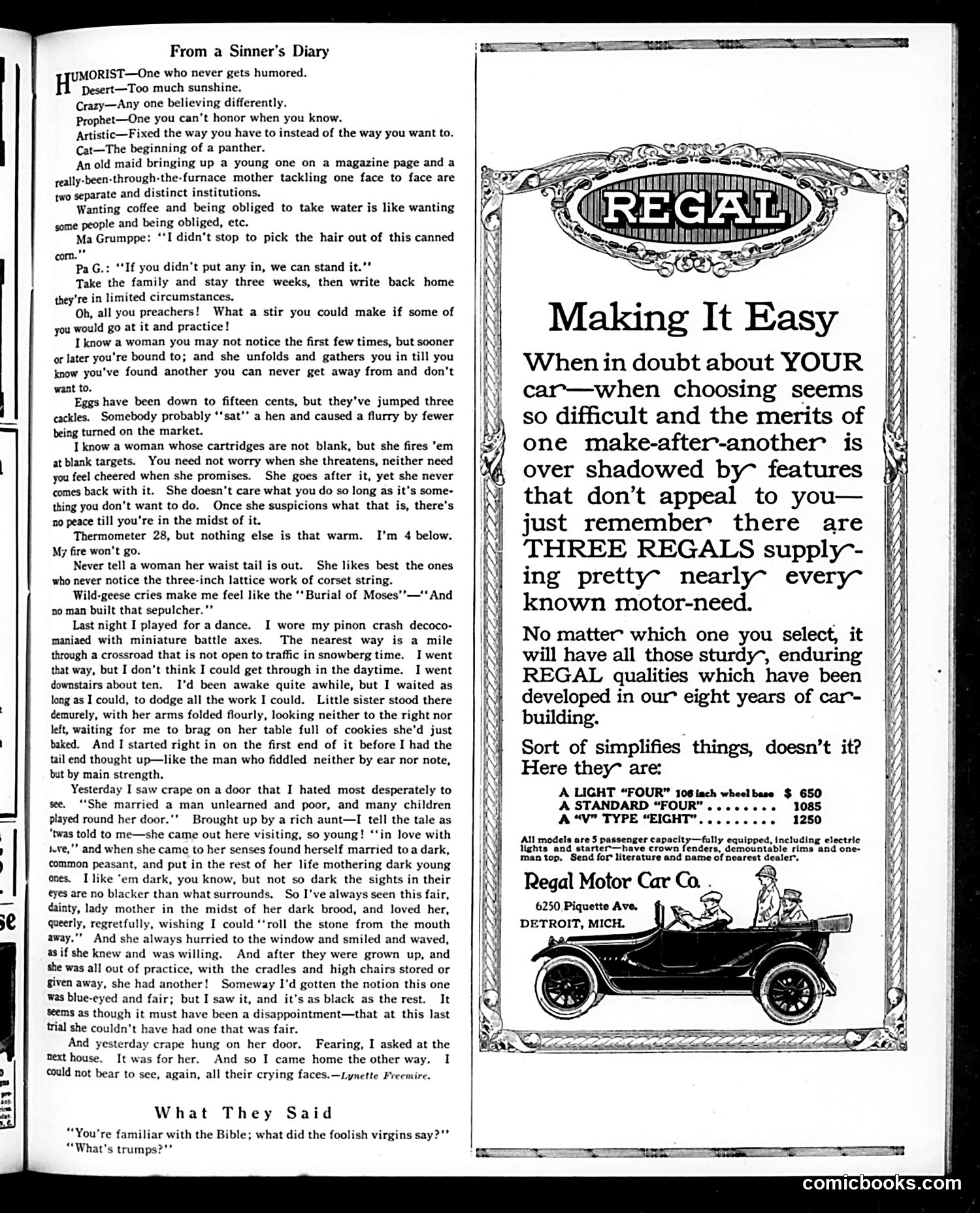
This page combines two distinct elements: a satirical diary column and a Regal automobile advertisement. **"From a Sinner's Diary"** presents cynical social observations in the style of early 20th-century humor magazines. It mocks contemporary life through sardonic definitions (humorist, prophet, artist) and anecdotes about domestic frustrations—nagging wives, spoiled eggs, inconsistent women. The humor relies on misogynistic stereotypes typical of the era: women are portrayed as illogical, manipulative, and querulous. The diary's tone suggests world-weary resignation to marital discord and social hypocrisy, particularly targeting clergy ("Oh, all you preachers!"). **The Advertisement** for Regal Motor Cars emphasizes reliability and simplicity as selling points, listing three models with prices and features. The accompanying illustration shows an early automobile. Together, the page reflects Judge's satirical approach: coupling biting social commentary about domestic life with commercial appeals to readers' aspirations for modern conveniences. The juxtaposition—complaints about life's frustrations paired with advertisements promising ease—creates implicit irony about consumer culture's promises.
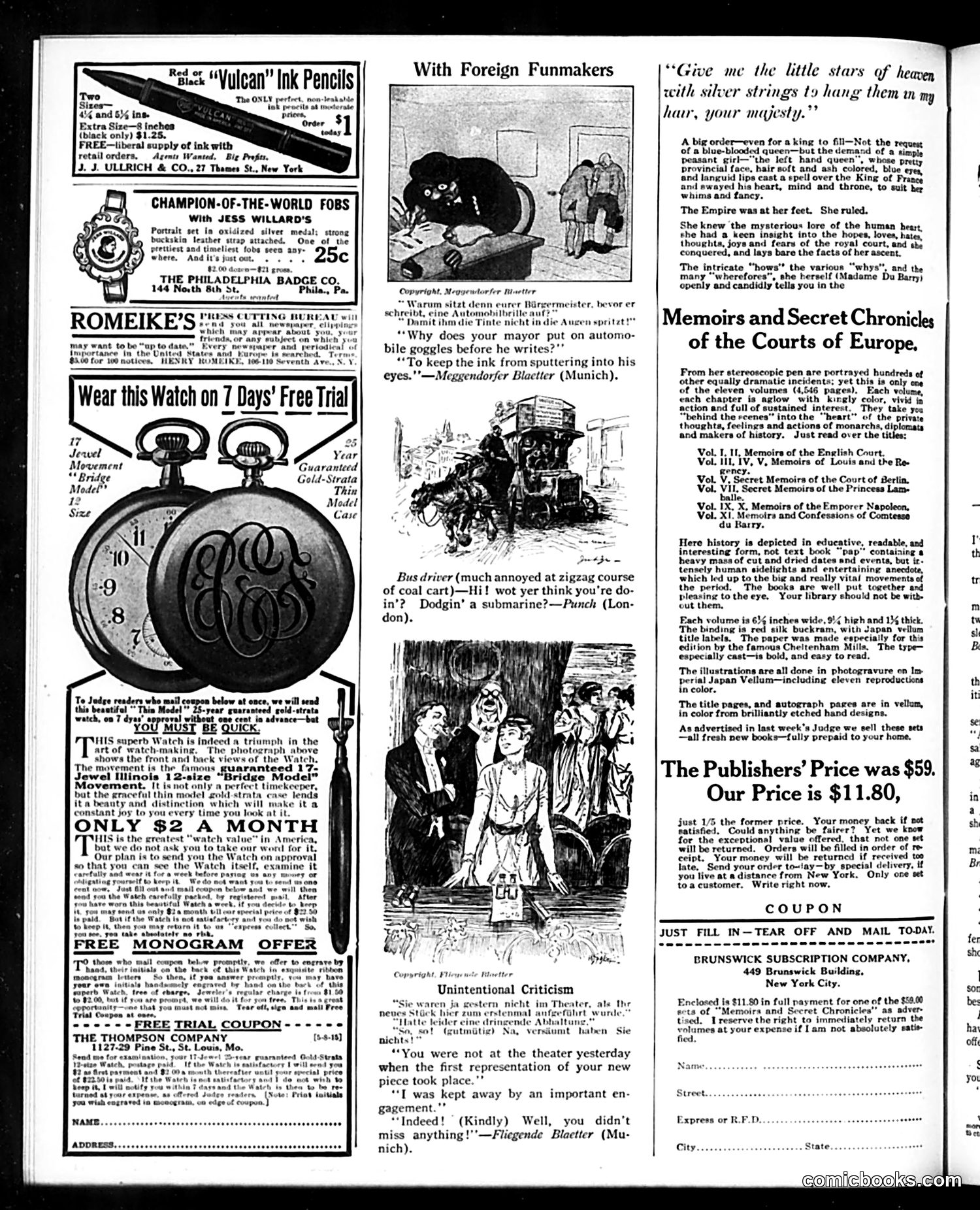
This page is primarily **advertising and serialized content**, not political satire. The dominant feature is a book advertisement for "Memoirs and Secret Chronicles of the Courts of Europe"—an 11-volume set depicting royal court scandals, particularly featuring a peasant girl ("the left hand queen") who captivated a European king. The small section titled "With Foreign Funmakers" reprints humorous anecdotes from European satirical magazines (Punch, Meggendorfer Blätter, Fliegende Blätter). These include jokes about mayors writing with fountain pens, bus drivers avoiding submarines, and theatrical mishaps—typical light humor without political content. The remaining space contains period advertisements for watches, ink pencils, and badges—standard commercial filler for 1910s-era magazines. **There is no significant political cartoon or satire requiring historical context on this particular page.**
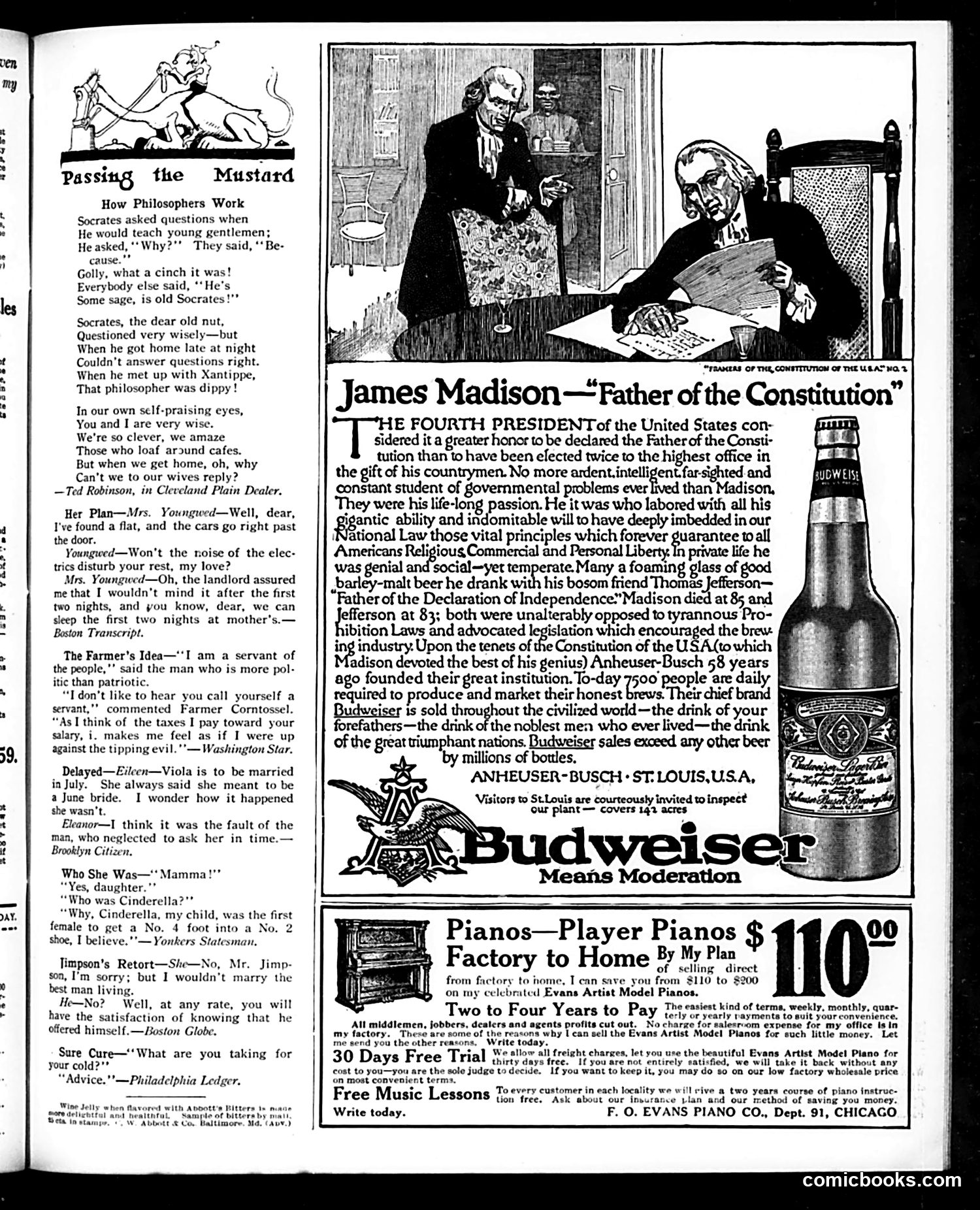
This Judge magazine page contains two distinct elements: **Upper Left - "Passing the Mustard" cartoon**: A satirical piece about philosophy and marriage. It jokes that Socrates could brilliantly question his students, but couldn't answer his wife Xantippe's questions at home. The humor targets men who appear wise in public but are bested by their wives in private—a common domestic satire trope of the era. **Right Side - Budweiser Advertisement**: An elaborate ad exploiting James Madison's reputation as "Father of the Constitution" to sell beer. The copy claims Madison and Jefferson both opposed Prohibition laws and "encouraged the brewing industry," falsely linking the founders to alcohol consumption. This appears designed to counter Prohibition sentiment by invoking founding fathers' authority—a propagandistic marketing approach linking beer to American patriotism and liberty. The juxtaposition is ironic: domestic comedy above, political manipulation below.
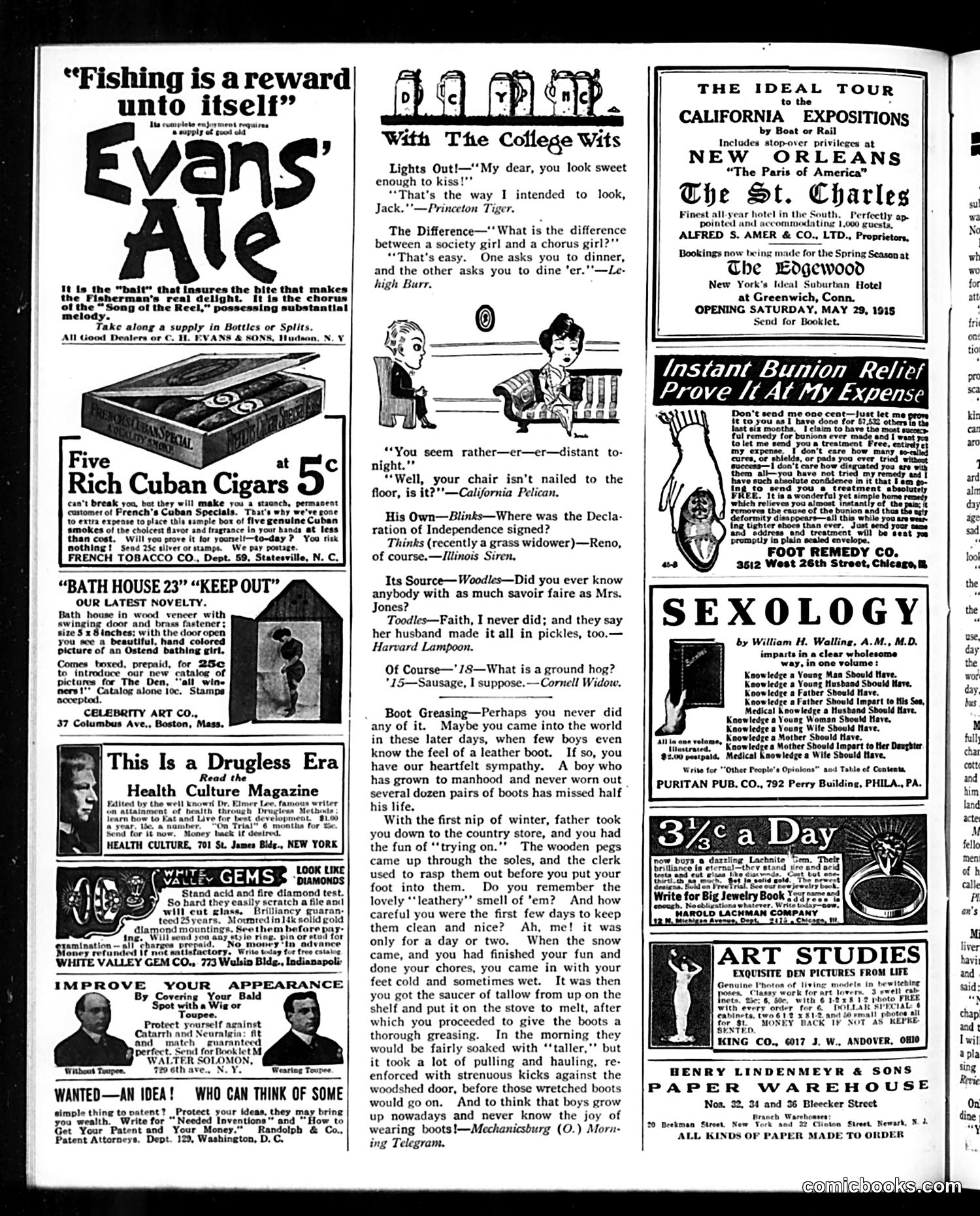
This page is primarily **advertisements and humor columns**, not political cartoons. The content includes: **"With The College Wits"** — A humor section featuring jokes from college publications (Princeton Tiger, Lehigh Burr, etc.). These are lighthearted gags about dating and romance, with no political content. Example: a woman says she dressed to be kissable, but won't let her date move his chair closer. **"Boot Greasing"** — A nostalgic essay about childhood experiences greasing leather boots in winter—an innocent reminiscence with no satirical intent. The remainder consists of **period advertisements**: Evans fishing line, Cuban cigars, a novelty "Bath House 23" toy, health magazines, wigs/toupees, and patent services. **No political satire is present.** The page reflects early 20th-century consumer culture and college humor rather than social commentary.
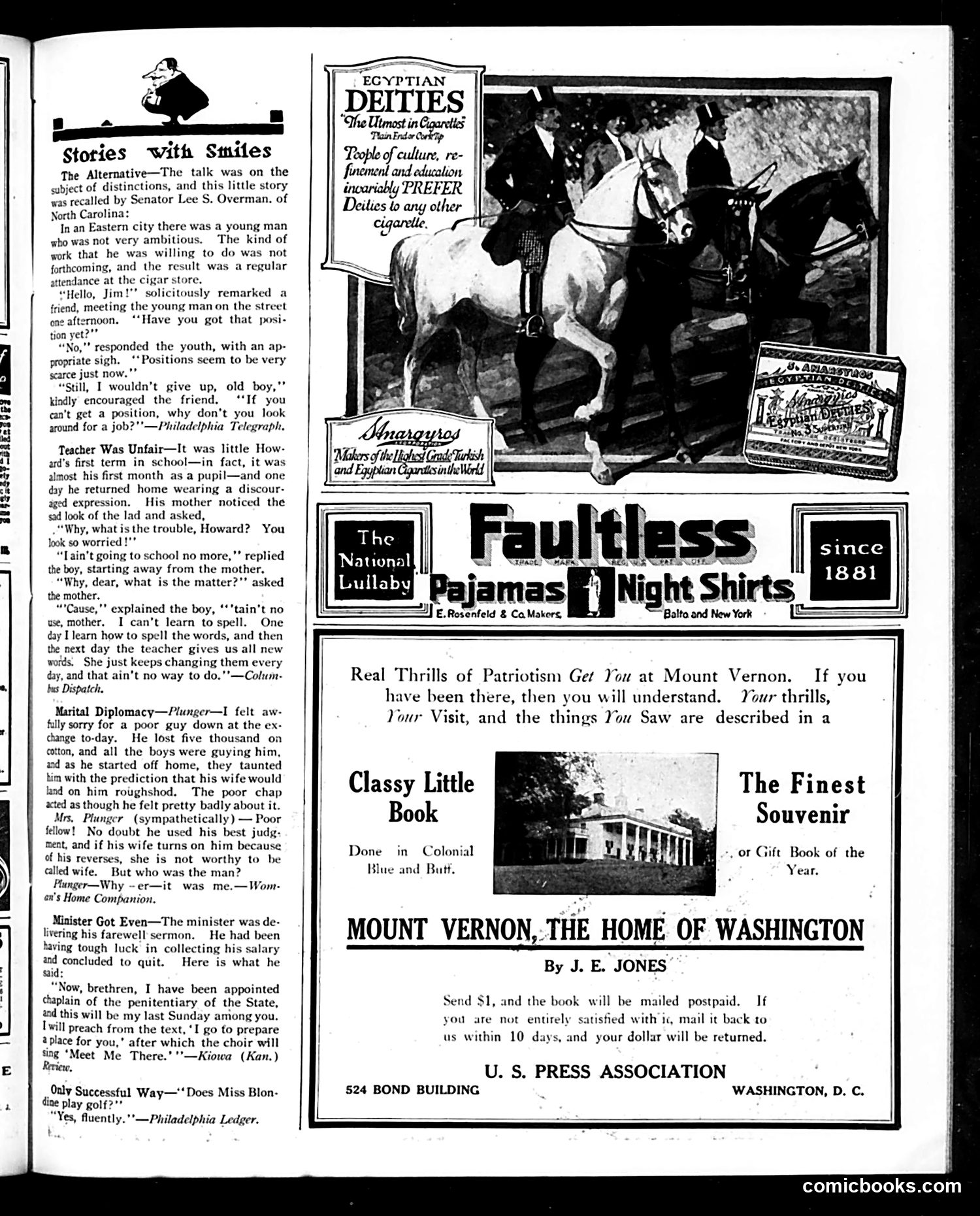
This page from *Judge* combines humor columns with advertising. The left side features "Stories with Smiles"—brief anecdotes mocking contemporary social anxieties: - **Job-seeking comedy**: A young man's laziness is satirized when a friend suggests looking for work rather than waiting for positions to appear. - **Teacher criticism**: A boy complains school is useless because teachers change spelling words daily—absurdist humor about educational rigidity. - **Marital/financial humor**: A stockbroker who lost money is pitied, then revealed to be the writer himself—self-deprecating satire about male vulnerability. - **Clergy joke**: A departing minister ironically tells his congregation he's moving to a penitentiary chaplaincy. The right side advertises cigarettes (*Egyptian Deities*, *Anargyros*, *Faultless Pajamas*) and a souvenir book about Mount Vernon—typical early-20th-century *Judge* content mixing light social commentary with commercial promotions.
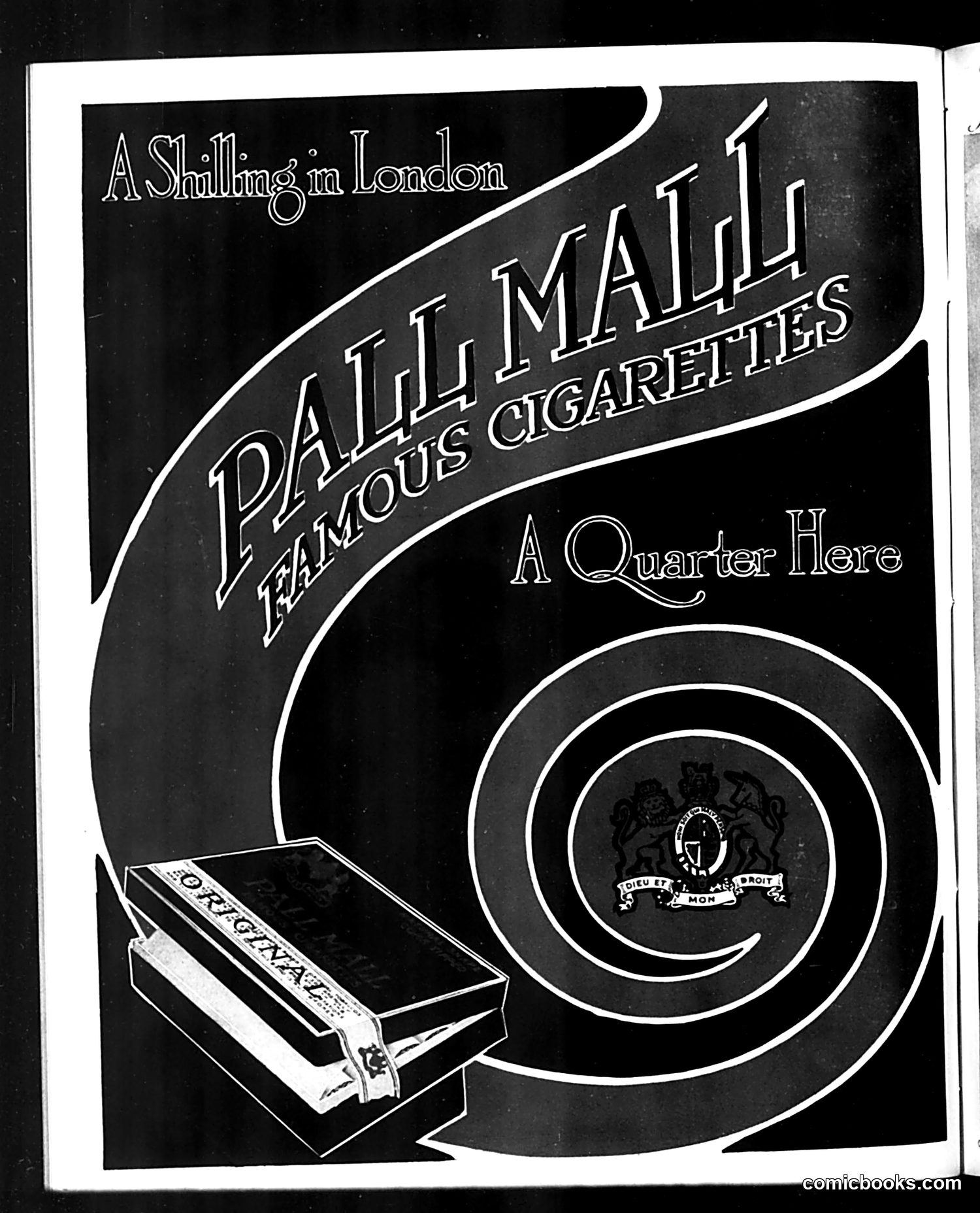
This is a **cigarette advertisement** rather than political satire. The page promotes "Pall Mall" cigarettes, marketed as "Famous Cigarettes" sold at "A Quarter Here" in London. The advertisement features: - Product packaging (shown lower left) - A large concentric circular design (lower right) displaying what appears to be a coat of arms or royal seal, likely emphasizing the brand's prestige and British heritage - Art deco styling typical of early-to-mid 20th century advertising The phrase "A Shilling in London" (top) likely refers to pricing in different markets, suggesting this ads targeted British consumers. The emphasis on the royal emblem was a common marketing tactic to convey quality and sophistication to consumers during this era.