
Judge, 1915-05-08 · page 5 of 24
Judge — May 8, 1915 — page 5: what you’re looking at
What you’re looking at
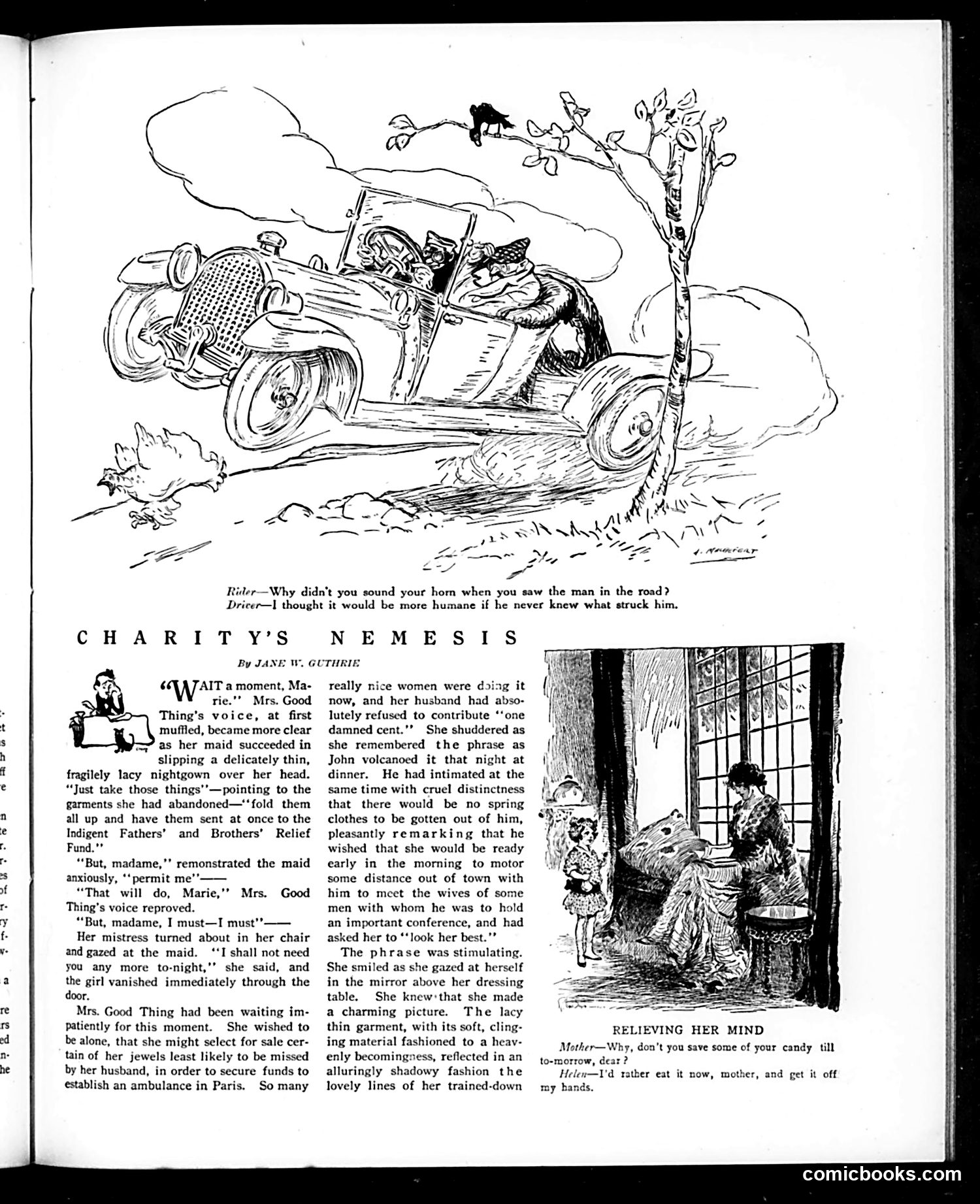
This page contains a short story by Jane W. Gutheir rather than political satire. The top cartoon illustrates a darkly humorous anecdote: a driver hits a man but doesn't sound the horn, claiming it would be "more humane" if the victim never knew what struck him. The joke relies on absurdist logic—rationalizing negligence as kindness. The story below depicts Mrs. Good Thing, a wealthy woman pressuring her maid to donate clothing to charity while simultaneously planning to donate her own jewels to an ambulance fund. The satire targets the self-righteousness of the wealthy who display charity while expecting servants to sacrifice more than they do themselves—critiquing performative philanthropy and class hypocrisy.
📄 Transcribed text from this page (OCR, searchable)
Machine-transcribed from the original scan — historical spelling and the odd misread are preserved.
— ——_ ys Lee te , “ AIK A\Y™ a on Re Se remrear Rider—Why didn’t you sound your hom when you saw the man in the road? Dricer—| thought it would be more humane if he never knew what struck him. CHA RIT Y’S NEMESIS By JANE W. GUTHRIE cA é ‘AIT a moment, Ma- rie."’ Mrs. Good Thing’s voice, at first muffled, became more clear as her maid succeeded in slipping a delicately thin, fragilely lacy nightgown over her head. “Just take those things’’—pointing to the garments she had abandoned—‘‘fold them all up and have them sent at once to the Indigent Fathers’ and Brothers’ Relief Fund."* ut, madame,’’ remonstrated the maid anxiously, ** permit me’’. “That will do, Marie,’’ "s voice reproved. ut, madame, I must—I must’?—— Her mistress turned about in her chair and gazed at the maid. ‘‘I shall not need you any more to-night,’’ she said, and the girl vanished immediately through the door, Mrs. Good Thing had been waiting im- patiently for this moment. She wished to be alone, that she might select for sale cer- tain of her jewels least likely to be missed by her husband, in order to secure funds to establish an ambulance in Paris. So many — Mrs. Good really nice women were doing it now, and her husband had abso- lutely refused to contribute ‘‘one damned cent.’’ She shuddered as she remembered the phrase as John volcanoed it that night at dinner. He had intimated at the same time with cruel distinctness that there would be no spring clothes to be gotten out of him, pleasantly remarking that he wished that she would be ready early in the morning to motor some distance out of town with him to mcet the wives of some men with whom he was to hold an important conference, and had asked her to ‘‘look her best.” The phrase was stimulating. She smiled as she gazed at herself in the mirror above her dressing table. She knew:that she made a charming picture. The lacy thin garment, with its soft, cling- ing material fashioned to a heav- enly becomin; reflected in an alluringly shadowy fashion the lovely lines of her trained-down | os i RELIEVING HER MIND Mother—Why, don't you save some of your candy till to-morrow, dear ? Helen—V'd rather eat it now, mother, and get it off my hands. comicbooks.com