
Judge, 1915-05-08 · page 8 of 24
Judge — May 8, 1915 — page 8: what you’re looking at
What you’re looking at
This story satirizes naive American pacifism and the fantasy of solving international conflict through simple schemes. Jones, an ordinary grocer, proposes ending all wars by petitioning President Wilson to create a single world government with one elected president—reasoning that one president couldn't be jealous of himself. The satire deepens through his exponential petition plan: ten copies become a hundred million through geometric multiplication over seven steps, which he'll send to Wilson as proof of public support. Jones imagines this will win him a $40,000 annual "peace prize." The humor targets both Jones's comical overconfidence and the broader American belief that idealistic solutions could resolve complex geopolitical rivalries. Published during WWI (when Wilson was president), it mocks the period's peace movement as well-intentioned but absurdly disconnected from political reality. His wife's admiration and his self-satisfied certainty underscore the satirical point: good intentions cannot substitute for understanding how nations actually function.
📄 Transcribed text from this page (OCR, searchable)
Machine-transcribed from the original scan — historical spelling and the odd misread are preserved.
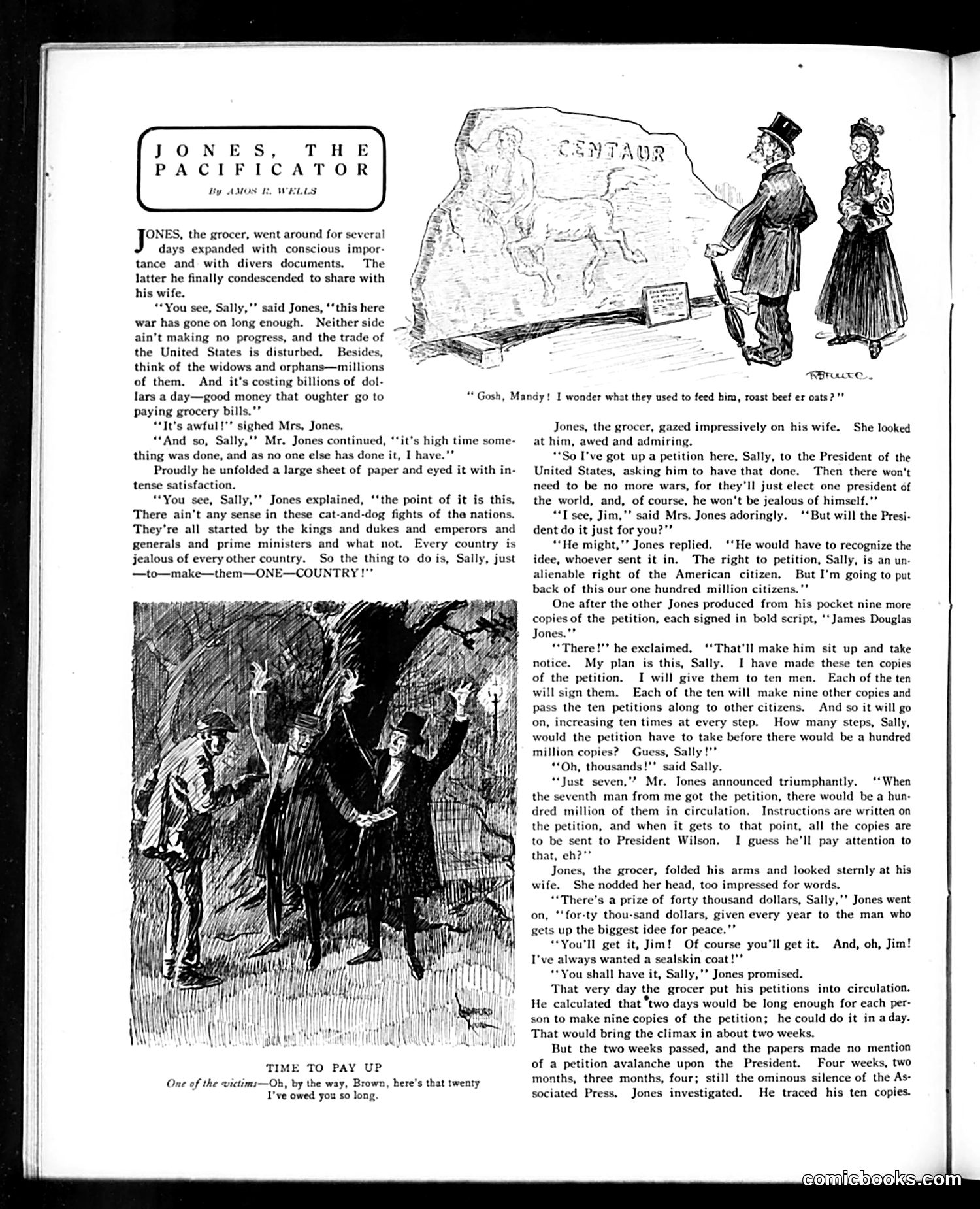
NE THE CIFICATOR By AMOS b WELLS ONES, the grocer, went around for several days expanded with conscious impor- tance and with divers documents. The latter he finally condescended to share with his wife. “*You see, Sally,’ said Jones, ‘‘this here war has gone on long enough. Neither side ain't making no progress, and the trade of the United States is disturbed. Besides, think of the widows and orphans—millions of them. And it’s costing billions of dol- lars a day—good money that oughter go to paying grocery bil “It’s awful!"’ sighed Mrs, Jones, “And so, Sally,” Mr. Jones continued, ‘‘it’s high time some- thing was done, and as no one else has done it, I have."" Proudly he unfolded a large sheet of paper and eyed it with in- tense satisfaction, “You see, Sally,"’ Jones explained, ‘‘the point of it is this. There ain’t any sense in these cat-and-dog fights of the nations. They're all started by the kings and dukes and emperors and generals and prime ministers and what not. Every country is jealous of every other country. So the thing to do is, Sally, just —to—make—them—ONE—COUNTRY!"" TIME TO PAY UP One of the victims—Oh, by the way, Brown, here's that twenty I've owed you so long. “Gosh, Mandy! I wonder what they used to feed him, roast beef er oats?"" Jones, the grocer, gazed impressively on his wife. at him, awed and admiring. **So I've got up a petition here, Sally, to the President of the United States, asking him to have that done. Then there won't need to be no more wars, for they'll just elect one president of the world, and, of course, he won't be jealous of himself."” “Tsee, Jim,”’ said Mrs. Jones adoringly. ‘* But will the Presi- dent do it just for you?”” “He might,"’ Jones replied. ‘‘He would have to recognize the idee, whoever sent it in. The right to petition, Sally, is an un- alienable right of the American citizen, But I'm going to put back of this our one hundred million citizens."’ One after the other Jones produced from his pocket nine more copies of the petition, each signed in bold script, ‘James Douglas Jones."" ‘There!’ he exclaimed, ‘*That'll make him sit up and take notice. My plan is this, Sally. I have made these ten copies of the petition. I will give them to ten men. Each of the ten will sign them. Each of the ten will make nine other copies and pass the ten petitions along to other citizens. And so it will go on, increasing ten times at every step. How many steps, Sally, would the petition have to take before there would be a hundred million copies? Guess, Sally !'" “Oh, thousands!"" said Sall *‘Just seven,"? Mr. Jones announced triumphantly. ‘*When the seventh man from me got the petition, there would be a hun- dred million of them in circulation, Instructions are written on the petition, and when it gets to that point, all the copies are to be sent to President Wilson. I guess he'll pay attention to that, eh?”’ Jones, the grocer, folded his arms and looked sternly at his wife. She nodded her head, too impressed for words. “There's a prize of forty thousand dollars, Sall Jones went on, ‘‘for-ty thou-sand dollars, given every year to the man who gets up the biggest idee for peace."’ “You'll get it, Jim! Of course you'll get it. I've always wanted a sealskin coat! **You shall have it, Sally,’’ Jones promised. That very day the grocer put his petitions into circulation. He calculated that *two days would be long enough for each per- son to make nine copies of the petition; he could do it in aday. That would bring the climax in about two weeks. But the two weeks passed, and the papers made no mention of a petition avalanche upon the President. Four weeks, two months, three months, four; still the ominous silence of the As- sociated Press. Jones investigated. He traced his ten copies. She looked And, oh, Jim!