
Judge, 1915-05-08 · page 10 of 24
Judge — May 8, 1915 — page 10: what you’re looking at
What you’re looking at
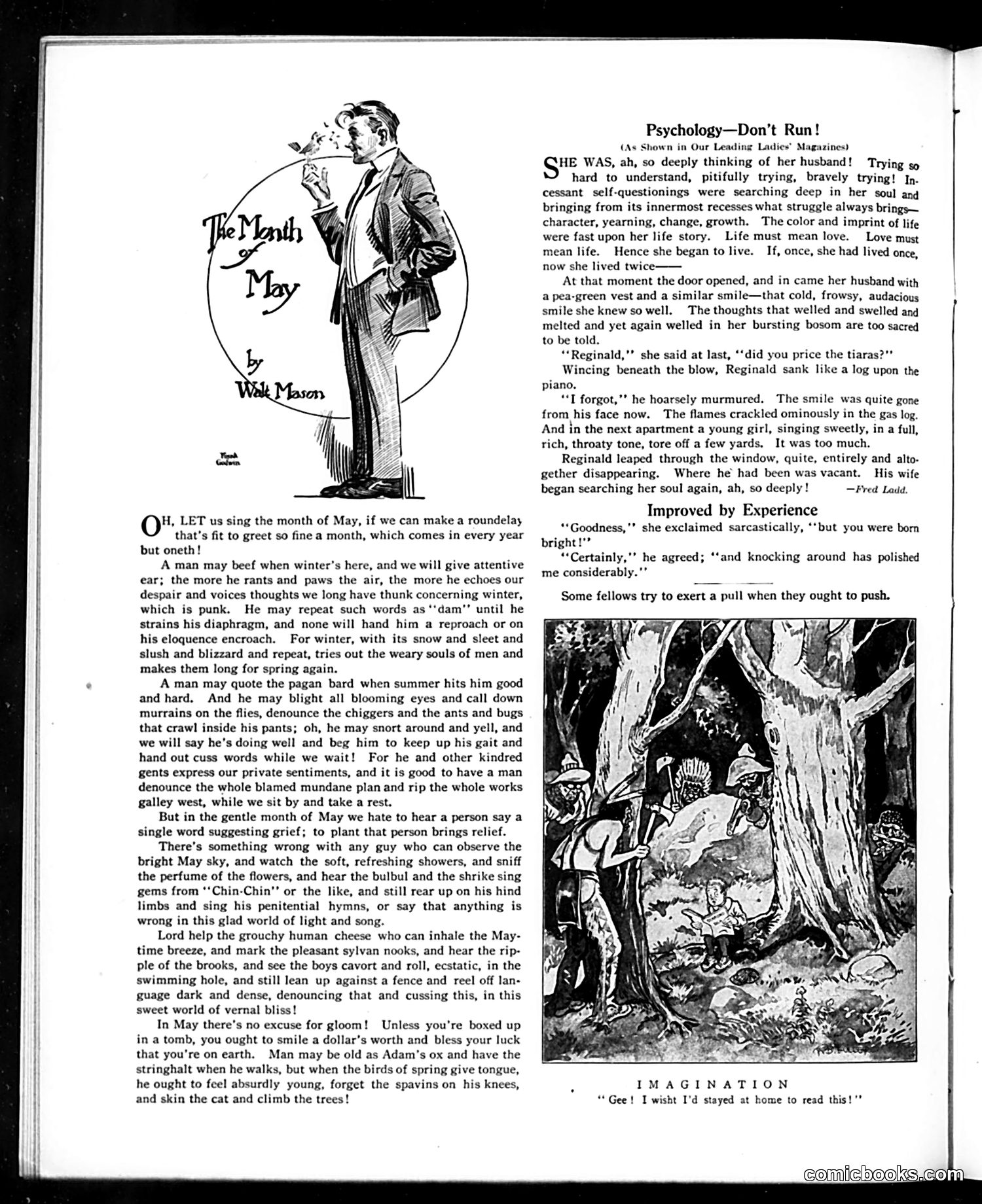
This page contains two distinct pieces of satire: **"The Month of May"** (left): A whimsical essay by Walt Mason celebrating May as the only month where complaining is socially unacceptable. The piece humorously argues that while men may legitimately grumble about winter's hardships or summer's discomforts, May's perfect weather makes griping inexcusable. It mocks anyone who remains gloomy despite May's beauty—flowers, singing birds, swimming holes—suggesting only the literally entombed have excuse for gloom. **"Psychology—Don't Run!"** (right): A satire of melodramatic literary fiction popular in women's magazines of the era. It mocks overwrought psychological introspection and emotional intensity in domestic scenarios. The wife's profound inner struggle about her husband dissolves into mundane reality when he arrives in an ugly vest and admits he forgot to price tiaras. The satire targets the gap between highbrow literary pretension and ordinary married life's banality. Both pieces mock excessive sentimentality and self-importance through exaggeration and deflation.
📄 Transcribed text from this page (OCR, searchable)
Machine-transcribed from the original scan — historical spelling and the odd misread are preserved.
H, LET us sing the month of May, if we can make a roundelay that’s fit to greet so fine a month, which comes in every year but oneth! A man may beef when winter's here, and we will give attentive ear; the more he rants and paws the air, the more he echoes our despair and voices thoughts we long have thunk concerning winter, which is punk. He may repeat such words as ‘‘dam'’ until he strains his diaphragm, and none will hand him a reproach or on his eloquence encroach. For winter, with its snow and sleet and slush and blizzard and repeat, tries out the weary souls of men and makes them long for spring again. A man may quote the pagan bard when summer hits him good and hard. And he may blight all blooming eyes and call down murrains on the flies, denounce the chiggers and the ants and bugs that crawl inside his pants; oh, he may snort around and yell, and we will say he’s doing well and beg him to keep up his gait and hand out cuss words while we wait! For he and other kindred gents express our private sentiments, and it is good to have a man denounce the whole blamed mundane plan and rip the whole works galley west, while we sit by and take a rest. But in the gentle month of May we hate to hear a person say a single word suggesting grief; to plant that person brings relief. There’s something wrong with any guy who can observe the bright May sky, and watch the soft, refreshing showers, and sniff the perfume of the flowers, and hear the bulbul and the shrike sing gems from ‘‘Chin-Chin’’ or the like, and still rear up on his hind limbs and sing his penitential hymns, or say that anything is wrong in this glad world of light and song. Lord help the grouchy human cheese who can inhale the May- time breeze, and mark the pleasant sylvan nooks, and hear the rip- ple of the brooks, and see the boys cavort and roll, ecstatic, in the swimming hole, and still lean up against a fence and reel off lan- guage dark and dense, denouncing that and cussing this, in this sweet world of vernal bliss! In May there's no excuse for gloom! Unless you're boxed up in a tomb, you ought to smile a dollar’s worth and bless your luck that you're on earth. Man may be old as Adam's ox and have the stringhalt when he walks, but when the birds of spring give tongue, he ought to feel absurdly young, forget the spavins on his knees, and skin the cat and climb the trees! Psychology—Don’t Run! (As Shown in Our Leading Ladies’ Magazines) HE WAS, ah, so deeply thinking of her husband! Trying g hard to understand, pitifully trying, bravely trying! In. cessant self-questionings were searching deep in her soul and bringing from its innermost recesses what struggle always brings— character, yearning, change, growth. The color and imprint of life were fast upon her life story. Life must mean love. Love must mean life. Hence she began to live. If, once, she had lived once, now she lived twice: At that moment the door opened, and in came her husband with a pea-green vest and a similar smile—that cold, frowsy, audacious smile she knew so well. The thoughts that welled and swelled and melted and yet again welled in her bursting bosom are too sacred to be told. **Reginald,’’ she said at last, ‘‘did you price the tiaras?"’ Wincing beneath the blow, Reginald sank like a log upon the piano, “T forgot,’* he hoarsely murmured. The smile was quite gone from his face now. The flames crackled ominously in the gas log. And in the next apartment a young girl, singing sweetly, in a full, rich, throaty tone, tore off a few yards. It was too much. Reginald leaped through the window, quite, entirely and alto- gether disappearing. Where he had been was vacant. His wife began searching her soul again, ah, so deeply! —Fred Ladd. Improved by Experience “‘Goodness,’? she exclaimed sarcastically, ‘*but you were born bright!” “*Certainly,’’ he agreed; ‘‘and knocking around has polished me considerably."* Some fellows try to exert a pull when they ought to push. IMAGINATION “Gee! I wisht I'd stayed at home to read this!'*