
Judge, 1915-05-08 · page 6 of 24
Judge — May 8, 1915 — page 6: what you’re looking at
What you’re looking at
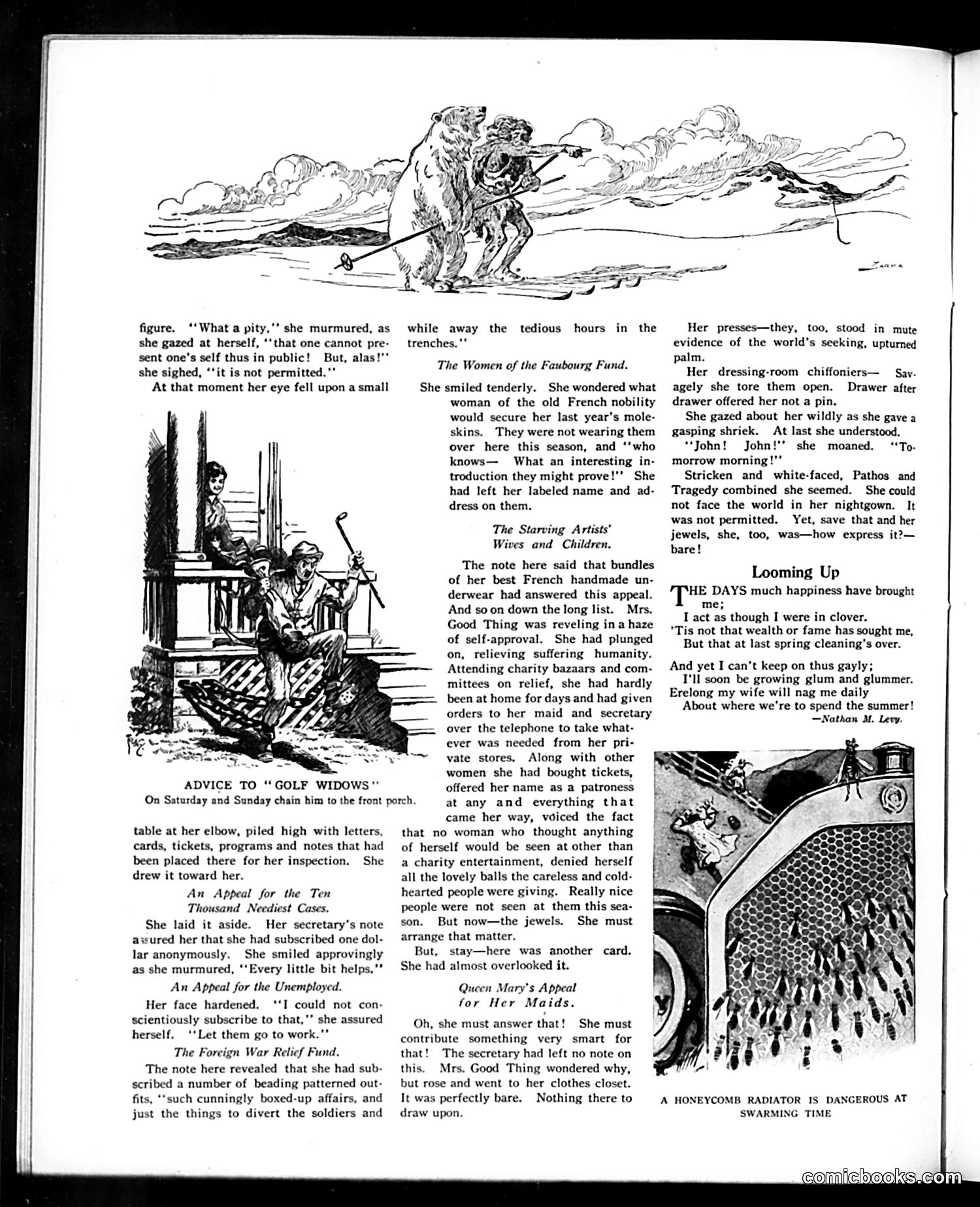
This Judge page satirizes wealthy women's shallow approach to wartime charity during WWI. The main cartoon (top) mocks "Golf Widows"—wives whose husbands abandon them for golf on weekends—with the sardonic advice to "chain him to the front porch." The longer narrative piece ridicules "Mrs. Good Thing," a society woman who performs conspicuous charitable giving while maintaining strict social pretense. She donates generously to *respectable* causes (French nobility, starving artists) while refusing the "Unemployed" appeal—she believes poor people should simply work. She brags publicly about charity work while attending no "lovely balls" (implying nice people only attend charity events, not social ones). The bitter punchline: when Queen Mary requests contributions for "Her Maids," Mrs. Good Thing frantically discovers she owns nothing but the jewels on her body—everything else has been donated. She cannot appear in public without clothes, yet charity has stripped her bare. The satire targets elite hypocrisy: performative wartime generosity masking class prejudice, and the vanity of women who donate castoffs while preening about their sacrifice.
📄 Transcribed text from this page (OCR, searchable)
Machine-transcribed from the original scan — historical spelling and the odd misread are preserved.
figure. ‘‘What a pity,’’ she murmured, as she gazed at herself, ‘‘that one cannot pre- sent one’s self thus in public! But, alas!’ she sighed, ‘‘it is not permitted.’" At that moment her eye fell upon a small ADVICE TO “GOLF WIDOWS" On Saturday and Sunday chain him to the front porch. table at her elbow, piled high with letters, cards, tickets, programs and notes that had been placed there for her inspection. She drew it toward her. An Appeal for the Ten Thousand Neediest Cases. She laid it aside. Her secretary's note assured her that she had subscribed one dol- lar anonymously. She smiled approvingly as she murmured, ‘Every little bit helps.’” An Appeal for the Unemployed. Her face hardened. ‘‘I could not con- scientiously subscribe to that,’’ she assured herself. ‘‘Let them go to work."’ The Foreign War Relief Fund. The note here revealed that she had sub- scribed a number of beading patterned out- fits, ‘such cunningly boxed-up affairs, and just the things to divert the soldiers and while away the tedious hours in the trenches."” The Women of the Faubourg Fund. She smiled tenderly. She wondered what woman of the old French nobility would secure her last year’s mole- skins. They were not wearing them over here this season, and ‘‘who knows— What an interesting in- troduction they might prove!’? She had left her labeled name and ad- dress on them, The Starving Artists’ Wives and Children, The note here said that bundles of her best French handmade un- derwear had answered this appeal. And so on down the long list. Mrs. Good Thing was reveling ina haze of self-approval. She had plunged on, relieving suffering humanity. Attending charity bazaars and com- mittees on relief, she had hardly been at home for days and had given orders to her maid and secretary over the telephone to take what- ever was needed from her pri- vate stores. Along with other women she had bought tickets, offered her name as a patroness at any and everything that came her way, voiced the fact that no woman who thought anything of herself would be seen at other than a charity entertainment, denied herself all the lovely balls the careless and cold- hearted people were giving. Really nice people were not seen at them this sea- son. But now—the jewels. She must arrange that matter. But, stay—here was another card. She had almost overlooked it. Queen Mary's Appeal for Her Maids. Oh, she must answer that! She must contribute something very smart for that! The secretary had left no note on this. Mrs. Good Thing wondered why, but rose and went to her clothes closet. It was perfectly bare. Nothing there to draw upon, Her presses—they, too, stood in mute evidence of the world’s seeking, upturned palm. Her dressing-room chiffoniers— agely she tore them open. drawer offered her not a pin. She gazed about her wildly as she gave a gasping shriek. At last she understood. “John! John!'’ she moaned. ‘‘To. morrow morning !"" Stricken and white-faced, Pathos and Tragedy combined she seemed. She could not face the world in her nightgown. It was not permitted. Yet, save that and her jewels, she, too, was—how express it?— bare! Sav- Drawer after Looming Up ‘HE DAYS much happiness have brought me; I act as though I were in clover. ‘Tis not that wealth or fame has sought me, But that at last spring cleaning’s over. And yet I can’t keep on thus gayly; T'll soon be growing glum and glummer. Erelong my wife will nag me daily About where we're to spend the summer! Nathan M. Levy. A HONEYCOMB RADIATOR IS DANGEROUS AT SWARMING TIME