
A complete issue · 24 pages · 1915
Judge — March 13, 1915
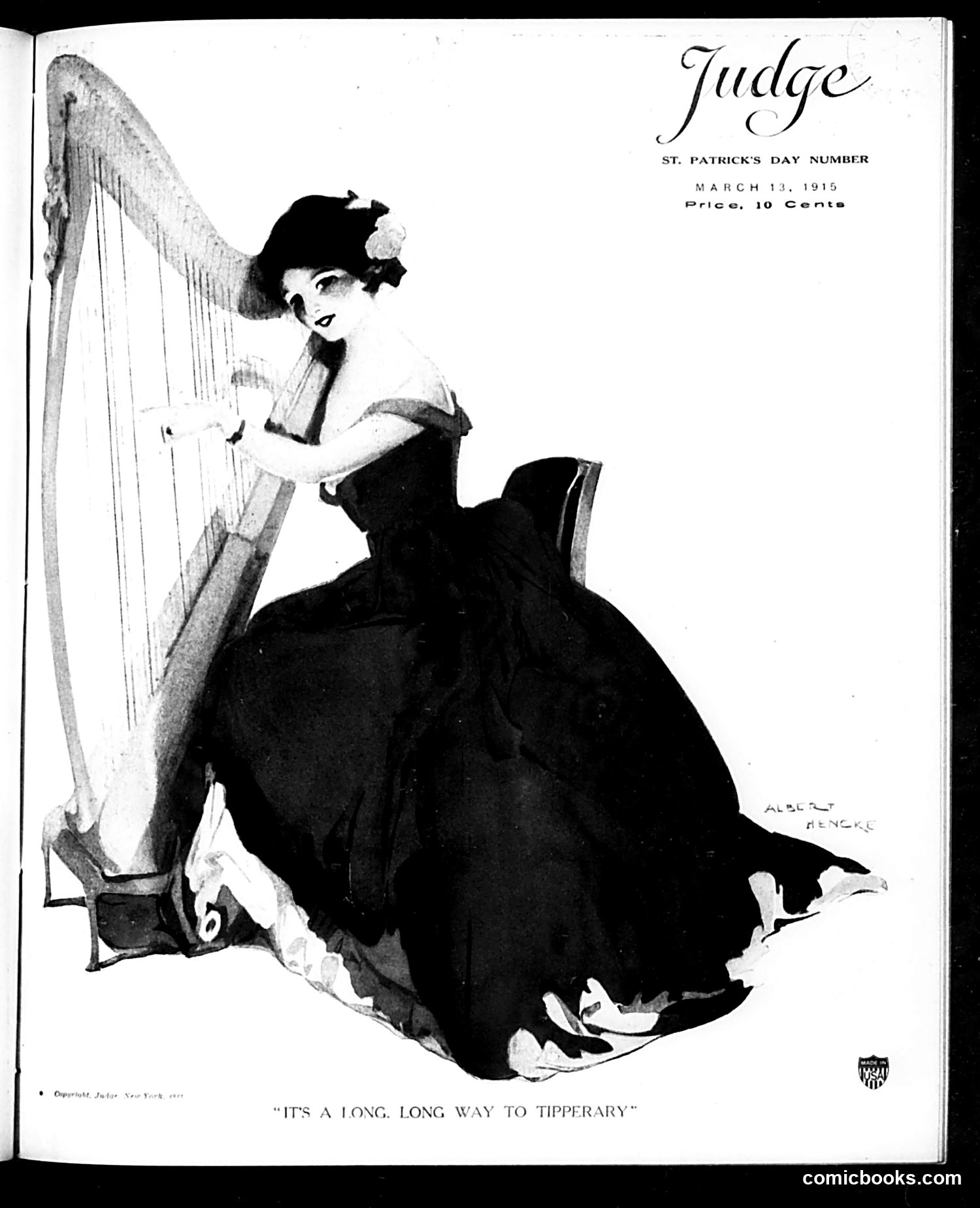
This is a **Judge magazine St. Patrick's Day issue** (March 13, 1915) featuring an Irish woman in traditional dress playing a harp. The caption references the popular WWI song "It's a Long, Long Way to Tipperary" (1912), which became an anthem for Irish soldiers serving in the British Army. The satire likely plays on the irony of Irish participation in British military efforts during World War I, despite Irish independence struggles. The woman at the harp—a symbol of Ireland—seems to evoke both Irish cultural identity and the distance between Ireland and those fighting overseas. The cartoon appears to comment on Irish-American identity and the complicated relationship between Irish nationalism and British war efforts during this period.
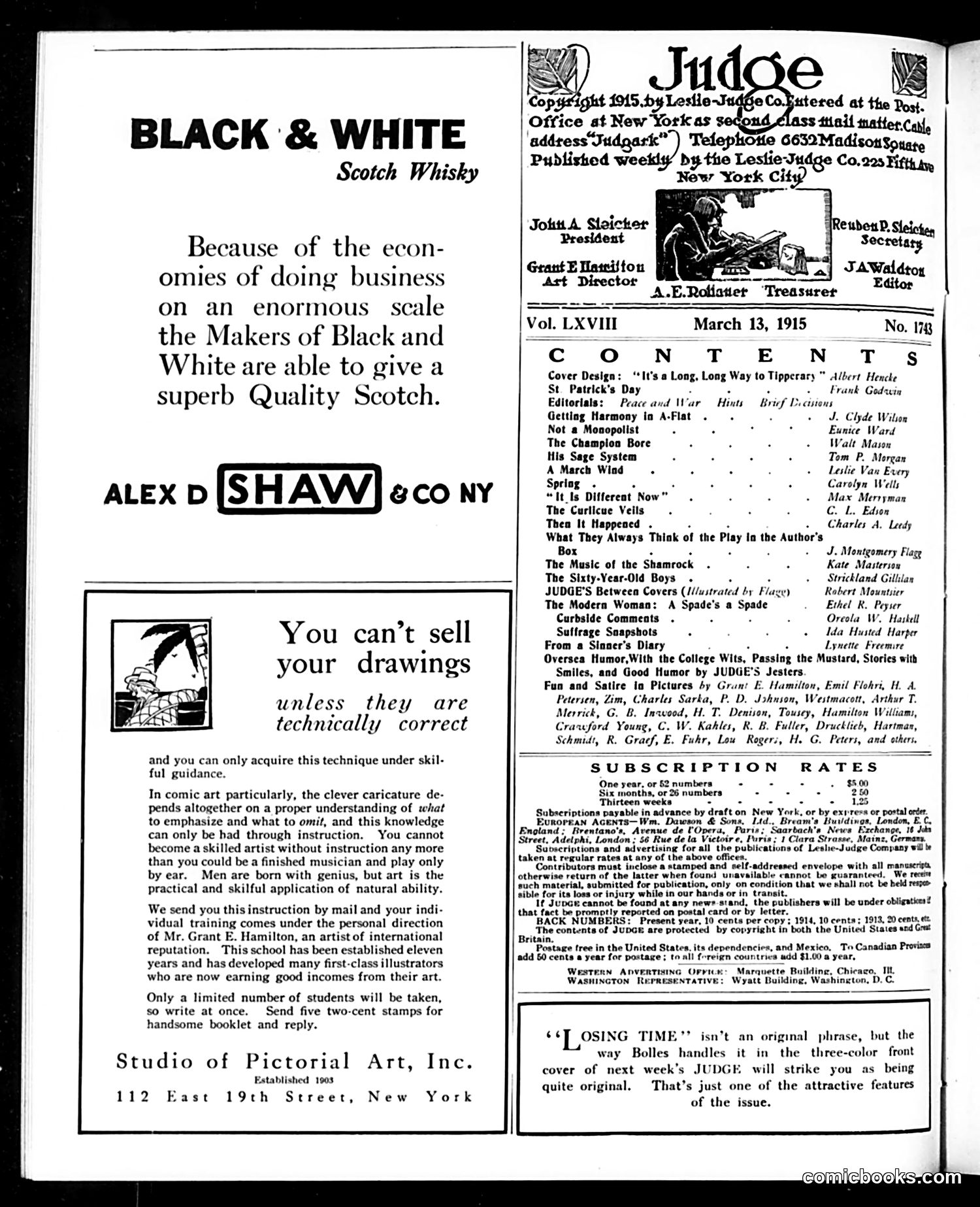
This page is primarily **advertising and editorial content** rather than political cartoons. The left side contains two ads: one for **Black & White Scotch Whisky** and another for the **Studio of Pictorial Art, Inc.**, promoting mail-order instruction in cartooning and drawing. The latter emphasizes that successful comic art requires "technical correctness" and proper training. The right side displays the magazine's masthead, contents list, and subscription information. Notable article titles include "Getting Harmony in A-Flat," "The Champion Bore," and "The Sixtey-Year-Old Boys." There are **no prominent political cartoons visible** on this particular page—it's primarily a table of contents and advertising, typical of magazine interior pages from 1915.
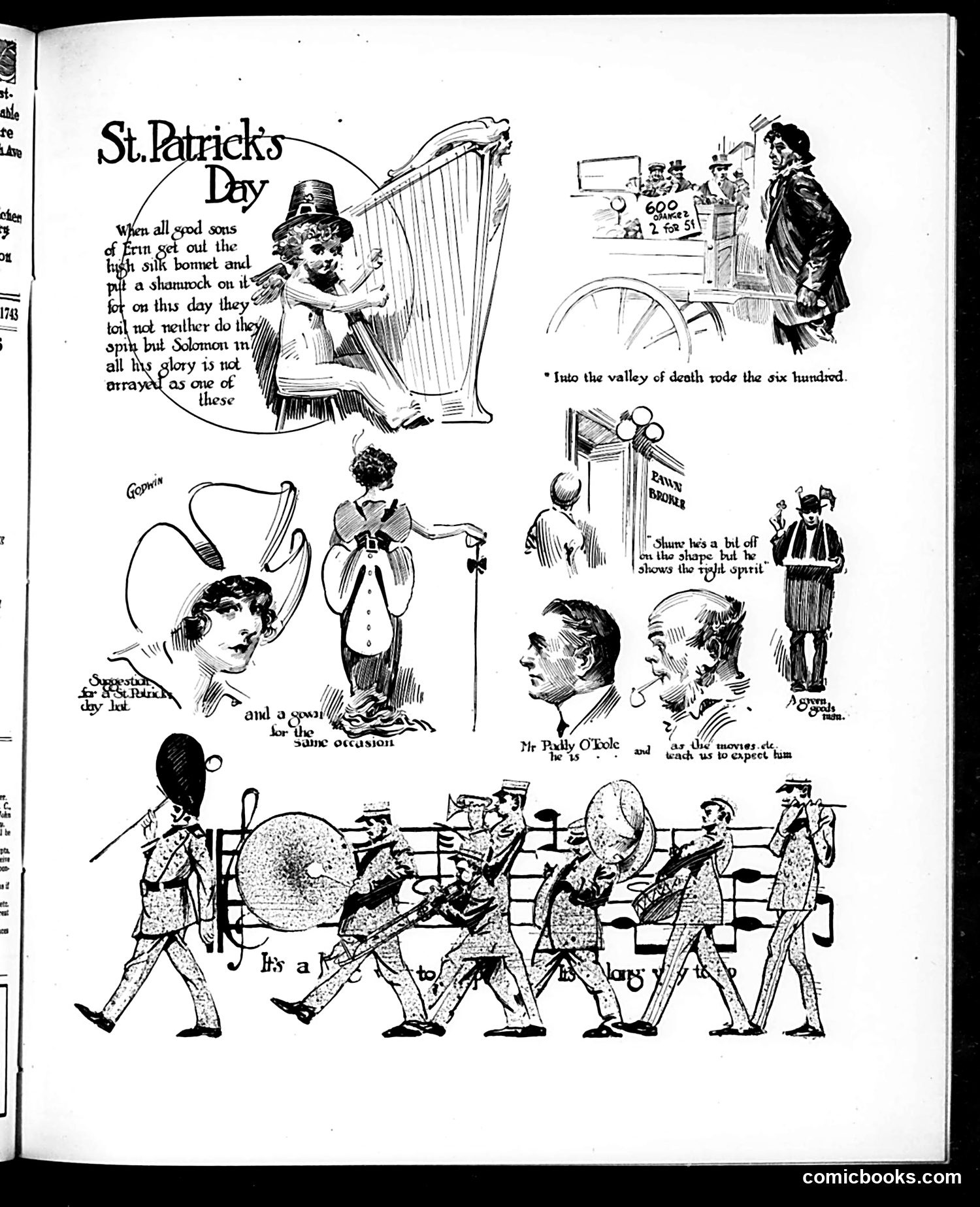
This **Judge** magazine page satirizes St. Patrick's Day celebrations, particularly among Irish-Americans. The top text mocks the holiday's grandiosity, claiming that while good Irishmen wear silk bonnets and shamrocks, their glory "is not arranged as one of these"—suggesting pretentiousness in how Irish identity is performed. The illustrations show Irish stereotypes common to the era: exaggerated facial features, caricatured dress, and comic situations. One panel references "Paddy O'Cole" and mentions "the movies" expecting someone's arrival, suggesting Irish participation in emerging popular entertainment. The bottom parade scene depicts marching figures in military dress, likely satirizing Irish-American civic pride and organized St. Patrick's Day parades. The overall tone mocks both the holiday's commercialization and Irish-American cultural presentation.
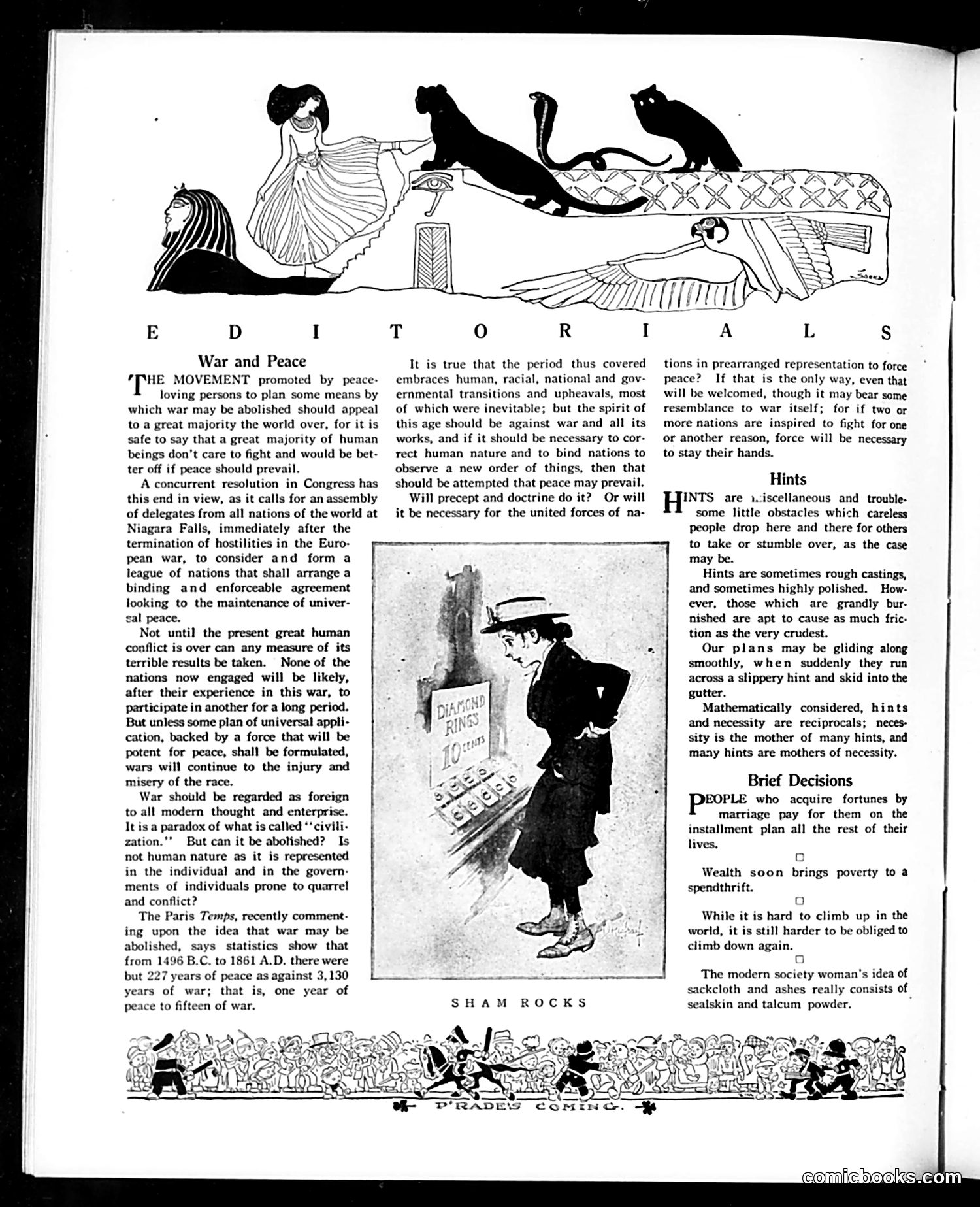
The top illustration, labeled "EDITORIALS," depicts ancient Egyptian imagery (pharaoh, hieroglyphics, animals) to frame an article titled "War and Peace." The accompanying text discusses whether war can be abolished and advocates for international peace agreements—likely referencing post-WWI discussions about the League of Nations (mentioned explicitly). The "SHAMROCKS" cartoon shows a man in formal dress examining what appears to be a diamond or jewel display, satirizing materialism or fraud in the gem trade. Below are sections titled "Hints" (offering practical domestic advice) and "Brief Decisions" (satirical one-liners about marriage, wealth, and modern women's fashions). The page's overall tone mixes serious political commentary on peace with light social satire—typical of Judge's approach during the early 20th century.
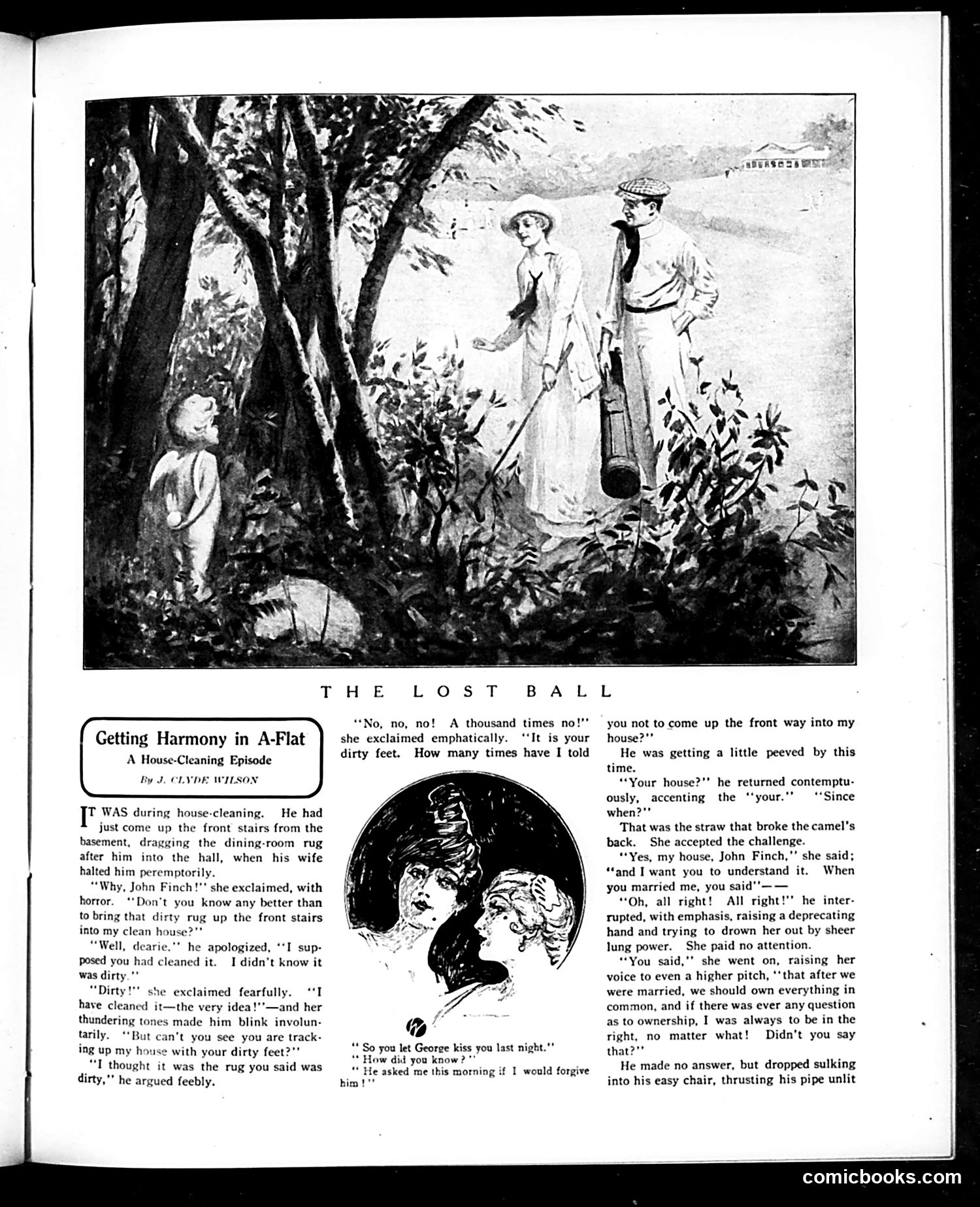
This domestic comedy from *Judge* magazine satirizes early 20th-century marriage tensions. A husband tracking mud through the house provokes his wife's exasperation about cleanliness standards. Their conflict escalates into a broader argument about authority in marriage—she demands he acknowledge her housekeeping expertise and right to rule domestic space. The satire targets both spouses: the husband's obliviousness and defensiveness, and the wife's aggressive assertion of control. The title pun ("A-Flat") references musical discord, suggesting marital disharmony. The humor derives from the relatable domesticity of the dispute—a common source of conflict in contemporary households—making it accessible social commentary on gender roles and household management expectations of the era.
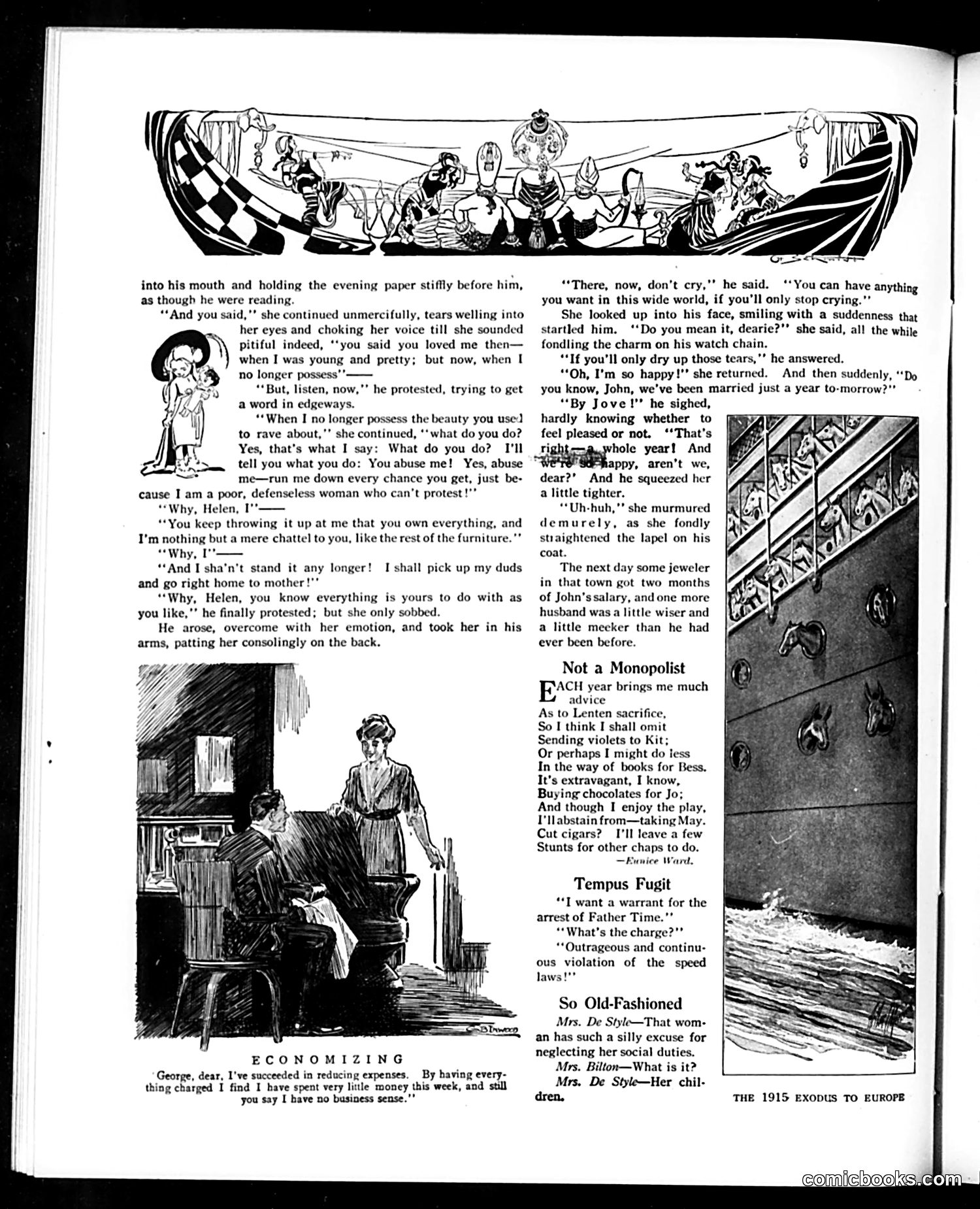
This page from Judge magazine (circa 1915) contains multiple satirical pieces about marriage and modern life: **Main Story ("Economizing")**: Depicts a marital conflict where a husband accuses his wife of overspending despite her claiming to "reduce expenses" by charging everything. The satire mocks wives' financial irresponsibility and the husband's weakness—he capitulates to tears, promising her anything. The twist ending shows him manipulated into buying expensive jewelry. **"Not a Monopolist"**: A humorous poem where the writer lists Lenten sacrifices he'll *avoid* making, satirizing those who grandly announce self-denial while doing nothing. **"Tempus Fugit"**: A brief joke about arresting "Father Time" for speeding—contemporary commentary on modern life's accelerating pace. **"So Old-Fashioned"**: A gossipy exchange mocking women who prioritize childcare over social obligations. The overall theme reflects 1915 anxieties about women's consumer power, changing gender roles, and modern manners.
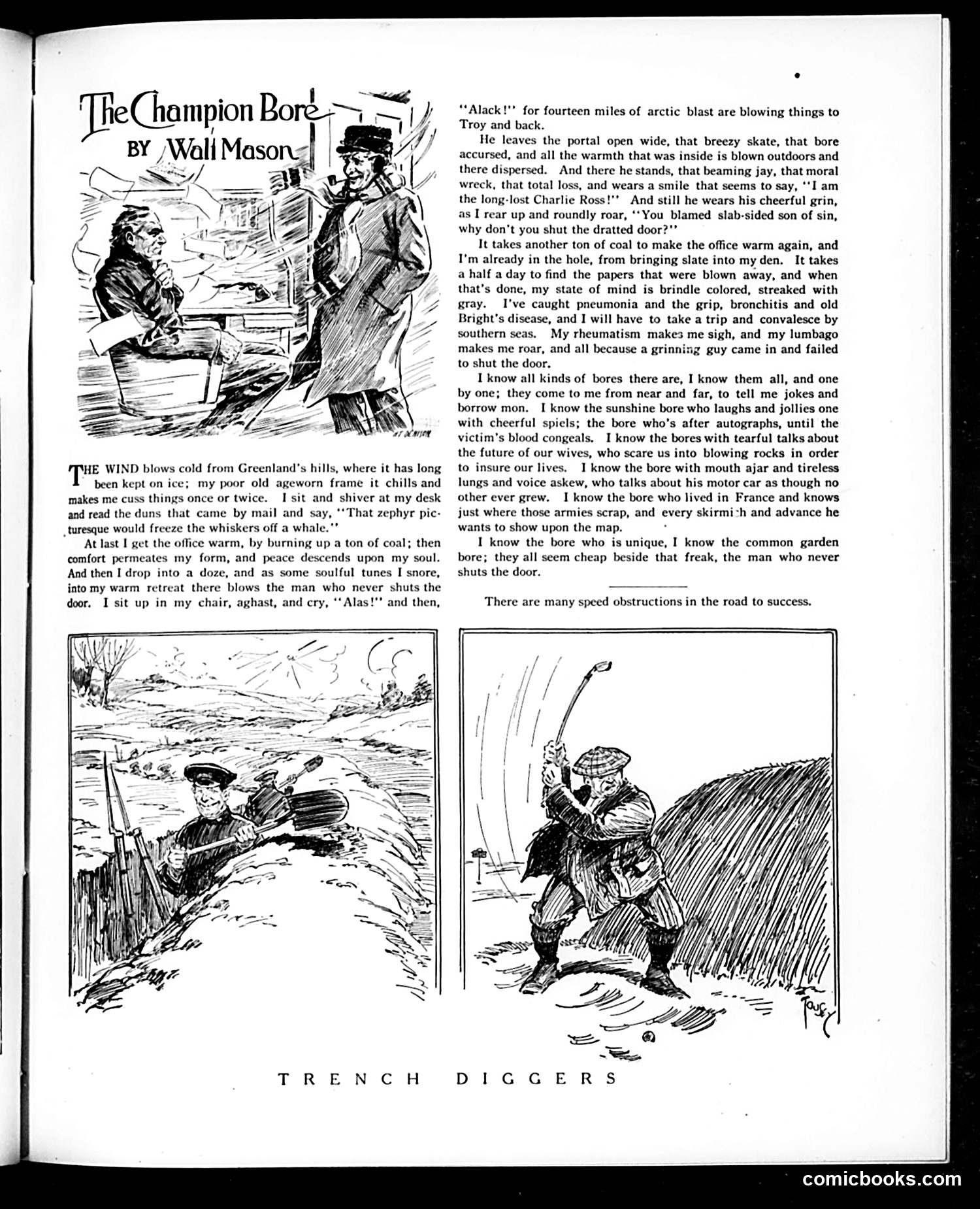
This satirical piece mocks a universal office annoyance: the colleague who perpetually leaves doors open, letting in cold drafts and undoing efforts to heat the workspace. The narrator, an office worker struggling against arctic winds from Greenland, finally gets warm by burning coal, only to have an inconsiderate coworker repeatedly burst in without closing the door behind him. The humor escalates through the narrator's catalog of different "bores"—the joke-teller, the autograph-seeker, the insurance-scare-monger, the motor-car-bore, the war-map expert. Yet all pale beside this "freak, the man who never shuts the door," making him the supreme annoyance. The cartoons depicting "trench diggers" visually reinforce the exhausting, futile labor of repeatedly reheating the office. This targets middle-class office culture's petty frustrations and the one inconsiderate person who wastes everyone's time and resources.
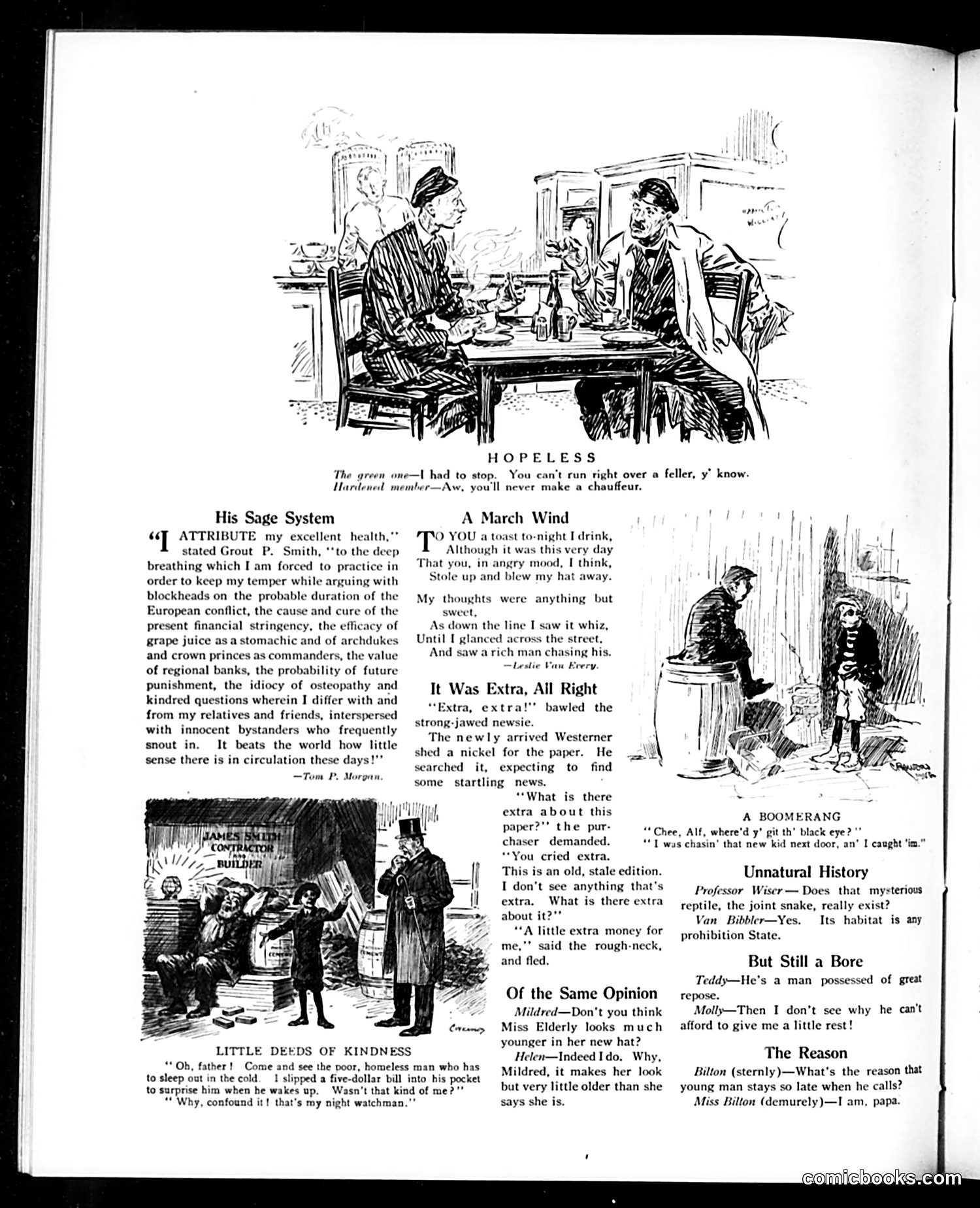
This page collects satirical humor pieces reflecting early 20th-century American concerns: **"Hopeless"** depicts a driving instructor frustrated with a pupil—likely mocking the novelty of automobiles and new drivers' incompetence. **"His Sage System"** satirizes a man who attributes his health to deep breathing while arguing with everyone about World War I, finances, and other topics. The joke: he's insufferable but calls it wellness practice. **"Little Deeds of Kindness"** shows a father proudly giving a homeless man money, only to be told he's "surprised" him—implying the gift was selfish theater rather than genuine charity. **"It Was Extra, All Right"** mocks a newspaper boy's con: selling an old edition as "extra" (urgent edition) simply to charge extra money. **"A Boomerang"** presents karma—a child chasing another child gets caught and beaten instead. **"Joint Snake" and other brief items** make topical jokes about Prohibition-era concerns and courtship customs. The overall tone emphasizes human folly, pretense, and hypocrisy in everyday situations.
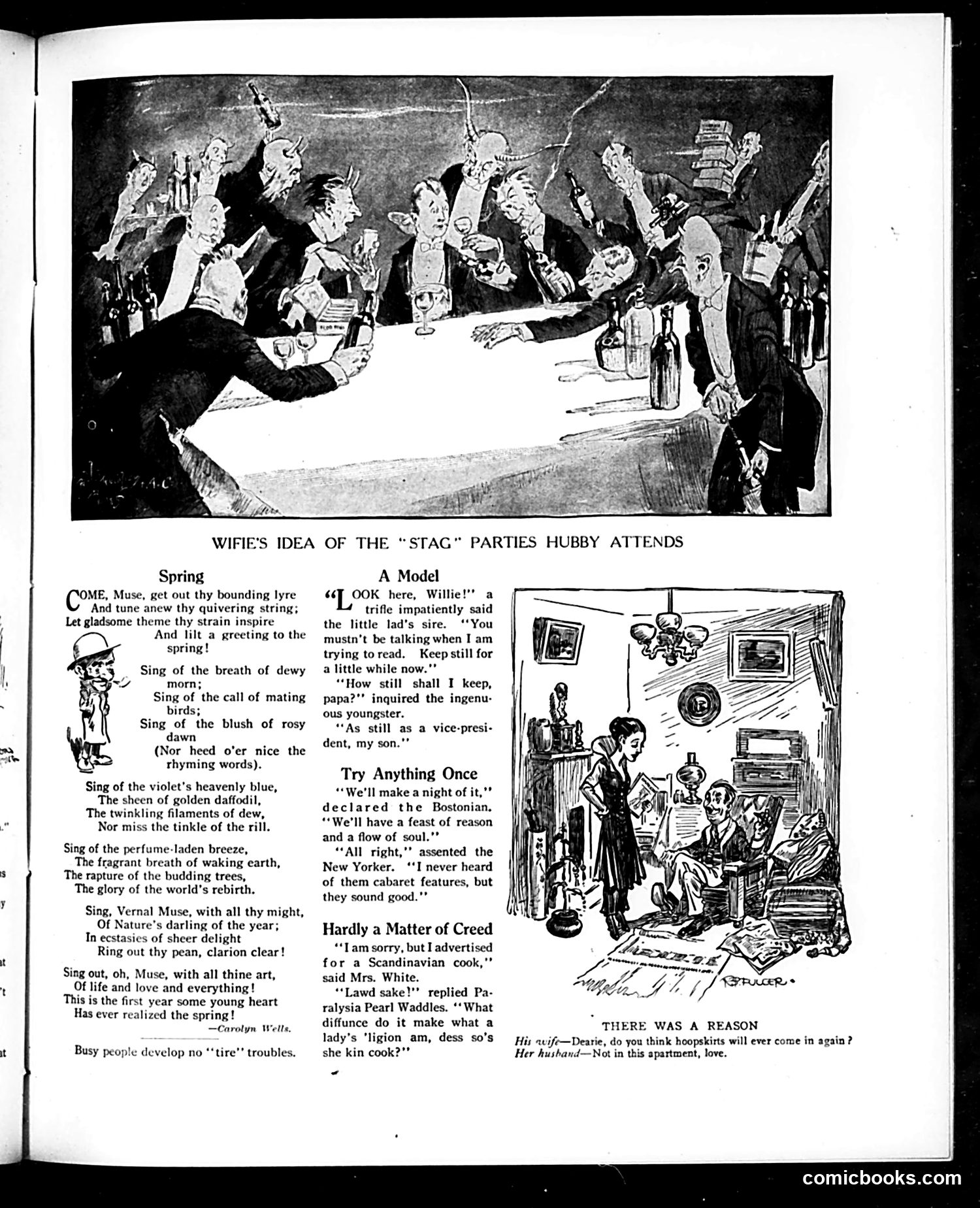
This Judge magazine page contains three separate humor pieces satirizing early 20th-century American social life: **"Spring"** is a sentimental poem gently mocked for its overwrought romanticism—the instruction to ignore "o'er nice" rhyming suggests the verse prioritizes flowery sentiment over actual craft. **"A Model"** jokes about a father telling his son to be "as still as a vice-president"—satirizing politicians as uselessly inactive. The bottom cartoon depicts a "stag party" (men-only gathering), with the caption "Wifie's Idea" suggesting wives imagined these gatherings as refined intellectual salons ("feast of reason"), when they were actually just drinking and socializing. **"Hardly a Matter of Creed"** uses dialect humor (common in period Judge): a Black domestic worker (Paralysia Pearl Waddles) applies for a Scandinavian cook position but argues competence matters more than ethnicity/religion—likely intended as gentle satire of employers' arbitrary hiring preferences, though the dialect itself reflects the magazine's problematic conventions. **"There Was a Reason"** makes a brief joke about hoopskirts never returning to apartments, implying marital domestic confinement.
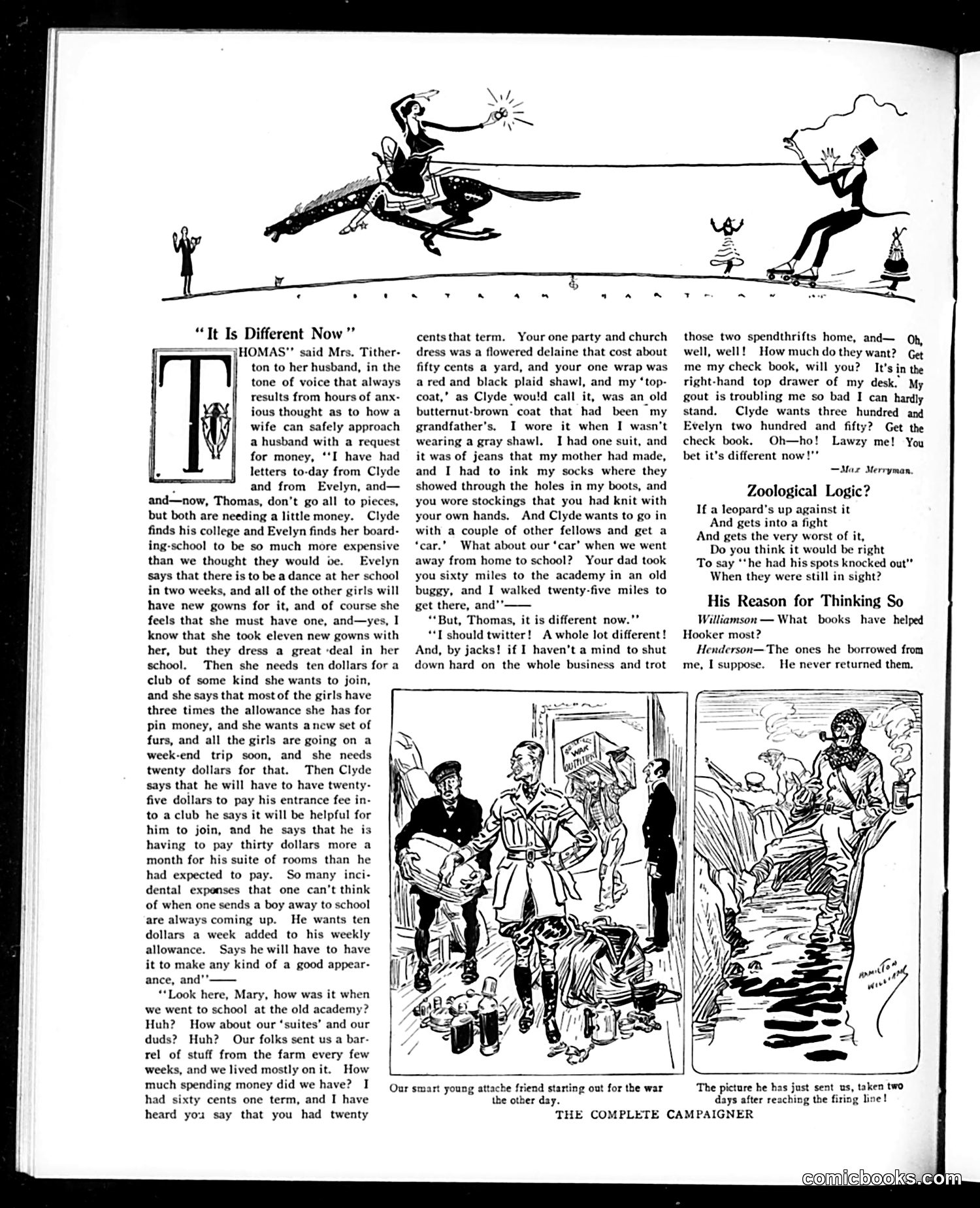
This page satirizes the generational gap in spending habits and parental indulgence. The main article, "It Is Different Now," presents a dialogue between Mr. and Mrs. Titherton about their adult children's financial demands. **The satire:** Mrs. Titherton carefully approaches her husband requesting money for their children's college and boarding school expenses—new gowns, club memberships, furs, a car, and expanded allowances. Mr. Titherton responds by reminiscing about his own frugal youth: worn hand-me-downs, homemade stockings with holes requiring ink repairs, traveling by foot and buggy. **The point:** Despite his complaints about modern extravagance, Mr. Titherton capitulates immediately, handing over substantial sums (three hundred and two hundred fifty dollars—considerable sums for the era). The humor lies in the contradiction: he criticizes his children's materialism while enabling it, and his gout complaint suggests physical discomfort from the financial "blow." The accompanying illustrations and shorter pieces offer additional social commentary on wartime attitudes and comic wordplay.
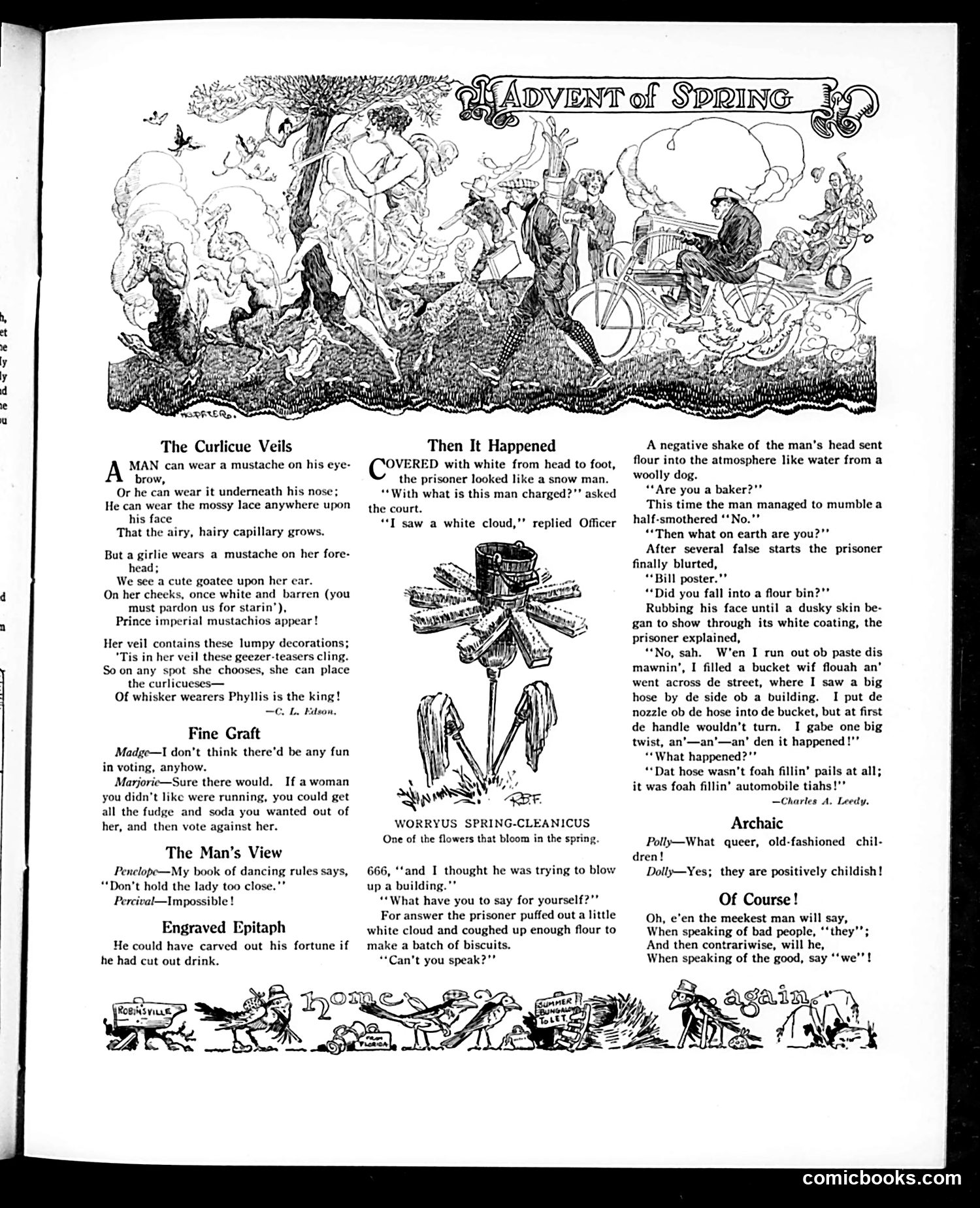
This page from Judge contains several short humorous pieces satirizing early 20th-century social conventions: **"The Curlicue Veils"** mocks women's fashion, specifically the elaborate facial hair-like decorative veils then in style. The poem jokes that women wear mustaches and goatees on their foreheads and ears through their veil ornamentation—inverting the male prerogative of facial hair. **"Then It Happened"** is a comic narrative about a bill poster (someone who pastes advertisements) who, while trying to refill his paste bucket, accidentally opens a fire hose, covering himself in flour. The humor derives from his confusion and the officer's absurd questioning. **"Fine Graft"** satirizes women's voting behavior, suggesting women vote against candidates they dislike primarily to extract treats (soda, fudge) from supporters. The remaining brief pieces mock dating customs, drinking problems, and grammatical hypocrisy in speech. The overall page targets contemporary fashion, politics, and social behaviors through lighthearted satirical verse and anecdotes typical of Judge's style.
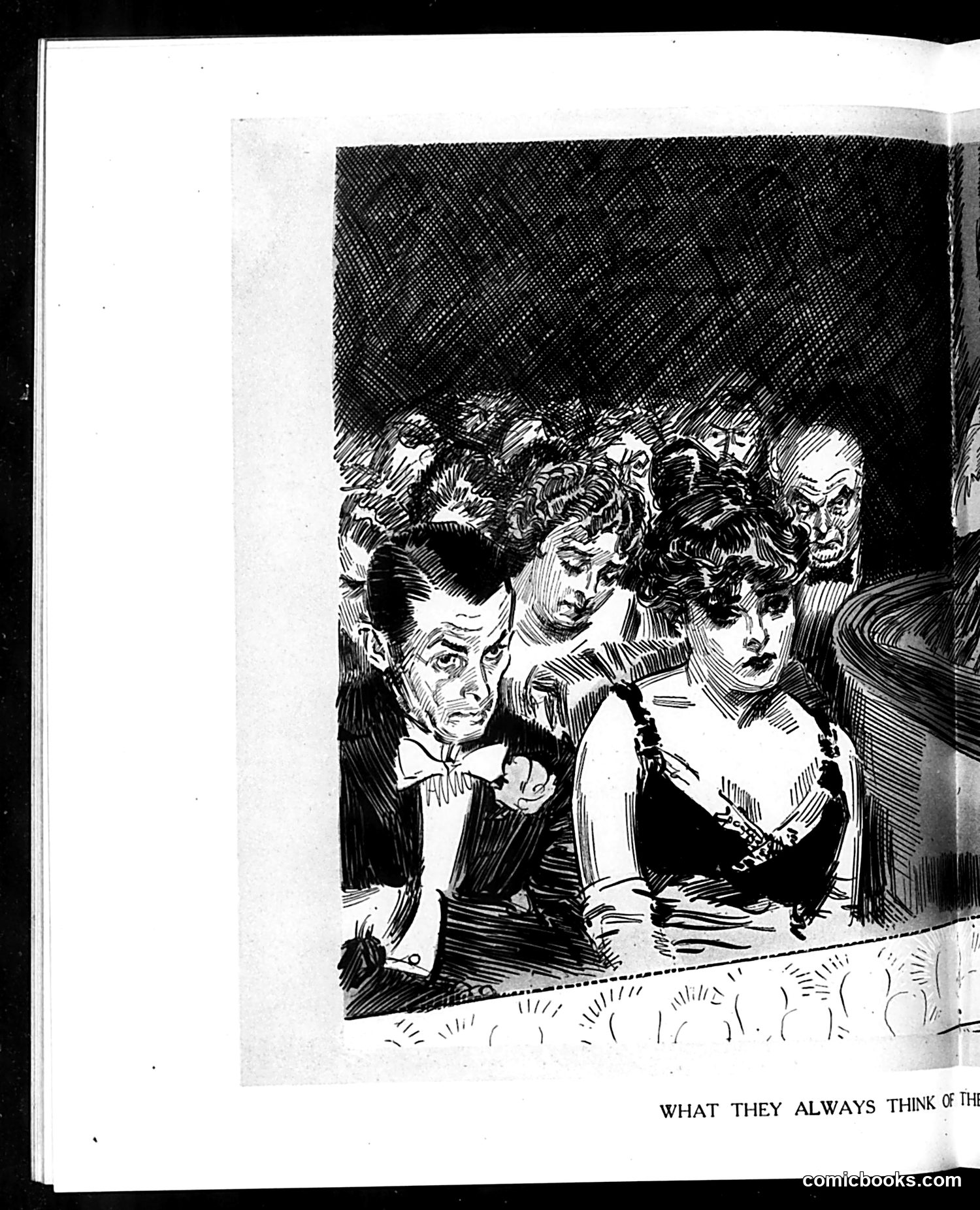
This is a black and white illustration from Judge magazine showing a formal social scene—apparently an elegant dinner or gathering where well-dressed guests are present. The caption reads "WHAT THEY ALWAYS THINK OF TH[E]" (text cut off). The cartoon appears to satirize the thoughts or prejudices of upper-class society figures toward someone or something, likely a person of lower social status who has entered their refined setting. The contrast between the formally-dressed attendees and the implied judgment in the caption suggests satire about class snobbery or social hypocrisy—how wealthy elites harbor contemptuous thoughts about working-class or "outsider" individuals despite maintaining polite facades. The artistic style and engraving technique are consistent with Judge's early-to-mid 20th century publication period, though the specific date and full caption remain unclear.
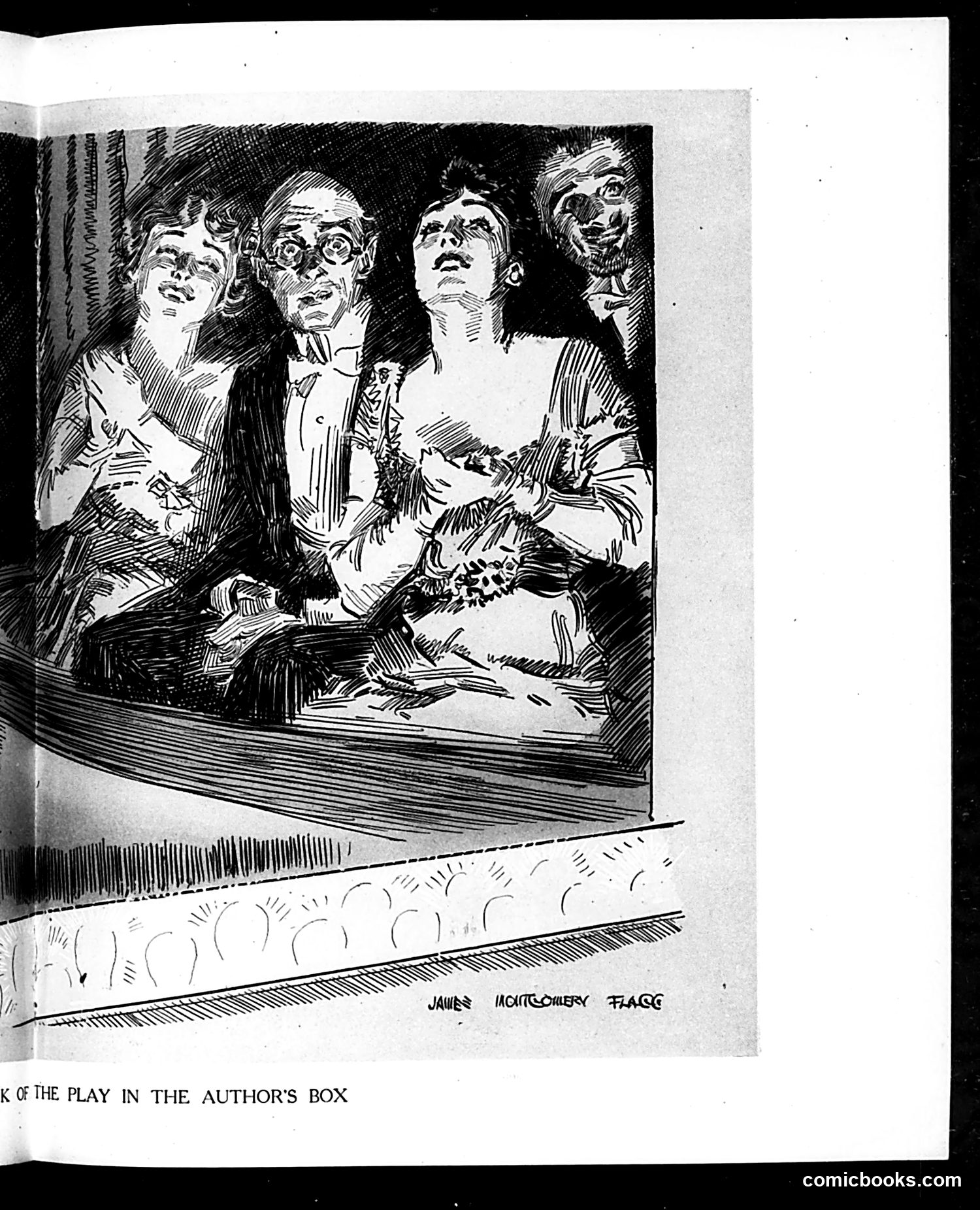
This is a theatrical illustration from *Judge* magazine signed by James Montgomery Flagg. The caption "K OF THE PLAY IN THE AUTHOR'S BOX" indicates this depicts a scene from a play as viewed from the author's box at a theater. The image shows four figures in formal evening wear reacting with exaggerated expressions—some amused, others scandalized or astonished—to what appears to be action on stage below (partially visible). The sketch style and their elaborate gestures suggest they're responding to something surprising or inappropriate happening in the theatrical performance. Without additional context about which specific play is referenced, the exact subject of their shock remains unclear, though the cartoon satirizes typical theater-audience reactions to dramatic or risqué stage moments.
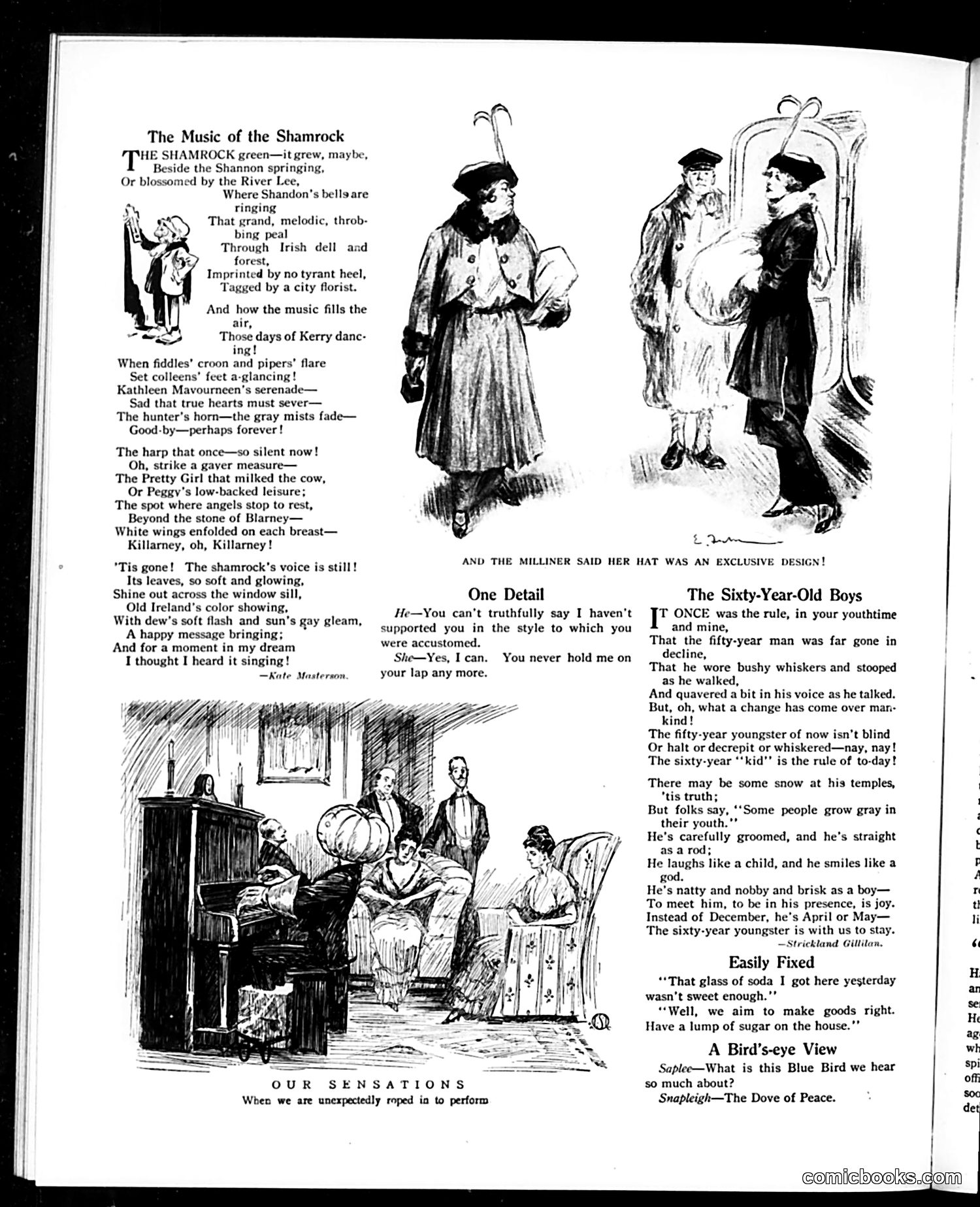
This page from *Judge* magazine contains several distinct pieces of social commentary: **"The Music of the Shamrock"** is a nostalgic poem by Kate Masterson lamenting the fading of traditional Irish culture and music—referencing iconic Irish symbols (harps, Killarney, traditional dances) now seemingly "gone" or commercialized ("tagged by a city florist"). **"The Milliner" cartoon** satirizes fashion pretension: a woman displays an ordinary hat, claiming it's an "exclusive design," while her male companion's knowing glance suggests the hat is actually mass-produced or copied. **"The Sixty-Year-Old Boys"** mocks the era's obsession with appearing youthful. It contrasts old ideals (elderly men as gray, stooped, infirm) with modern vanity culture where sixty-year-old men dress fashionably, groom meticulously, and affect youthful behavior—suggesting this trend is here to stay despite being somewhat ridiculous. **"One Detail"** is a brief marriage joke about romantic affection declining with time. The remaining items are minor humor pieces about customer service and wordplay.
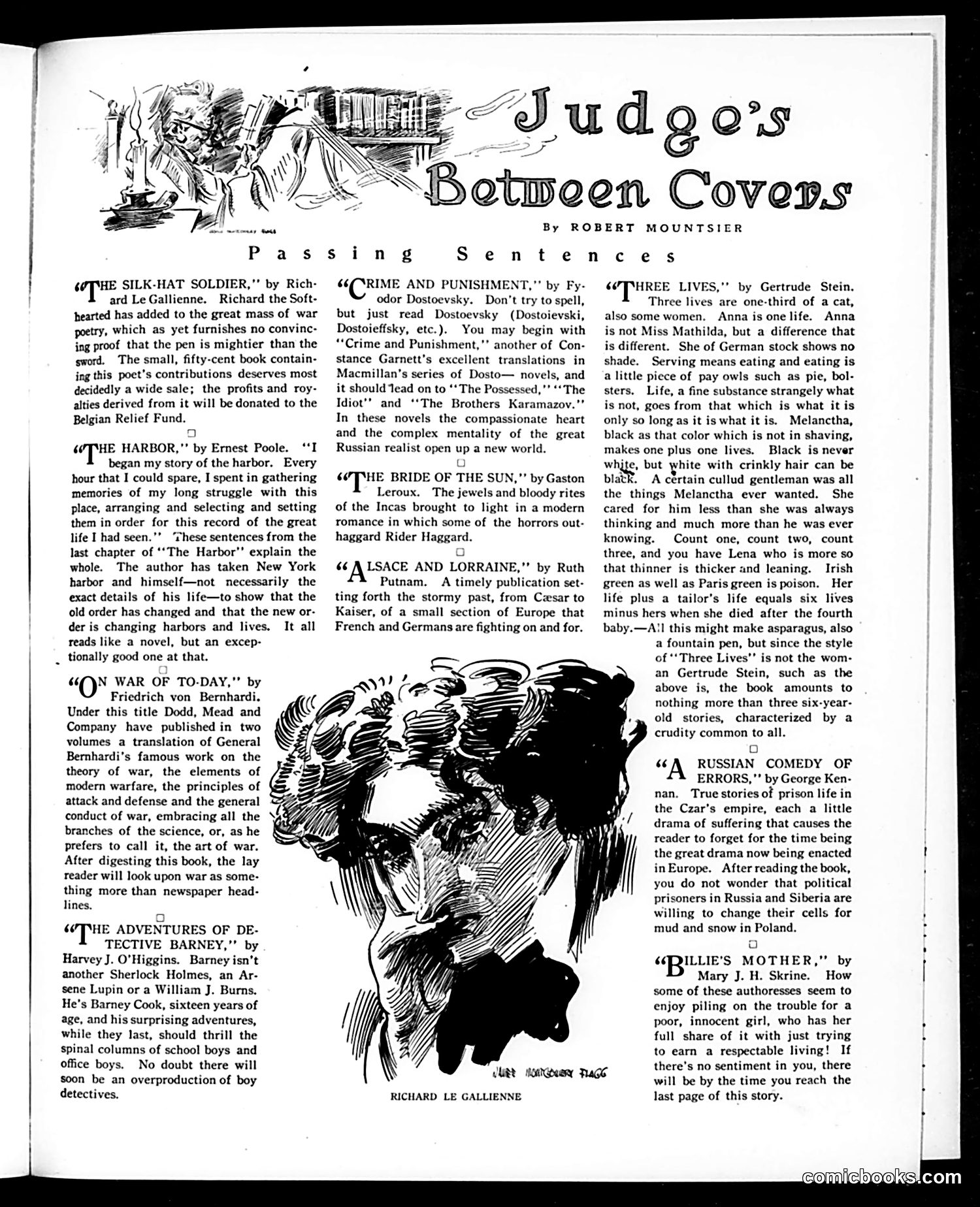
This page reviews contemporary books, with a large portrait sketch of Richard Le Gallienne (a popular poet/writer of the era) dominating the center. **Context for modern readers:** The reviews reveal early WWI-era concerns. "The Silk-Hat Soldier" and "On War of To-Day" (Bernhardi's military theory) reflect America's anxious debate over the European conflict. "Alsace and Lorraine" addresses the disputed French-German border region—then a active war zone. The satirical "Three Lives" review mocks Gertrude Stein's experimental modernist prose style, presenting her abstract sentences as nonsensical word-play. Contemporary readers would recognize this as criticism of avant-garde literary experimentation that seemed impenetrable to general audiences. The book selections—Russian realist fiction (Dostoevsky), adventure tales, detective stories—show Judge magazine's audience as educated but mainstream readers skeptical of artistic modernism.
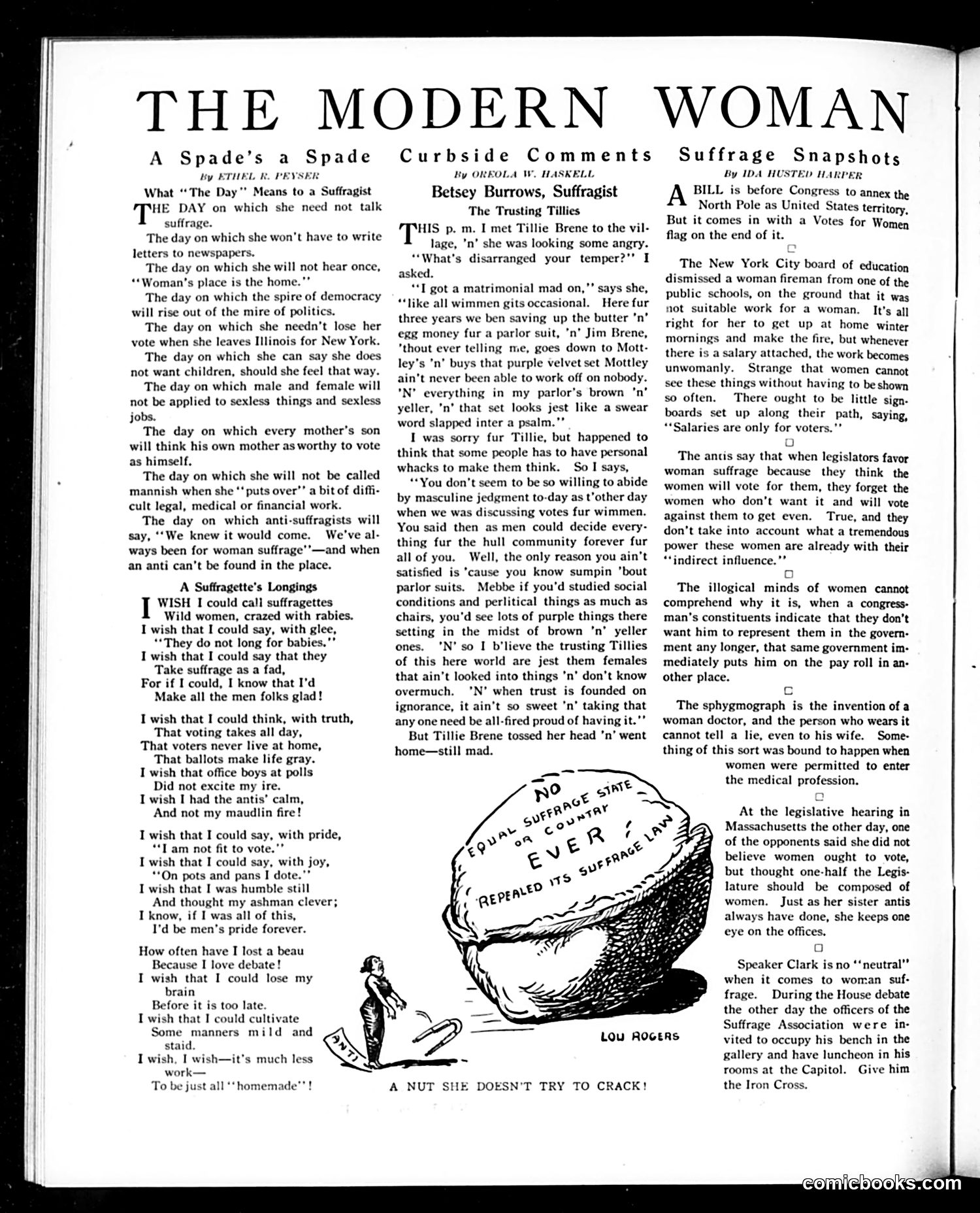
This Judge magazine page satirizes the women's suffrage movement circa 1910s-1920s through three pieces: **Left column ("A Spade's a Spade")**: Ethel R. Peyser lists what suffragists mean by "the day"—voting rights, freedom from dismissive comments about women's place being "the home," and equal treatment in professional work. **Center ("A Suffragette's Longings")**: A poem ironically expresses a suffragette's wish to be "traditional"—to stop caring about voting, lose her brain, and be "just all 'homemade'"—while admitting she's lost romantic prospects due to her commitment to debate and reform. **Right column ("Curbside Comments")**: A rural-dialect story where character Betsey Burrows uses Tillie Brene's complaint about her husband buying ugly furniture without consulting her to argue that women shouldn't trust men's judgment on "social conditions and political things" either—a clever reductio ad absurdum for women's suffrage. **Lou Rogers' cartoon** depicts a nut resisting being cracked, captioned "A NUT SHE DOESN'T TRY TO CRACK"—likely commentary on resistant opposition to suffrage. The overall tone is pro-suffrage, using humor to argue women deserve voting rights.
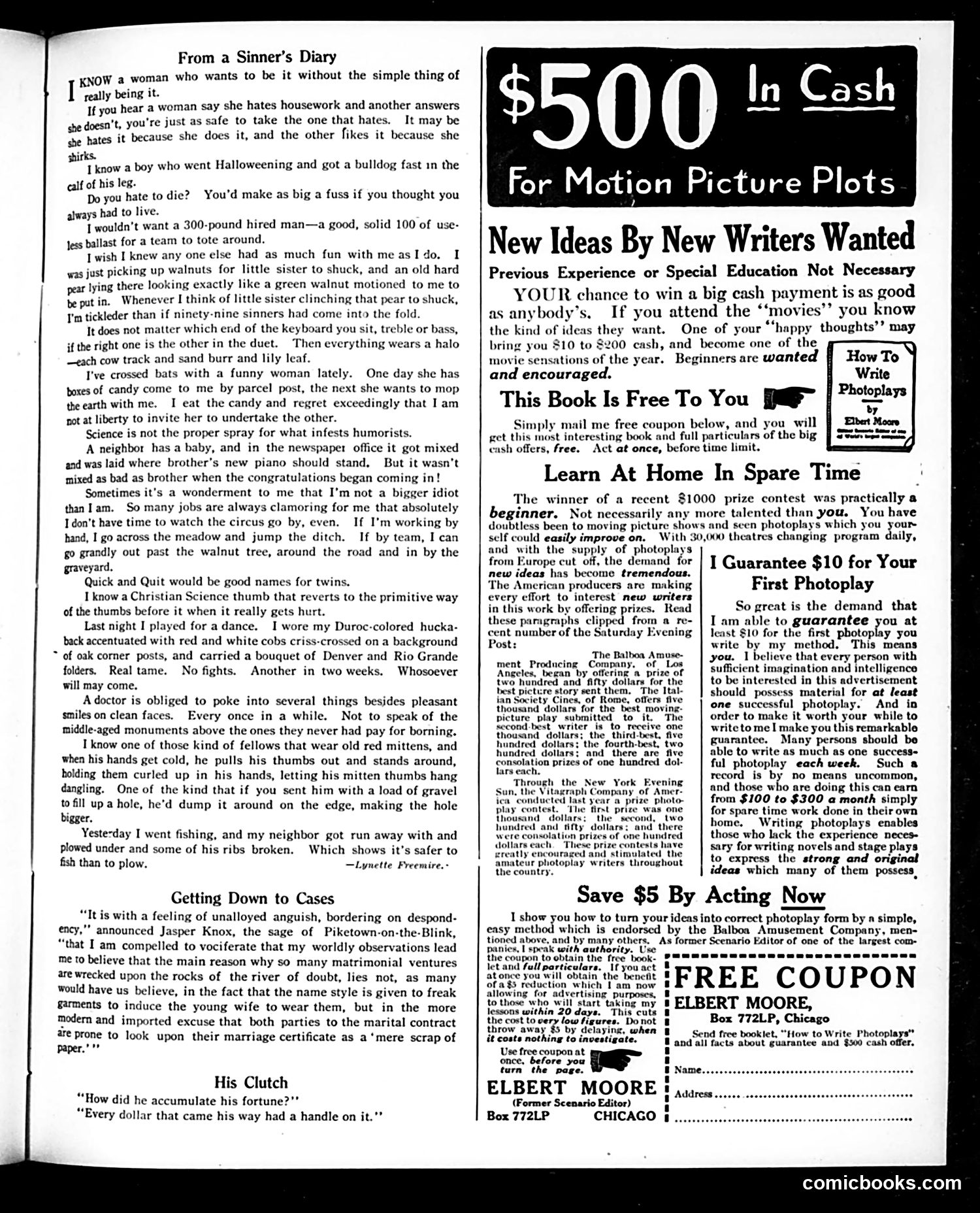
This page contains a humorous personal essay by Lynette Freemire rather than political cartoons. The "Sinner's Diary" presents wry observations on human nature and everyday life through anecdotes—a woman who claims to hate housework but shirks it, a prank involving substituting a pear for walnuts, a neighbor whose moody candy-giving contrasts with subsequent coldness. The satire is gentle and domestic rather than political. Freemire mocks human contradictions: people who deny enjoying things they avoid, the absurdity of daily struggles, and the humor in life's small misadventures (a man plowing after being run away with). The piece exemplifies Judge's miscellaneous humor content—witty, folksy observations meant to amuse middle-class readers about relatable social situations and character quirks, without targeting specific political figures or events.
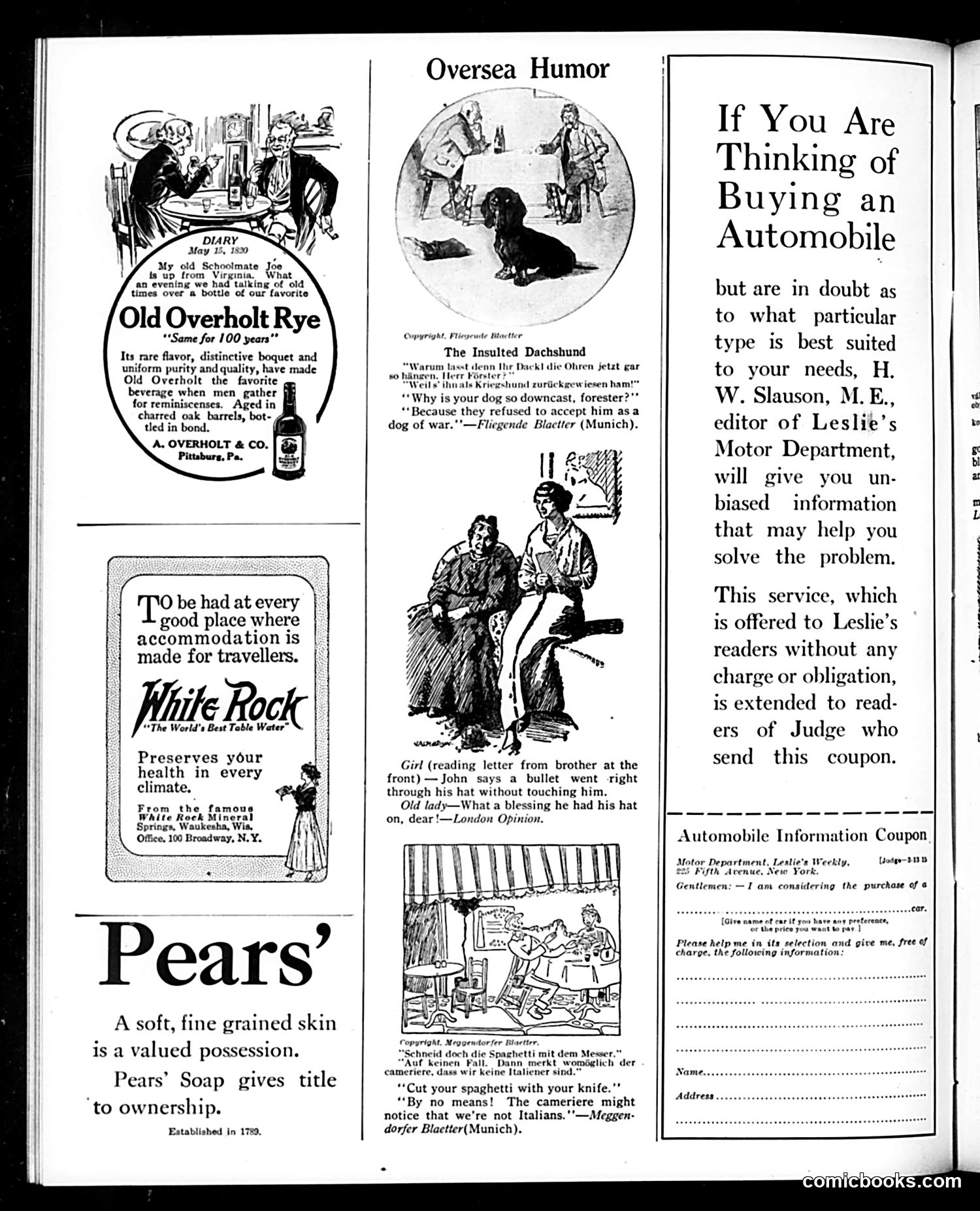
This page consists primarily of **advertisements and reprinted humor** rather than original satirical content. The "Oversea Humor" section features translated jokes from German and British publications, reflecting Judge's practice of sharing international wit. The jokes are mild: a dachshund refuses military service (likely a WWI-era jab at Germany), a woman misinterprets her brother's bullet-hole hat as providential, and immigrants awkwardly avoid using a knife on spaghetti to hide their non-Italian status. The main advertisements—Old Overholt Rye whiskey, White Rock mineral water, and Pears' Soap—use nostalgic and class-conscious appeals typical of early 20th-century marketing. The automobile information coupon offers readers free automotive advice, cross-promoting Judge with Leslie's Weekly, a sister publication. This page is **primarily commercial**, using humor as filler between paid content rather than delivering Judge's signature political satire.
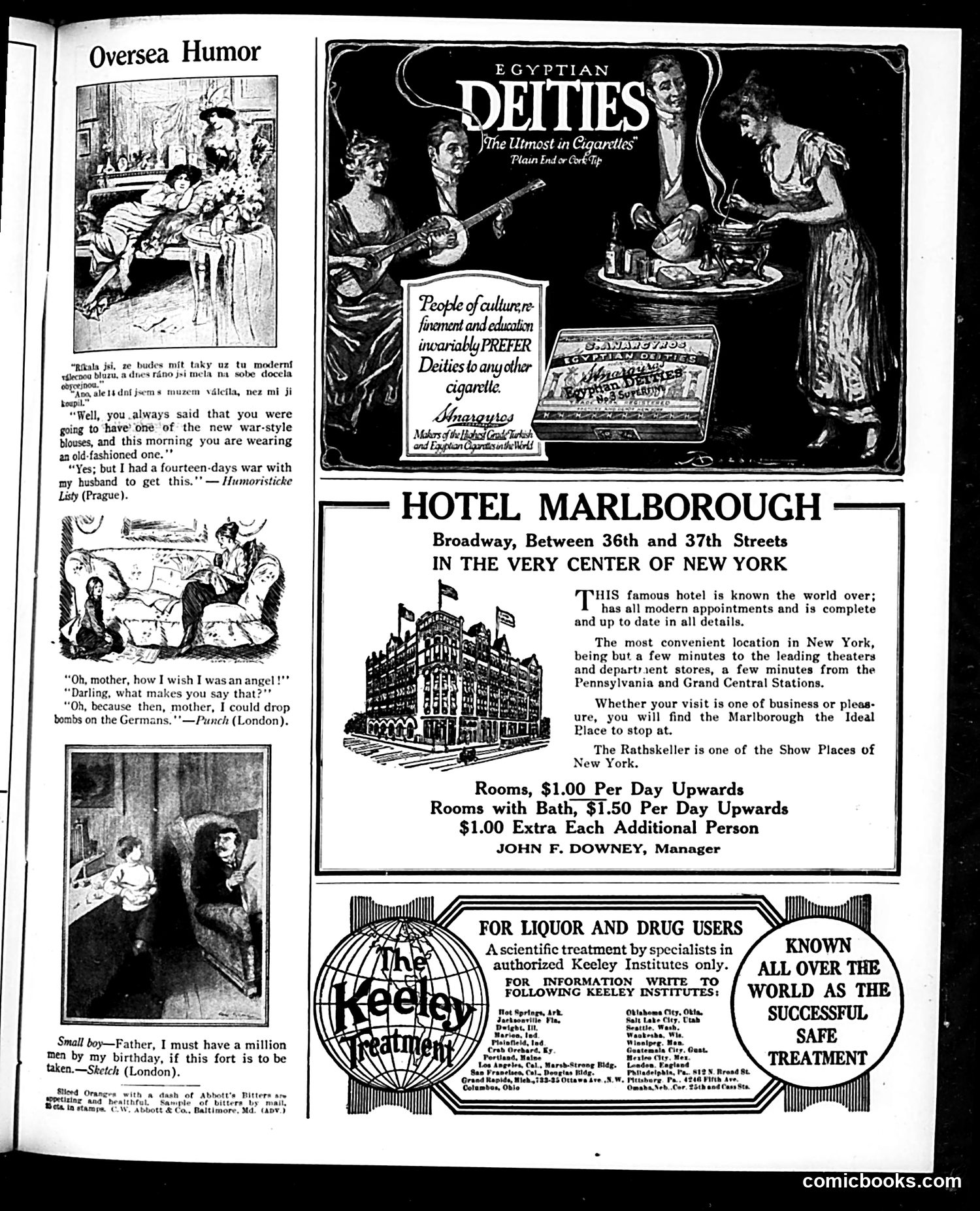
This page from *Judge* magazine contains primarily **advertisements and reprinted international humor** rather than original political cartoons. The "Oversea Humor" section features three brief jokes translated from European sources (Prague, London, and London again), satirizing **World War I-era attitudes**: 1. A wife justifies wearing an old-fashioned blouse after a "four-days war" with her husband—domestic conflict mirroring real warfare. 2. A child wishes to be an angel to drop bombs on Germans—darkly satirizing how children absorbed wartime propaganda and violence. 3. A boy demands a million soldiers by his birthday to capture a fort—mocking childish military ambitions during wartime. The remaining content is **commercial advertising**: Egyptian Deities cigarettes, Hotel Marlborough in New York, and a Keeley Institute treatment facility for alcohol and drug addiction. The page reflects early-20th-century magazine formatting, mixing editorial content with revenue-generating ads.
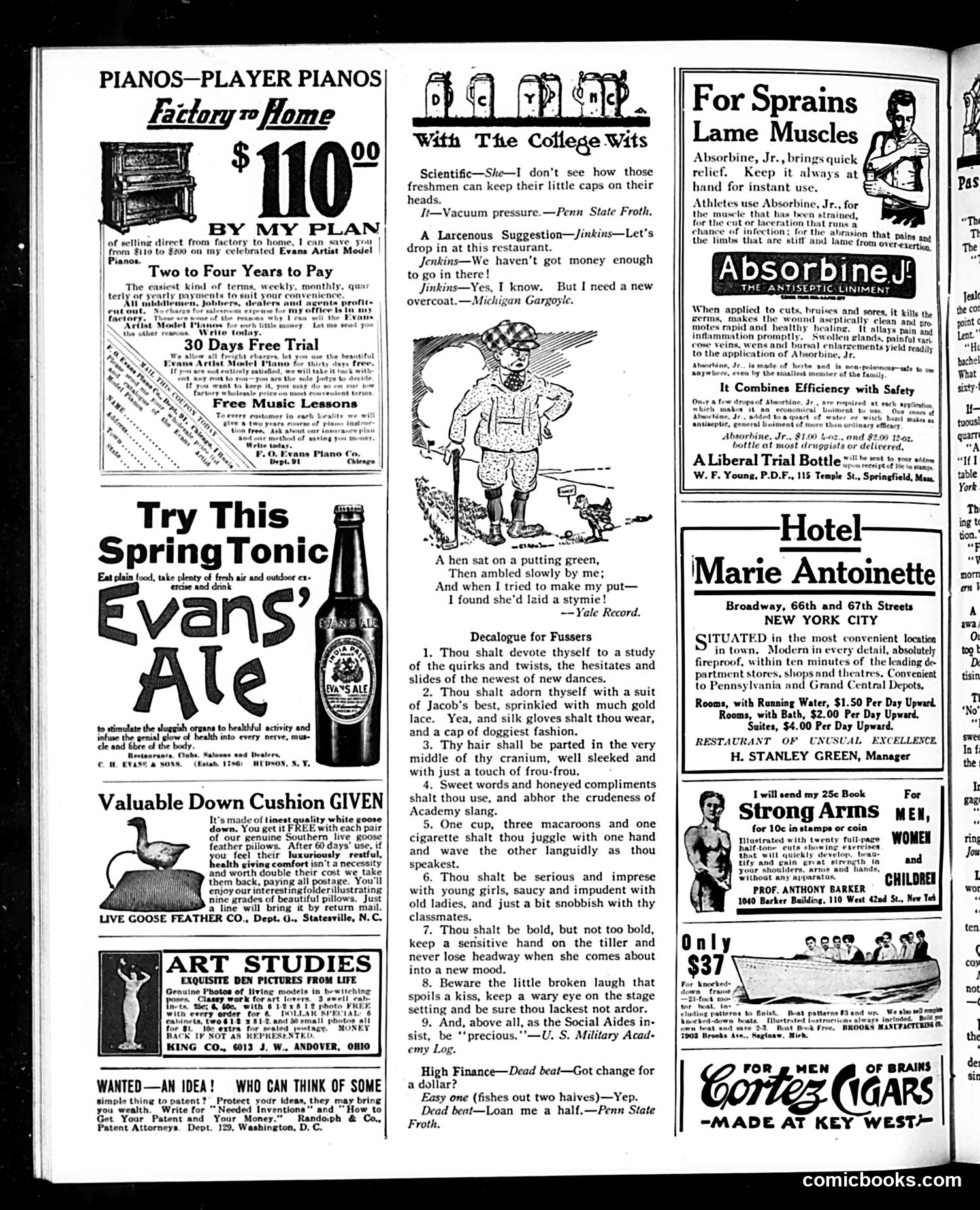
This page is primarily **advertisements and humor pieces** rather than political cartoons. The main content consists of: 1. **Advertisements** for pianos, patent services, art studies, goose-feather pillows, Evans' Ale, Absorbine liniment, and a hotel—typical early 20th-century magazine ads. 2. **"With The College Wits"** section—a collection of jokes from college humor magazines (Penn State Froth, Michigan Gargoyle, Yale Record, U.S. Military Academy Log). These include: - A physics joke about freshman hats and vacuum pressure - A joke about stealing a coat from a restaurant - A golf joke about a hen creating a "stymie" - A satirical "Decalogue for Fussers" (young men courting women), mocking affected fashion and behavior among college men pursuing dates The "Fussers" piece is the closest to social satire—it ridicules pretentious young men who adopt exaggerated mannerisms, fancy clothes, and affected speech to impress women. No major political references are visible on this page.
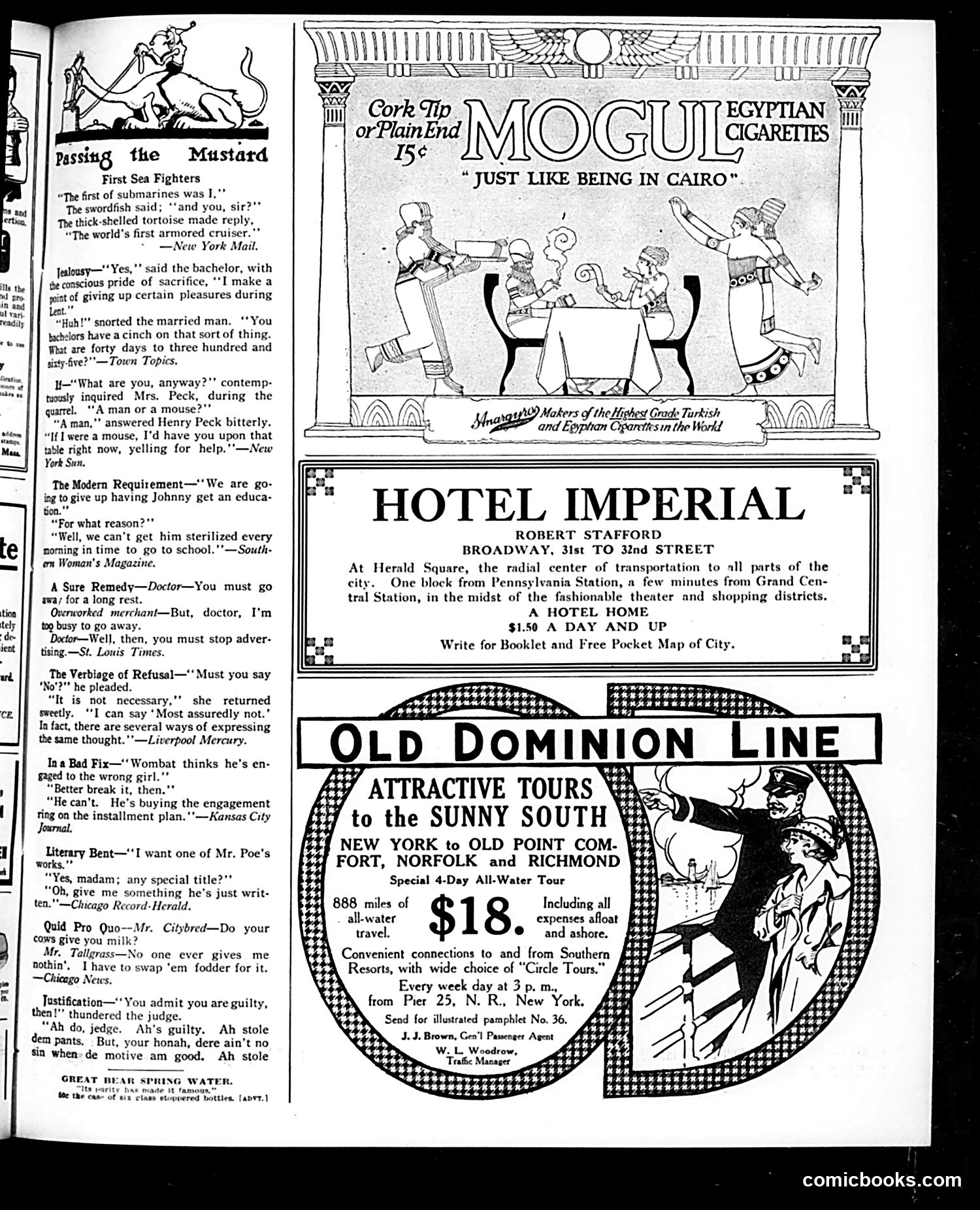
This page from *Judge* magazine consists primarily of **short humorous anecdotes** rather than political cartoons. The jokes satirize early 20th-century American social attitudes: **Key content:** - "Passing the Mustard" references naval technology competition (submarines vs. armored cruisers) - Several jokes mock marriage, gender relations, and spousal dynamics (bachelor vs. married man sacrifices; henpecked husbands) - "The Modern Requirement" satirizes eugenic anxieties—a parent wanting their child "sterilized" before school, reflecting contemporary pseudo-scientific concerns - A joke mocking rural/urban dialect differences - Racial caricature in the final anecdote using stereotyped dialect and a Black defendant **The advertisements** feature Egyptian cigarettes, a Manhattan hotel, and a Southern steamship tour—typical period travel/consumer marketing. The humor reflects *Judge's* audience: educated, urban, middle-class readers amused by class distinctions, marital complaints, and contemporary anxieties about progress and public health.
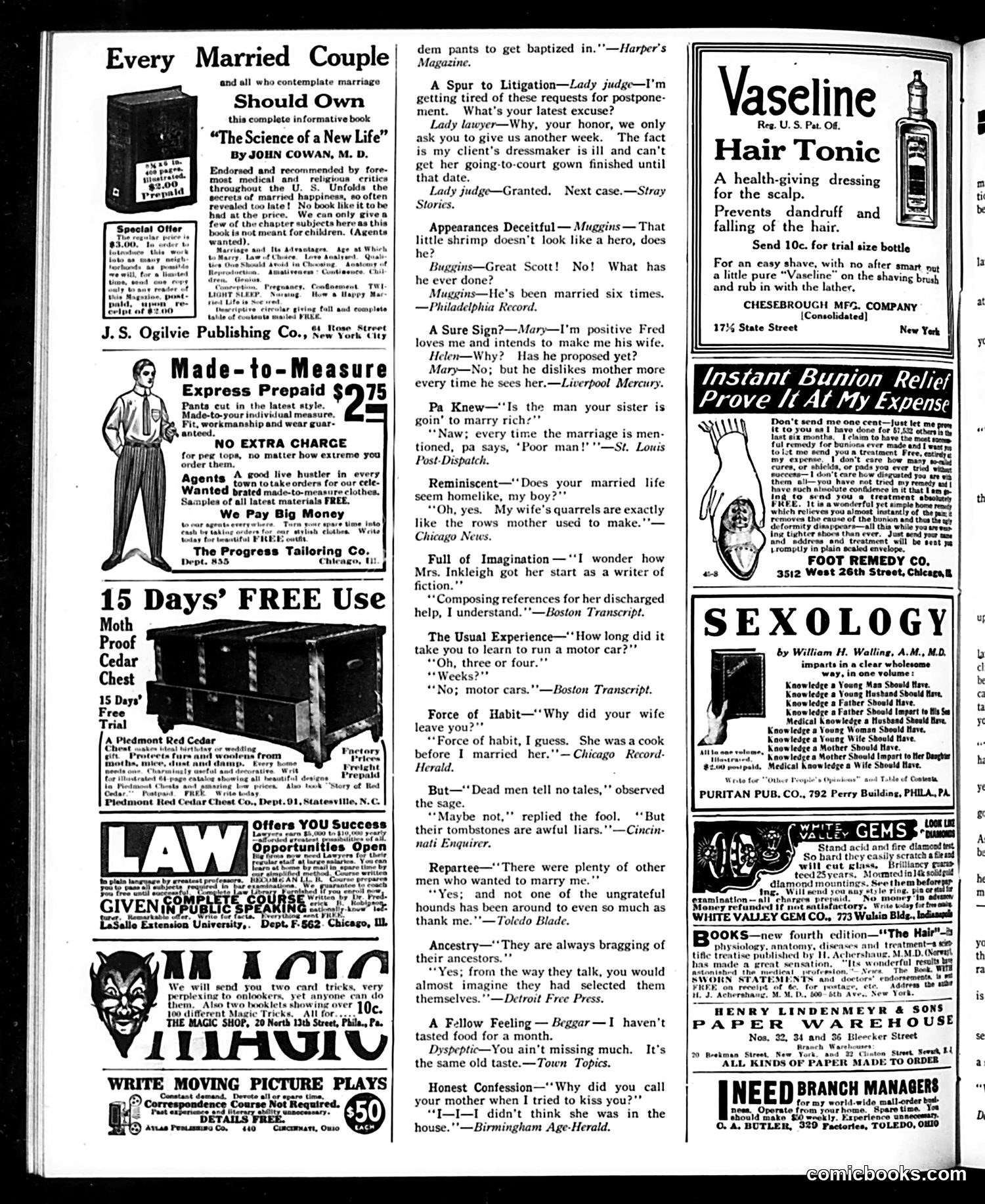
This page consists primarily of **advertisements and humorous short jokes** rather than political cartoons. The jokes center on **marriage and domestic life**, a recurring theme in early 20th-century American humor. The jokes satirize: - **Women's legal participation**: A female judge and lawyer requesting postponements because a dressmaker is slow—mocking women's recent entry into law - **Marriage as obligation**: A man who dislikes his fiancée's mother, implying he doesn't truly love her - **Domestic discord**: A wife's quarrels likening married life to her mother's arguments - **Gender roles**: A cook-wife who leaves through "force of habit," treating marriage as another job The advertisements (Vaseline, tailoring, law courses, books on sexuality) reflect **contemporary consumer culture and anxieties** about modern life. The humor is genteel rather than cutting—observational comedy about the gap between romantic ideals and marital reality, targeting educated middle-class readers familiar with courtrooms and social pretension.
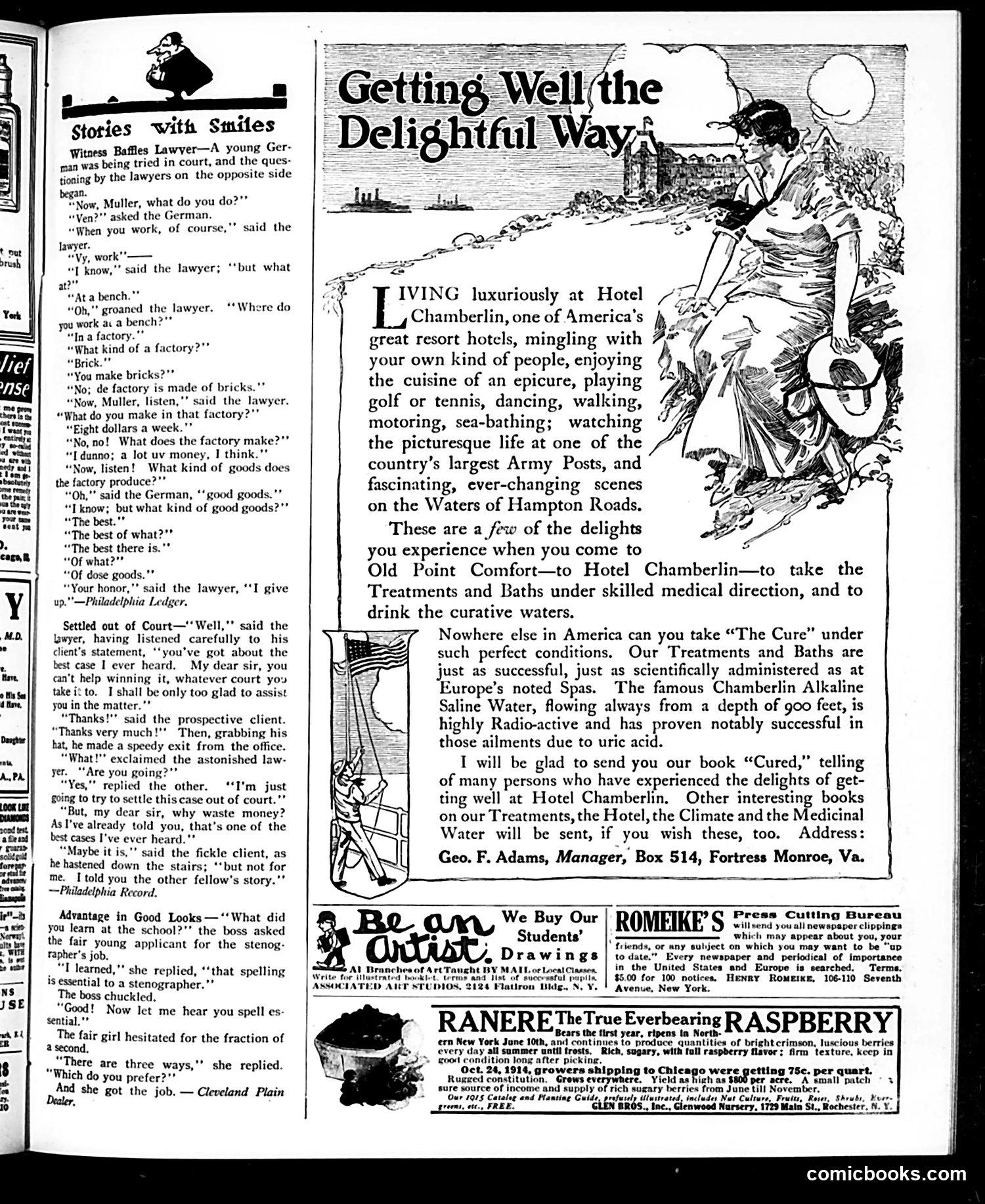
This page contains **humorous anecdotes** (left side) and **advertisements** (right side), typical of Judge's satirical format. ## The Jokes: The three brief stories mock **linguistic confusion and courtroom absurdity**. The "Witness Baffles Lawyer" piece satirizes a German immigrant's difficulty with English—the lawyer repeatedly tries extracting what the factory makes, but Muller interprets each question literally, answering about his personal wages instead. It's gentle ethnic humor common to the era, poking fun at miscommunication rather than malice. The "Settled out of Court" joke reverses expectations: despite the lawyer assuring the client of a winning case, the client immediately seeks settlement—implying the lawyer's own conflicting interest story was actually damaging. The stenographer joke plays on young women's limited education and the irony that poor spelling skills don't prevent job-getting if one is attractive. ## The Advertising: The right side advertises **Hotel Chamberlin** (a Virginia resort claiming medicinal water treatments), **Romeike's Press Clipping Bureau**, and **Ranere Raspberry plants**—typical early-20th-century commercial appeals emphasizing health cures and agricultural products.
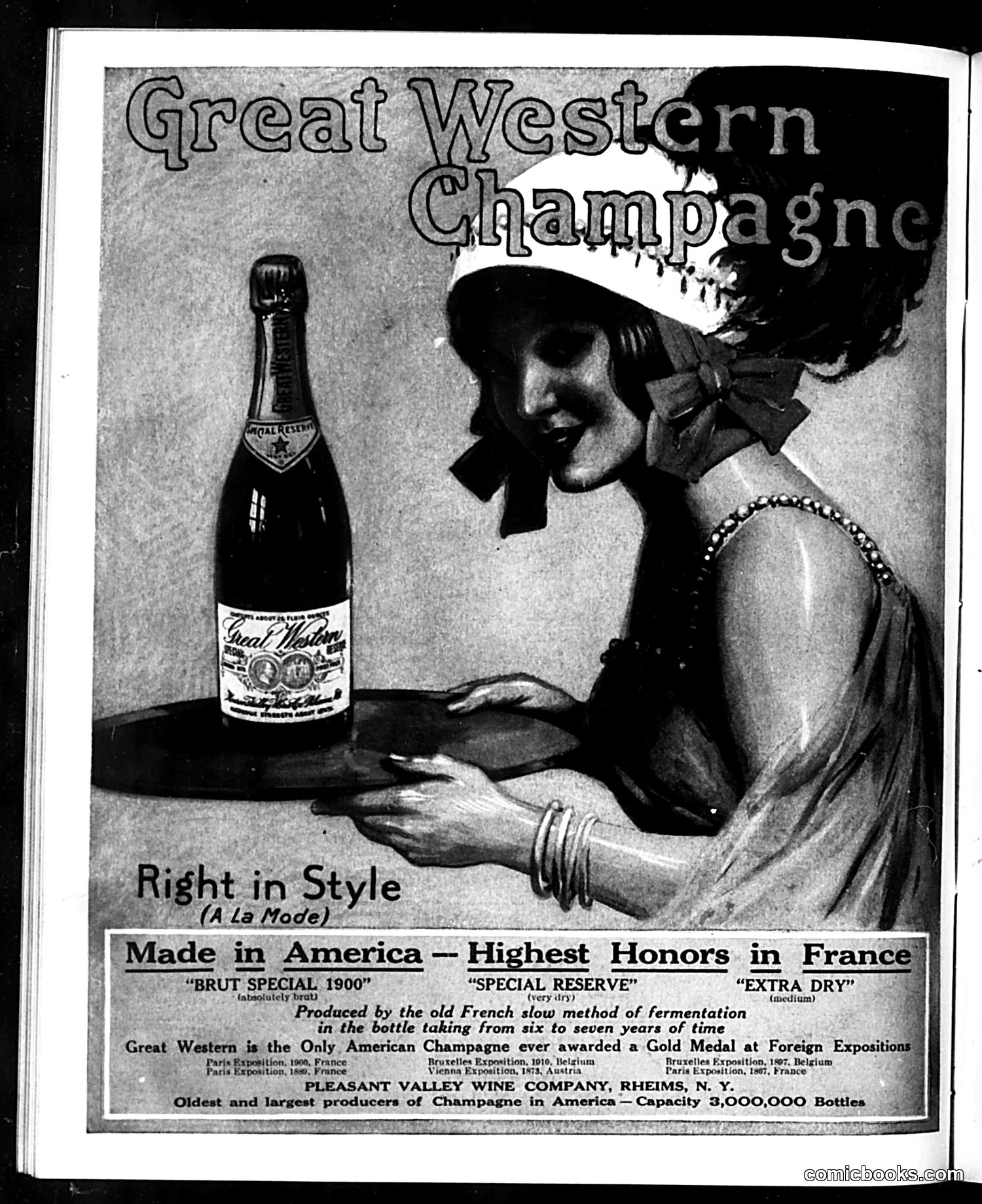
This page is a **champagne advertisement**, not a political cartoon. It's a full-page ad for Great Western Champagne, produced by Pleasant Valley Wine Company in Rheims, New York. The image shows a fashionably dressed woman in an elaborate hat with a large feather, presented in an elegant Art Nouveau style typical of early 1900s advertising. The tagline "Right in Style (À la Mode)" emphasizes sophistication and fashion. The advertisement emphasizes that this is American-made champagne that won international gold medals in Paris, Brussels, and Vienna—a marketing strategy positioning American wine as competition for French imports. The copy stresses production using "old French slow method" and claims it's "the Only American Champagne ever awarded a Gold Medal at Foreign Expositions." This represents early 20th-century American commercial ambition and nationalist pride in domestic products.