
Judge, 1915-03-13 · page 15 of 24
Judge — March 13, 1915 — page 15: what you’re looking at
What you’re looking at
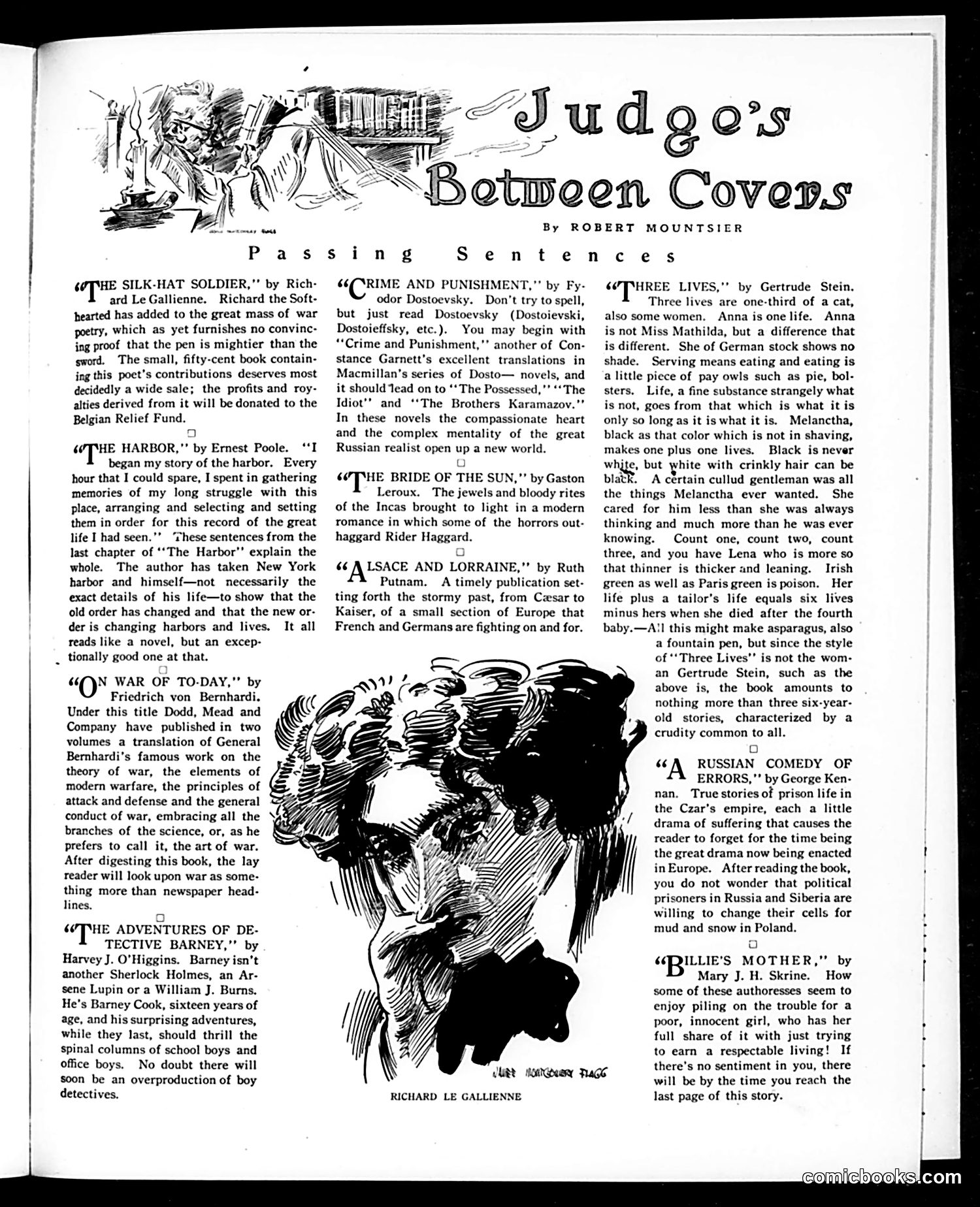
This page reviews contemporary books, with a large portrait sketch of Richard Le Gallienne (a popular poet/writer of the era) dominating the center. **Context for modern readers:** The reviews reveal early WWI-era concerns. "The Silk-Hat Soldier" and "On War of To-Day" (Bernhardi's military theory) reflect America's anxious debate over the European conflict. "Alsace and Lorraine" addresses the disputed French-German border region—then a active war zone. The satirical "Three Lives" review mocks Gertrude Stein's experimental modernist prose style, presenting her abstract sentences as nonsensical word-play. Contemporary readers would recognize this as criticism of avant-garde literary experimentation that seemed impenetrable to general audiences. The book selections—Russian realist fiction (Dostoevsky), adventure tales, detective stories—show Judge magazine's audience as educated but mainstream readers skeptical of artistic modernism.
📄 Transcribed text from this page (OCR, searchable)
Machine-transcribed from the original scan — historical spelling and the odd misread are preserved.
|, tionally good one at that. 6@PHE SILK-HAT SOLDIER," by Rich- ard LeGallienne. Richard the Soft- hearted has added to the great mass of war poetry, which as yet furnishes no convinc- ing proof that the pen is mightier than the sword. The small, fifty-cent book contain- ing this poet’s contributions deserves most decidedly a wide sale; the profits and roy- alties derived from it will be donated to the Belgian Relief Fund. o [email protected] HARBOR,” by Ernest Poole. ‘‘I began my story of the harbor. Every hour that I could spare, I spent in gathering memories of my long struggle with this place, arranging and selecting and setting them in order for this record of the great life I had seen.’’ These sentences from the last chapter of ‘The Harbor’’ explain the whole. The author has taken New York harbor and himself—not necessarily the exact details of his life—to show that the old order has changed and that the new or- der is changing harbors and lives. It all reads like a novel, but an excep- 66()N WAR OF TO-DAY,” by Friedrich von Bernhardi. Under this title Dodd, Mead and Company have published in two volumes a translation of General Bernhardi’s famous work on the theory of war, the elements of modern warfare, the principles of attack and defense and the general conduct of war, embracing all the branches of the science, or, as he prefers to call it, the art of war. After digesting this book, the lay reader will look upon war as some- thing more than newspaper head- lines. 67THE ADVENTURES OF DE- TECTIVE BARNEY,’’ by Harvey J. O'Higgins. Barney isn’t another Sherlock Holmes, an Ar- sene Lupin or a William J. Burns. He's Barney Cook, sixteen years of age, and his surprising adventures, while they last, should thrill the spinal columns of school boys and office boys. No doubt there will soon be an overproduction of boy detectives. ng 66(°RIME AND PUNISHMENT,” by Fy- odor Dostoevsky. Don’t try to spell, but just read Dostoevsky (Dostoievski, Dostoieffsky, etc.). You may begin with “Crime and Punishment,"’ another of Con- stance Garnett’s excellent translations in Macmillan's series of Dosto— nov and it should ead on to ‘‘ The Posse: “The Idiot'’ and ‘‘The Brothers Karamazov."* In these novels the compassionate heart and the complex mentality of the great Russian realist open up a new world. a 6@T-HE BRIDE OF THE SUN,” by Gaston Leroux. The jewels and bloody rites of the Incas brought to light in a modern romance in which some of the horrors out- haggard Rider Haggard. 66 ALSACE AND LORRAINE,"’ by Ruth Putnam. A timely publication set- ting forth the stormy past, from Czesar to Kaiser, of a small section of Europe that French and Germans are fighting on and for. RICHARD LE GALLIENNE By ROBERT MOUNTSIER Sentences 6/T’HREE LIVES,"’ by Gertrude Stein, Three lives are one-third of a cat, also some women. Anna is one life. Anna is not Miss Mathilda, but a difference that is different. She of German stock shows no shade. Serving means eating and eating is a little piece of pay owls such as pie, bol- sters. Life, a fine substance strangely what is not, goes from that which is what it is only so long as it is what it is. Melanctha, black as that color which is not in shaving, makes one plus one lives. Black is never white, but yhite with crinkly hair can be blatR. A certain cullud gentleman was all the things Melanctha ever wanted. She cared for him less than she was always thinking and much more than he was ever knowing. Count one, count two, count three, and you have Lena who is more so that thinner is thicker and leaning. Irish green as well as Paris green is poison. Her life plus a tailor's life equals six lives minus hers when she died after the fourth baby.—A!I this might make asparagus, also a fountain pen, but since the style of ‘‘ Three Lives’’ is not the wom- an Gertrude Stein, such as the above is, the book amounts to nothing more than three six-year- old stories, characterized by a crudity common to all. Oo “ RUSSIAN COMEDY OF ERRORS,"’ by George Ken- nan. True stories of prison life in the Czar’s empire, each a little drama of suffering that causes the reader to forget for the time being the great drama now being enacted inEurope. After reading the book, you do not wonder that political prisoners in Russia and Siberia are willing to change their cells for mud and snow in Poland. o ésPILLIE’S MOTHER," by Mary J. H. Skrine. How some of these authoresses seem to enjoy piling on the trouble for a poor, innocent girl, who has her full share of it with just trying to earn a respectable living! If there's no sentiment in you, there will be by the time you reach the last page of this story.