
Judge, 1915-03-13 · page 4 of 24
Judge — March 13, 1915 — page 4: what you’re looking at
What you’re looking at
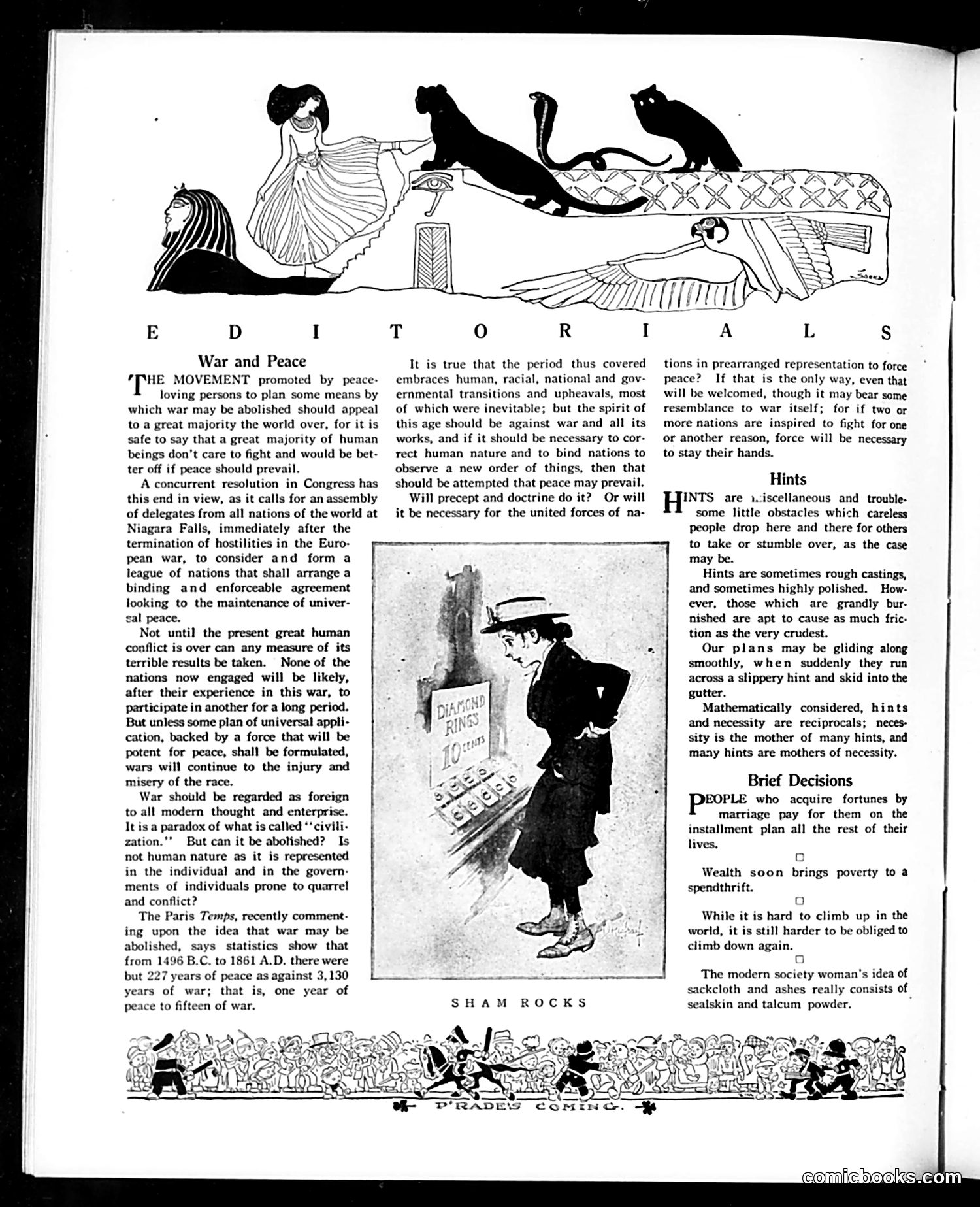
The top illustration, labeled "EDITORIALS," depicts ancient Egyptian imagery (pharaoh, hieroglyphics, animals) to frame an article titled "War and Peace." The accompanying text discusses whether war can be abolished and advocates for international peace agreements—likely referencing post-WWI discussions about the League of Nations (mentioned explicitly). The "SHAMROCKS" cartoon shows a man in formal dress examining what appears to be a diamond or jewel display, satirizing materialism or fraud in the gem trade. Below are sections titled "Hints" (offering practical domestic advice) and "Brief Decisions" (satirical one-liners about marriage, wealth, and modern women's fashions). The page's overall tone mixes serious political commentary on peace with light social satire—typical of Judge's approach during the early 20th century.
📄 Transcribed text from this page (OCR, searchable)
Machine-transcribed from the original scan — historical spelling and the odd misread are preserved.
War and Peace ‘THE MOVEMENT promoted by peace- loving persons to plan some means by which war may be abolished should appeal to a great majority the world over, for it is safe to say that a great majority of human beings don’t care to fight and would be bet- ter off if peace should prevail. A concurrent resolution in Congress has this end in view, as it calls for an assembly of delegates from all nations of the world at Niagara Falls, immediately after the termination of hostilities in the Euro- pean war, to consider and form a league of nations that shall arrange a binding and enforceable agreement looking to the maintenance of univer- cal peace. Not until the present great human conflict is over can any measure of its terrible results be taken. None of the nations now engaged will be likely, after their experience in this war, to participate in another for a long period. But unless some plan of universal appli- cation, backed by a force that will be potent for peace, shall be formulated, wars will continue to the injury and misery of the race. War should be regarded as foreign to all modern thought and enterprise. It is a paradox of what is called **civili- zation.’ But can it be abolished? Is not human nature as it is represented in the individual and in the govern- ments of individuals prone to quarrel and conflict? The Paris Temps, recently comment- ing upon the idea that war may be abolished, says statistics show that from 1496 B.C. to 1861 A.D. there were but 227 years of peace as against 3,130 years of war; that is, one year of peace to fifteen of war. r ~UAN AS PN AN XK PRA It is true that the period thus covered embraces human, racial, national and gov- ernmental transitions and upheavals, most of which were inevitable; but the spirit of this age should be against war and all its works, and if it should be necessary to cor- rect human nature and to bind nations to observe a new order of things, then that should be attempted that peace may prevail. Will precept and doctrine do it? Or will it be necessary for the united forces of na- SHAM ROCKS tions in prearranged representation to force peace? If that is the only way, even that will be welcomed, though it may bear some resemblance to war itself; for if two or more nations are inspired to fight for one or another reason, force will be necessary to stay their hands. Hints INTS are i.iscellaneous and trouble- some little obstacles which careless people drop here and there for others to take or stumble over, as the case may be. Hints are sometimes rough castings, and sometimes highly polished. How- ever, those which are grandly bur- nished are apt to cause as much fric- tion as the very crudest. Our plans may be gliding along smoothly, when suddenly they run across a slippery hint and skid into the gutter. Mathematically considered, hints and necessity are reciprocals; neces- sity is the mother of many hints, and many hints are mothers of necessity. Brief Decisions Prorte who acquire fortunes by marriage pay for them on the installment plan all the rest of their lives. oO Wealth soon brings poverty to a spendthrift. ia} While it is hard to climb up in the world, it is still harder to be obliged to climb down again. The modern society woman's idea of sackcloth and ashes really consists of sealskin and talcum powder. :