
A complete issue · 24 pages · 1915
Judge — February 13, 1915
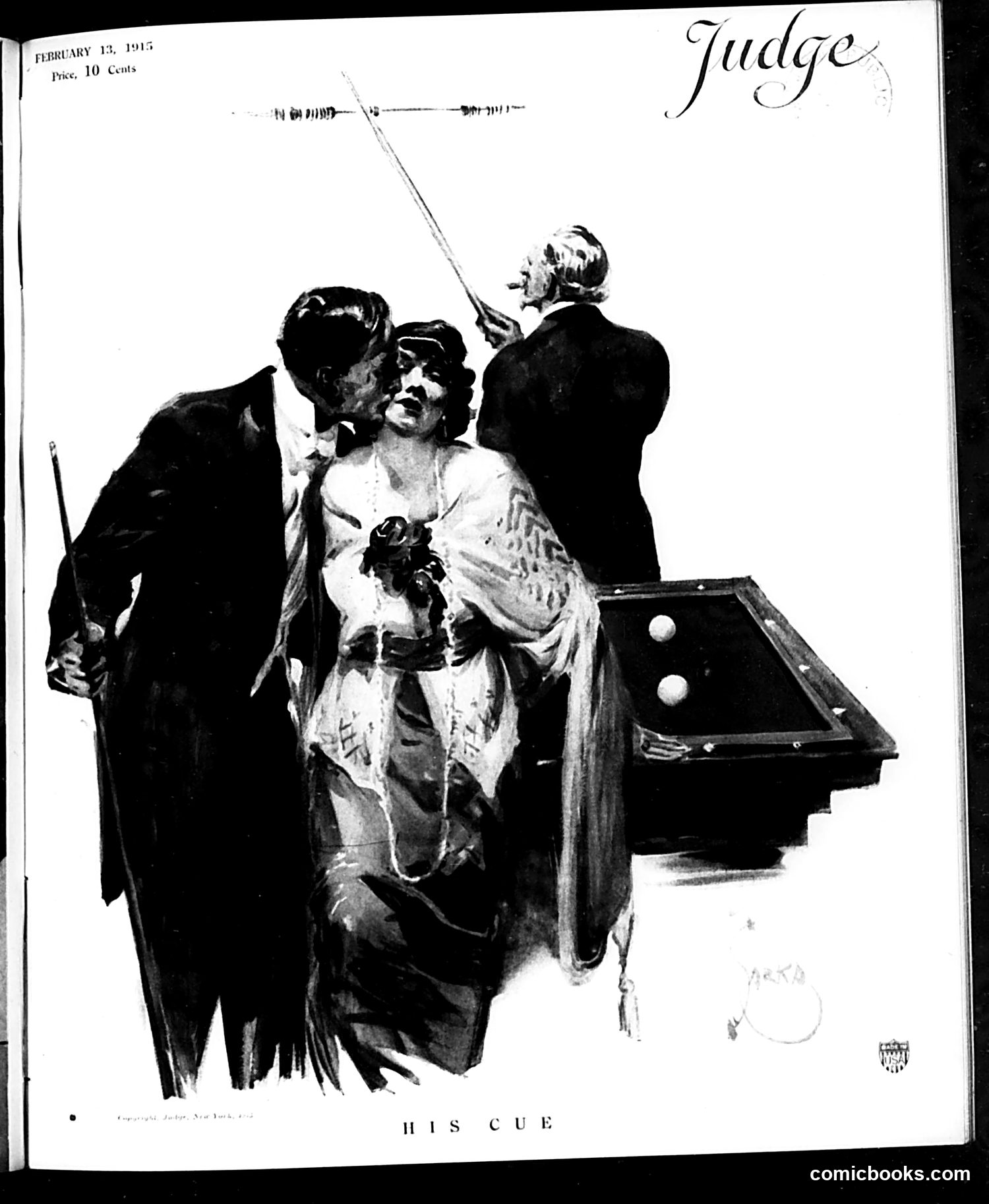
This cartoon depicts a social scene with three men in formal dress surrounding a woman in an elegant gown. One man holds a billiards cue, pointing upward. The title "His Cue" suggests a double meaning: both the literal pool cue and the theatrical/social "cue" (signal for action). The satire appears to comment on gentlemen's behavior in high society—specifically, the opportunistic moment one man seizes while others are distracted. The billiards table visible in the background reinforces the leisure/gentleman's club setting. The woman's expression and body language suggest she's the subject of this social maneuvering. This likely satirizes courtship rituals and masculine behavior among the wealthy during the Edwardian era, mocking how men compete for attention or advantage in social situations.
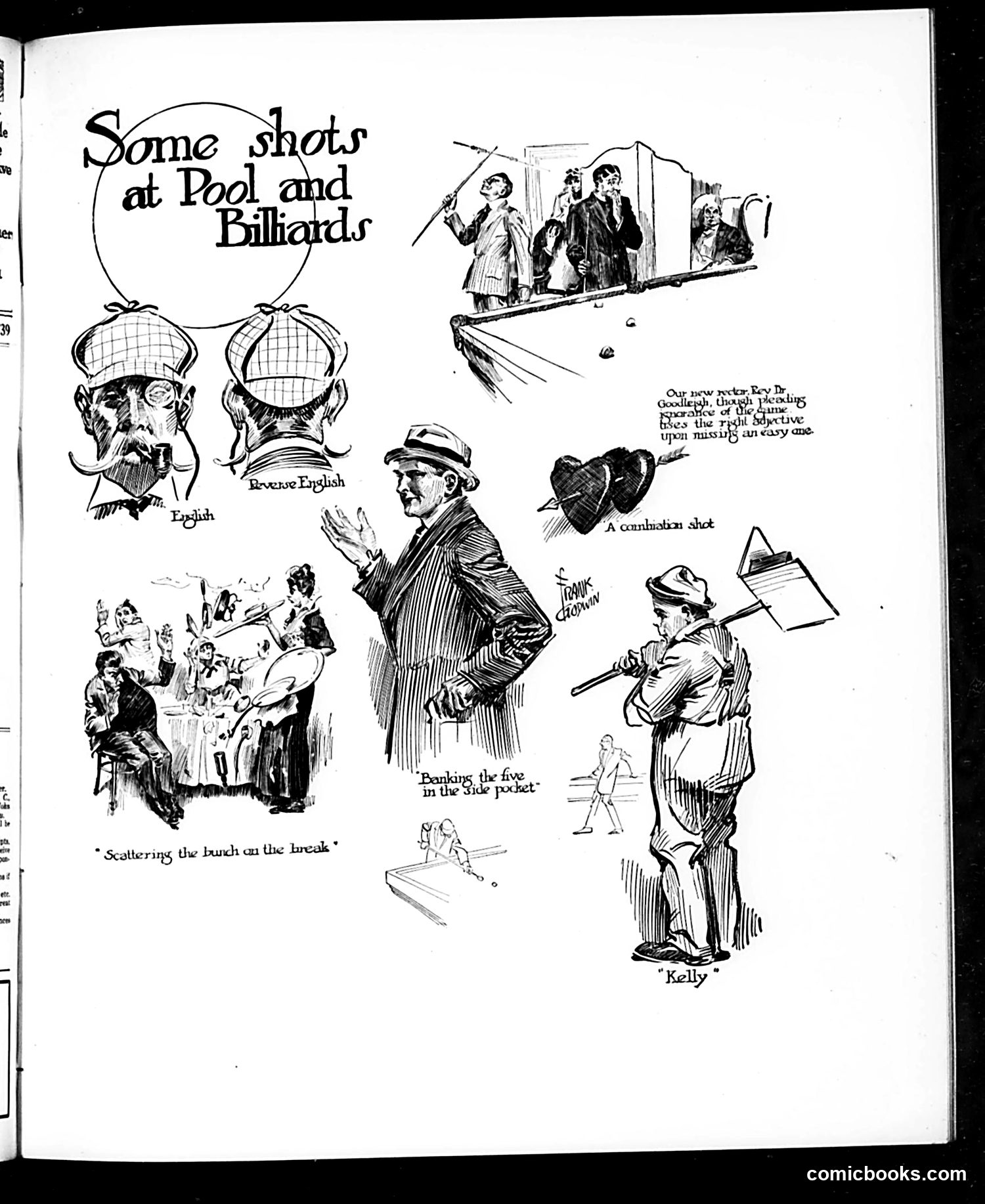
This page presents satirical sketches about pool and billiards players and their mannerisms. The top caricatures labeled "English" and "Reverse English" mock stereotypical British players, likely playing on the term "English" (a billiards technique involving spin). The scenes below depict various pool-hall scenarios: "Scattering the bunch on the break," "Banking the five in the side pocket," and a figure labeled "Kelly" appear to represent different player types and techniques. The sketches use exaggeration and physical humor typical of early 20th-century Judge magazine satire—depicting working-class leisure activities and regional/ethnic stereotypes. The humor relies on viewers' familiarity with pool halls and billiards culture, which was popular entertainment of that era.
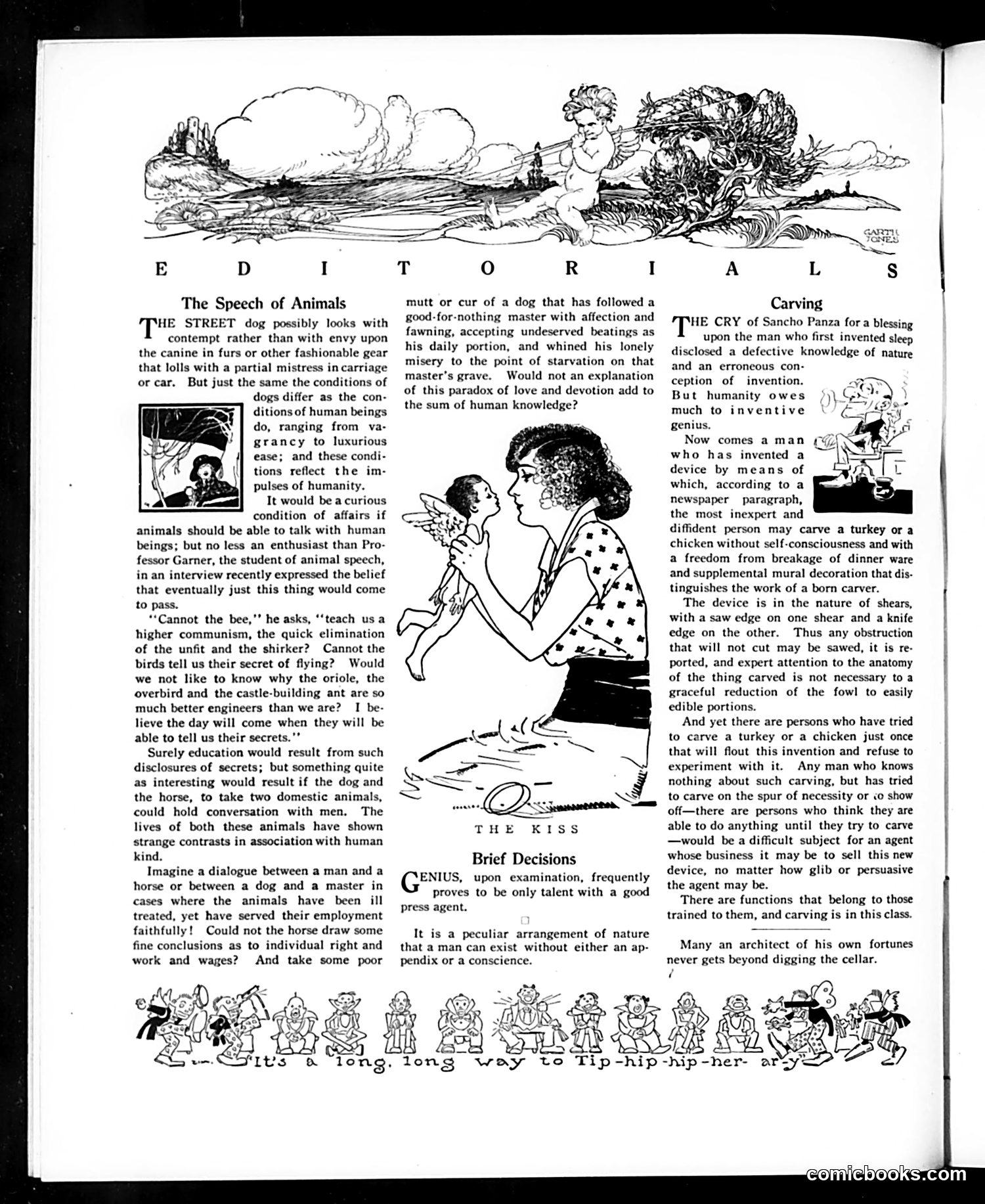
This page contains two distinct pieces: **"The Speech of Animals"** (left column) is a philosophical essay arguing that animals possess intelligence and emotional complexity worthy of human respect. The author speculates that if animals could speak, they'd reveal impressive knowledge—citing examples like dogs' loyalty despite poor treatment and horses' engineering prowess. The piece advocates for recognizing animal consciousness and dignity. **"Carving"** (right column) satirizes an invented carving device designed to make poultry carving foolproof. The satire mocks the notion that such a gadget is necessary, suggesting that anyone lacking basic carving skill shouldn't rely on mechanical shortcuts. It's a light jab at over-engineered solutions to simple problems and at those seeking easy alternatives to developing competence.
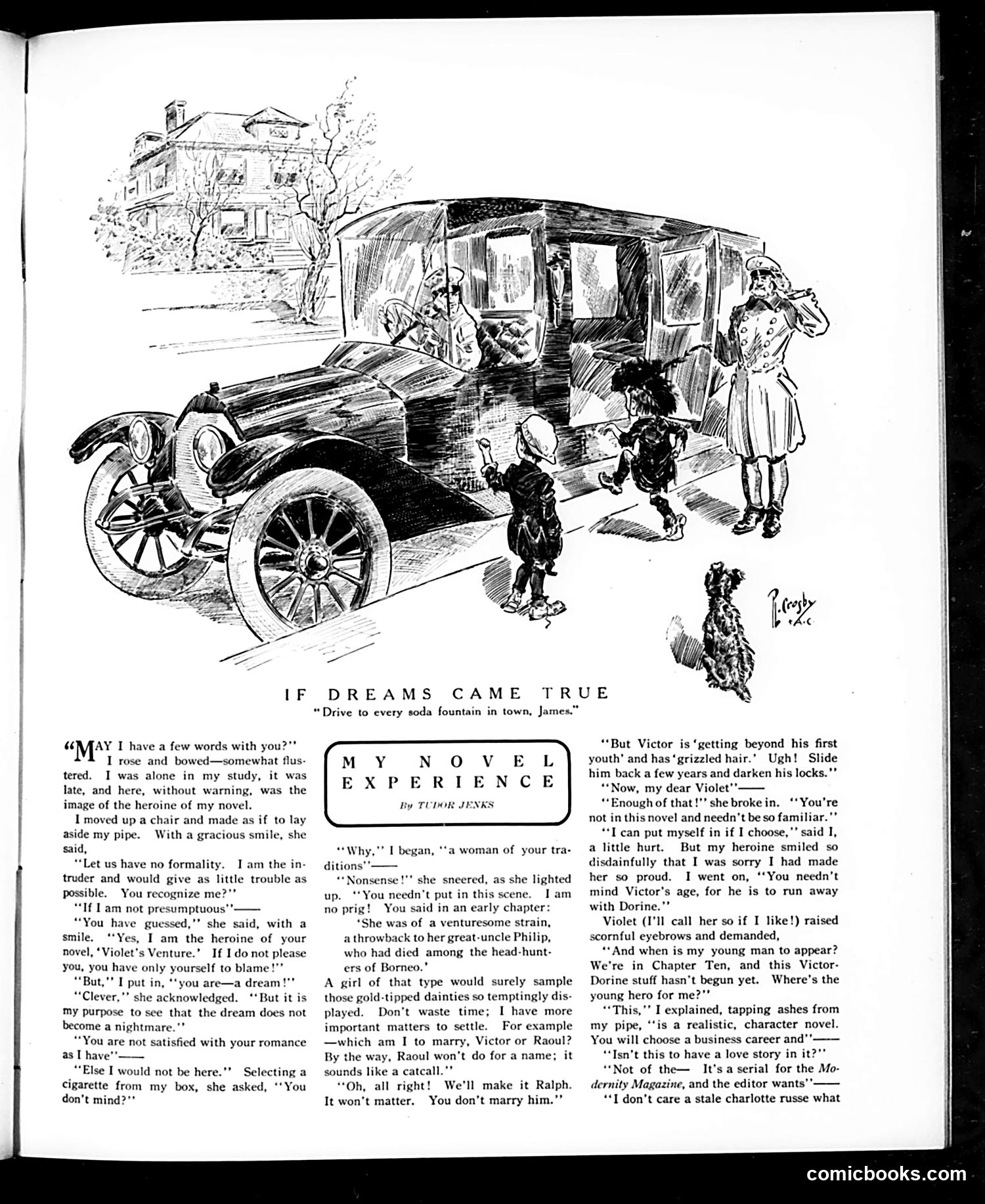
This page from *Judge* magazine combines an illustration with a serialized story titled "My Novel Experience" by Thyra Jenks. **The Illustration:** Shows an early-automobile scene with well-dressed figures and children. The caption "If Dreams Came True—'Drive to every soda fountain in town, James'" appears to satirize wealthy aspirations of the automobile age. The humor likely targets nouveau-riche fantasies about car ownership and leisure activities. **The Serial Story:** Appears to be romantic fiction about a character named Violet and her relationships with Victor and Raoul. The excerpt shows editorial banter about plot elements—suggesting *Judge* published both satirical commentary and serialized entertainment. The page reflects early-20th-century magazine format combining humor, social commentary, and fiction for middle-class readers.
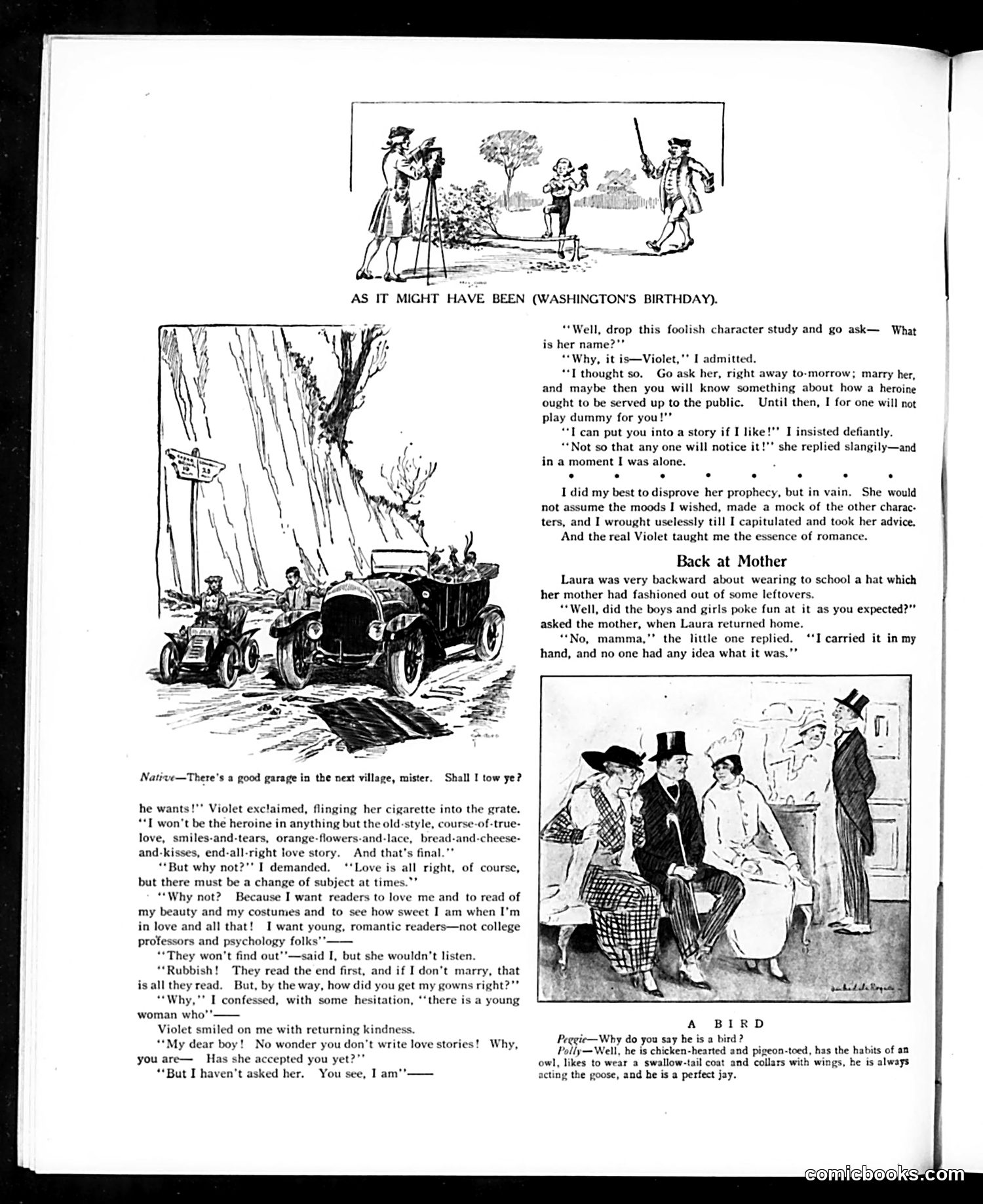
This page contains three distinct pieces of satirical content: **Top cartoon** titled "As It Might Have Been (Washington's Birthday)" appears to depict a Revolutionary War scene, likely satirizing historical romanticism or patriotic mythology around the founding era. **Main story** is a meta-commentary on popular fiction. A character named Violet, a fictional heroine, lectures the narrator (a writer) about what readers want: traditional romance with marriage endings, not intellectual "character studies." The satire targets both: (1) readers' predictable tastes for sentimental romance over substance, and (2) writers who pander to these preferences. The irony is that Violet herself—real, defiant, refusing to perform emotions—teaches genuine romance better than any fictional character. **"Back at Mother"** is a brief humorous anecdote about a child who avoids embarrassment by hiding an unfashionable homemade hat. **"A Bird"** is a wordplay joke defining someone as "a bird" through animal-related insults (chicken-hearted, pigeon-toed, owl-like, etc.). The page primarily satirizes popular taste in literature and social pretension.
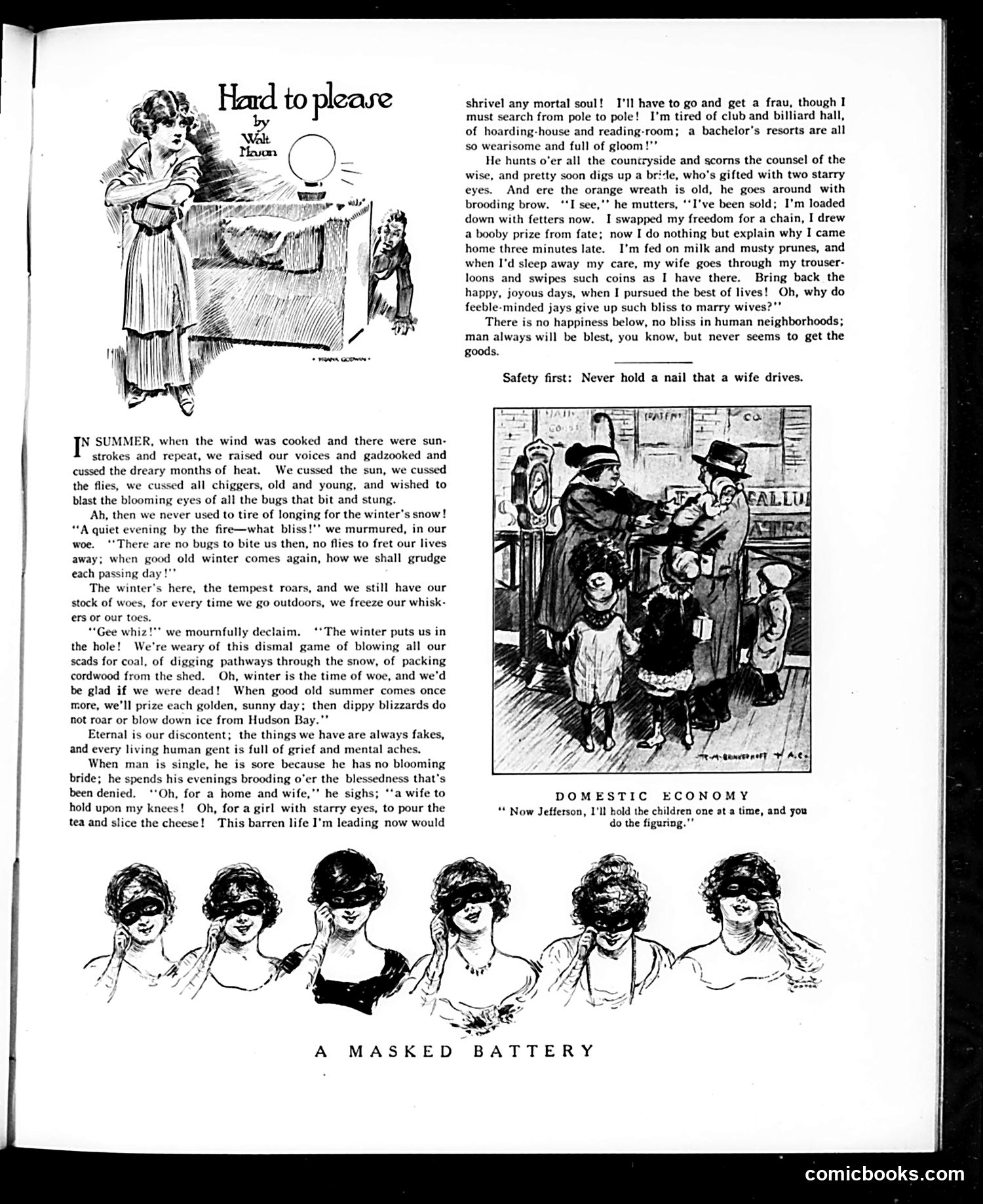
This satirical piece mocks male perpetual discontent through interconnected vignettes: **The main narrative** follows an unmarried man complaining about bachelor life, then a married man lamenting marriage—illustrating the impossibility of male satisfaction. The joke: men always believe the opposite condition would bring happiness, but never actually achieve contentment. **"A Masked Battery"** (bottom) shows six women's faces in hats, each representing a different "type" or social presentation. The caption sarcastically suggests women strategically disguise themselves—a commentary on feminine artifice and deception in courtship. **The seasonal complaint section** applies the same logic: men curse summer heat, then winter cold—again emphasizing how men eternally blame external circumstances rather than accepting reality. **"Domestic Economy"** depicts a couple managing household finances, poking fun at domestic gender roles and financial management. The overall satire targets male irrationality, perpetual grievance, and unrealistic expectations about both bachelorhood and marriage—a critique of masculine immaturity disguised as lighthearted humor.
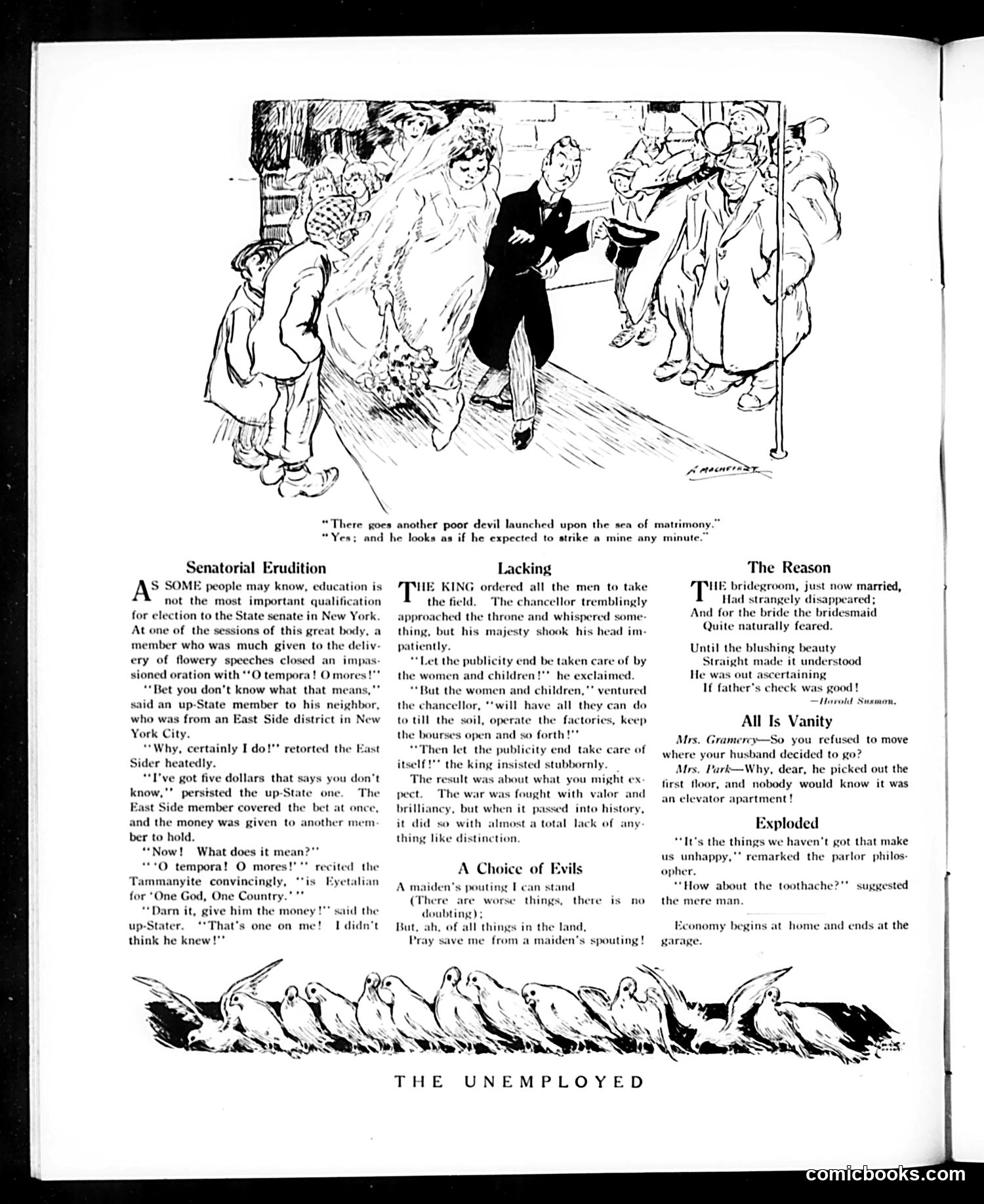
This page contains multiple satirical pieces typical of Judge's early 20th-century humor: **Main Cartoon (top)**: A newlywed groom appears distressed, prompting the caption about marriage being like a minefield—a common era joke about matrimony as dangerous/unpredictable. **"Senatorial Erudition"**: Mocks New York State senators' lack of education. A Tammany Hall politician (East Side/NYC machine politics) wins a bet by confidently mistranslating Latin phrase "O tempora! O mores!" as "One God, One Country"—satirizing that political connections, not knowledge, secured legislative positions. **"Lacking"**: Dark wartime satire where a king prioritizes military operations over civilian welfare, resulting in a hollow victory—likely commenting on WWI's human cost. **Remaining items**: Brief humor pieces about marriage disappointments, social pretension (apartment snobbery), and consumer culture ("economy ends at the garage")—typical Judge fare poking fun at contemporary middle-class anxieties and hypocrisies.
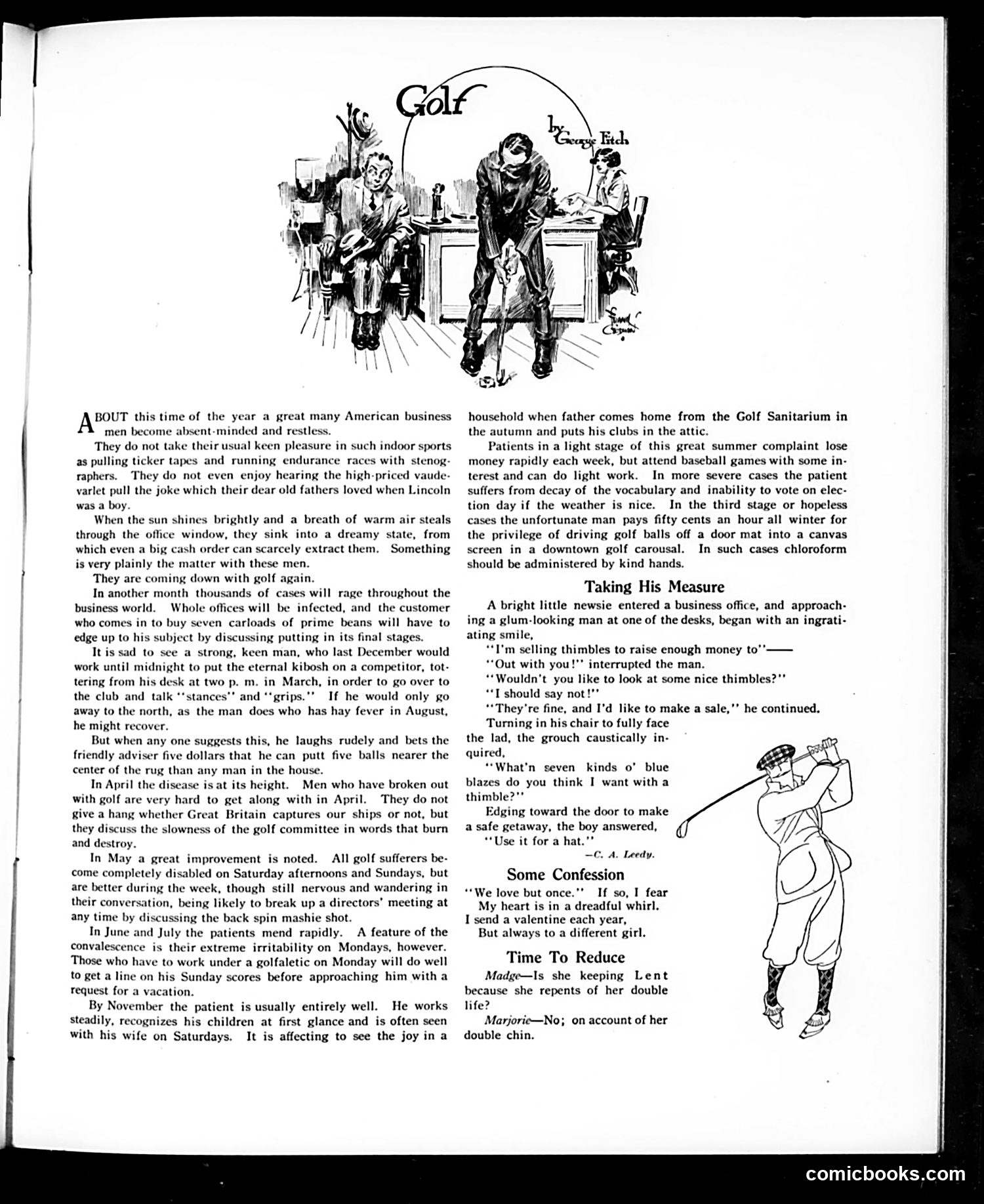
This page satirizes "golf fever" as a seasonal affliction striking American businessmen. The main article treats golf obsession as a medical condition—a "disease" that incapacitates normally productive men from spring through summer. The satire targets how grown professionals abandon work, neglect families, and become socially dysfunctional when golf season arrives. They lose money, can't discuss serious topics, and neglect civic duties like voting if weather permits golf. The humor relies on treating recreational golf as pathological, contrasting the normally ruthless businessman (willing to destroy competitors) with the golf-addicted version who becomes useless and irritable. By November, he "recovers"—recognizing his children and spending time with his wife again. The sidebar sketches are lighter social humor: a young newspaper seller pitching thimbles uses humor about blue blazes and hats; the poems mock romantic fickleness and weight-loss dieting—typical period light verse.
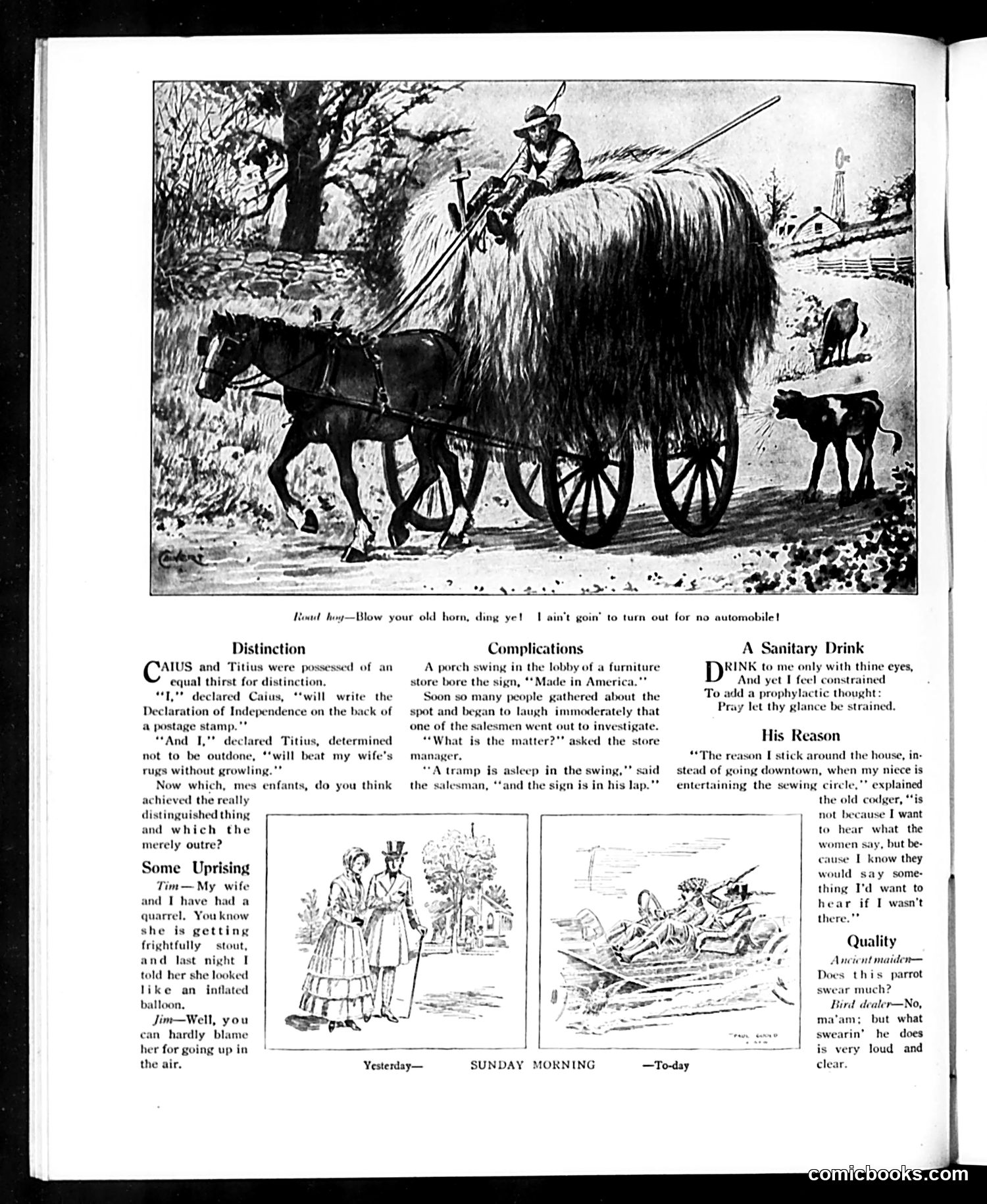
This page contains several short humorous pieces satirizing early 20th-century American life: **Main cartoon (top)**: A farmer with a massive hayload on a cart ignores an automobile's horn. The caption mocks rural resistance to automobiles, suggesting farmers won't accommodate this new technology. **"Distinction"**: A satire on vanity—two men compete over trivial achievements (writing on a stamp vs. beating rugs without complaint), questioning what truly constitutes distinction. **"Complications"**: Humor about a furniture store's "Made in America" sign being ironically obscured by a sleeping tramp—exposing the gap between patriotic marketing and social reality. **Remaining pieces**: Short jokes about marital dynamics, prophylactic drinking etiquette, a husband avoiding downtown social life, and a parrot's crude language. The overall tone reflects Judge's satirical approach to American manners, gender relations, and the friction between traditional rural life and modern urban society.
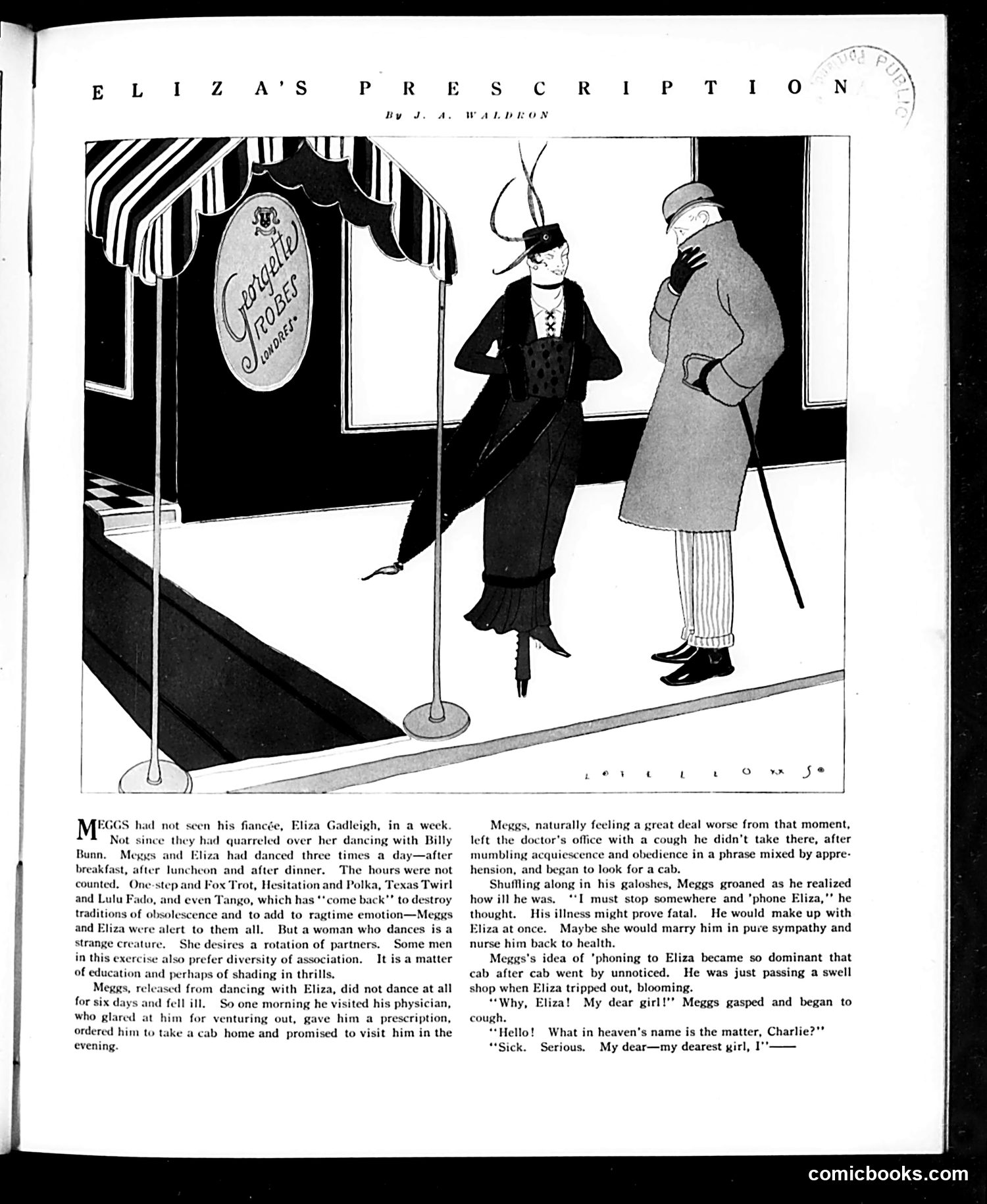
This is a romantic comedy story illustrated in Judge magazine. The narrative follows Meggs, who becomes ill after six days without dancing with his fiancée Eliza Gadleigh. His doctor prescribes rest and a cab ride home, but Meggs becomes so preoccupied with calling Eliza that he ignores passing cabs. The illustrated scene shows Meggs, appearing sickly and bundled in an overcoat, encountering Eliza just outside a fashionable shop. She appears vibrant and well, having clearly not been pining away. Meggs dramatically reveals his illness, apparently hoping she'll nurse him back to health and marry him out of sympathy. The satire targets romantic male melodrama—Meggs's self-pitying assumption that his illness will move Eliza to marry him, despite their recent quarrel over dancing partners. It also gently mocks the era's dance crazes (tango, hesitation waltz) and social conventions around courtship.
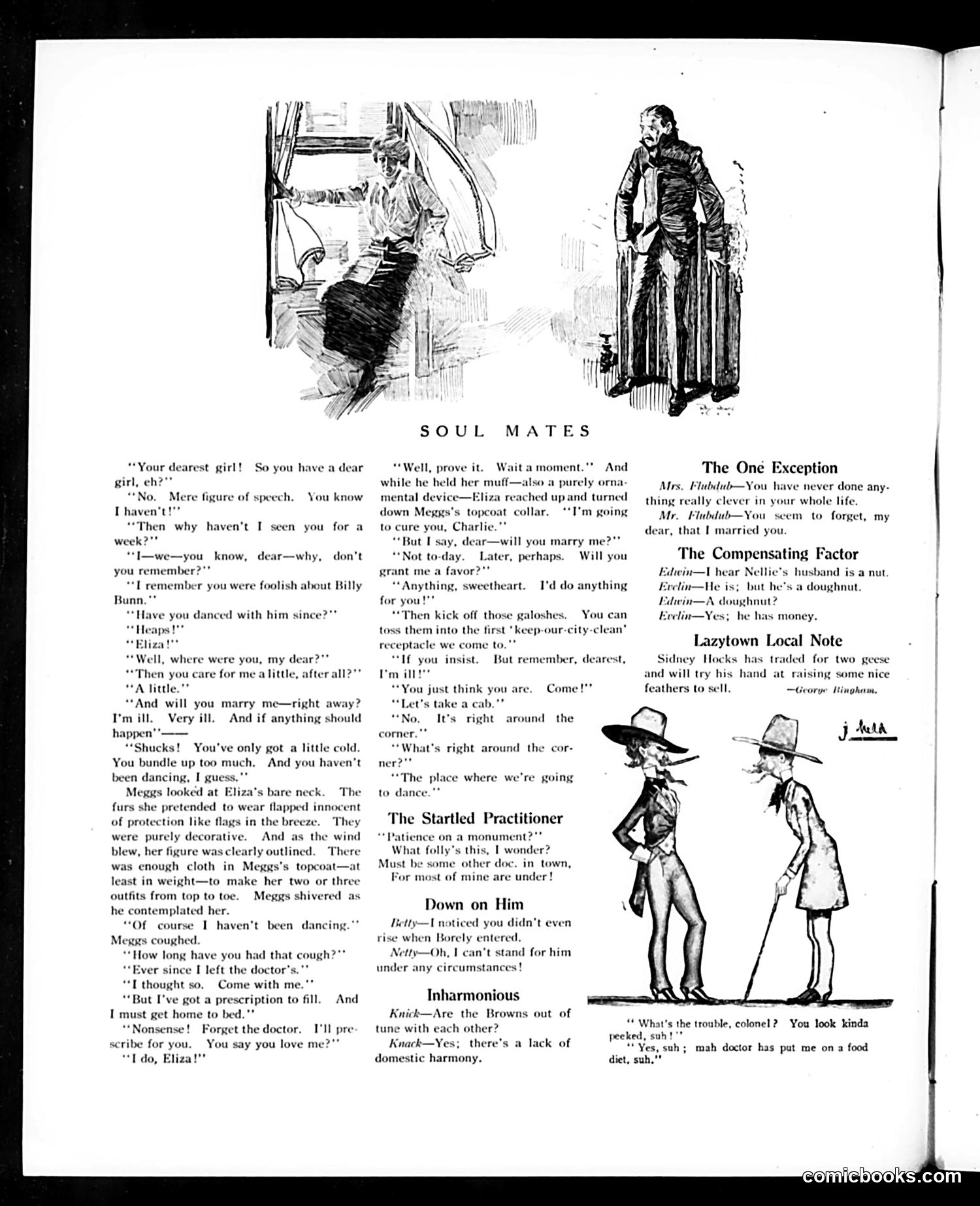
This page contains multiple short humor pieces typical of Judge's satirical format. The main narrative, "Soul Mates," depicts a romantic encounter between a man (Meggs) and woman (Eliza). The satire targets gender dynamics: Eliza feigns affection to manipulate Meggs into removing his warm coat so she can steal it for her own warmth—she's visibly underdressed (bare neck, decorative furs). The joke satirizes both romantic deception and class disparity: she exploits his romantic overtures while he exploits her poverty. Supporting vignettes mock domestic life ("Inharmonious," "The Compensating Factor") and social pretense. One brief note about "Sidney Hocks" trading geese mocks small-town life. The cartoon illustration shows figures in period dress (appears early 20th century). Overall, the page satirizes romantic dishonesty, class exploitation, and the absurdities of courtship among its contemporary readers.
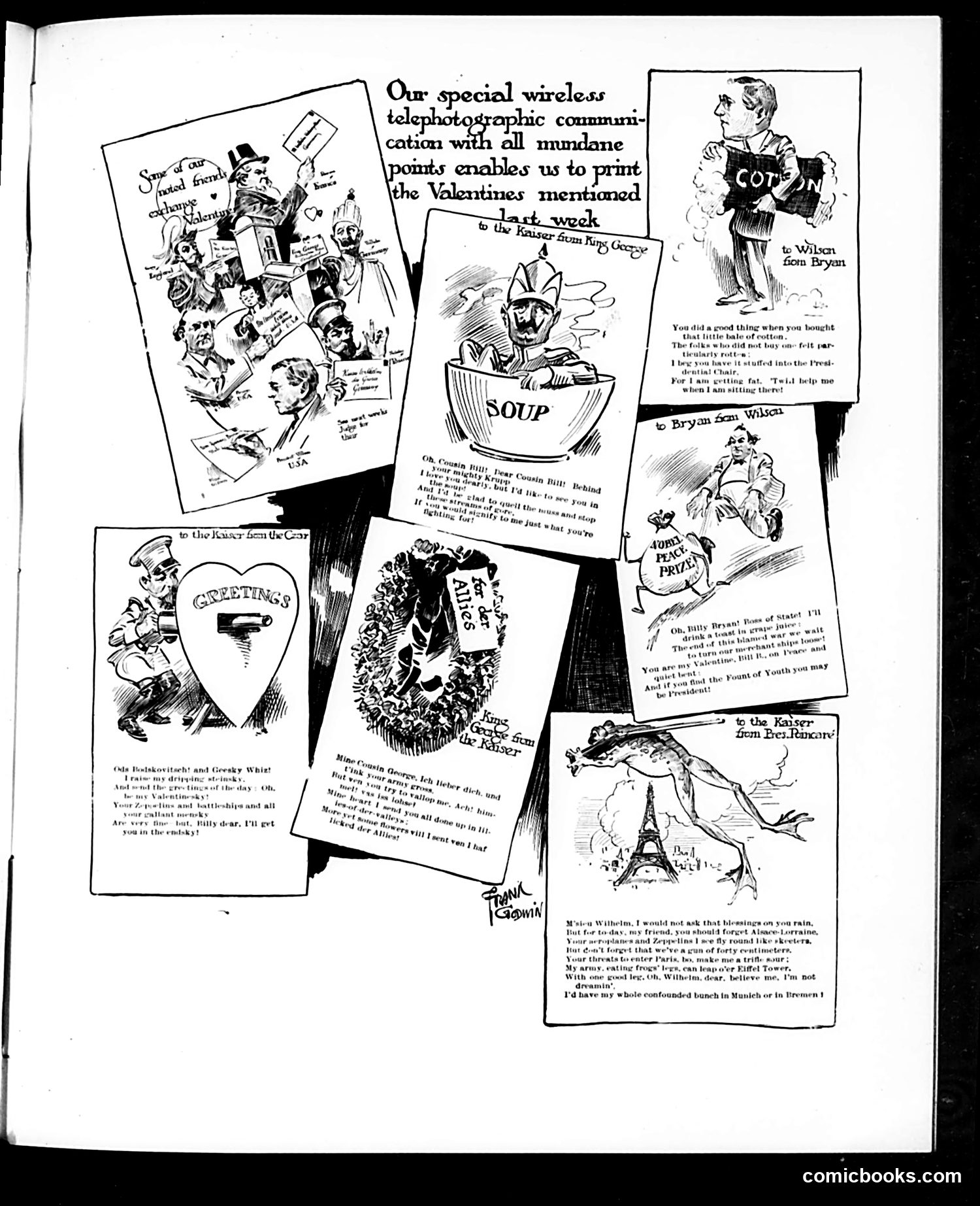
This page contains WWI-era satirical cartoons with Valentine's Day themed greetings. The cartoons mock military and political figures through mock "wireless" messages allegedly sent between world leaders and generals. References include: - **The Kaiser** (German Emperor Wilhelm II) - appears in multiple cartoons - **Soup imagery** - likely references food shortages or deprivation - **Military figures** - caricatured generals and commanders The satire targets the absurdity of the war through faux-romantic "greetings" that actually contain bitter complaints about combat, supplies, and military strategy. The humor relies on readers recognizing specific figures and current war conditions. The "wireless telephotographic communication" framing is itself satirical—mocking the era's fascination with new technology while delivering propaganda-style messaging. The overall point: exposing the disconnect between public patriotism and soldiers' actual miserable conditions during WWI.
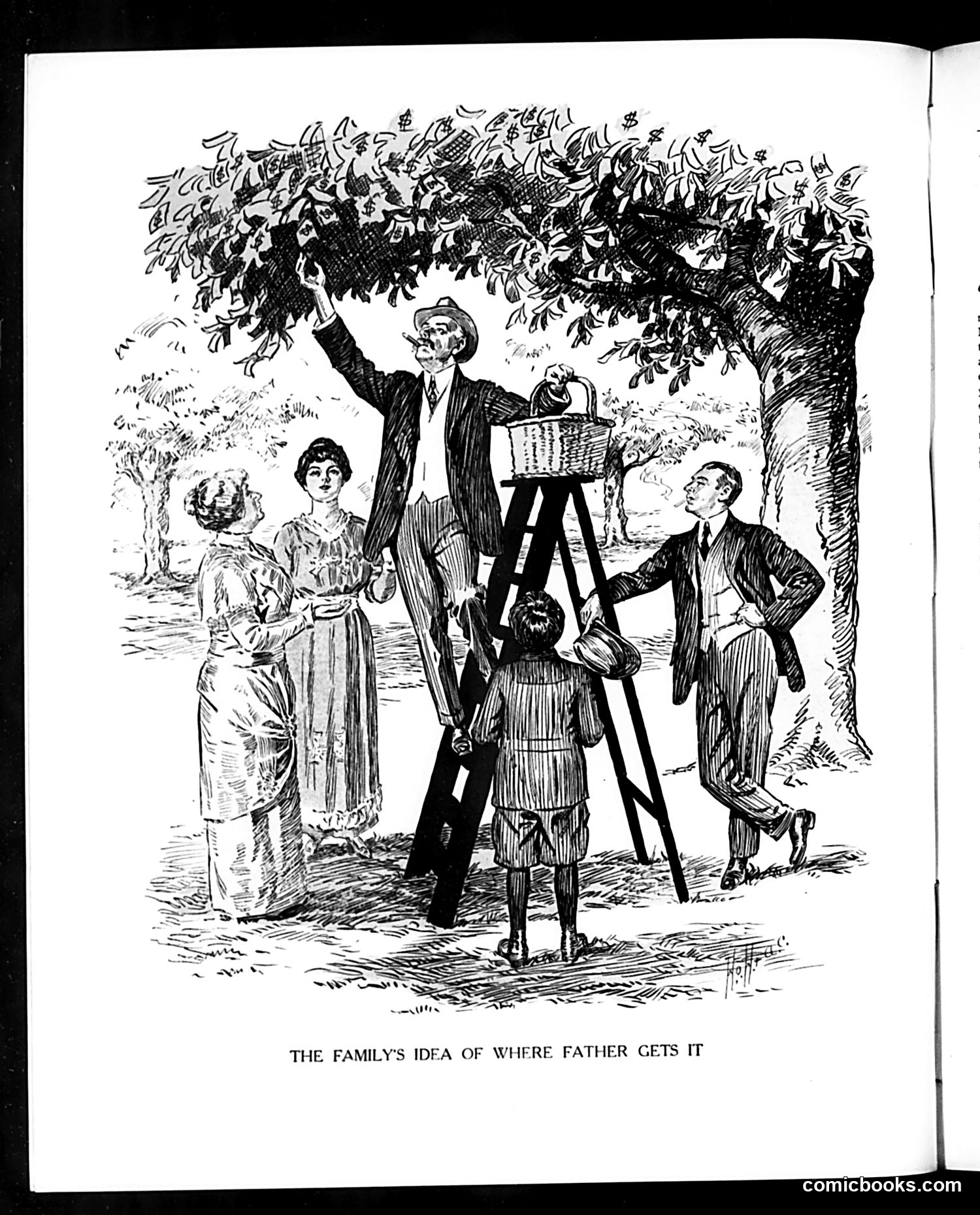
This satirical cartoon mocks middle-class assumptions about men's income sources. The family stands beneath a large tree while the father reaches up on a ladder toward hanging fruit or money, suggesting they imagine wealth comes easily—plucked from nature like fruit. The joke targets the gap between what families *think* their breadwinner does and the actual work involved. The idealized pastoral setting contrasts with reality: fathers don't find money in trees. Instead of understanding the actual labor, struggle, and business dealings required to earn income, the family naively envisions an effortless, almost magical source of their prosperity. This reflects early 20th-century satirical commentary on middle-class ignorance about economic realities and masculine labor.
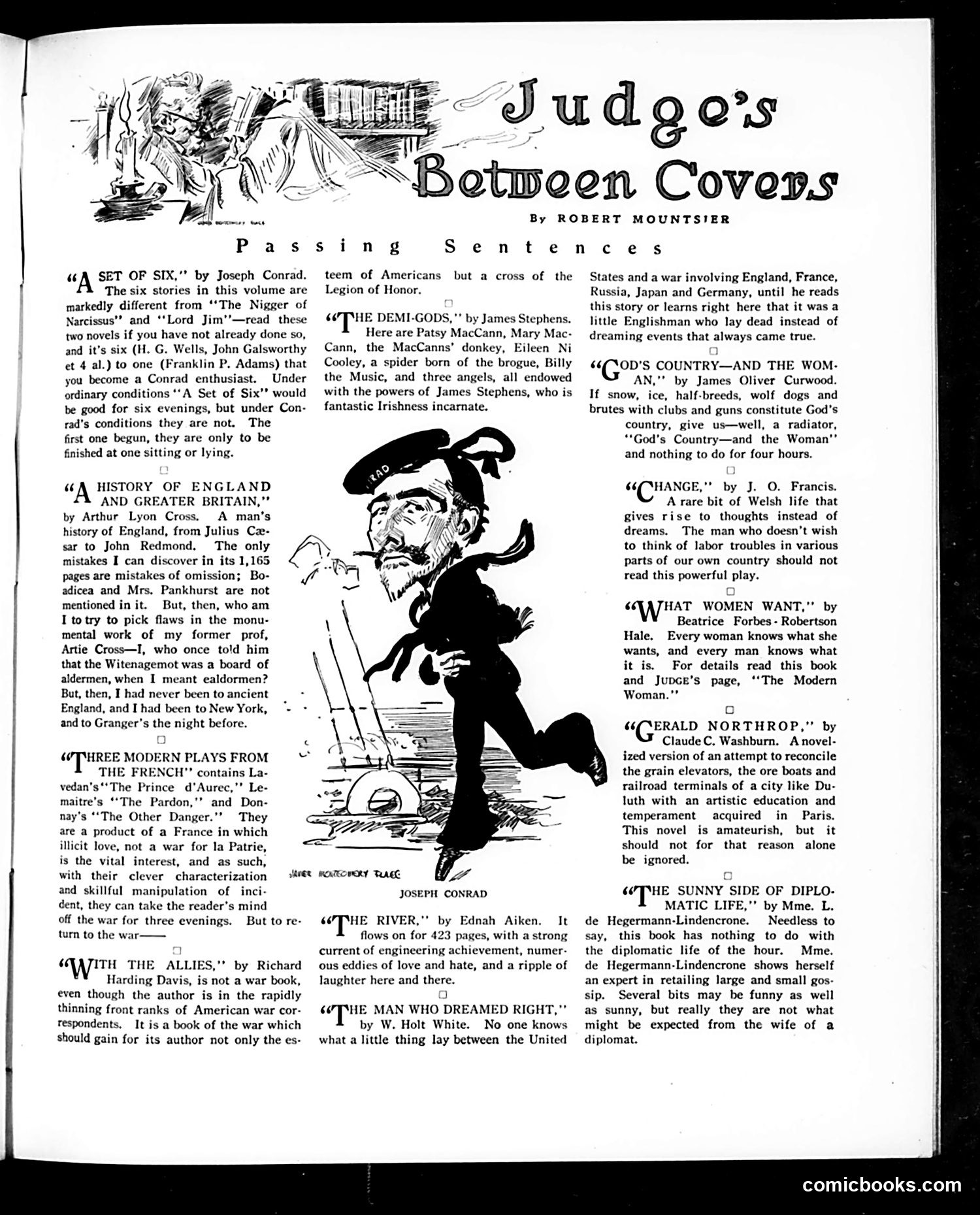
This is a book review section from *Judge*, an American satirical weekly. The central cartoon depicts a caricatured figure in exaggerated dress (appears to be a theatrical or comedic character type) and is credited to "Joseph Conrad," the famous author whose work is being reviewed. The satire works on multiple levels: the reviews themselves are witty and mocking—praising Conrad's stories as so absorbing readers cannot put them down, yet joking about history books omitting women (referencing the women's suffrage movement and Emmeline Pankhurst), and dismissing French plays about infidelity as escapism from the pressing reality of war. The cartoon likely lampoons either Conrad himself or a theatrical adaptation of his work. Without clearer identification in the visible image, the exact target remains somewhat unclear, but the overall page mocks contemporary literature and its pretensions while referencing real historical concerns of the era—women's rights and World War I's impact on society.
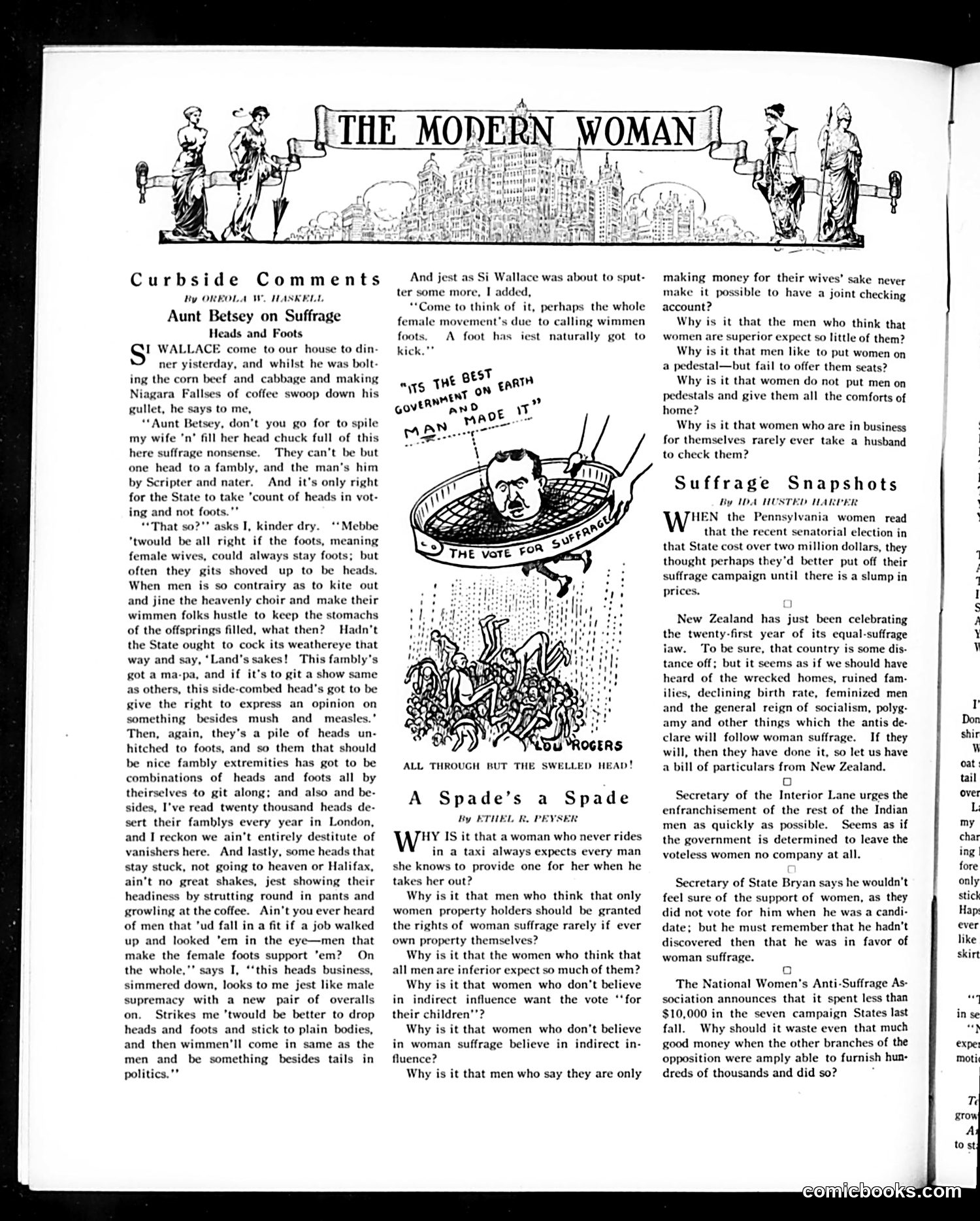
This page satirizes women's suffrage through working-class dialogue and rhetorical questions. **Main Cartoon:** "All Through But the Swelled Head" depicts a man in a bathtub labeled "The Vote for Suffrage," drowning under rain—mocking anti-suffrage arguments that granting women votes will cause social chaos. **"Curbside Comments":** Aunt Betsey's folk-wisdom argument for suffrage. A man claims only male "heads" should vote, not female "foots" (wives). Betsey counters: if men abandon families or can't support dependents, shouldn't women have political voice affecting their welfare? The satire exposes male hypocrisy—men deny women voting rights while expecting them to support households. **"A Spade's a Spade":** A series of pointed rhetorical questions exposing contradictions in anti-suffrage logic: men claim women are inferior yet expect their financial support; claim women are superior yet deny them seats or joint accounts. **"Suffrage Snapshots":** Brief anecdotes mocking suffrage opponents' arguments (Pennsylvania women noting election costs). The page argues for women's suffrage through humor and logic, targeting working-class and middle-class readers.
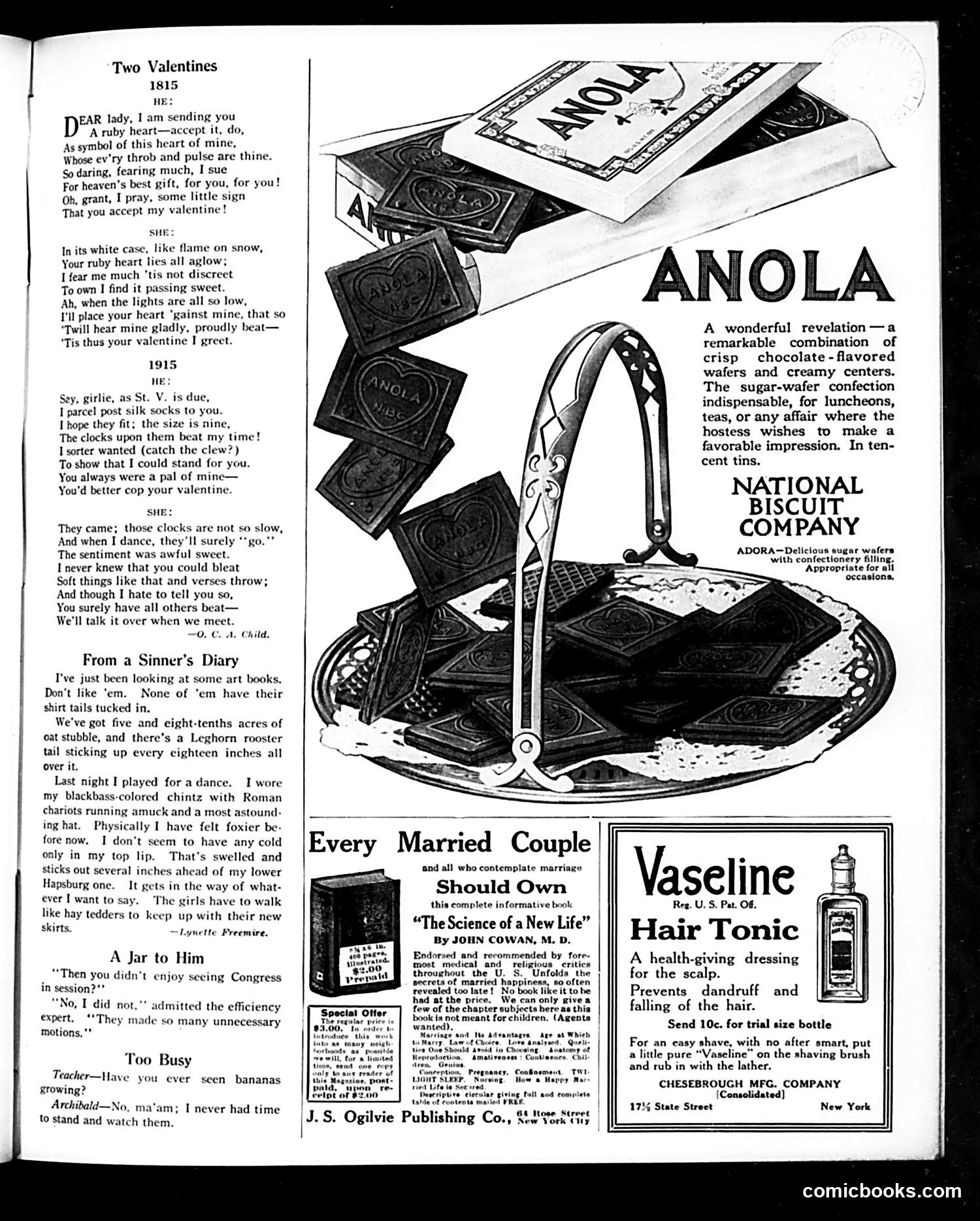
This comic compares Valentine's Day courtship across a century. In 1815, the suitor offers an elaborate ruby heart with flowery, passionate poetry about devotion and placing her heart against his. By 1915, he sends practical silk socks via parcel post with a crude pun about clocks "beating his time"—suggesting he wants to show he's reliable and can "stand for" (support) her. The satire critiques how American romance became commercialized and casualized: genuine sentiment replaced by practical gifts, romantic language by colloquial slang ("Sey, girlie"). The woman's responses mirror this shift—from grateful acceptance of symbolic love to pragmatic appreciation of useful goods. The joke targets modern courtship's loss of earnestness, reflecting early 20th-century anxieties about industrialization eroding traditional romance.
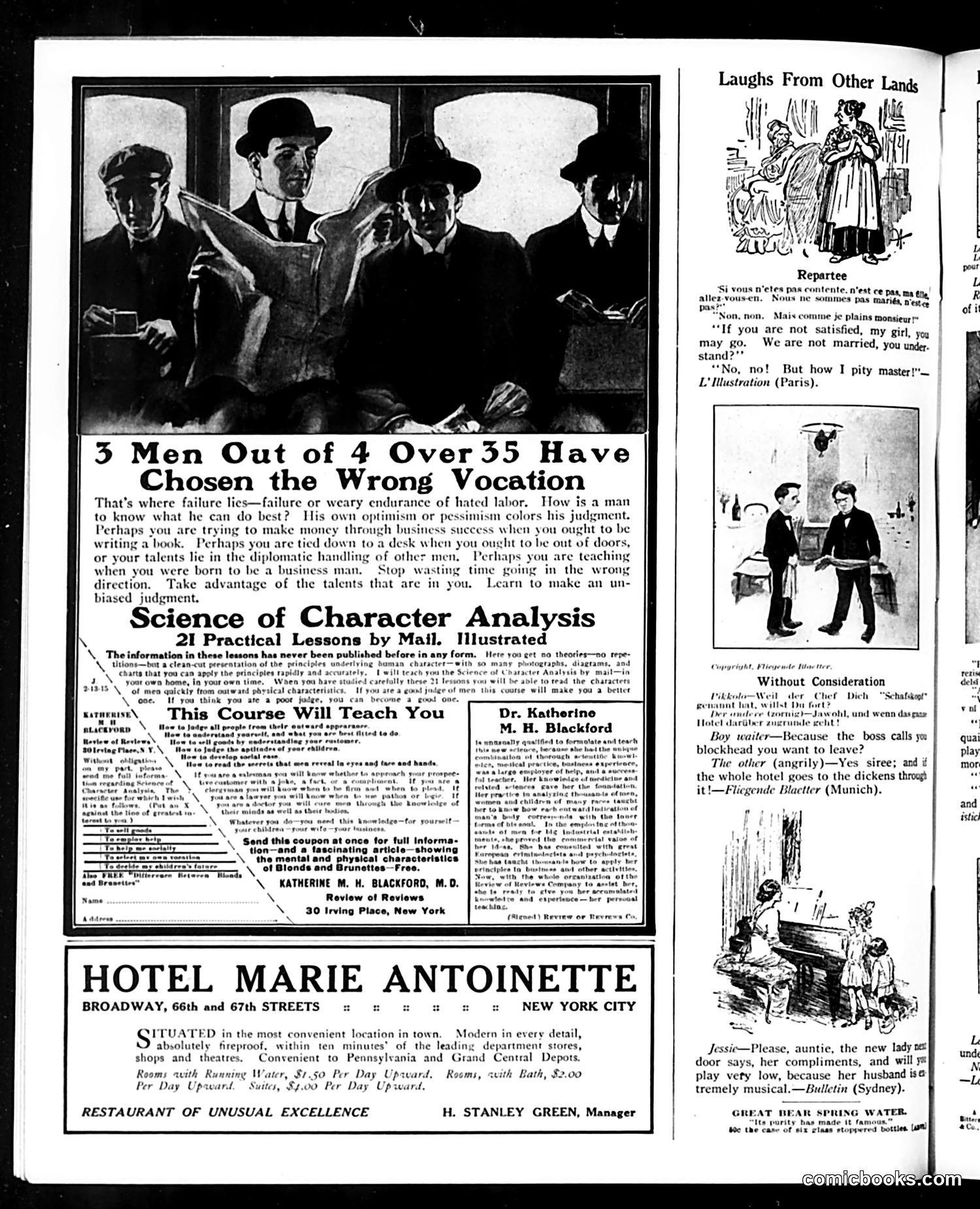
This Judge magazine page presents **early career-guidance advertising**, not political satire. The dominant feature is a full-page advertisement for "Science of Character Analysis" by Dr. Katherine M. H. Blackford—a mail-order course claiming to teach readers to judge people's abilities and aptitudes from physical characteristics ("outward physical characteristics"). The sensationalist headline claims "3 Men Out of 4 Over 35 Have Chosen the Wrong Vocation," positioning the course as solving career regret. The right-hand column contains several international humor pieces labeled "Laughs From Other Lands," including jokes sourced from Paris and Munich publications. These are gentle domestic comedies (a waiter being scolded, a woman joking about a new lady's musical abilities) with no political content. At bottom, a hotel advertisement appears. **Historical context**: The pseudoscientific character-analysis field was genuinely popular in early 20th-century American self-improvement culture, though such practices are now recognized as dubious.
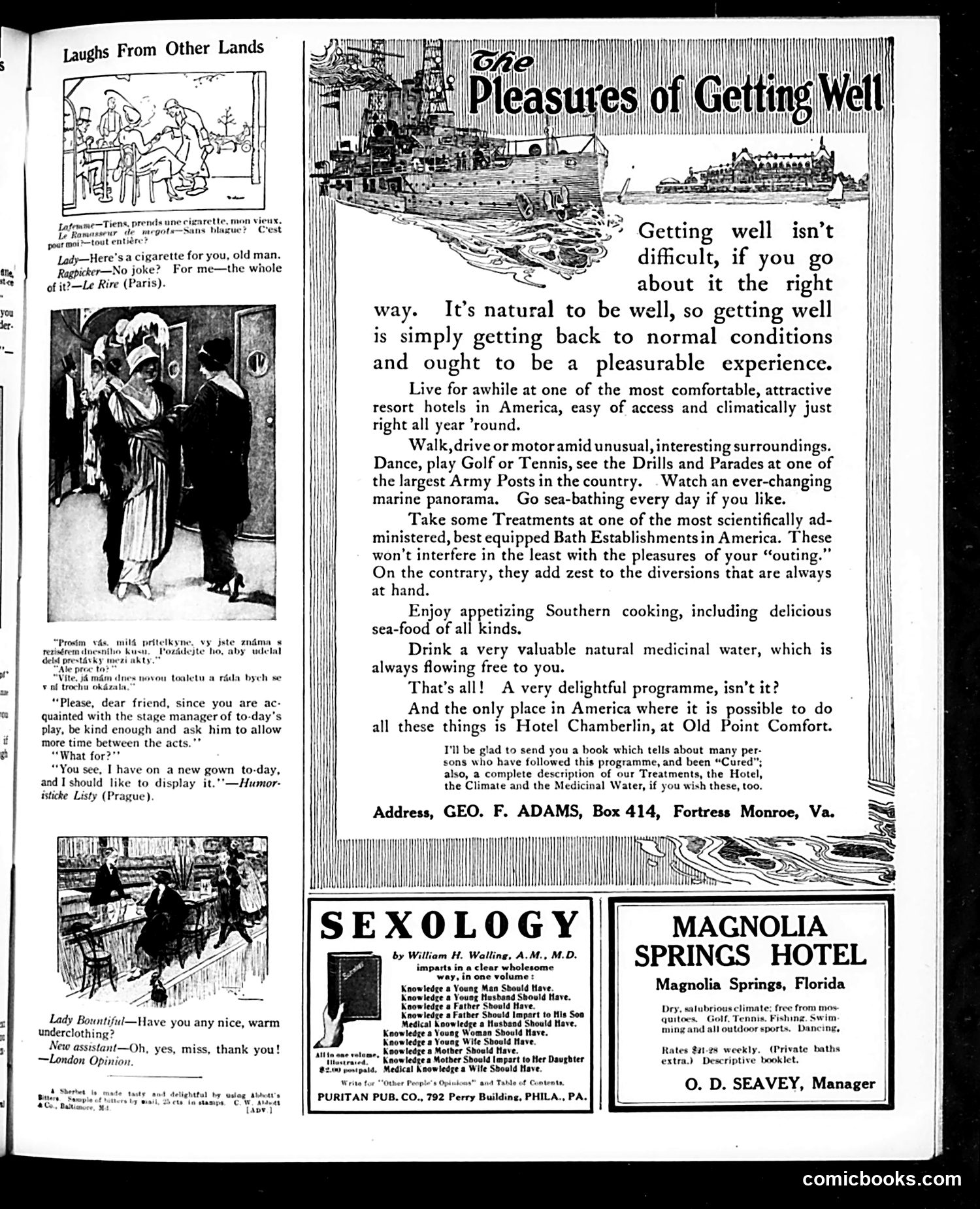
This page combines international humor with period advertisements. The left column presents three brief satirical comics from European publications, illustrating cross-cultural comedic themes: a ragpicker's delight at receiving cigarette tobacco (Paris), a vain theatergoer requesting intermission extension to display her new gown (Prague), and a domestic servant misunderstanding about "warm underclothing" (London). The dominant right side advertises Hotel Chamberlin at Old Point Comfort, Virginia, as a health resort promising recovery through leisure activities, medical treatments, and natural medicinal water—reflecting early 20th-century "therapeutic tourism" beliefs about resort healing. Below appear advertisements for "Sexology," a medical education book by William H. Walling, and Magnolia Springs Hotel in Florida—both offering respectable, medically-framed wellness solutions typical of the era's approach to health and propriety. The page reflects Judge's international scope and the period's emphasis on health resorts as legitimate medical interventions.
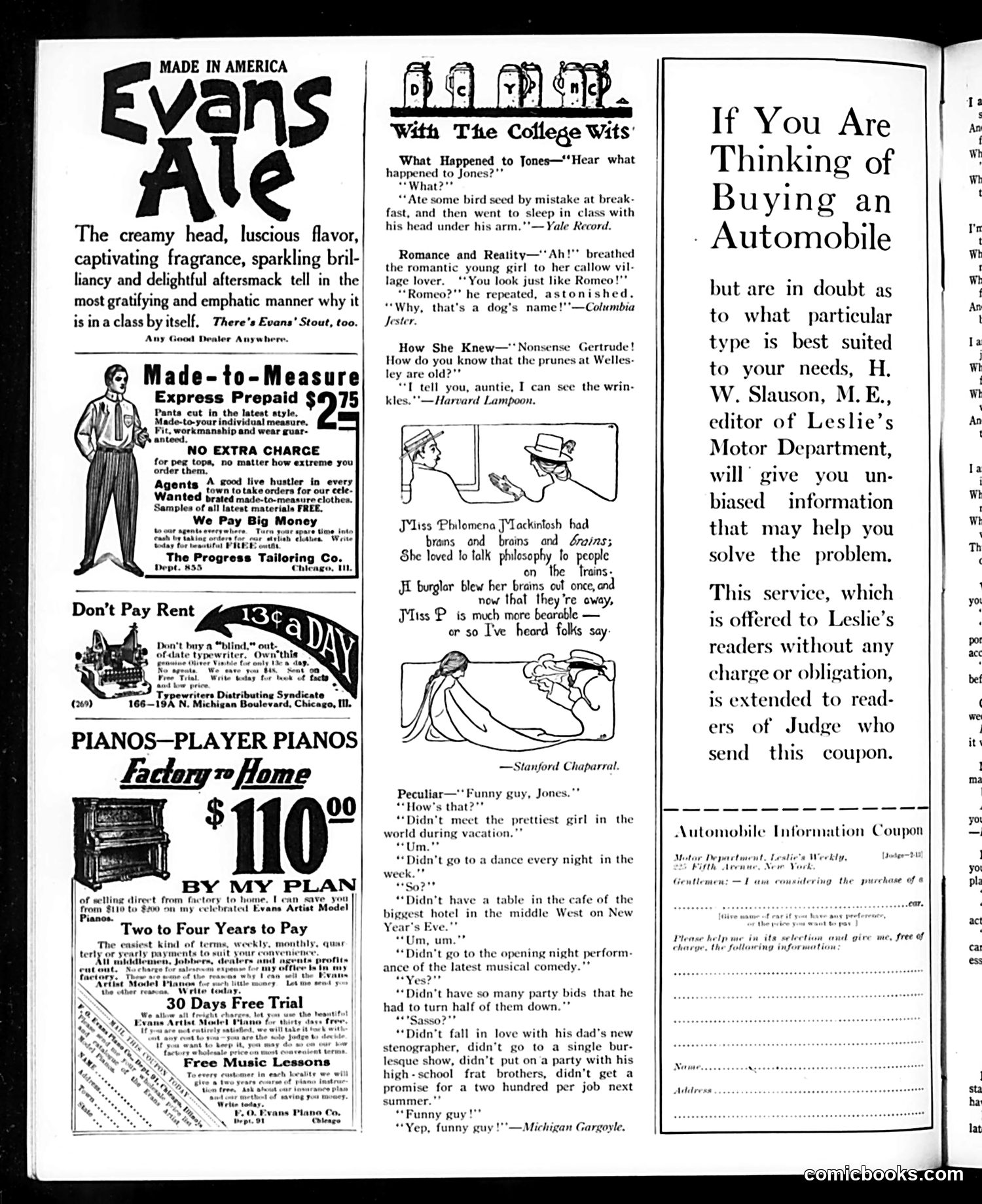
This page is primarily **advertising and humor content** rather than political commentary. The main elements are: **Advertisements:** Evans Ale, made-to-measure clothing, player pianos, and an automobile information service dominate the layout. **"College Wits" Humor Section:** A collection of brief jokes attributed to college humor magazines (Yale Record, Columbia Jester, Harvard Lampoon, Stanford Chaparral, Michigan Gargoyle). These gentle gags mock: - Absent-minded students (eating bird seed) - Romantic clichés (comparing lovers to Romeo) - Female students' social pretensions (claiming old prunes are young, exaggerating vacation activities) The humor targets college life stereotypes—dating, parties, socializing—with no political edge. The final joke's punchline relies on the contrast between an overly eventful vacation narrative and the deadpan response "Funny guy!" This reflects early 20th-century American magazine humor: lighthearted, youth-focused, and reliant on understated comedic timing rather than satire.
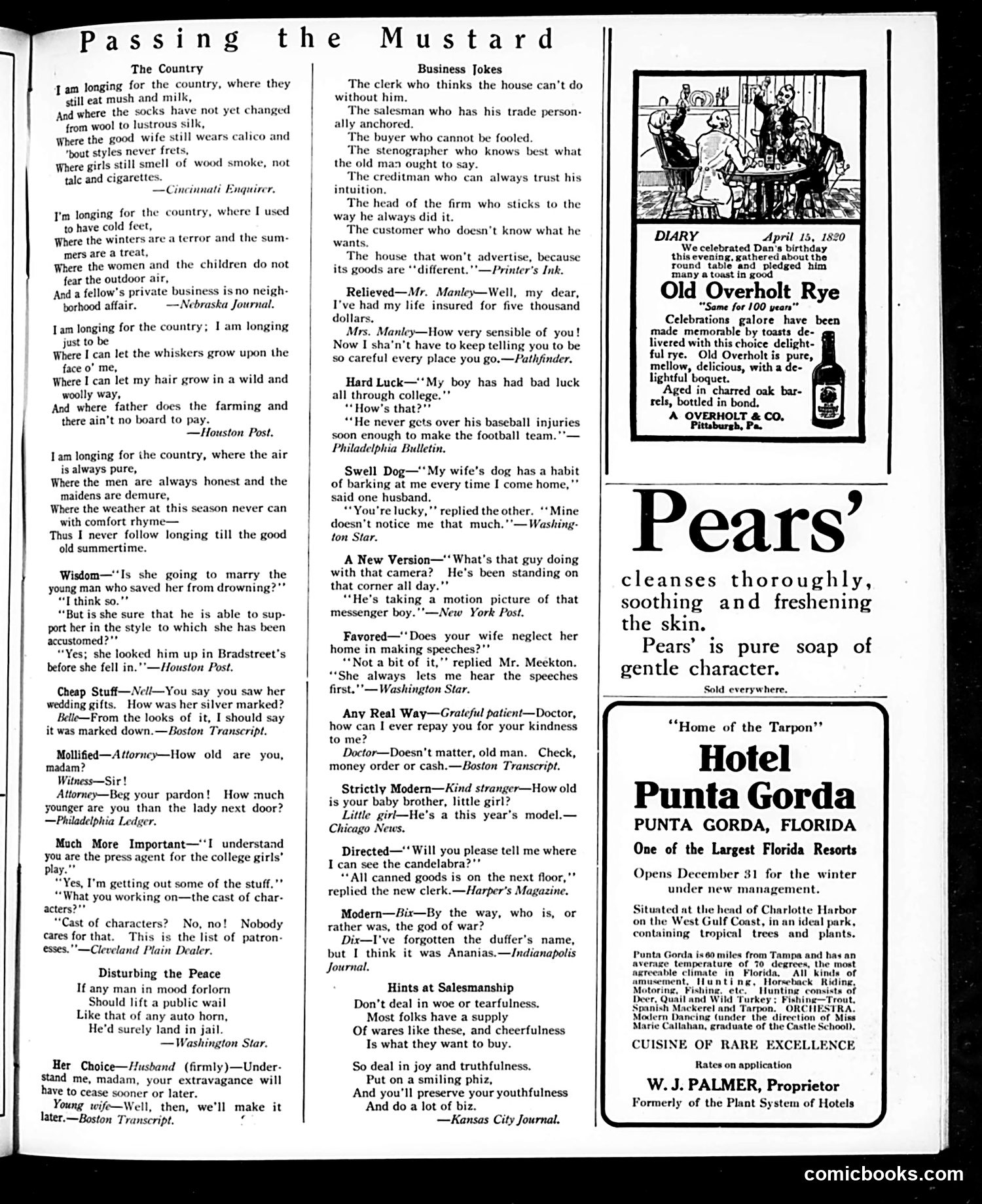
This page from Judge magazine (appears to be early 20th century based on style) contains nostalgic poetry and light humor targeting urban middle-class readers. **The Poetry Section ("The Country"):** Multiple poems express yearning for rural life—a common theme reflecting anxieties about rapid industrialization and urbanization. Writers romanticize countryside simplicity: honest men, demure women, no gossip, no pretense. This contrasts sharply with city life's materialism and social climbing. **The Jokes Section ("Business Jokes"):** Quick satirical barbs mock workplace absurdities—employees overestimating importance, salesmen with inflated egos, stubborn bosses resisting change, and companies refusing to advertise yet expecting sales. These target recognizable business stereotypes. **Other Humor:** Brief jokes mock women's materialism (the Bradstreet's reference suggests checking a suitor's credit rating), wedding gift quality, and marital dynamics where wives ignore husbands. The overall tone: gentle social satire aimed at middle-class readers, balancing nostalgia for rural virtue against contemporary urban and commercial foibles.
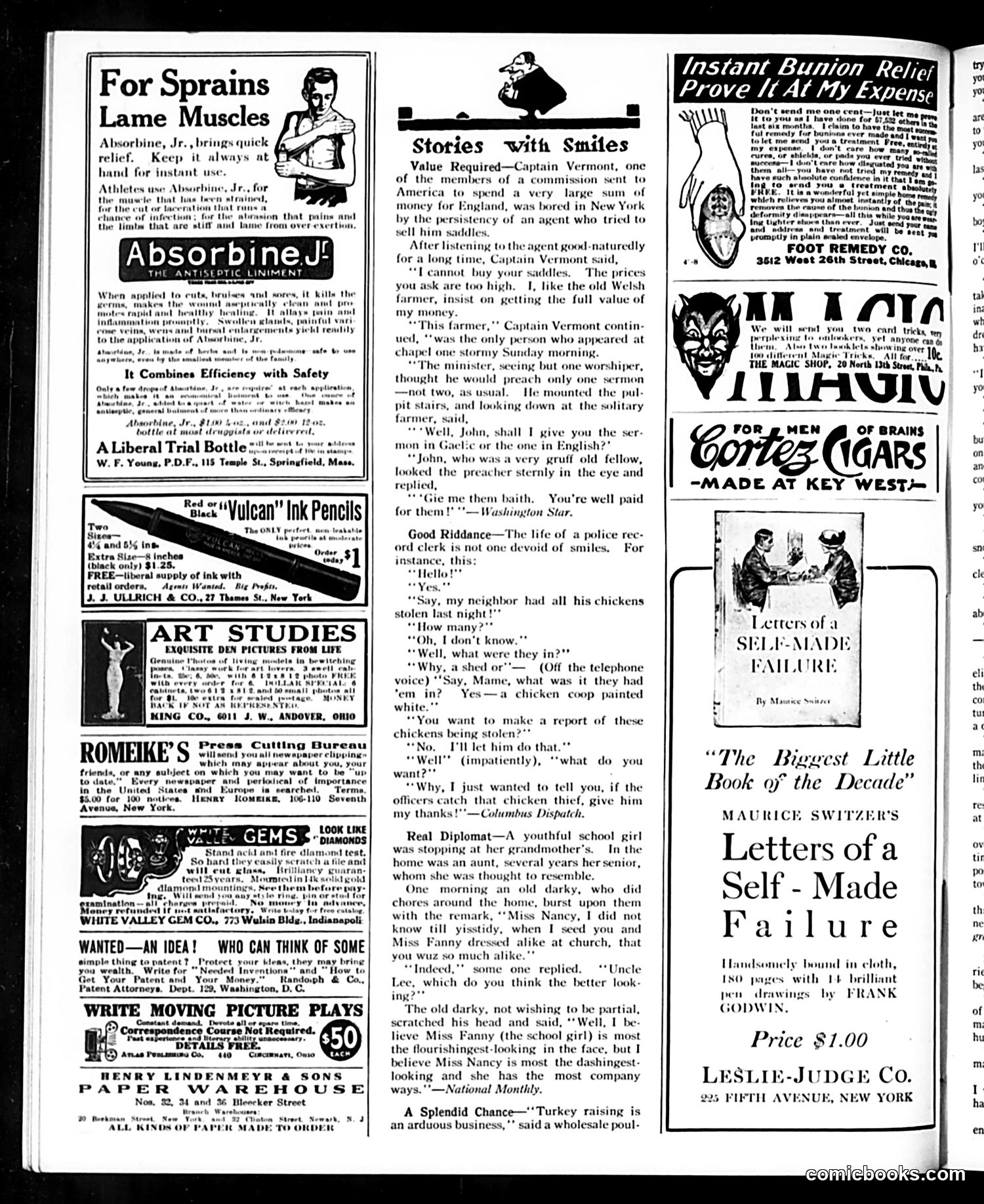
This page is primarily **advertising and light humor content** from an early-20th-century Judge magazine—not political cartoons. The main text feature is "Stories with Smiles," a humor column. The first anecdote features **Captain Vermont**, described as a British commission member sent to America to purchase supplies. A vendor tries to sell him saddles; Vermont deflects by telling a story about a Welsh farmer who insisted on "full value for money"—a gentle jab at British thriftiness and negotiating tactics that would resonate with American readers amused by foreign customs. The remaining brief anecdotes are lighthearted workplace and domestic humor: a police clerk's interaction about stolen chickens, a child's diplomatic compliment about relatives' appearances, and commentary on turkey-raising difficulties. The surrounding content is entirely advertising—remedies (Absorbine for muscle strains, bunion relief), pen pictures, art studies, patent services, and cigars. This reflects the magazine's reliance on commercial revenue, typical of this publishing era.
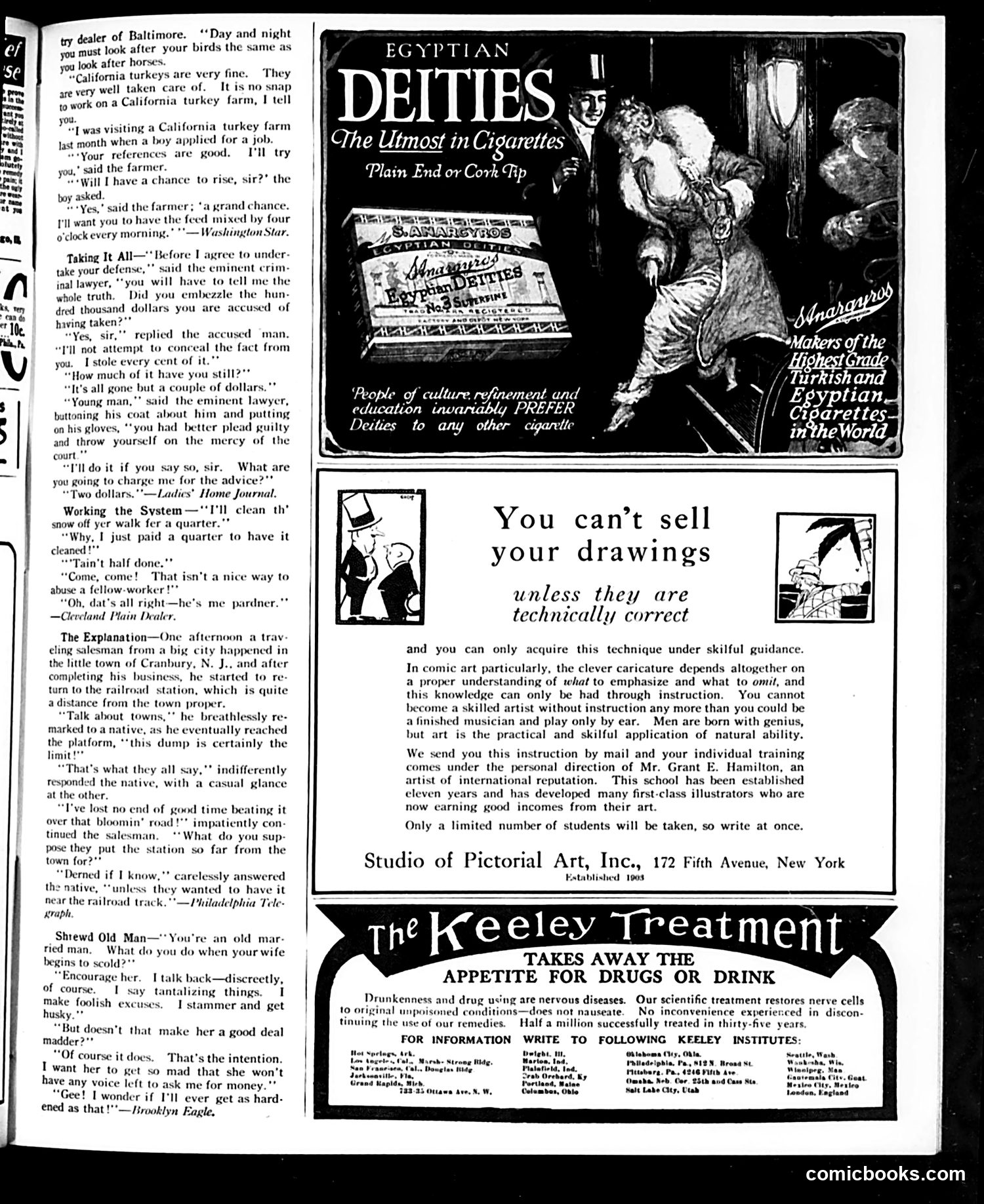
This page contains several humorous short anecdotes and advertisements typical of early 20th-century American satirical journalism. **The jokes** mock ordinary people's foolishness: a farm boy asking about advancement (told he'll "rise" by waking at 4am), a lawyer charging $2 to advise an embezzler to plead guilty, a man paying twice to have snow cleared, a traveling salesman confused why a train station is near the railroad, and a husband deliberately angering his wife to avoid her financial demands. **The advertisements** include: - Egyptian Deities cigarettes, marketed as superior to competitors - Studio of Pictorial Art offering illustration instruction under "Grant Hamilton" - The Keeley Treatment, a dubious medical remedy claiming to cure alcoholism and drug addiction The page reflects period attitudes: casual endorsement of questionable "cures," emphasis on hustling and petty deceptions, and humor based on class stereotypes. The content is mostly filler material between ads, typical of Judge's format.
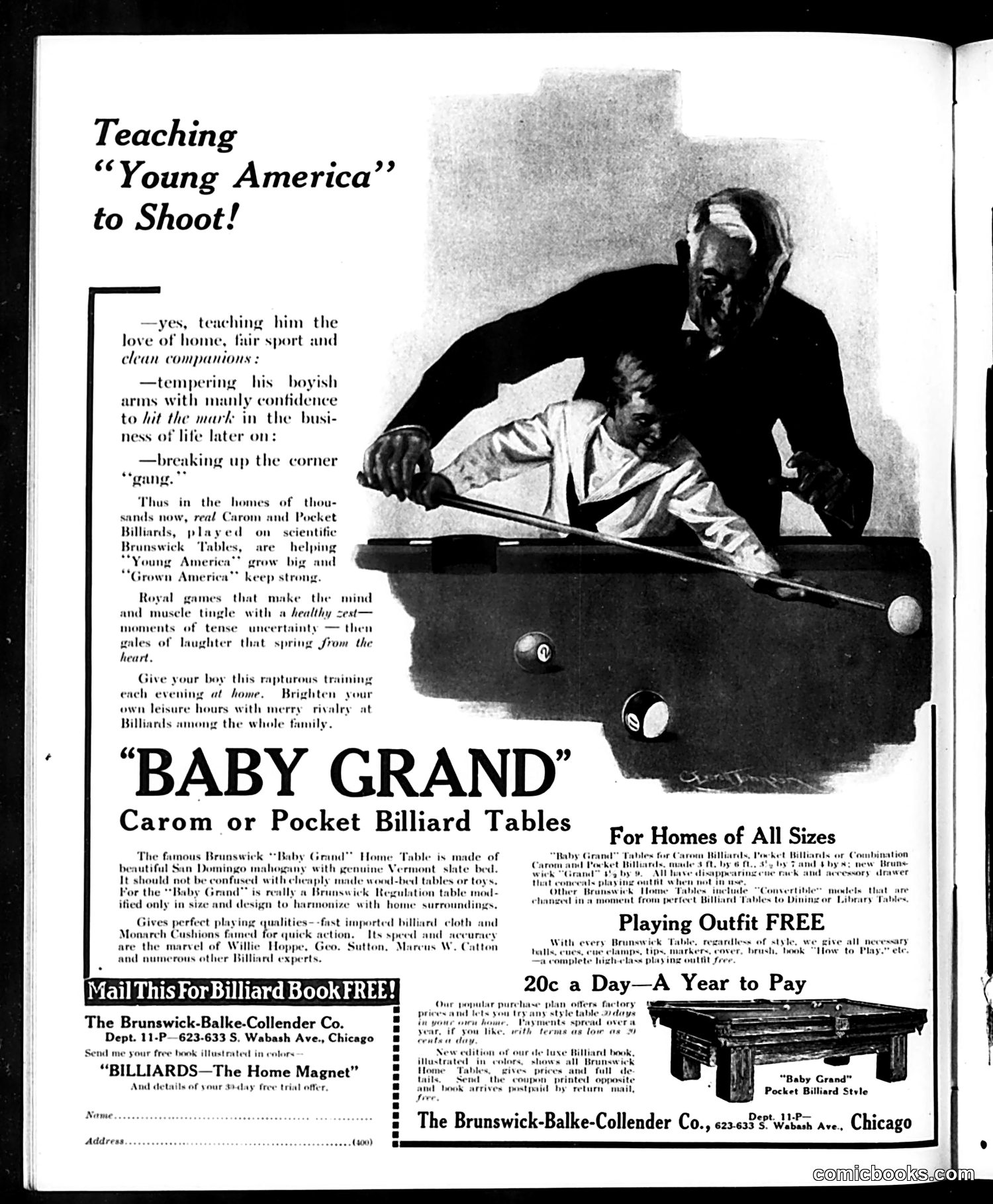
This page is primarily **advertising for Brunswick billiard tables**, not political satire. The "satire" is implicit in the marketing pitch itself. The headline "Teaching 'Young America' to Shoot!" uses deliberate double meaning—appearing to reference firearms training, but actually promoting billiards as a character-building activity for boys. The accompanying illustration shows an adult instructor guiding a young boy at a pool table. The ad's satirical angle targets **Progressive Era anxieties** about urban youth. By framing billiards as wholesome recreation that keeps boys away from "corner gangs" and street trouble, it exploits parental fears about juvenile delinquency. The irony: billiards halls were historically associated with gambling and vice, yet Brunswick markets them as moral improvement tools for homes. The sales pitch emphasizes "manly confidence," patriotic virtue ("love of home"), and character development—typical early 20th-century advertising rhetoric that equated consumer goods with social responsibility and American strength.