
Judge, 1915-02-13 · page 4 of 24
Judge — February 13, 1915 — page 4: what you’re looking at
What you’re looking at
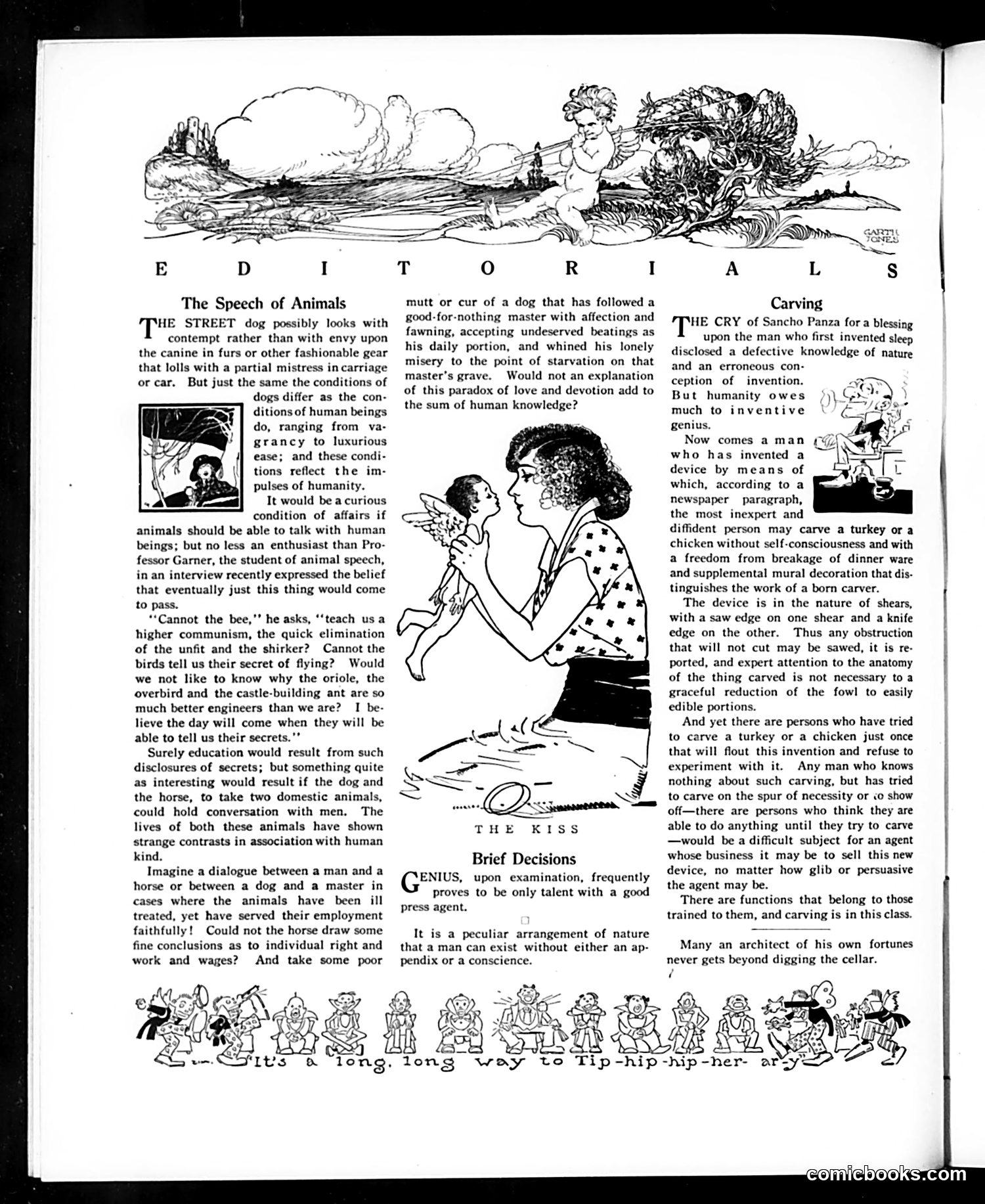
This page contains two distinct pieces: **"The Speech of Animals"** (left column) is a philosophical essay arguing that animals possess intelligence and emotional complexity worthy of human respect. The author speculates that if animals could speak, they'd reveal impressive knowledge—citing examples like dogs' loyalty despite poor treatment and horses' engineering prowess. The piece advocates for recognizing animal consciousness and dignity. **"Carving"** (right column) satirizes an invented carving device designed to make poultry carving foolproof. The satire mocks the notion that such a gadget is necessary, suggesting that anyone lacking basic carving skill shouldn't rely on mechanical shortcuts. It's a light jab at over-engineered solutions to simple problems and at those seeking easy alternatives to developing competence.
📄 Transcribed text from this page (OCR, searchable)
Machine-transcribed from the original scan — historical spelling and the odd misread are preserved.
The Speech of Animals HE STREET dog possibly looks with contempt rather than with envy upon the canine in furs or other fashionable gear that lolls with a partial mistress in carriage But just the same the conditions of dogs differ as the con- ditions of human beings do, ranging from va- grancy to luxurious ease; and these condi- tions reflect the im- pulses of humanity. It would be a curious condition of affairs if animals should be able to talk with human beings; but no less an enthusiast than Pro- fessor Garner, the student of animal speech, in an interview recently expressed the belief that eventually just this thing would come to pass. “*Cannot the bee,’’ he asks, ‘‘teach us a higher communism, the quick elimination of the unfit and the shirker? Cannot the birds tell us their secret of flying? Would we not like to know why the oriole, the overbird and the castle-building ant are so much better engineers than we are? I be- lieve the day will come when they will be able to tell us their secrets."" Surely education would result from such disclosures of secrets; but something quite as interesting would result if the dog and the horse, to take two domestic animals, could hold conversation with men. The lives of both these animals have shown strange contrasts in association with human kind. Imagine a dialogue between a man and a horse or between a dog and a master in cases where the animals have been ill treated, yet have served their employment faithfully! Could not the horse draw some fine conclusions as to individual right and work and wages? And take some poor or car. mutt or cur of a dog that has followed a good-for-nothing master with affection and fawning, accepting undeserved beatings as his daily portion, and whined his lonely misery to the point of starvation on that master’s grave. Would not an explanation of this paradox of love and devotion add to the sum of human knowledge? a SS SS deeanee, 7 SS Sumanaeenetten, — THE KISS Brief Decisions ENIUS, upon examination, frequently proves to be only talent with a good press agent. It is a peculiar arrangement of nature that a man can exist without either an ap- pendix or a conscience. THE CRY of Sancho Panza for a blessing upon the man who first invented sleep disclosed a defective knowledge of nature and an erroneous con- ception of invention. But humanity owes much to inventive genius. Now comes a man who has invented a device by means of which, according to a newspaper paragraph, the most inexpert and diffident person may carve a turkey or a chicken without self-consciousness and with a freedom from breakage of dinner ware and supplemental mural decoration that dis- tinguishes the work of a born carver. The device is in the nature of shears, with a saw edge on one shear and a knife edge on the other. Thus any obstruction that will not cut may be sawed, it is re- ported, and expert attention to the anatomy of the thing carved is not necessary to a graceful reduction of the fowl to easily edible portions. And yet there are persons who have tried to carve a turkey or a chicken just once that will flout this invention and refuse to experiment with it. Any man who knows nothing about such carving, but has tried to carve on the spur of necessity or <o show off—there are persons who think they are able to do anything until they try to carve —would be a difficult subject for an agent whose business it may be to sell this new device, no matter how glib or persuasive the agent may be. There are functions that belong to those trained to them, and carving is in this class. ers Many an architect of his own fortunes never gets beyond digging the cellar. 7 |