
Judge, 1915-02-13 · page 15 of 24
Judge — February 13, 1915 — page 15: what you’re looking at
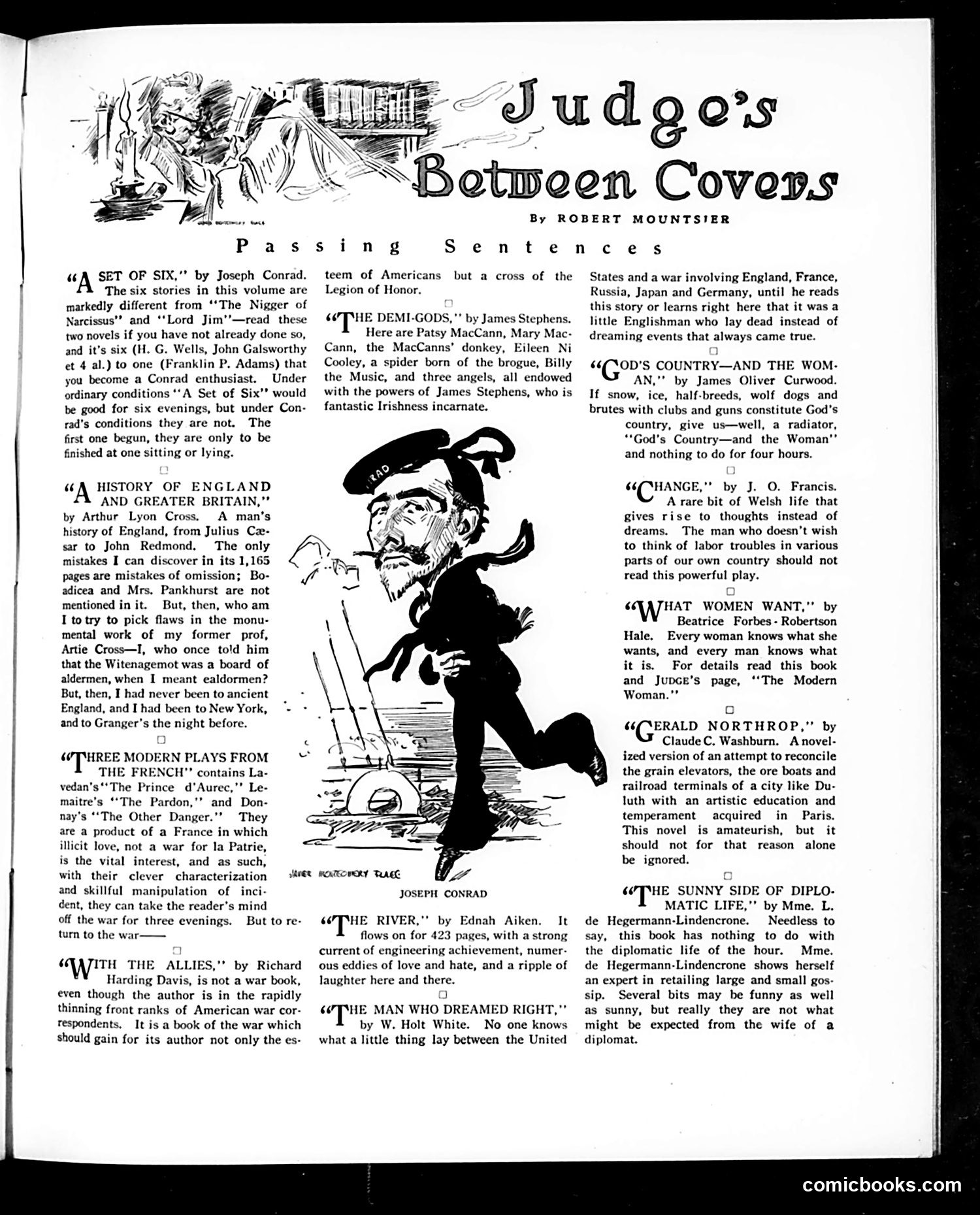
What you’re looking at
This is a book review section from *Judge*, an American satirical weekly. The central cartoon depicts a caricatured figure in exaggerated dress (appears to be a theatrical or comedic character type) and is credited to "Joseph Conrad," the famous author whose work is being reviewed. The satire works on multiple levels: the reviews themselves are witty and mocking—praising Conrad's stories as so absorbing readers cannot put them down, yet joking about history books omitting women (referencing the women's suffrage movement and Emmeline Pankhurst), and dismissing French plays about infidelity as escapism from the pressing reality of war. The cartoon likely lampoons either Conrad himself or a theatrical adaptation of his work. Without clearer identification in the visible image, the exact target remains somewhat unclear, but the overall page mocks contemporary literature and its pretensions while referencing real historical concerns of the era—women's rights and World War I's impact on society.
📄 Transcribed text from this page (OCR, searchable)
Machine-transcribed from the original scan — historical spelling and the odd misread are preserved.
$< ——— “A SET OF SIX,"’ by Joseph Conrad. The six stories in this volume are markedly different from ‘‘The Nigger of Narcissus’ and ‘‘Lord Jim’’—read these two novels if you have not already done so, and it’s six (H. G. Wells, John Galsworthy et 4 al.) to one (Franklin P, Adams) that you become a Conrad enthusiast. Under ordinary conditions ‘‘A Set of Six’? would be good for six evenings, but under Con- rad's conditions they are not. The first one begun, they are only to be finished at one sitting or lying. «6A HISTORY OF ENGLAND AND GREATER BRITAIN,” by Arthur Lyon Cross, A man’s history of England, from Julius Cax- The only sar to John Redmond. mistakes I can discover in its 1,165 pages are mistakes of omission; Bo- adicea and Mrs. Pankhurst are not mentioned i But, then, who am I to try to pick flaws in the monu- mental work of my former prof, Artie Cross—I, who once told him that the Witenagemot was a board of aldermen, when I meant ealdormen? But, then, I had never been to ancient England, and I had been to New York, and to Granger's the night before. 67T‘HREE MODERN PLAYS FROM THE FRENCH" contains La- vedan's‘'The Prince d'Aurec,"’ Le- maitre’s ‘*The Pardon,’’ and Don- nay's ‘‘The Other Danger.’? They are a product of a France in which illicit love, not a war for la Patrie, is the vital interest, and as such, with their clever characterization and skillful manipulation of inci- dent, they can take the reader's mind off the war for three evenings. But to re- turn to the war: 6 ITH THE ALLIES,’’ by Richard Harding Davis, is not a war book, even though the author is in the rapidly thinning front ranks of American war cor- respondents. It is a book of the war which should gain for its author not only the es- ng teem of Americans Legion of Honor. but a cross of the 60° HE DEMI-GODS,"’ by James Stephens. Here are Patsy MacCann, Mary Mac- Cann, the MacCanns’ donkey, Eileen Ni Cooley, a spider born of the brogue, Billy the Music, and three angels, all endowed with the powers of James Stephens, who is fantastic Irishness incarnate. JOSEPH CONRAD 607HE RIVER," by Ednah Aiken. = It flows on for 423 pages, with a strong current of engineering achievement, numer- ous eddies of love and hate, and a ripple of laughter here and there. a 607P.HE MAN WHO DREAMED RIGHT," by W. Holt White. No one knows what a little thing lay between the United By ROBERT MOUNTSIER Sentences States and a war involving England, France, Russia, Japan and Germany, until he reads this story or learns right here that it was a little Englishman who lay dead instead of dreaming events that always came true. a 66(0D'S COUNTRY—AND THE WOM- AN,"’ by James Oliver Curwood. If snow, ice, half-breeds, wolf dogs and brutes with clubs and guns constitute God’s country, give us—well, a radiator, “*God’s Country—and the Woman"’ and nothing to do for four hours. 66(HANGE, by J. O. Francis. A rare bit of Welsh life that gives rise to thoughts instead of dreams. The man who doesn’t wish to think of labor troubles in various parts of our own country should not read this powerful play. 6 HAT WOMEN WANT," by Beatrice Forbes - Robertson Hale, Every woman knows what she wants, and every man knows what it is. For details read this book and Jupce’s page, ‘‘The Modern Woman.”* ie] 66(~ERALD NORTHROP,” by Claude C, Washburn. A novel- ized version of an attempt to reconcile the grain elevators, the ore boats and railroad terminals of a city like Du- luth with an artistic education and temperament acquired in Paris. This novel is amateurish, but it should not for that reason alone be ignored. [email protected] SUNNY SIDE OF DIPLO- MATIC LIFE,”’ by Mme. L. de Hegermann-Lindencrone. Needless to say, this book has nothing to do with the diplomatic life of the hour. Mme. de Hegermann-Lindencrone shows herself an expert in retailing large and small gos- sip. Several bits may be funny as well as sunny, but really they are not what might be expected from the wife of a diplomat. comicbooks.com