
Judge, 1915-02-13 · page 11 of 24
Judge — February 13, 1915 — page 11: what you’re looking at
What you’re looking at
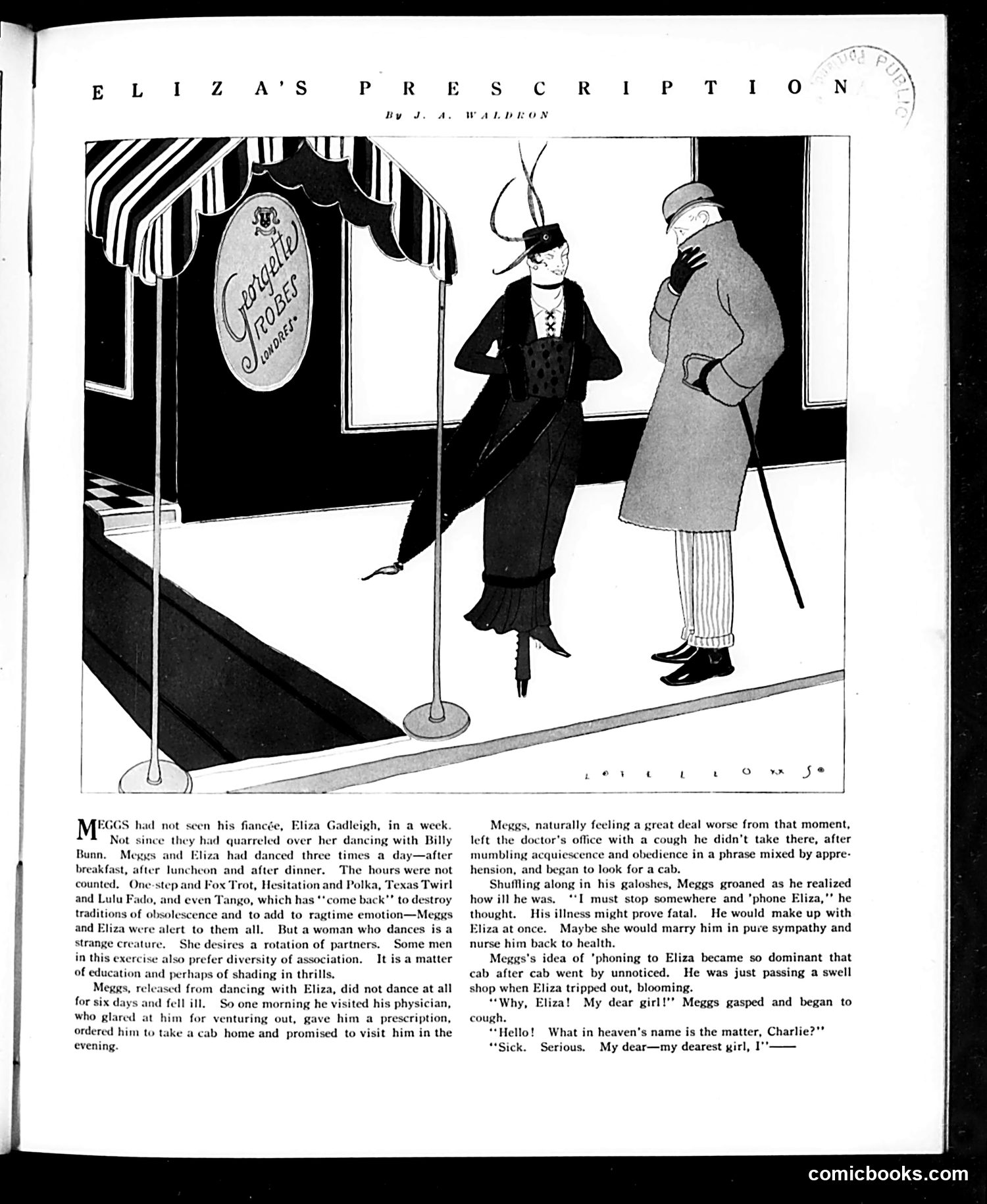
This is a romantic comedy story illustrated in Judge magazine. The narrative follows Meggs, who becomes ill after six days without dancing with his fiancée Eliza Gadleigh. His doctor prescribes rest and a cab ride home, but Meggs becomes so preoccupied with calling Eliza that he ignores passing cabs. The illustrated scene shows Meggs, appearing sickly and bundled in an overcoat, encountering Eliza just outside a fashionable shop. She appears vibrant and well, having clearly not been pining away. Meggs dramatically reveals his illness, apparently hoping she'll nurse him back to health and marry him out of sympathy. The satire targets romantic male melodrama—Meggs's self-pitying assumption that his illness will move Eliza to marry him, despite their recent quarrel over dancing partners. It also gently mocks the era's dance crazes (tango, hesitation waltz) and social conventions around courtship.
📄 Transcribed text from this page (OCR, searchable)
Machine-transcribed from the original scan — historical spelling and the odd misread are preserved.
sled over her dancing with Billy Bunn. Megs and Eliza had danced three times a day—after breakfast, after luncheon and after dinner. The hours were not x Trot, Hesitation and Polka, Texas Twirl en Tango, which has **come back"’ to destroy and to add to ragtime emotion—Me But a woman who dances is ¢ Some men a matter counted. One-step and and Lulu Fado, and ¢ traditions of obsolescenc and Eliza were alert to them all. Strange creature, She desires a rotation of partners. in this exercise also prefer diversity of association. It is and perhaps of shading in thrill S ased from dancing with El did not dance at all for six days and fell ill, So one morning he visited his physician, who glared at him for venturing out, e him a prescription, ordered him to take a cab home and promised to visit him in the evening. Ss C R WALDEON se — J Meggs, naturally feeling a great deal worse from that moment, left the doctor's office with a cough he didn't take there, after mumbling acquiescence and obedience in a phrase mixed by appre- hension, and began to look for a cab. Shuflling along in his galoshes, Meggs groaned as he realized how ill he was, ‘'I must stop somewhere and ‘phone Eliza,’’ he thought. His illness might prove fatal. He would make up with Eliza at once. Maybe she would marry him in pure sympathy and nurse him back to health. Meggs's idea of ‘phoning to Eliza became so dominant that cab after cab went by unnoticed. He was just passing a swell shop when Eliza tripped out, blooming. “Why, Eliza! My dear girl!’ Meggs gasped and began to cough. “Hello! “Sick. What in heaven's name is the matter, Charlie?"’ Serious. My dear—my dearest girl, 1'’ comicbooks.com