
A complete issue · 24 pages · 1915
Judge — January 30, 1915
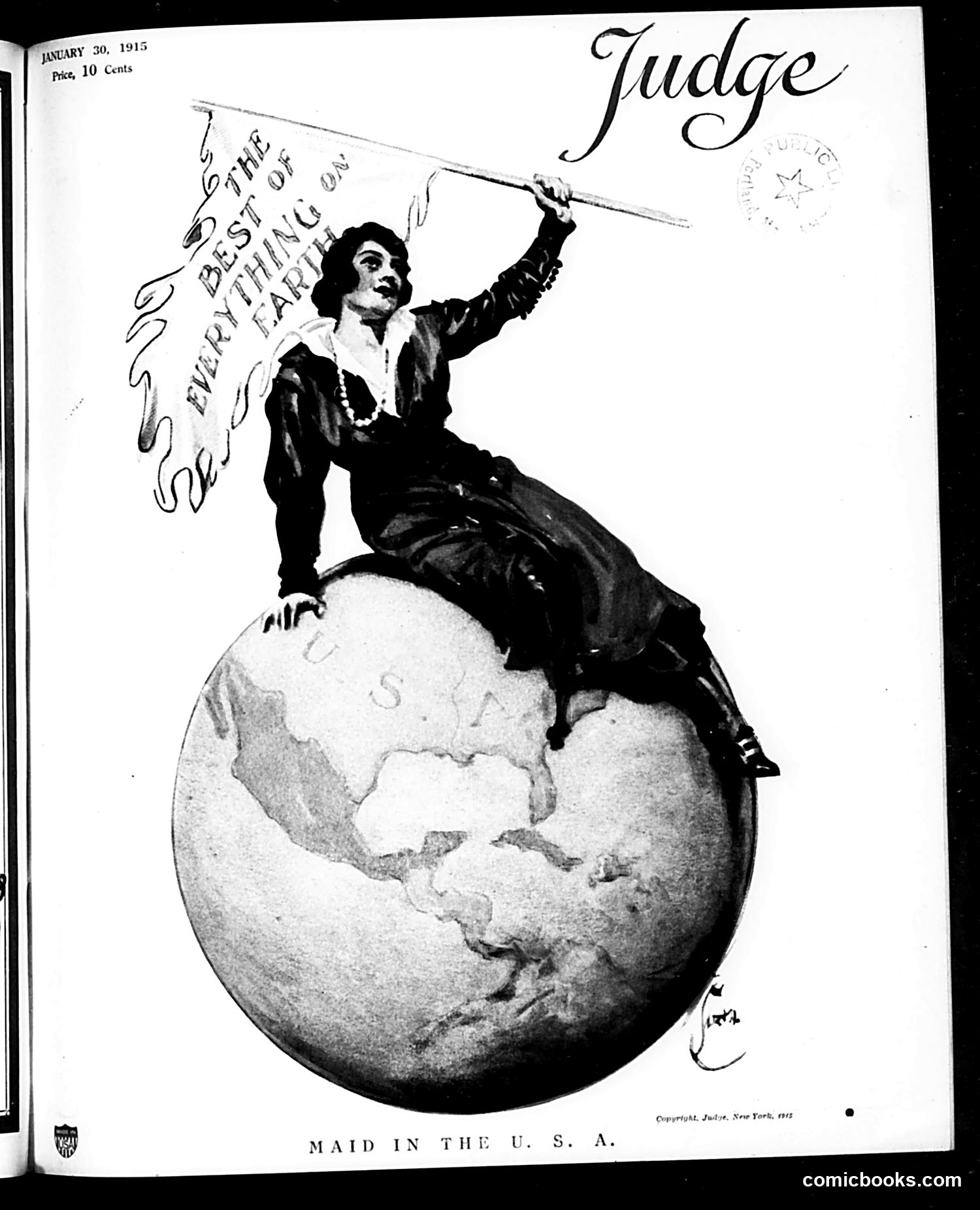
This cover satirizes American domestic labor and immigration. A fashionably dressed woman sits atop a globe, wielding a paintbrush to inscribe text reading "Maid of [the] Employing [Nations]" — likely commentary on America's growing international influence and economic power in the early 20th century. The title "Maid in the U.S.A." plays on the phrase "Made in the U.S.A.," suggesting America itself functions as a servant or maid to the world, or ironically, that American domestic service and labor are being "produced" for export. This reflects concerns about American labor conditions, immigration policy, and the nation's expanding role in global affairs during the Progressive Era, when such economic and social tensions generated considerable satirical commentary.
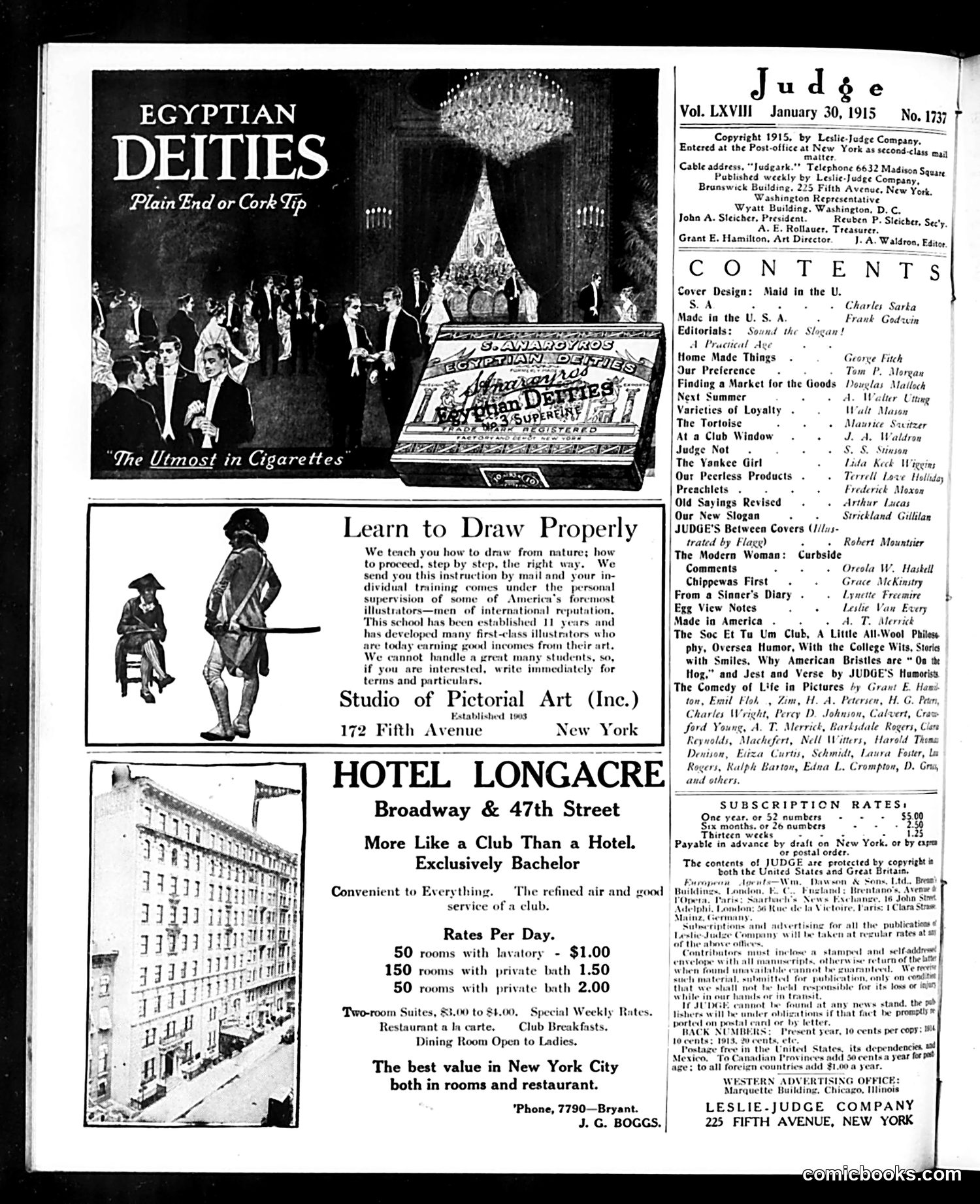
This page is primarily **advertising and contents listing** rather than satirical commentary. The top advertisement features "Egyptian Deities" cigarettes with an illustration of what appears to be an Egyptian temple scene and worshippers—a common advertising trope of the era using Orientalist imagery to suggest exotic luxury and sophistication. Below are ads for art instruction, a hotel, and other services typical of the period. The "CONTENTS" section lists articles and illustrations from that week's issue, including pieces titled "Judge Not," "The Yankee Girl," and "Our Peerless Products," but the actual satirical content isn't visible on this page. Without seeing the interior articles and cartoons themselves, specific political or social satire cannot be identified from this contents page alone.
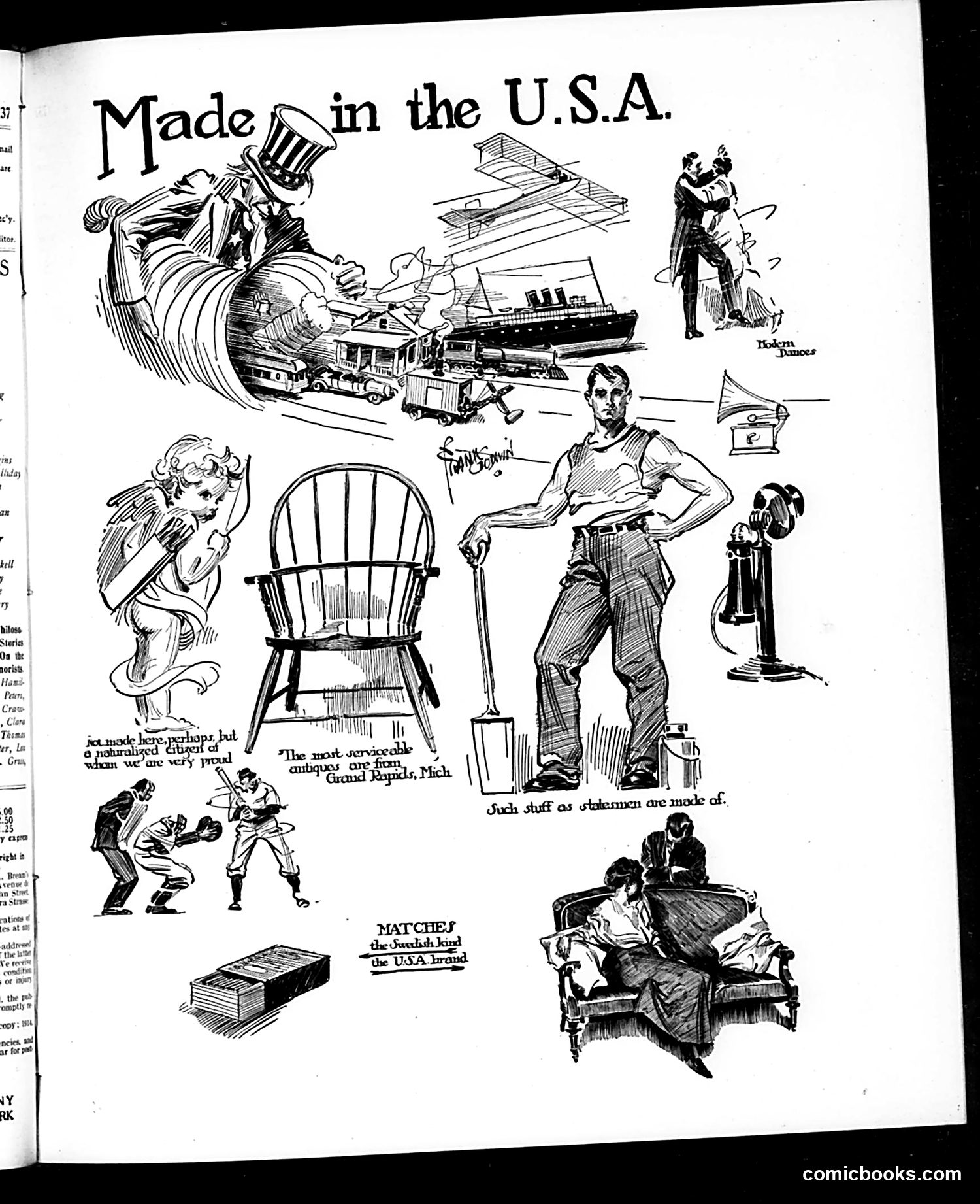
This satirical page celebrates American manufacturing and industrial prowess. The central figure is Uncle Sam (identifiable by his top hat), presiding over various American-made products: ships, aircraft, furniture, and matches. The imagery emphasizes domestic production capabilities. The middle section features a workingman with tools, captioned text noting "such stuff as workmen are made of"—celebrating American labor. A cherub appears in the lower left, suggesting pride and prosperity. The matches box at bottom states "the Swedish kind" with "the U.S.A. brand"—likely satirizing American competition with Swedish imports, implying American-made matches are superior. The overall message promotes American industrial excellence and domestic manufacturing during what appears to be an era of international trade competition.
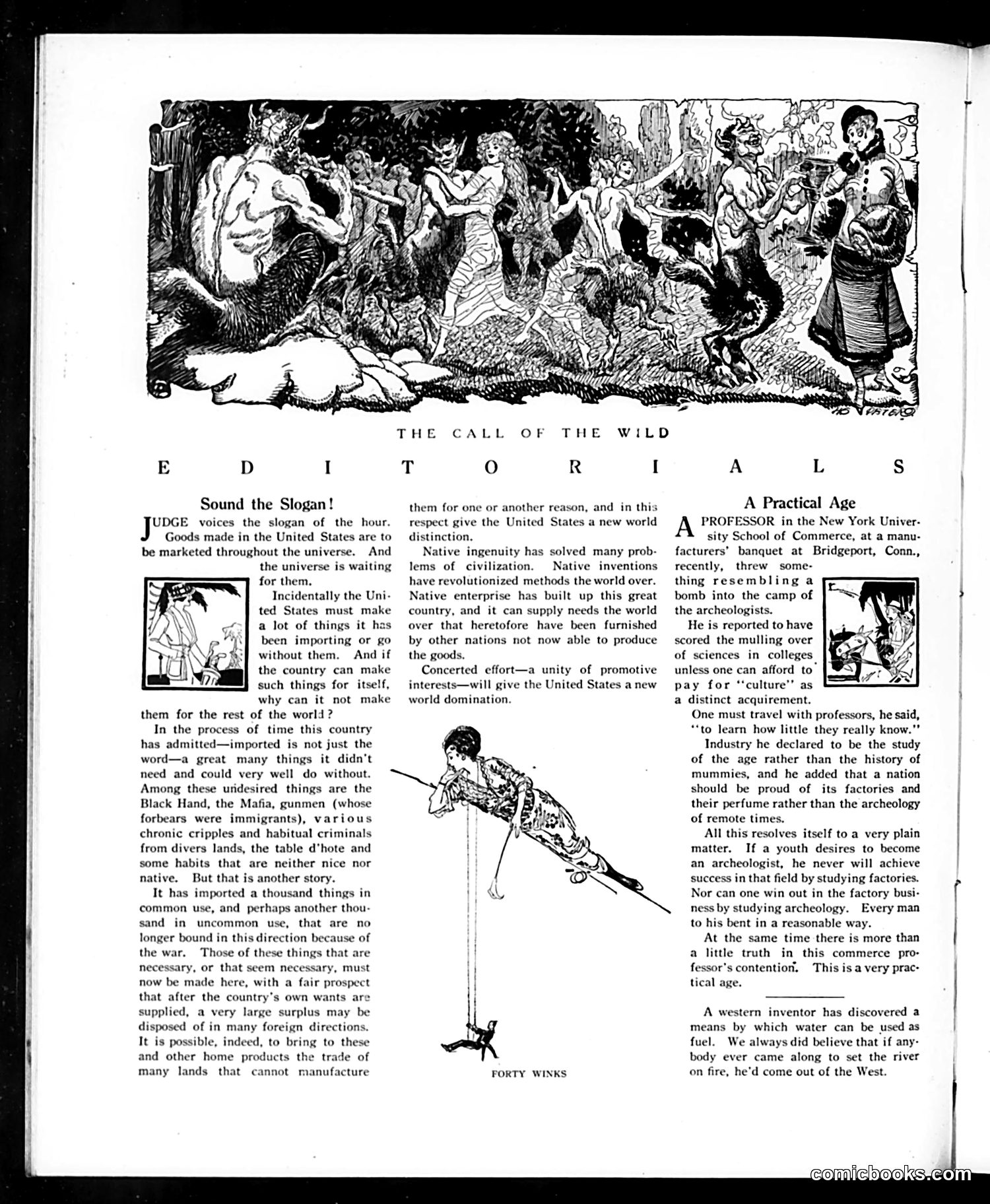
The top illustration titled "THE CALL OF THE WILD" depicts a chaotic forest scene with nude or partially-clothed figures engaged in wild, uninhibited behavior—appearing to satirize primitivism or "back to nature" movements popular in early 20th-century intellectual circles. The left editorial section "Sound the Slogan!" argues for American manufacturing dominance, advocating that the U.S. should produce goods previously imported, positioning domestic industry as patriotic necessity. The right section "A Practical Age" mocks academic pretension, suggesting that studying factories and commerce matters more than archaeology. The illustration "FORTY WINKS" shows someone sleeping, likely commenting on impractical scholarship. The final anecdote about water-as-fuel appears to joke about Western American tall tales and gullibility.
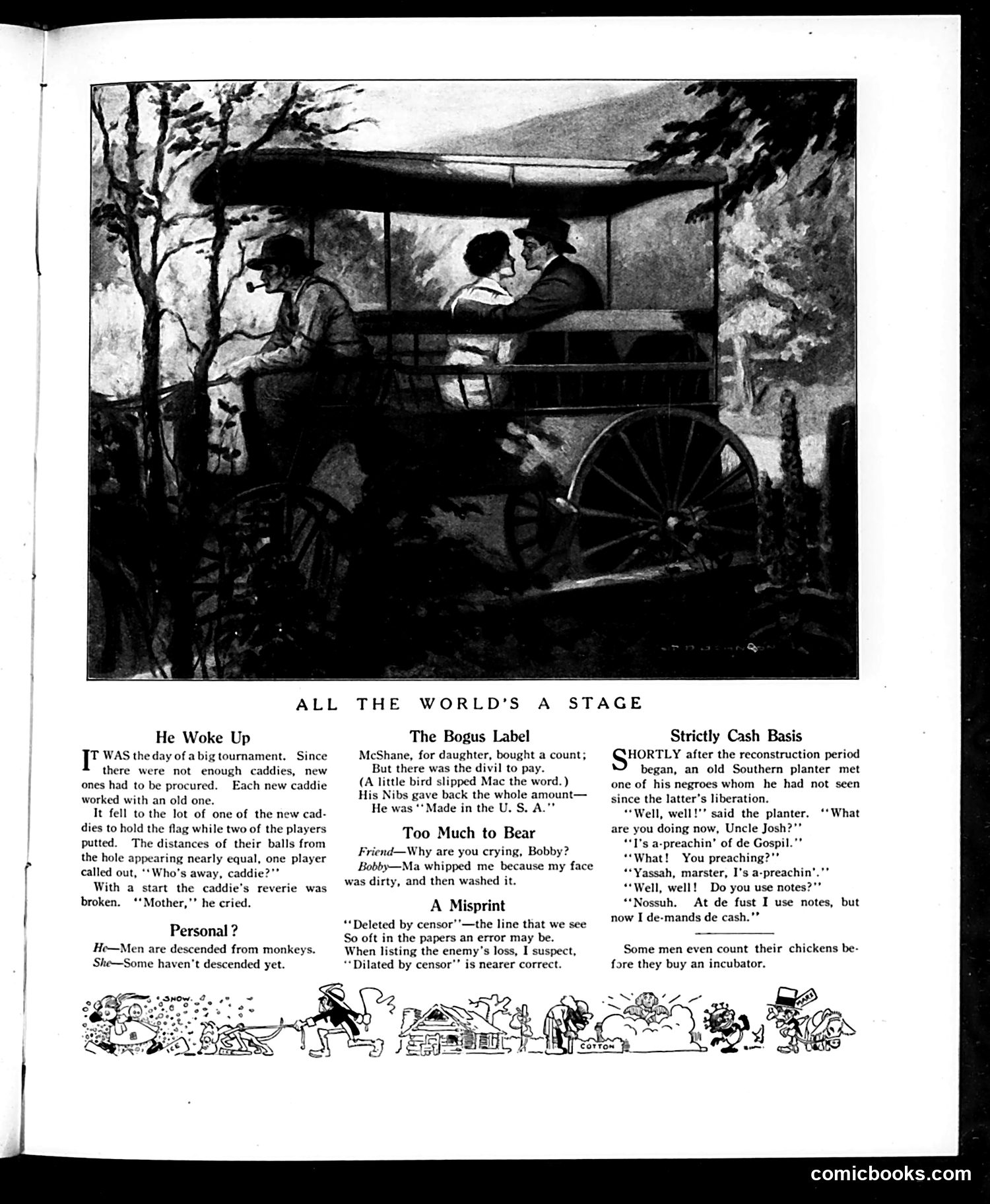
This Judge magazine page presents six short humorous sketches satirizing everyday social situations: 1. **"He Woke Up"**: Mocks nouveau-riche behavior—a caddie's broken equipment becomes a status symbol when used in a golf tournament. 2. **"Personal?"**: A brief joke about human descent from monkeys. 3. **"The Bogus Label"**: Satirizes consumer deception—a man buys counterfeit goods marked "Made in the U.S.A." while claiming patriotism. 4. **"Two Much to Bear"**: A child's innocent complaint about parental discipline. 5. **"A Misprint"**: Mocks newspaper censorship and editorial errors. 6. **"Strictly Cash Basis"**: Satirizes Southern planters' post-Reconstruction economic struggles and their resistance to modern credit systems. The sketches collectively lampoon American social pretension, dishonesty, and regional economic tensions.
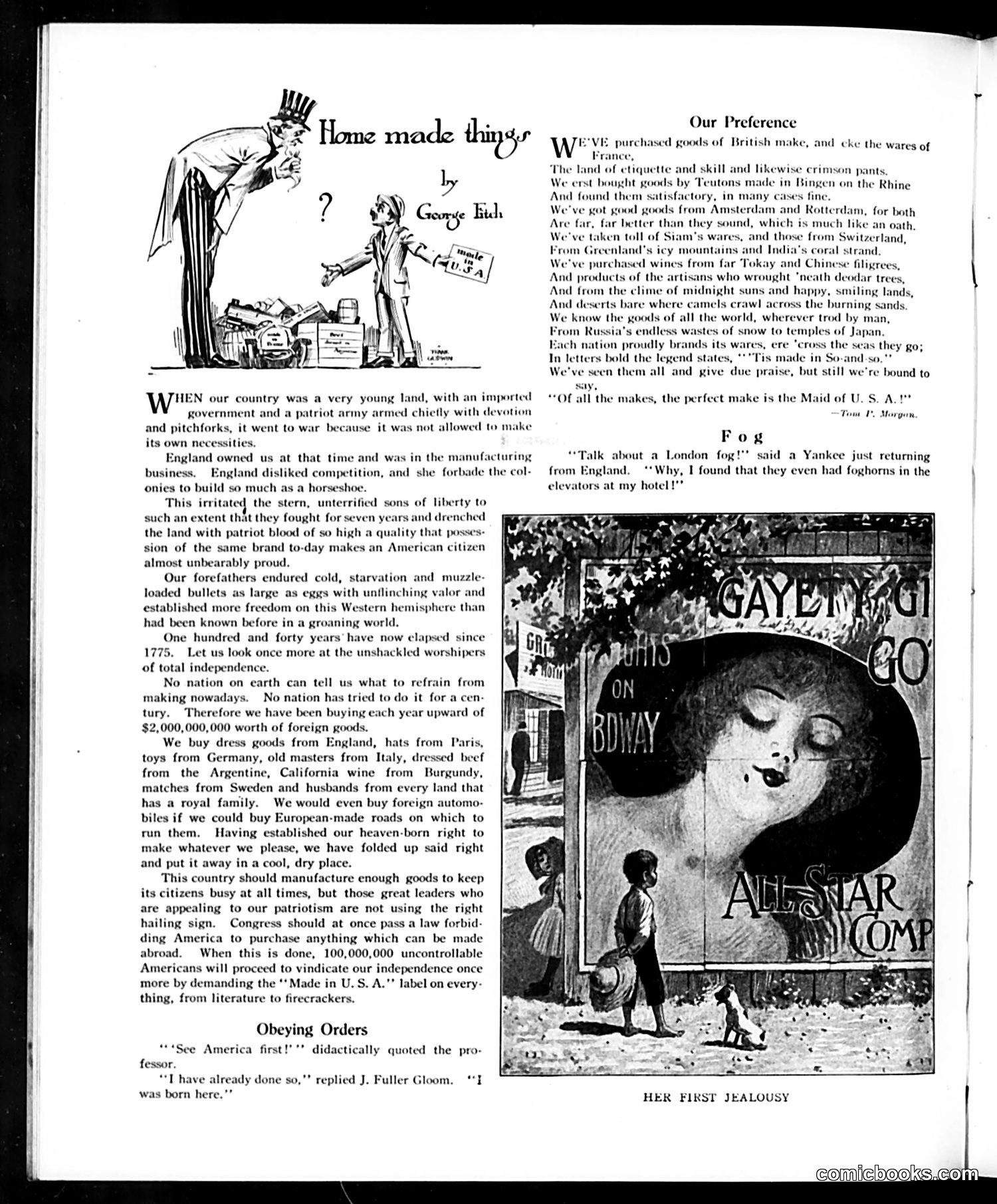
This page satirizes American consumer habits and national pride. The main article, "Home Made Things" by George Fitch, ironically critiques how Americans—despite celebrating independence from Britain (1775)—spend $2 billion annually importing foreign goods rather than supporting domestic manufacturing. The piece argues Congress should ban foreign purchases to force Americans to embrace "Made in U.S.A." products. The cartoon at top depicts Britannia (the female figure representing Britain, identifiable by her crown) watching as an American character purchases foreign wares, illustrating the irony that post-revolutionary Americans remain economically dependent on foreign nations they claimed to reject. The accompanying poem and sidebar anecdotes reinforce the theme: Americans eagerly consume imported goods while paradoxically demanding nationalist pride. The "Obeying Orders" joke mocks empty patriotic slogans. The image at bottom ("Her First Jealousy") appears unrelated—likely from a separate feature.
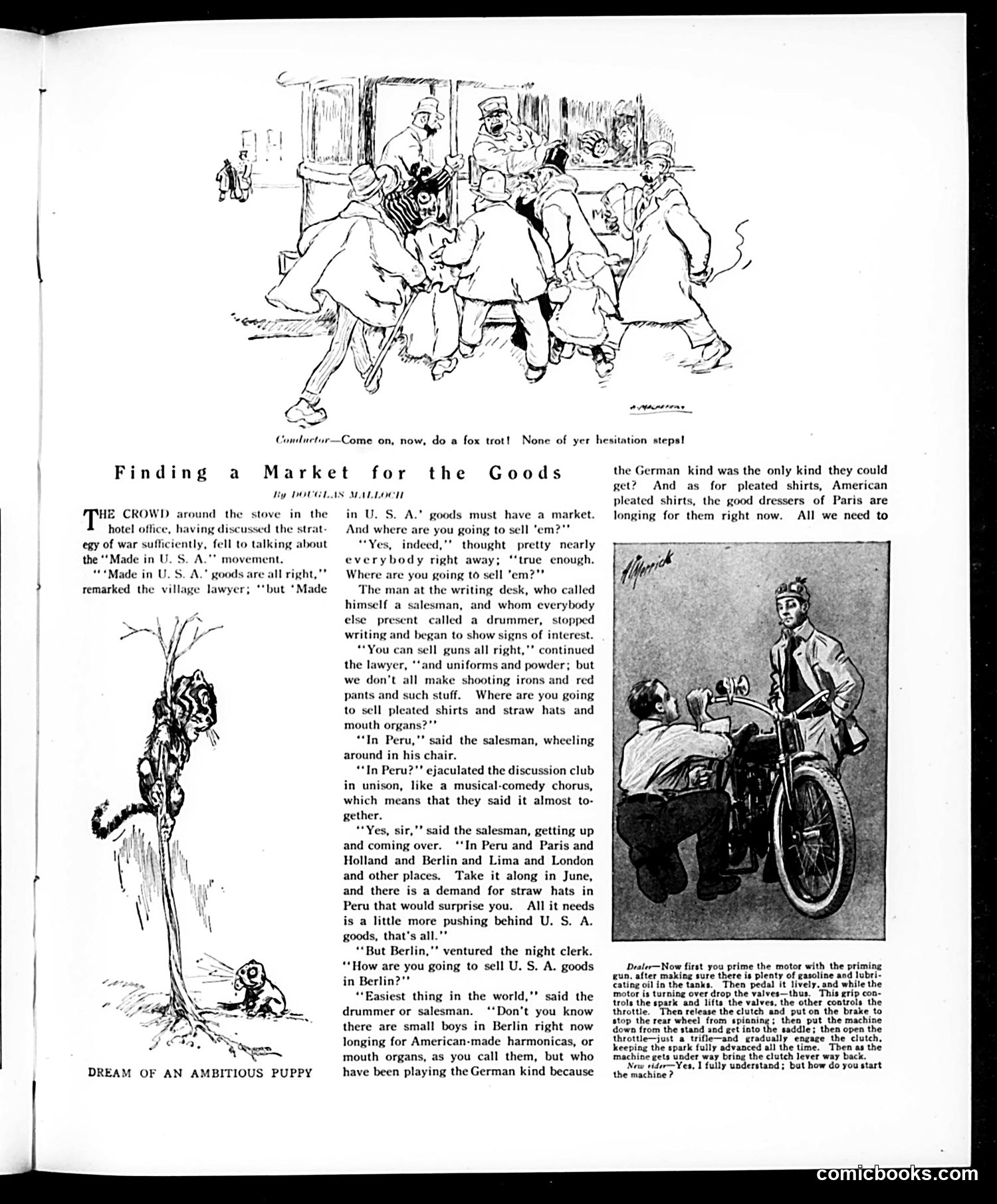
This satirical piece from *Judge* magazine addresses post-World War I economic nationalism—specifically the "Made in U.S.A." movement promoting American goods. **The Setup:** A small-town discussion group debates where to sell American products like pleated shirts and harmonicas, assuming there's no market abroad. **The Satire:** A traveling salesman counters that demand exists everywhere—even in recently-defeated Germany and Austria. He argues that despite wartime antagonism, consumers in Berlin, Peru, Paris, and other cities actively *want* American goods and would buy them if properly marketed. **The Point:** The cartoon mocks both isolationist skepticism about foreign markets AND the notion that wartime enmity automatically closes commercial opportunities. It suggests pragmatic American salesmanship can overcome nationalist sentiment—that commerce transcends recent conflict. The "fox trot" caption adds era-appropriate humor, linking American cultural exports (jazz, dance) to commercial ones. The unrelated motorcycle instruction at page bottom appears to be separate advertising content.
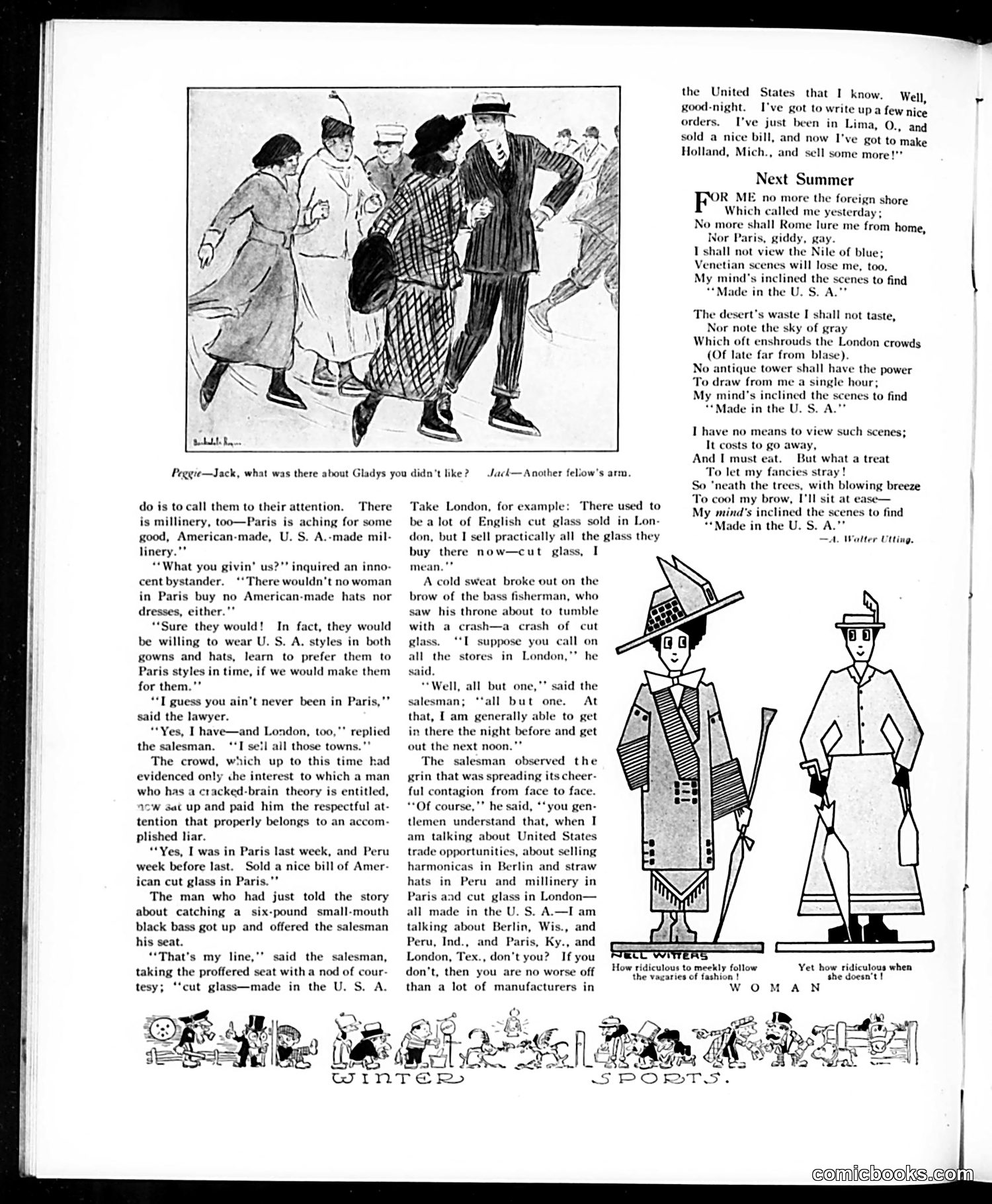
This page satirizes American commercial boosterism and the "Buy American" movement, likely from the 1920s post-WWI era. **The Main Story:** A traveling salesman boasts of selling American-made goods (cut glass, harmonicas, straw hats, millinery) globally—London, Paris, Peru, Berlin. The joke's twist: he reveals he's actually been selling to American towns *named* after foreign cities (Lima, Ohio; Paris, Kentucky; London, Texas; Berlin, Wisconsin). The fisherman and lawyer who'd been impressed—their "cracked-brain theories" about American superiority—are deflated when they realize the salesman has been cleverly equivocating all along. **The Poem "Next Summer":** Complements the satire by celebrating staying home and enjoying American-made goods rather than traveling abroad—reinforcing nationalist consumer sentiment. **The Fashion Cartoons (right):** Mock women who uncritically follow Paris fashion trends as ridiculous, while praising those who embrace American styles. **Overall Satire:** Judge mocks both American manufacturers' exaggerated export claims *and* Americans' blind devotion to foreign (especially Parisian) goods and aesthetics—exposing nationalist marketing as hollow rhetoric.
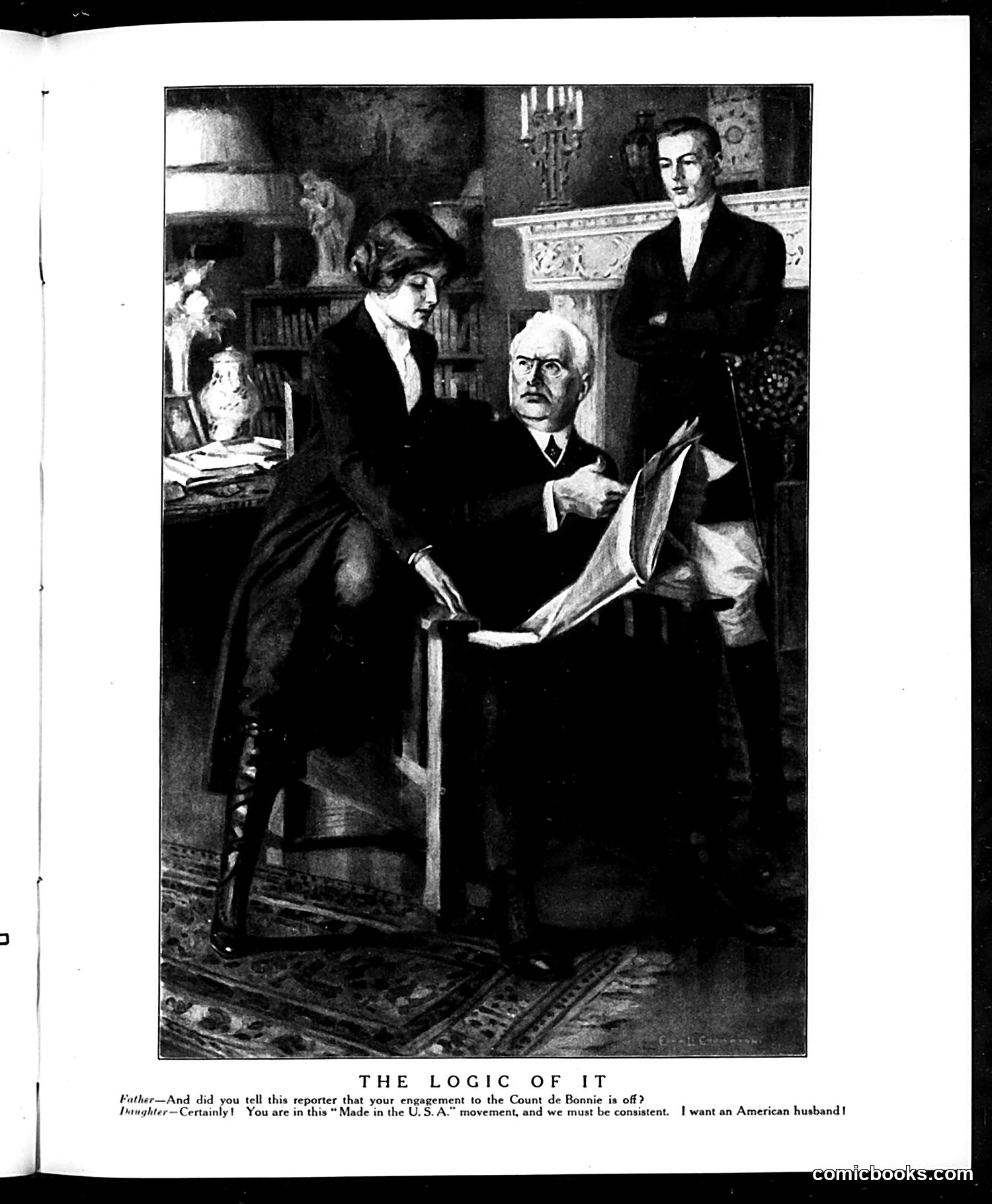
This cartoon satirizes the "Made in the U.S.A." movement—likely an early-20th-century campaign promoting American-made products and economic nationalism. A father confronts his daughter about breaking her engagement to "the Count de Bonnie" (a foreign aristocrat). Her response invokes the movement's logic: if the family supports buying American goods for consistency, she argues, they should logically support marrying an American husband rather than a foreign nobleman. The joke mocks both the movement's absolutism and the daughter's cheeky application of its principles to marriage. It reflects contemporary tension between American isolationism/nationalism and the traditional upper-class practice of marrying European nobility for status.
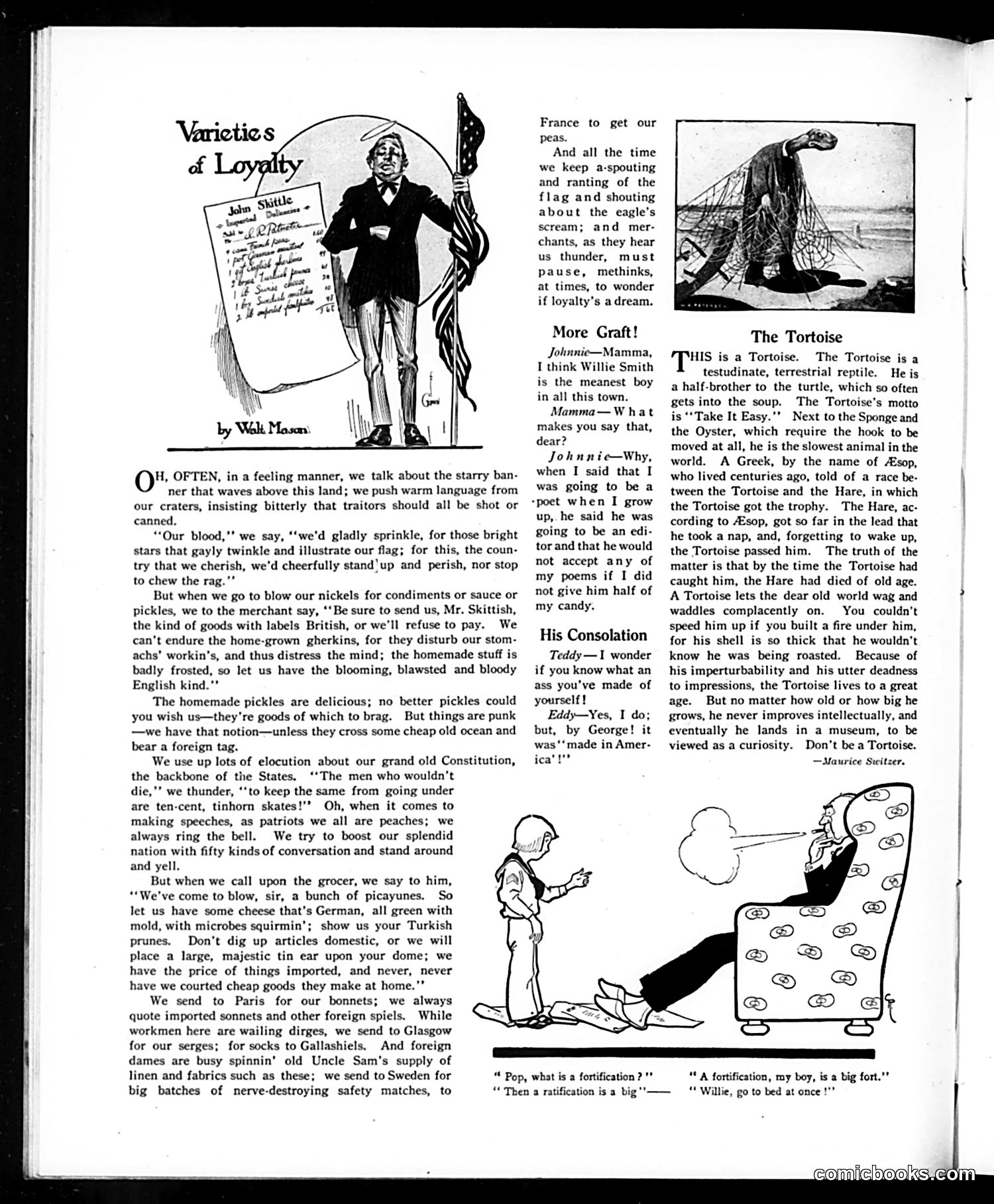
**"Varieties of Loyalty"** (main essay by Walt Mason): This satirical piece attacks American hypocrisy. Citizens loudly proclaim patriotic devotion to the flag and Constitution, vowing to die for their country. Yet the same people refuse to buy American-made goods—demanding imported pickles, German cheese, Glasgow serges, and Swedish matches instead. The satire's point: such consumers' patriotic speeches ring hollow when their wallets betray the nation by enriching foreign manufacturers while domestic workers suffer. **"More Graft!"** (small dialogue): A child describes a boy exploiting another's poetic ambitions by demanding half his candy as payment for editorial consideration—a cynical jab at corruption in publishing. **"The Tortoise"** (fable retelling): A humorous piece celebrating the tortoise's patience and slowness as virtues, contrasting with the hare's failure. The reference to Aesop grounds this in classic moral instruction. The page overall critiques American consumer behavior and corruption through wit and classical allusion.
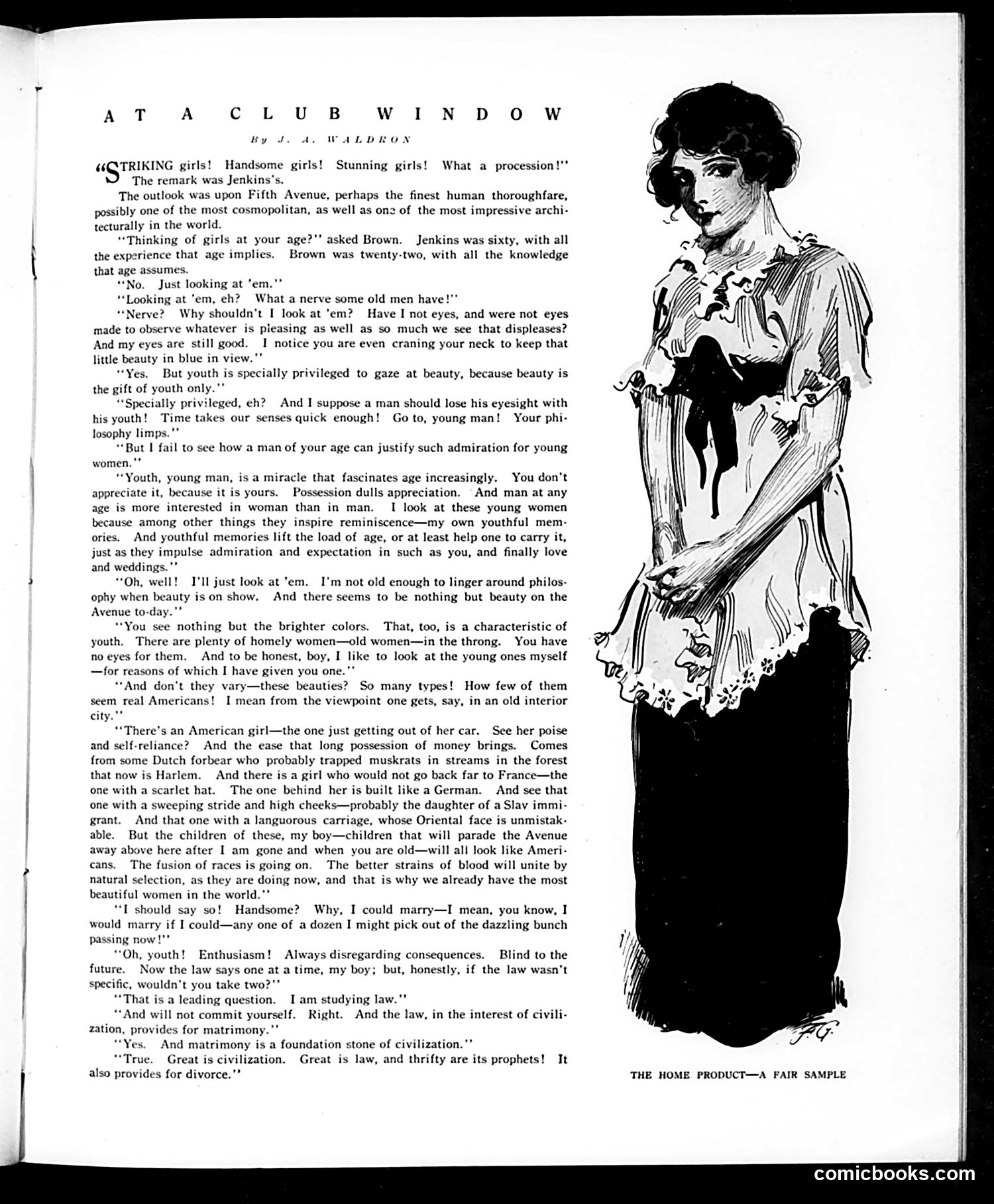
This is a comedic dialogue between two men—Jenkins (60) and Brown (22)—observing women passing on Fifth Avenue from a club window. The satire targets multiple subjects: **The Age/Beauty Dynamic**: Jenkins defends an older man's right to admire young women, arguing that age finds fascination in youth's "miracle," while youth takes beauty for granted. Brown disapproves on moral grounds. **American Racial/Ethnic Identity**: Jenkins catalogs the women by ancestry—Dutch, French, German, Slavic, Oriental—then prophesies their descendants will all look "American" through racial fusion and "natural selection." This reflects early-20th-century anxieties about immigration and racial mixing, though presented here as inevitable progress. **Marriage Law**: The dialogue ends with Brown fantasizing about marrying multiple women; Jenkins jokes that only law prevents polygamy. The cartoon's caption, "The Home Product—A Fair Sample," suggests American women (as a mixed-race product) represent national superiority. The satire gently mocks both characters: Jenkins's philosophical rationalizations and Brown's youthful prudishness and legal literalism.
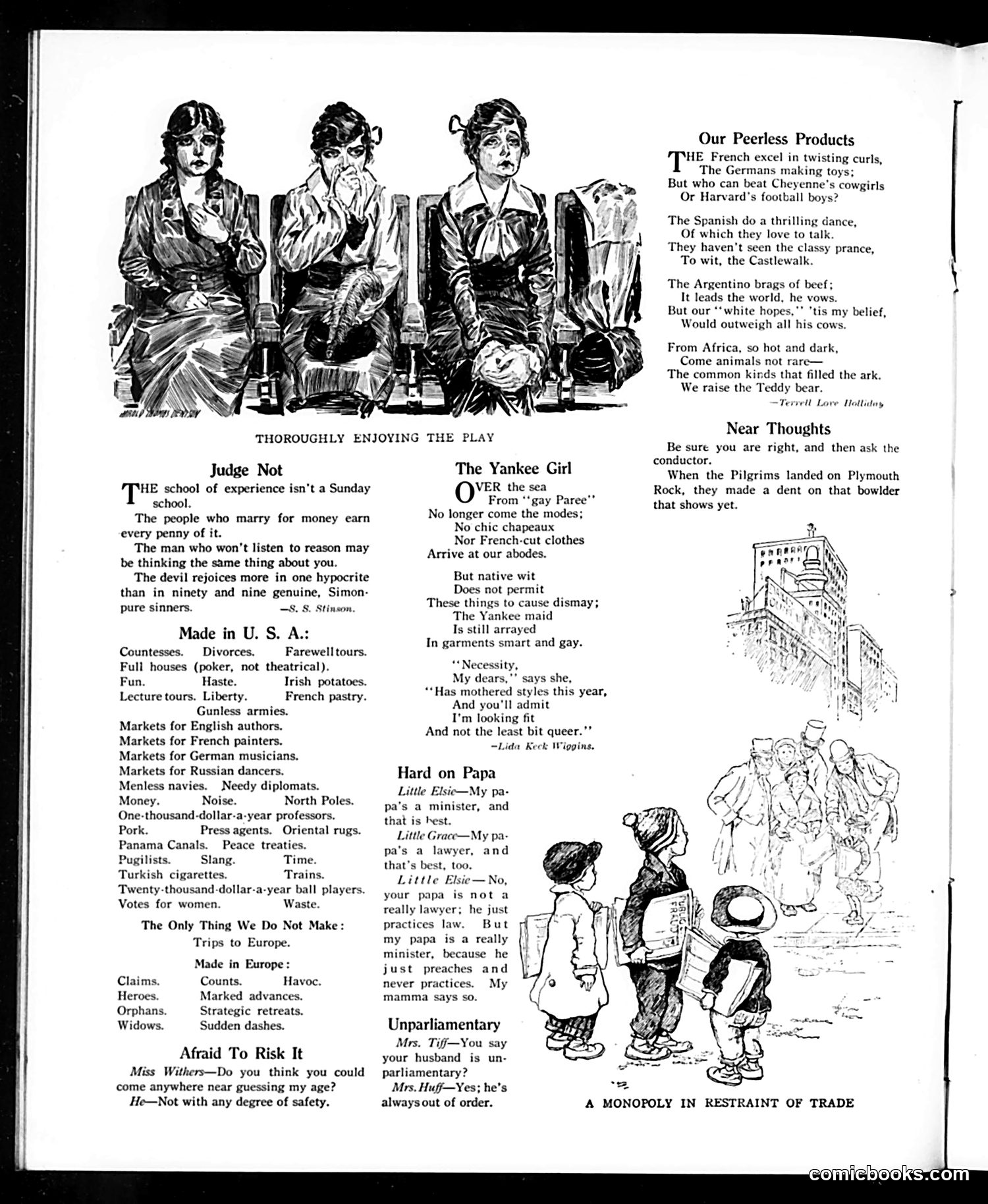
This page from Judge magazine contains multiple satirical pieces typical of early 20th-century American humor: **"Made in U.S.A." and "Made in Europe"** sections mock American and European stereotypes. The U.S. list ironically claims credit for frivolous or problematic exports (divorces, countesses, gunless armies, votes for women treated as absurd), while Europe produces "havoc" and "widows"—suggesting American superiority despite exporting social problems. **"Our Peerless Products"** celebrates American achievements (Cheyenne's dancing, Harvard football, "white hopes"—likely boxers), comparing them favorably to foreign accomplishments. The "Teddy bear" reference dates this to Theodore Roosevelt's era. **"The Yankee Girl"** celebrates American ingenuity: French fashions are unavailable (likely WWI-era import restrictions), but American women adapt stylishly through "necessity." **The comic dialogues** ("Judge Not," "Hard on Papa," "Unparliamentary") are brief jokes about marriage, professions, and wordplay—standard magazine filler humor. The illustrations show women "thoroughly enjoying the play," emphasizing social life as entertainment.
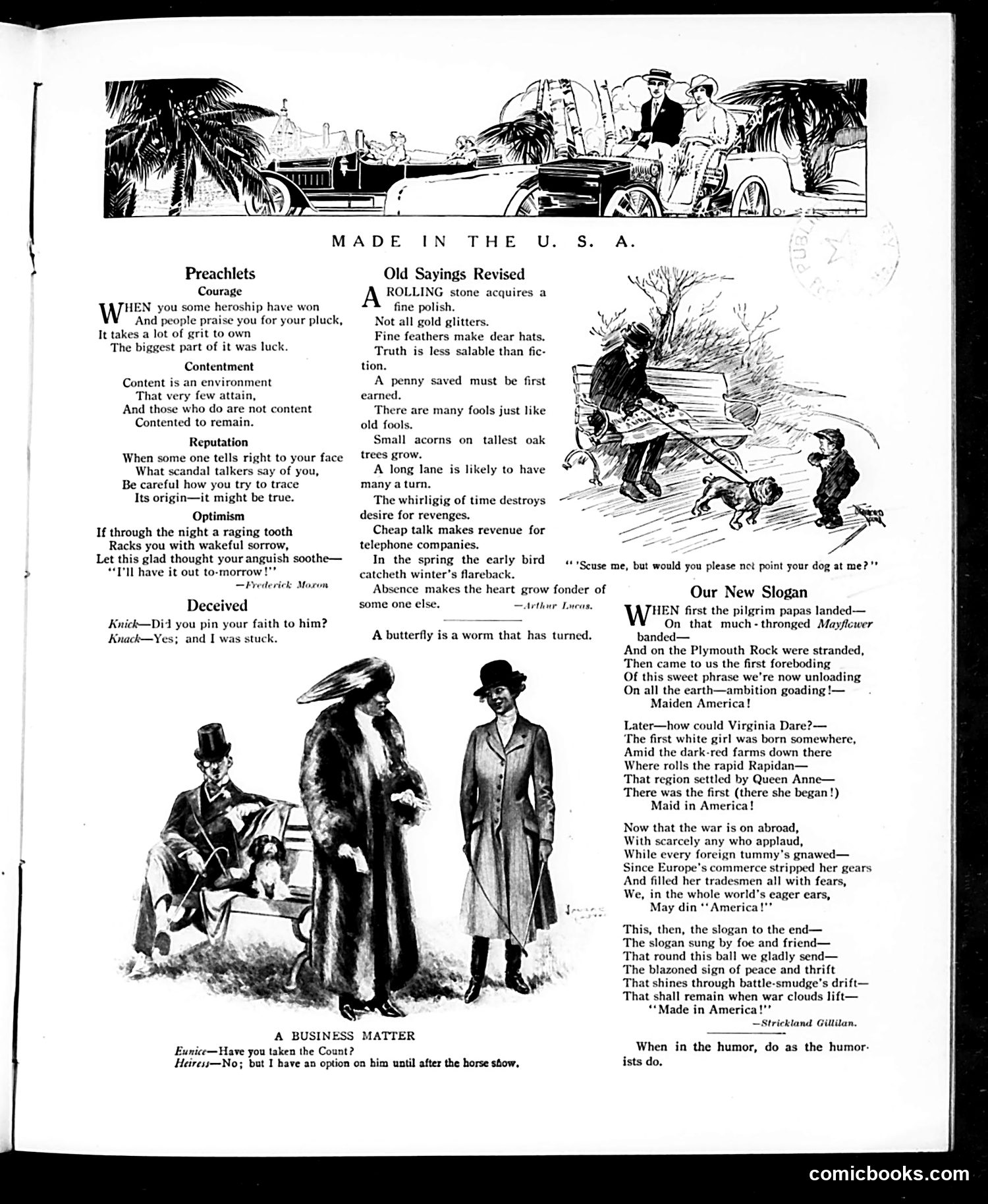
This page combines patriotic messaging with light social satire. The dominant feature is "Our New Slogan," a poem celebrating American manufacturing and national pride—likely from WWI era, given references to "the war is on abroad" and Europe's economic disruption. The poem traces "Made in America" from colonial settlement through contemporary commerce, positioning American goods as symbols of "peace and thrift." The page includes typical Judge humor: "Old Sayings Revised" offers cynical twists on proverbs (e.g., "Truth is less salable than fiction"), while brief jokes mock social pretension. "A Business Matter" depicts a wealthy woman treating a European nobleman like a commodity with an expiration date—satire on transatlantic marriages between American heiresses and impoverished aristocrats, popular during this era. The cartoons and preachlets present middle-class morality wrapped in irony, characteristic of Judge's editorial voice blending patriotism with skepticism toward affectation and dishonesty.
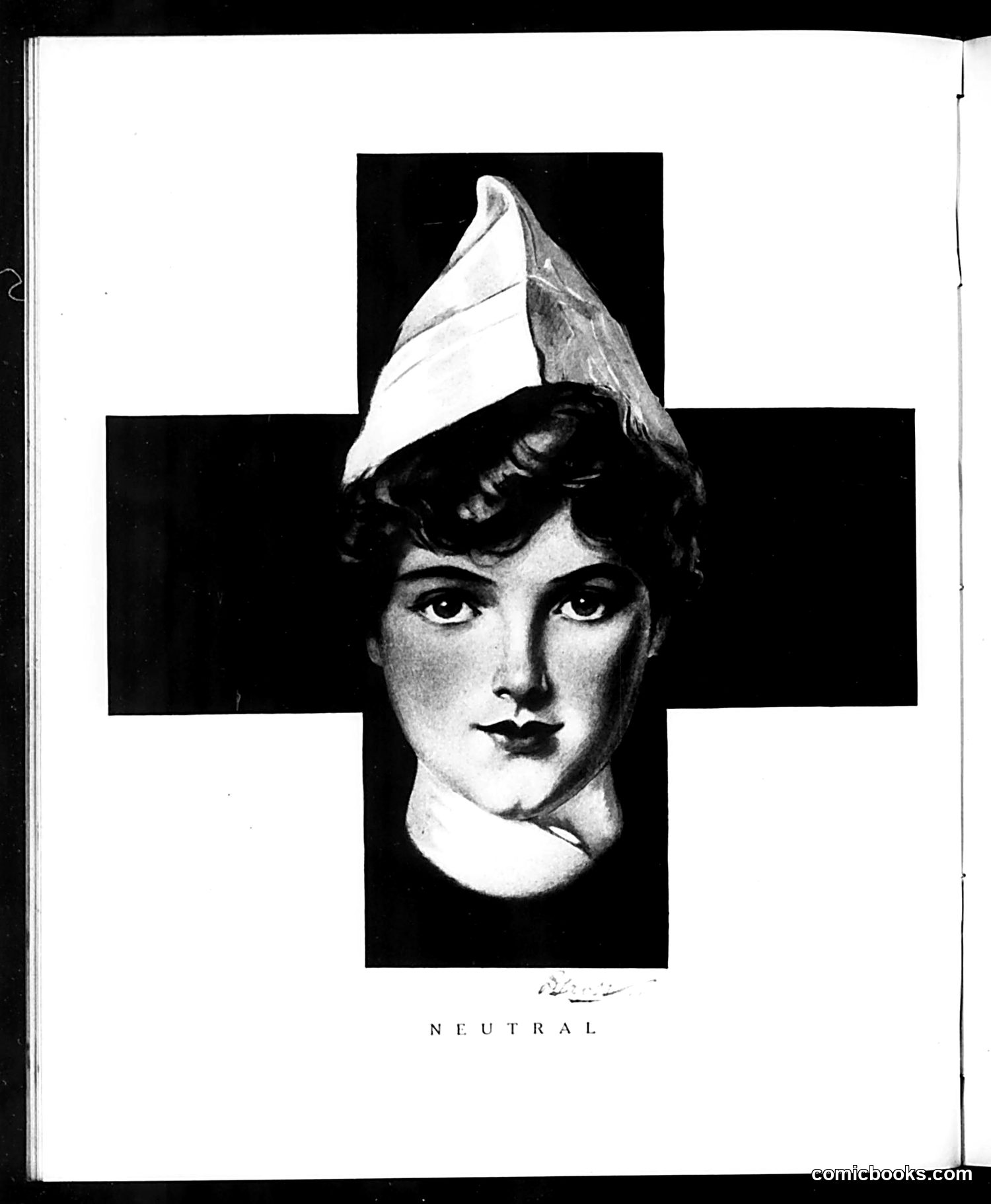
This appears to be a title page or section divider from *Judge* magazine, not a political cartoon. The image shows a woman's face positioned within a Swiss cross (or plus sign), wearing a nurse's cap and collar. The word "NEUTRAL" appears below. This likely references Switzerland's formal neutrality during World War I (1914-1918), when the U.S. was still technically neutral before entering the war in 1917. The nurse imagery suggests healthcare and humanitarian concerns. The composition—positioning the woman's face within the Swiss national symbol—appears to be either illustrating Switzerland's neutral stance or commenting on American neutrality during the conflict, possibly with ironic undertones about whether such neutrality was truly sustainable or desirable.
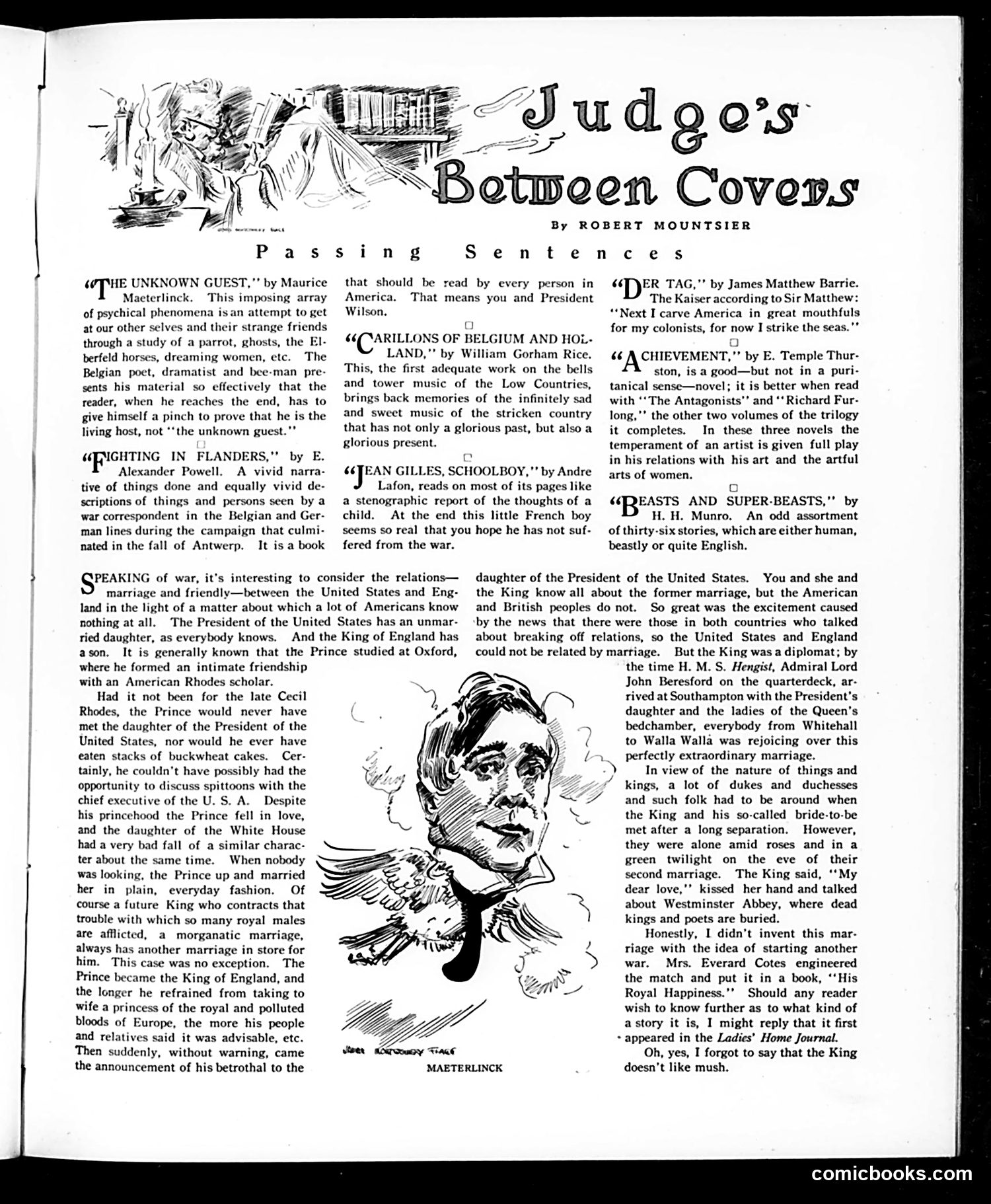
This page reviews books while embedding a satirical commentary on Anglo-American relations during World War I. The central narrative concerns the British Prince (later King George V) who married an American woman (daughter of a U.S. President), then later married a British princess—creating diplomatic awkwardness. The satire critiques how both nations' populations were unaware of the first marriage, and how rumors of dissolved relations threatened the alliance. The piece mocks the pretense and "morganatic marriage" complications of royal protocol, suggesting American and British leaders understood the political necessity of maintaining relations despite royal scandals. The caricatured bust (Maeterlinck, labeled) represents one of the reviewed authors. References to WWI books ("Fighting in Flanders," "The Kaiser") anchor the piece in the wartime period when U.S.-British solidarity was diplomatically crucial, making the royal marriage situation potentially problematic for maintaining public support for the alliance.
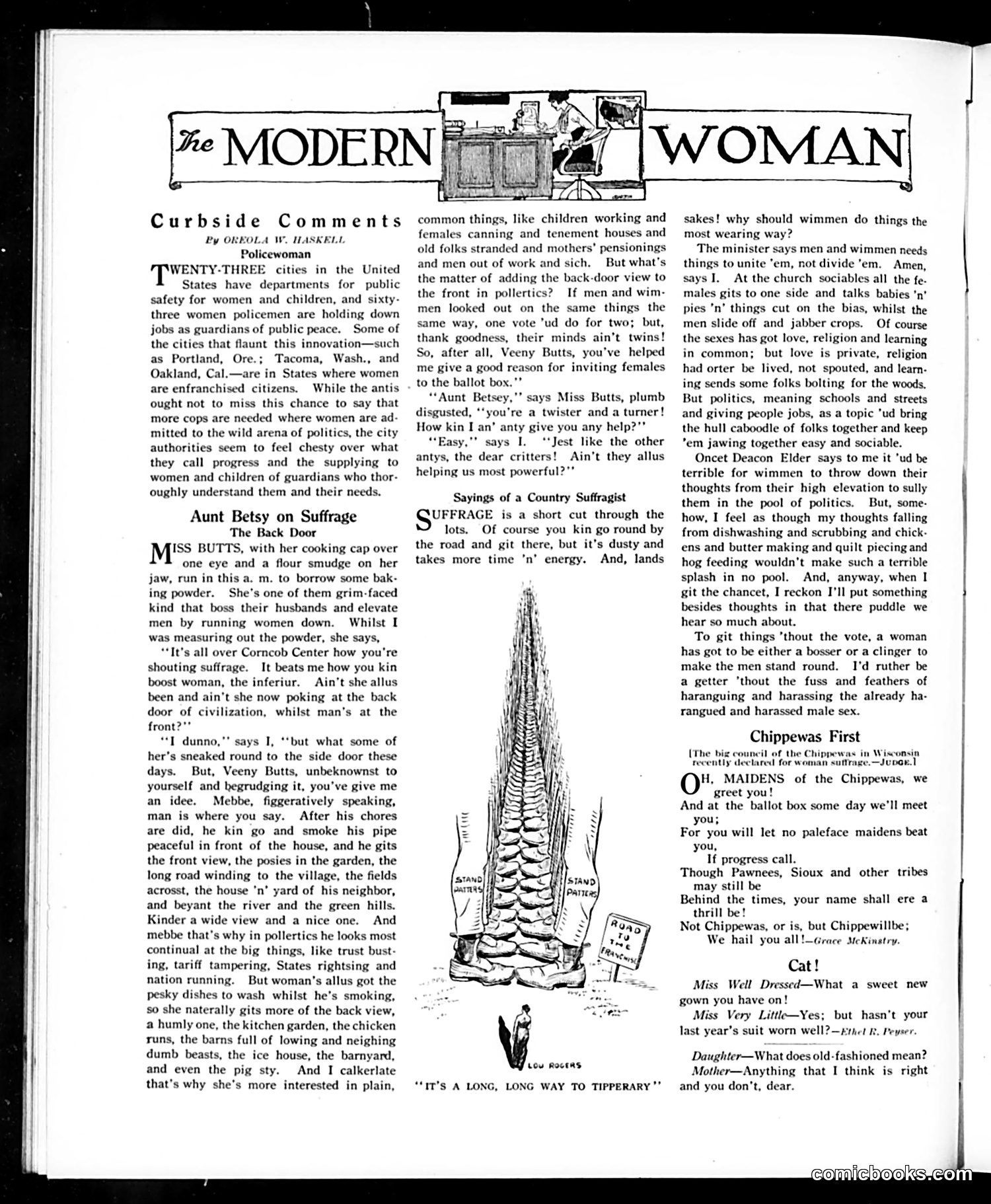
This Judge magazine page satirizes opposition to women's suffrage through rural, working-class female characters who ironically argue *for* voting rights. **"Aunt Betsy on Suffrage"** presents Miss Butts, an anti-suffrage woman, who dismisses female voters as inferior and claims women belong at the "back door of civilization" while men occupy the front. The narrator (Oreola Haskell) responds cleverly: women's domestic perspective—managing households, children, tenements—actually qualifies them to vote on practical matters. She argues that adding women's viewpoint to men's would strengthen democracy, not divide it. **"Sayings of a Country Suffragist"** uses a metaphor: suffrage is a shortcut through fields rather than a dusty road—why should women take the harder path? The satire mocks anti-suffragists by showing their arguments backfiring. The page also notes that 63 women police officers now work in American cities, suggesting women's capability for public responsibility. The tone is colloquial and humorous, using dialect to make suffrage arguments accessible and appealing to ordinary readers while undercutting the opposition as narrow-minded.
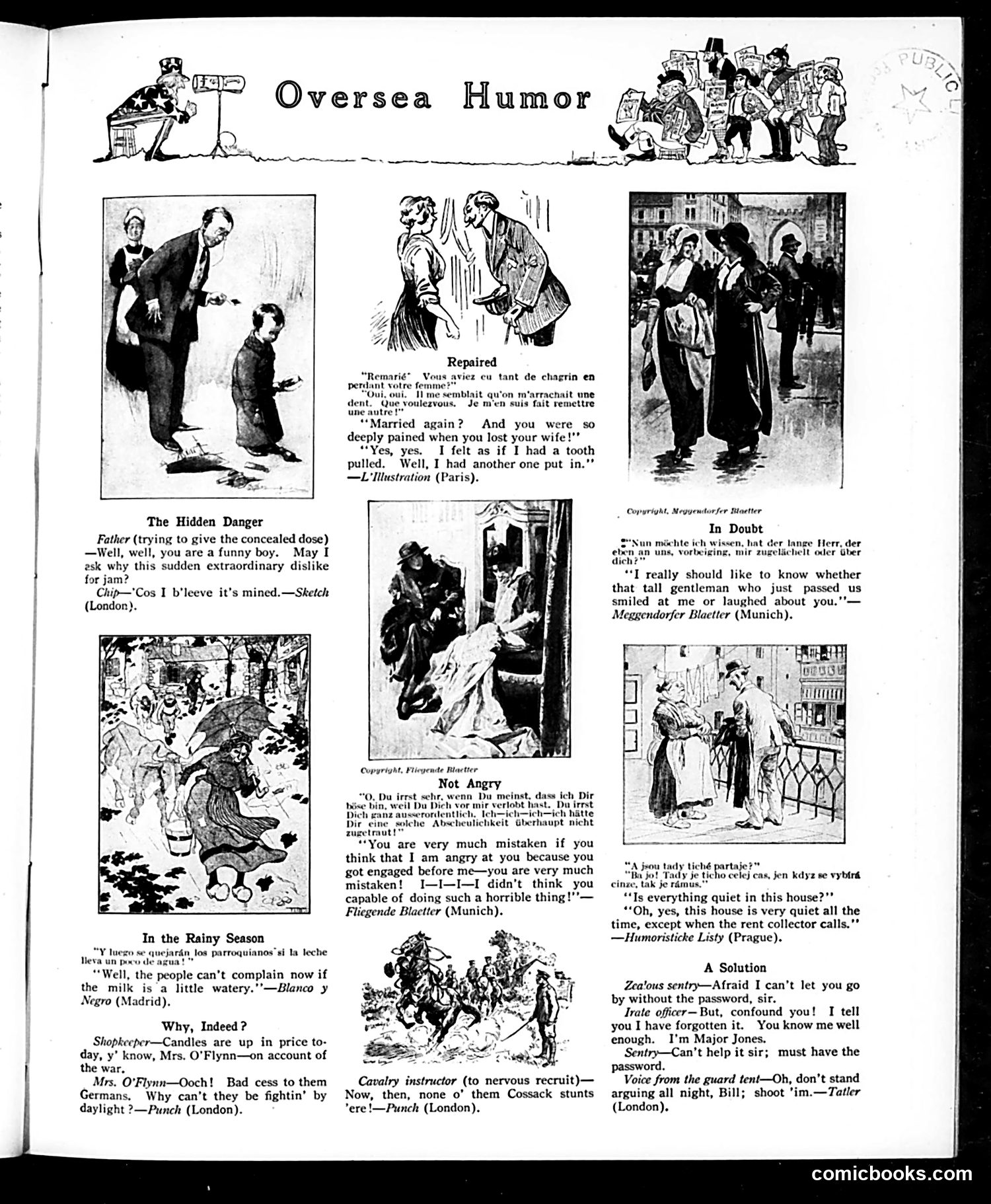
This page compiles humorous cartoons from international sources during World War I, mocking civilian and military life during wartime. **Key cartoons:** - **"The Hidden Danger"**: A child suspects jam is "mined" (contains explosives), reflecting wartime anxiety about contaminated food. - **"In the Rainy Season"**: Spanish joke about watered-down milk—civilians accepting inferior goods due to wartime shortages. - **"Why, Indeed?"**: Irish woman sarcastically asks why Germans don't fight during daylight instead of using nighttime attacks, since candles are expensive. - **"Remaried"**: French humor about a man replacing his deceased wife as casually as replacing a tooth—gallows humor about loss. - **"Not Angry"**: German woman sarcastically insists she's not upset her fiancé got engaged before her, using theatrical overreaction for effect. - **"Cavalry instructor"**: Warning recruits against "Cossack stunts," likely referencing Russian cavalry tactics feared by Western armies. The page demonstrates how different nations used satire to process wartime hardships and anxieties.
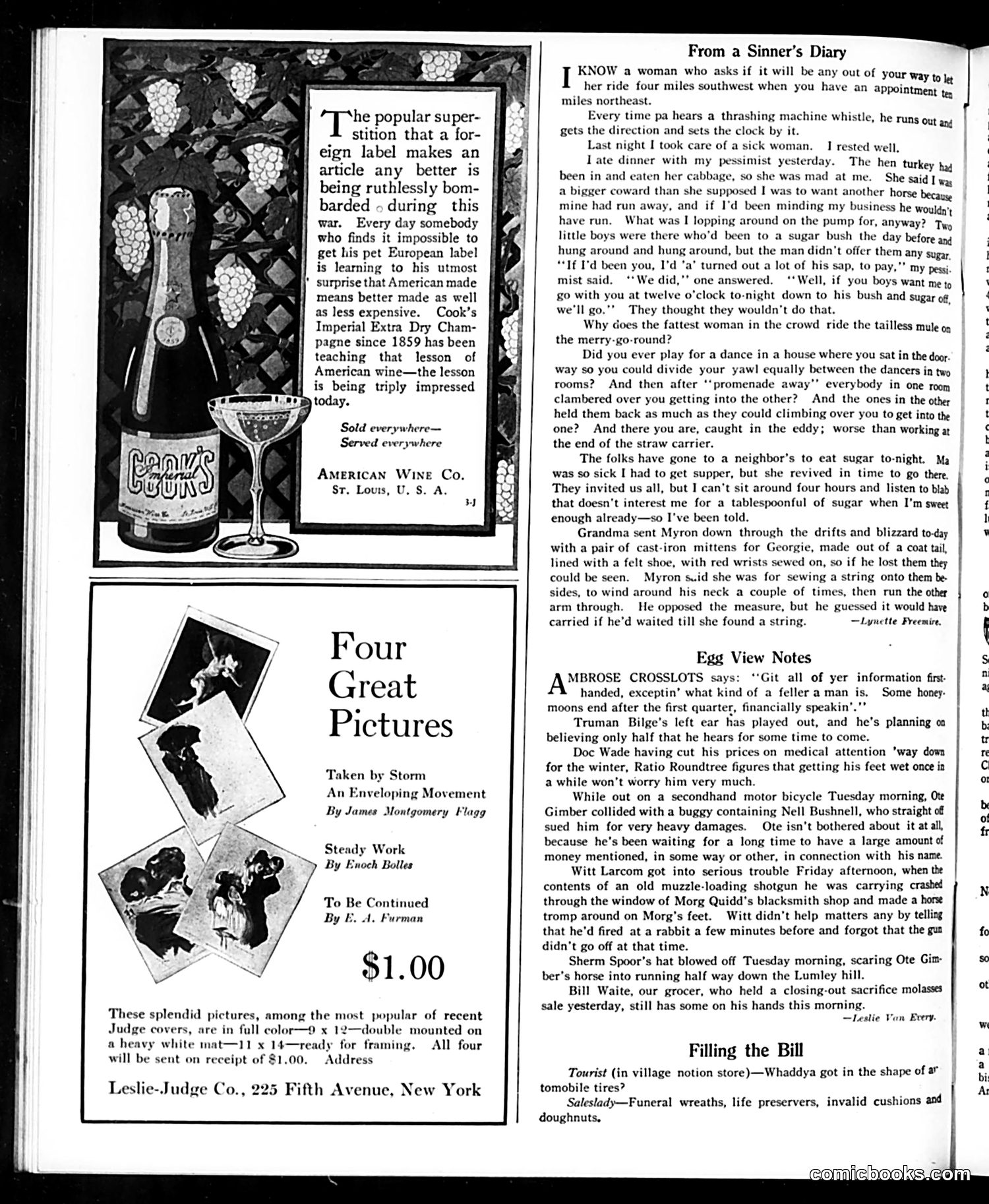
This page contains mostly **advertising and humorous fiction** rather than political cartoons. The **Cook's Imperial champagne ad** argues that American-made products equal European imports in quality—a wartime nationalist message (likely WWI era, given "during this war"). It combats the then-common assumption that foreign labels meant superiority. **"From a Sinner's Diary"** is a rural humor column by Lynette Freemire, containing observational jokes about country life: absent-minded women, farm machinery, sugar-making parties, and domestic annoyances. The humor relies on exaggerated rural stereotypes and deadpan delivery typical of early 20th-century American comic literature. **"Egg View Notes"** offers brief, cynical aphorisms in similar rustic-dialect style. The page also advertises Judge cover reprints available for purchase. No specific political figures or events are referenced—this is entertainment and lifestyle advertising aimed at Judge's middle-class readership.
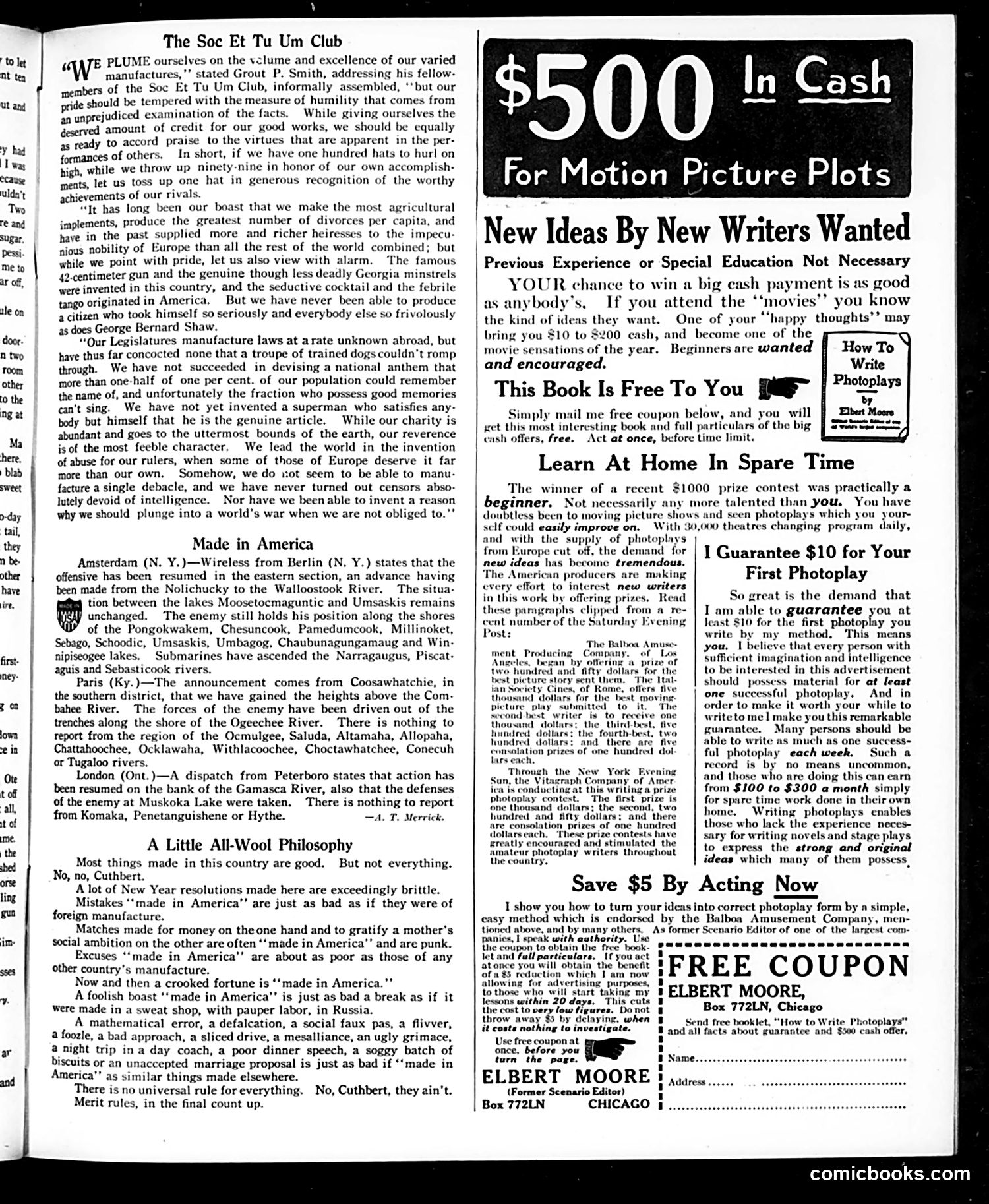
This page contains a satirical club speech mocking American self-satisfaction and hypocrisy. Speaker Grout P. Smith addresses the "Soc Et Tu Um Club" (a play on "Et Tu Brute"), urging members to balance pride in American achievements with humility about American failings. The satire lists genuine American inventions and exports (agricultural implements, divorces, heiresses, the cocktail, the tango) alongside embarrassing ones (the 42-centimeter gun, George Bernard Shaw's self-seriousness). It critiques American legislative incompetence, inability to create a memorable national anthem, and failure to produce a "superman" or genuine censor. The final jab concerns American reluctance to enter "a world's war"—likely referencing WWI debates circa 1915-1917. The lower section, "Made in America," parodies war dispatches using absurdly unpronounceable American river names, further mocking national pretension. The page is largely advertisement for motion picture plot ideas and a writing guide book.
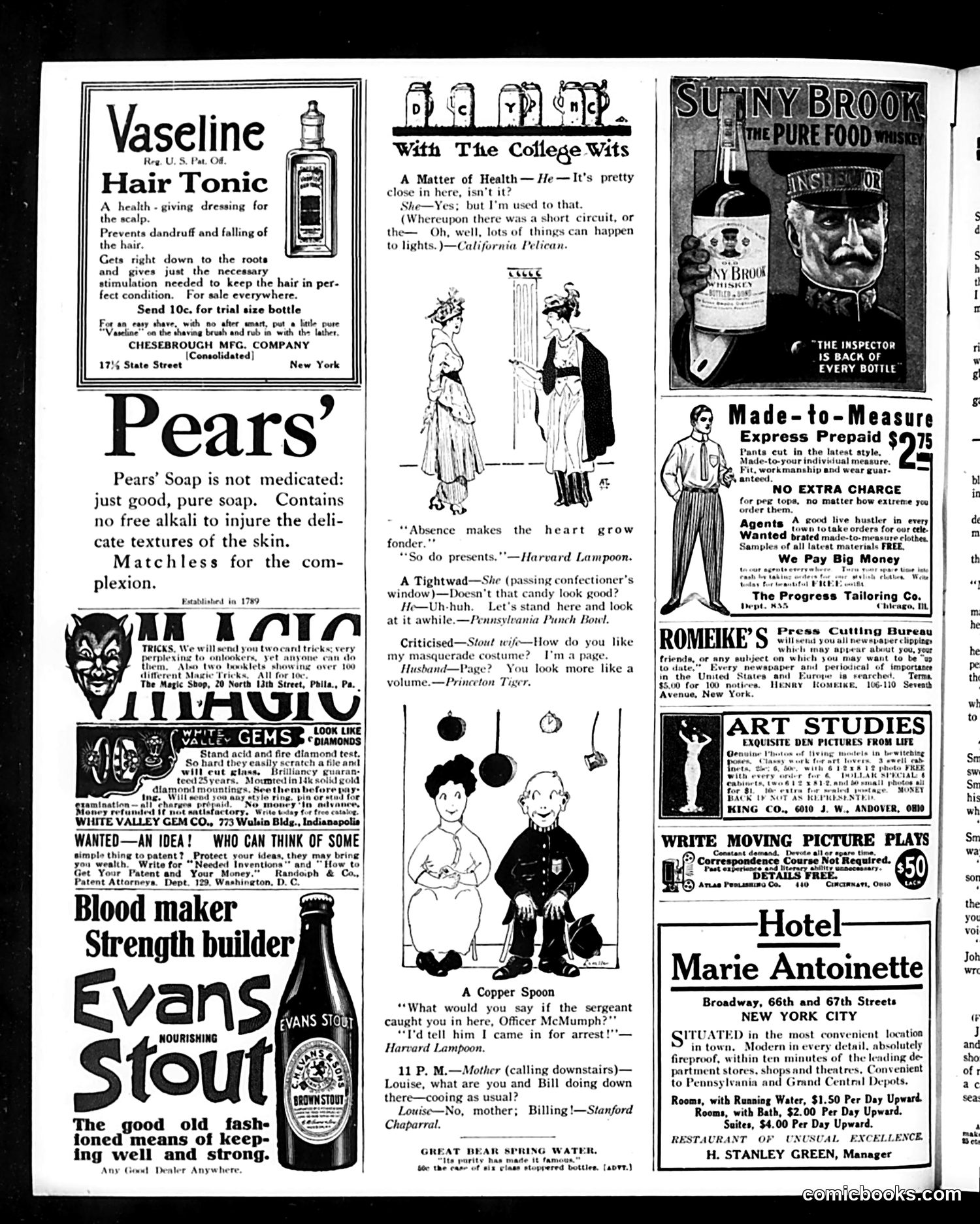
This is primarily an **advertisement page** from Judge magazine, featuring various product ads (Vaseline, Pears' Soap, Evans Stout, patent services) interspersed with brief humorous college humor items and jokes. The **central cartoon** labeled "A Copper Spoon" and "11 P.M." appear to be simple joke illustrations: one depicting a soldier's arrest threat over being caught in a bar, and another showing a mother suspecting her daughter and Bill of "cooing" (courting/kissing) when they claim merely to be "billing" (dividing costs). These are mild domestic/romantic humor typical of early-1900s college magazines. The cartoons reflect **contemporary anxieties**: parental concern over courtship propriety, and the casual nature of young people's social interactions. The humor relies on wordplay and double meanings rather than visual satire. The page is **not primarily satirical**—it's filler content designed to entertain while selling products. Historical interest lies mainly in the **advertising claims** (patent services, tailor-made clothes, hotel amenities) showing consumer culture of the era.
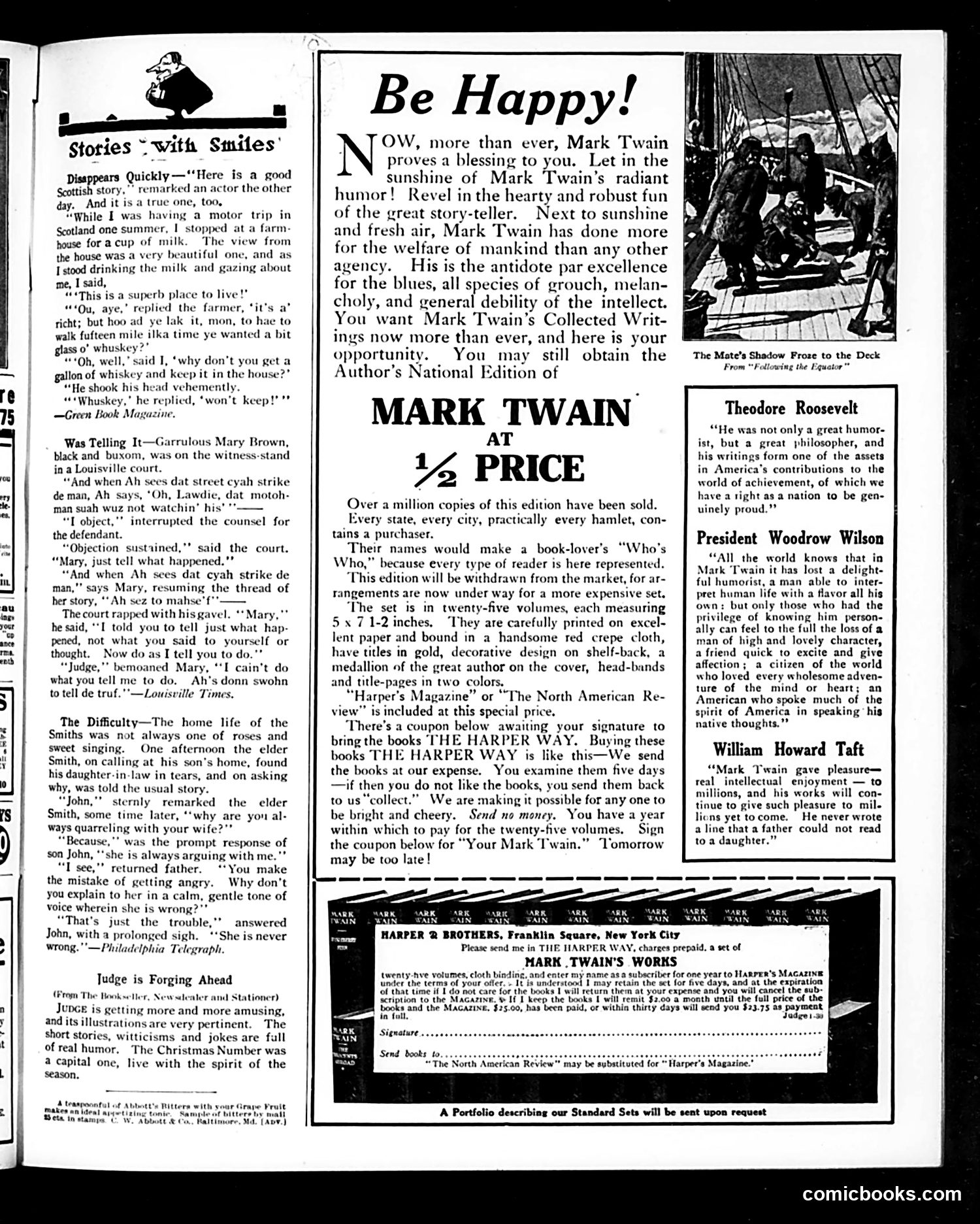
This page is primarily **advertising** for Mark Twain's collected works, dressed up as editorial content. The actual satirical material occupies only the left column. **The humor pieces** are brief anecdotes typical of early 20th-century Judge magazine: 1. A Scottish farmer's deadpan response about whiskey not keeping—playing on dialect humor and rural character stereotypes popular at the time. 2. A courtroom scene with "Mary Brown," a Black woman whose verbose testimony frustrates the judge. This relies on racist dialect humor and the "talkative Black servant" stereotype common in period publications. 3. A domestic dispute where a husband admits his wife is always right—playing on tired "nagging wife" marital humor. **The dominant content** is a full-page advertisement promoting Twain's National Edition at half-price, featuring endorsements from Theodore Roosevelt, Woodrow Wilson, and William Howard Taft. This emphasizes Twain as a patriotic American institution and cure for modern gloom—characteristic marketing strategy during uncertain times (likely WWI era). The page reflects Judge's mix of mild satire and advertising dressed as journalism.
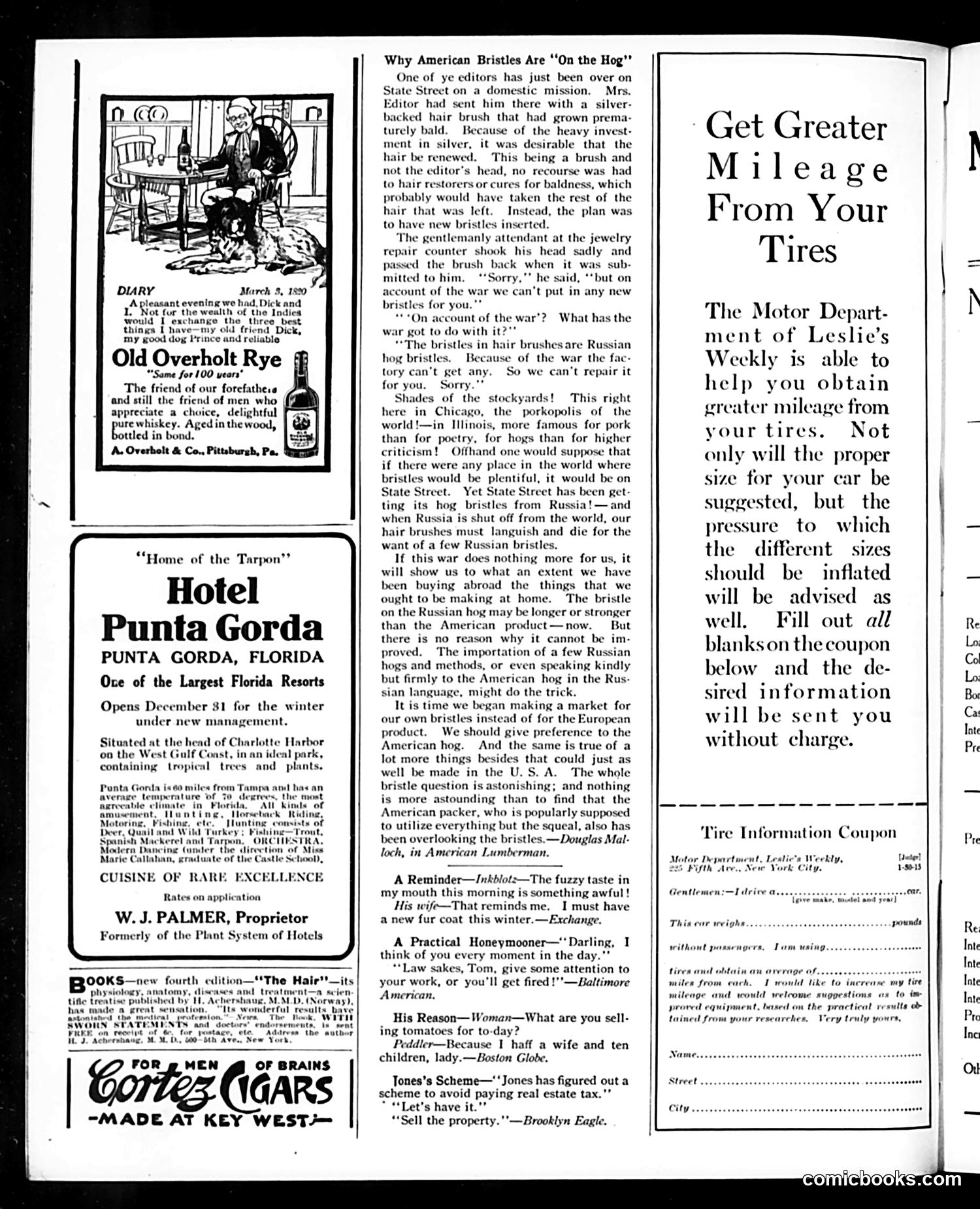
This page is primarily **advertising and light humor**, not political satire. The main article, "Why American Bristles Are 'On the Hog,'" discusses a domestic supply problem: a woman's hairbrush needs new bristles, but the repair shop cannot oblige because **Russian hog bristles are unavailable due to war** (likely the Russo-Turkish conflict). The piece satirizes American dependence on imports. Despite Chicago being famous for pork production ("porkopolis"), Americans import Russian hog bristles for brushes rather than developing domestic alternatives. The author argues Americans should establish markets for American bristles and prefer homemade products. The humor is gentle—mocking American oversight and importing habits rather than attacking any political figure. Sidebar advertisements include whiskey, a Florida hotel, and cigars. The short comic anecdotes below address marriage and honeymoons with mild domestic humor typical of the era.
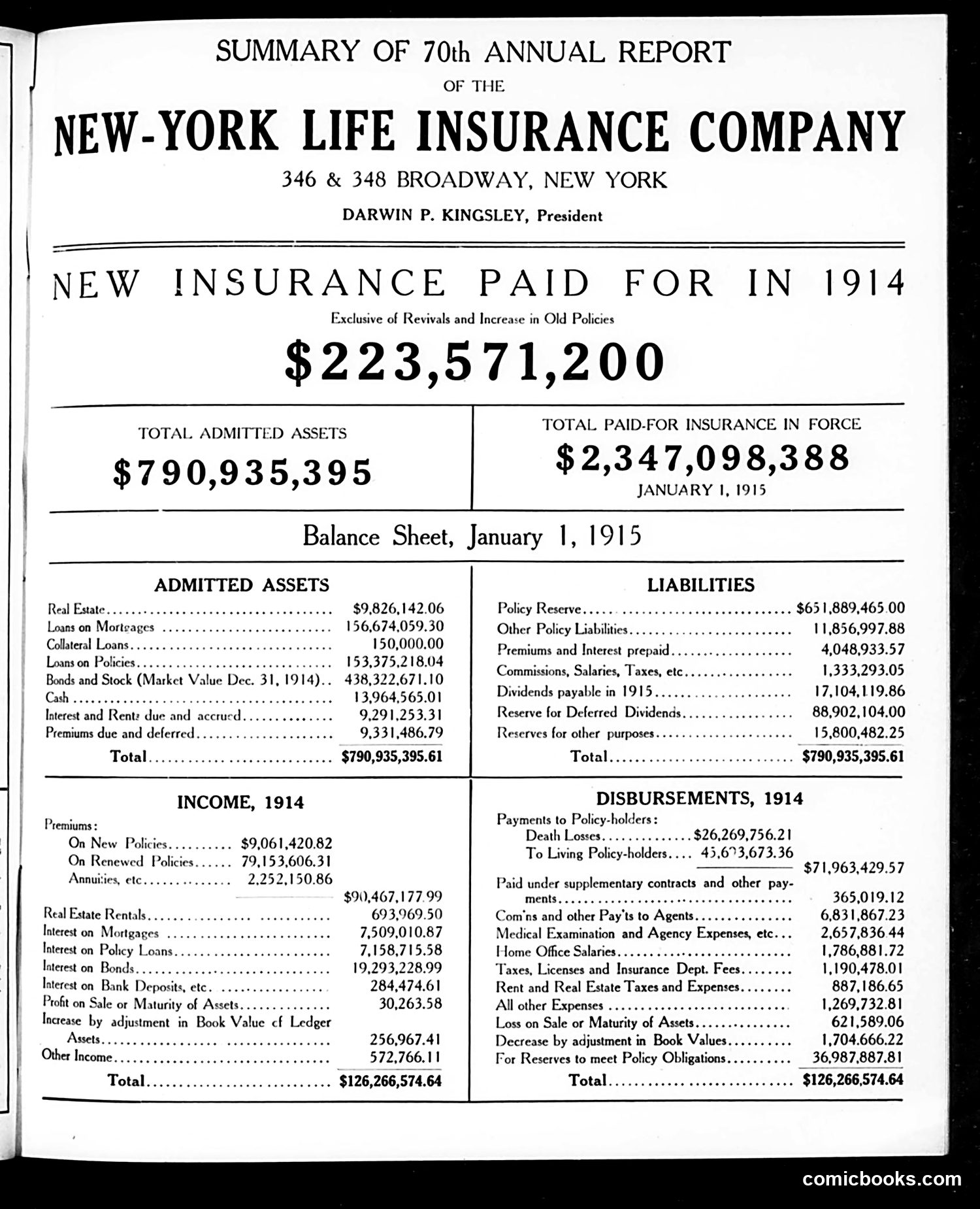
This is not a cartoon or satirical content—it's a financial document. The page reproduces the summary of New York Life Insurance Company's 70th annual report for 1914, showing their balance sheet, assets, liabilities, income, and disbursements as of January 1, 1915. The document lists President Darwin P. Kingsley at the top and details approximately $790 million in admitted assets and over $2.3 billion in insurance in force. Income sources included premiums ($90.4 million) and various investment returns. Major disbursements went to policyholders in death benefits and living payouts totaling nearly $72 million. This appears in *Judge* magazine as a straightforward business report reprint, not as satirical content.
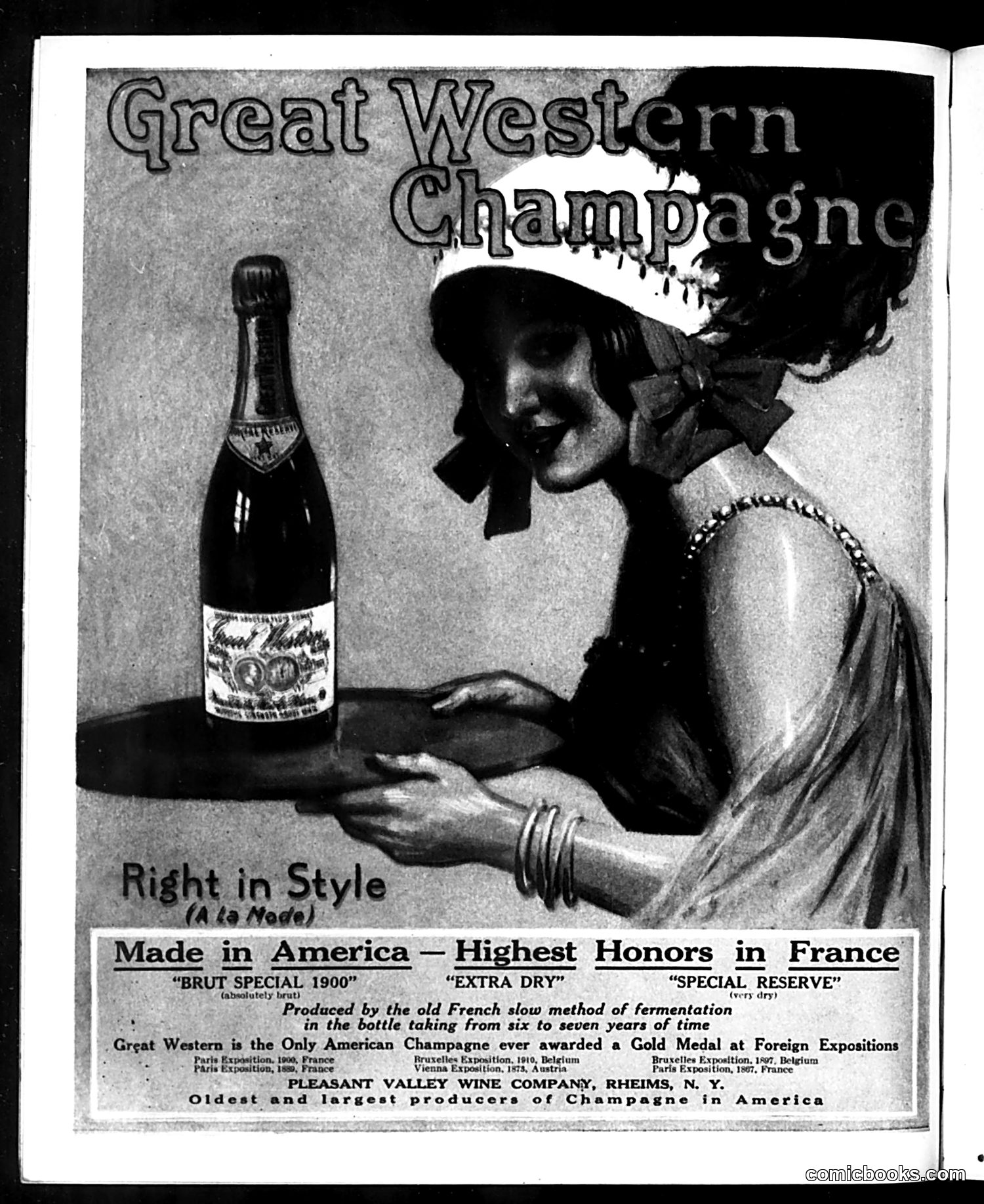
This is a **champagne advertisement**, not a political cartoon. It promotes "Great Western" champagne, made by Pleasant Valley Wine Company in Rheims, New York. The ad features a fashionable woman in an elegant hat with a black bow, presented as aspirational imagery to sell the product. The slogan "Right in Style (À la Mode)" emphasizes social prestige and fashion consciousness. The key selling point is nationalist pride: "Made in America — Highest Honors in France." The ad claims Great Western is "the Only American Champagne ever awarded a Gold Medal at Foreign Expositions," listing multiple international awards (Paris 1880, 1900, 1897; Vienna 1873; Brussels 1897, 1910). For modern readers: This reflects early 20th-century American confidence in domestic manufacturing and the prestige of French validation—American producers were competing with established European champagne houses by emphasizing quality recognition from prestigious European competitions.