
Judge, 1915-01-30 · page 11 of 24
Judge — January 30, 1915 — page 11: what you’re looking at
What you’re looking at
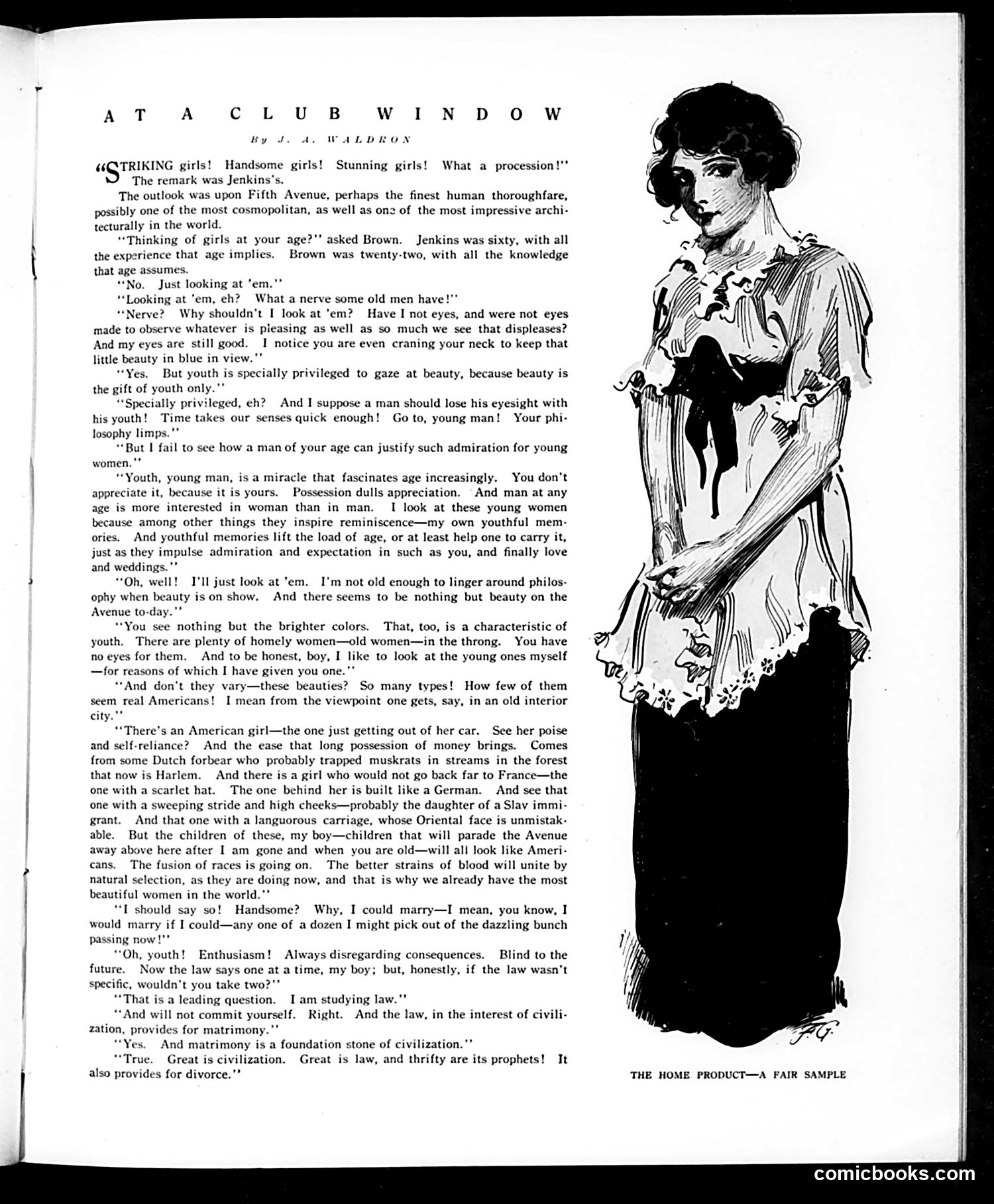
This is a comedic dialogue between two men—Jenkins (60) and Brown (22)—observing women passing on Fifth Avenue from a club window. The satire targets multiple subjects: **The Age/Beauty Dynamic**: Jenkins defends an older man's right to admire young women, arguing that age finds fascination in youth's "miracle," while youth takes beauty for granted. Brown disapproves on moral grounds. **American Racial/Ethnic Identity**: Jenkins catalogs the women by ancestry—Dutch, French, German, Slavic, Oriental—then prophesies their descendants will all look "American" through racial fusion and "natural selection." This reflects early-20th-century anxieties about immigration and racial mixing, though presented here as inevitable progress. **Marriage Law**: The dialogue ends with Brown fantasizing about marrying multiple women; Jenkins jokes that only law prevents polygamy. The cartoon's caption, "The Home Product—A Fair Sample," suggests American women (as a mixed-race product) represent national superiority. The satire gently mocks both characters: Jenkins's philosophical rationalizations and Brown's youthful prudishness and legal literalism.
📄 Transcribed text from this page (OCR, searchable)
Machine-transcribed from the original scan — historical spelling and the odd misread are preserved.
—— A T A C LU B W IN DO W By J. WALDRON UG TRIKING girls! Handsome girls! Stunning girls! What a procession!" The remark was Jenkins’s. The outlook was upon Fifth Avenue, perhaps the finest human thoroughfar possibly one of the most cosmopolitan, as well as onz of the most impressive archi- tecturally in the world. “Thinking of girls at your age?’’ asked Brown. Jenkins was sixty, with all the experience that age implies. Brown was twenty-two, with all the knowledge that age assume: “No. Just looking at 'em."" “Looking at ‘em, eh? What a nerve some old men have! ‘Nerve? Why shouldn't I look at 'em? Have I not eyes, and were not eyes made to observe whatever is pieasing as well as so much we see that displeases? And my eyes are still good. I notice you are even craning your neck to keep that little beauty in blue in view."" . But youth is specially privileged to gaze at beauty, because beauty is the gift of youth only."* “Specially privileged, eh? And I suppose a man should lose his eyesight with his youth! Time takes our senses quick enough! Go to, young man! Your phi- losophy limp “But I fail to see how a man of your age can justify such admiration for young women. “Youth, young man, is a miracle that fascinates age increasingly. You don't appreciate it, because it is yours. Possession dulls appreciation. And man at any age is more interested in woman than in man. I look at these young women because among other things they inspire reminiscence—my own youthful mem- ories. And youthful memories lift the load of age, or at least help one to carry it, just as they impulse admiration and expectation in such as you, and finally love and weddings. “Oh, well! I'll just look at "em. I'm not old enough to linger around philos- ophy when beauty is on show. And there seems to be nothing but beauty on the Avenue to-day."" “You see nothing but the brighter colors. That, too, is a characteristic of youth, There are plenty of homely women—old women—in the throng. You have no eyes for them. And to be honest, boy, I like to look at the young ones myself —for reasons of which I have given you one.”’ “And don’t they vary—these beauties? So many types! How few of them seem real Americans! I mean from the viewpoint one gets, say, in an old interior city.”” “There's an American girl—the one just getting out of her car. See her poise and self-reliance? And the ease that long possession of money brings. Comes from some Dutch forbear who probably trapped muskrats in streams in the forest that now is Harlem. And there is a girl who would not go back far to France—the one with a scarlet hat. The one behind her is built like a German. And see that one with a sweeping stride and high cheeks—probably the daughter of a Slav immi- grant. And that one with a languorous carriage, whose Oriental face is unmistak- able. But the children of these, my boy—children that will parade the Avenue away above here after I am gone and when you are old—will all look like Ameri- cans. The fusion of races is going on. The better strains of blood will unite by they are doing now, and that is why we already have the most natural selection, beautiful women in the world."’ “I should say so! Handsome? Why, I could marry—I mean, you know, I would marry if I could—any one of a dozen I might pick out of the dazzling bunch passing now “Oh, youth! Enthusiasm! Always disregarding consequences. Blind to the future. Now the law says one at a time, my boy; but, honestly, if the law wasn't specific, wouldn't you take two?’’ “That is a leading question. I am studying law."’ “And will not commit yourself. Right. And the law, in the interest of civili- zation, provides for matrimon: “Yes, And matrimony i “True. Great is civilization, Great also provides for divorce.’ a foundation stone of civilization."* law, and thrifty are its prophets! It THE HOME PRODUCT—A PAIR SAMPLE comicbooks.com