
Judge, 1915-01-30 · page 15 of 24
Judge — January 30, 1915 — page 15: what you’re looking at
What you’re looking at
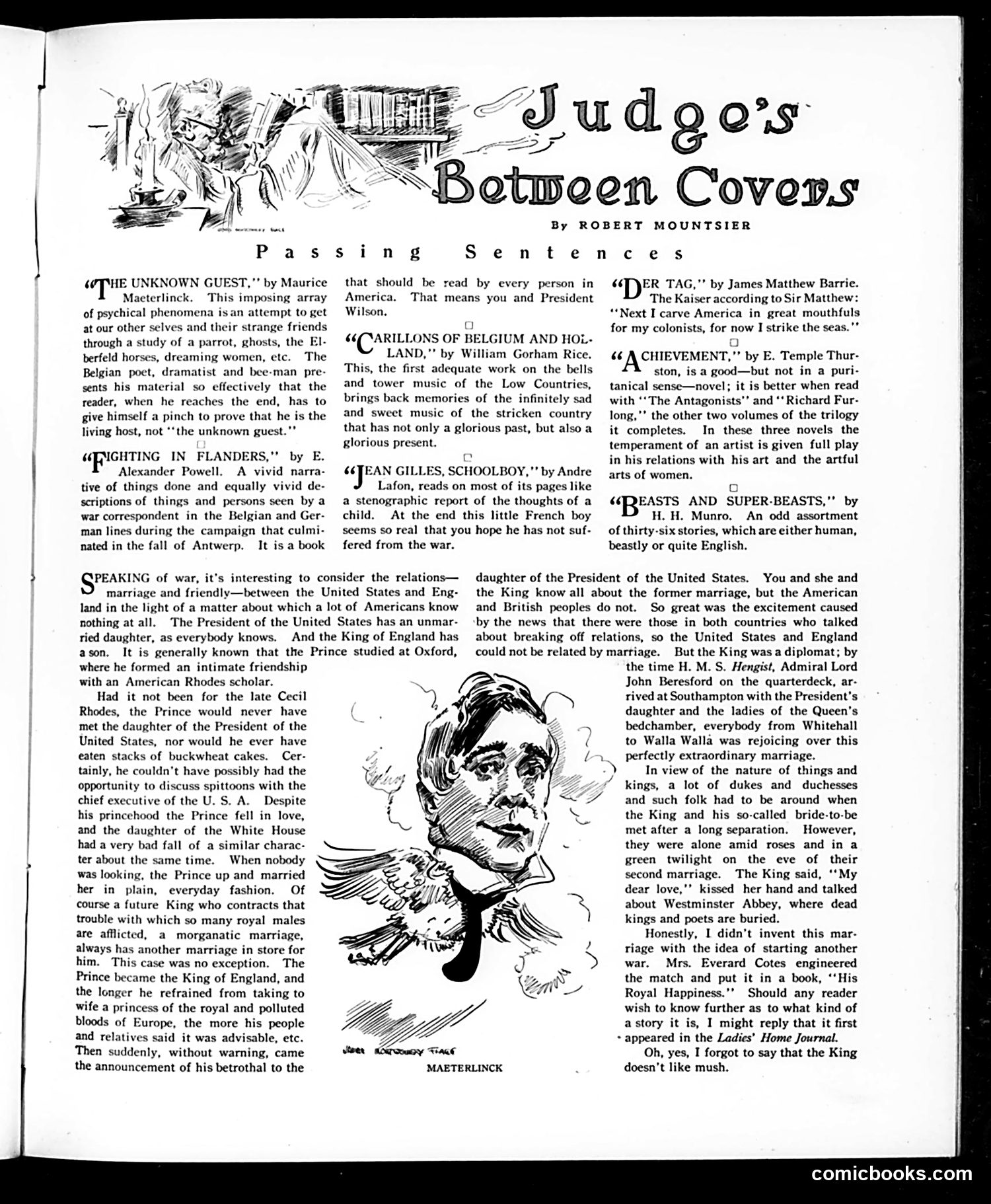
This page reviews books while embedding a satirical commentary on Anglo-American relations during World War I. The central narrative concerns the British Prince (later King George V) who married an American woman (daughter of a U.S. President), then later married a British princess—creating diplomatic awkwardness. The satire critiques how both nations' populations were unaware of the first marriage, and how rumors of dissolved relations threatened the alliance. The piece mocks the pretense and "morganatic marriage" complications of royal protocol, suggesting American and British leaders understood the political necessity of maintaining relations despite royal scandals. The caricatured bust (Maeterlinck, labeled) represents one of the reviewed authors. References to WWI books ("Fighting in Flanders," "The Kaiser") anchor the piece in the wartime period when U.S.-British solidarity was diplomatically crucial, making the royal marriage situation potentially problematic for maintaining public support for the alliance.
📄 Transcribed text from this page (OCR, searchable)
Machine-transcribed from the original scan — historical spelling and the odd misread are preserved.
~ Pass [email protected] UNKNOWN GUEST,"’ by Maurice Maeterlinck. This imposing array of psychical phenomena isan attempt to get at our other selves and their strange friends through a study of a parrot, ghosts, the El- berfeld horses, dreaming women, etc. The Belgian poet, dramatist and bee-man pre- sents his material so effectively that the reader, when he reaches the end, has to give himself a pinch to prove that he is the living host, not ‘‘the unknown guest."* 66EMGHTING IN FLANDERS,"’ by E. Alexander Powell. A vivid narra- tive of things done and equally vivid de- scriptions of things and persons seen by a war correspondent in the Belgian and Ger- man lines during the campaign that culmi- nated in the fall of Antwerp. It is a book PEAKING of war, it's interesting to consider the relations— marriage and friendly—between the United States and Eng- land in the light of a matter about which a lot of Americans know The President of the United States has an unmar- ried daughter, as everybody knows. And the King of England has It is generally known that the Prince studied at Oxford, nothing at all. a son. where he formed an intimate friendship with an American Rhodes scholar. Had it not been for the late Cecil Rhodes, the Prince would never have met the daughter of the President of the United States, nor would he ever have eaten of buckwheat cakes. Cer- tainly, he couldn't have possibly had the Opportunity to discuss spittoons with the chief executive of the U. S. A. Despite his princehood the Prince fell in love, and the daughter of the White House had a very bad fall of a similar charac- ter about the same time. When nobody was looking, the Prince up and married her in plain, everyday fashion. Of course a future King who contracts that trouble with which so many royal males are afflicted, a morganatic marriage, always has another marriage in store for him. This case was no exception. The Prince became the King of England, and the longer he refrained from taking to wife a princess of the royal and polluted bloods of rope, the more his people and relatives said it was advisable, etc. Then suddenly, without warning, came the announcement of his betrothal to the ing that should be read by every person in America. That means you and President Wilson. a 64(“ARILLONS OF BELGIUM AND HOi- LAND," by William Gorham Rice. This, the first adequate work on the bells and tower music of the Low Countries, brings back memories of the infinitely sad and sweet music of the stricken country that has not only a glorious past, but also a glorious present. J N GILLES, SCHOOLBOY,"’ by Andre Lafon, reads on most of its pages like a stenographic report of the thoughts of a child. At the end this little French boy seems so real that you hope he has not suf- fered from the war. Ze steer LZ Fee MAETERLINCK A Rictooon Covers By ROBERT MOUNTSIER Sentences daughter of the President of the United States. You and she and the King know all about the former marriage, but the American and British peoples do not. by the news that there were those in both countries who talked about breaking off relations, so the United States and England could not be related by marriage. 66T)ER TAG," by James Matthew Barrie. The Kaiser according to Sir Matthew: “Next I carve America in great mouthfuls for my colonists, fort now I strike the seas.’ “ CHIEVEMENT, ” by E. Temple Thur- ston, is a good—but not in a puri- tanical sense—novel; it is better when read with ‘‘The Antagonists’’ and *‘ Richard Fur- long,’’ the other two volumes of the trilogy it completes. In th three novels the temperament of an ai is given full play in his relations with his art and the artful arts of women. o é¢6REASTS AND SUPER-BEASTS,"’ by H. H. Munro. An odd assortment of thirty-six stories, which are either human, beastly or quite English. So great was the excitement caused But the King was a diplomat; by the time H. M. S. Hengist, Admiral Lord John Beresford on the quarterdeck, ar- rived at Southampton with the President's daughter and the ladies of the Queen’s bedchamber, everybody from Whitehall to Walla Walla was rejoicing over this perfectly extraordinary marriage. In view of the nature of things and kings, a lot of dukes and duchesses and such folk had to be around when the King and his so-called bride-to-be met after a long separation. However, they were alone amid roses and in a green twilight on the eve of their second marriage. The King said, ‘‘My dear love,"’ kissed her hand and talked about Westminster Abbey, where dead kings and poets are buried. Honestly, I didn’t invent this mar- riage with the idea of starting another war. Mrs. Everard Cotes engineered the match and put it in a book, ‘‘His Royal Happiness.’’ Should any reader wish to know further as to what kind of astory it is, I might reply that it first + appeared in the Ladies’ Home Journal. Oh, yes, I forgot to say that the King doesn’t like mush. comicbooks.com