
Judge, 1915-01-30 · page 10 of 24
Judge — January 30, 1915 — page 10: what you’re looking at
What you’re looking at
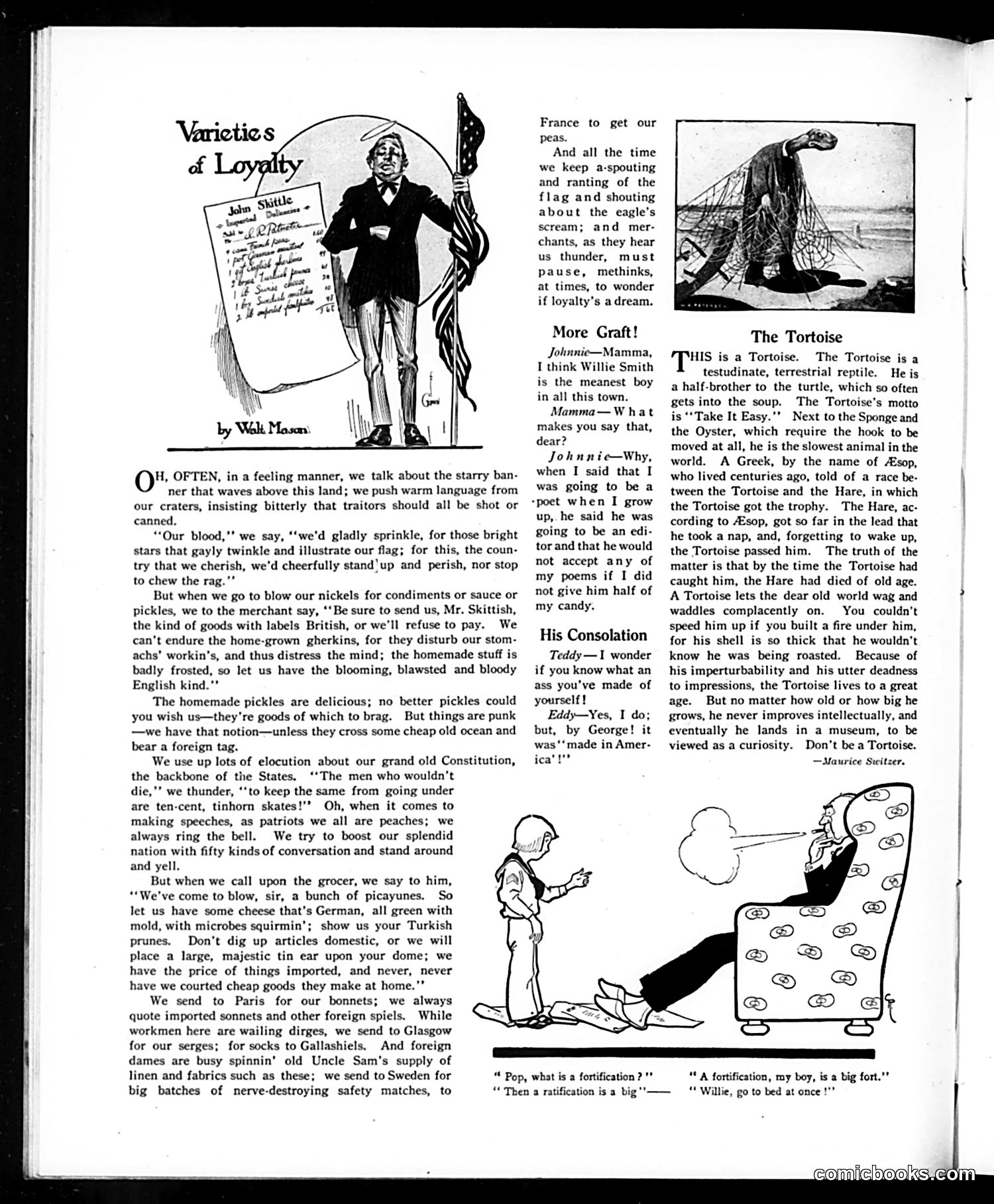
**"Varieties of Loyalty"** (main essay by Walt Mason): This satirical piece attacks American hypocrisy. Citizens loudly proclaim patriotic devotion to the flag and Constitution, vowing to die for their country. Yet the same people refuse to buy American-made goods—demanding imported pickles, German cheese, Glasgow serges, and Swedish matches instead. The satire's point: such consumers' patriotic speeches ring hollow when their wallets betray the nation by enriching foreign manufacturers while domestic workers suffer. **"More Graft!"** (small dialogue): A child describes a boy exploiting another's poetic ambitions by demanding half his candy as payment for editorial consideration—a cynical jab at corruption in publishing. **"The Tortoise"** (fable retelling): A humorous piece celebrating the tortoise's patience and slowness as virtues, contrasting with the hare's failure. The reference to Aesop grounds this in classic moral instruction. The page overall critiques American consumer behavior and corruption through wit and classical allusion.
📄 Transcribed text from this page (OCR, searchable)
Machine-transcribed from the original scan — historical spelling and the odd misread are preserved.
H, OFTEN, in a feeling manner, we talk about the starry ban- ner that waves above this land; we push warm language from our craters, insisting bitterly that traitors should all be shot or canned. “‘Our blood,’’ we say, ‘‘we'd gladly sprinkle, for those bright stars that gayly twinkle and illustrate our flag; for this, the coun- try that we cherish, we'd cheerfully stand'up and perish, nor stop to chew the rag. But when we go to blow our nickels for condiments or sauce or pickles, we to the merchant say, ‘Be sure to send us, Mr. Skittish, the kind of goods with labels British, or we'll refuse to pay. We can’t endure the home-grown gherkins, for they disturb our stom- achs’ workin’s, and thus distress the mind; the homemade stuff is badly frosted, so let us have the blooming, blawsted and bloody English kind." The homemade pickles are delicious; no better pickles could you wish us—they're goods of which to brag. But things are punk —we have that notion—unless they cross some cheap old ocean and bear a foreign tag. We use up lots of elocution about our grand old Constitution, the backbone of the States, ‘*The men who wouldn't die,’’ we thunder, ‘‘to keep the same from going under are ten-cent, tinhorn skates!’ Oh, when it comes to making speeches, as patriots we all are peaches; we always ring the bell. We try to boost our splendid nation with fifty kinds of conversation and stand around and yell. But when we call upon the grocer, we say to him, ‘*We've come to blow, sir, a bunch of picayunes. So let us have some cheese that's German, all green with mold, with microbes squirmin’; show us your Turkish prunes. Don't dig up articles domestic, or we will place a large, majestic tin ear upon your dome; we have the price of things imported, and never, never have we courted cheap goods they make at home.’’ We send to Paris for our bonnets; we always quote imported sonnets and other foreign spiels. While workmen here are wailing dirges, we send to Glasgow for our serges; for socks to Gallashiels. And foreign dames are busy spinnin’ old Uncle Sam's supply of linen and fabrics such as these; we send to Sweden for big batches of nerve-destroying safety matches, to France to get our peas. And all the time we keep a-spouting and ranting of the flag and shouting about the eagle's scream; and mer- chants, as they hear us thunder, must pause, methinks, at times, to wonder if loyalty’s a dream. More Graft! Johnnie—Mamma, I think Willie Smith is the meanest boy in all this town. Mamma— What makes you say that, dear? Johnnie—Why, when I said that I was going to be a spoet when I grow up, he said he was going to be an edi- tor and that he would not accept any of my poems if I did not give him half of my candy. His Consolation Teddy —1 wonder if you know what an ass you've made of yourself! Eddy—Yes, I do; but, by George! it was ‘‘made in Amer- ica’!"" “ Pop, what is a fortification ? "* “ Then a ratification is a big''—— The Tortoise HIS is a Tortoise. The Tortoise is a testudinate, terrestrial reptile. He is a half-brother to the turtle, which so often gets into the soup. The Tortoise’s motto is ‘‘Take It Easy.’ Next to the Sponge and the Oyster, which require the hook to be moved at all, he is the slowest animal in the world. A Greek, by the name of sop, who lived centuries ago, told of a race be- tween the Tortoise and the Hare, in which the Tortoise got the trophy. The Hare, ac- cording to AZsop, got so far in the lead that he took a nap, and, forgetting to wake up, the Tortoise passed him. The truth of the matter is that by the time the Tortoise had caught him, the Hare had died of old age. A Tortoise lets the dear old world wag and waddles complacently on. You couldn't speed him up if you built a fire under him, for his shell is so thick that he wouldn't know he was being roasted. Because of his imperturbability and his utter deadness to impressions, the Tortoise lives to a great age. But no matter how old or how big he grows, he never improves intellectually, and eventually he lands in a museum, to be viewed as a curiosity. Don't be a Tortoise. Maurice Switzer. “A fortification, my boy, is a big fort.” “* Willie, go to bed at once !""