
Judge, 1915-01-30 · page 7 of 24
Judge — January 30, 1915 — page 7: what you’re looking at
What you’re looking at
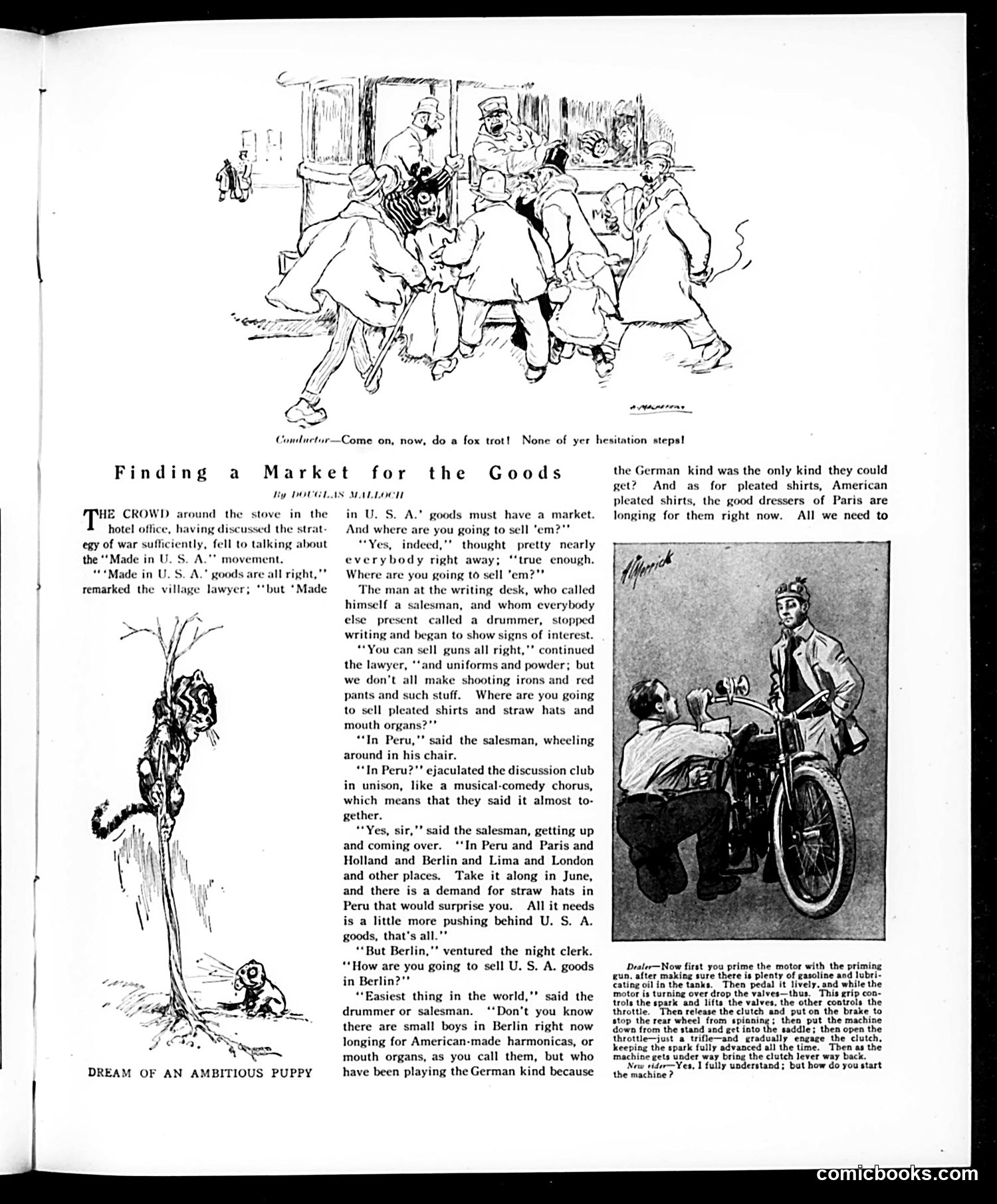
This satirical piece from *Judge* magazine addresses post-World War I economic nationalism—specifically the "Made in U.S.A." movement promoting American goods. **The Setup:** A small-town discussion group debates where to sell American products like pleated shirts and harmonicas, assuming there's no market abroad. **The Satire:** A traveling salesman counters that demand exists everywhere—even in recently-defeated Germany and Austria. He argues that despite wartime antagonism, consumers in Berlin, Peru, Paris, and other cities actively *want* American goods and would buy them if properly marketed. **The Point:** The cartoon mocks both isolationist skepticism about foreign markets AND the notion that wartime enmity automatically closes commercial opportunities. It suggests pragmatic American salesmanship can overcome nationalist sentiment—that commerce transcends recent conflict. The "fox trot" caption adds era-appropriate humor, linking American cultural exports (jazz, dance) to commercial ones. The unrelated motorcycle instruction at page bottom appears to be separate advertising content.
📄 Transcribed text from this page (OCR, searchable)
Machine-transcribed from the original scan — historical spelling and the odd misread are preserved.
Finding a Market ‘Come on, now, do a fox trot! for the Goods None of yer hesitation steps! German And kind was the only kind they could as for pleated shirts, American Ky DOUGLAS MALLOCH HE CROWD around the in the hotel office, having discussed the strat- egy of war sufficiently, fell to talking about the ‘'Made in U.S. A."" movement. “*Made in U.S. A." goods are all right,"” t remarked the village lawyer; ‘*but ‘Made stove ‘ea — tN PT, Te DREAM OF AN AMBITIOUS PUPPY in U. S. A." goods must have a market. And where are you going to sell ‘em?"* “Yes, indeed,’’ thought pretty nearly everybody right away; ‘‘true enough. Where are you going to sell 'em?"* The man at the writing desk, who called himself a salesman, and whom everybody present led a drummer, stopped writing and began to show signs of interest. “You can sell guns all right,'’ continued the lawyer, ‘‘and uniforms and powder; but we don’t all make shooting irons and red pants and such stuff. Where are you going to sell pleated shirts and straw hats and mouth organs? “In Peru,"’ said the salesman, wheeling around in his chair. “In Peru?’ ejaculated the discussion club in unison, like a musical-comedy chorus, which means that they said it almost to- gether. “Yes, sir,’’ said the salesman, getting up and coming over. ‘‘In Peru and Paris and Holland and Berlin and Lima and London and other places. Take it along in June, and there is a demand for straw hats in Peru that would surprise you. All it needs is a little more pushing behind U. S. A. goods, that's all. ‘*But Berlin,’’ ventured the night clerk. “How are you going to sell U. S. A. goods in Berlin?" “Easiest thing in the world,’ said the drummer or salesman. ‘Don’t you know there are small boys in Berlin right now longing for American-made harmonicas, or mouth organs, as you call them, but who have been playing the German kind because pleated shirts, the good dressers of Paris are longing for them right now. All we need to Draler—Now first you prime the motor with the priming kun, after making sure there is plenty of gasoline and lubri- cating oil in the tanks. Then pedal it lively. and while the motor is turning over drop the valves—thus. This grip con- trols the spark and lifts the valves, the other controls the throttle. Then release the clutch and put on the brake to stop the rear wheel from spinning; then put the machine down from the stand and get into the saddle; then open the throttle—just a trifle—and gradually engage the clutch, keeping the spark fully advanced all the time. Then as the machine gets under way bring the clutch lever way back. New rider—Yes, 1 fully understand; but how do you start the machine ? comicbooks.com