
Judge, 1915-01-30 · page 4 of 24
Judge — January 30, 1915 — page 4: what you’re looking at
What you’re looking at
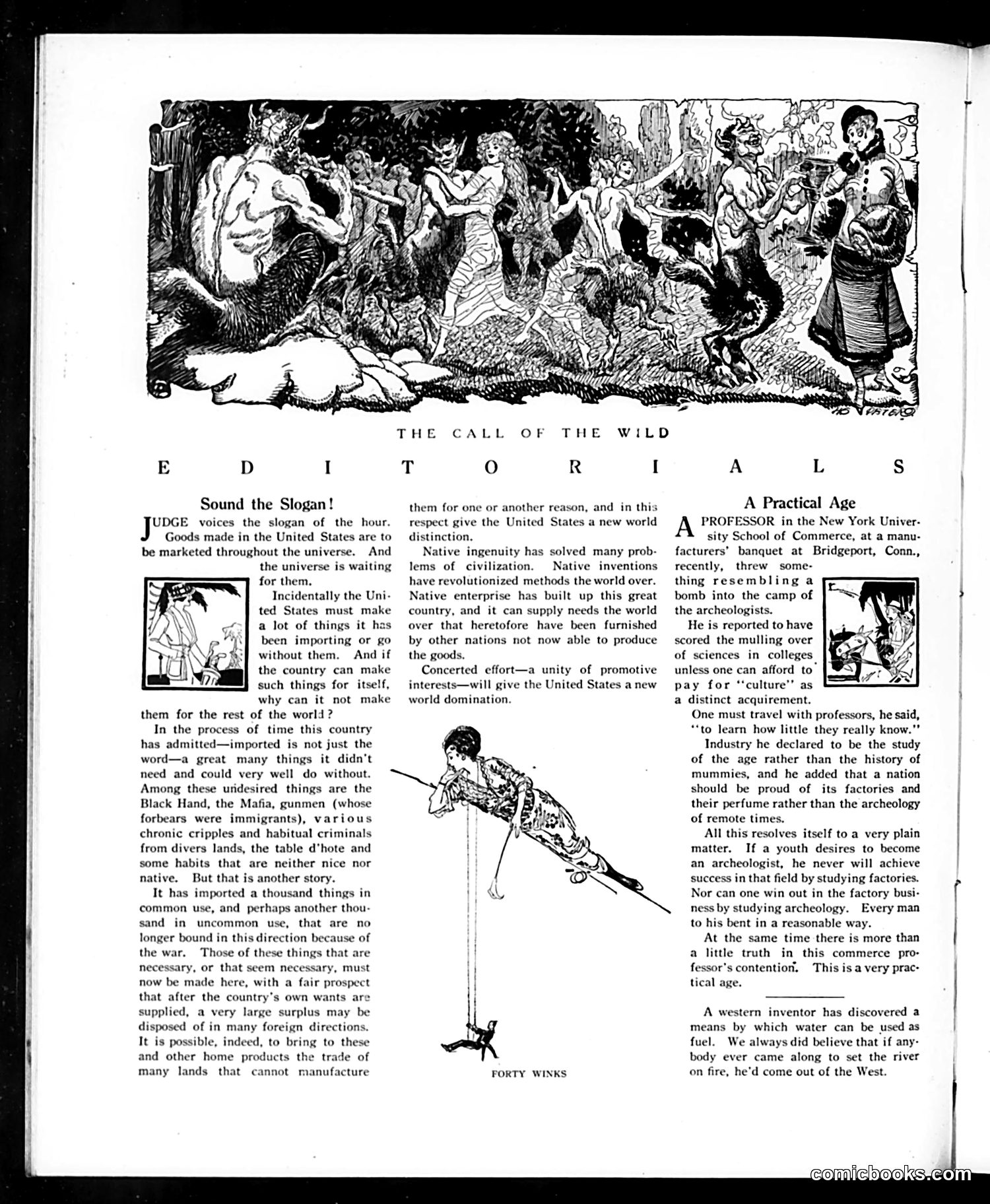
The top illustration titled "THE CALL OF THE WILD" depicts a chaotic forest scene with nude or partially-clothed figures engaged in wild, uninhibited behavior—appearing to satirize primitivism or "back to nature" movements popular in early 20th-century intellectual circles. The left editorial section "Sound the Slogan!" argues for American manufacturing dominance, advocating that the U.S. should produce goods previously imported, positioning domestic industry as patriotic necessity. The right section "A Practical Age" mocks academic pretension, suggesting that studying factories and commerce matters more than archaeology. The illustration "FORTY WINKS" shows someone sleeping, likely commenting on impractical scholarship. The final anecdote about water-as-fuel appears to joke about Western American tall tales and gullibility.
📄 Transcribed text from this page (OCR, searchable)
Machine-transcribed from the original scan — historical spelling and the odd misread are preserved.
Sound the Slogan! UDGE voices the slogan of the hour. Goods made in the United States are to be marketed throughout the unive: And the universe is waiting for them. Incidentally the Uni ted States must mal a lot of things it has been importing or go without them. And if the country can make such things for itself, why can it not make them for the rest of the world? In the process of time this country has admitted—imported is not just the word—a great many things it didn’t need and could very well do without. Among these uridesired things are the Black Hand, the Mafia, gunmen (whose forbears were immigrants), various chronic cripples and habitual criminals from divers lands, the table d'hote and some habits that are neither nice nor native. But that is another story. It has imported a thousand things in common use, and perhaps another thou- sand in uncommon use, that are no longer bound in this direction because of the war. Those of these things that are necessary, or that seem necessary, must now be made here, with a fair prospect that after the country’s own wants are supplied, a very large surplus may be disposed of in many foreign directions. It is possible, indeed, to bring to these and other home products the trade of many lands that cannot manufacture THE CALL T oO R I OF them for one or another reason, and in this respect give the United States a new world distinction, Native ingenuity has solved many prob- lems of civilization. Native inventions have revolutionized methods the world over. Native enterprise has built up this great country, and it can supply needs the world over that heretofore have been furnished by other nations not now able to produce the goods. Concerted effort—a unity of promotive interests—will give the United States a new world domination. FORTY WINKS THE WILD A L Ss A Practical Age PROFESSOR in the New York Univer- sity School of Commerce, at a manu- facturers’ banquet at Bridgeport, Conn., recently, threw some- thing resembling a bomb into the camp of the archeologists. He is reported to have scored the mulling over of sciences in colleges unless one can afford to” pay for ‘‘culture’’ as a distinct acquirement. One must travel with professors, he sai **to learn how little they really know. Industry he declared to be the study of the age rather than the history of mummies, and he added that a nation should be proud of its factories and their perfume rather than the archeology of remote times. All this resolves itself to a very plain matter. If a youth desires to become an archeologist, he never will achieve success in that field by studying factories. Nor can one win out in the factory busi- ness by studying archeology. Every man to his bent in a reasonable way. At the same time there is more than a little truth in this commerce pro- fessor's contention. This is a very prac- tical age. A western inventor has discovered a means by which water can be used as fuel. We always did believe that if any- body e came along to set the river on fir “d come out of the West. h ——_—_+,