
A complete issue · 24 pages · 1915
Judge — January 9, 1915
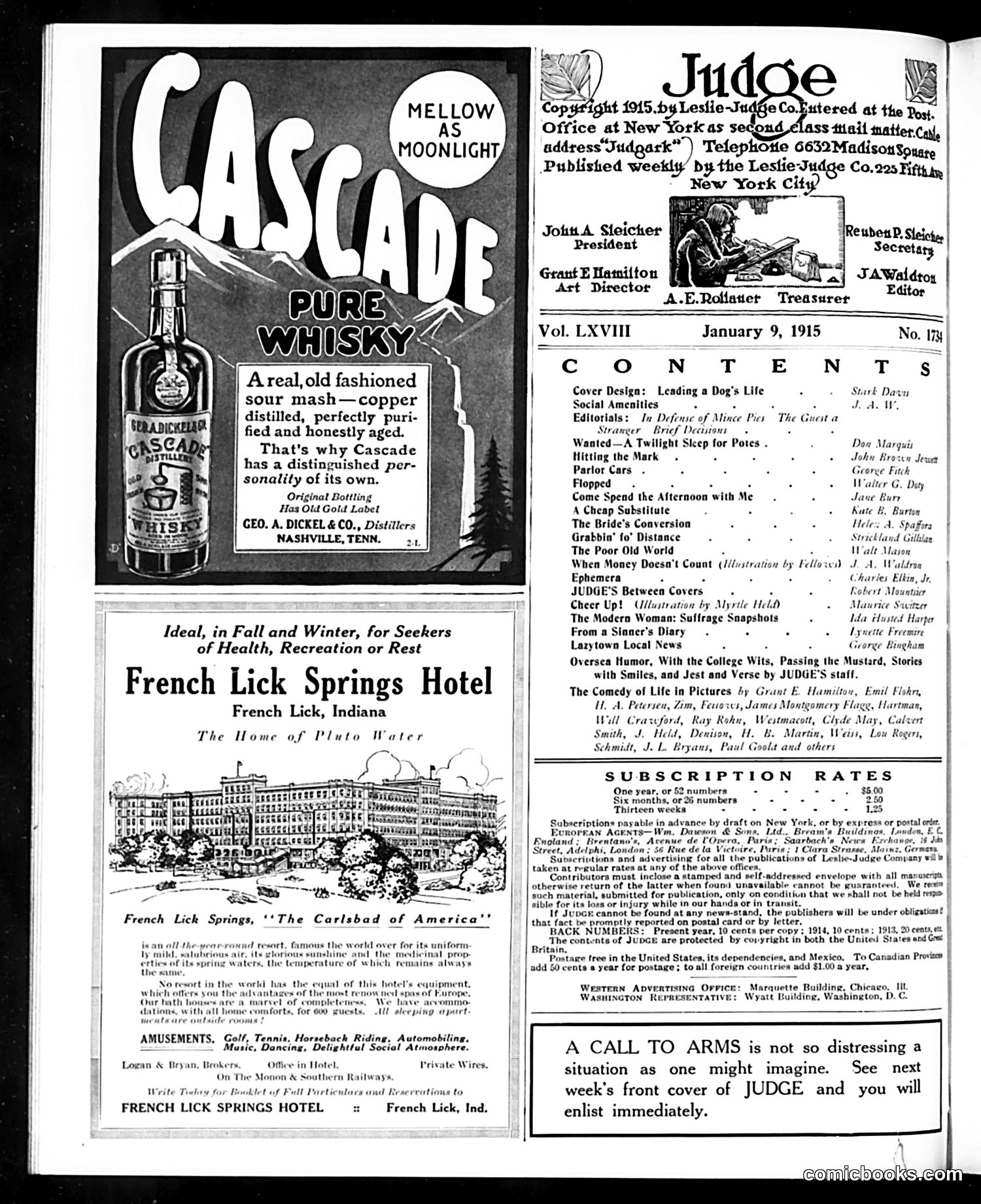
This page is primarily **advertising and masthead information** rather than political satire. The left side features a Cascade Whisky advertisement emphasizing traditional distilling methods ("real, old fashioned sour mash"), and promotes French Lick Springs Hotel in Indiana as a health resort featuring "Pluto Water." The right side shows the magazine's table of contents and publication details. A brief teaser at bottom references next week's front cover concerning "A Call to Arms," likely alluding to **World War I**, which the U.S. had not yet entered (America joined in 1917). This suggests the magazine was beginning to address the European conflict's growing relevance to American readers.
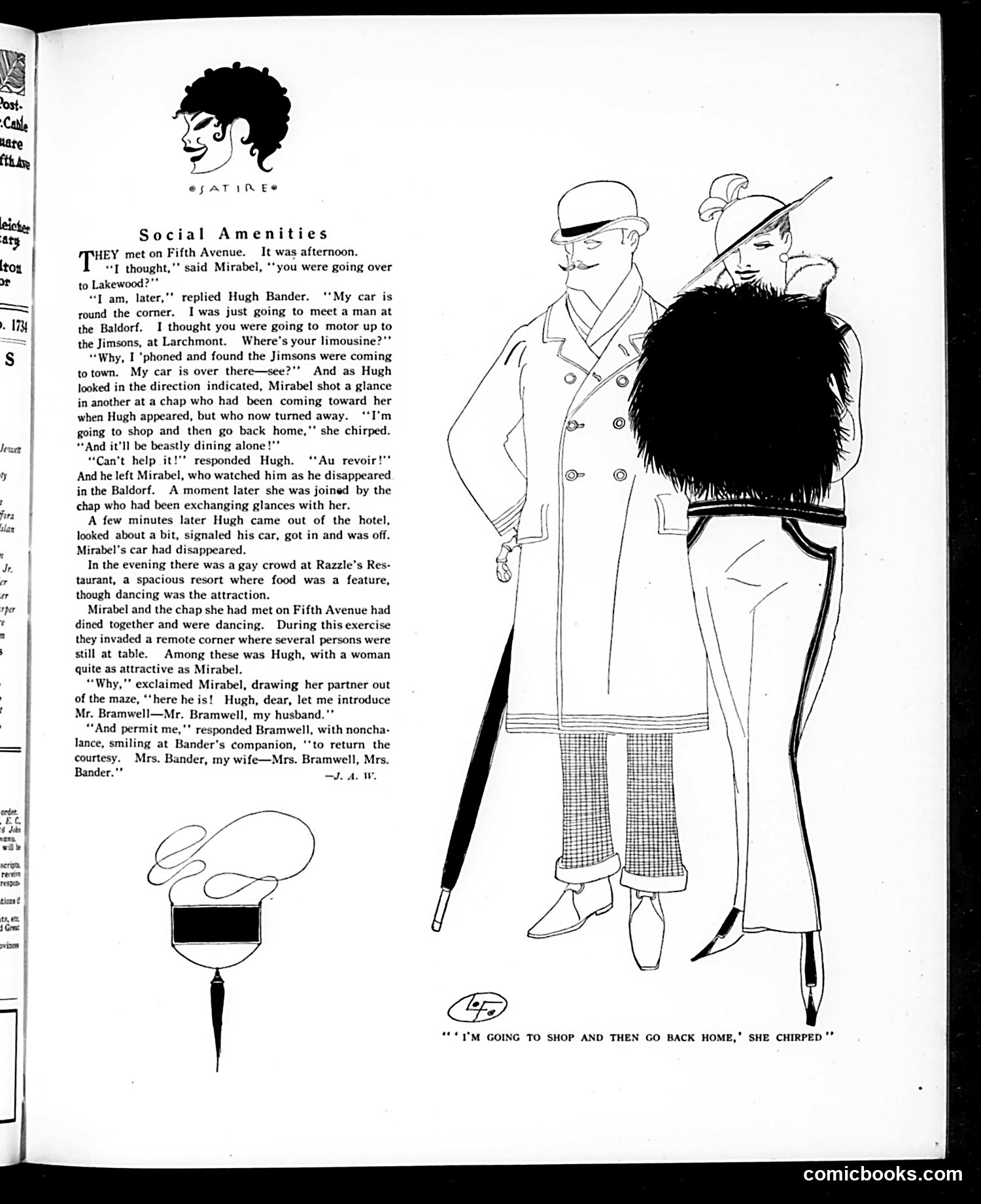
This page presents a short comedic story illustrated with fashion sketches. The narrative describes a chance encounter on Fifth Avenue between Mirabel and Hugh Bander, who pretend not to know each other despite being married. Hugh claims he's meeting someone at the Baldorf (likely the Waldorf), while Mirabel insists she's going to Lakewood. Later that evening, they coincidentally meet at Razzle's Restaurant with other companions—Hugh with "a woman quite as attractive as Mirabel." The satire targets upper-class marital infidelity and social hypocrisy. The couple's elaborate pretense of separate activities, followed by their embarrassing encounter at a public venue with romantic companions, mocks the shallow "social amenities" that allowed wealthy New Yorkers to maintain appearances while conducting affairs.
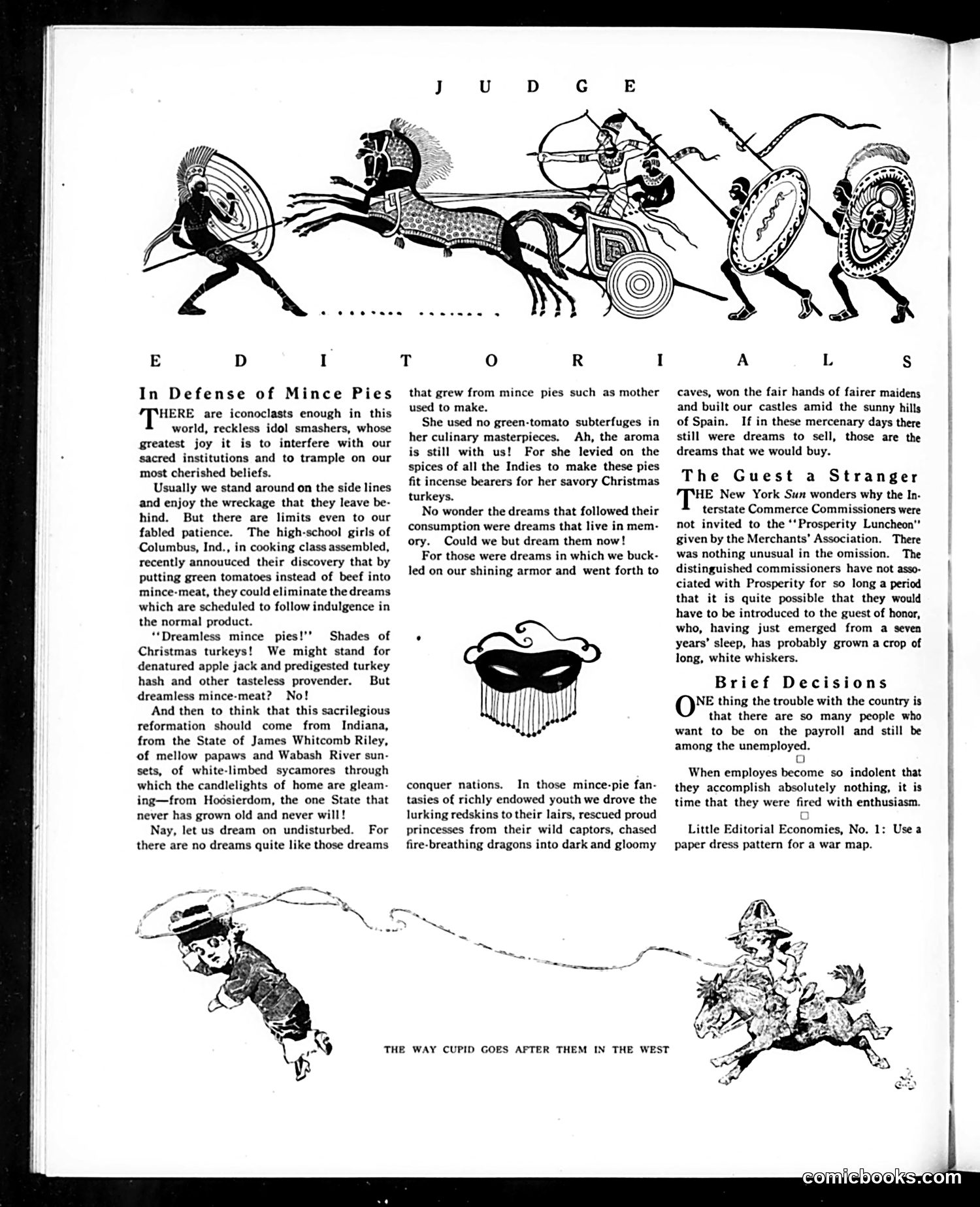
The top illustration depicts a "Judge" (a figure of authority/justice) in a chariot pulled by horses, attacking figures with shields labeled "Editorial" and "Trials"—likely representing critics or opposition to the magazine itself. This is self-referential satire. The main article "In Defense of Mince Pies" ironically defends an American food tradition against reformers seeking to eliminate it. The text mocks those who want to ban mince pies, framing this as part of broader attacks on cherished American customs and beliefs by progressive reformers. It's nostalgia-driven satire criticizing food-purity or dietary-reform movements. The bottom cartoons and "Brief Decisions" section contain minor satirical commentary on employment and business matters. The overall page reflects Judge's satirical defense of traditional American values against reform-minded critics.
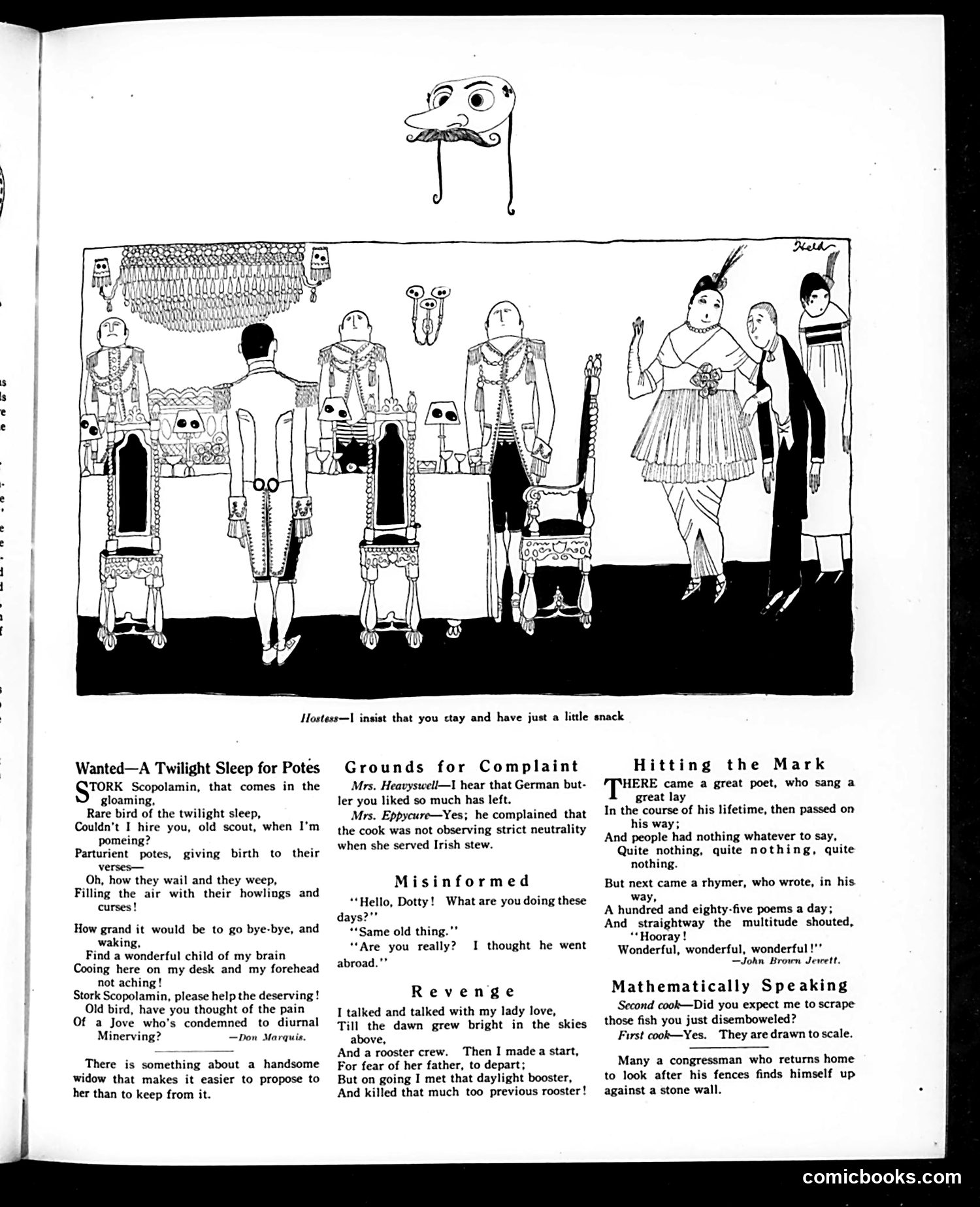
The main cartoon depicts an elaborate formal gathering with elaborately dressed figures in period costume. The hostess's caption—"I insist that you stay and have just a little snack"—suggests satire about excessive hospitality or pretense at social gatherings. Below are four humorous short pieces: "Wanted—A Twilight Sleep for Potés" mocks a bird's complaints about childbirth; "Grounds for Complaint" jokes about German butter and Irish stew quality; "Misinformed" plays on miscommunication; and "Revenge," "Hitting the Mark," and "Mathematically Speaking" are brief comedic anecdotes about romantic disappointment, poetry appreciation, and congressional incompetence, respectively. The page emphasizes social satire and domestic humor typical of Judge's early 20th-century focus, though specific contemporary references remain unclear without additional context.
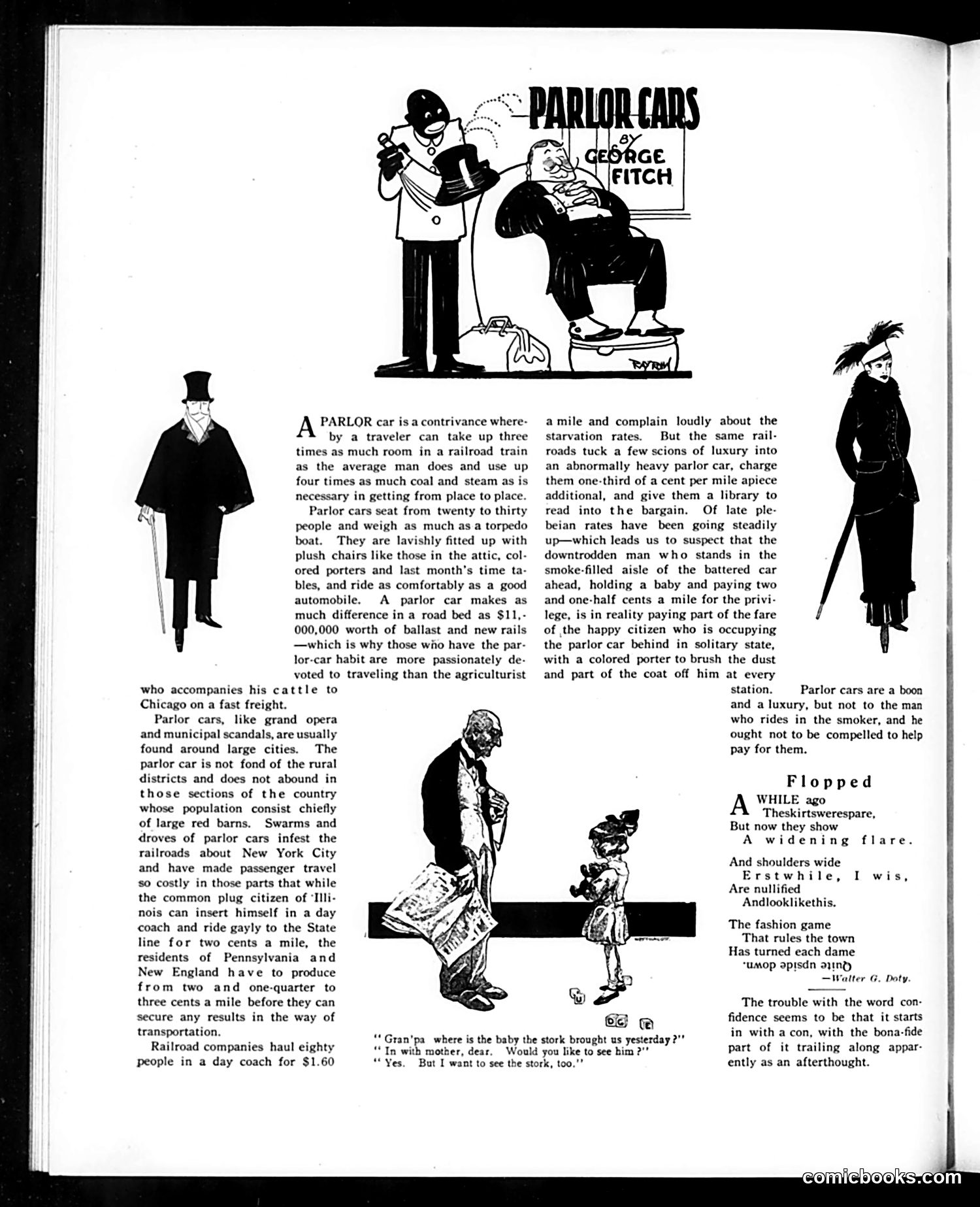
This article by George Fitch satirizes the parlor car system as an unjust luxury that shifts costs to ordinary passengers. The central complaint: parlor cars are expensive, heavy conveyances that use disproportionate resources (coal, steam, track wear) but charge first-class passengers only marginally more than standard-fare riders—forcing working-class commuters to subsidize the wealthy's comfort. Fitch notes the geographical disparity: while an Illinois laborer pays two cents per mile in a day coach, Pennsylvania and New England residents pay 2.25-3 cents because parlor cars concentrate on lucrative urban routes, inflating overall rail costs. The comic strips show genteel passengers contrasting with working-class struggling families, emphasizing the wealth divide. The satire targets railroad companies' pricing scheme as fundamentally unfair—ordinary people shouldn't subsidize luxury travel for the elite.
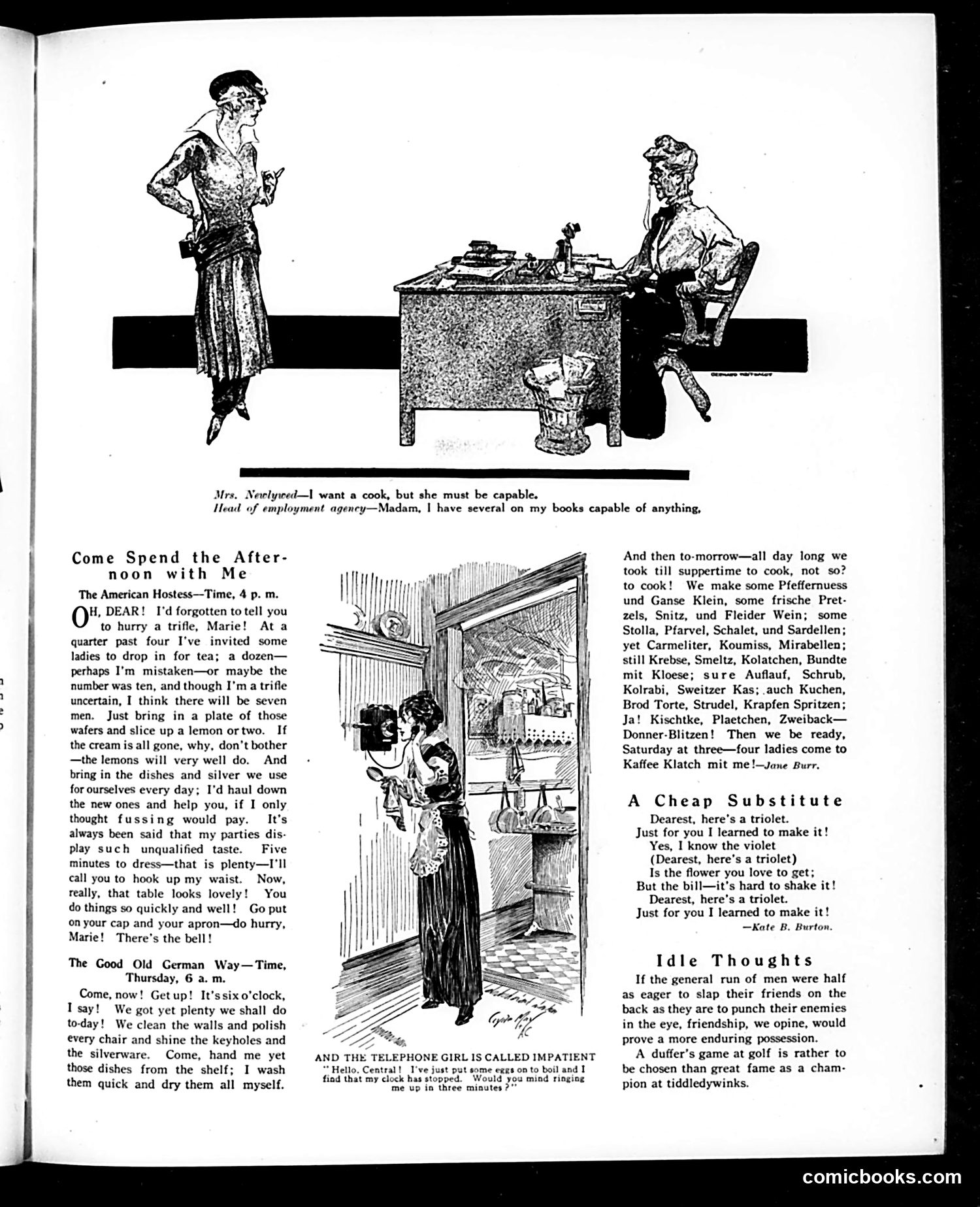
This page satirizes early 20th-century class divisions and domestic expectations through contrasting portrayals of American and German housekeeping. The top cartoon mocks newly affluent Americans: a society hostess casually summons her maid Marie to prepare an impromptu tea for numerous guests with minimal notice and resources, expecting flawless execution. The employment agency head's boast that his workers are "capable of anything" underscores the unrealistic demands placed on domestic servants. "The Good Old German Way" contrasts this with a German household's methodical, thorough approach—rising at 6 a.m. to meticulously clean and prepare elaborate traditional foods. The satire cuts both ways: Americans are portrayed as wasteful and disorganized; Germans as obsessively industrious. The telephone girl cartoon adds commentary on service workers' limited agency—she must interrupt her duties to accommodate a passenger's needs. The remaining content (poetry, "Idle Thoughts") appears filler rather than satirical commentary. Overall, the page reflects period anxieties about labor, class status, and changing domestic expectations in America.
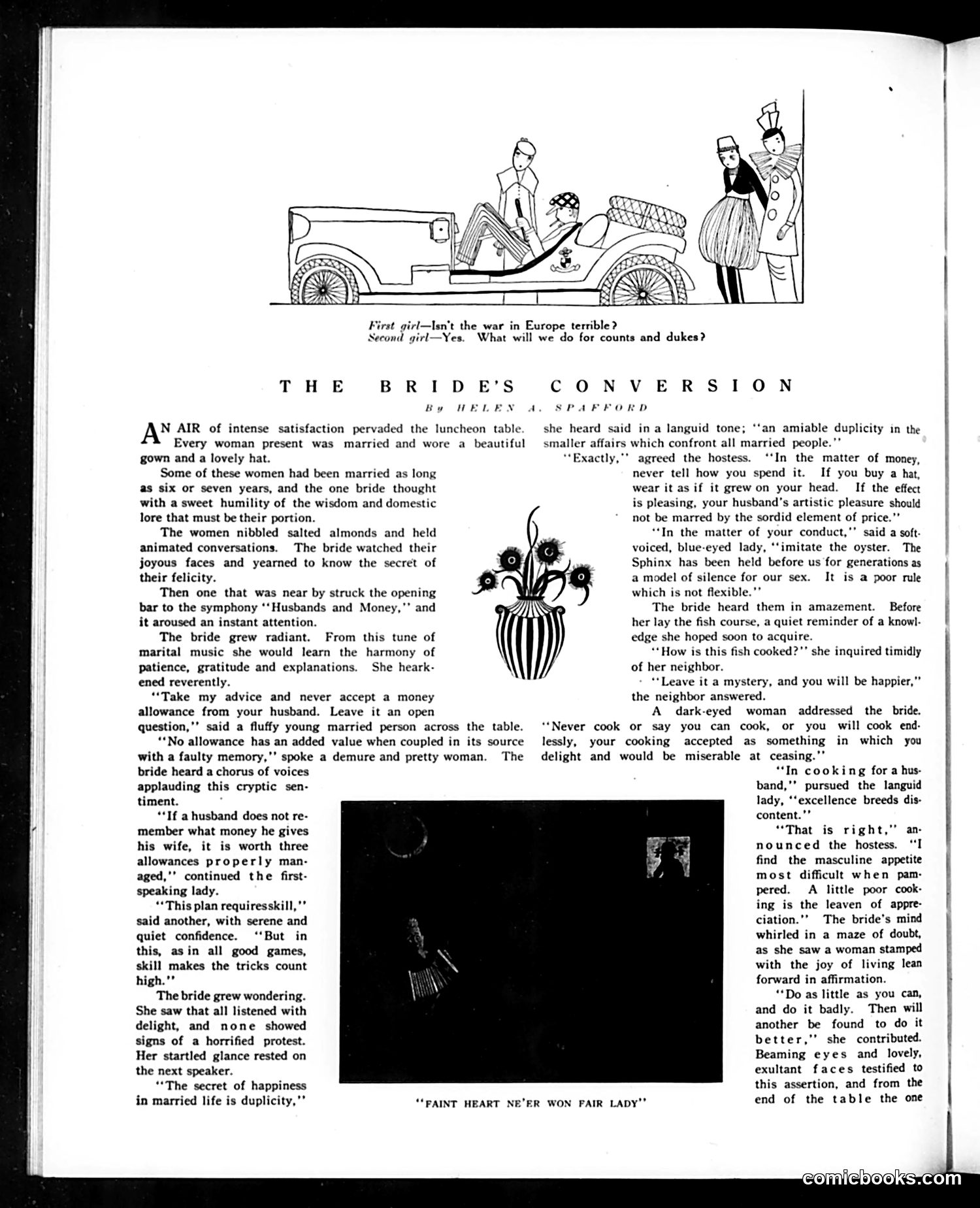
This story satirizes the marital advice given to a young bride by experienced married women at a luncheon. The humor targets early 20th-century women's prescribed roles: the married women counsel deception and deliberate incompetence as strategies for domestic happiness. The advice is deliberately cynical: hide spending habits, cultivate mystery, cook badly so husbands remain grateful, imitate the Sphinx's silence, and practice "duplicity." The satire works by having the women earnestly present these dishonest tactics as wisdom—revealing how limited women's actual options and agency were in marriage. The top cartoon's joke about "counts and dukes" appears to reference wartime Europe (World War I context likely), suggesting women's concern that war might eliminate aristocratic marriage prospects. The satire's target is unclear: it could mock either the married women's cynicism or critique a society that forces women toward such strategies.
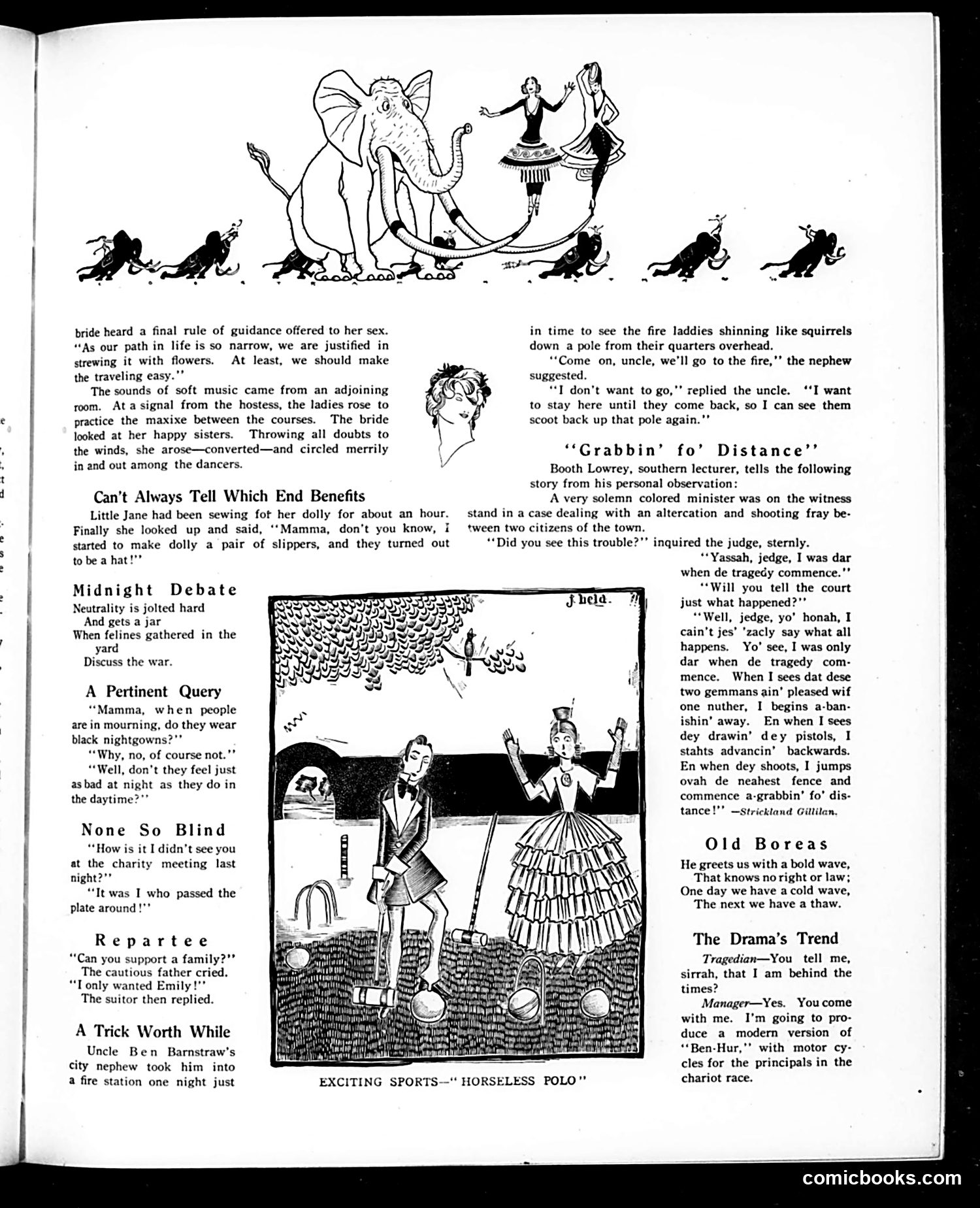
This page from Judge magazine contains multiple brief humorous items typical of early 20th-century American satire. **Main cartoon** ("Horseless Polo"): Shows people on motorcycles playing polo—a direct satire of modernization's absurdity. The joke mocks how new technology (motorcycles) is being retrofitted into traditional aristocratic sports, suggesting people blindly adopt novelties regardless of practicality. **Other humor items** include: - **"Grabbin' fo' Distance"**: A dialect-heavy anecdote with racist caricature of a Black witness whose description of retreating backward from gunfire uses exaggerated speech patterns for comedic effect—reflecting prevalent early-20th-century racial stereotyping in American humor. - **"The Drama's Trend"**: Satirizes theater's obsession with modernizing classics (updating Ben-Hur with motorcycles instead of chariots). - Various domestic humor snippets about courtship, children, and daily life. The page reflects Judge's formula: social commentary through exaggeration and ethnic/class-based humor typical of the era.
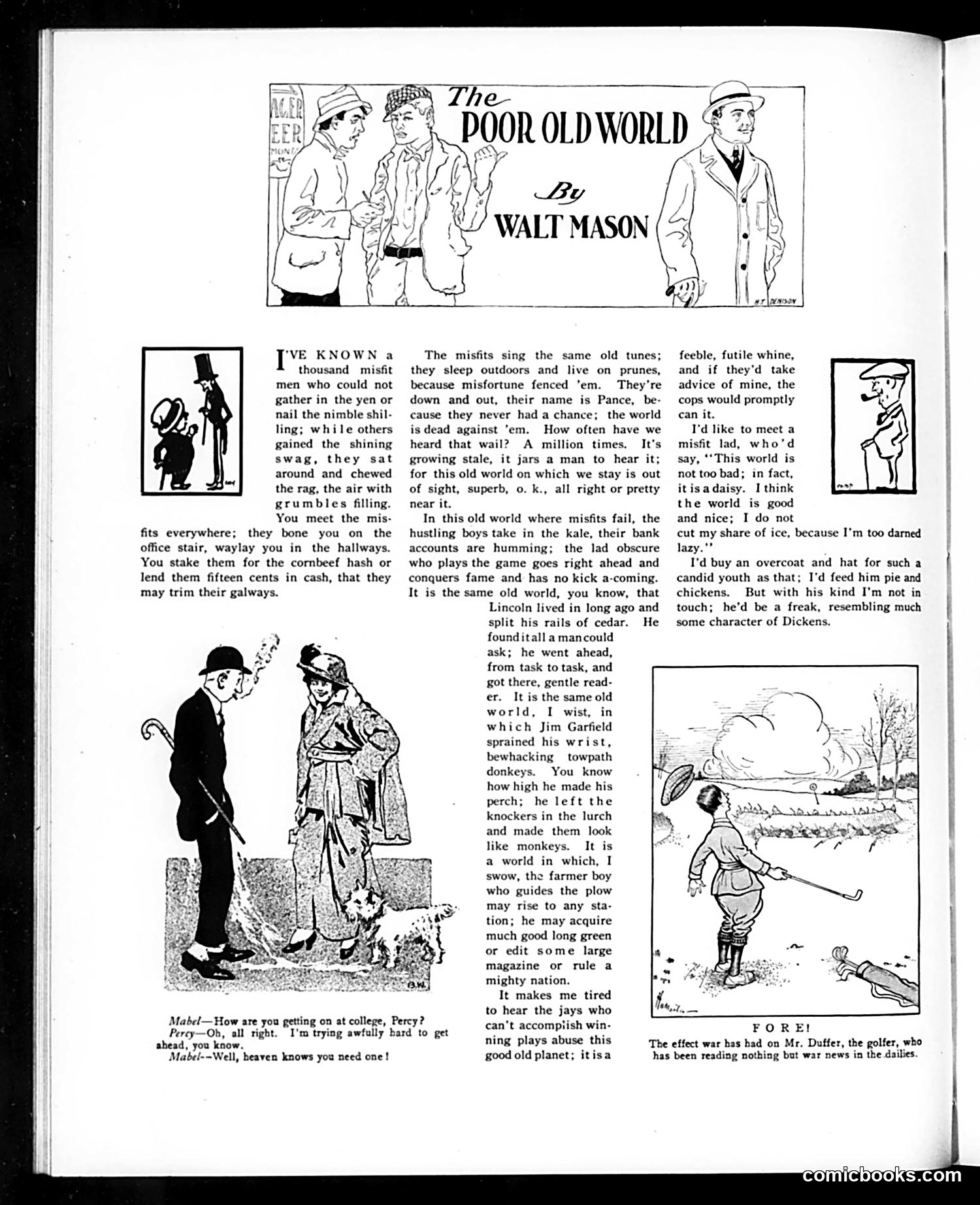
This page contains two distinct pieces of social commentary: **Main Article**: Mason's essay criticizes men who blame society for their failures as "misfits." He argues the world offers opportunity to those who work hard, citing Lincoln and James Garfield as self-made success stories. The piece dismisses complaints about unfair circumstances as "feeble, futile whine," asserting that lazy men who claim the world is "too bad" are simply making excuses. It reflects early 20th-century American bootstrap mythology. **Two Cartoons**: 1. A college dialogue where Percy admits he's "trying awfully hard to get ahead," and his mother sarcastically responds he needs the effort, mocking privileged incompetence. 2. "Fore!" depicts Mr. Duffer, a golfer so preoccupied with reading war news (likely WWI coverage) that he's become dangerously distracted during play—a light joke about war's cultural obsession.
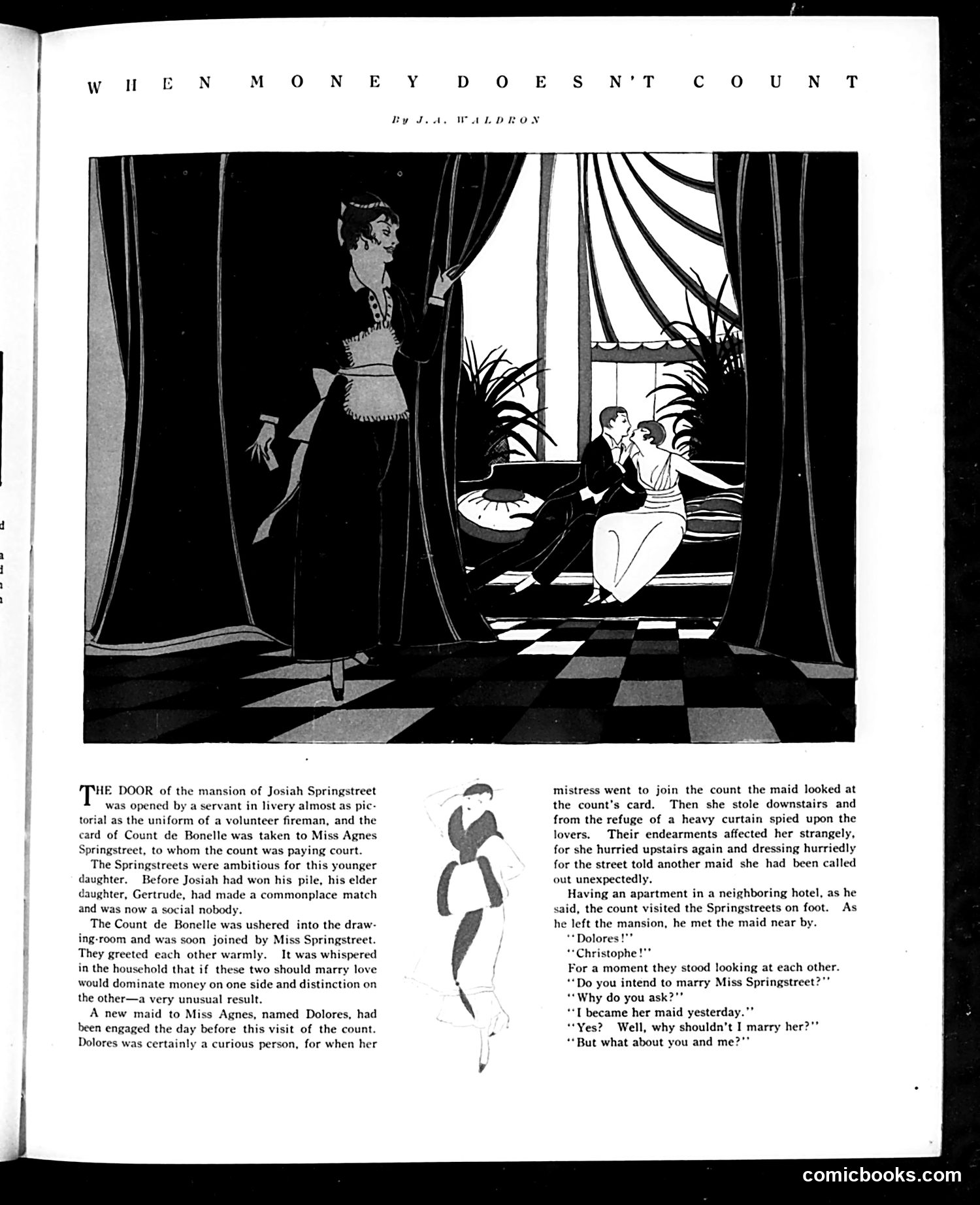
This satirical story by J.A. Waldron mocks the social ambitions of the newly wealthy. The Springstreets, who recently acquired their fortune, eagerly pursue a match between their daughter Agnes and a European count—valuing his aristocratic "distinction" over genuine feeling. The twist reveals that the maid Dolores is actually the count's former lover (likely from Europe, given the Spanish name). Their reunion exposes the count's mercenary nature: he's pursuing Miss Springstreet for her money while abandoning Dolores. The story's title ironically suggests that love should transcend wealth, yet the count proves that money *does* count to him. The satire targets both the pretentious newly rich seeking aristocratic legitimacy and the con-man fortune-hunter who exploits their social climbing. The maid's unexpected prominence in the narrative may also comment on class mobility and the complications of immigration.
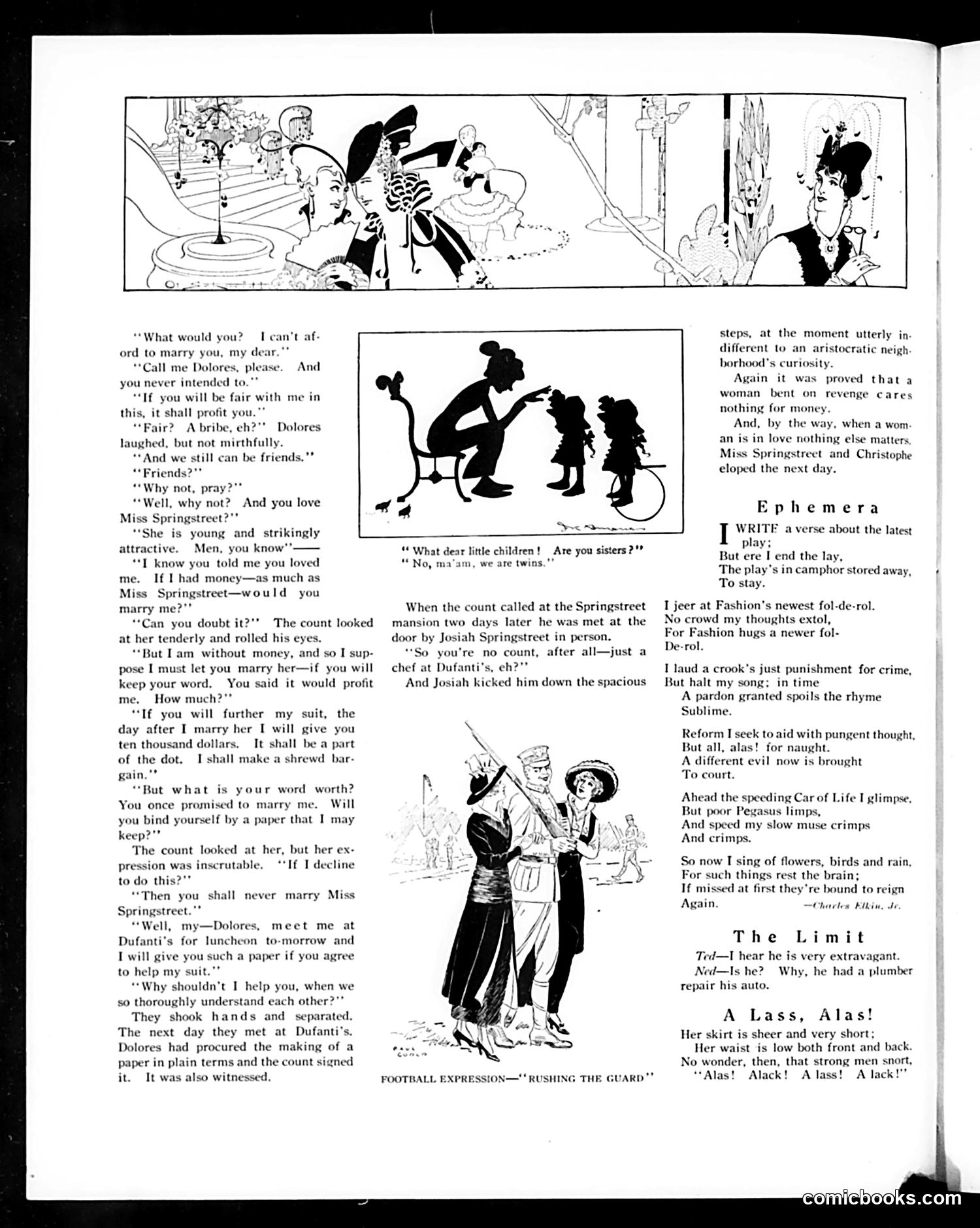
This page presents a serialized story about social climbing and romantic deception in the upper class. A European count, lacking money, attempts to marry the wealthy Miss Springstreet. He bribes her rival, Dolores, to help by promising her ten thousand dollars and a signed contract—essentially purchasing her assistance. The satire targets the mercenary nature of aristocratic marriages and class pretension. The punchline reveals the "count" is actually a chef at Dufanti's restaurant—his false nobility is exposed when confronted by Miss Springstreet's father, Josiah, who literally kicks him down the steps. The joke undercuts European aristocratic pretense: American self-made men like Springstreet dismiss fake titles. The story also mocks Dolores's miscalculation: seeking revenge through financial transaction, she loses everything when Miss Springstreet elopes with someone else instead. The page's remaining content—brief poems and witticisms about fashion and morality—are typical Judge filler pieces offering social commentary on contemporary foibles.
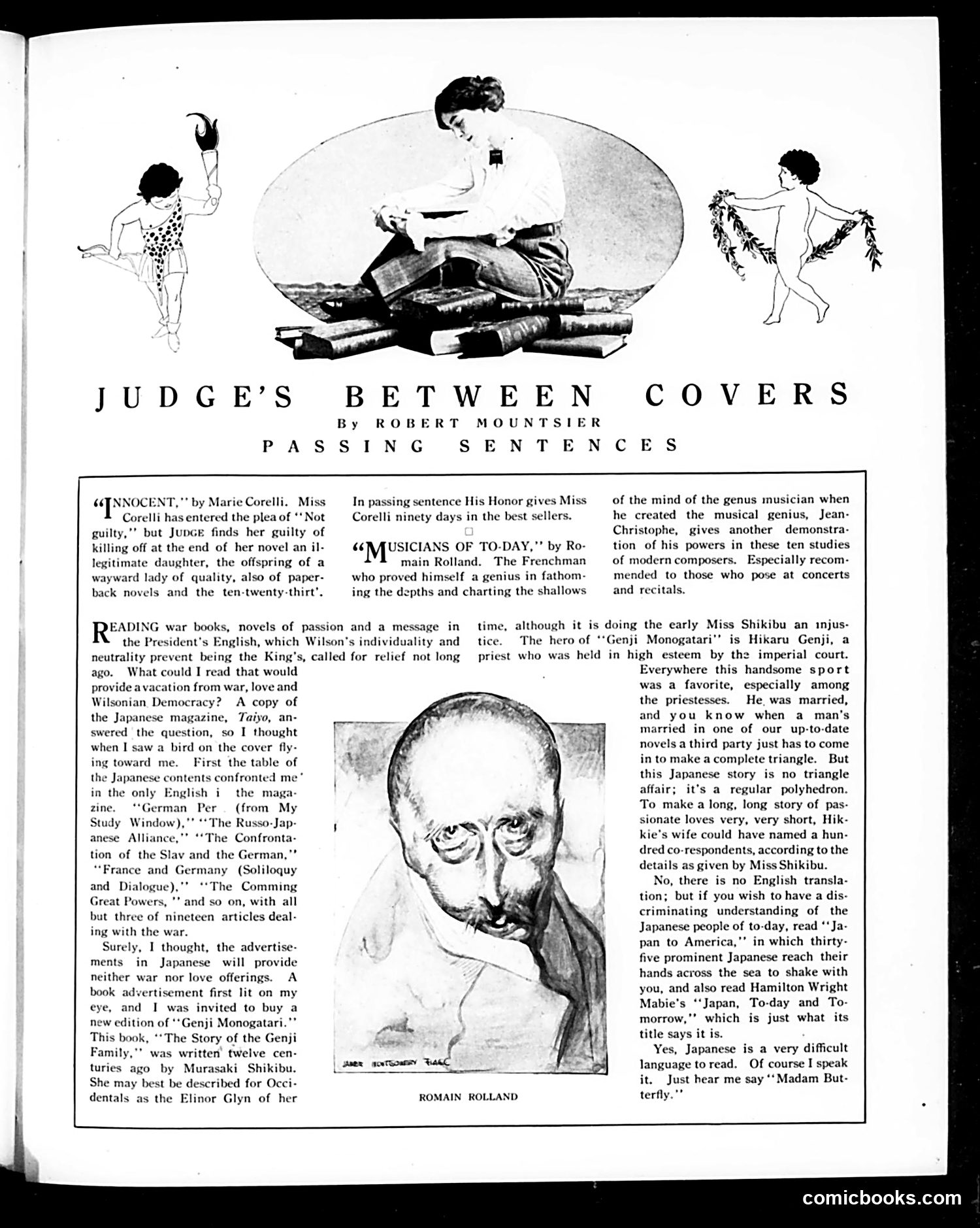
This is a book-review column by Robert Mountsier titled "Judge's Between Covers: Passing Sentences," using court imagery as metaphor. The "judge" verdict concerns recent publications. The satire mocks sentimental novelist **Marie Corelli** for killing off an illegitimate daughter in her plot—the reviewer humorously "convicts" her of this narrative crime. French composer **Romain Rolland** (whose portrait appears) receives praise for his musical studies. The main joke targets the reviewer's attempt to escape WWI and "Wilsonian Democracy" by reading a Japanese magazine (*Taiyo*), only to discover it contains the ancient novel *Genji Monogatari*—which features not a love triangle but a "polyhedron" of affairs. The reviewer sarcastically notes the Japanese story is more complex than modern Western romance fiction. The satire mocks both American literary pretension and the era's fascination with "exotic" Japanese culture as respite from contemporary war and politics.
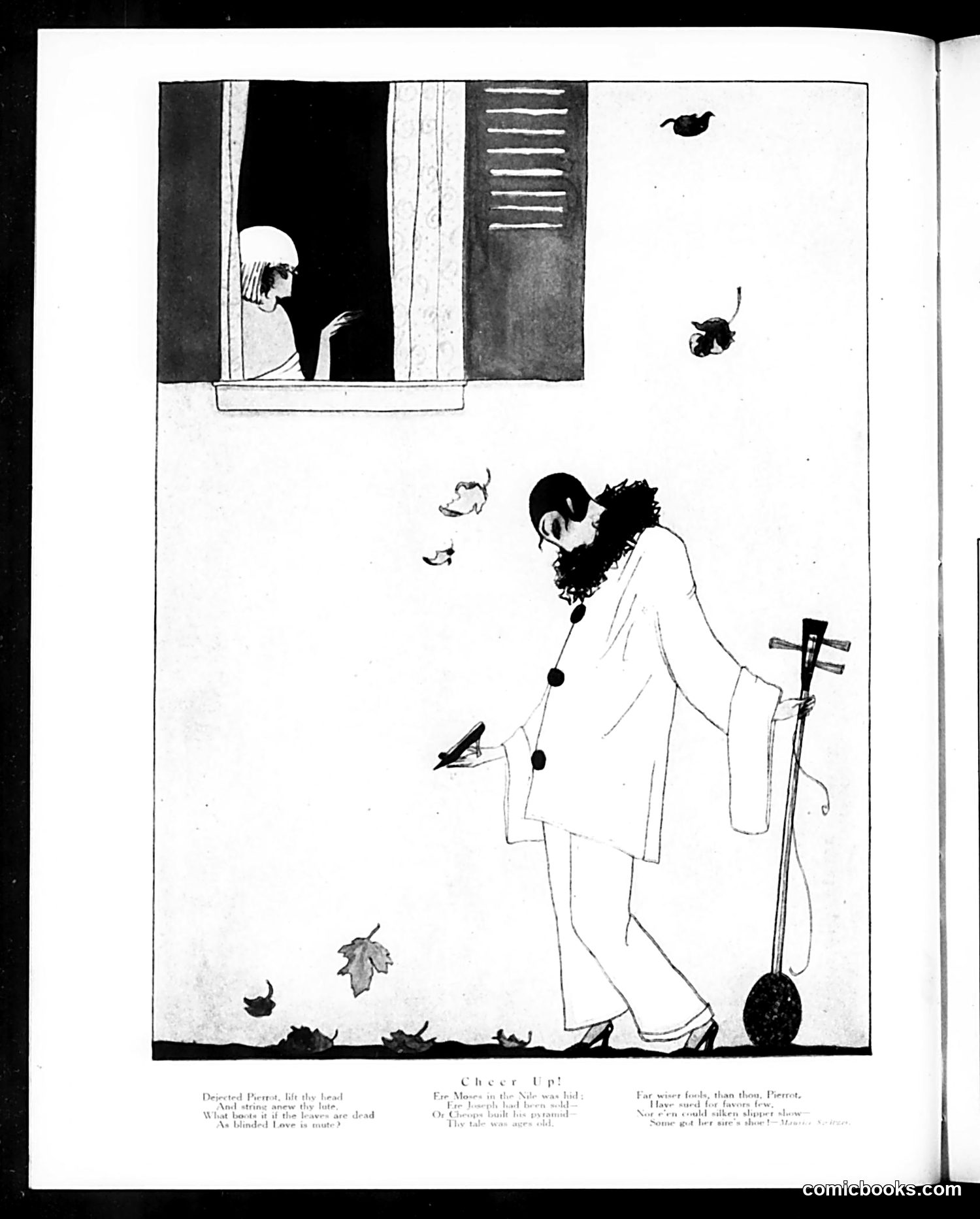
This single-panel cartoon depicts a woman at a window watching a man below operating a scooter or similar wheeled toy in a courtyard. Several birds fly overhead, and autumn leaves scatter the ground. The caption "Cheer Up!" and accompanying verse (partially legible) appears to reference romantic disappointment or melancholy. The woman observes the man with apparent resignation while he pursues what seems an amusing distraction—suggesting the satire contrasts emotional sadness with trivial amusement-seeking. Without clearer text legibility, the specific social commentary remains unclear, though the period styling and composition suggest early-20th-century commentary on relationships, gender dynamics, or the gap between romantic ideals and reality.
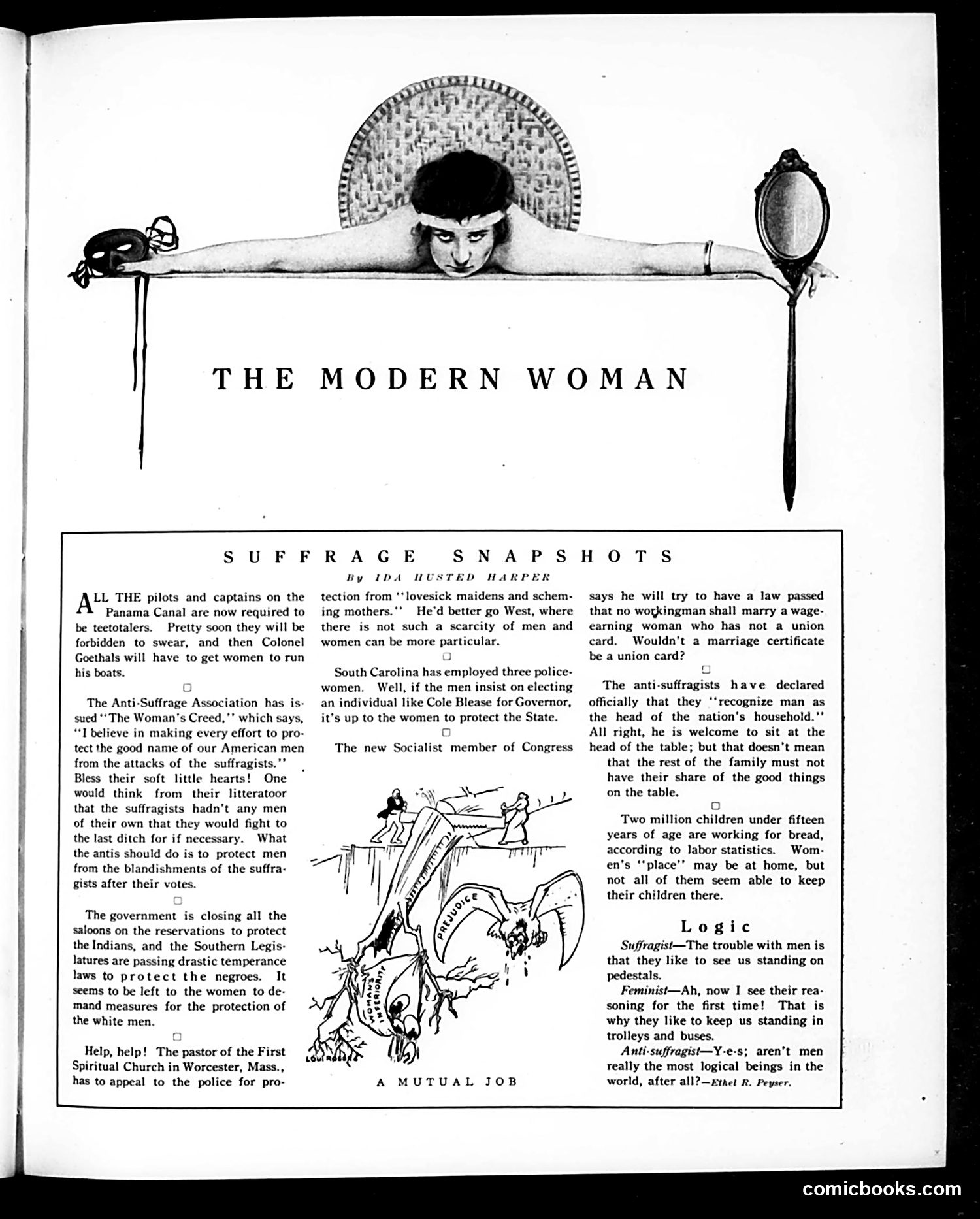
This page satirizes anti-suffrage arguments by highlighting their logical contradictions. Written by Ida Husted Harper, a suffrage advocate, it presents mock "snapshots" of anti-suffragist positions. **Key targets:** - The Anti-Suffrage Association's claim to protect "good name of American men," mocked as absurdly defensive - Southern resistance to women's voting while employing women police officers - Anti-suffragist rhetoric that women belong at home, yet two million children under fifteen work for wages (contradicting the "women's place" argument) - The cartoon "A Mutual Job" depicts suffragists and anti-suffragists as engaged partners in the same struggle **The satire's point:** Anti-suffragists claim men need protection from women seeking votes, yet simultaneously deny women economic protection and workplace rights. The final "Logic" section exposes how men claim to "protect" women by keeping them on pedestals in metaphor while forcing them to stand on actual trolleys and buses—revealing the gap between sentimental rhetoric and economic reality. The overall message: anti-suffrage positions are intellectually inconsistent.
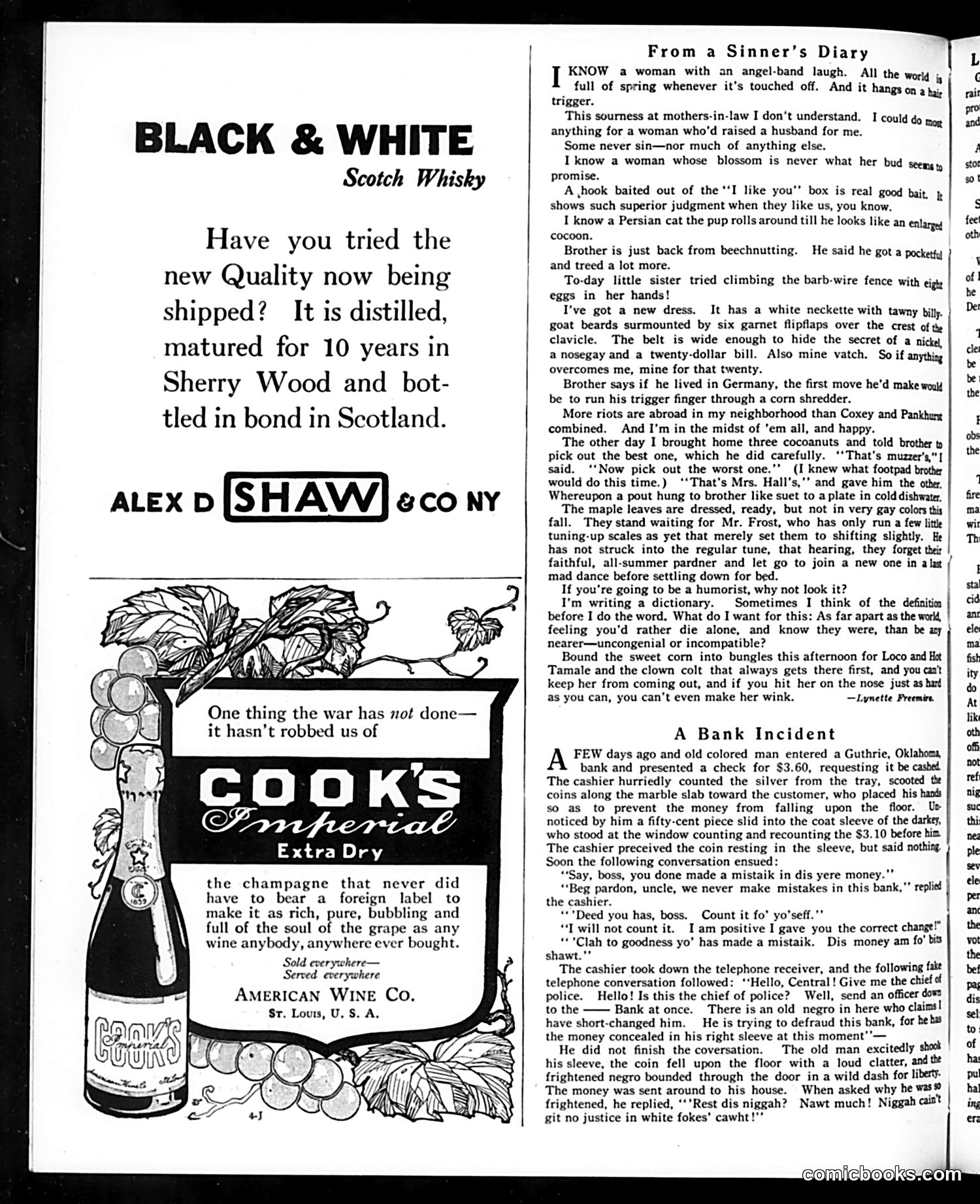
This page contains **primarily advertisements** with a sidebar humor column. The **ads** promote luxury goods during wartime (likely WWI): Black & White Scotch Whisky, Cook's Imperial champagne, and American Wine Co. products. They emphasize these are quality domestic/imported goods unaffected by war disruptions—reassuring consumers about continued availability. The left column, "From a Sinner's Diary," is a **humorous personal essay** by Lynette Freemire offering satirical observations about women, family life, and everyday absurdities. Jokes include exaggerated fashion descriptions, sibling antics, and philosophical musings on relationships. The final story, "A Bank Incident," begins describing a racial encounter at an Oklahoma bank where an elderly Black man deposits money. The narrative appears designed to build toward a punchline about racial dynamics or banking procedures—**the humor likely depends on period prejudices** that modern readers would find offensive rather than amusing. The page reflects early 20th-century magazine culture: mixing commerce, light satirical writing, and humor dependent on now-problematic social attitudes.
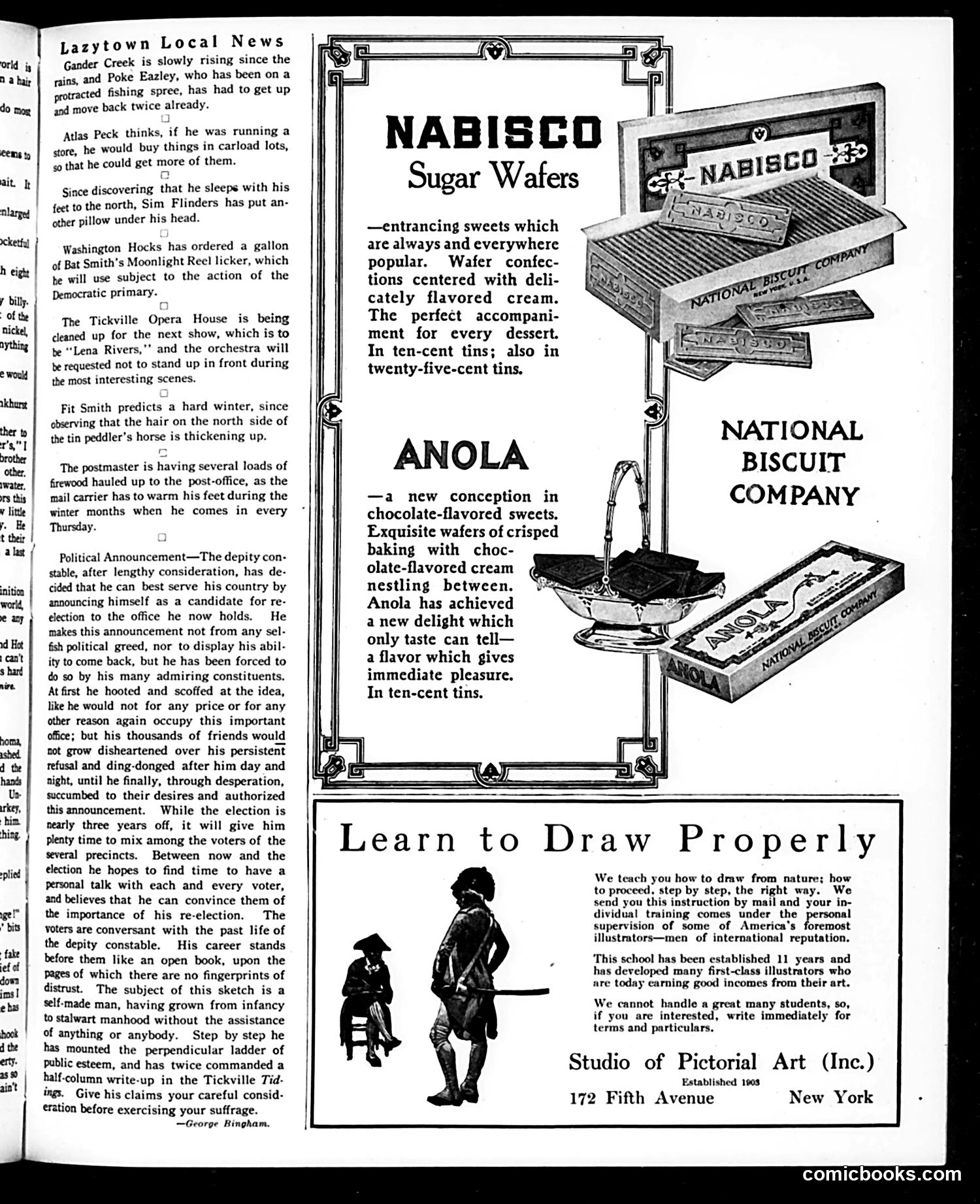
This page is primarily **advertising**, not political satire. The bulk of the content consists of three commercial advertisements for National Biscuit Company products (Nabisco Sugar Wafers and Anola chocolates) and a drawing instruction school. The left column contains **"Lazytown Local News"**—gentle rural humor about small-town characters and gossip, including a lengthy political announcement satirizing small-town politicians' self-importance. The deputy constable's announcement mocks the inflated rhetoric politicians use to describe mundane re-election bids, presenting his reluctant candidacy as though he's sacrificing himself for the common good when he's actually been pressured by constituents. The satire here is **mild and local**, poking fun at small-town vanity and political pomposity rather than addressing national issues. This reflects Judge magazine's typical mix of advertising, rural humor, and gentle mockery of American life.
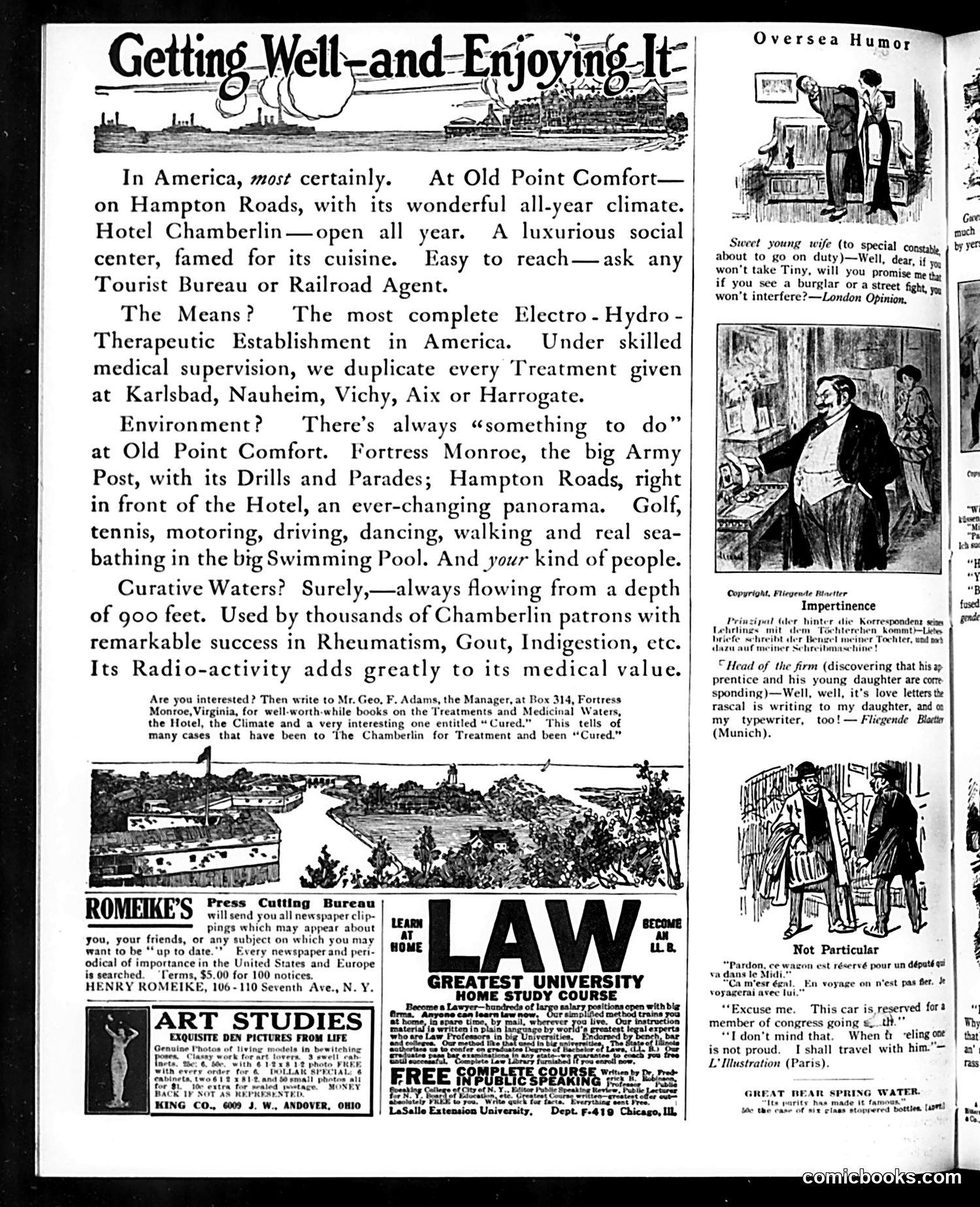
This page is primarily **advertising**, not political satire. The main content promotes the Hotel Chamberlin at Old Point Comfort, Virginia, as a health resort offering "Electro-Hydro-Therapeutic" treatments (early 20th-century medical spa therapies claiming to cure rheumatism, gout, and indigestion using radioactive mineral waters). The right column contains "Oversea Humor"—brief comedic anecdotes reprinted from European publications. These are gentle, domestic jokes: a wife asks her husband not to intervene in street fights, a boss discovers his apprentice courting his daughter on company time, and a traveler claims he doesn't mind sharing a train car reserved for congressmen. These vignettes illustrate period attitudes about marital propriety, workplace hierarchy, and class—but they're simply filler content meant to amuse readers between advertisements. No specific political figures or events are referenced. The page reflects typical magazine publishing of the era: mixing commercial promotion with light international humor.
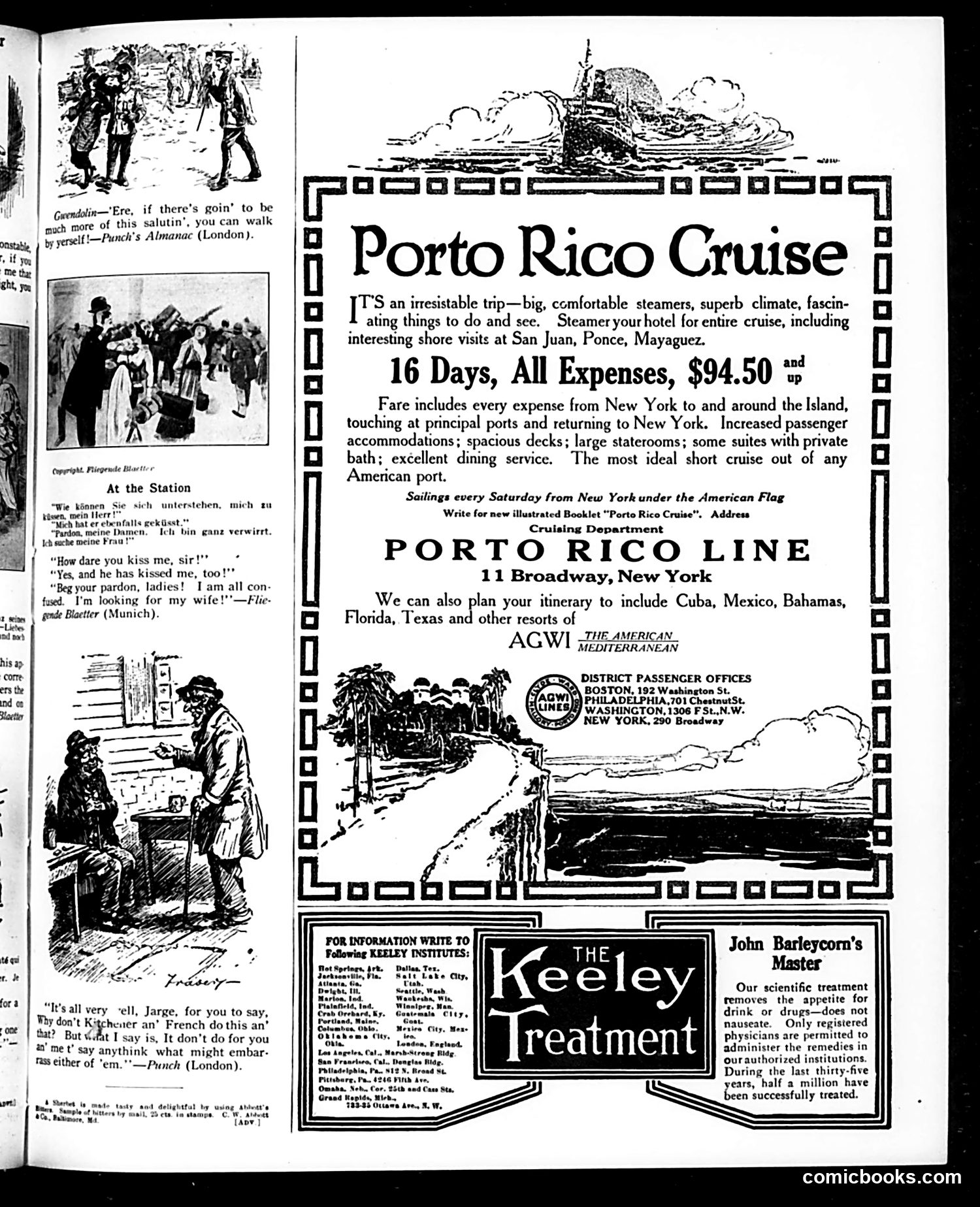
This page mixes humor cartoons with period advertising. The three small cartoons use cross-cultural misunderstandings for comedy: **The cartoons** (credited to European humor magazines *Punch* and *Fliegende Blätter*) depict situations where men kiss women in greeting—a Continental custom—causing confusion and offense to English-speaking women who interpret it as improper familiarity. One cartoon shows a confused man who's kissed multiple women, searching for his wife. The jokes play on class and cultural anxiety about "foreign ways." **The ads** are period cruise and medical services: a Porto Rico cruise for $94.50 (all-inclusive), and "John Barleycorn's Master," a temperance-era treatment claiming to cure alcoholism and drug addiction through medical intervention at authorized institutions. The page reflects early 20th-century American attitudes: curiosity about exotic travel, anxiety about European customs, and faith in medical "cures" for social problems like drinking.
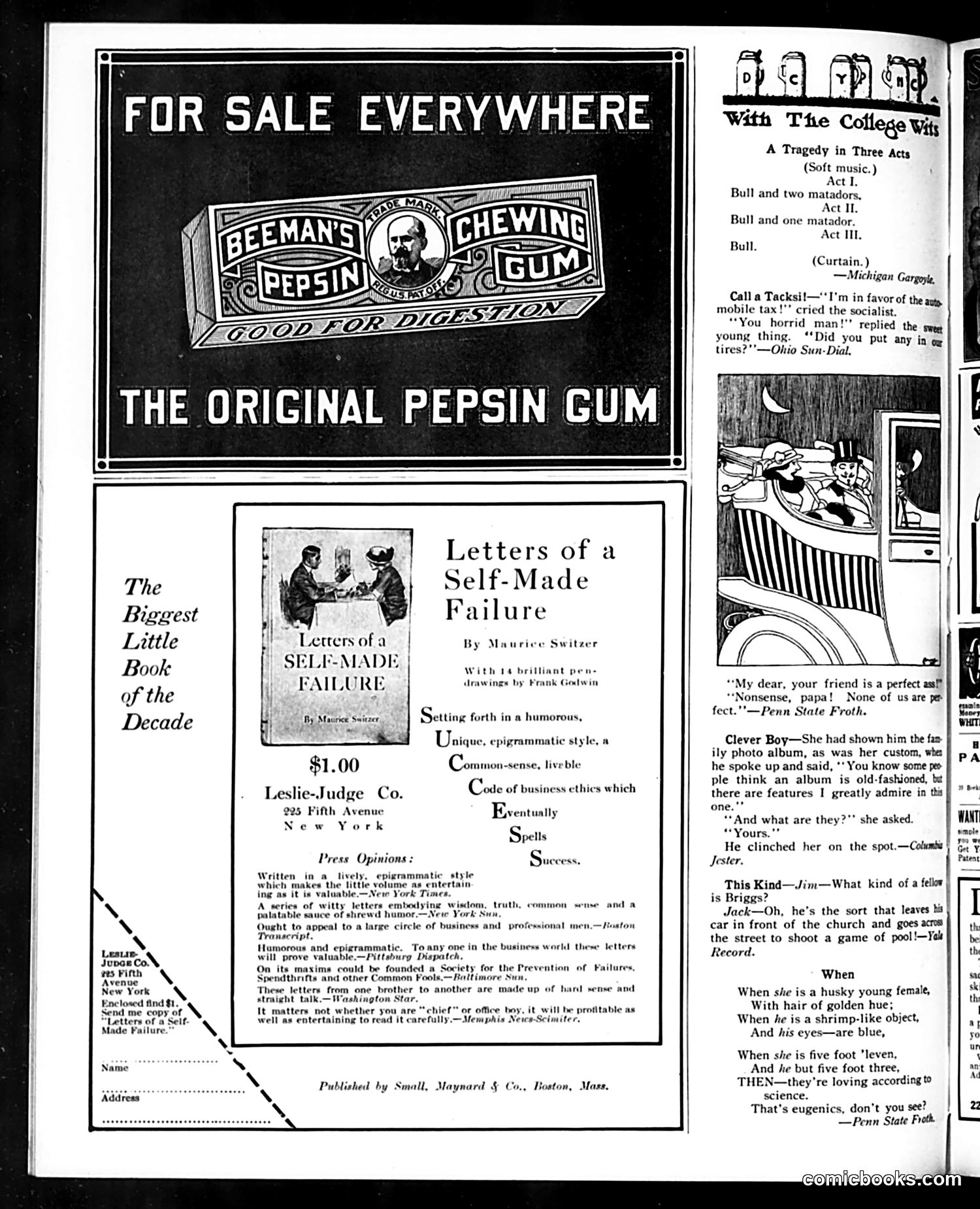
This page is primarily **advertising and miscellaneous content** rather than political cartoons requiring historical context. The main advertisement promotes "Letters of a Self-Made Failure" by Maurice Switzer—a humorous business ethics book marketed to professionals. The satirical premise is transparent: the book humorously mocks business failures through witty letters, apparently appealing to early 20th-century readers interested in business self-improvement literature. The right side contains **short humorous sketches and jokes** typical of Judge magazine's lighter fare: - A three-act "tragedy" reducing a bullfight to its logical conclusion (absurdist humor) - A socialist's hypocrisy about automobile taxes - Flirtation scenarios and romantic comedies These jokes rely on contemporary social assumptions—socialism as a fashionable position, gender dynamics in courtship, and eugenic theory (referenced in the final joke about height differences in couples). The humor is genteel, domestic, and apolitical—aimed at middle-class readers rather than commentary on major events or figures.
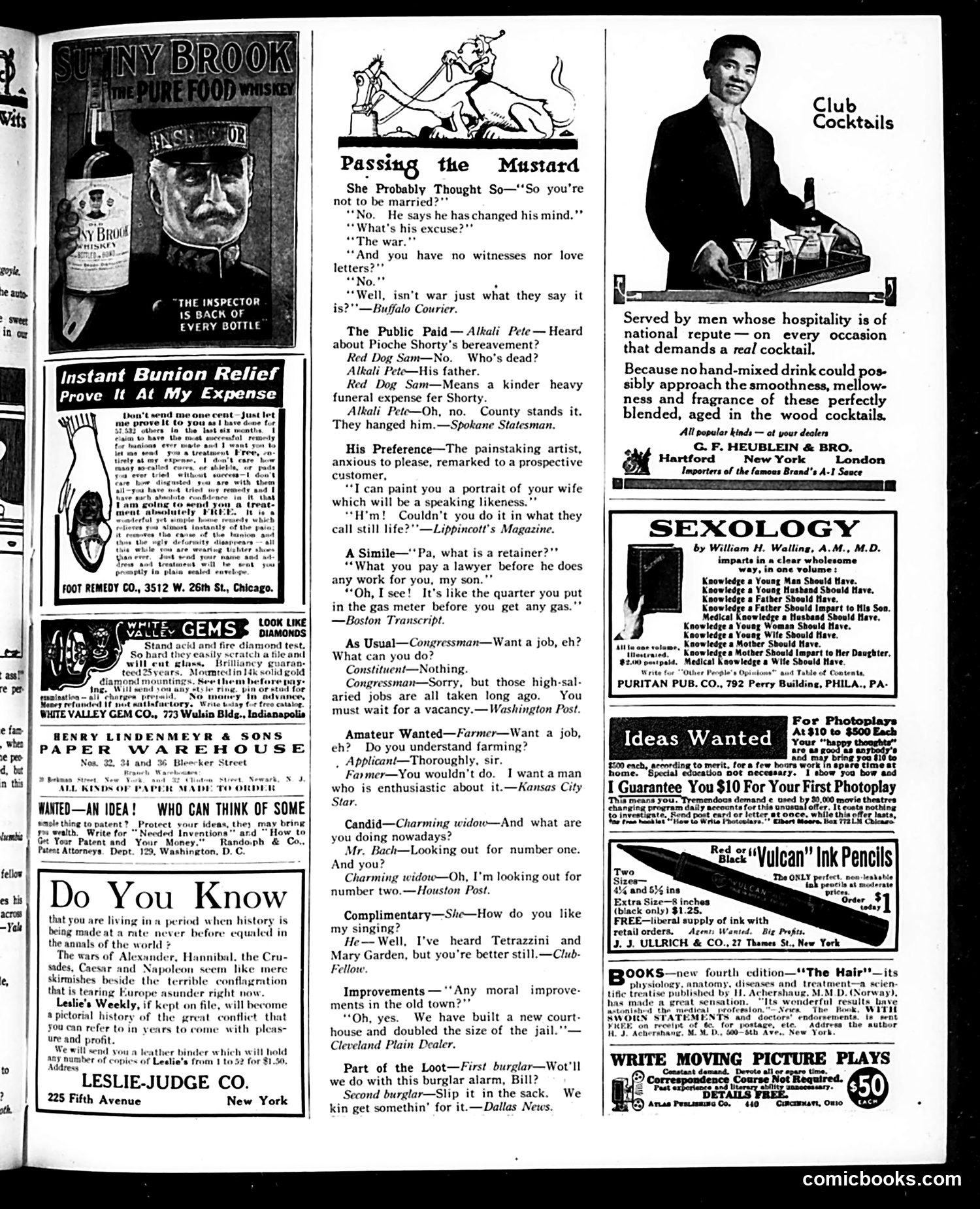
This page is primarily **advertisements and humor fillers** from Judge magazine, with no significant political cartoons or social satire of evident historical importance. The humor pieces are short, conversational jokes typical of early-20th-century American wit: - **"Passing the Mustard"**: A woman cynically dismisses a broken engagement because the man blamed "the war" (likely WWI), questioning if war is a legitimate excuse - **"The Public Paid"**: Gallows humor about a hanging treated as a county expense rather than tragedy - **Congressional job seeker**: Satirizes politician indifference to qualifications The advertisements include patent services, a sexology book, cocktail promotions (Heublein brand), photography contests, and ink pencils—typical commercial content. The **"Do You Know"** section suggests readers subscribe to Leslie's Weekly for historical documentation of current world events, emphasizing wartime relevance. The page reflects American society during or shortly after WWI, when war references permeate even casual humor.
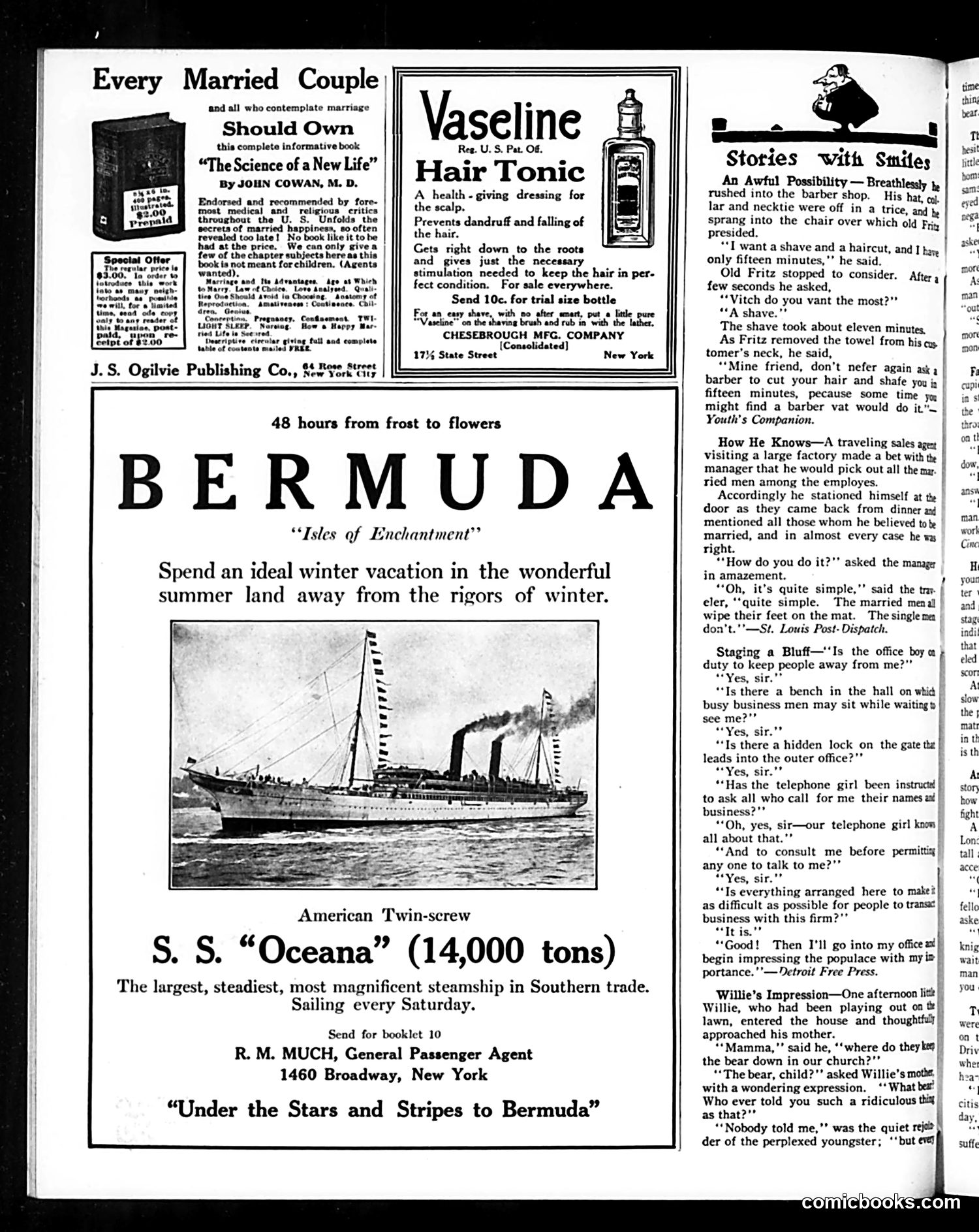
This page is primarily **advertising with comedic interludes**, not political satire. The major advertisements promote: 1. **"The Science of a New Life"** — a marriage/sexuality instructional book marketed to couples 2. **Vaseline Hair Tonic** — a grooming product 3. **Bermuda cruise** on the S.S. "Oceana" steamship The right column contains three **humorous short stories**: - A barber anecdote about time management - A traveling salesman's trick for identifying married men (they wipe their feet on doormats, unmarried men don't) - A comic dialogue about an office boy's duties creating barriers to access - An incomplete story about "Willie's Impression" These are **mild workplace and domestic humor pieces**, typical of early 20th-century Judge magazine—observational comedy rather than political commentary. The page reflects period attitudes about marriage, gender roles, and office etiquette without targeting specific figures or events.
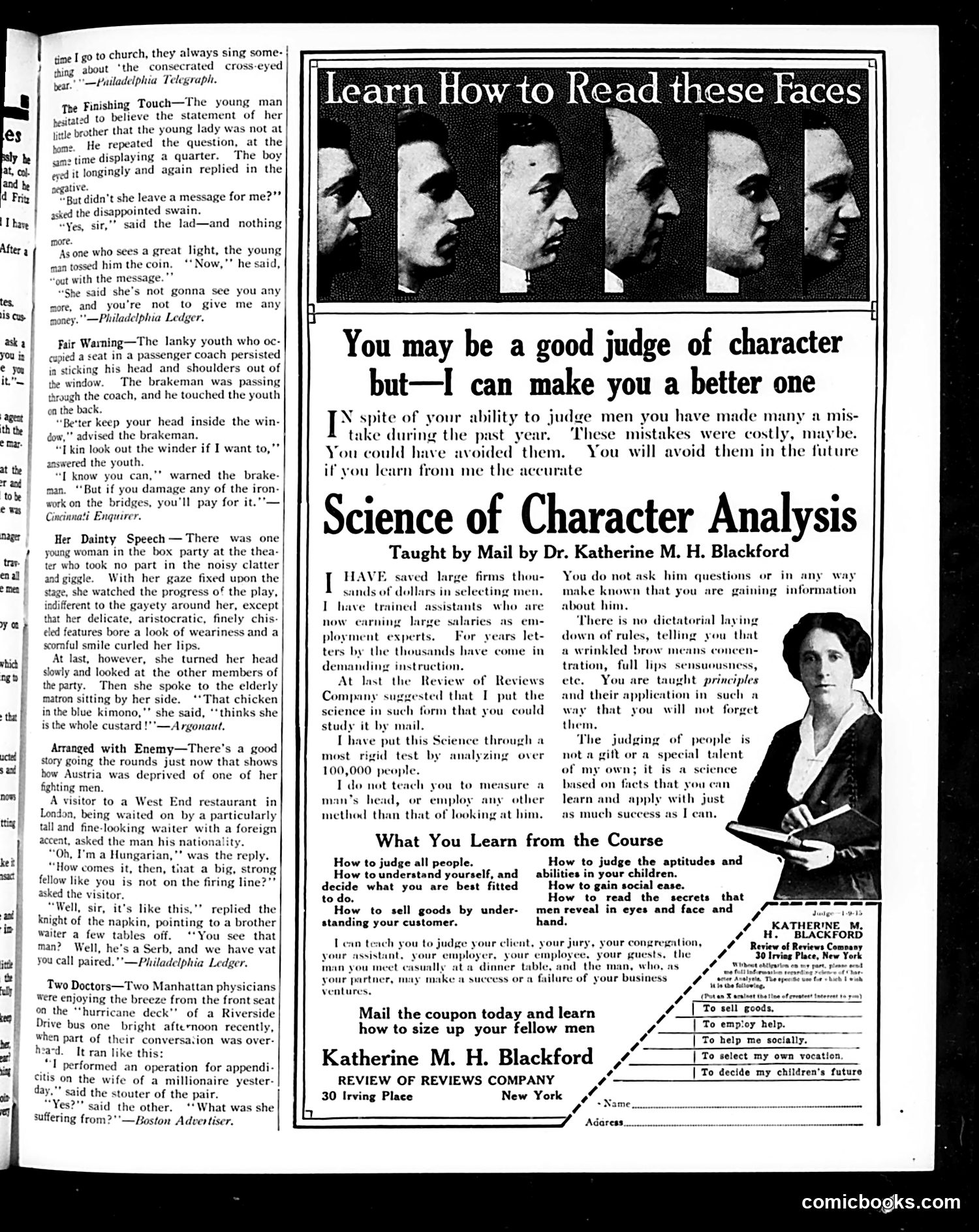
This page from *Judge* magazine combines short humorous anecdotes on the left with a full-page advertisement on the right. **The Anecdotes (Left Side):** These are brief satirical stories typical of early 20th-century humor magazines—jokes about miscommunication, physical comedy, and character types. They include: a boy messenger demanding payment for delivering a message, a lanky passenger threatening damage to train infrastructure, a snobbish woman at the theater, an Austrian-Hungarian waiter's excuse for not fighting in World War I, and two doctors discussing a millionaire's wife's appendectomy. **The Advertisement (Right Side):** This is a mail-order course in "Science of Character Analysis" taught by Dr. Katherine M. H. Blackford. The ad promises to teach readers to judge people's character through physiognomy (reading faces), claiming this skill will improve business decisions, sales, parenting, and personal relationships. The course emphasizes learning to read "secrets that are revealed in face and hand." This reflects early-20th-century pseudoscientific interest in character reading and phrenology—now discredited methods based on facial features.
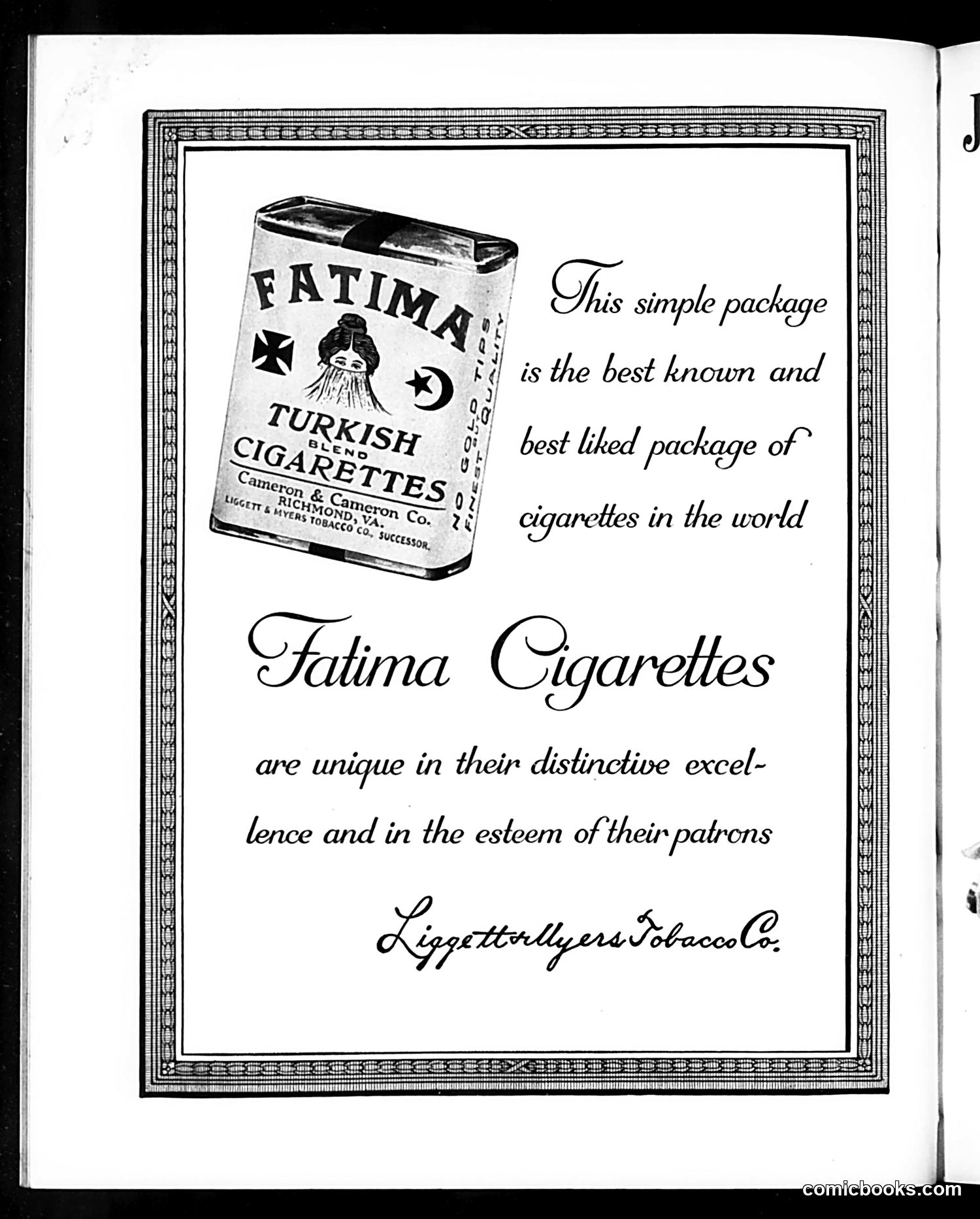
This page is primarily a **cigarette advertisement**, not satire or political commentary. It promotes Fatima Turkish Blend Cigarettes, manufactured by Cameron & Cameron (Richmond, VA), successor to Liggett & Myers Tobacco Co. The ad claims Fatima's "simple package" is "the best known and best liked package of cigarettes in the world" and praises the brand's "distinctive excellence" and patron loyalty. The package features a crescent moon and cross symbol, emphasizing the "Turkish" branding popular in early 20th-century cigarette marketing. There is no apparent satire here—this is straightforward vintage advertising, likely from Judge magazine's commercial pages rather than its editorial/humorous content.