
Judge, 1915-01-09 · page 6 of 24
Judge — January 9, 1915 — page 6: what you’re looking at
What you’re looking at
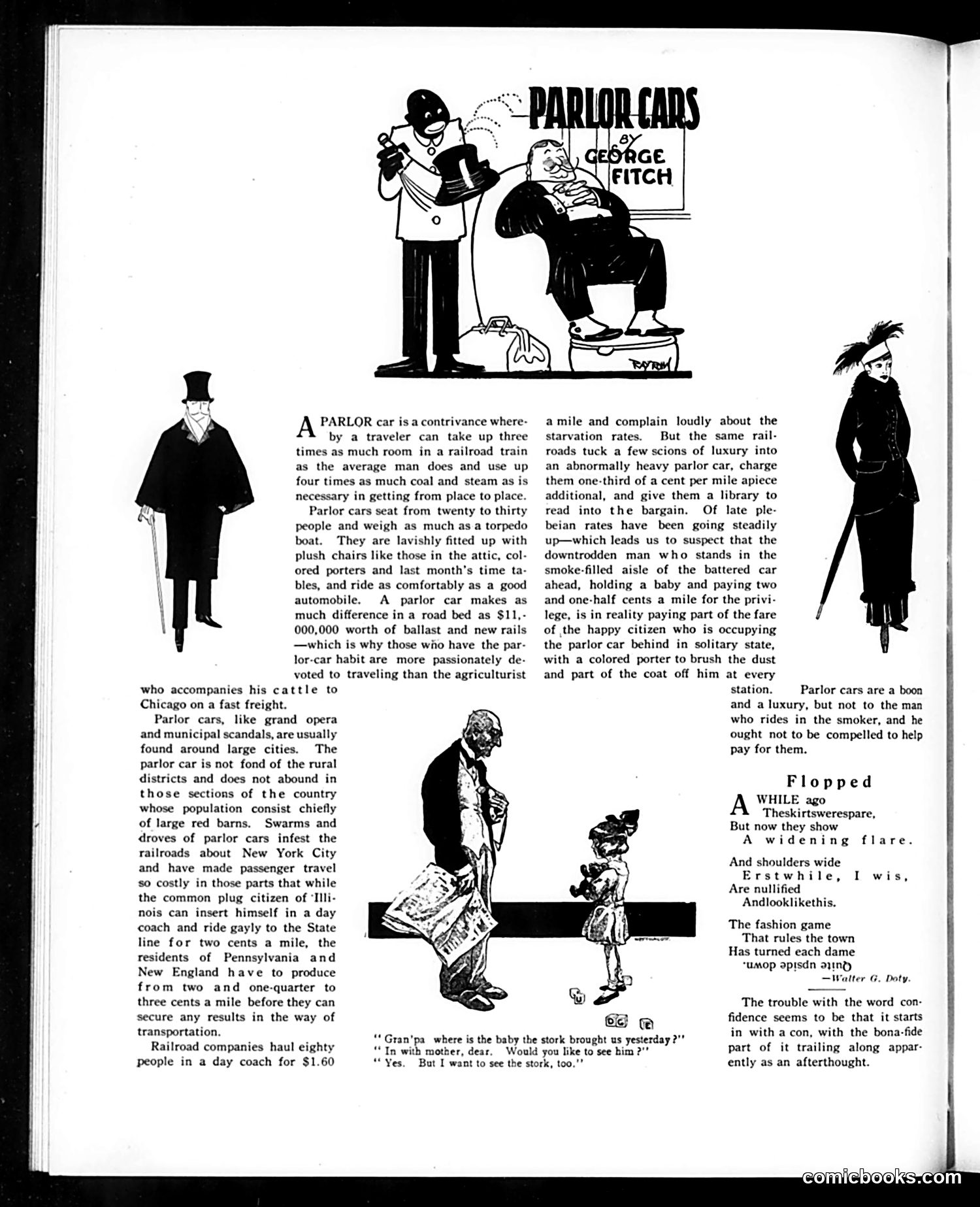
This article by George Fitch satirizes the parlor car system as an unjust luxury that shifts costs to ordinary passengers. The central complaint: parlor cars are expensive, heavy conveyances that use disproportionate resources (coal, steam, track wear) but charge first-class passengers only marginally more than standard-fare riders—forcing working-class commuters to subsidize the wealthy's comfort. Fitch notes the geographical disparity: while an Illinois laborer pays two cents per mile in a day coach, Pennsylvania and New England residents pay 2.25-3 cents because parlor cars concentrate on lucrative urban routes, inflating overall rail costs. The comic strips show genteel passengers contrasting with working-class struggling families, emphasizing the wealth divide. The satire targets railroad companies' pricing scheme as fundamentally unfair—ordinary people shouldn't subsidize luxury travel for the elite.
📄 Transcribed text from this page (OCR, searchable)
Machine-transcribed from the original scan — historical spelling and the odd misread are preserved.
PARLOR car is a contrivance where- by a traveler can take up three times as much room in a railroad train as the average man does and use up four times as much coal and steam as is necessary in getting from place to place. Parlor cars seat from twenty to thirty people and weigh as much as a torpedo boat. They are lavishly fitted up with plush chairs like those in the attic, col- ored porters and last month's time ta- bles, and ride as comfortably as a good automobile. A parlor car makes as much difference in a road bed as $11,- 000,000 worth of ballast and new rails —which is why those who have the par- lor-car habit are more passionately de- voted to traveling than the agriculturist amile and complain loudly about the starvation rates. But the same rail- roads tuck a few scions of luxury into an abnormally heavy parlor car, charge them one-third of a cent per mile apiece additional, and give them a library to read into the bargain. Of late ple- beian rates have been going steadily up—which leads us to suspect that the downtrodden man who stands in the smoke-filled aisle of the battered car ahead, holding a baby and paying two and one-half cents a mile for the privi- lege, is in reality paying part of the fare and part of the coat off him at e who accompanies his cattle to Chicago on a fast freight. Parlor cars, like grand opera and municipal scandals, are usually found around large cities. The parlor car is not fond of the rural districts and does not abound in those sections of the country whose population consist chiefly of large red barns. Swarms and droves of parlor cars infest the railroads about New York City and have made passenger travel ‘so costly in those parts that while the common plug citizen of ‘Illi- nois can insert himself in a day coach and ride gayly to the State line for two cents a mile, the residents of Pennsylvania and New England have to produce from two and one-quarter to three cents a mile before they can secure any results in the way of transportation. Railroad companies haul eighty people in a day coach for $1.60 ** Yes. ‘*Gran'pa where is the baby the stork brought us yesterday ?”" “In with mother, dear. Would you like to see him ?"’ But I want to see the stork, too,'" \ of the happy citizen who is occupying the parlor car behind in solitary state, with a colored porter to brush the dust Parlor cars are a boon and a luxury, but not to the man station. who rides in the smoker, and he ought not to be compelled to help pay for them. Flopped WHILE ago Theskirtswerespare, But now they show A widening flare. And shoulders wide Erstwhile, I wis, Are nullified Andlooklikethis. The fashion game That rules the town Has turned each dame sumop apisdn ayingy —Walter G. Doty. The trouble with the word con- fidence seems to be that it starts in with acon, with the bona-fide part of it trailing along appar- ently as an afterthought.