
Judge, 1915-01-09 · page 12 of 24
Judge — January 9, 1915 — page 12: what you’re looking at
What you’re looking at
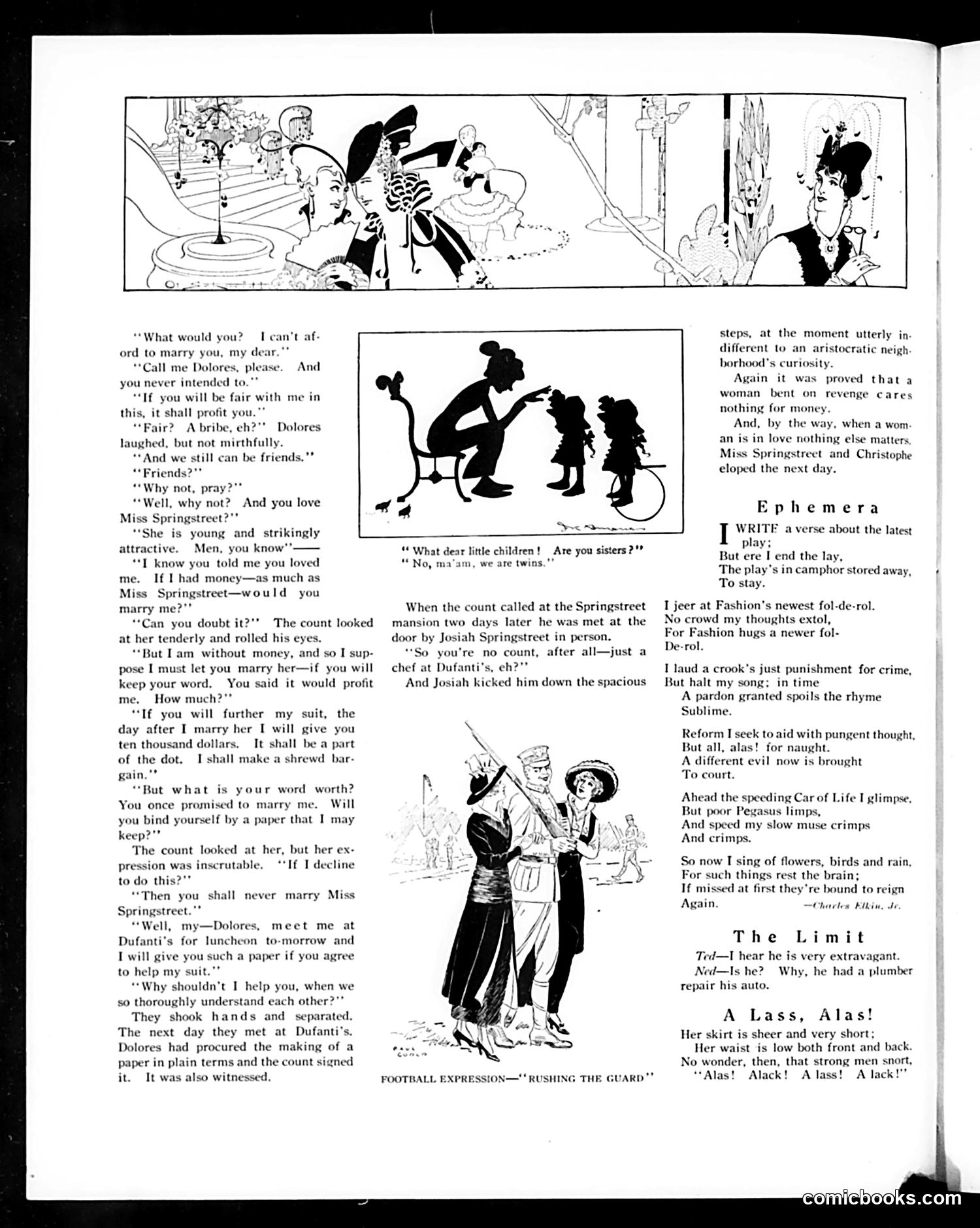
This page presents a serialized story about social climbing and romantic deception in the upper class. A European count, lacking money, attempts to marry the wealthy Miss Springstreet. He bribes her rival, Dolores, to help by promising her ten thousand dollars and a signed contract—essentially purchasing her assistance. The satire targets the mercenary nature of aristocratic marriages and class pretension. The punchline reveals the "count" is actually a chef at Dufanti's restaurant—his false nobility is exposed when confronted by Miss Springstreet's father, Josiah, who literally kicks him down the steps. The joke undercuts European aristocratic pretense: American self-made men like Springstreet dismiss fake titles. The story also mocks Dolores's miscalculation: seeking revenge through financial transaction, she loses everything when Miss Springstreet elopes with someone else instead. The page's remaining content—brief poems and witticisms about fashion and morality—are typical Judge filler pieces offering social commentary on contemporary foibles.
📄 Transcribed text from this page (OCR, searchable)
Machine-transcribed from the original scan — historical spelling and the odd misread are preserved.
“What would you? — [can’t af- ord to marry you, my dear."* “Call me Dolores, please: you never intended to.” “If you will be fair with me in this, it shall profit you. “Fair? A bribe, eh? Dolores laughed, but not mirthfully. “And we still can be friend: “Friends?” “Why not, pray?’ “Well, why not? Miss Springstreet?"’ “She is young and strikingly And And you love <2 attractive. Men, you know “I know you told me you loved me. If I had money—as much as Miss Springstreet—would you marry me?"’ “Can you doubt it?’’ The count looked at her tenderly and rolled his eyes. **But Lam without money, and so I sup- pose I must let you marry her—if you will keep your word, You said it would profit me. How much?" “T€ you will further my suit, the day after I marry her I will give you ten thousand dollars. It shall be a part of the dot. I shall make gain.” “But what is your word worth? You once promised to marry me. Will you bind yourself by a paper that I may keep?” The count looked at her, but her ex- “If [decline shrewd bar- pression was inscrutable. to do this?"* “Then you shall never marry Miss Springstreet.”" “Well, my—Dolores, meet me at Dufanti’s for luncheon to-morrow and I will give you such a paper if you agree to help my suit.”’ **Why shouldn't I help you, when we so thoroughly understand each other?”’ They shook hands and _ separated. The next day they met at Dufanti’s. Dolores had procured the making of a paper in plain terms and the count signed it. It was also witnessed. “What dear little children! Are you sisters ?"” “No, ma'am, we are twins,” When the count called at the Springstreet mansion two days later he was met at the door by Josiah Springstreet in person. © you're no count, after all—just a chef at Dufanti’s, eh?" And Josiah kicked him down the spacious steps, at the moment utterly in- different to an aristocratic neigh- borhood's curiosity. Again it was proved that a woman bent on revenge nothing for money. And, by the way, when a wom an is in love nothing else matters. Miss Springstreet and Christophe eloped the next day. cares Ephemera WRITE a verse about the latest ple But ere I end the lay, The play's in camphor stored away, To sta} : I jeer at Fashion's newest fol-de-rol. No crowd my thoughts extol, For Fashion hugs a newer fol- De-rol. I laud a crook’s just punishment for crime, But halt my song; in time A pardon granted spoils the rhyme Sublime. Reform I seek to aid with pungent thought, But all, alas! for naught. A different evil now is brought To court. Ahead the speeding Car of Life I glimpse, But poor Pegasus limps, And speed my slow muse crimps And crimps. So now I sing of flowers, birds and rain, For such things rest the brain; If missed at first they're bound to reign Again. Charles Rhian, de The Limit Ted—I hear he is very extravaga Ned—Is he? Why, he had a plumber repair his auto. A Lass, Alas! Her skirt is sheer and very short; Her waist is low both front and back. No wonder, then, that strong men snort, ‘Alas! Alack! A lass! A lack!"