
Judge, 1915-01-09 · page 13 of 24
Judge — January 9, 1915 — page 13: what you’re looking at
What you’re looking at
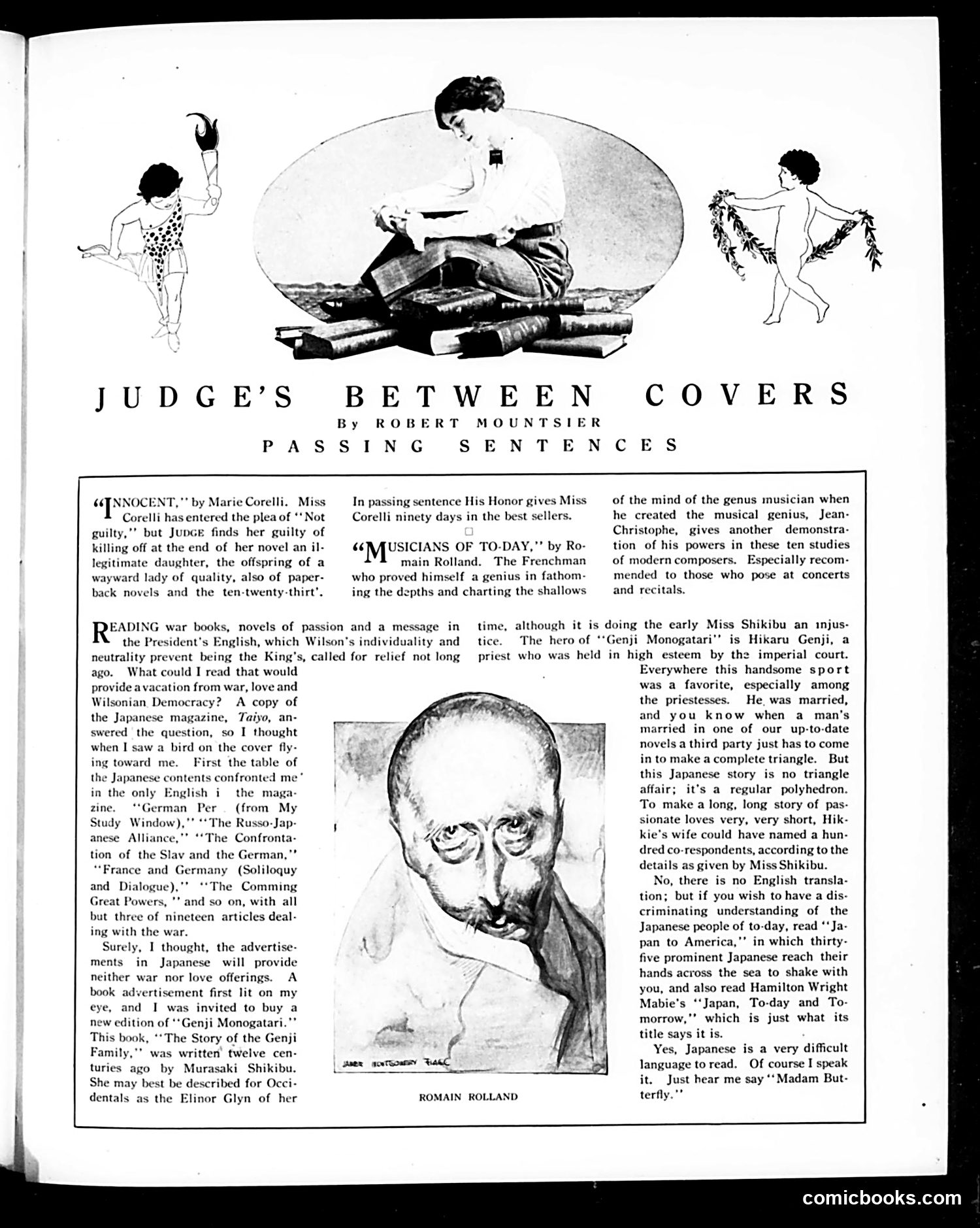
This is a book-review column by Robert Mountsier titled "Judge's Between Covers: Passing Sentences," using court imagery as metaphor. The "judge" verdict concerns recent publications. The satire mocks sentimental novelist **Marie Corelli** for killing off an illegitimate daughter in her plot—the reviewer humorously "convicts" her of this narrative crime. French composer **Romain Rolland** (whose portrait appears) receives praise for his musical studies. The main joke targets the reviewer's attempt to escape WWI and "Wilsonian Democracy" by reading a Japanese magazine (*Taiyo*), only to discover it contains the ancient novel *Genji Monogatari*—which features not a love triangle but a "polyhedron" of affairs. The reviewer sarcastically notes the Japanese story is more complex than modern Western romance fiction. The satire mocks both American literary pretension and the era's fascination with "exotic" Japanese culture as respite from contemporary war and politics.
📄 Transcribed text from this page (OCR, searchable)
Machine-transcribed from the original scan — historical spelling and the odd misread are preserved.
JUDGE’S BETWEEN COVERS By ROBERT MOUNTSIER PASSING SENTENCES NOCENT,"" by Marie Corelli. Miss In passing sentence His Honor gives Miss of the mind of the genus musician when Corelli has entered the plea of ‘* Not Corelli ninety days in the best sellers. he created the musical genius, Jean- guilty,’’ but JupGe finds her guilty of Christophe, gives another demonstra- killing off at the end of her novel an il- “ USICIANS OF TO-DAY,"’ by Ro- tion of his powers in these ten studies t legitimate daughter, the offspring of a main Rolland. The Frenchman of modern composers. Especially recom- wayward lady of quality, also of paper- who proved himself a genius in fathom- mended to those who pose at concerts back novels and the ten-twenty-thirt’, ing the depths and charting the shallows and recitals. READING war books, novels of passion and a message in time, although it is doing the early Miss Shikibu an injus- the President's English, which Wilson’s individuality and tice. The hero of ‘*Genji Monogatari"’ is Hikaru Genji, a neutrality prevent being the King’s, called for relief not long priest who was held in high esteem by the imperial court. ago. What could I read that would Everywhere this handsome sport provide a vacation from war, love and was a favorite, especially among Wilsonian Democracy? A copy of the priestesses. He, was married, the Japanese magazine, Taiyo, an- and you know when a man’s swered the question, so I thought married in one of our up-to-date when I saw a bird on the cover fly- novels a third party just has to come ing toward me. First the table of in to make a complete triangle. But the Japanese contents confronted me* this Japanese story is no triangle in the only English i the maga- affair; it's a regular polyhedron. zine. ‘‘German Per (from My To make a long, long story of pa Study Window),"* ‘‘ The Russo-Jap- ? sionate loves very, very short, Hik- anese Alliance," ‘‘The Confronta- Xk kie’s wife could have named a hun- , — dred co-respondents, according to the 4 details as given by Miss Shikibu. No, there is no English transla- tion; but if you wish to have a dis- criminating understanding of the Japanese people of to-day, read ‘Ja- tion of the Slav and the German, “France and Germany (Soliloquy and Dialogue he Comming Great Powers, "' and so on, with all but three of nineteen articles deal- ing with the w Surely, I thought, the advertise- ments in Japanese will provide neither war nor love offerings. A book advertisement first lit on my eye, and I wi invited to buy new edition of ‘‘Genji Monogatari This book, ‘‘The Story of the Genji Family,’ was written’ twelve cen- ies ago by Murasaki Shikibu. y best be described for Occi- Elinor Glyn of her f pace gorTuouney Wael bf ROMAIN ROLLAND pan to America,"’ in which thirty- five prominent Japanese reach their hands across the sea to shake with you, and also read Hamilton Wright Mabie’s ‘‘Japan, To-day and To- morrow,’’ which is just what its title says it is. Yes, Japanese is a very difficult language to read. Of course I speak it. Just hear me say ‘Madam But- terfly."” comicbooks.com