
A complete issue · 24 pages · 1914
Judge — December 19, 1914
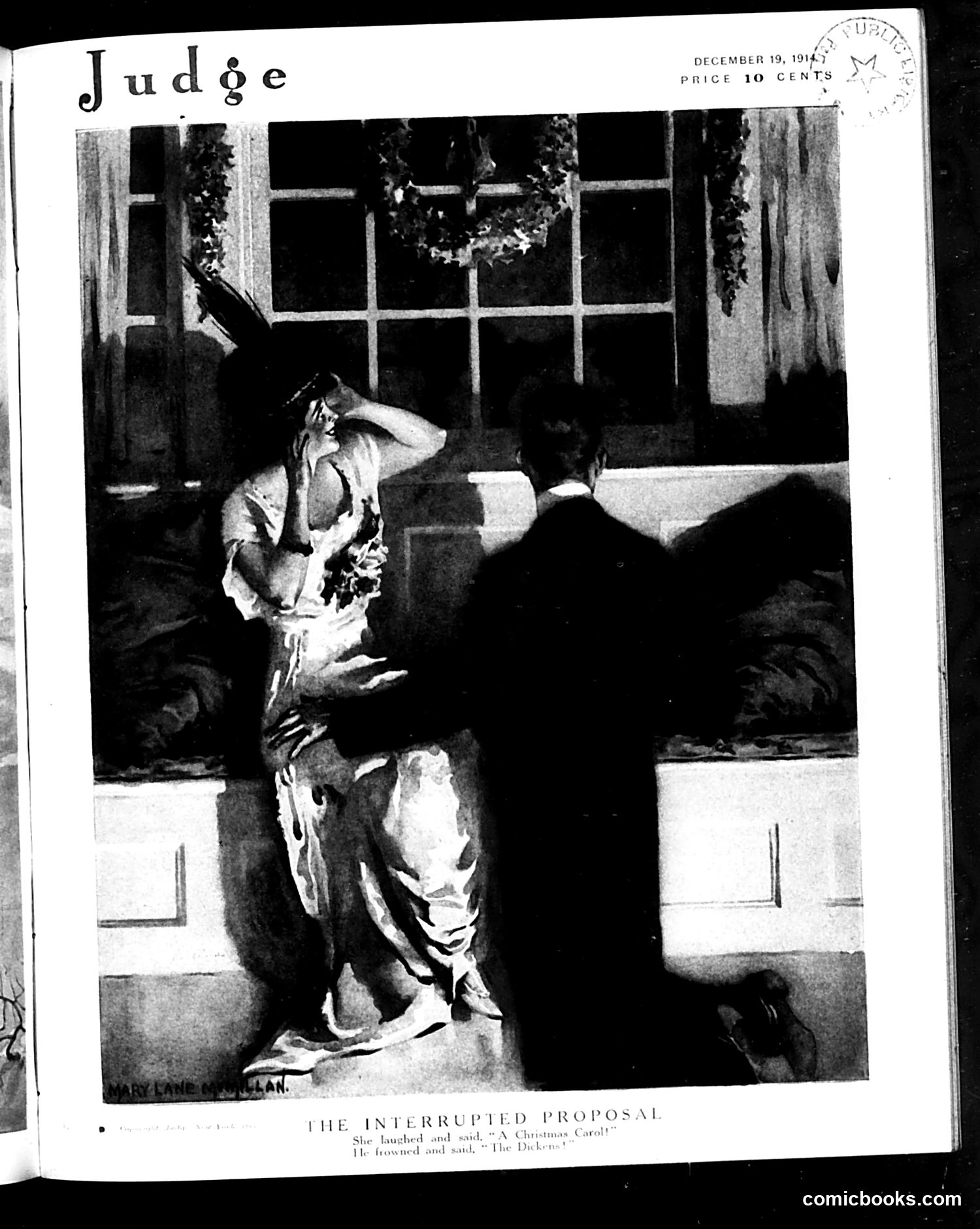
This December 1918 *Judge* cartoon depicts a romantic scene interrupted by holiday caroling. A couple is shown in an intimate moment—the man appears to be proposing (she has her hand to her head in surprise or emotion), while a man outside the window sings Christmas carols, calling out "A Christmas Carol!" The humor relies on the contrast between the private romantic moment and the intrusion of public festive tradition. The caption quotes Dickens ("The Dickens!"), making a pun on the character's exclamation with the famous author's name. This plays on the tension between sentimental holiday customs and personal, intimate moments—a genteel comedy of manners typical of *Judge*'s satirical approach to middle-class domestic life.
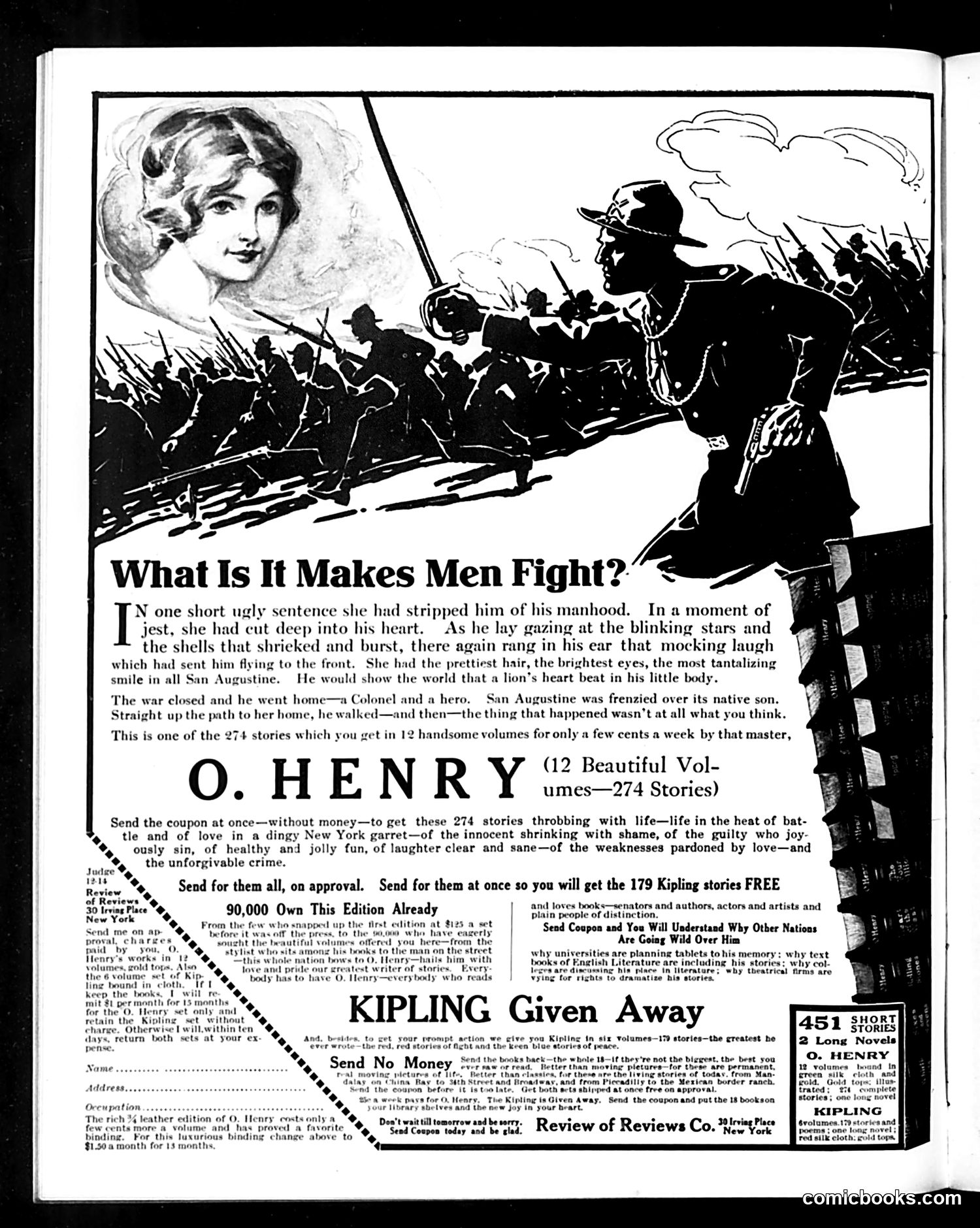
This page is primarily an **advertisement for O. Henry's collected stories**, not a political cartoon. The ad features an illustration of a woman's face and a military officer addressing troops, accompanying a story excerpt titled "What Is It Makes Men Fight?" The narrative describes a woman who mocked a soldier's patriotism, wounding his pride so deeply that he went to war to prove his manhood. He returns a "Colonel and a hero," vindicating himself. **The satire's point**: The ad uses this story to suggest that female mockery and wounded masculine pride are motivators for military service—a commentary on gender dynamics and patriotic fervor, possibly critiquing how women's disapproval pressures men into warfare. The ad promotes 274 O. Henry stories available in 12 volumes, offering Rudyard Kipling stories free as an incentive.
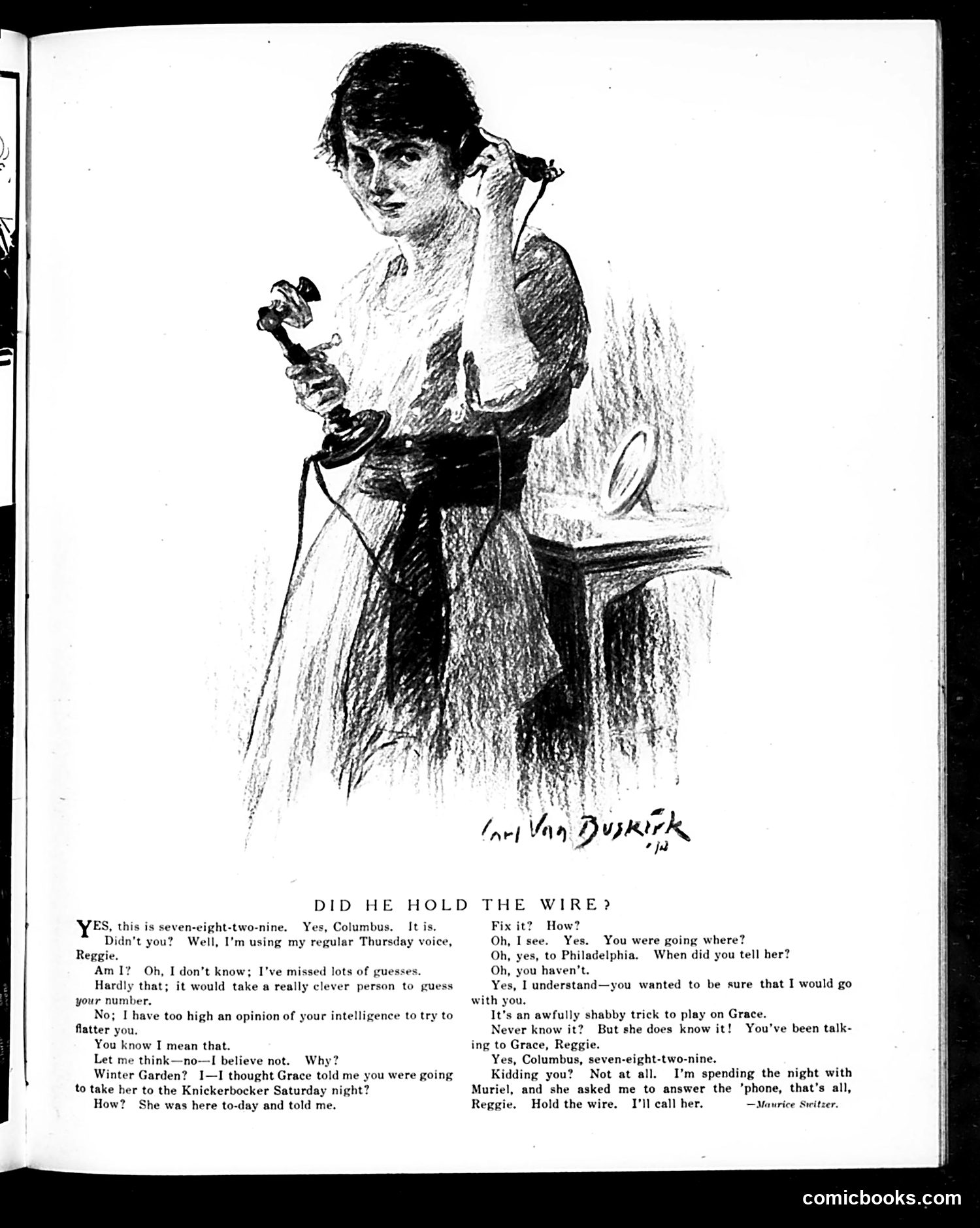
This page features a sketch by Carl von Duskirk depicting a woman on a telephone, accompanied by dialogue about a social engagement. The conversation reveals a domestic comedy: a man (apparently named Reggie) claims he's going to Philadelphia with someone named Muriel but is actually spending the evening with Muriel elsewhere. When confronted about telling his companion "Grace" of his plans, he admits to a deception—asking a friend to "hold the wire" (stay on the phone) while he fabricates his alibi. The humor targets early 20th-century courtship deceptions and the new technology of telephones enabling such schemes. It satirizes both male duplicity in romantic situations and the awkwardness created by this modern communication device, which makes lies harder to maintain convincingly.
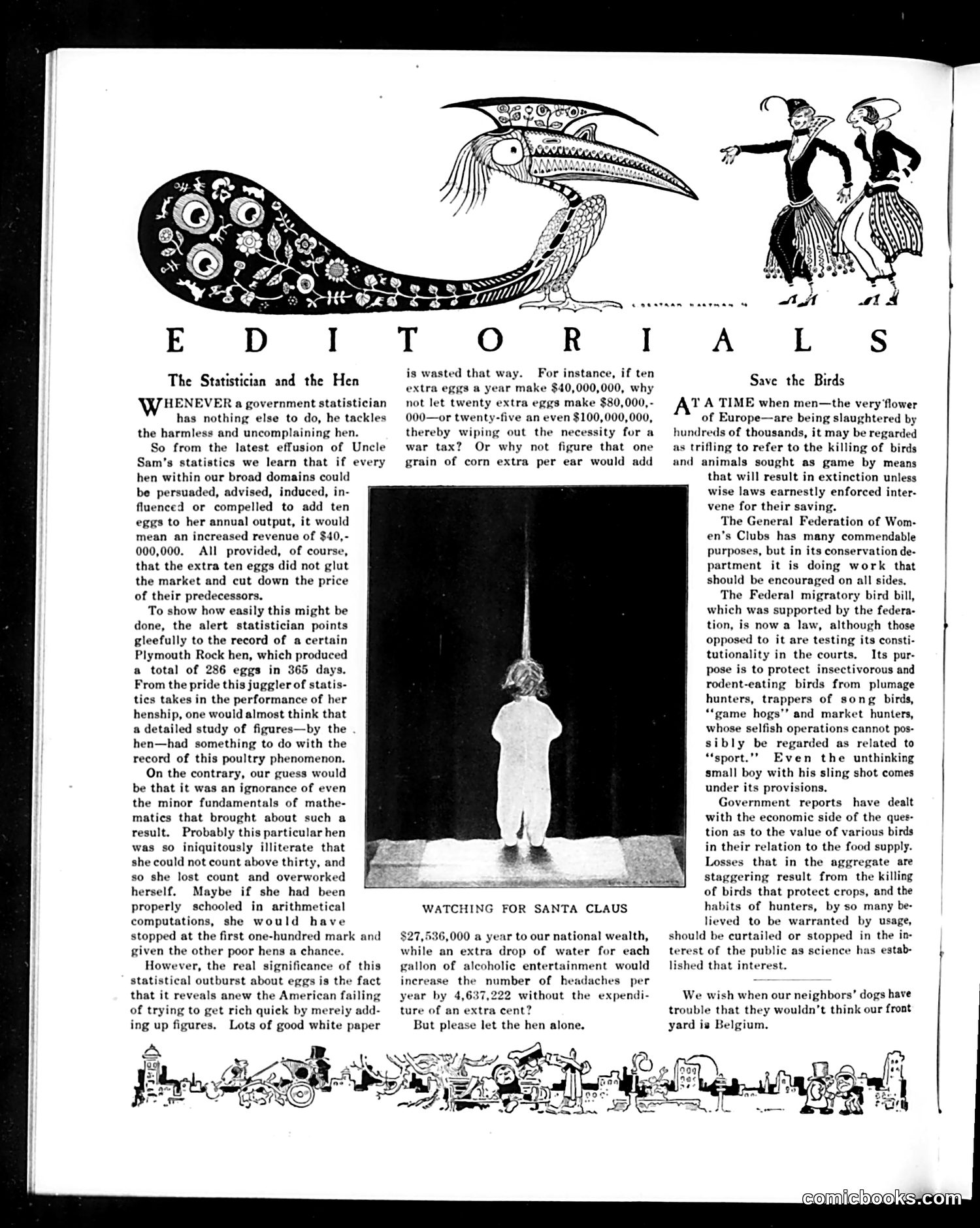
This page contains two unrelated editorial pieces: **"The Statistician and the Hen"** satirizes government statisticians who waste resources on trivial calculations. The editorial argues that compelling hens to produce extra eggs would increase national wealth by $40 million annually—yet such impractical schemes reveal how statisticians obsess over minor economic data rather than addressing real policy questions. The satirist suggests statisticians lack basic common sense. **"Save the Birds"** advocates for protecting migratory birds from hunters and trappers. It references the Federal Migratory Bird Bill (now law), which faced court challenges from those opposing it. The editorial argues that bird conservation serves the public interest as established science, despite economic arguments from hunters and others opposing the law. Both pieces critique flawed reasoning in policy debates.
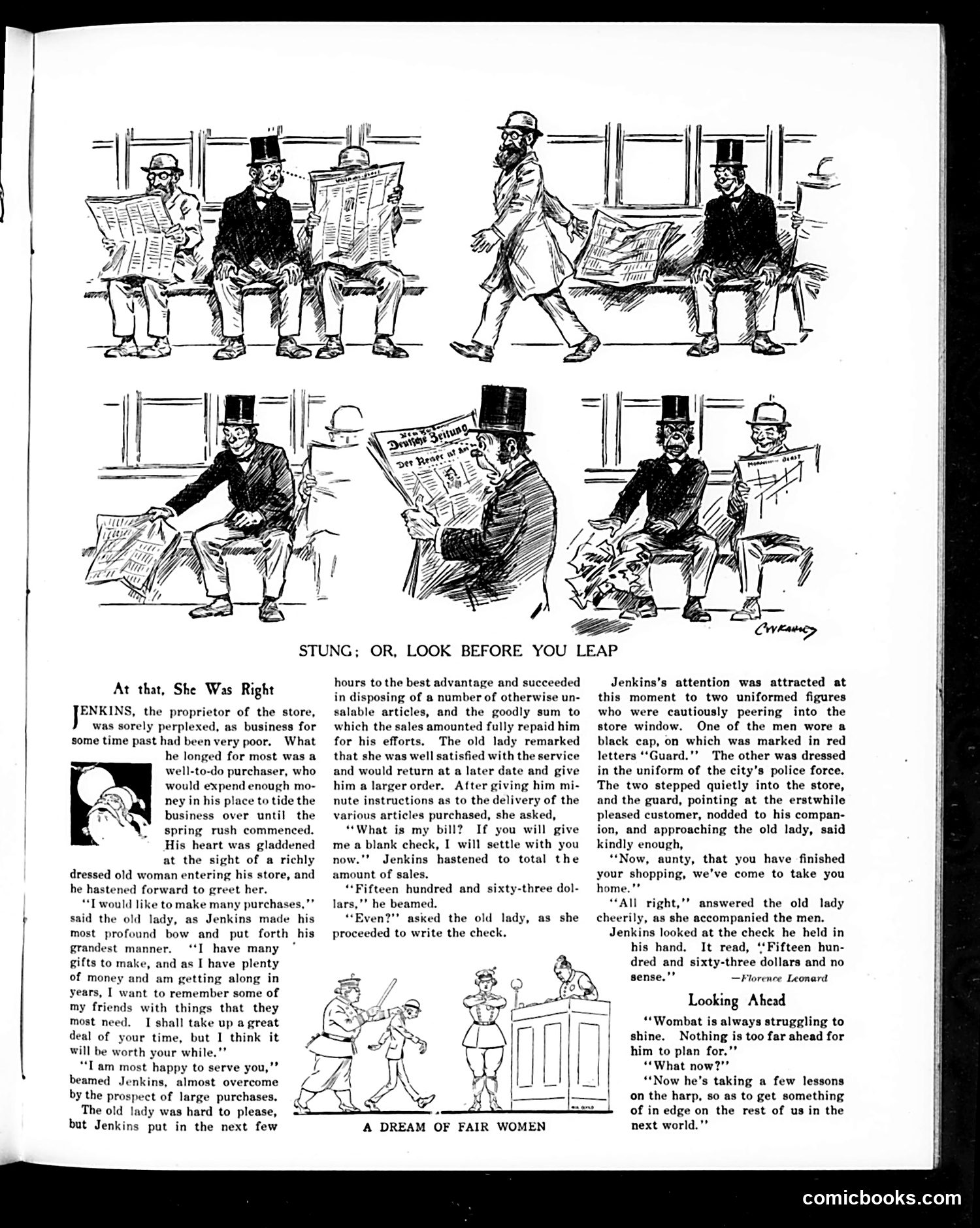
The page contains two satirical elements: **Top section ("Stung; Or, Look Before You Leap"):** A four-panel comic strip showing men on public transit reading newspapers. The humor appears to satirize how newspaper readers become absorbed in their reading, unaware of their surroundings or fellow passengers—one man is so engrossed he fails to notice others beside him. **Bottom section ("At that, She Was Right"):** A story about Mr. Jenkins, a store proprietor, who is pleasantly surprised when an elderly woman makes a large purchase ($153.63). The satire likely mocks assumptions about customers based on appearance—the poorly-dressed old lady proves a valuable client, contradicting Jenkins's initial dismissal of her. The accompanying illustration "A Dream of Fair Women" appears unrelated decorative content. The page demonstrates Judge's focus on everyday social observations and class-based humor typical of early 20th-century American satire.
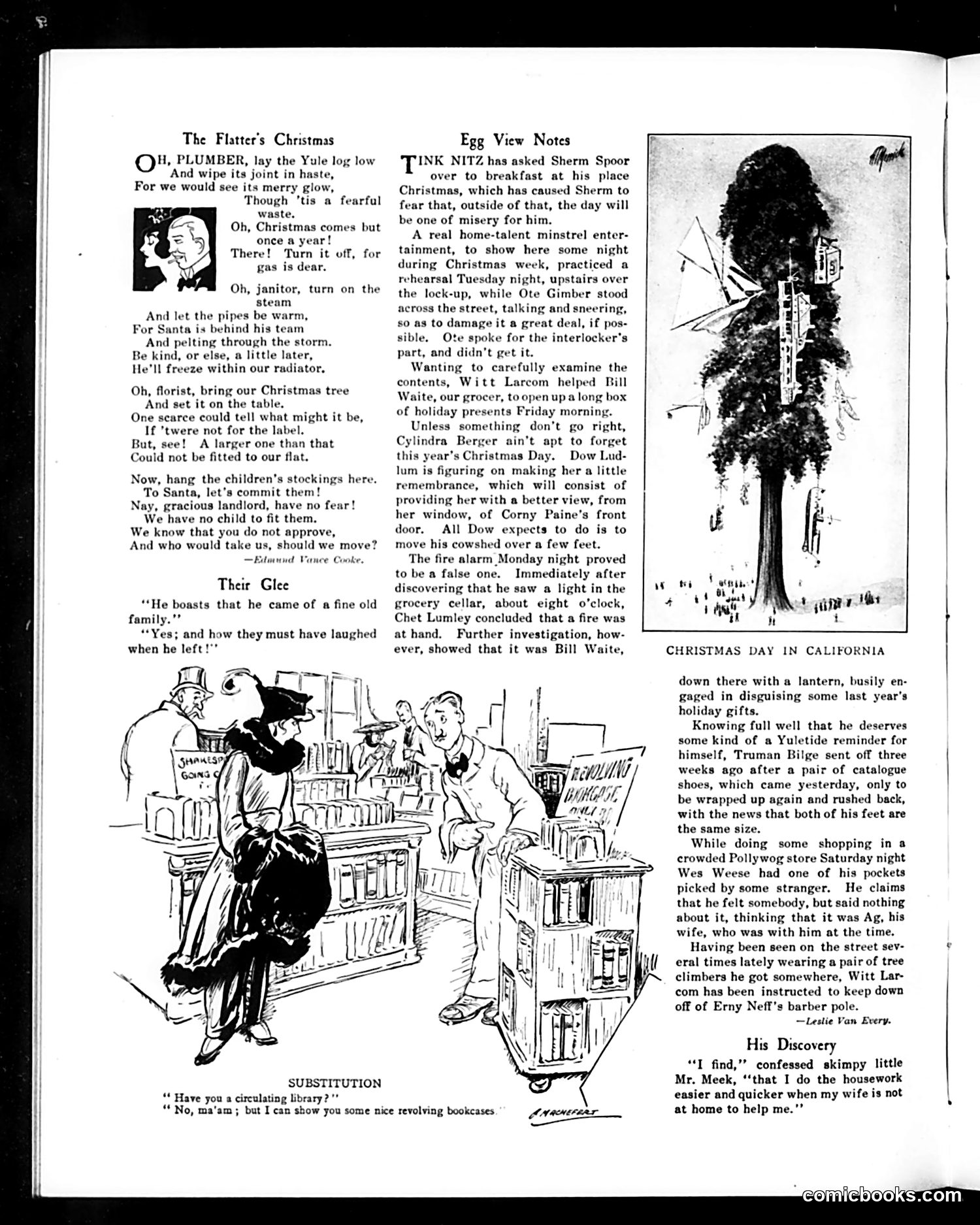
This page contains Christmas-themed humor mixing satirical poetry with small-town gossip columns. **"The Flatter's Christmas"** is a satirical poem mocking landlords' penny-pinching during the holiday season. It addresses various building workers (plumber, janitor, florist) with ironic instructions to provide comfort while the landlord complains about costs—the joke being that stingy landlords grudgingly maintain minimal heat and amenities during Christmas. **"Their Glee"** is a brief joke about social climbing: someone boasts of coming from "a fine old family," implying others laughed when he left—suggesting he was an embarrassment to that family. **"Egg View Notes"** and **"His Discovery"** are small-town gossip columns with light humor about local characters and domestic situations, typical of Judge's rural American satire. **The "Substitution" cartoon** shows a librarian's substitute offer—lacking a real circulating library, she offers "revolving bookcases" as a literal substitute, a pun on "revolving." The page reflects early 20th-century American magazine humor: class tensions, domestic comedy, and wordplay.
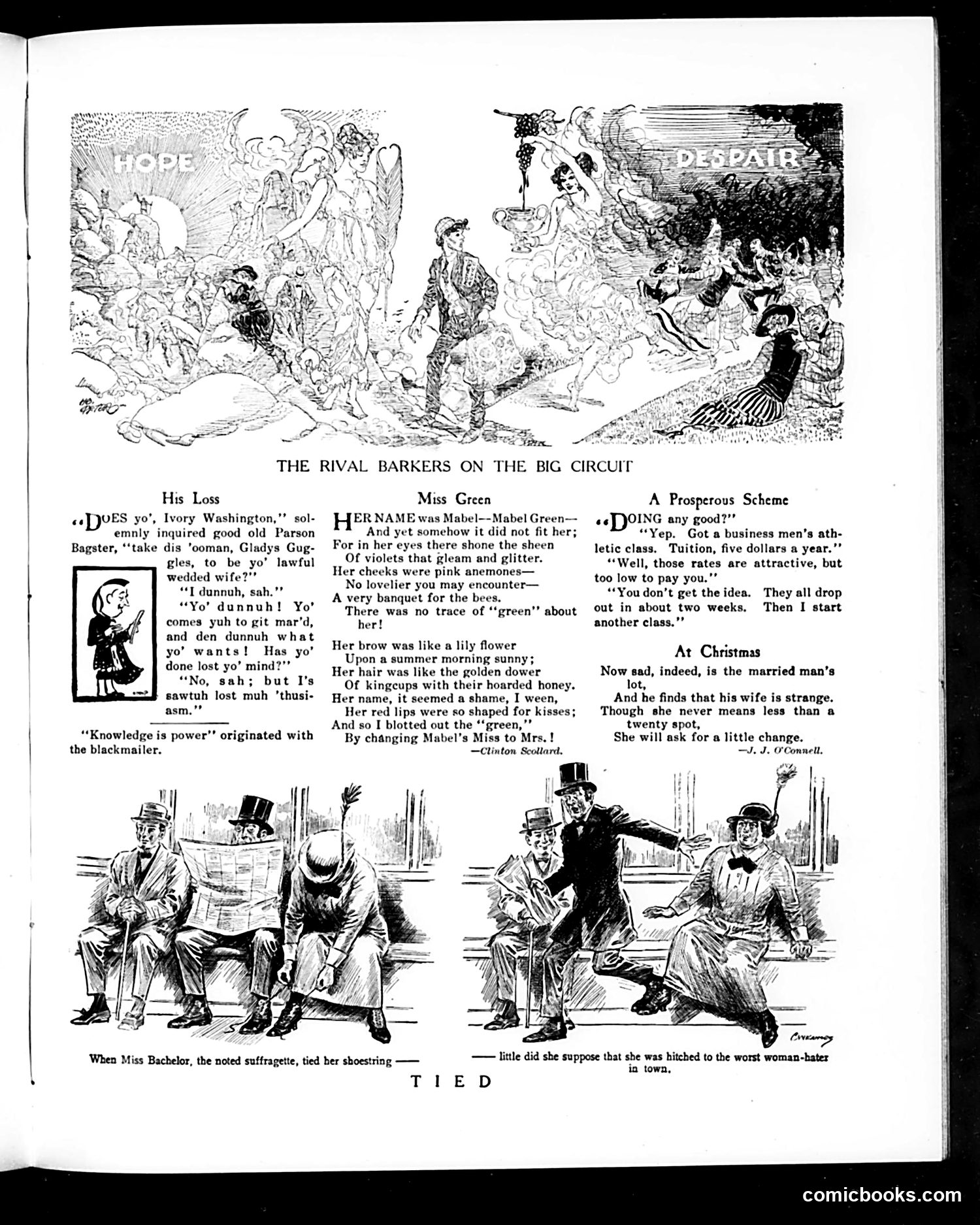
This page contains three satirical pieces typical of early-20th-century Judge magazine: **"His Loss"**: A dialect-heavy joke about a groom ("Ivory Washington") losing enthusiasm at the altar. The humor relies on period stereotypes and the punchline that he's "lost his enthusiasm"—playing on contemporary anxieties about marriage commitment. **"Miss Green"**: A romantic poem by Clinton Scollard about a woman whose name doesn't match her appearance. The "joke" concerns changing "Miss" to "Mrs."—implying marriage transforms identity. Fairly lightweight romantic satire. **"A Prosperous Scheme"**: Social commentary on entrepreneurship. A man profits by recruiting business students for athletic classes at five dollars annually, then dismisses them after two weeks to recruit a new class—pure turnover-based fraud. This satirizes get-rich-quick schemes and dubious business practices of the era. The bottom panel about "Miss Bachelor the suffragette" and the Christmas marriage joke are brief social commentary typical of the magazine's lighter content.
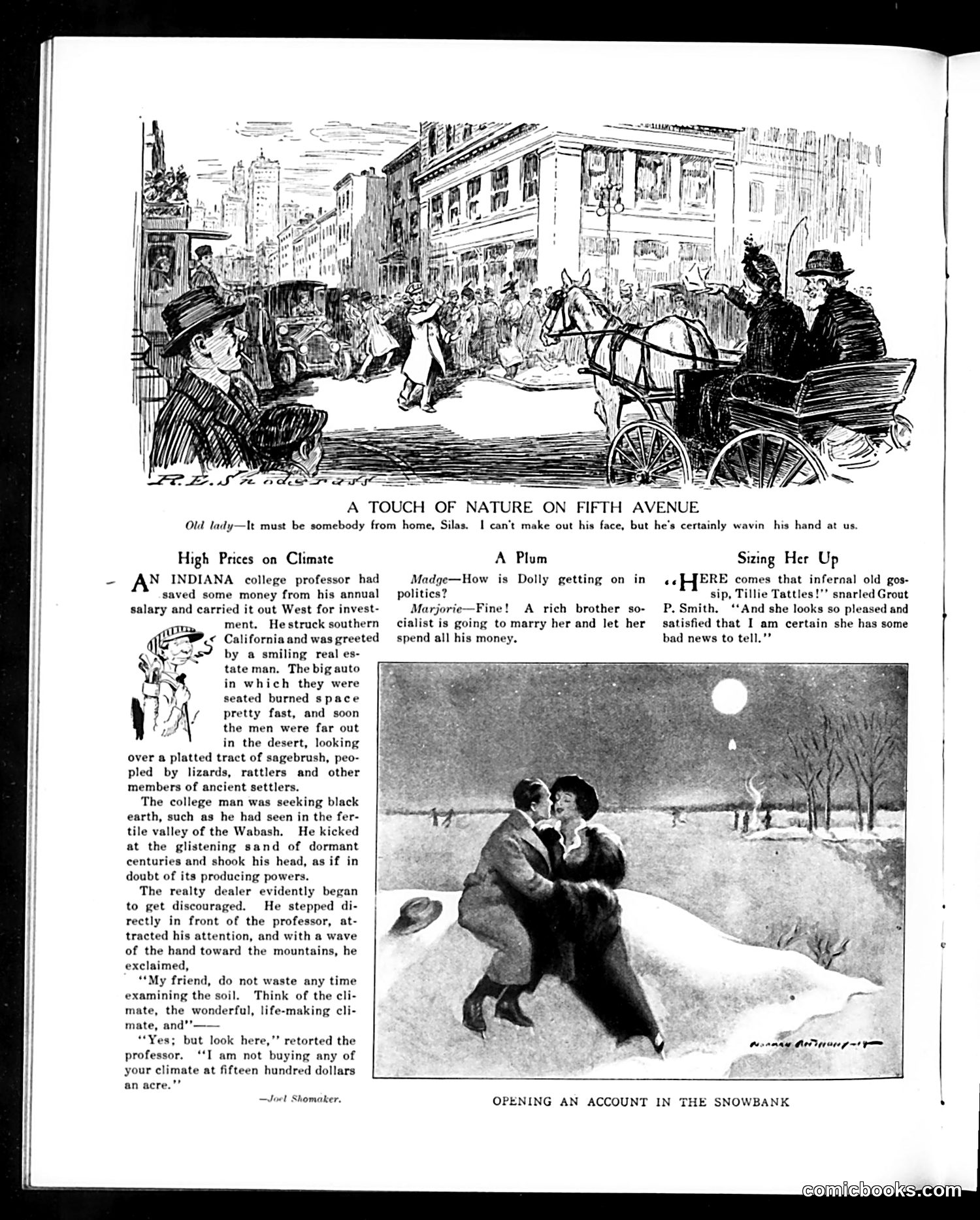
The page contains three separate satirical pieces: **"A Touch of Nature on Fifth Avenue"** (top): A sketch mocking rural visitors to New York City. An elderly couple from the countryside mistake a man waving from a carriage as someone they know from home—satirizing the culture clash between rural and urban America. **"High Prices on Climate"** (left): Joel Shomaker's story ridiculing California real estate fraud. A salesman tries selling an Indiana professor worthless desert land by emphasizing the "wonderful climate" rather than addressing the barren soil. The professor's retort—refusing to pay $1,500/acre for climate alone—mocks inflated Western land prices and deceptive sales tactics common in early 20th-century development schemes. **"A Plum" and "Swing Her Up"** (right): Two brief joke items about marriage and gossip among society women. **"Opening an Account in the Snowbank"** (bottom photo): A humorous photograph of a couple in snow, likely making a pun about "banking" or financial activity. The overall theme targets con artists, real estate speculation, and class differences in American society.
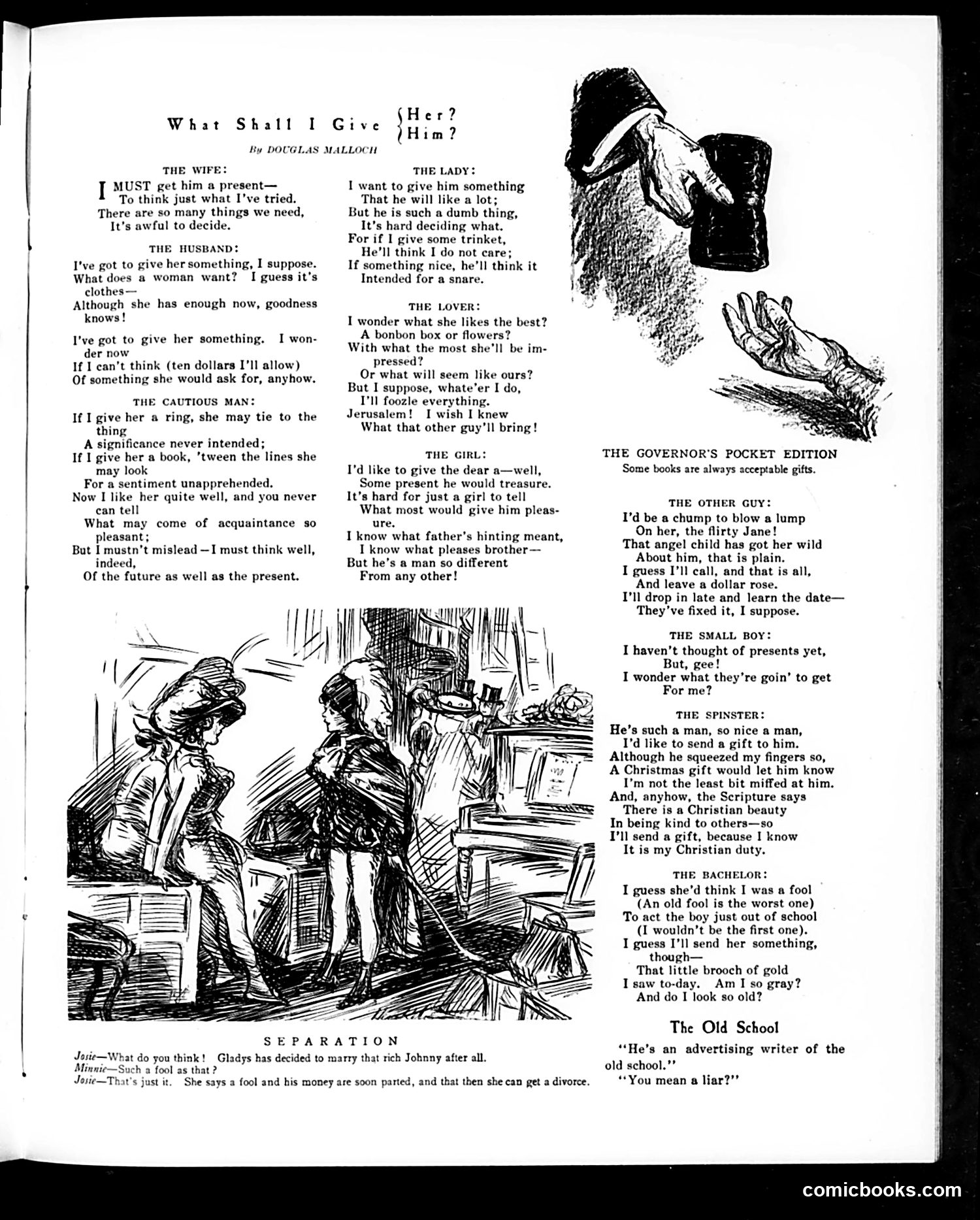
This humorous piece by Douglas Malloch satirizes the anxiety surrounding gift-giving across social classes and relationships. Each monologue—from wives to spinsters to bachelors—reveals the overthinking and second-guessing that accompanies selecting presents. The satire targets how people project meaning onto gifts: the husband fears a book's "lines" will be misinterpreted; the cautious man worries a ring implies unintended commitment; the spinster justifies her gift through Christian duty rather than honest affection; the bachelor obsesses over appearing foolish. The illustrations show domestic and social scenes of the era. A companion joke, "Separation," mocks marriage dissolution, with a woman planning divorce after securing a wealthy husband's money—satirizing both marital instability and mercenary motivations. The overall message: gift-giving exposes our anxieties about relationships, class, and how others perceive us.
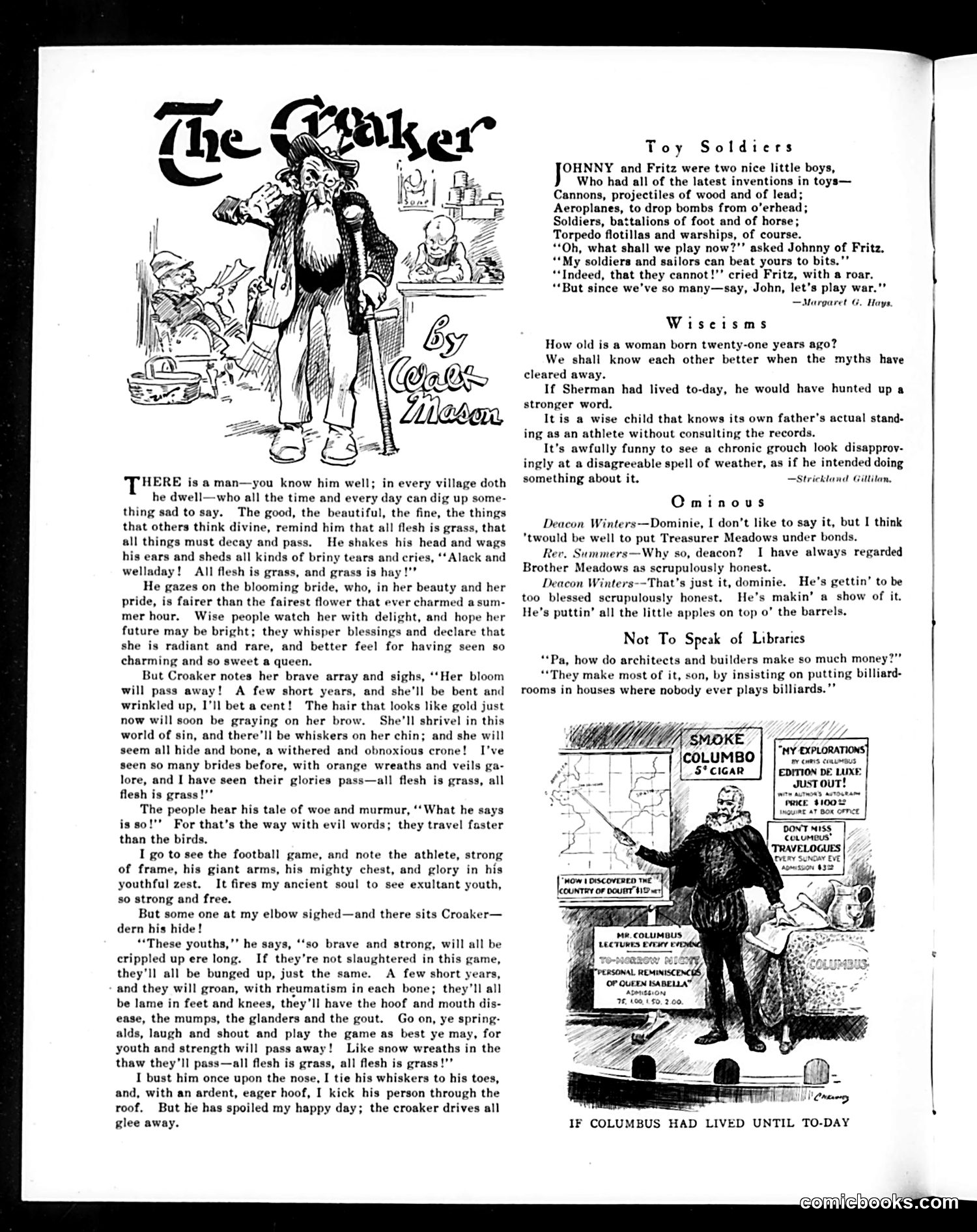
**"The Croaker"** is a moral fable satirizing chronic pessimists—those who compulsively predict doom and decay in every situation. The figure of "Croaker" represents the archetypal curmudgeon who intrudes upon joyful moments (a wedding, a football game) to remind everyone that "all flesh is grass"—life is temporary, beauty fades, youth leads to infirmity. The satire mocks not just his negativity but how his toxic rhetoric spreads ("evil words travel faster than birds"), culminating in the narrator violently silencing him. **"Toy Soldiers"** is a brief children's poem about two boys playing with military toys who decide to wage war with their collections, capturing period anxieties about militarism and childhood play mimicking real warfare. The **"Wiscisms"** section comprises short, unrelated quips—wordplay and social observation typical of Judge's filler content. The page reflects early-20th-century concerns about pessimism, aging, and militarism, using humor to critique both personal negativity and broader cultural anxieties.
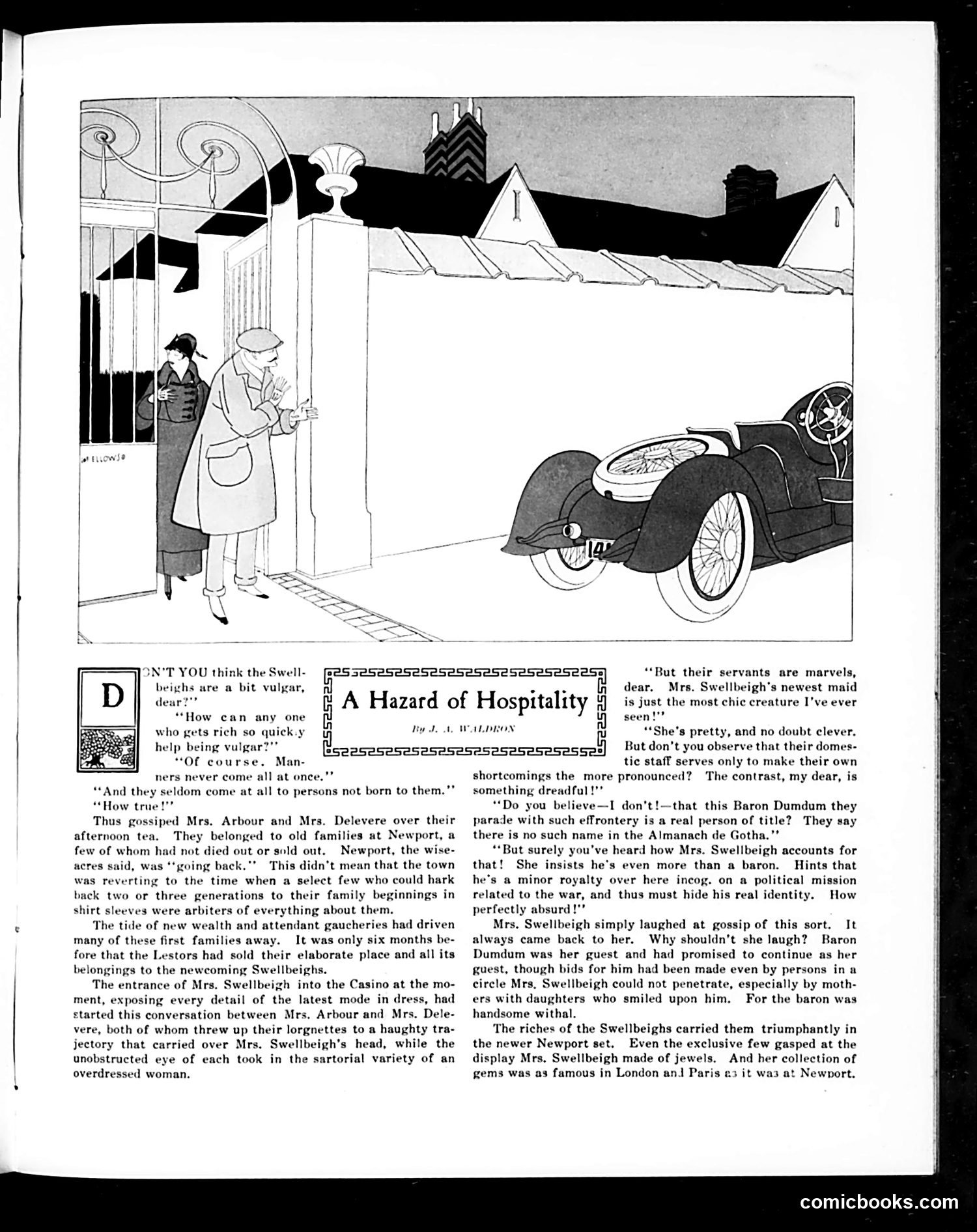
This satirical story mocks newly wealthy Americans ("nouveau riche") and old-money snobbery in the Newport social scene. Mrs. Swellbeigh represents the newly rich—ostentatiously dressed, driving expensive cars, employing fashionable servants—who've purchased estates from declining old families like Mrs. Arbour and Mrs. Delevere. The satire cuts both ways: the old-money women are portrayed as cattily dismissive (using lorgnettes to snub Mrs. Swellbeigh), while the Swellbeighs are ridiculous—parading a suspicious "Baron Dumdum," whose title likely doesn't exist, as a mysterious political exile. The irony is that despite their vulgarity and pretense, the Swellbeighs' wealth commands social power even among the exclusive old guard who despise them. The cartoon satirizes both the arriviste's desperate social climbing and established society's hollow superiority.
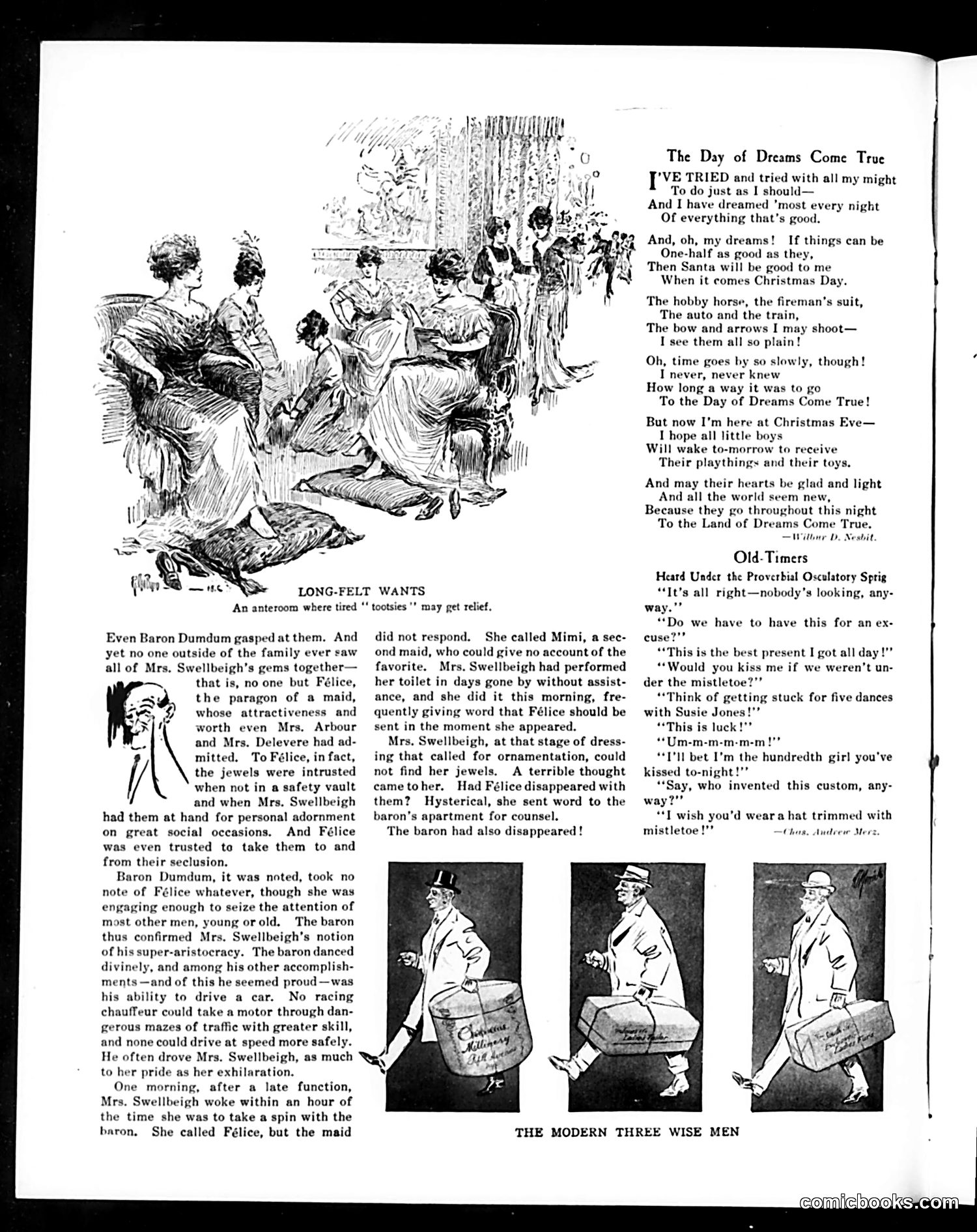
This Judge magazine page contains a serialized story about wealthy socialite Mrs. Swellbeigh. The narrative setup: Mrs. Swellbeigh's trusted maid Félice disappears on the morning she's supposed to drive with Baron Dumdum (a visiting aristocrat noted for his skilled driving). Mrs. Swellbeigh then discovers her valuable jewels are also missing, and the Baron has vanished too—implying they've eloped together. The satire targets wealthy pretension: the Baron's "super-aristocracy" is shown as hollow (he ignores the attractive maid, proving his supposed refinement), while the story suggests even the wealthy's prized possessions and social standing are vulnerable to betrayal by those in lower positions they trust. The page's other content includes a sentimental Christmas poem and "Old-Timers"—nostalgic mistletoe-kissing dialogue, reflecting period dating customs.
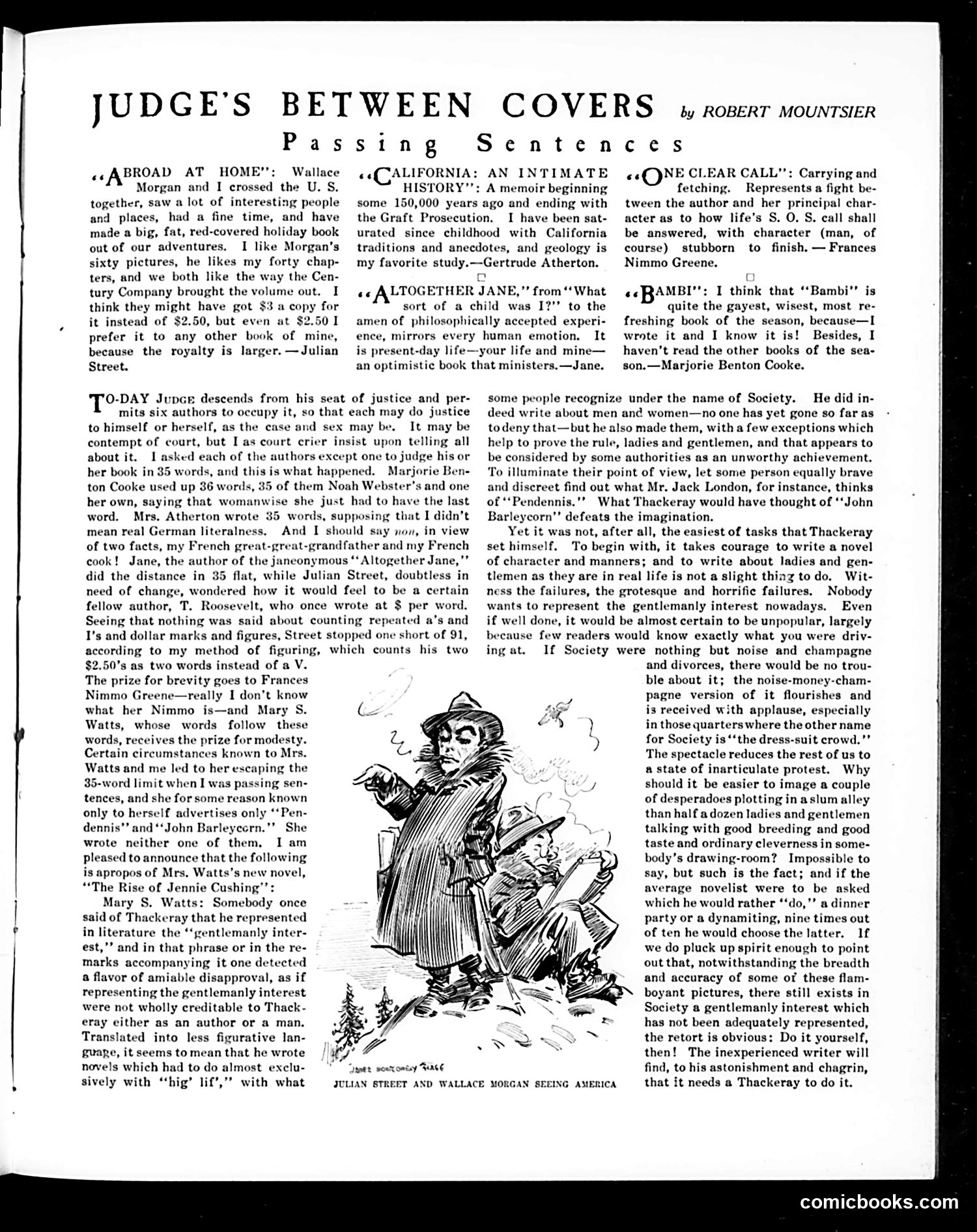
This page from *Judge* magazine features book reviews by six authors, presented as if they were judges in a courtroom. Robert Mountsier invites prominent writers—including Gertrude Atherton, Jane Addams(?), Frances Nimmo Greene, and Marjorie Benton Cooke—to "judge" their own works, creating humorous self-assessments. The accompanying illustration depicts a figure (likely representing one of these authors) in Victorian dress, carrying a child—possibly referencing one of the books discussed, "One Clear Call" which involves "carrying and fetching." The satire mocks authors' vanity: they're asked to judge their own books impartially but inevitably praise them. Mountsier humorously notes the authors couldn't resist the "last word" and counts their word usage (some at exactly 35-36 words). The broader point satirizes the difficulty of writing seriously about genteel society and morality—a concern of literary circles of this era—suggesting such work requires a Thackeray-level talent most contemporary writers lack.
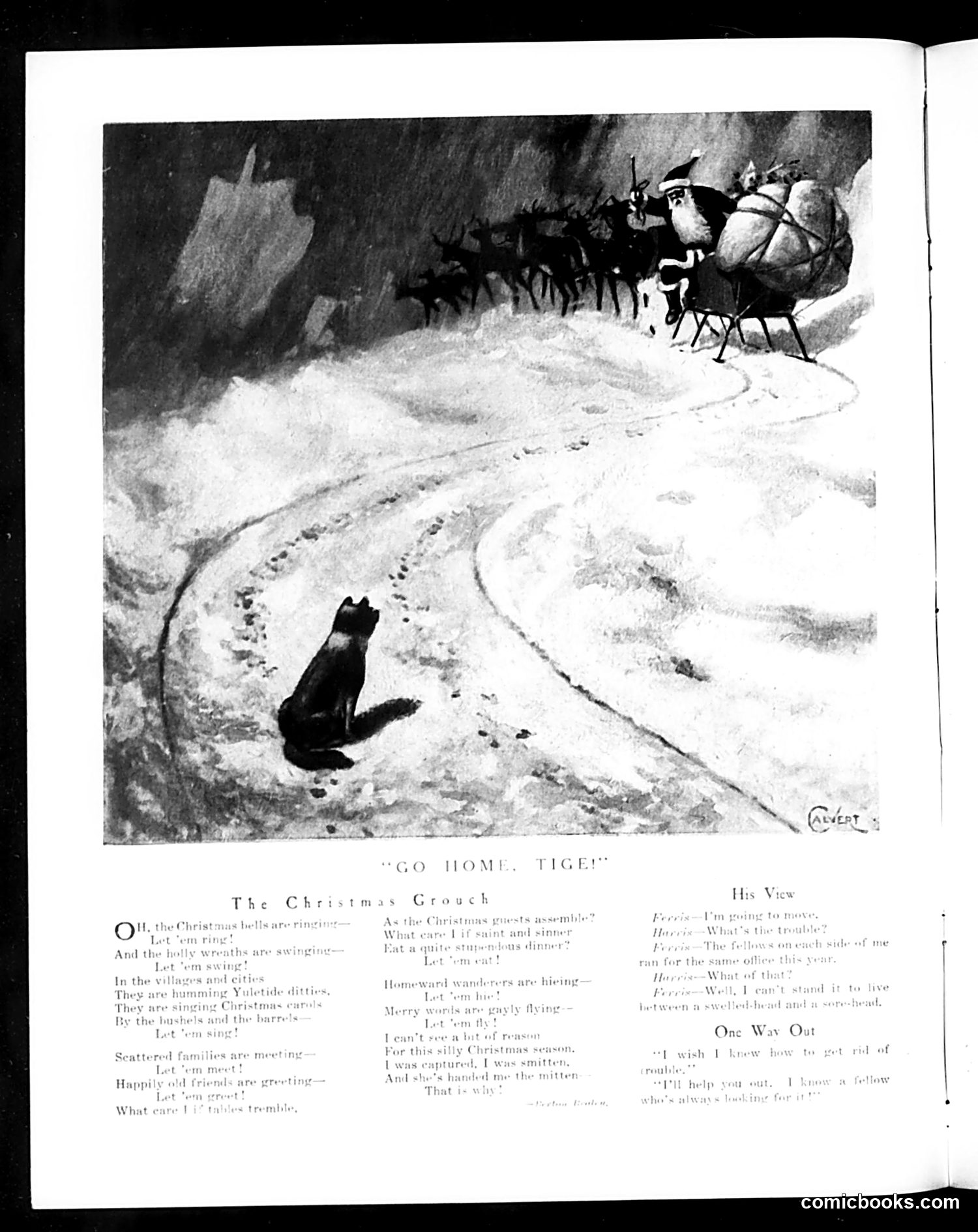
This illustrated piece combines a winter scene with two contrasting monologues. The image shows a dog encountering what appears to be a tiger in a snowy landscape—an absurd, impossible situation presented as darkly comedic. "The Christmas Grouch" (left) features someone complaining bitterly about holiday obligations: family gatherings, Christmas carols, and social expectations ("What care I? unless trouble, / Let 'em sing!"). "His View" (right) presents the tiger's perspective: trapped, captured, and miserable during the Christmas season, wishing for escape ("I wish I knew how to get rid of trouble"). The satire equates holiday misery with being caged—suggesting Christmas social pressures feel as unnatural and confining as captivity. The impossible tiger represents feeling trapped by seasonal expectations.
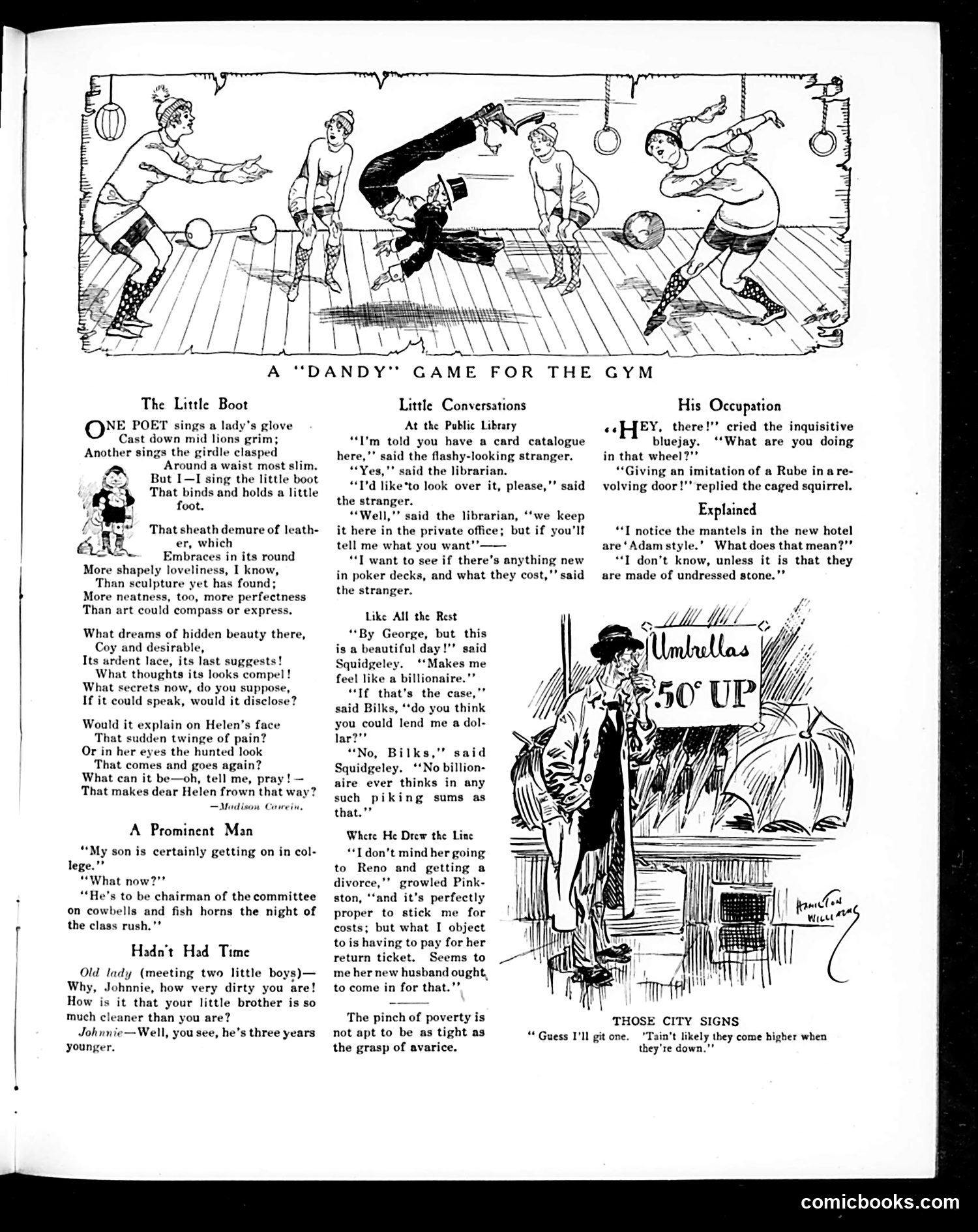
This page from Judge (a satirical weekly) contains multiple short humorous pieces typical of early 20th-century American humor: **"The Little Boot"** is a mock-romantic poem parodying sentimental Victorian poetry about women's fashion—here absurdly elevating a boot to artistic significance while hinting at voyeuristic interest in what it conceals. **The short jokes** satirize everyday social pretension: a college student proud of a meaningless committee role; a librarian's condescension; a man trying to borrow money from someone claiming wealth; a divorce dispute over return-ticket costs. **"His Occupation"** is a simple visual pun: a squirrel in a exercise wheel mimics a "Rube" (country person) stuck in a revolving door—confusing/amusing urban technology. **"Those City Signs"** jokes about unclear pricing signs. The page reflects Judge's formula: lightweight social satire mocking human vanity, pretension, and middle-class anxieties, with minimal political content. The humor relies on recognizable social situations rather than specific contemporary references.
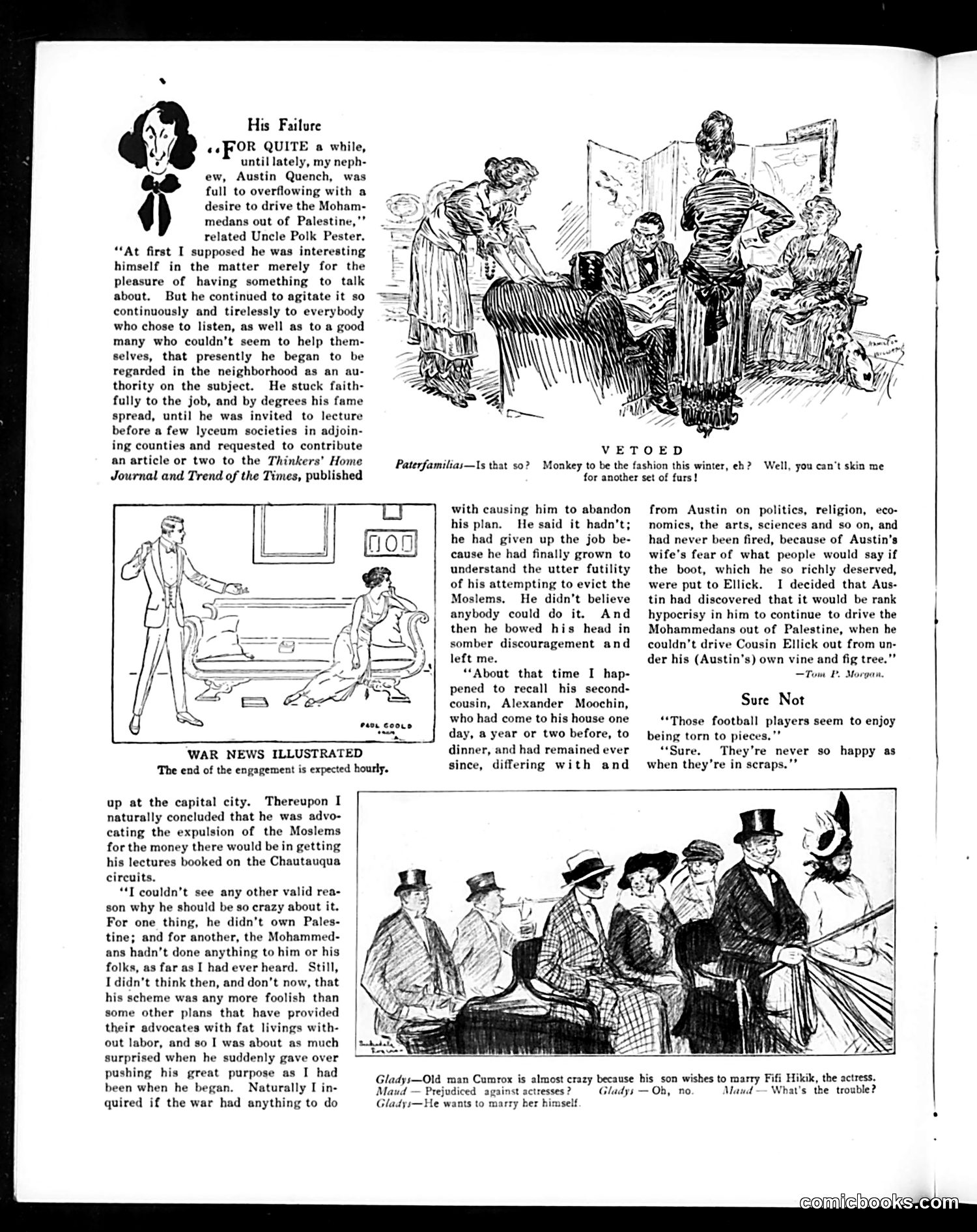
This page satirizes Austin Quench, a man who publicly champions driving Muslims from Palestine—apparently to build a lucrative lecture circuit on the Chautauqua speaking circuit. The narrator (Uncle Polk Pester) initially assumes Austin's moral crusade is financially motivated rather than genuine. The joke's punchline: Austin abandons his grand cause not from principle, but upon realizing the hypocrisy of expelling foreign "invaders" when he cannot even remove his own unwanted houseguest, Cousin Ellick, from his home. The satire mocks both reform advocates who appear self-righteous while tolerating personal failures, and the era's casual middle-class activism—adopting distant causes for social status and income rather than authentic conviction. The accompanying cartoons offer lighter social humor about fashion and marriage, typical of Judge's mixed content.
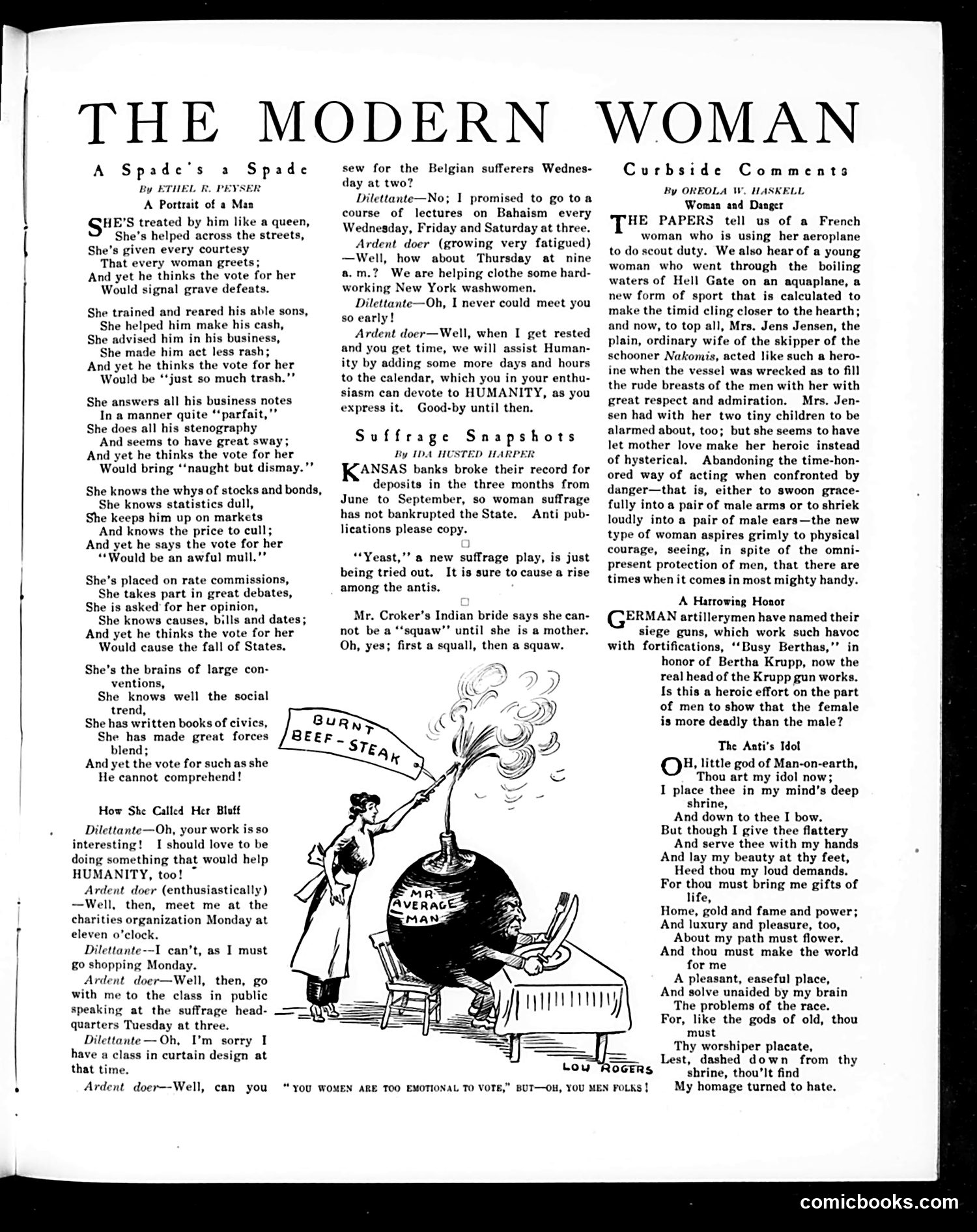
This Judge magazine page satirizes anti-suffrage arguments through multiple pieces mocking male hypocrisy about women's capabilities. **Main cartoon** ("A Spade's a Spade"): Depicts a man who relies on women for business advice, stenography, financial management, and civic knowledge—yet opposes her voting rights. The repeated refrain "And yet he thinks the vote for her / Would [cause disaster]" exposes the contradiction: men trust women's competence in private spheres but deny it in politics. **"How She Called Her Bluff"**: Satirizes the "society woman" who claims to support helping humanity but cancels charity work for shopping, lectures, and curtain design—exposing performative activism. **The cartoon by Lou Rogers** shows a woman wielding a "burnt beefsteak" against the "Average Man," illustrating the emotional volatility argument anti-suffragists used ("You women are too emotional to vote"). **Curbside Comments** celebrates women's actual bravery (aviators, aquaplane riders), undermining claims of female fragility. The page's cumulative message: men's objections to women's voting rest on flimsy, contradictory grounds.
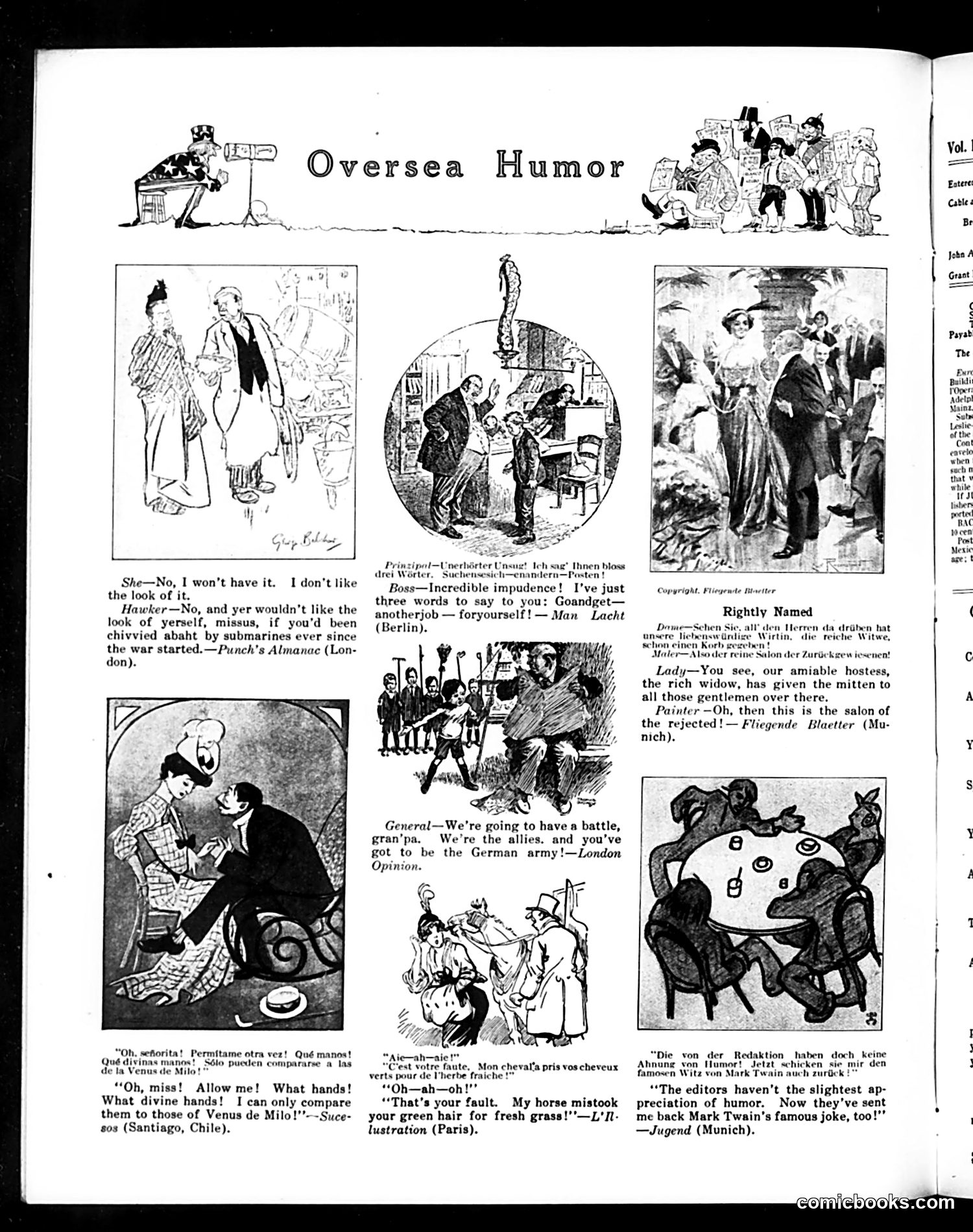
This page from *Judge* collects humorous cartoons translated from European magazines, offering cross-cultural wartime comedy. The jokes reflect early-20th-century social anxieties and customs: **Top left**: A street hawker defends his shabby appearance to a woman by invoking submarine warfare—suggesting even civilians endured wartime hardships. **Middle**: A Spanish suitor compares a woman's hands to the Venus de Milo (the famous armless statue)—an absurd compliment that backfires. **Right side**: A general enlists his grandfather in a children's war game, reflecting how WWI permeated all aspects of life. **Bottom**: A horse mistakes green hair for fresh grass, and separately, a painter calls a drawing room of rejected suitors "the salon of the rejected"—wordplay on artistic rejection. **Final joke**: A magazine editor rejected a Mark Twain story, suggesting even famous humor fails editorial standards. The page demonstrates how wartime satire, translated internationally, traded on universal social embarrassments and domestic absurdities.
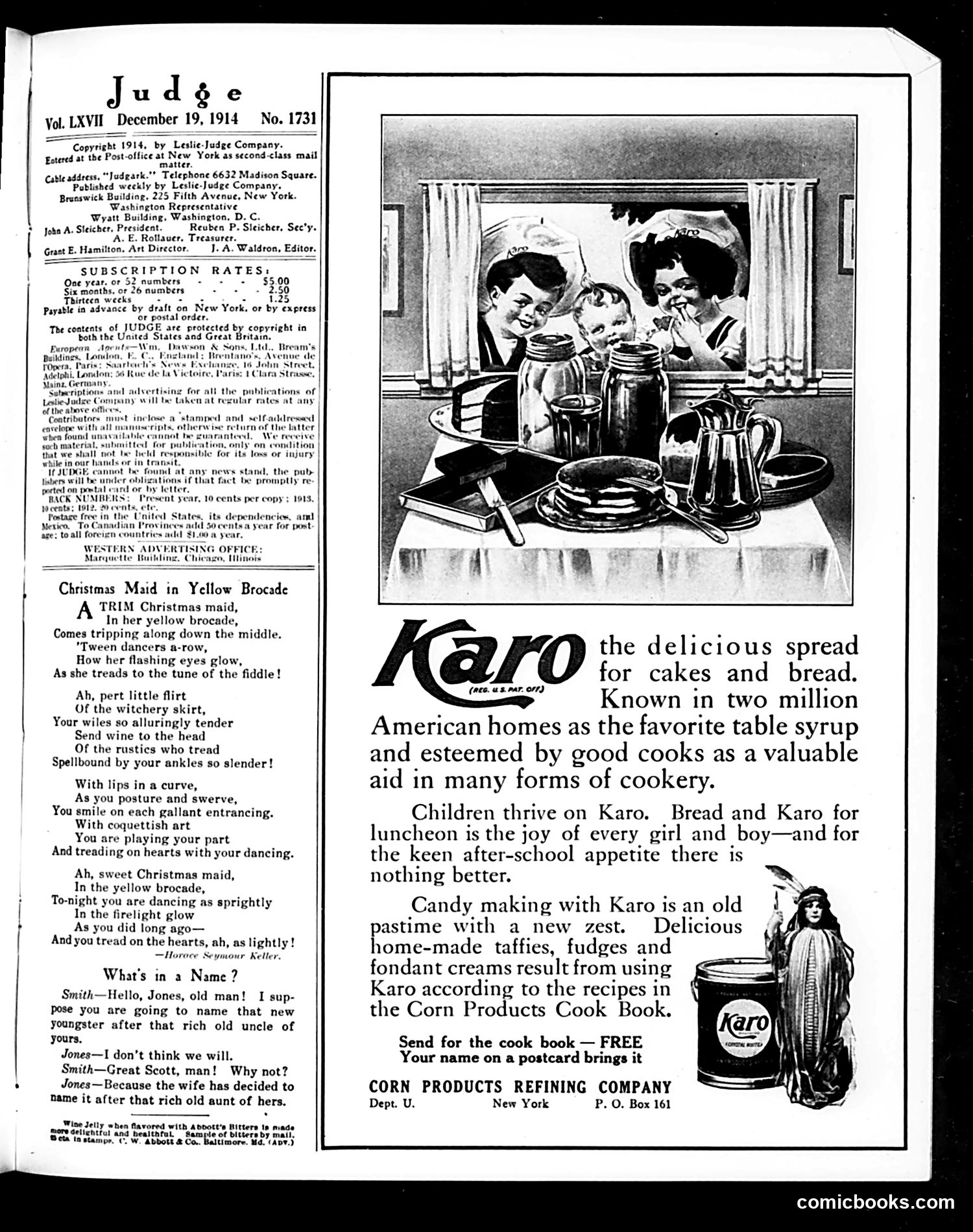
This is primarily an **advertising page** for Karo syrup, not political satire. The magazine content is minimal. ## Visible Content: **"Christmas Maid in Yellow Brocade"** — A romantic poem by Horace Seymour Keller celebrating a flirtatious female dancer in period costume at what appears to be a holiday celebration. The tone is mildly flirtatious rather than satirical. **"What's in a Name?"** — A brief comic dialogue between two men (Smith and Jones) joking about naming their newborn after a wealthy relative. The humor relies on the wife wanting to name the child after *her* rich aunt rather than the husband's uncle—a mild domestic comedy about money and in-law dynamics. ## Dominant Content: The page is **dominated by a Karo syrup advertisement** featuring an illustration of children enjoying breakfast with the product. The ad emphasizes Karo's uses in cooking and candy-making, promoting it as a family staple. The page demonstrates how Judge, despite its satirical heritage, relied heavily on advertising revenue by the 1910s.
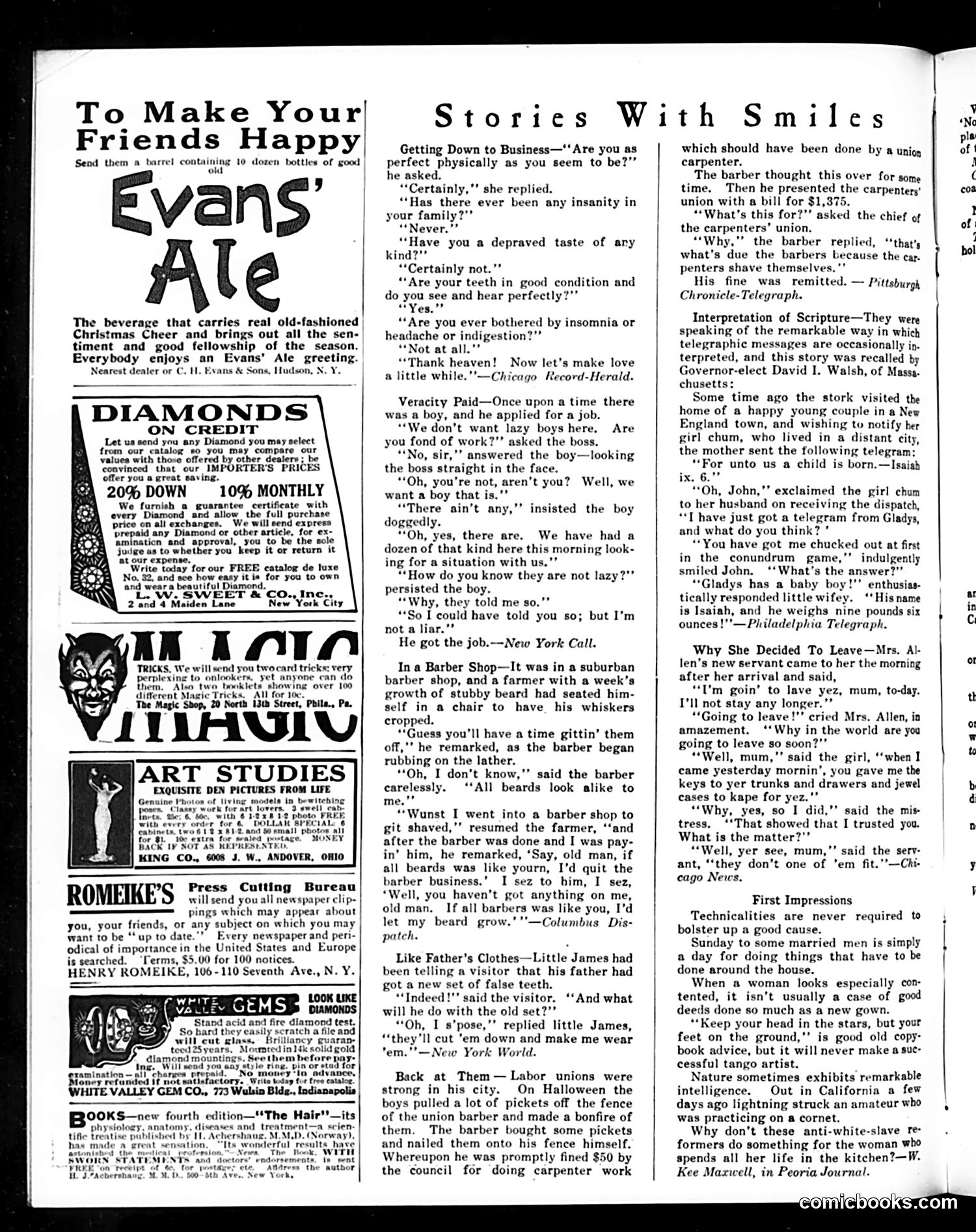
This page is primarily **advertisements and humorous short anecdotes** rather than political cartoons. The satirical content consists of brief jokes addressing early 20th-century social concerns: **Key humor pieces:** 1. **"Getting Down to Business"**: A man interrogates a woman about her physical and mental health before proposing romance—satirizing the era's pseudo-scientific eugenic concerns about heredity and fitness. 2. **"Veracity Paid"**: A boy's brutal honesty about not liking work gets him hired—the joke being that he's at least truthful, unlike other applicants who lie about their work ethic. 3. **"In a Barber Shop"**: A farmer discusses beard-shaving experiences—appears to be a setup for a longer anecdote (text cuts off). **The advertisements** (Evans' Ale, diamonds on credit, art studies, magic tricks) reflect period consumer culture targeting middle-class readers. No specific political figures are caricatured; rather, the satire targets common social behaviors and anxieties of the era.
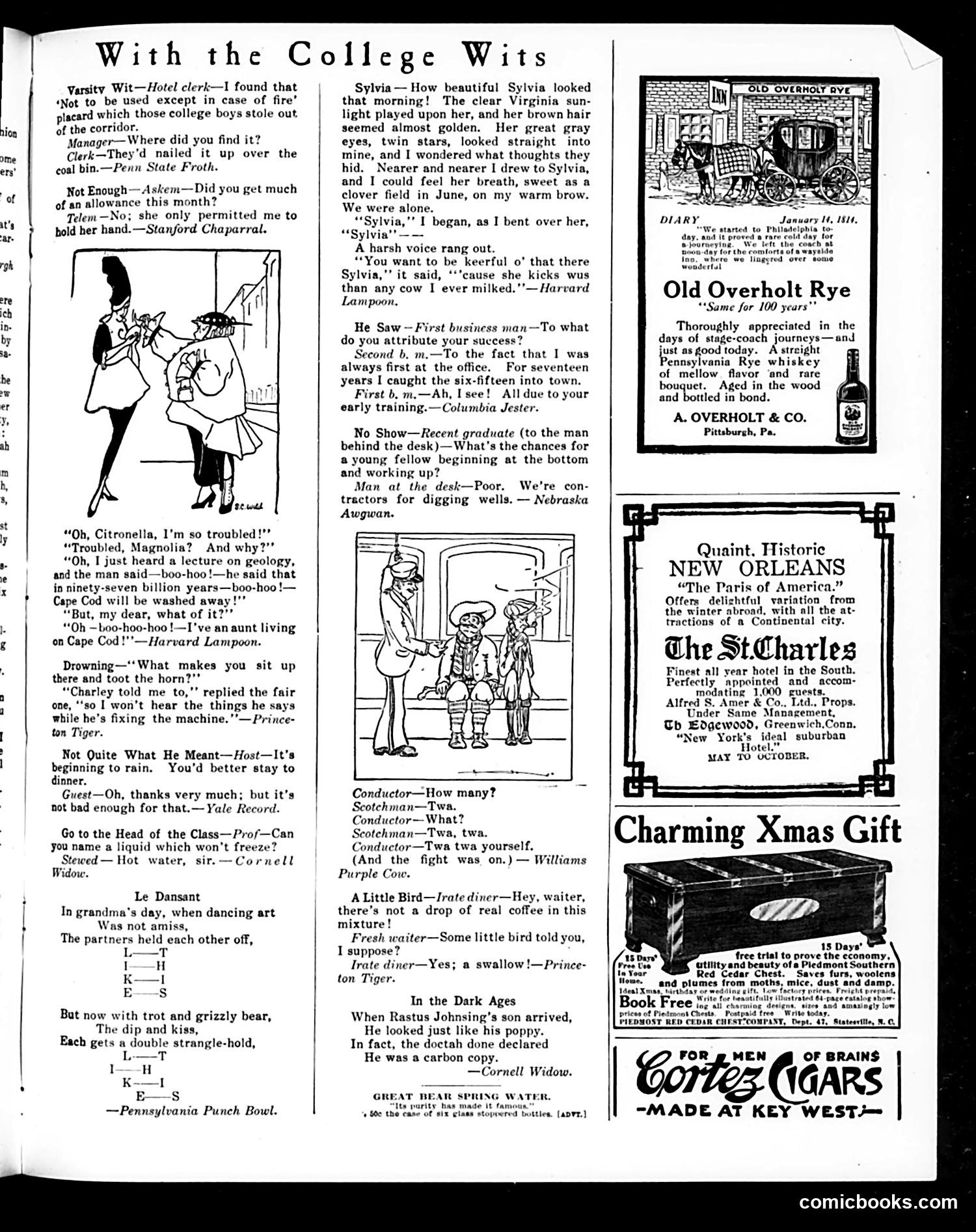
This page from *Judge* magazine consists primarily of **college humor** — jokes reprinted from various university publications (Penn State Froth, Stanford Chaparral, Harvard Lampoon, etc.). The cartoons and witticisms target typical college student experiences: allowances, dormitory life, romantic encounters, and the absurdities of academic instruction. The humor relies on period-specific references (Cape Cod erosion anxiety, stage-coach travel) and dated social assumptions (gender dynamics, class distinctions). Notable is "Le Dansant," which mocks modern dancing as physically aggressive compared to genteel Victorian-era dancing. The page's bulk consists of **advertisements** for whiskey (Old Overholt Rye), New Orleans tourism, and a hotel — typical of *Judge*'s revenue model. These ads are presented as cultural endorsements rather than neutral pitches. The "Dark Ages" joke uses racist dialect humor common to early 20th-century publications. Overall, this represents mainstream American college culture and commercial interests circa 1910s-1920s.
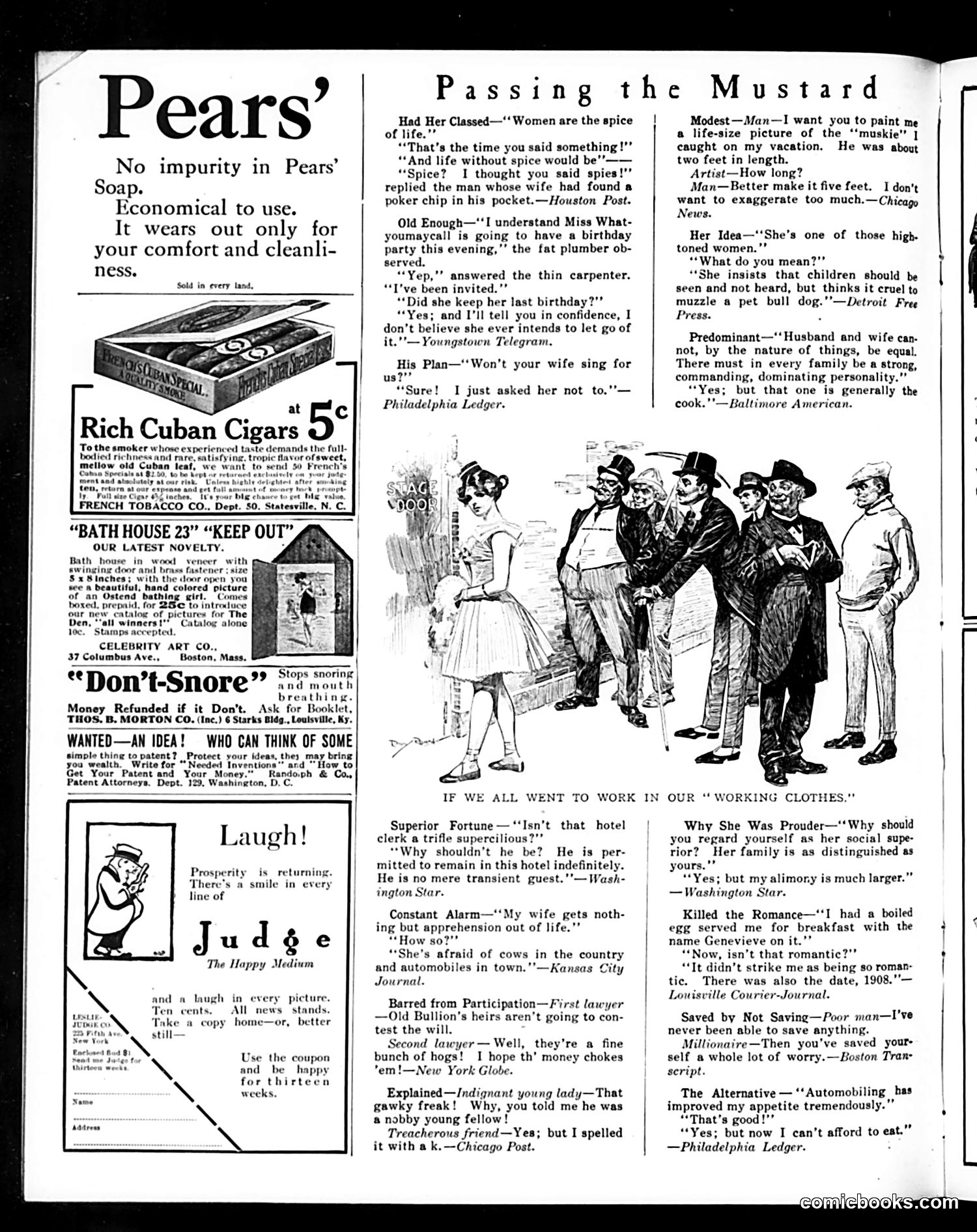
This page from *Judge* magazine is primarily a collection of short humorous anecdotes and advertisements rather than political cartoons. The jokes satirize early-20th-century domestic and social life: **Key themes:** - **Marriage dynamics**: Multiple jokes mock wives' behavior (hiding poker chips, refusing to sing, dominating households). The humor assumes wives are controlling or deceptive. - **Class anxiety**: References to hotel clerks, wealth, and social status reflect period preoccupations with hierarchy. - **Gender roles**: A joke about a woman opposed to children making noise but permitting a dangerous dog muzzle mocks inconsistent female logic. - **Materialism**: Jokes about inheritance disputes and alimony reflect concerns about money and divorce. The large illustration shows men in formal dress surrounding a woman in working clothes, captioned "If We All Went to Work in Our 'Working Clothes'"—likely satirizing women's emerging workforce participation or gender role disruption. The advertisements (cigars, soap, anti-snoring devices) are typical period marketing with dubious health claims.
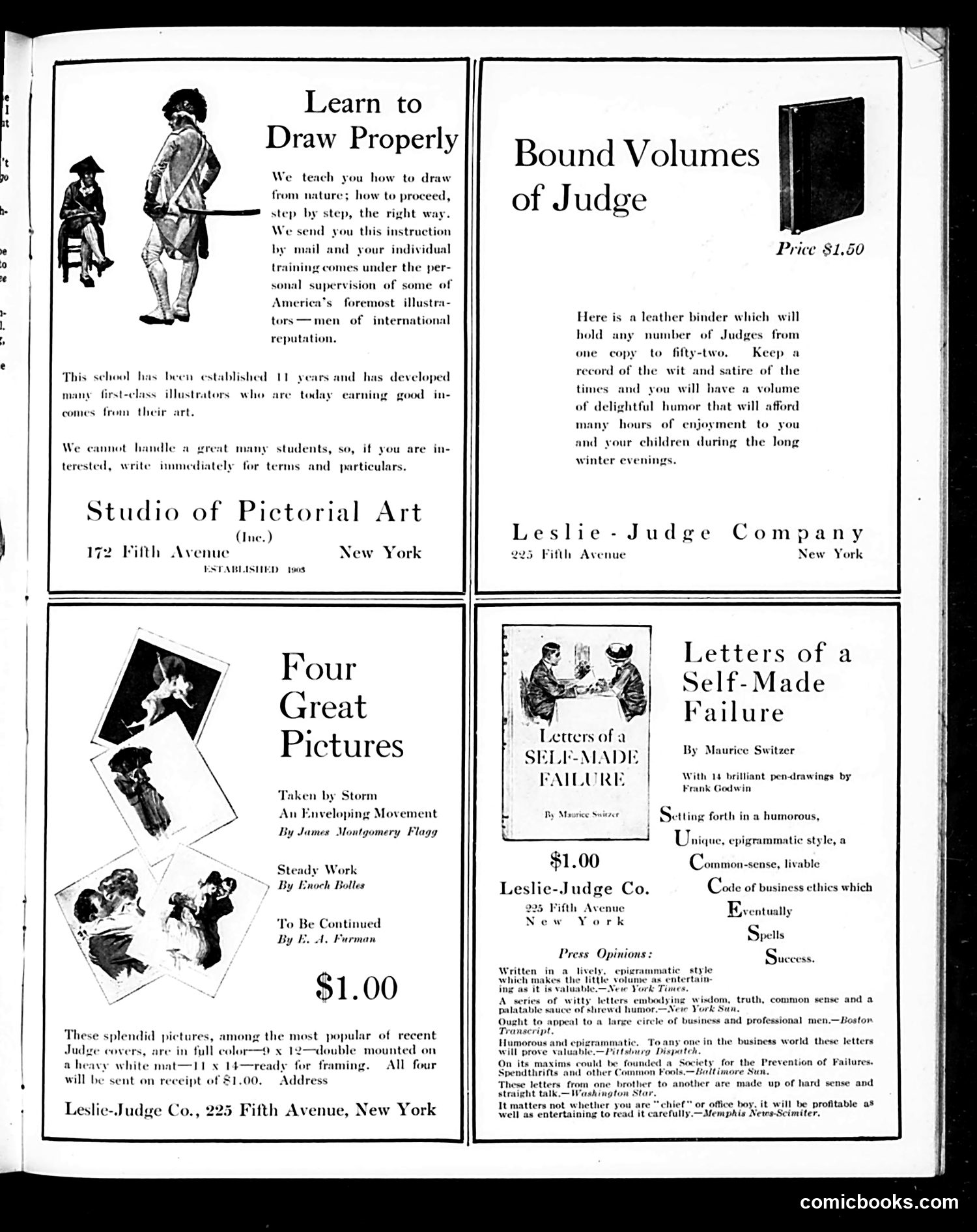
This is primarily an **advertising page** from Judge magazine, not a satirical cartoon spread. It features four book/product advertisements: 1. **Studio of Pictorial Art** (top left): An art instruction school offering mail-based drawing lessons under supervision of "America's foremost illustrators." The illustration shows a student and instructor, typical recruitment imagery. 2. **Bound Volumes of Judge** (top right): Offering leather binders to collect Judge issues 1-52, marketed as family entertainment for "winter evenings." 3. **Four Great Pictures** (bottom left): Reproductions of popular Judge cover illustrations by James Montgomery Flagg and others, sold as framed art ($1.00). 4. **Letters of a Self-Made Failure** (bottom right): A humorous business ethics book by Maurice Switzer with pen drawings, marketed to businessmen seeking wit and practical advice. All ads use period-typical sales copy emphasizing quality, affordability, and self-improvement—common themes in early 20th-century American magazines.
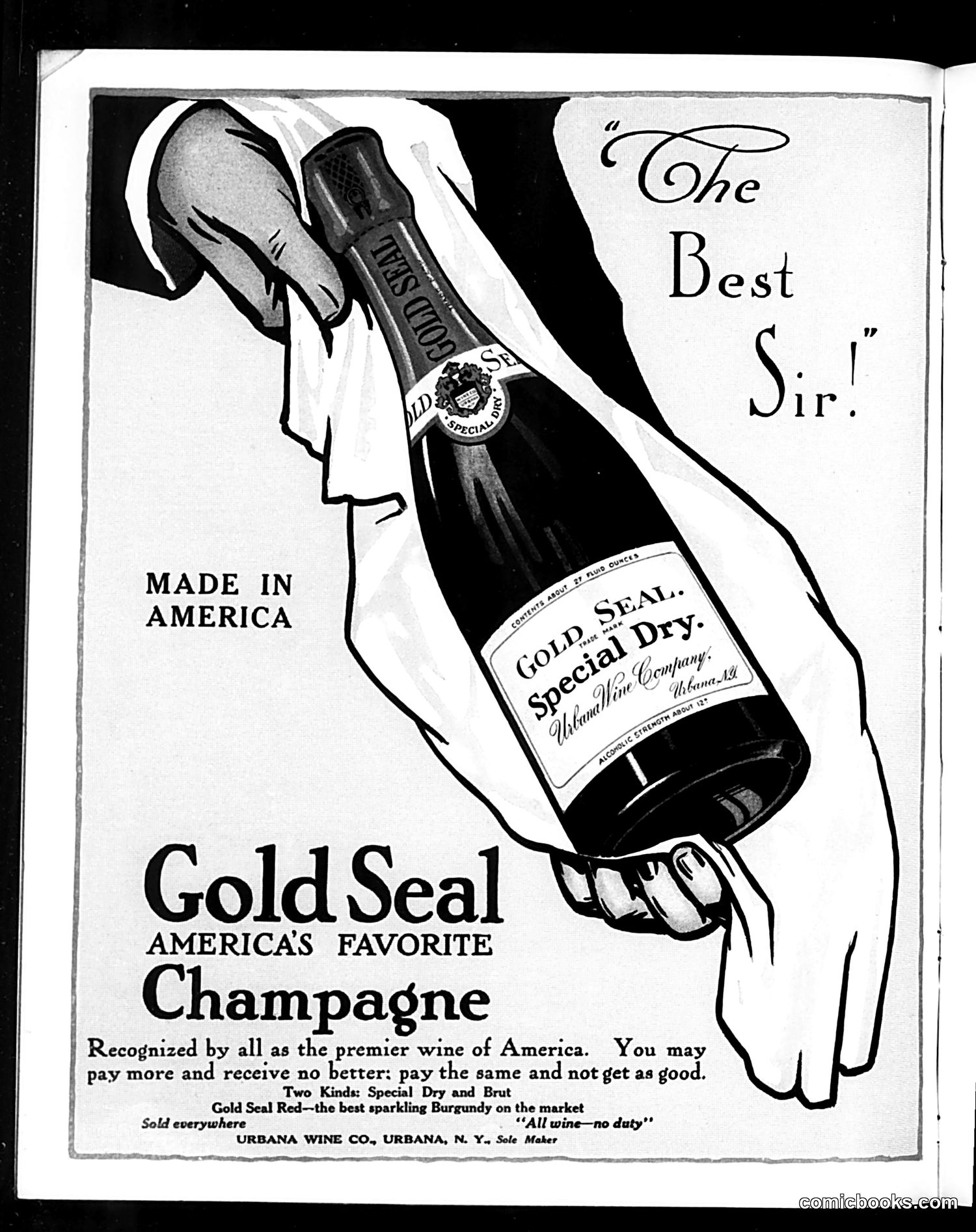
This is a straightforward **product advertisement**, not satire or political commentary. It promotes Gold Seal Champagne, made by Urbana Wine Co. in New York, as "America's Favorite Champagne." The imagery shows an elegant hand holding a bottle, emphasizing quality and sophistication. Key marketing claims include: - **"Made in America"** — emphasizing domestic production during a period when imported European wines dominated - **"Premier wine of America"** — asserting superiority over competitors - **Value proposition** — "pay more and receive no better; pay the same and not get as good" - **"All wine—no duty"** — likely referencing tax advantages or pricing The two varieties offered were Special Dry and Brut (plus a sparkling Burgundy). This appears in *Judge* magazine because such glossy publications relied heavily on luxury goods advertising to fund operations.