
Judge, 1914-12-19 · page 11 of 24
Judge — December 19, 1914 — page 11: what you’re looking at
What you’re looking at
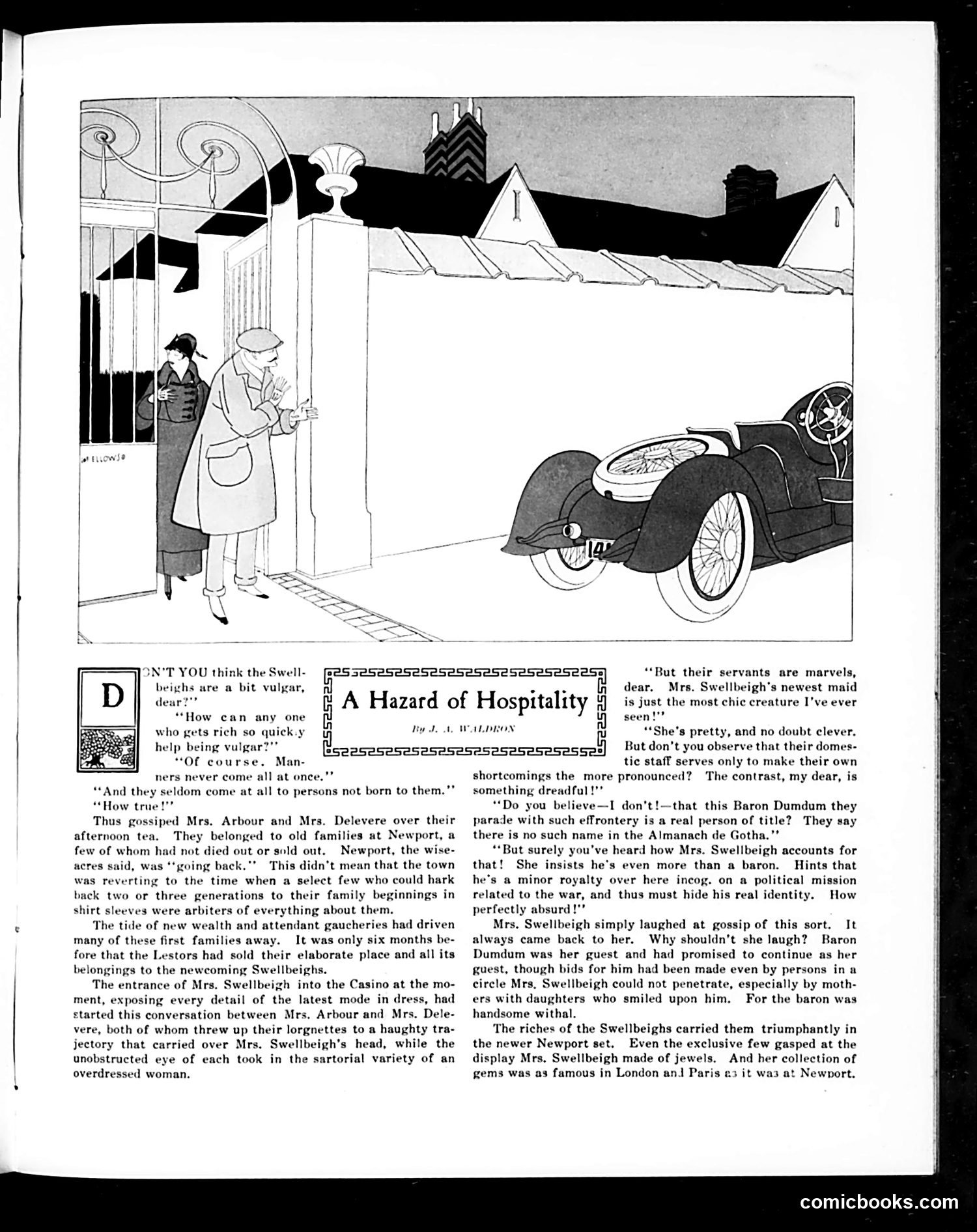
This satirical story mocks newly wealthy Americans ("nouveau riche") and old-money snobbery in the Newport social scene. Mrs. Swellbeigh represents the newly rich—ostentatiously dressed, driving expensive cars, employing fashionable servants—who've purchased estates from declining old families like Mrs. Arbour and Mrs. Delevere. The satire cuts both ways: the old-money women are portrayed as cattily dismissive (using lorgnettes to snub Mrs. Swellbeigh), while the Swellbeighs are ridiculous—parading a suspicious "Baron Dumdum," whose title likely doesn't exist, as a mysterious political exile. The irony is that despite their vulgarity and pretense, the Swellbeighs' wealth commands social power even among the exclusive old guard who despise them. The cartoon satirizes both the arriviste's desperate social climbing and established society's hollow superiority.
📄 Transcribed text from this page (OCR, searchable)
Machine-transcribed from the original scan — historical spelling and the odd misread are preserved.
3N'T YOU think the Swell- “But their servants are marvels, beighs are a bit vulgar, dear?" “How can any one who gets rich so quick.y help being vulgar?” Ky de. Gro zesesesesesesesesesesesess A Hazard of Hospitality Weswesedescesceesesasesssasdicel dear. Mrs. Swellbeigh's newest maid is just the most chic creature I've ever seen!"" “*She’s pretty, and no doubt clever. But don't you observe that their domes- HI q) WALDRON “Of course. Man- ners never come all at once.” “And they seldom come at all to persons not born to them,”’ “How true Thus gi ed Mrs. Arbour and Mrs. Delevere over their afternoon tea. They belonged to old families at Newport, a few of whom had not died out or sold out. Newport, the wise- acres said, was ‘going back.’ This didn’t mean that the town was reverting to the time when a select few who could hark back two or three generations to their family beginnings in shirt sleeves were arbiters of everything about them. The tide of new wealth and attendant gaucheries had driven many of these first families away. It was only six months be- fore that the Lestors had sold their elaborate place and all its belongings to the newcoming Swellbeighs. The entrance of Mrs. Swellbeizh into the Casino at the mo- ment, exposing every detail of the latest mode in dress, had started this conversation between Mrs. Arbour and Mrs. Dele- vere, both of whom threw up their lorgnettes to a haughty tra- jectory that carried over Mrs. Swellbeigh’s head, while the unobstructed eye of each took in the sartorial variety of an overdressed woman. tic staff serves only to make their own shortcomings the more pronounced? The contrast, my dear, is something dreadful !"" “Do you belie I don't!—that this Baron Dumdum they parade with such effrontery is a real person of title? They say there is no such name in the Almanach de Gotha."" “But surely you've heard how Mrs. Swellbeigh accounts for that! She insists he’s even more than a baron. Hints that he’s a minor royalty over here incog. on a political mission related to the war, and thus must hide his real identity. How perfectly absurd Mrs. Swellbeigh simply laughed at gossip of this sort. It always came back to her. Why shouldn’t she laugh? Baron Dumdum was her guest and had promised to continue as her guest, though bids for him had been made even by persons in a circle Mrs, Swellbeigh could not penetrate, especially by moth- ers with daughters who smiled upon him, For the baron was handsome withal. The riches of the Swellbeighs carried them triumphantly in the newer Newport set. Even the exclusive few gasped at the display Mrs. Swellbeigh made of jewels. And her collection of gems was as famous in London anJ Paris 23 it wa3 at Newport. comicbooks.com