
Judge, 1914-12-19 · page 16 of 24
Judge — December 19, 1914 — page 16: what you’re looking at
What you’re looking at
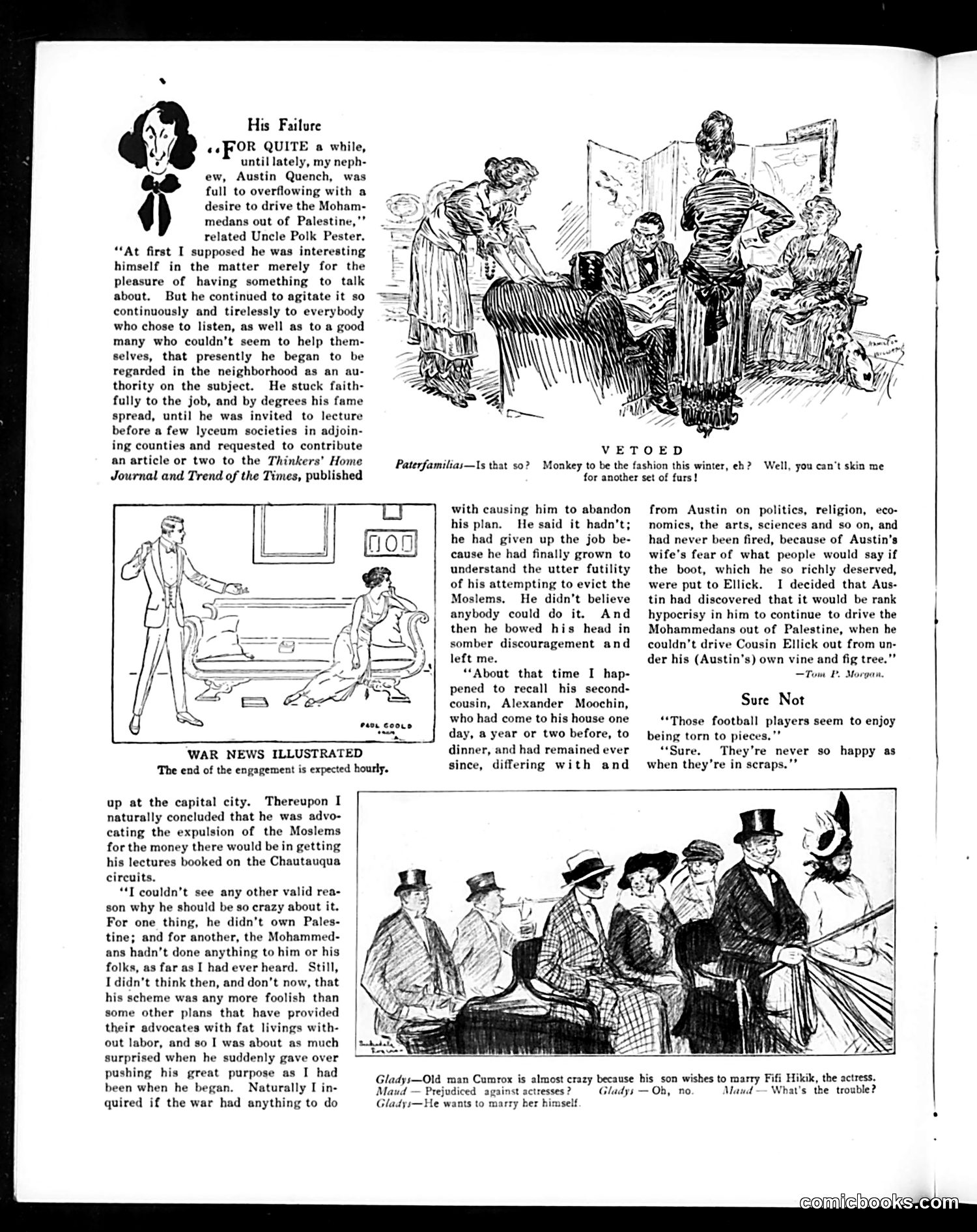
This page satirizes Austin Quench, a man who publicly champions driving Muslims from Palestine—apparently to build a lucrative lecture circuit on the Chautauqua speaking circuit. The narrator (Uncle Polk Pester) initially assumes Austin's moral crusade is financially motivated rather than genuine. The joke's punchline: Austin abandons his grand cause not from principle, but upon realizing the hypocrisy of expelling foreign "invaders" when he cannot even remove his own unwanted houseguest, Cousin Ellick, from his home. The satire mocks both reform advocates who appear self-righteous while tolerating personal failures, and the era's casual middle-class activism—adopting distant causes for social status and income rather than authentic conviction. The accompanying cartoons offer lighter social humor about fashion and marriage, typical of Judge's mixed content.
📄 Transcribed text from this page (OCR, searchable)
Machine-transcribed from the original scan — historical spelling and the odd misread are preserved.
His Failure ««FOR QUITE a while, until lately, my neph- ew, Austin Quench, was full to overflowing with a desire to drive the Moham- medans out of Palestine,’’ related Uncle Polk Pester. “At first I supposed he was interesting himself in the matter merely for the pleasure of having something to talk about. But he continued to agitate it so continuously and tirelessly to everybody who chose to listen, as well as to a good many who couldn't seem to help them- selves, that presently he began to be regarded in the neighborhood as an au- thority on the subject. He stuck faith- fully to the job, and by degrees his fame spread, until he was invited to lecture before a few lyceum societies in adjoin- ing counties and requested to contribute an article or two to the Thinkers’ Home Journal and Trend of the Times, published ann coon WAR NEWS ILLUSTRATED ‘The end of the engagement is expected hourly. VETOED Paterfamilias—Is that so? Monkey to be the fashion this winter, eh ? Well, you can’t skin me for another set of furs! with causing him to abandon his plan. He said it hadn't; he had given up the job be- cause he had finally grown to understand the utter futility of his attempting to evict the Moslems. He didn’t believe anybody could do it. And then he bowed his head in somber discouragement and left me. “About that time I hap- pened to recall his second- cousin, Alexander Moochin, who had come to his house one day, a year or two before, to dinner, and had remained ever since, differing with and from Austin on politics, religion, eco- nomics, the arts, sciences and so on, and had never been fired, because of Austin’s wife's fear of what people would say if the boot, which he so richly deserved, were put to Ellick. I decided that Aus- tin had discovered that it would be rank hypocrisy in him to continue to drive the Mohammedans out of Palestine, when he couldn't drive Cousin Ellick out from un- der his (Austin’s) own vine and fig tree."” Tom P. Morgan. Sure Not “Those football players seem to enjoy being torn to pieces,” “Sure. They’re never so happy as when they’re in scraps.’” up at the capital city. Thereupon I naturally concluded that he was advo- cating the expulsion of the Moslems for the money there would be in getting his lectures booked on the Chautauqua circuits. “I couldn’t see any other valid re: son why he should be so crazy about it. For one thing, he didn’t own Pales- tine; and for another, the Mohammed- ans hadn’t done anything to him or his folks, as far as I had ever heard. Still, I didn't think then, and don’t now, that his scheme was any more foolish than some other plans that have provided their advocates with fat livings with- out labor, and so I was about as much surprised when he suddenly gave over pushing his great purpose as I had been when he began. Naturally I in- quired if the war had anything to do Gladys—Old_ man Cumrox is almost crazy because his son wishes to marry Fifi Hikik, the actress. Maud — Prejudiced against actresses? Gladys—He wants to marry ber himself Gladys — Ob, no. Maud — What's the trouble?