
Judge, 1914-12-19 · page 15 of 24
Judge — December 19, 1914 — page 15: what you’re looking at
What you’re looking at
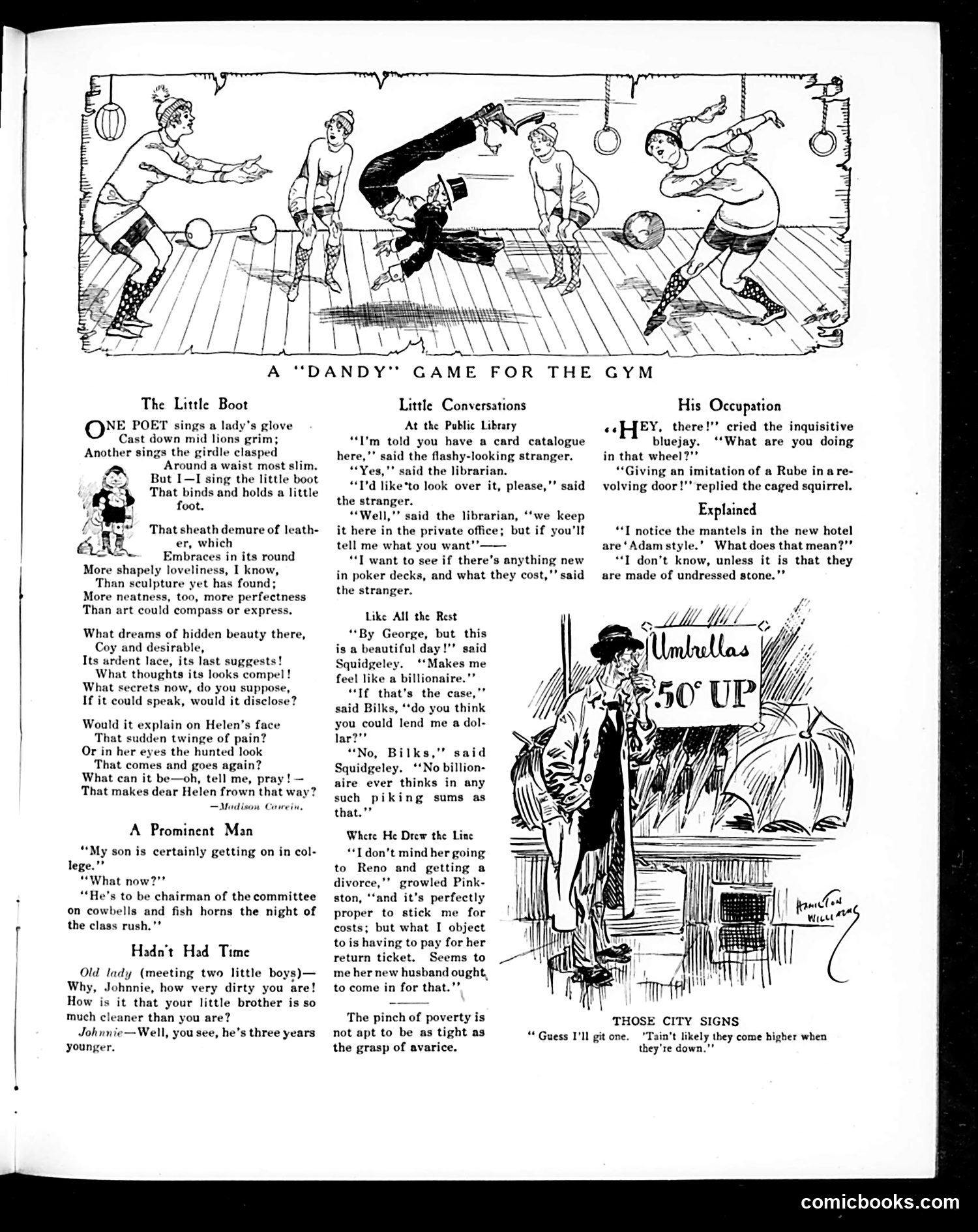
This page from Judge (a satirical weekly) contains multiple short humorous pieces typical of early 20th-century American humor: **"The Little Boot"** is a mock-romantic poem parodying sentimental Victorian poetry about women's fashion—here absurdly elevating a boot to artistic significance while hinting at voyeuristic interest in what it conceals. **The short jokes** satirize everyday social pretension: a college student proud of a meaningless committee role; a librarian's condescension; a man trying to borrow money from someone claiming wealth; a divorce dispute over return-ticket costs. **"His Occupation"** is a simple visual pun: a squirrel in a exercise wheel mimics a "Rube" (country person) stuck in a revolving door—confusing/amusing urban technology. **"Those City Signs"** jokes about unclear pricing signs. The page reflects Judge's formula: lightweight social satire mocking human vanity, pretension, and middle-class anxieties, with minimal political content. The humor relies on recognizable social situations rather than specific contemporary references.
📄 Transcribed text from this page (OCR, searchable)
Machine-transcribed from the original scan — historical spelling and the odd misread are preserved.
The Little Boot NE POET sings a lady's glove Cast down mid lions grim; Another sings the girdle clasped Around a waist most slim. But I—I sing the little boot That binds and holds a little foot. ~ That sheath demure of leath- er, which Than sculpture yet More neatness, too, more perfectness Than art could compass or express. What dreams of hidden beauty there, Coy and desirable, Its ardent lace, its last suggests! What thoughts its looks compel ! What secrets now, do you suppose, If it could speak, would it disclo: Would it explain on Helen’s face That sudden twinge of pain? Or in her eyes the hunted look That comes and goes again? What can it be—oh, tell me, pray !— That makes dear Helen frown that way? —Madison Comein, A Prominent Man “My son is certainly getting on in col- lege.’’ “What now?” ‘*He’s to be chairman of the committee on cowbells and fish horns the night of the class rush.’” Hadn't Had Time Old lady (meeting two little boys)— Why, Johnnie, how very dirty you are! How is it that your little brother is so much cleaner than you are? Johnnie—Well, you see, he’s three years younger. Little Conversations At the Public Library “I'm told you have a card catalogue here,’’ said the flashy-looking stranger. id the librarian. “I'd like*to look over it, please,’’ said the stranger. “‘Well,’’ said the librarian, ‘‘we keep it here in the private office; but if you'll tell me what you want”’ “IT want to see if there’s anything new in poker decks, and what they cost,’’ said the stranger. Like All the Rest “By George, but this is a beautiful day!’’ said Squidgeley. ‘Makes me feel like a billionaire “If that’s the cas said Bilks, ‘do you think you could lend me a dol- lar?’’ “No, Bilks,"”’ said Squidgeley. ‘‘No billion- aire ever thinks in any such piking sums as that.’” Where He Drew the Line “IT don’t mind her going to Reno and getting a divorce,’’ growled Pink- ston, ‘‘and it’s perfectly proper to stick me for costs; but what I object to is having to pay for her return ticket. Seems to me her new husband ought, to come in for that.”” The pinch of poverty is not apt to be as tight as the grasp of avarice. “ Guess I'll git one. His Occupation “ee EY, there!’’ cried the inquisitive bluejay. ‘‘What are you doing in that wheel? “Giving an imitation of a Rube in are- volving door!’’ replied the caged squirrel. Explained “T notice the mantels in the new hotel are‘Adamstyle.’ What does that mean?”’ “I don’t know, unless it is that they are made of undressed stone.’’ THOSE CITY SIGNS "Tain't likely they come higher when they're down.’” comicbooks.com