
A complete issue · 24 pages · 1914
Judge — November 21, 1914
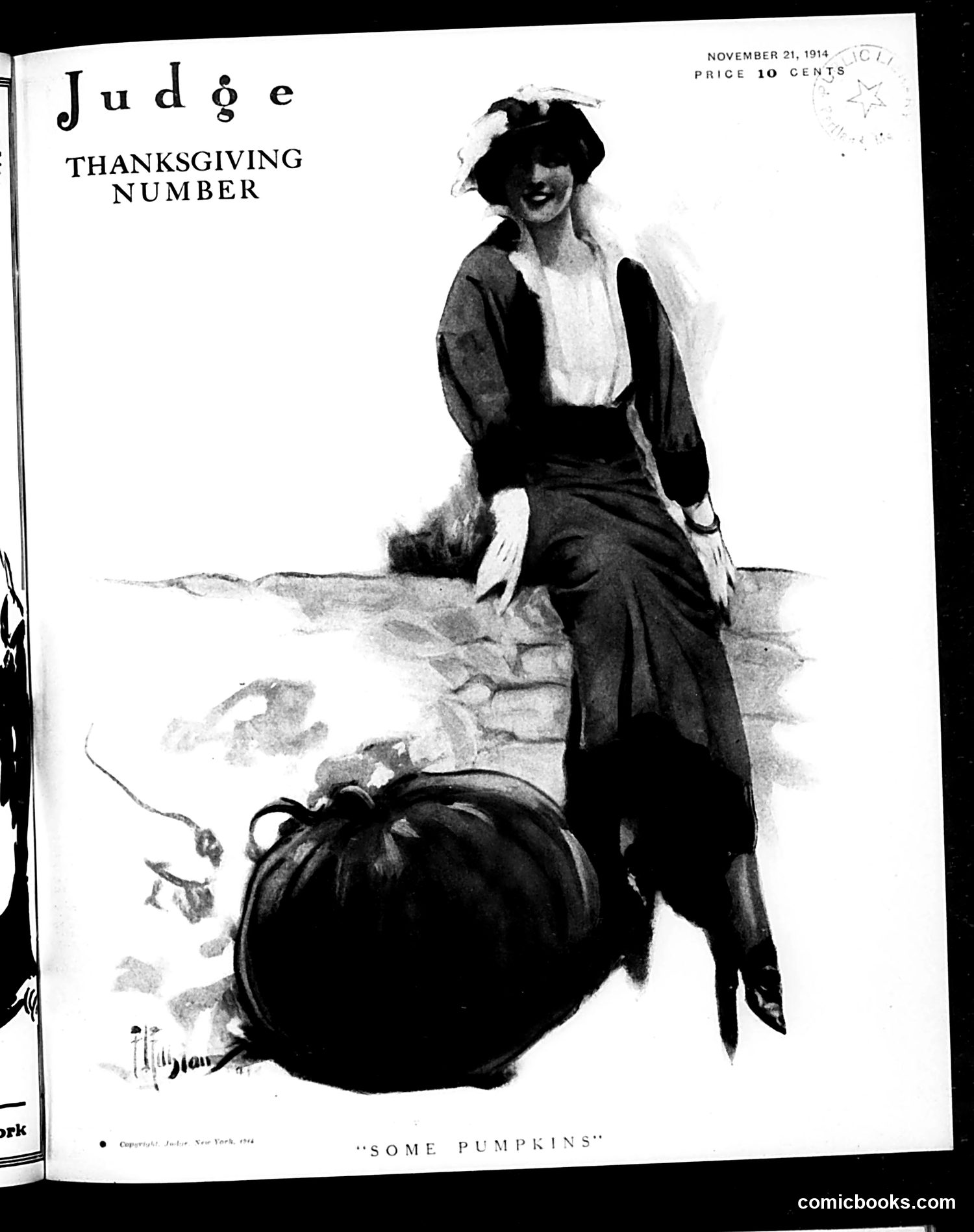
This cover illustration depicts a fashionably dressed woman posing with an oversized pumpkin, playing on the phrase "some pumpkins"—a slang expression meaning "something impressive" or "noteworthy." The Thanksgiving context is explicit in the header. The satire appears to mock either female fashion vanity or women's contemporary social prominence. By pairing an elegantly attired woman with a harvest vegetable—traditionally associated with rural simplicity and domestic duty—the artist creates ironic contrast. Whether this critiques women's fashion extravagance, their increasing public visibility, or simply plays on the holiday theme remains somewhat ambiguous from the image alone. The composition suggests the woman herself is being humorously presented as "some pumpkins"—worthy of display and attention.
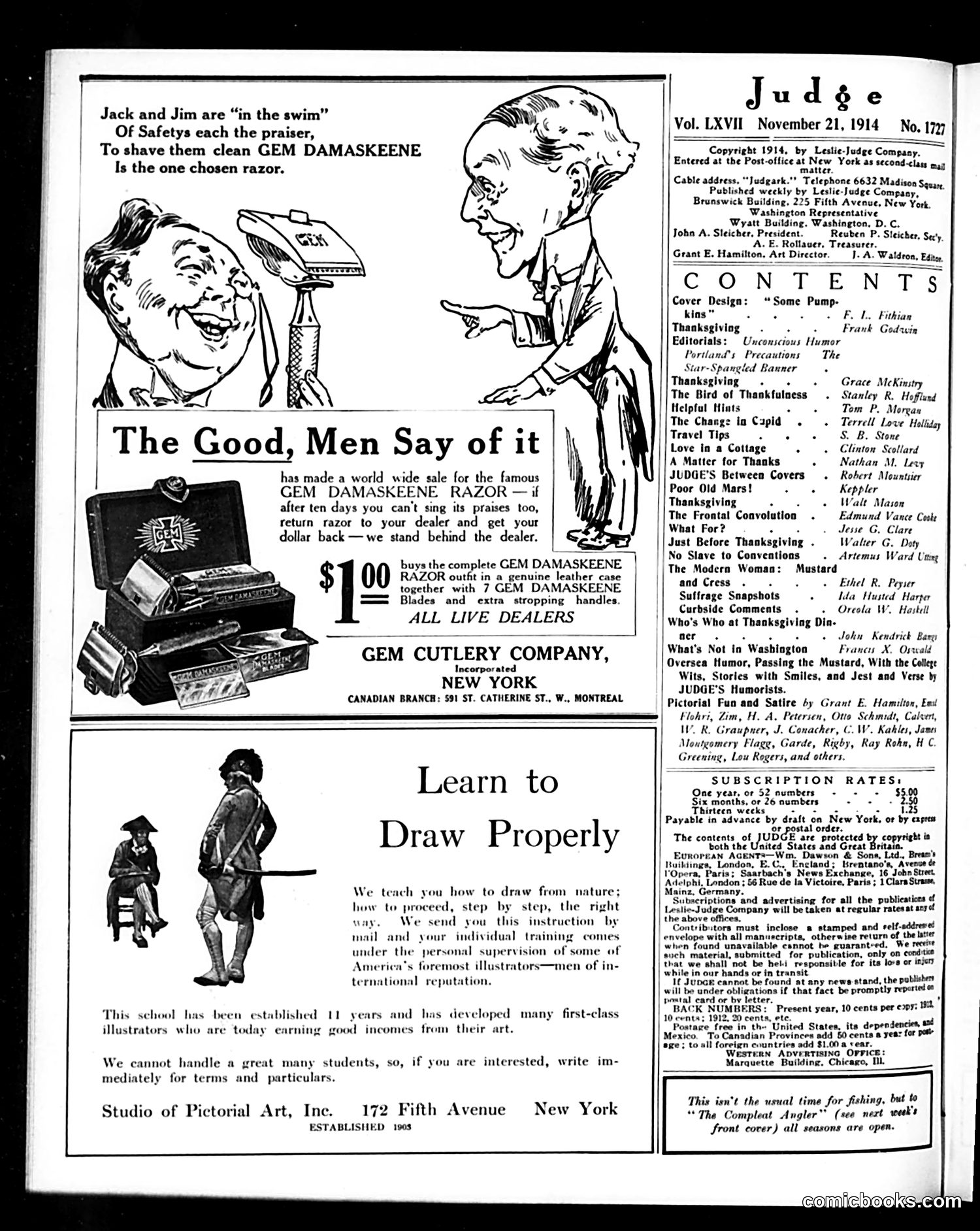
This page is primarily **advertising and editorial content** rather than political satire. The main cartoon at top depicts two men shaving, promoting Gem Damascene razors with the caption "The Good Men Say of it." The humor is straightforward product marketing—the cartoon shows satisfied users endorsing the razor's quality. Below is an advertisement for the "Studio of Pictorial Art, Inc." offering drawing instruction by mail. The right side contains the magazine's table of contents and subscription information. No significant political commentary or social satire is evident on this page. It appears to be a typical commercial magazine layout from 1914, mixing advertisements with editorial matter.
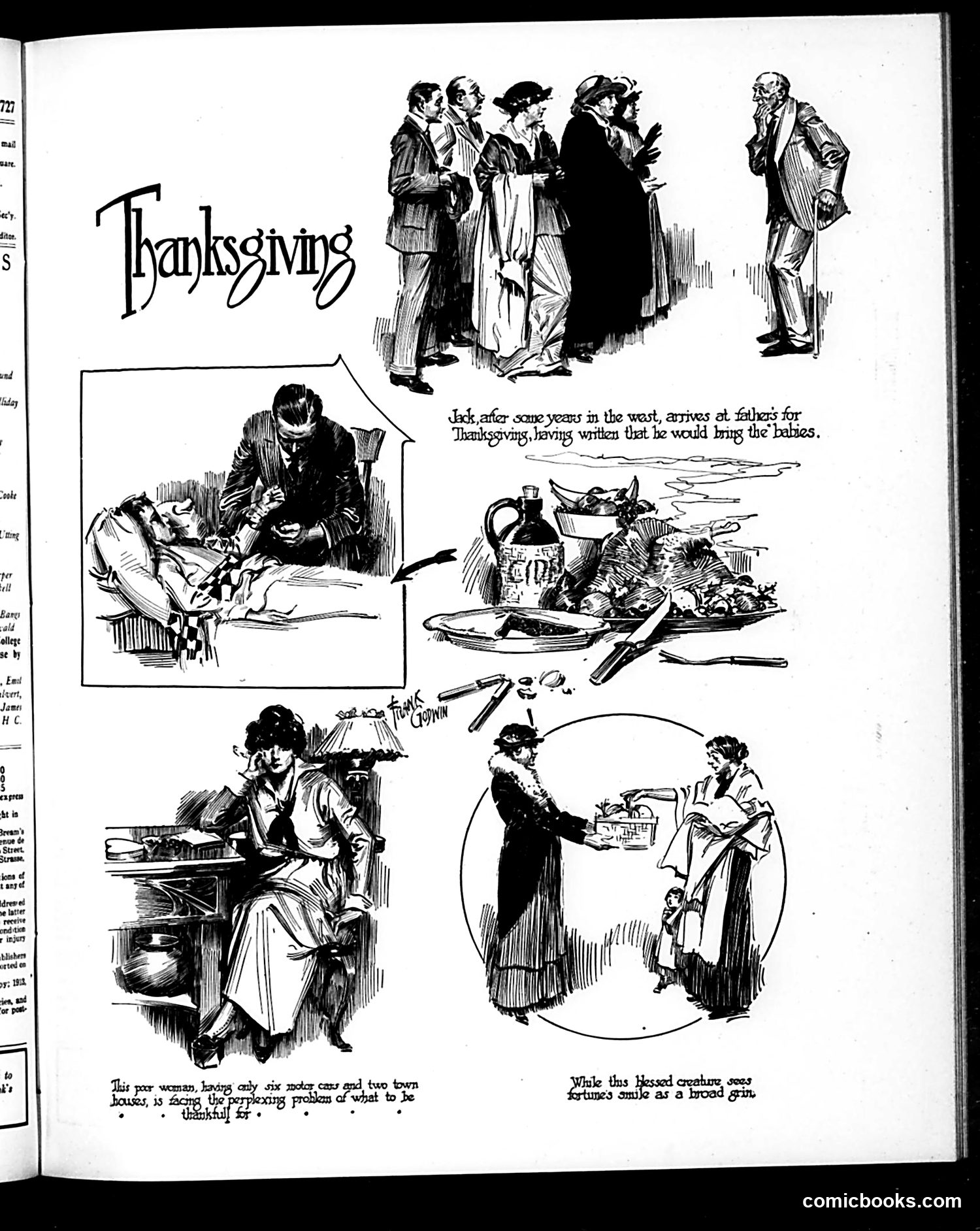
This page satirizes Thanksgiving dinner preparations and family dynamics. The narrative follows "Jack," who returns west after years away, promising to bring babies to his father's house for the holiday. The sequential panels depict: - Family members gathering to welcome him - A lavish Thanksgiving feast spread - A woman managing holiday cooking with limited resources ("only six weeks can and two town housed") - A final scene showing Jack arriving with a "blessed creature" (unclear if this refers to a wife or child) The satire appears to mock both the challenges of holiday entertaining and perhaps contemporary anxieties about bachelor life, family obligations, and domestic responsibilities. The humor derives from the contrast between expectations and domestic realities.
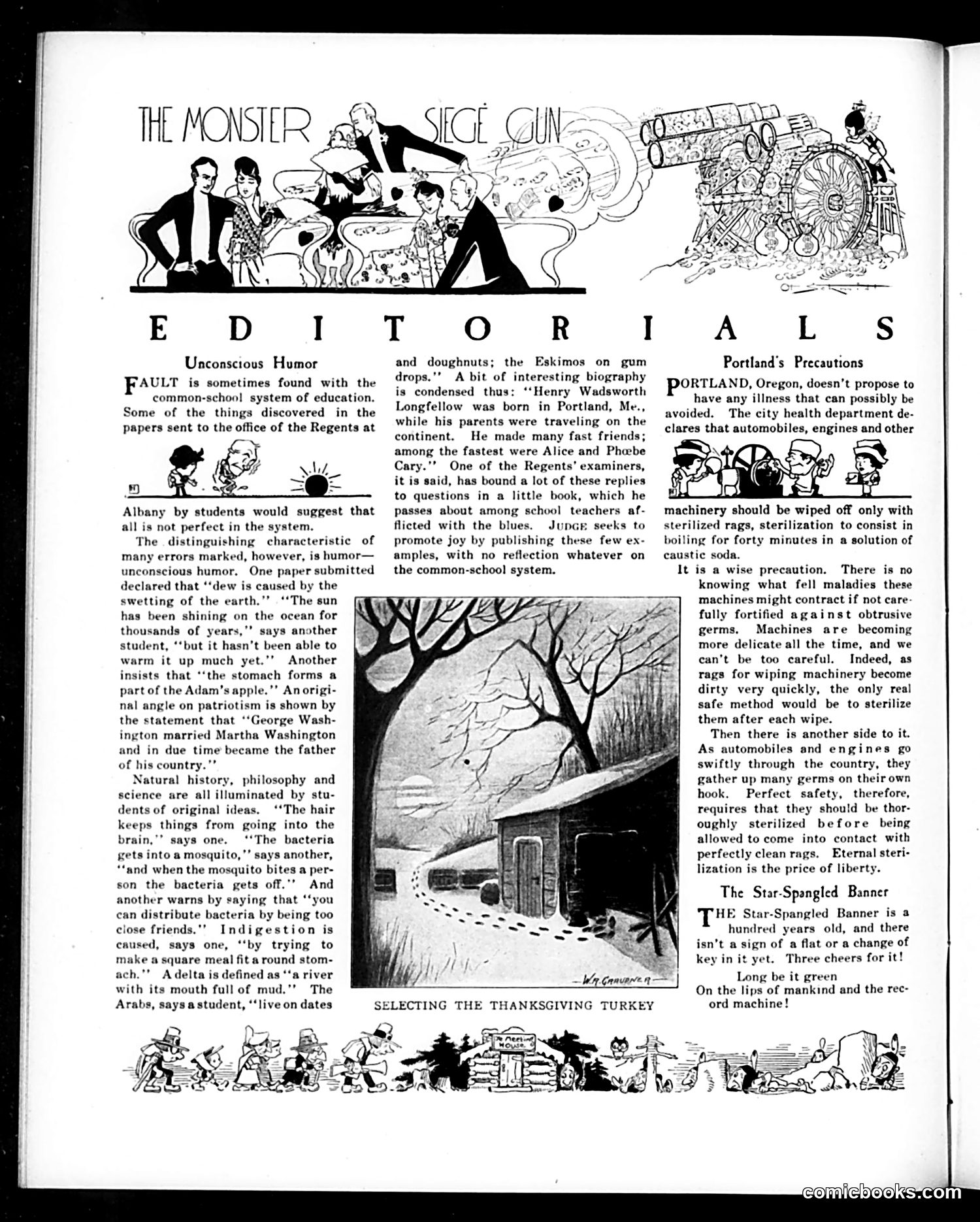
This Judge magazine page contains three separate satirical pieces: 1. **"Unconscious Humor"** - Mocks absurdities in education by republishing student papers and exam answers containing unintentional logical errors (dew caused by sweating, stomach as part of alimentary canal, etc.). The satire targets flawed reasoning in the school system. 2. **"Portland's Precautions"** - Criticizes Portland, Oregon's overly cautious health regulations requiring machinery sterilization. The piece ridicules this as excessive germaphobia, arguing that automobiles gathering germs during travel makes sterilization impractical and oppressive. 3. **"The Star-Spangled Banner"** - A brief celebratory piece about the national anthem's hundred-year anniversary, calling it unchanged and worthy of patriotic reverence. The page blends educational critique, public health satire, and patriotic sentiment typical of Judge's editorial voice.
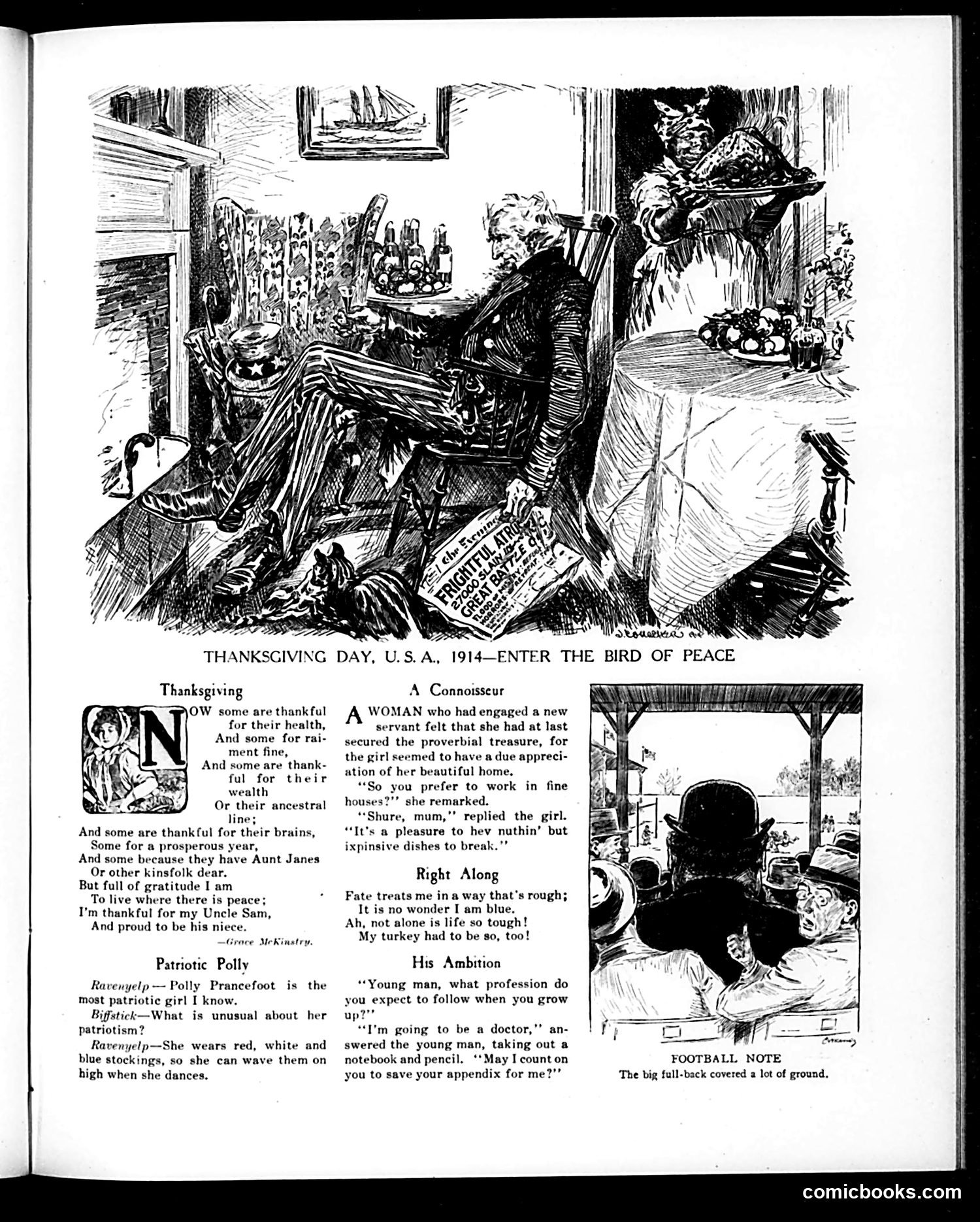
The main cartoon depicts Thanksgiving 1914 with a figure relaxing while a dove of peace enters—a reference to World War I's ongoing devastation in Europe. The irony suggests American comfort contrasting with global suffering. The accompanying text pieces are lighter humor: "Patriotic Polly" jokes about a woman wearing patriotic stockings; "A Connoisseur" features servant-employer banter about fine dishes; "Right Along" presents working-class resignation to hardship; "His Ambition" shows a young man joking with a doctor about saving his appendix. "Football Note" (lower right) makes a visual pun about fullbacks covering ground. These pieces represent typical Judge content—mixing political commentary about the war with domestic social satire and wordplay aimed at middle-class readers.
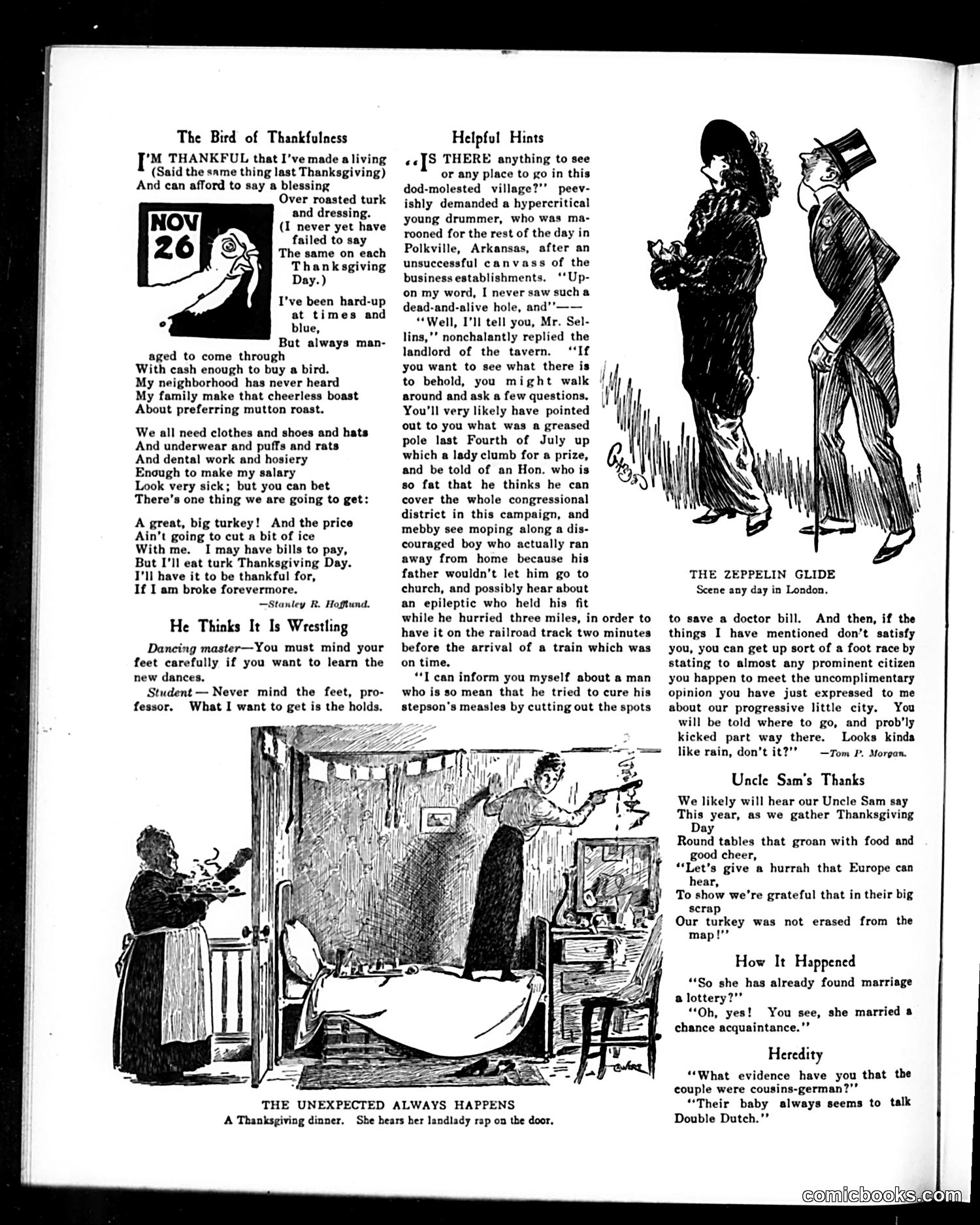
This Thanksgiving-themed page from Judge contains several satirical pieces reflecting early 20th-century American life: **"The Bird of Thankfulness"** celebrates working-class gratitude, with a man proud he can afford a turkey despite financial hardships—a relatable sentiment during economically uncertain times. **"He Thinks It Is Wrestling"** jokes about a dance student more interested in physical holds than footwork, likely mocking either working-class masculinity or dating customs of the era. **"The Zeppelin Glide"** references the contemporary threat of German zeppelin airships over London during World War I, satirizing how Londoners adapted to this danger through a new dance craze. **"Helpful Hints"** humorously describes a small-town drummer (traveling salesman) finding entertainment in local curiosities and eccentrics—poking fun at both provincial life and the drummer's sophistication. The remaining short pieces ("Uncle Sam's Thanks," "How It Happened," "Heredity") are brief joke items typical of Judge's format, with the last one playing on immigrant communities speaking Dutch or German.
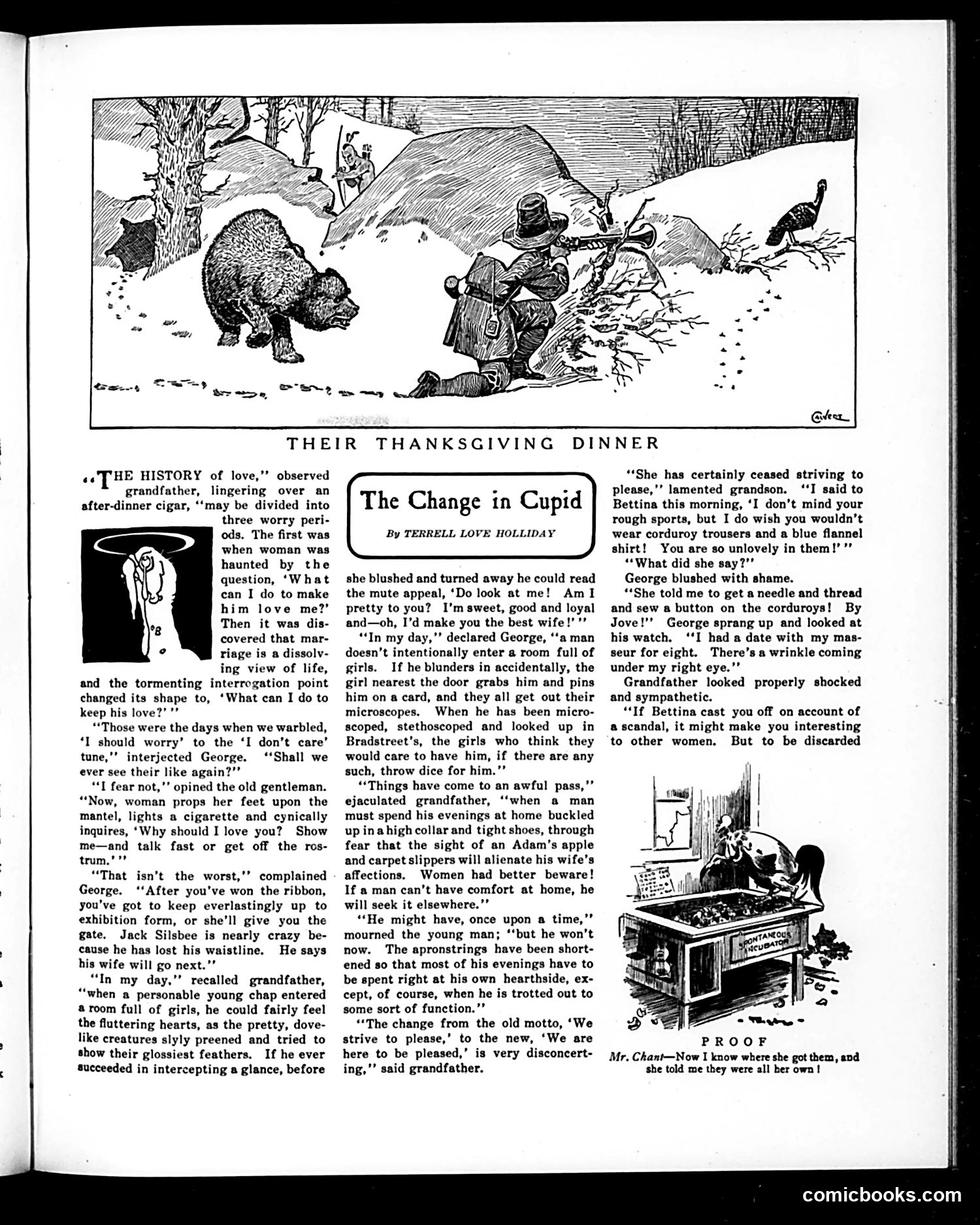
This 1920s satirical piece mocks the dramatic shift in courtship and marriage dynamics following women's increased independence and suffrage. **The main cartoon** (top) shows a hunter with a rifle encountering a bear—a visual metaphor for the role reversal discussed in the text. **"The Change in Cupid"** story contrasts three eras of romance: 1. **The Past**: Women were passive, demure, seeking male approval ("Do look at me! Am I pretty?") 2. **The Present** (the grandfather's day): Men still held power, women competed for attention 3. **Modern times** (when the story is set): Women are aggressive, dismissive, and controlling—they "grab" men, subject them to scrutiny like merchandise, and demand men stay home in discomfort rather than seek pleasure elsewhere The satire targets modern women as domineering and ungrateful, while depicting men as emasculated, worried about wrinkles, and attending masseuses. Judge presents this role reversal as absurd and threatening to masculine comfort and freedom—a common conservative complaint about 1920s "New Women."
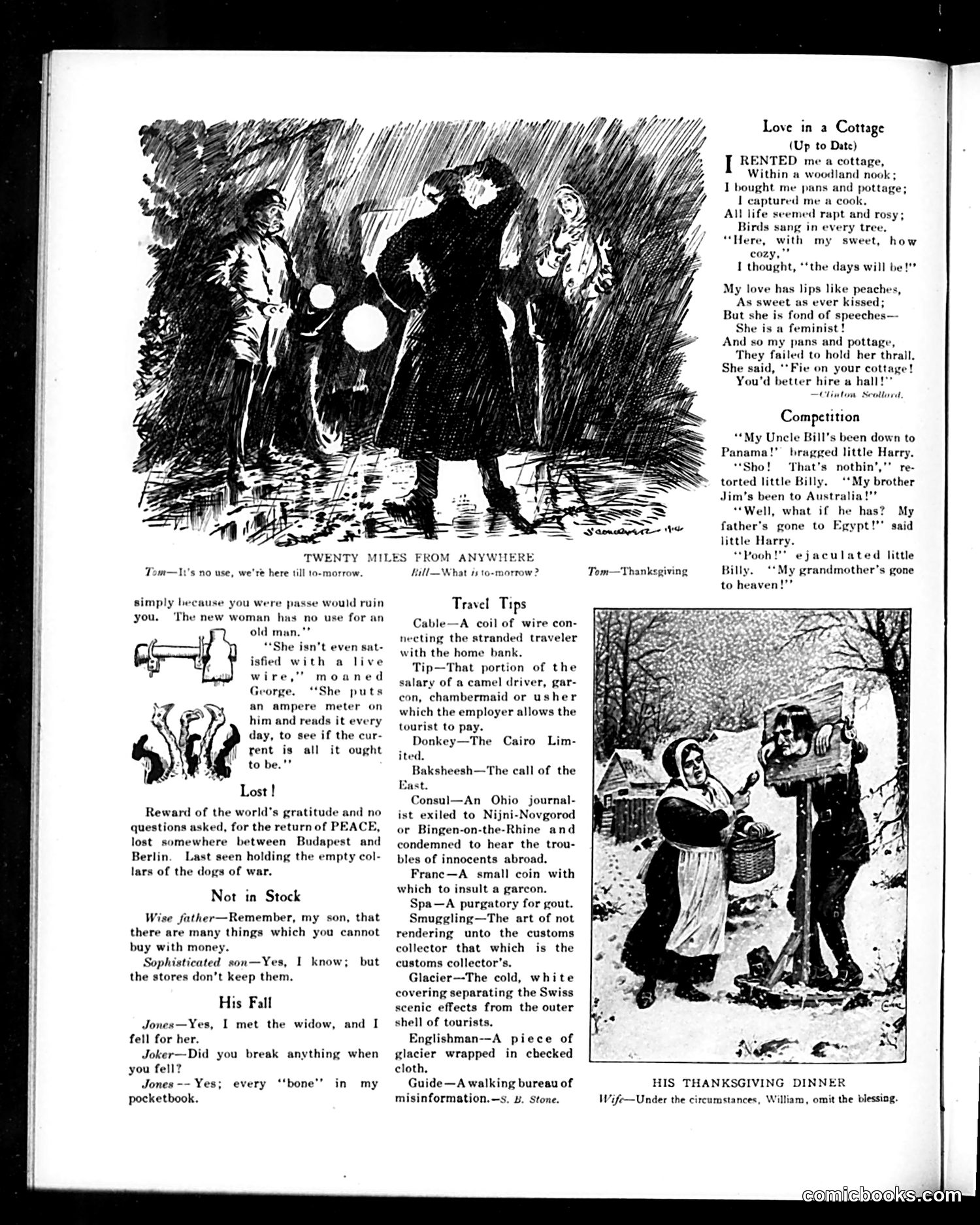
This page contains several satirical pieces mocking early 20th-century social trends and gender relations: **"Love in a Cottage (Up to Date)"** critiques the "New Woman" movement. A man rents a cottage expecting domestic bliss, but his girlfriend—described as a "feminist"—refuses to stay, demanding he "hire a hall" instead. The satire suggests feminists reject traditional domesticity, viewing it as constraining rather than romantic. **"Competition"** mocks children's boasting about world travel, culminating in one child claiming his grandmother has "gone to heaven"—a darkly humorous non-sequitur suggesting even the afterlife is now a competitive travel destination. **"His Thanksgiving Dinner"** shows a wife asking her husband to omit grace, implying cynicism about blessing their circumstances—likely referencing post-WWI disillusionment (the page references "dogs of war"). The "Travel Tips" section is satirical definitions of tourist-related terms, poking fun at travelers and foreign customs. Overall, the page reflects anxieties about changing gender roles and post-war cultural shifts.
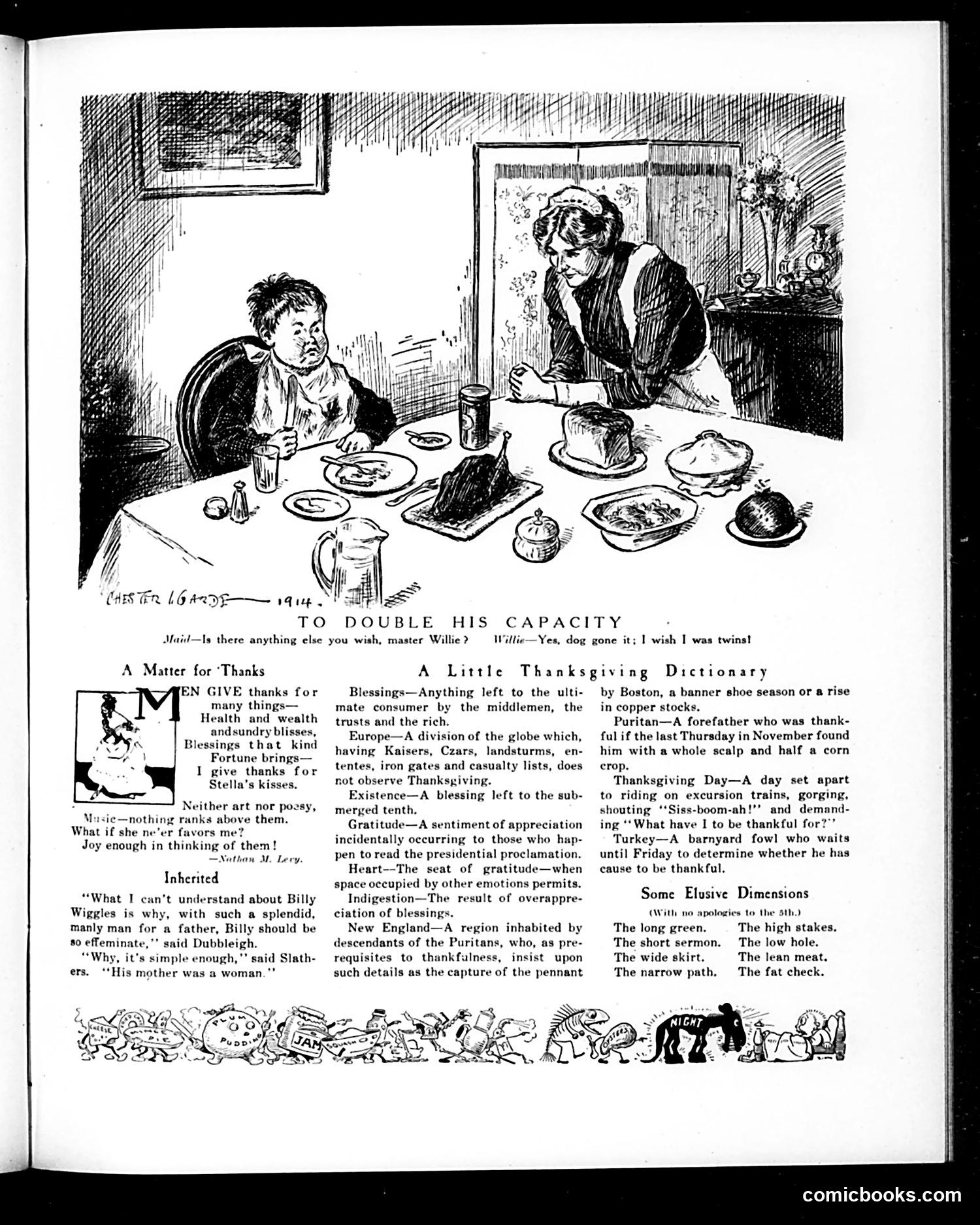
The main cartoon "To Double His Capacity" depicts a maid asking young Willie if he needs anything else at dinner. Willie responds he wishes he were twins—implying he wants to eat twice as much. This is a simple joke about childish gluttony, likely satirizing overindulgence during the Thanksgiving season. The page's primary content is a "Little Thanksgiving Dictionary"—satirical definitions mocking American attitudes toward the holiday and broader social conditions. Key targets include: the wealthy and middlemen who exploit consumers; Europe's ongoing warfare (likely WWI-era); economic inequality ("the submerged tenth"); and hypocrisy around gratitude. The definitions mock that New Englanders demand material prosperity before giving thanks, Puritans were grateful merely to survive, and modern Americans use the holiday primarily for excess consumption and boasting. The humor critiques commercialism, class inequality, and the gap between Thanksgiving's stated purpose and actual American practice.
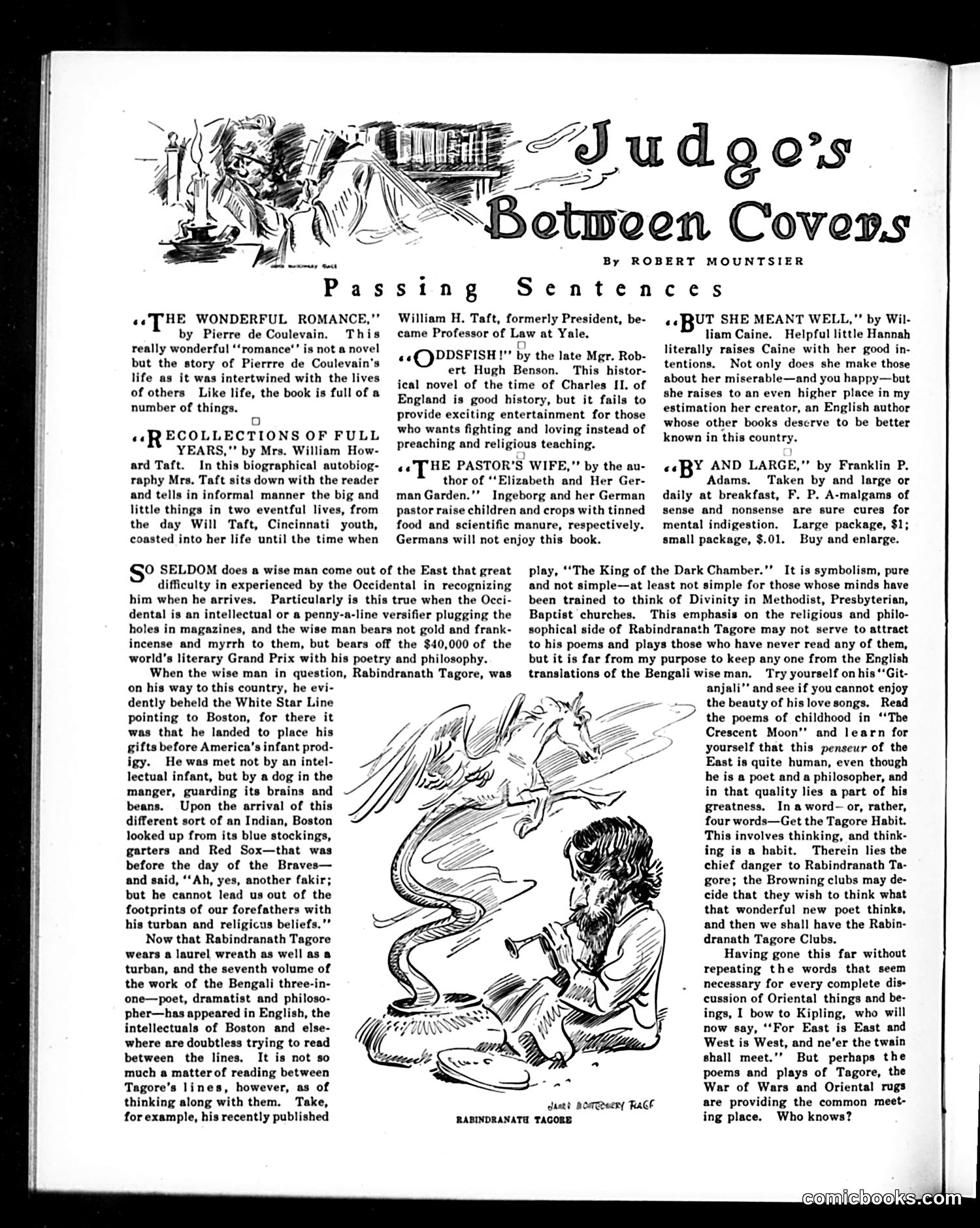
This page contains literary book reviews under the column title "Judge's Between Covers" by Robert Mountsier. The reviews are brief, witty dismissals of contemporary books, several by notable figures: William H. Taft's wife's autobiography, and works by various authors. The main satirical essay focuses on **Rabindranath Tagore**, the Bengali poet who won the Nobel Prize for Literature. The piece mocks Boston's initial dismissive reception of Tagore upon his arrival—calling him a "fakir" and doubting his turban and "religious beliefs" could teach anything to American intellectuals. The satire criticizes Boston's provincial smugness: the city's establishment (represented by "blue stockings, garters and Red Sox") couldn't recognize genuine intellectual merit from the East. Now that Tagore has been validated by international acclaim, Bostonians pretend to appreciate his complex symbolist plays, yet they lack the philosophical training to understand his work outside narrow Protestant frameworks. The cartoon depicting Tagore illustrates this theme of the misunderstood Eastern sage.
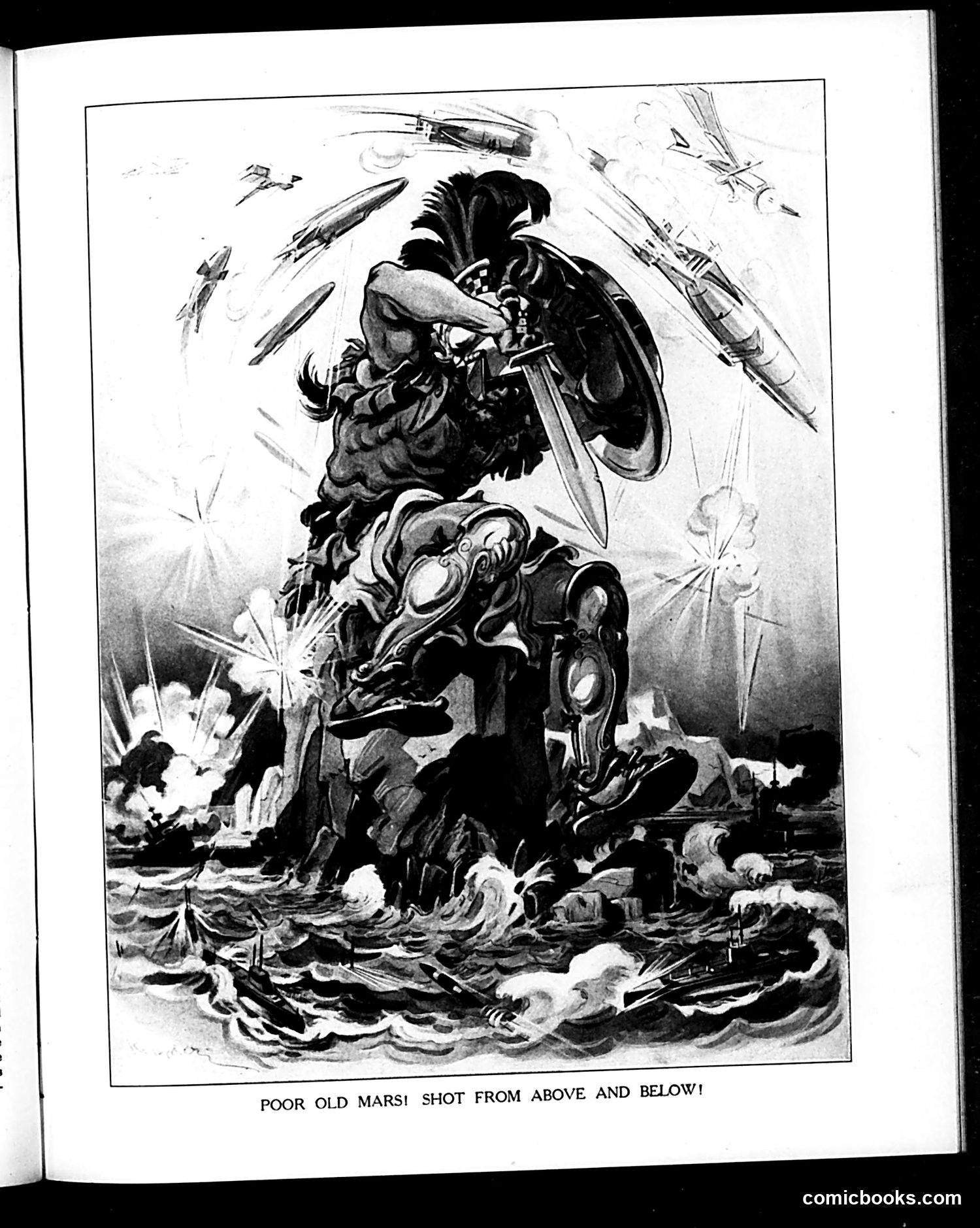
This is a satirical illustration depicting Mars (the Roman god of war, shown as an armored classical figure) under attack from above and below—likely representing bombardment from aircraft and naval vessels. The figure is surrounded by explosions, falling aircraft, and turbulent waters filled with debris. The cartoon appears to be WWI-era anti-war satire, critiquing the destructive power of modern warfare technology (planes, ships, artillery). By personifying Mars as a classical god being overwhelmed and suffering, the artist suggests that even the traditional symbol of warfare itself is being devastated by contemporary industrial-scale combat. The tone is darkly humorous—"Poor old Mars"—treating the god's plight sympathetically while illustrating war's unprecedented destructiveness.
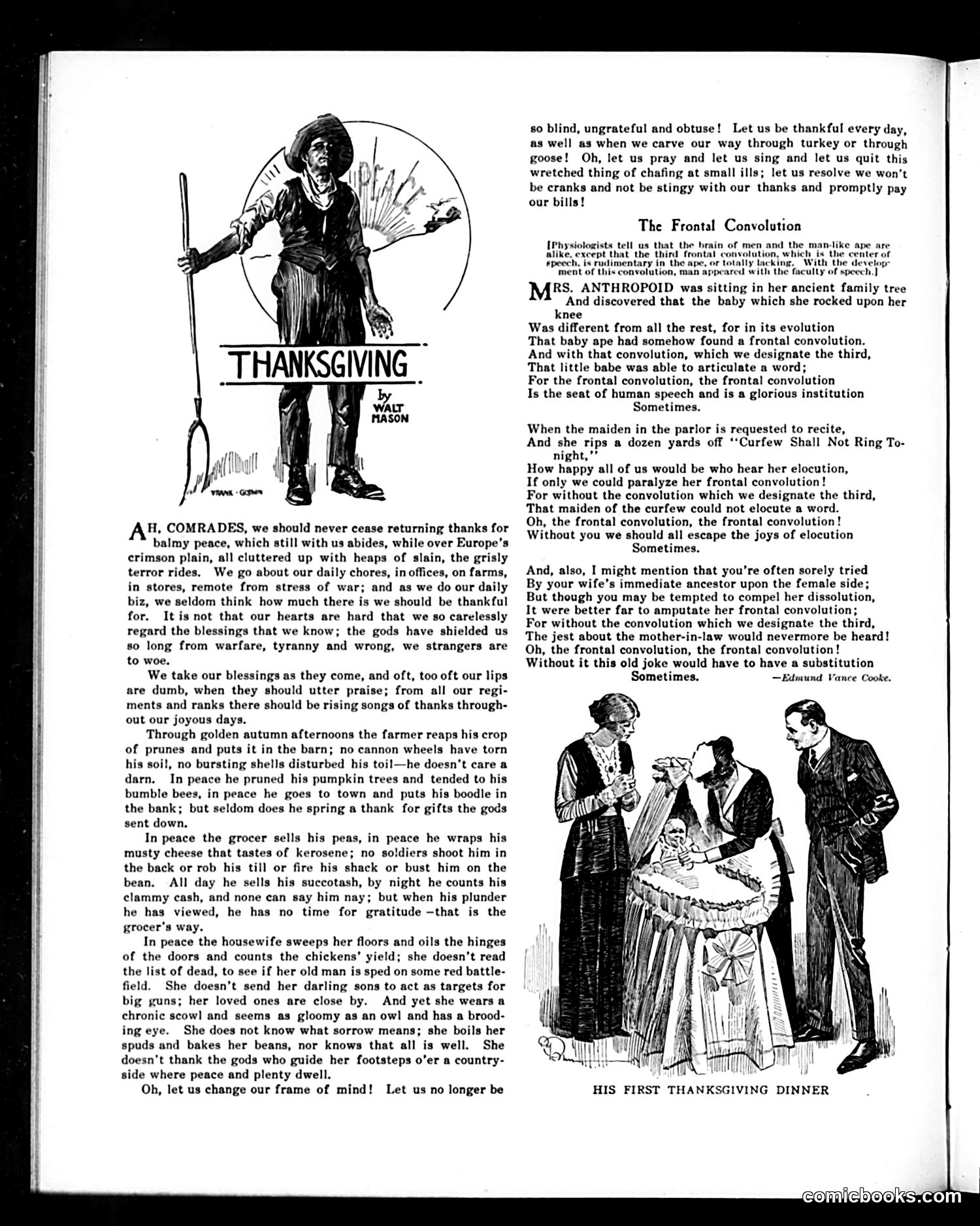
**"Thanksgiving"** (by Walt Mason) is a wartime moral essay. It contrasts Americans' peaceful abundance with Europe's ongoing warfare, urging citizens to show genuine gratitude rather than take blessings for granted. The piece satirizes specific types—farmers, grocers, and housewives—who enjoy peace and prosperity yet remain ungrateful, "cranky," and reluctant to pay bills promptly. The message: Americans should appreciate their safety and plenty, especially relative to war-torn Europe. **"The Frontal Convolution"** is a humorous poem based on contemporary neuroscience claims that speech ability derives from a brain region (the third frontal convolution) absent or undeveloped in apes. It jokes that while this convolution enables human speech, sometimes we wish it could be "paralyzed"—particularly when women recite lengthy poems like "Curfew Shall Not Ring Tonight" (a popular sentimental verse). The satire targets overly dramatic elocution and verbose speakers.
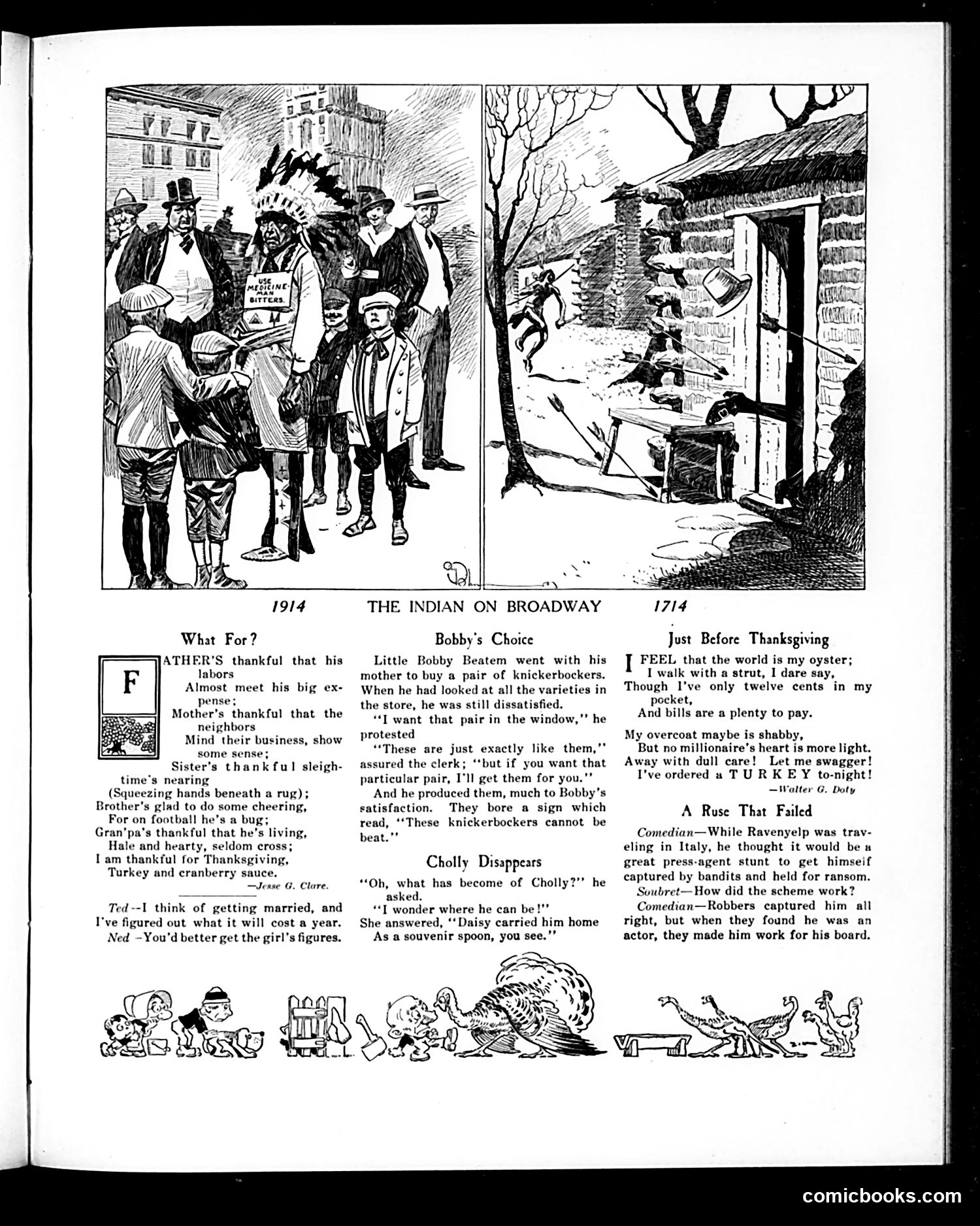
This page contains multiple brief humorous pieces typical of Judge magazine. The title cartoon appears to contrast urban sophistication (left panel showing well-dressed city people, one wearing a Native American headdress) with frontier/rural simplicity (right panel showing a cabin scene). The specific satire is unclear without additional context, though it likely mocks either pretentious "playing Indian" among city dwellers or Native American stereotypes popular in early 20th-century entertainment. The surrounding items are lighthearted domestic humor: poems about Thanksgiving gratitude, brief jokes about shopping for children's clothing and romance, and theatrical anecdotes. The humor relies on wordplay and gentle social observation rather than sharp political commentary. The "Indian on Broadway" title suggests contrasting civilization with primitiveness—a common satirical theme of the era.
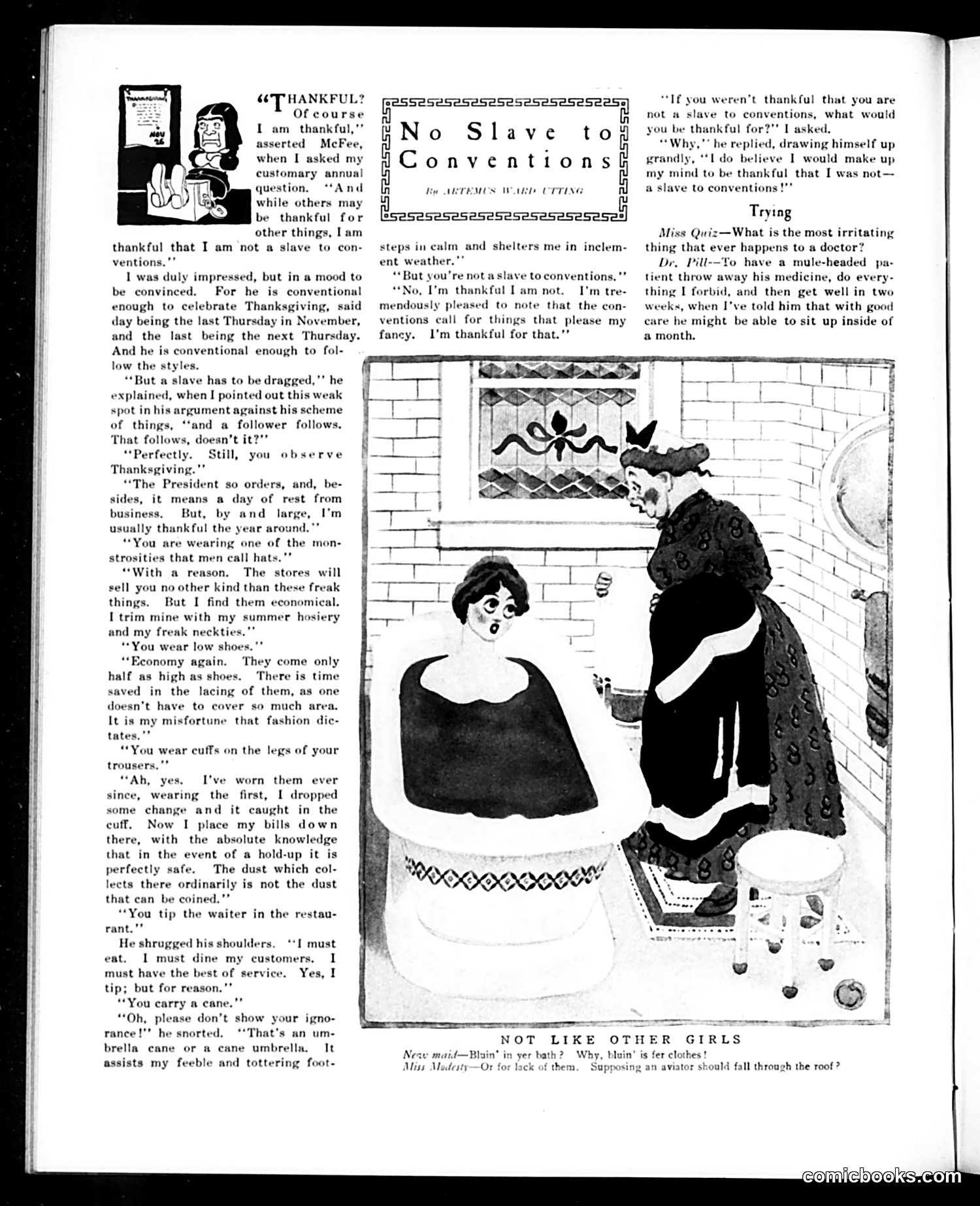
This page contains satirical commentary on American conventions and social conformity circa the early 1900s. **Main Article**: "No Slave to Conventions" features a dialogue (attributed to Artemus Ward writing) between a narrator and a man named McFee. McFee claims he's not enslaved by social conventions, yet the narrator systematically demonstrates that McFee *is* bound by them—he celebrates Thanksgiving because the President orders it, wears fashionable (if impractical) hats and low shoes, tips waiters, and carries a cane-umbrella. The satire targets the hypocrisy of people who boast of independence while rigidly following fashion and etiquette. **Bottom cartoon**: "Not Like Other Girls" shows a maid and mistress discussing bathing and laundry. The humor appears to hinge on the maid's confusion between "bluing" (a laundry additive) and the mistress's implicit moral judgment, with absurdist humor about an aviator falling through the roof. The page mocks conformism and pretentious claims of individuality among the middle class.
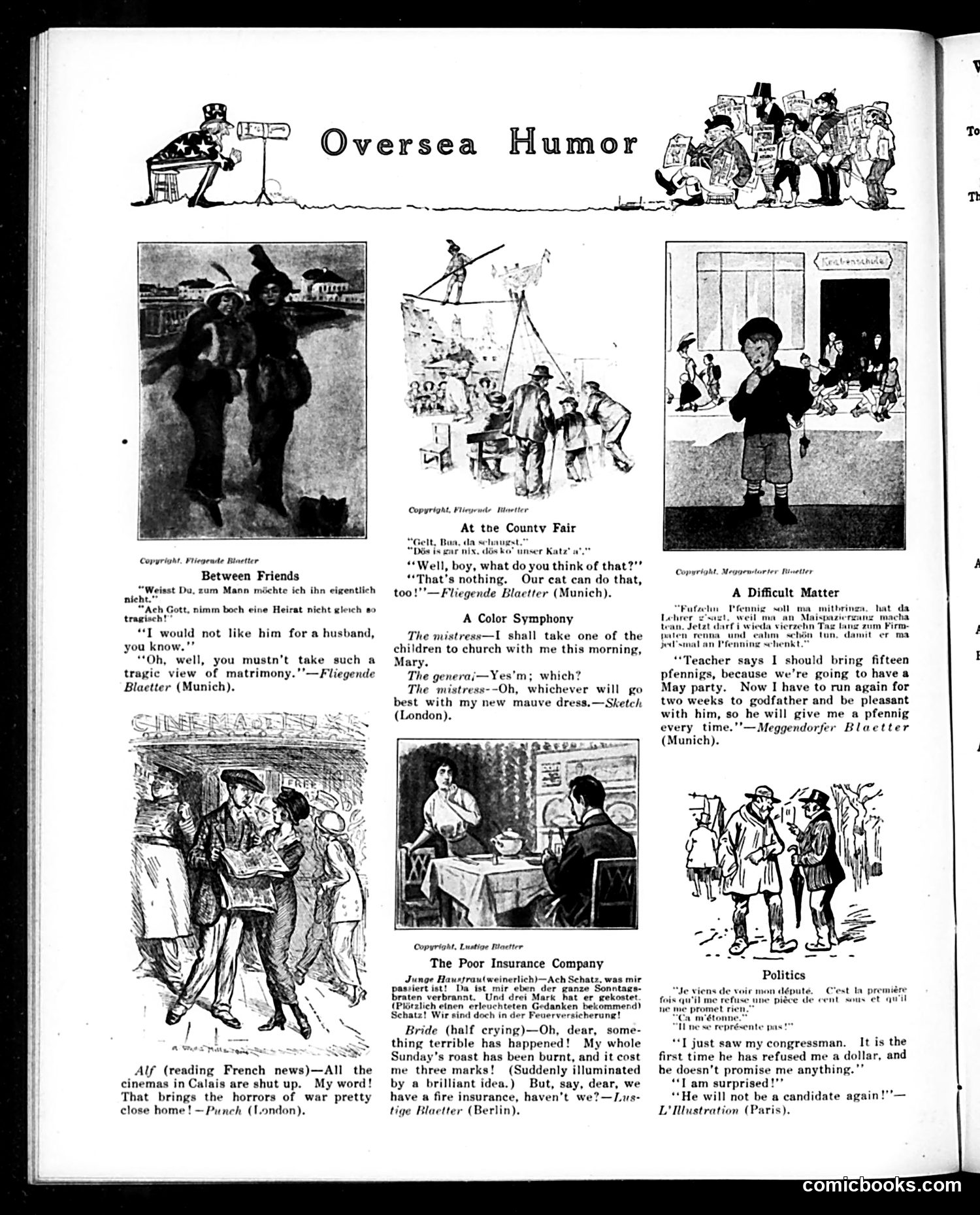
This page collects humorous shorts from European satirical magazines, translated for American readers. Key pieces: **"Between Friends"** (Munich): A woman dismisses a suitor, and her friend advises not taking matrimony "tragically"—gentle satire on marriage attitudes. **"Alf"** (London): A man reads that cinemas in Calais closed, lamenting this brings "horrors of war pretty close home"—dark humor about WWI's impact on civilian life through entertainment closures rather than combat. **"County Fair"** & **"Color Symphony"**: Mild domestic humor about children and fashion. **"Poor Insurance Company"** (Berlin): A newlywed burns Sunday roast, then realizes she can claim it via fire insurance—satirizing fraud temptation or insurance absurdity. **"Politics"** (Paris): A congressman refuses a dollar for the first time and won't promise anything—cynical commentary on political corruption and broken promises to constituents. The page reflects early-20th-century European attitudes toward marriage, war, and political dishonesty.
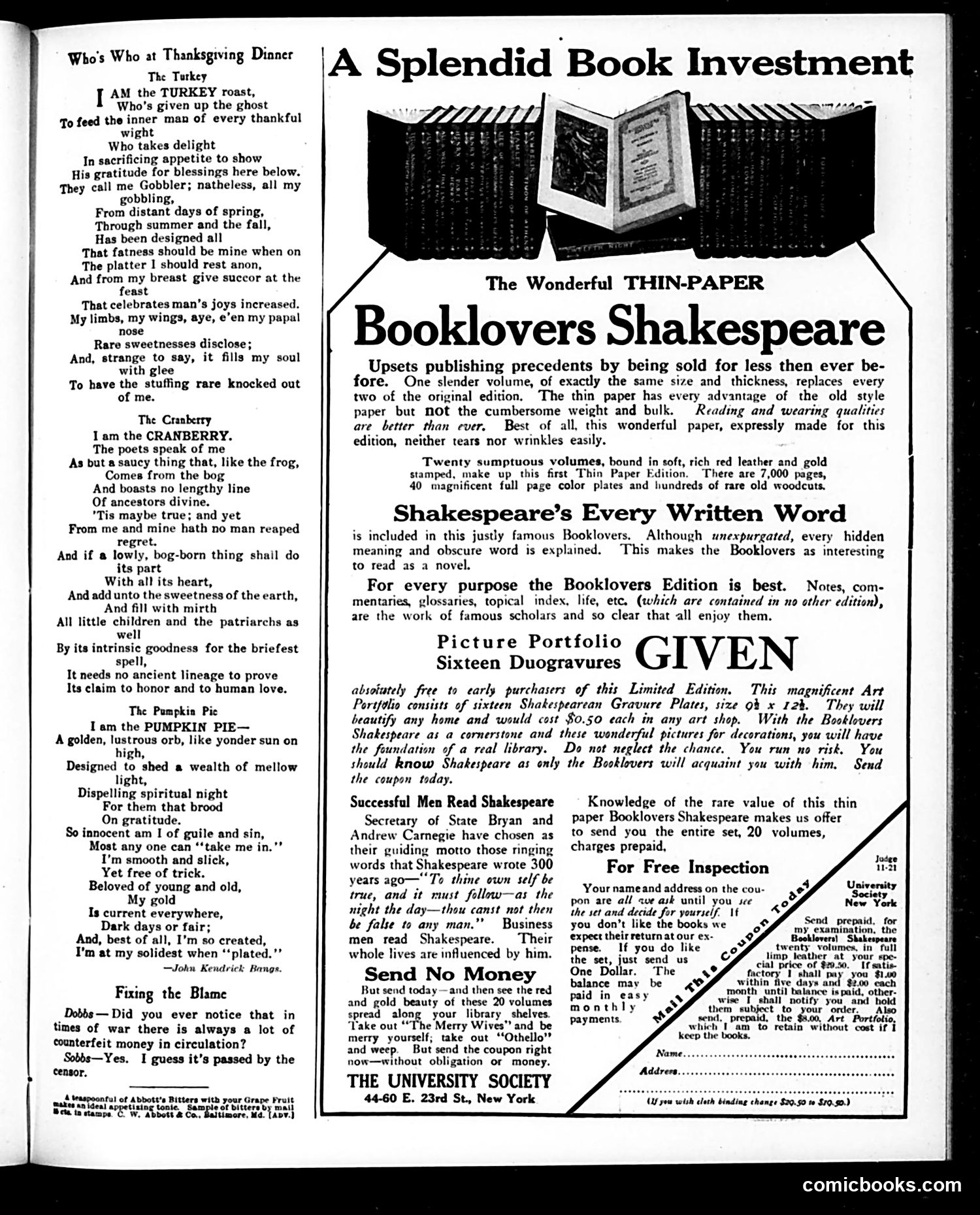
This page is primarily **advertising**, not political satire. The left side presents humorous Thanksgiving poems personifying the turkey, cranberry, and pumpkin pie—a lighthearted literary feature typical of *Judge* magazine. The right side advertises the "Booklovers Shakespeare," a thin-paper edition claiming to revolutionize book publishing by reducing twenty volumes into ten while maintaining readability. The pitch emphasizes completeness ("every written word"), scholarly annotations, and a free art portfolio of sixteen gravure plates. The small joke at bottom—"Fixing the Blame"—is unrelated humor about counterfeit money circulating during wartime; it's a throwaway gag. **For modern readers:** This reflects early 20th-century publishing marketing and shows how luxury books were sold to middle-class collectors as status symbols and cultural investments. The thin-paper innovation was genuinely novel then.
This satirical column mocks Congress for proposing absurd "reforms" during periods of legislative inactivity. The specific target is a hypothetical plan to revise the multiplication table "downward"—a nonsensical proposal that uses mathematical absurdity to lampoon Congressional tendency toward trivial, grandstanding legislation. The satire works on multiple levels: it ridicules politicians for wasting time on frivolous reforms while ignoring substantive issues (tariffs, currency, war taxes, Philippines policy). It also mocks Democratic platform promises of "downward" revision across all policy—suggesting such logic applied to basic mathematics becomes obviously ridiculous. The author implies Congress seeks voter approval through populist-sounding but meaningless initiatives, and notes that even conservative "stand-patters" would resist such radical change. The piece expresses cynical skepticism about Congressional priorities and legislative competence during the early 20th century.
This is primarily a **humor/joke collection page** from Judge magazine, with advertising. The left column contains short satirical anecdotes mocking everyday absurdities and human nature. **Key jokes include:** - A pun about "hen" (the letter abbreviation for "new-laid") confusing an American tourist in London - Social commentary on class aspiration (a man bragging about having a bell to ring for a valet he doesn't actually employ) - Gender stereotypes (women attracted to "battered-up football players" due to "feminine love of remnants") - Marital dynamics (a wife's endless shopping demands motivating her husband's success) **The main poem, "Wanderlust,"** expresses romanticized restlessness—the universal human desire to escape one's current circumstances, drawn by distant sensations (street organs, sea breezes, travel). **Right side:** Advertisements for Club Cocktails and The Craftsman magazine, featuring period imagery typical of early 20th-century luxury goods marketing. The humor is lighthearted, relying on wordplay, gender stereotypes, and observations of middle-class behavior rather than political satire.
This page's main satirical content is "The Expert," a poem illustrated with a drawing of a man giving advice. The satire targets a recognizable social type: someone who constantly offers unsolicited guidance to others—telling plumbers how to plumb, bakers how to bake, bankers about money—yet refuses to apply effort to his own tasks. The poem's core joke is the hypocrisy of expertise without practice. The "expert" is an armchair critic and busybody who feels qualified to instruct everyone around him but promptly shirks when faced with actual work himself. The illustration shows this meddlesome figure gesturing instructively. This targets a universal human tendency the 1910s audience would recognize: the know-it-all who masks laziness or incompetence behind the performance of expertise. It's social commentary on false authority and performative knowledge, presented through gentle, accessible humor typical of *Judge* magazine's satirical approach.
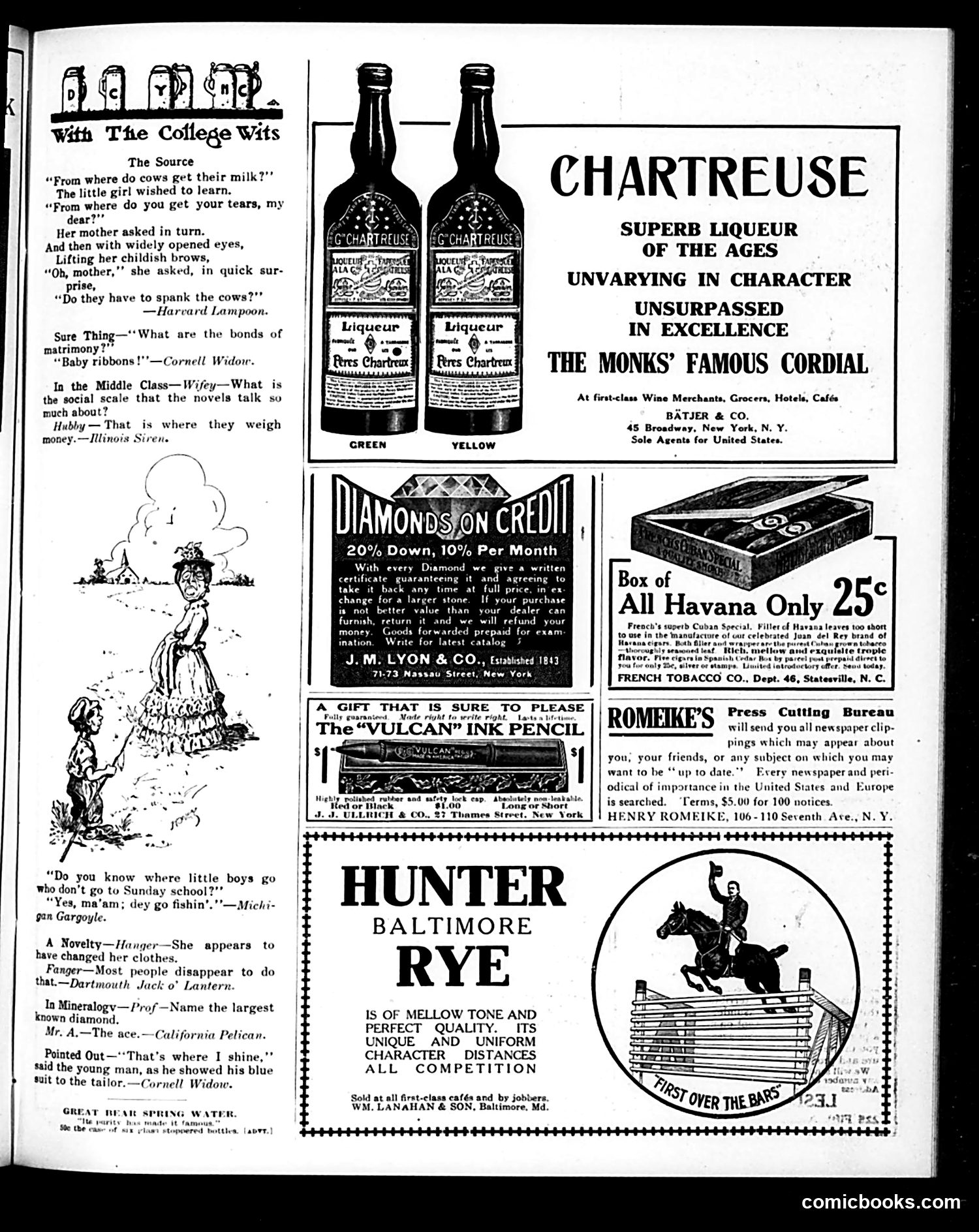
This page is primarily **advertising with minimal editorial content**. The top section, "With The College Wits," reprints humorous one-liners from college humor publications (Harvard Lampoon, Cornell Widow, etc.)—mostly innocent jokes about children, marriage, and student life typical of early 20th-century college humor. The bulk of the page contains **period advertisements**: Chartreuse liqueur, diamond sales, ink pencils, cigars, a press-clipping service, and Hunter Baltimore Rye whiskey. These ads reflect contemporary consumer goods and services. **Context for modern readers**: The repeated alcohol advertising (liqueur, rye whiskey) reflects the pre-Prohibition era (before 1920), when such advertisements were standard in mainstream publications. The "20% Down" diamond financing and mail-order goods represent emerging consumer credit practices. The college humor reprints show early 20th-century sensibilities about gender and childhood that differ markedly from today. There is **no significant political satire or social commentary** on this particular page—it functions as a commercial publication mixing light collegiate humor with paid advertisements.
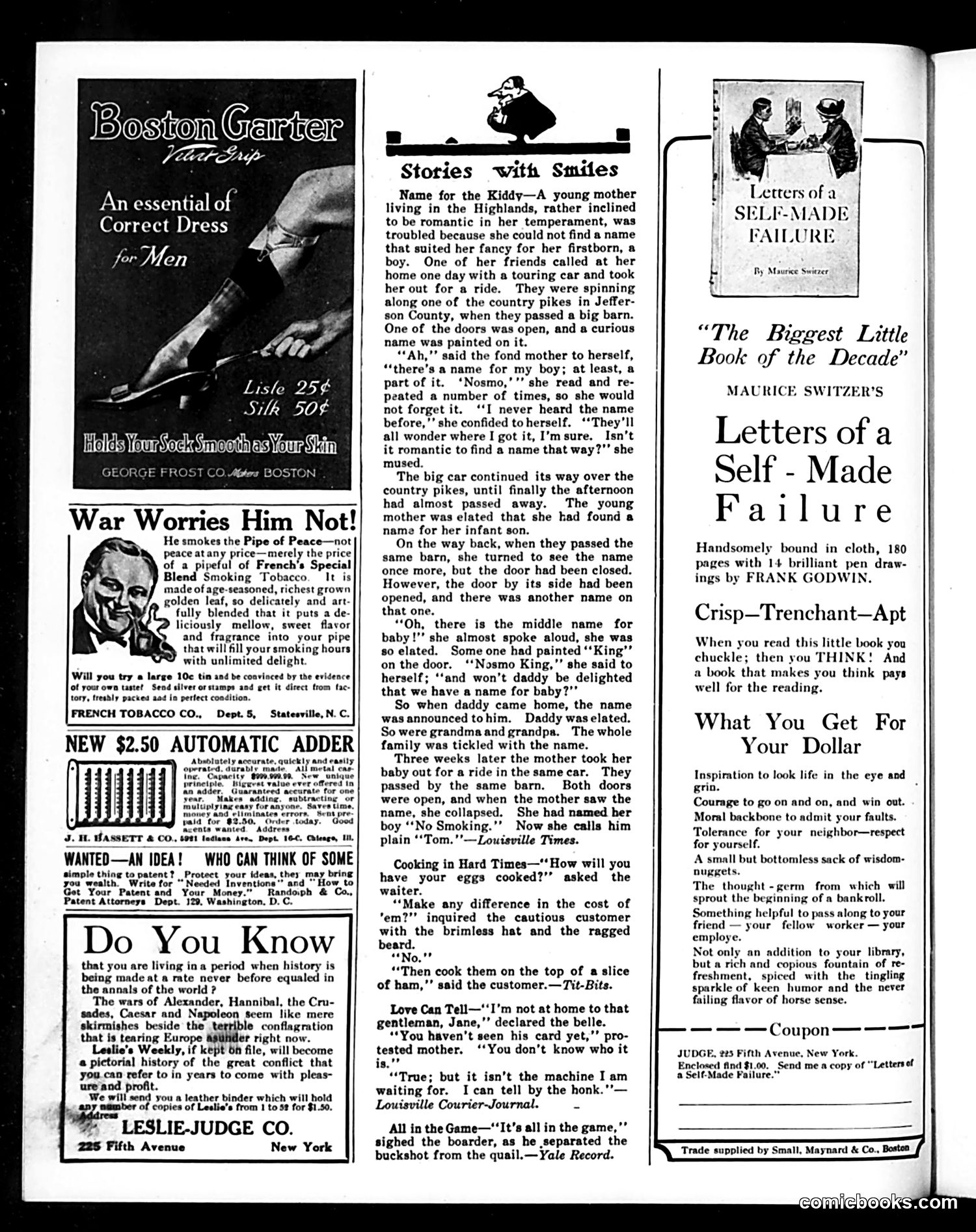
This page is primarily **advertisements and light humor** with no political cartoons. The main content is an anecdote titled "Name for the Kiddy." A romantic mother sees "Nosmo" painted on a barn door and decides to name her son after it. Later, passing the barn again, she sees "King" on another door and adds it as a middle name, thrilled with "Nosmo King." The joke's punchline: when she drives past once more, both doors are open, revealing the full text: **"No Smoking King"**—she'd unknowingly named her child after a prohibition sign. The humor relies on the reader recognizing the absurdity of missing obvious context. It's genteel satire about romantic sentimentality overriding practical observation—a common *Judge* magazine style. The anecdote mocks sentimental middle-class mothers of the era who prioritize aesthetic or romantic notions over sense. The surrounding content consists entirely of commercial advertisements (Boston Garters, tobacco, patent services, book subscriptions).
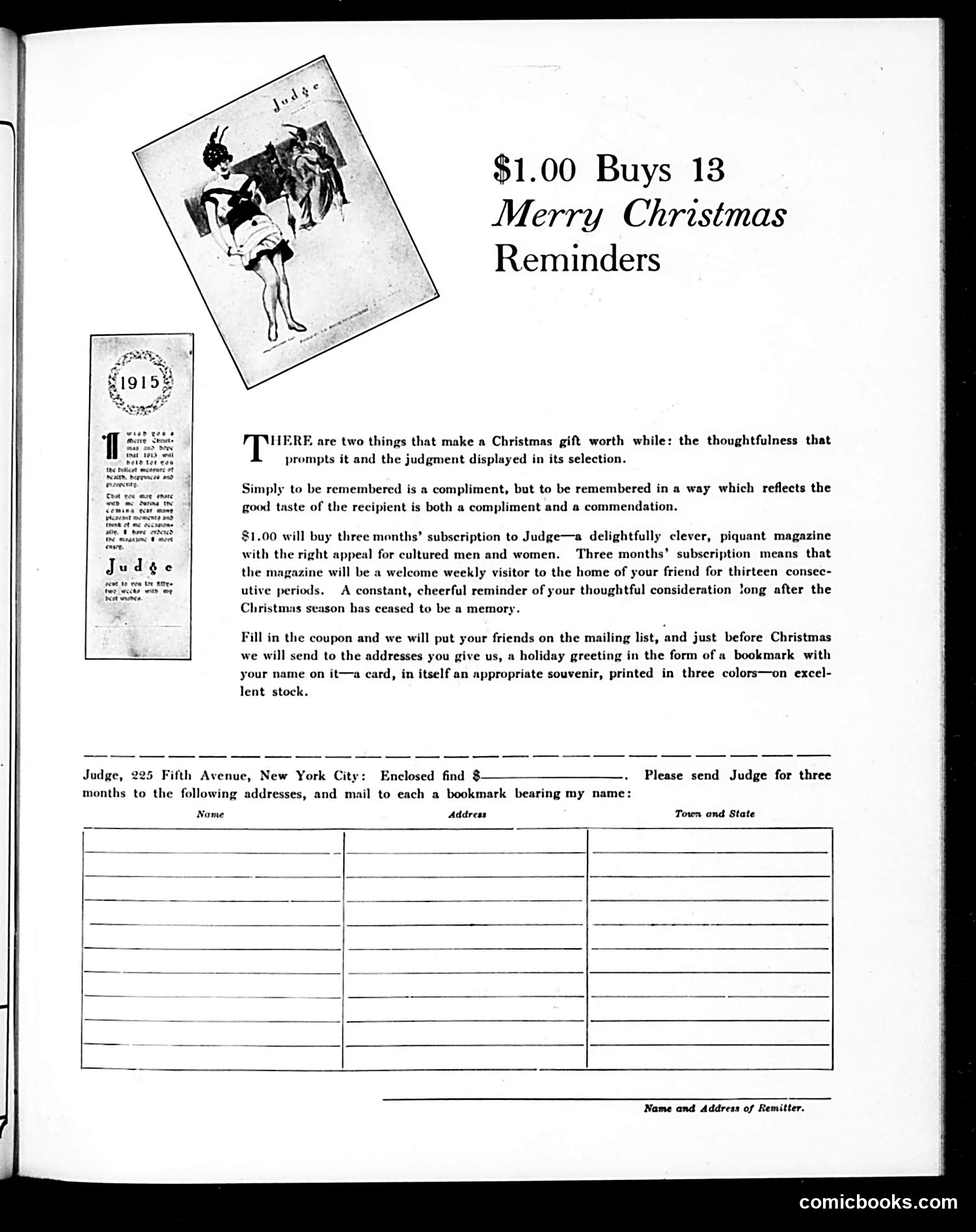
This is primarily a **gift subscription advertisement** for *Judge* magazine, not a political cartoon page. The small illustration at top left shows a figure labeled "Judge" (the magazine's mascot/personification) in a satirical pose—appearing to be a jester or fool-like character, which is typical of how *Judge* branded itself as a witty, irreverent publication. The advertisement pitches a $1.00 three-month subscription as an ideal Christmas gift for "cultured men and women." The sales pitch emphasizes that it's a "thoughtful" gift that keeps reminding recipients of the giver's good taste for thirteen consecutive weeks. As incentive, *Judge* promises to send personalized bookmarks (printed in three colors) bearing the gift-giver's name to each recipient's address before Christmas. The 1915 date badge visible on the left confirms this is vintage advertising, reflecting early 20th-century gift-giving practices and magazine subscription marketing.
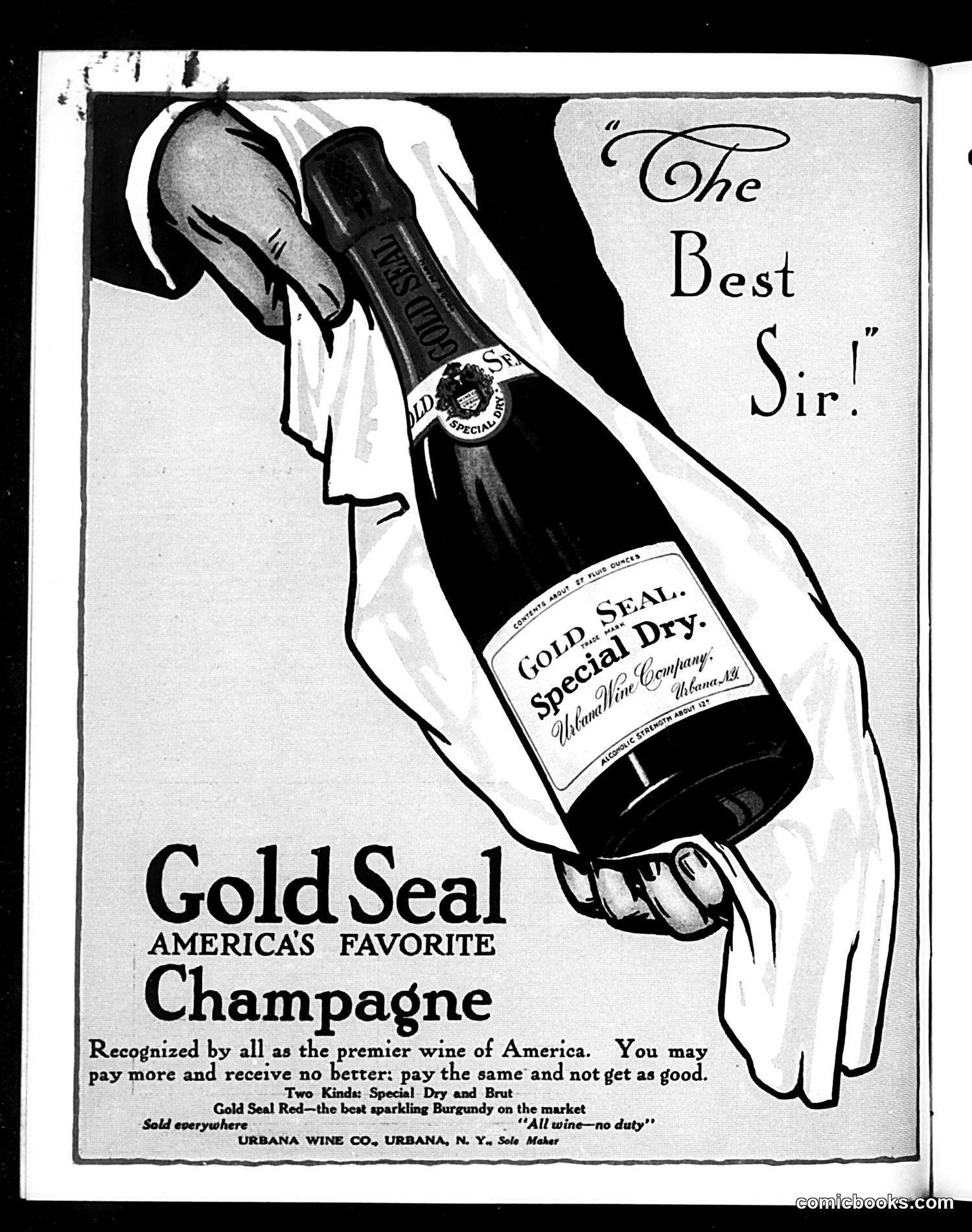
This is a **full-page advertisement**, not political satire. It promotes Gold Seal Champagne, made by Urbana Wine Co. in New York. The image shows an elegantly gloved hand holding a bottle labeled "Cold Seal Special Dry." The tagline "'The Best Sir'" positions the product as a premium choice. The sales pitch claims Gold Seal is "America's favorite" and "premier wine," arguing you cannot buy better quality at any price point—a classic luxury goods marketing strategy. The reference to "All wine—no duty" likely alludes to **Prohibition-era politics** (the ad appears pre-1933), when imported wine faced tariffs. This suggests the champagne was American-made, positioning it as patriotic and economical. The overall tone appeals to affluent consumers seeking status and value.