
Judge, 1914-11-21 · page 10 of 24
Judge — November 21, 1914 — page 10: what you’re looking at
What you’re looking at
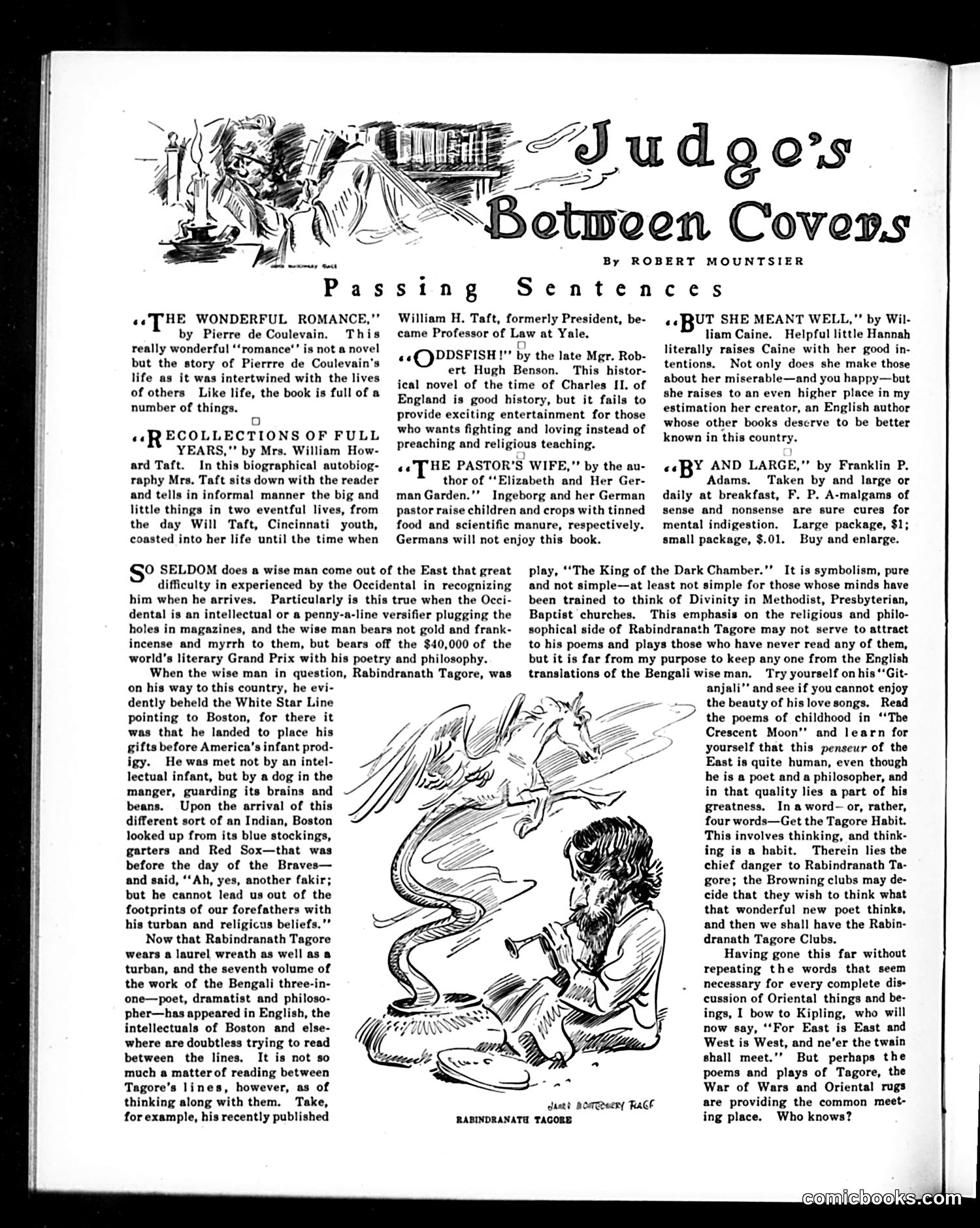
This page contains literary book reviews under the column title "Judge's Between Covers" by Robert Mountsier. The reviews are brief, witty dismissals of contemporary books, several by notable figures: William H. Taft's wife's autobiography, and works by various authors. The main satirical essay focuses on **Rabindranath Tagore**, the Bengali poet who won the Nobel Prize for Literature. The piece mocks Boston's initial dismissive reception of Tagore upon his arrival—calling him a "fakir" and doubting his turban and "religious beliefs" could teach anything to American intellectuals. The satire criticizes Boston's provincial smugness: the city's establishment (represented by "blue stockings, garters and Red Sox") couldn't recognize genuine intellectual merit from the East. Now that Tagore has been validated by international acclaim, Bostonians pretend to appreciate his complex symbolist plays, yet they lack the philosophical training to understand his work outside narrow Protestant frameworks. The cartoon depicting Tagore illustrates this theme of the misunderstood Eastern sage.
📄 Transcribed text from this page (OCR, searchable)
Machine-transcribed from the original scan — historical spelling and the odd misread are preserved.
Passing ee THE WONDERFUL ROMANCE,” by Pierre de Coulevain. This really wonderful ‘‘romance’’ is not a novel but the story of Pierrre de Coulevain's life as it was intertwined with the lives of others Like life, the book is full of a number of things. o oR ECOLLECTIONS OF FULL YEARS," by Mrs. William How- ard Taft. In this biographical autobiog- raphy Mrs. Taft sits down with the reader and tells in informal manner the big and little things in two eventful lives, from the day Will Taft, Cincinnati youth, coasted into her life until the time when e“JSudgo's “Between Covens By ROB Senten William H. Taft, formerly President, be- came Professor of Law at Yale. fa) ‘ «CDDSFISH !'’ by the late Mgr. Rob- ert Hugh Benson. This histor- ical novel of the time of Charles II. of England is good history, but it fails to provide exciting entertainment for those who wants fighting and loving instead of preaching and religious teaching. oe THE PASTOR'S WIFE,"’ by the au- thor of ‘‘Elizabeth and Her Ger- manGarden.’? Ingeborg and her German pastor raise children and crops with tinned food and scientific manure, respectively. Germans will not enjoy this book. ERT MOUNTSIER ces «« RUT SHE MEANT WELL," by Wil- liam Caine. Helpful little Hannah literally raises Caine with her good in- tentions. Not only does she make those about her miserable—and you happy—but she raises to an even higher place in my estimation her creator, an English author whose other books descrve to be better known in this country. ««BY AND LARGE,” by Franklin P. Adams. Taken by and large or daily at breakfast, F. P. A-malgams of sense and nonsense are sure cures for mental indigestion. Large package, $1; small package, $.01. Buy and enlarge. s° SELDOM does a wise man come out of the East that great difficulty in experienced by the Occidental in recognizing him when he arrives. Particularly is this trae when the Occi- dental is an intellectual or a penny-a-line versifier plugging the holes in magazines, and the wise man bears not gold and frank- incense and myrrh to them, but bears off the $40,000 of the world’s literary Grand Prix with his poetry and philosophy. When the wise man in question, Rabindranath Tagore, was on his way to this country, he evi- dently beheld the White Star Line pointing to Boston, for there it was that he landed to place his gifts before America’s infant prod- igy. He was met not by an intel- lectual infant, but by a dog in the manger, guarding its brains and beans. Upon the arrival of this different sort of an Indian, Boston looked up from its blue stockings, garters and Red Sox—that was before the day of the Braves— and said, ‘‘Ah, yes, another fakir; but he cannot lead us out of the footprints of our forefathers with his turban and religicus beliefs.”" Now that Rabindranath Tagore wears a laurel wreath as well as a turban, and the seventh volume of the work of the Bengali three-in- one—poet, dramatist and philoso- pher—has appeared in English, the intellectuals of Boston and else- where are doubtless trying to read between the lines, It is not so much a matter of reading between Tagore’s lines, however, as of thinking along with them. Take, for example, his recently published RABINDRANATH TAGORE play, ‘‘The King of the Dark Chamber.”’ It is symbolism, pure and not simple—at least not simple for those whose minds have been trained to think of Divinity in Methodist, Presbyterian, Baptist churches. This emphasis on the religious and philo- sophical side of Rabindranath Tagore may not serve to attract to his poems and plays those who have never read any of them, but it is far from my purpose to keep any one from the English translations of the Bengali wise man. Try yourself on his ‘‘Git- anjali’’ and see if you cannot enjoy the beauty of his love songs. Read the poems of childhood in ‘The Crescent Moon’ and learn for yourself that this penseur of the East is quite human, even though he is a poet and a philosopher, and in that quality lies a part of his greatness. In a word-— or, rather, four words—Get the Tagore Habit. This involves thinking, and think- ing is a habit. Therein lies the chief danger to Rabindranath Ta- gore; the Browning clubs may de- cide that they wish to think what that wonderful new poet thinks, and then we shall have the Rabin- dranath Tagore Clubs. Having gone this far without repeating the words that seem necessary for every complete dis cussion of Oriental things and be- ings, I bow to Kipling, who will now say, ‘‘For East is East and West is West, and ne’er the twain shall meet.’’ But perhaps the poems and plays of Tagore, the War of Wars and Oriental rugs are providing the common meet- dhant ROmeeER/ Race ing place. Who knows?